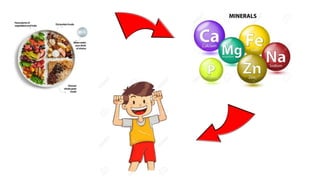
How do we get those
important minerals
and vitamins from
foods?
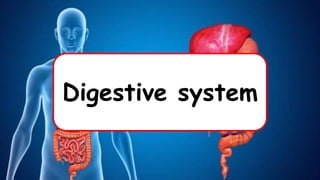
Digestive system
ORGA N SY STEM
Integumentary System
Nervous System
Respiratory System
Circulatory System
Muscular System
Skeletal System
Endocrine System
Digestive System
Reproductive System
Excretory System
Lymphatic System
DIGESTIVE SYSTEM
A collection of organs that
breaks down food into energy.
What are the
functions of the
digestive system?
FUNCTIONS:
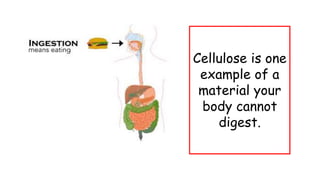
Ingestion
The process of putting food into
your mouth.
FUNCTIONS:
Digestion
Refers to the breakdown of food
into small pieces or molecules
that can be used by the body.
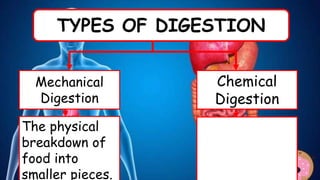
TYPES OF DIGESTION
Mechanical
Digestion
Chemical
Digestion
The physical
breakdown of
food into
smaller pieces.
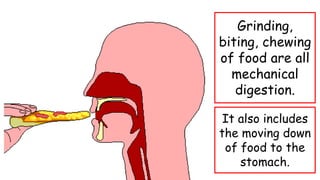
Grinding,
biting, chewing
of food are all
mechanical
digestion.
It also includes
the moving down
of food to the
stomach.
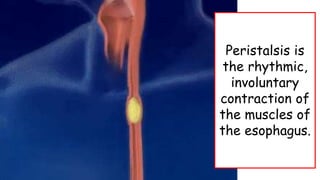
Peristalsis is
the rhythmic,
involuntary
contraction of
the muscles of
the esophagus.
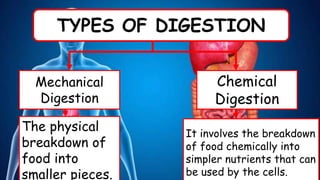
TYPES OF DIGESTION
Mechanical
Digestion
Chemical
Digestion
The physical
breakdown of
food into
smaller pieces.
It involves the breakdown
of food chemically into
simpler nutrients that can
be used by the cells.
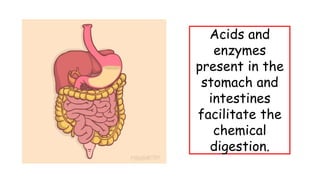
Acids and
enzymes
present in the
stomach and
intestines
facilitate the
chemical
digestion.
FUNCTIONS:
Absorption
Nutrients from the food you eat
pass through the wall of the
digestive system into your blood.
FUNCTIONS:
Elimination
Some food substances that are
not absorbed and digested are
eliminated from the body as
feces.
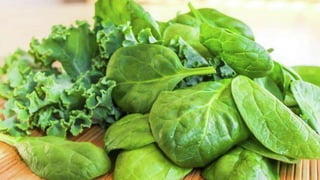
Cellulose is one
example of a
material your
body cannot
digest.
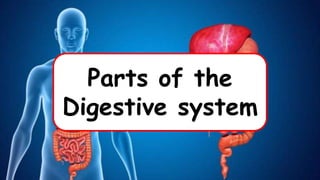
Parts of the
Digestive system
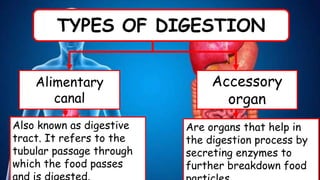
TYPES OF DIGESTION
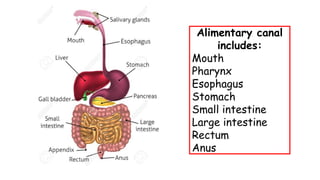
Alimentary
canal
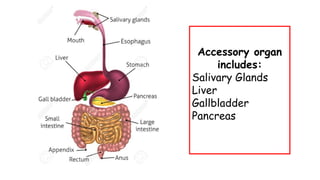
Accessory
organ
Are organs that help in
the digestion process by
secreting enzymes to
further breakdown food
Also known as digestive
tract. It refers to the
tubular passage through
which the food passes
Alimentary canal
includes:
Mouth
Pharynx
Esophagus
Stomach
Small intestine
Large intestine
Rectum
Anus
Accessory organ
includes:
Salivary Glands
Liver
Gallbladder
Pancreas
Let us
summarize!
Homework # 1
Answer Self-Check on page 97
of your textbook. To be checked
tomorrow.
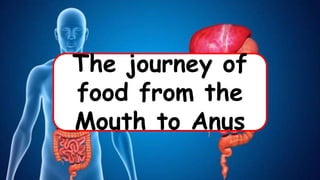
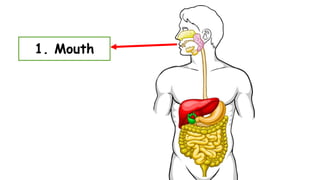
The journey of
food from the
Mouth to Anus
1. Mouth
Mouth
Digestion begins in the mouth
with the help of your teeth,
tongue, and salivary glands.
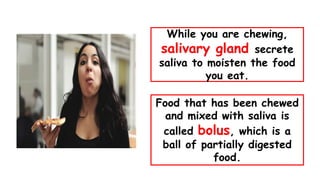
While you are chewing,
salivary gland secrete
saliva to moisten the food
you eat.
Food that has been chewed
and mixed with saliva is
called bolus, which is a
ball of partially digested
food.
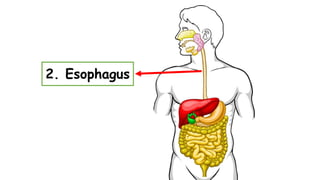
2. Esophagus
Esophagus
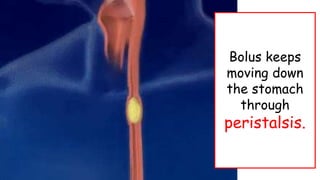
A muscular tube transports bolus
from mouth to stomach.
Bolus keeps
moving down
the stomach
through
peristalsis.
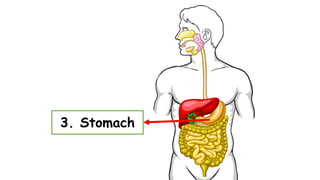
3. Stomach
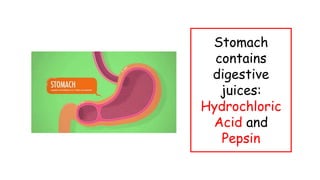
Stomach
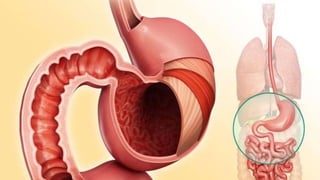
A J-shaped muscular sac that
digests and temporarily stores
food.
Stomach
contains
digestive
juices:
Hydrochloric
Acid and
Pepsin
Hydrochloric Acid
A gastric juice that prepares
protein in the stomach for
digestion and kills bacteria found
on food.
Pepsin
Breaks down proteins into
smaller pieces.
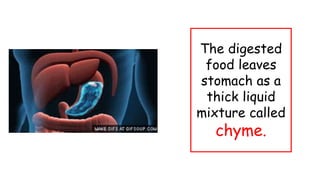
The digested
food leaves
stomach as a
thick liquid
mixture called
chyme.
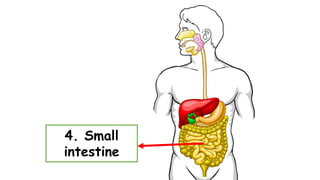
4. Small
intestine
Small intestine
It has smooth muscles that also
churns the food. This is where
most of the chemical digestion
process happens.
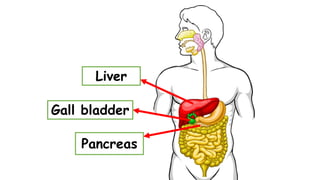
Liver
Pancreas
Gall bladder
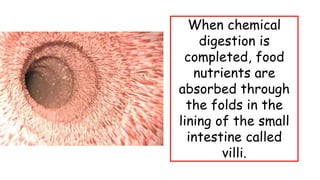
When chemical
digestion is
completed, food
nutrients are
absorbed through
the folds in the
lining of the small
intestine called
villi.
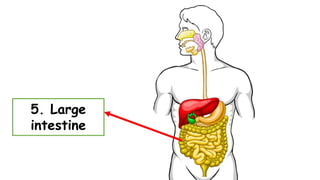
5. Large
intestine
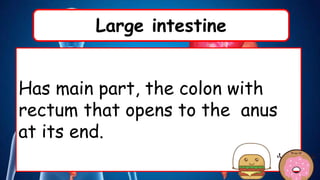
Large intestine
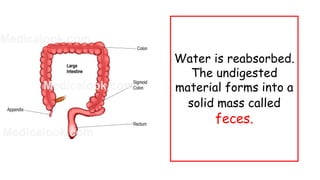
Has main part, the colon with
rectum that opens to the anus
at its end.
Water is reabsorbed.
The undigested
material forms into a
solid mass called
feces.
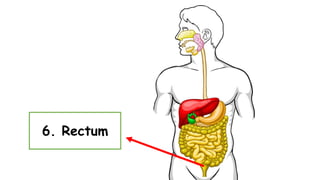
6. Rectum
Rectum
Serves as storage site of feces
before it is eliminated from the
digestive tract.
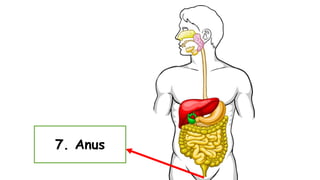
7. Anus
Anus
A muscular opening and the end
of the digestive tract.
Let us
summarize!
Book Exercise # 1
Answer Self-Check PART B only
on page 100 of your textbook. To
be passed today.
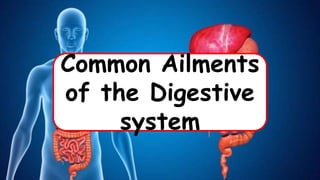
Common Ailments
of the Digestive
system
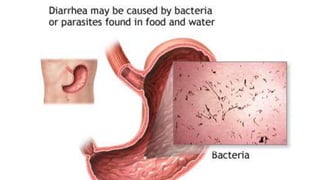
Diarrhea
Characterized by loosed and
watery stool and frequent bowel
movement.
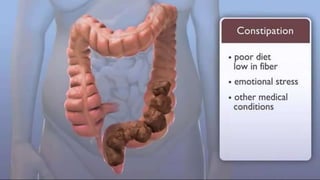
Constipation
Characterized by compact, dry,
and hard stool.
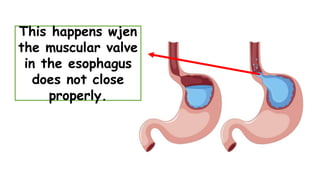
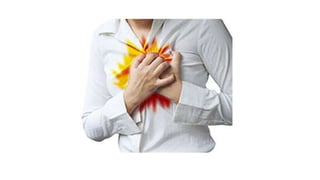
Gastroesophageal reflux
disorder (GERD)
Occurs when the acid from
stomach flows back to
esophagus.
This happens wjen
the muscular valve
in the esophagus
does not close
properly.
Gallstone
Are stones or lumps that build up
in the bladder.
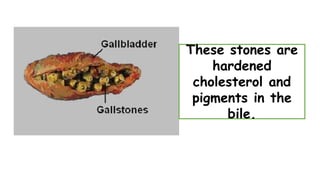
These stones are
hardened
cholesterol and
pigments in the
bile.
Peptic Ulcer
A painful wound in the stomach
and small intestine.
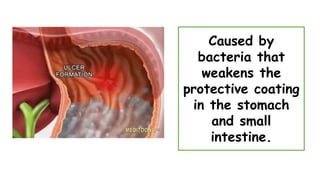
Caused by
bacteria that
weakens the
protective coating
in the stomach
and small
intestine.
Colorectal Cancer
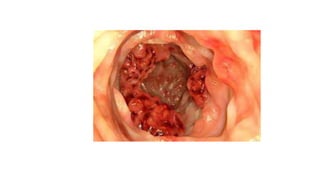
Occurs when tumors form in the
lining of the large intestine.
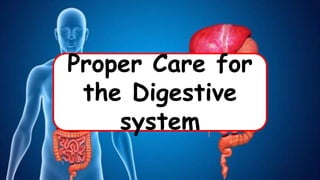
Proper Care for
the Digestive
system
Proper Care
Proper Nutrition
Proper Hygiene
Health Habits
Regular Exercise

Digestive system Grade 6