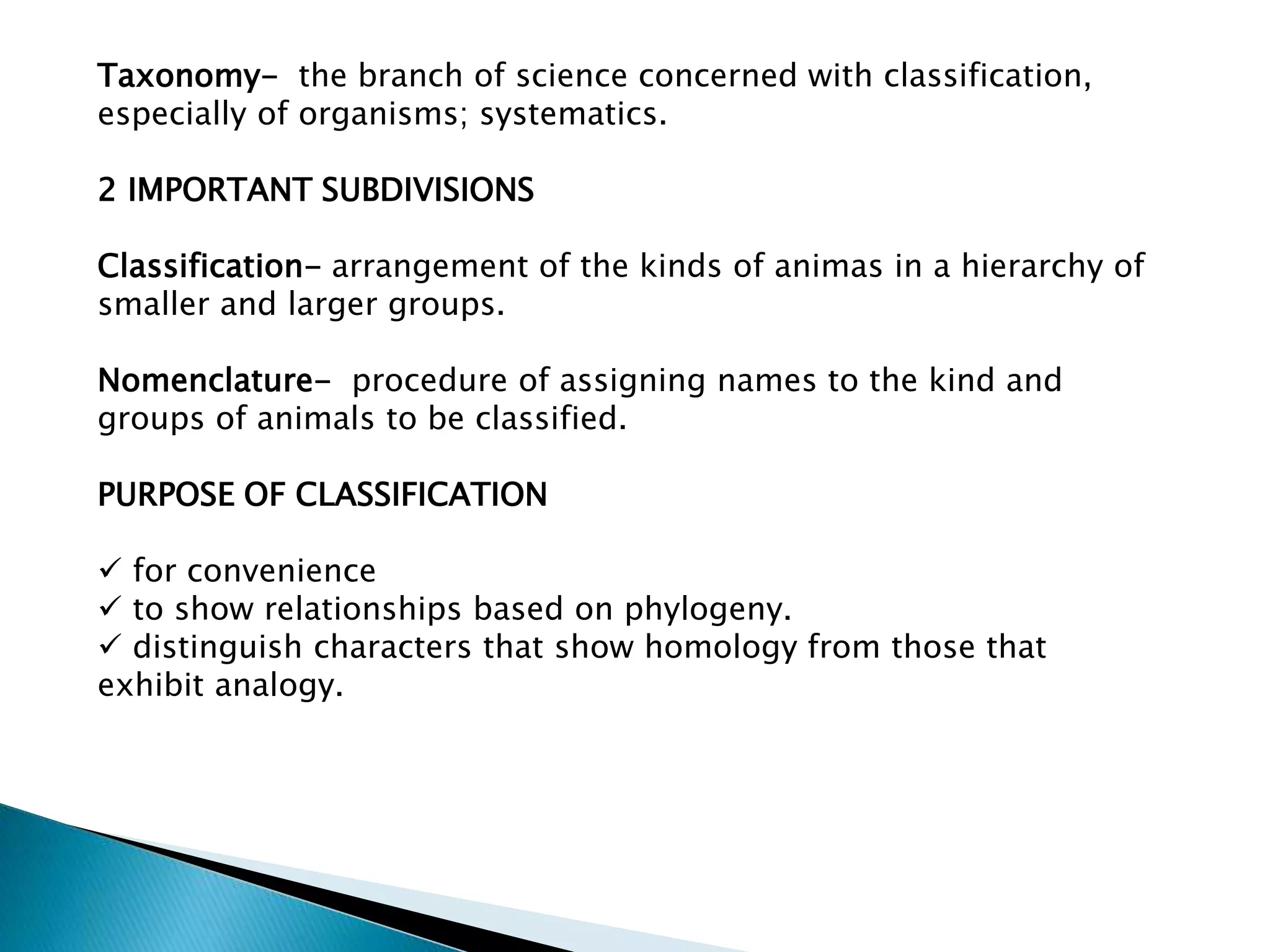
Taxonomy- the branch of science concerned with classification,
especially of organisms; systematics.
2 IMPORTANT SUBDIVISIONS
Classification- arrangement of the kinds of animas in a hierarchy of
smaller and larger groups.
Nomenclature- procedure of assigning names to the kind and
groups of animals to be classified.
PURPOSE OF CLASSIFICATION
 for convenience
 to show relationships based on phylogeny.
 distinguish characters that show homology from those that
exhibit analogy.
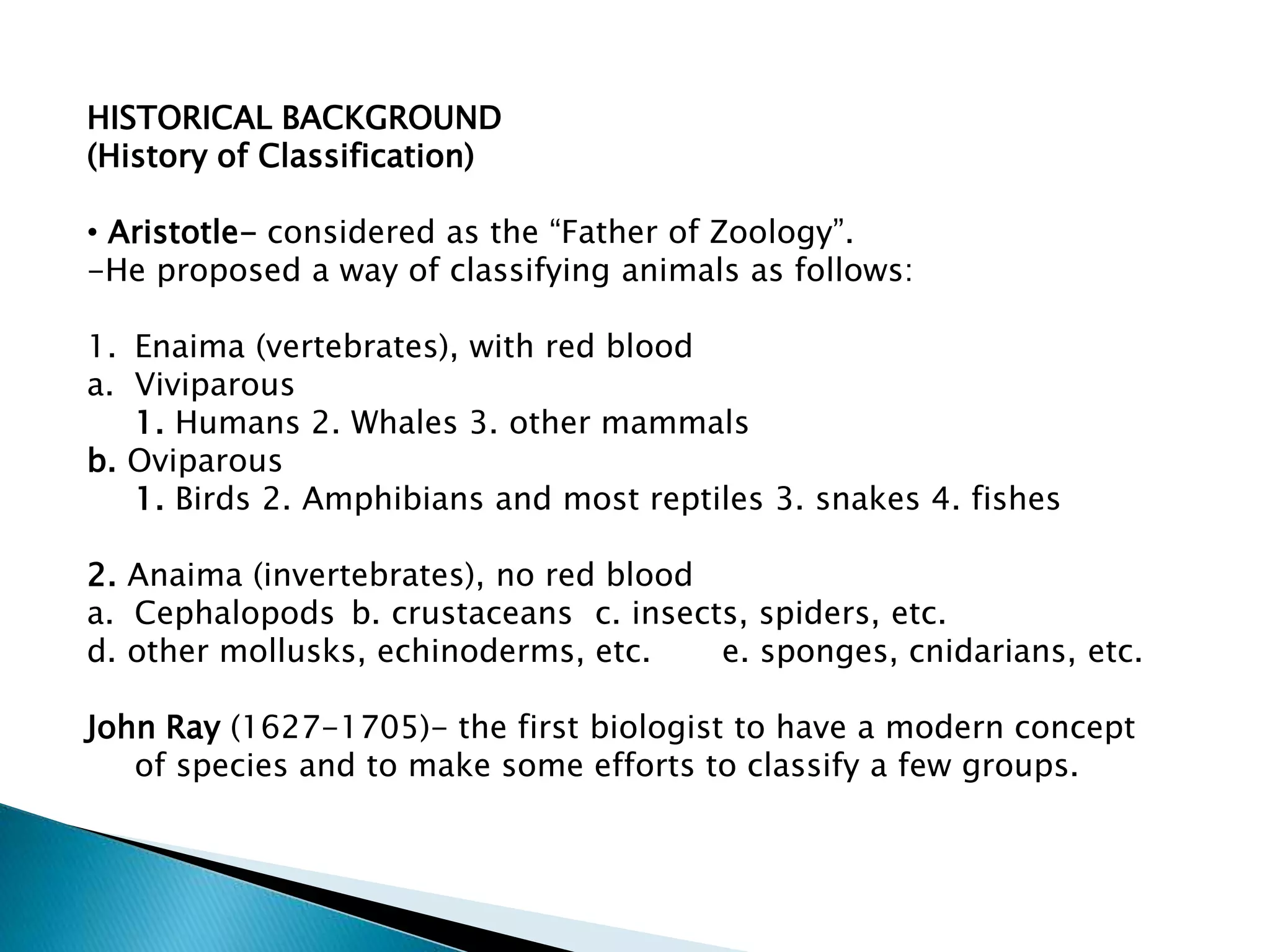
HISTORICAL BACKGROUND
(History of Classification)
• Aristotle- considered as the “Father of Zoology”.
-He proposed a way of classifying animals as follows:
1. Enaima (vertebrates), with red blood
a. Viviparous
1. Humans 2. Whales 3. other mammals
b. Oviparous
1. Birds 2. Amphibians and most reptiles 3. snakes 4. fishes
2. Anaima (invertebrates), no red blood
a. Cephalopods b. crustaceans c. insects, spiders, etc.
d. other mollusks, echinoderms, etc.
e. sponges, cnidarians, etc.

John Ray (1627-1705)- the first biologist to have a modern concept
of species and to make some efforts to classify a few groups.
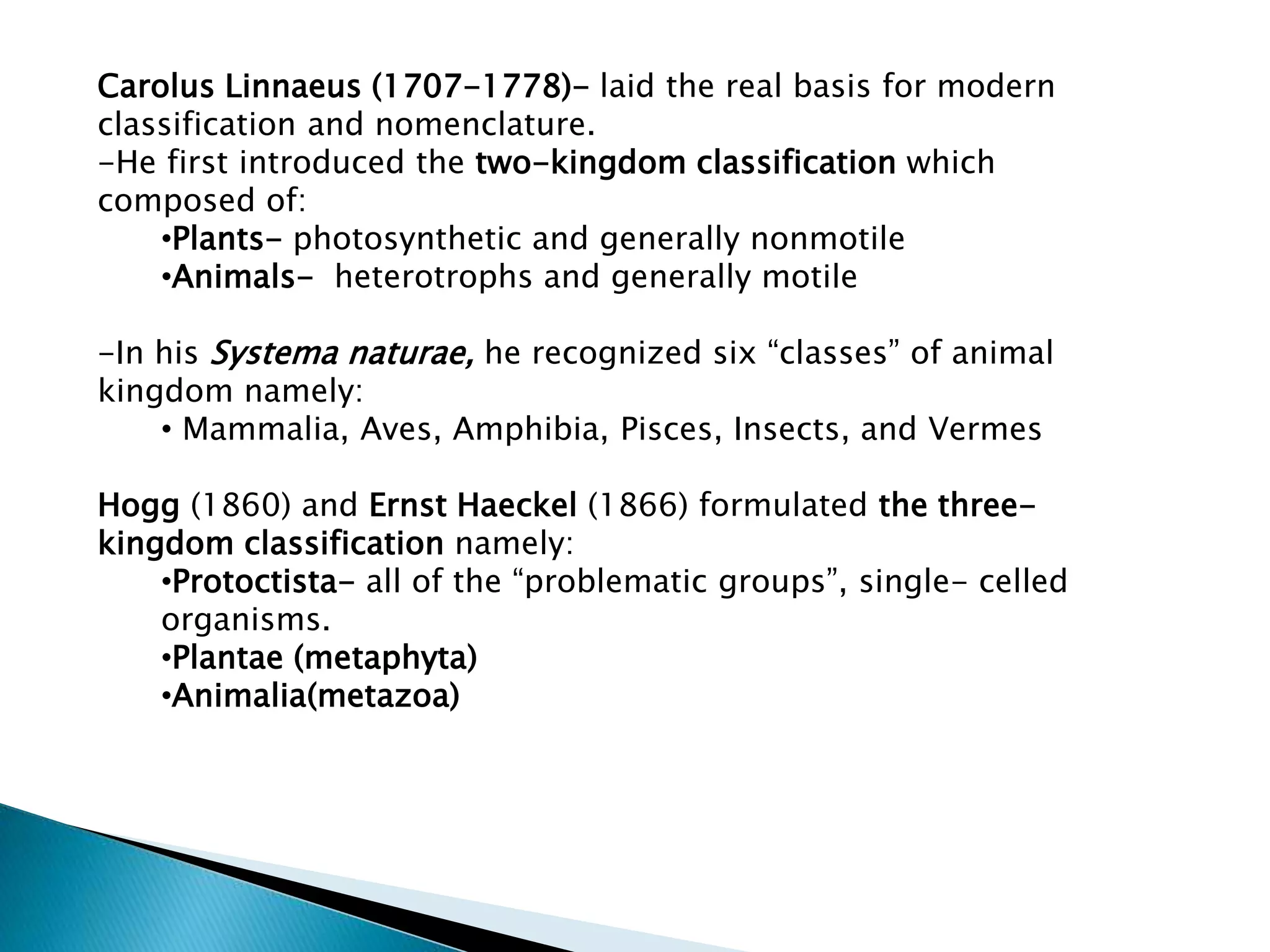
Carolus Linnaeus (1707-1778)- laid the real basis for modern
classification and nomenclature.
-He first introduced the two-kingdom classification which
composed of:
•Plants- photosynthetic and generally nonmotile
•Animals- heterotrophs and generally motile
-In his Systema naturae, he recognized six “classes” of animal
kingdom namely:
• Mammalia, Aves, Amphibia, Pisces, Insects, and Vermes

Hogg (1860) and Ernst Haeckel (1866) formulated the threekingdom classification namely:
•Protoctista- all of the “problematic groups”, single- celled
organisms.
•Plantae (metaphyta)
•Animalia(metazoa)
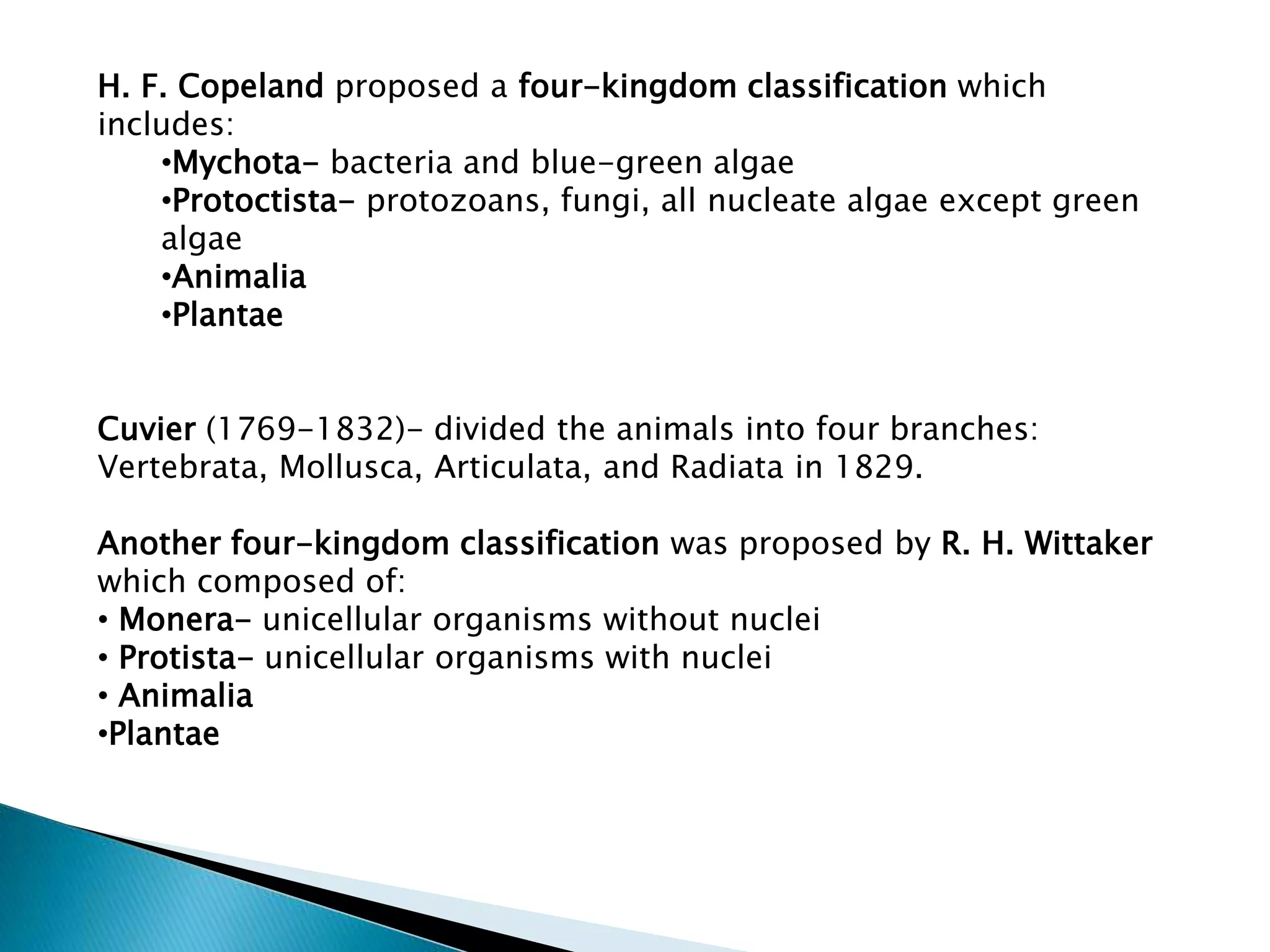
H. F. Copeland proposed a four-kingdom classification which
includes:
•Mychota- bacteria and blue-green algae
•Protoctista- protozoans, fungi, all nucleate algae except green
algae
•Animalia
•Plantae
Cuvier (1769-1832)- divided the animals into four branches:
Vertebrata, Mollusca, Articulata, and Radiata in 1829.
Another four-kingdom classification was proposed by R. H. Wittaker
which composed of:
• Monera- unicellular organisms without nuclei
• Protista- unicellular organisms with nuclei
• Animalia
•Plantae
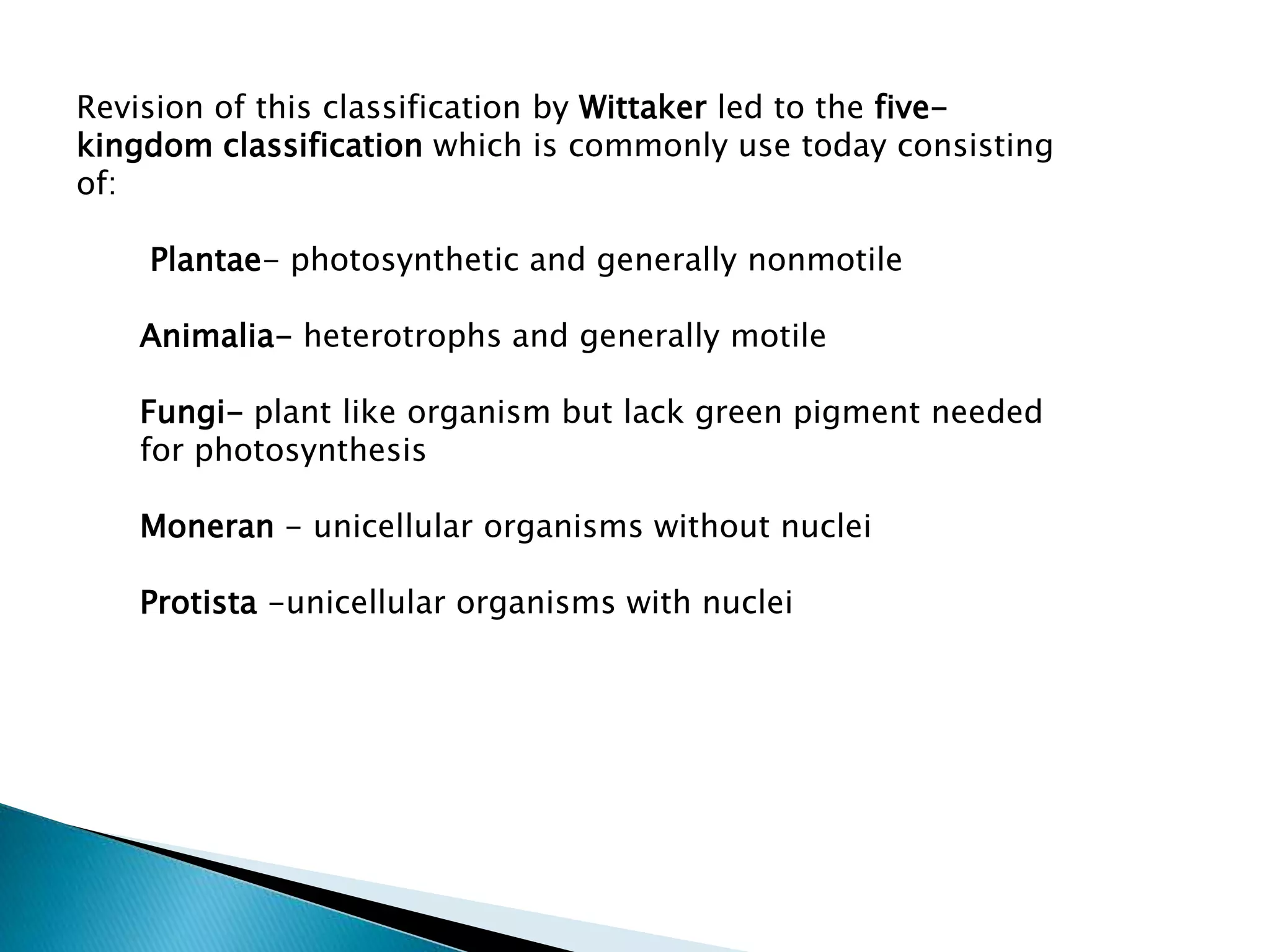
Revision of this classification by Wittaker led to the fivekingdom classification which is commonly use today consisting
of:
Plantae- photosynthetic and generally nonmotile
Animalia- heterotrophs and generally motile
Fungi- plant like organism but lack green pigment needed
for photosynthesis
Moneran - unicellular organisms without nuclei
Protista -unicellular organisms with nuclei
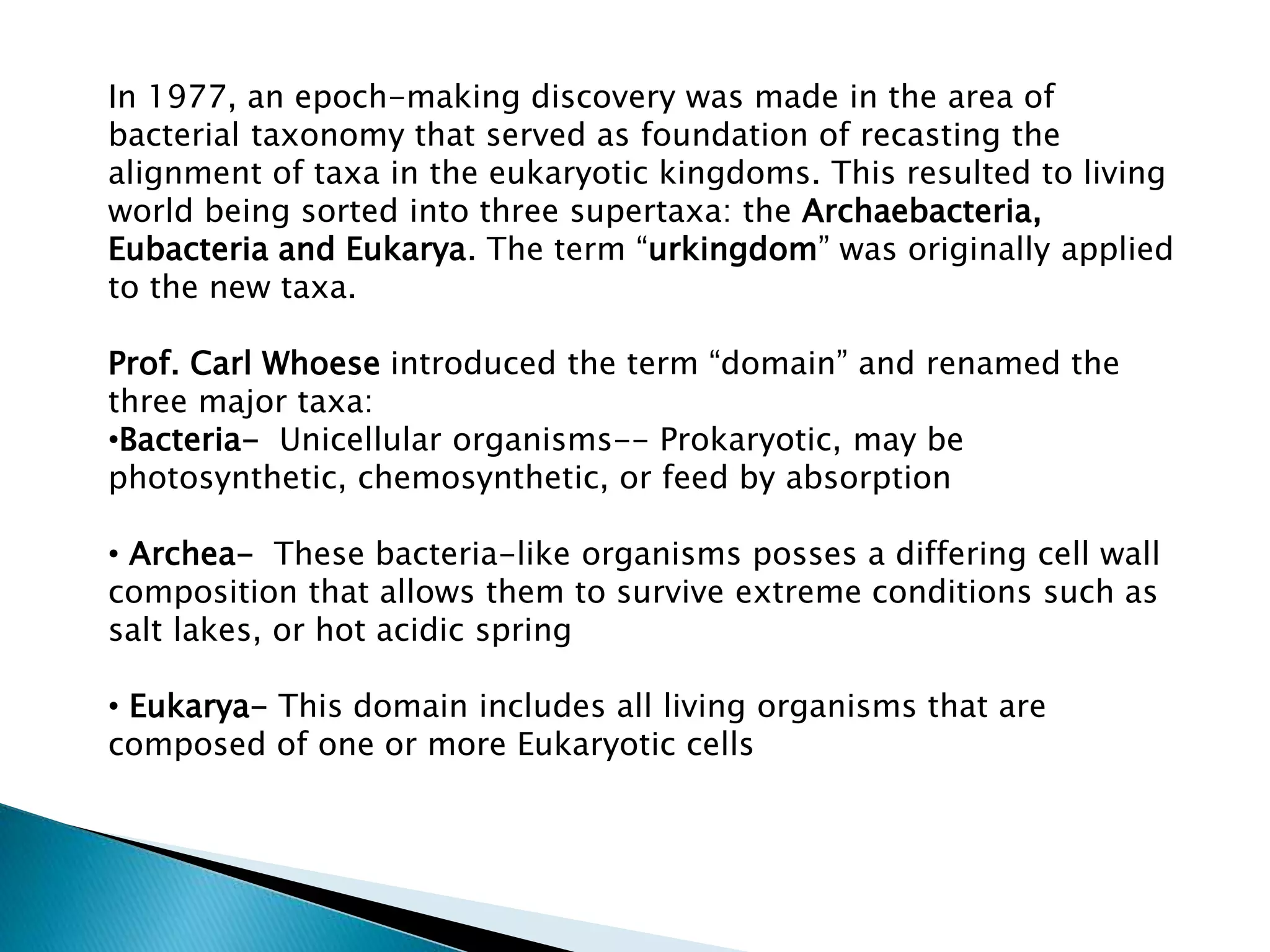
In 1977, an epoch-making discovery was made in the area of
bacterial taxonomy that served as foundation of recasting the
alignment of taxa in the eukaryotic kingdoms. This resulted to living
world being sorted into three supertaxa: the Archaebacteria,
Eubacteria and Eukarya. The term “urkingdom” was originally applied
to the new taxa.
Prof. Carl Whoese introduced the term “domain” and renamed the
three major taxa:
•Bacteria- Unicellular organisms-- Prokaryotic, may be
photosynthetic, chemosynthetic, or feed by absorption
• Archea- These bacteria-like organisms posses a differing cell wall
composition that allows them to survive extreme conditions such as
salt lakes, or hot acidic spring
• Eukarya- This domain includes all living organisms that are
composed of one or more Eukaryotic cells
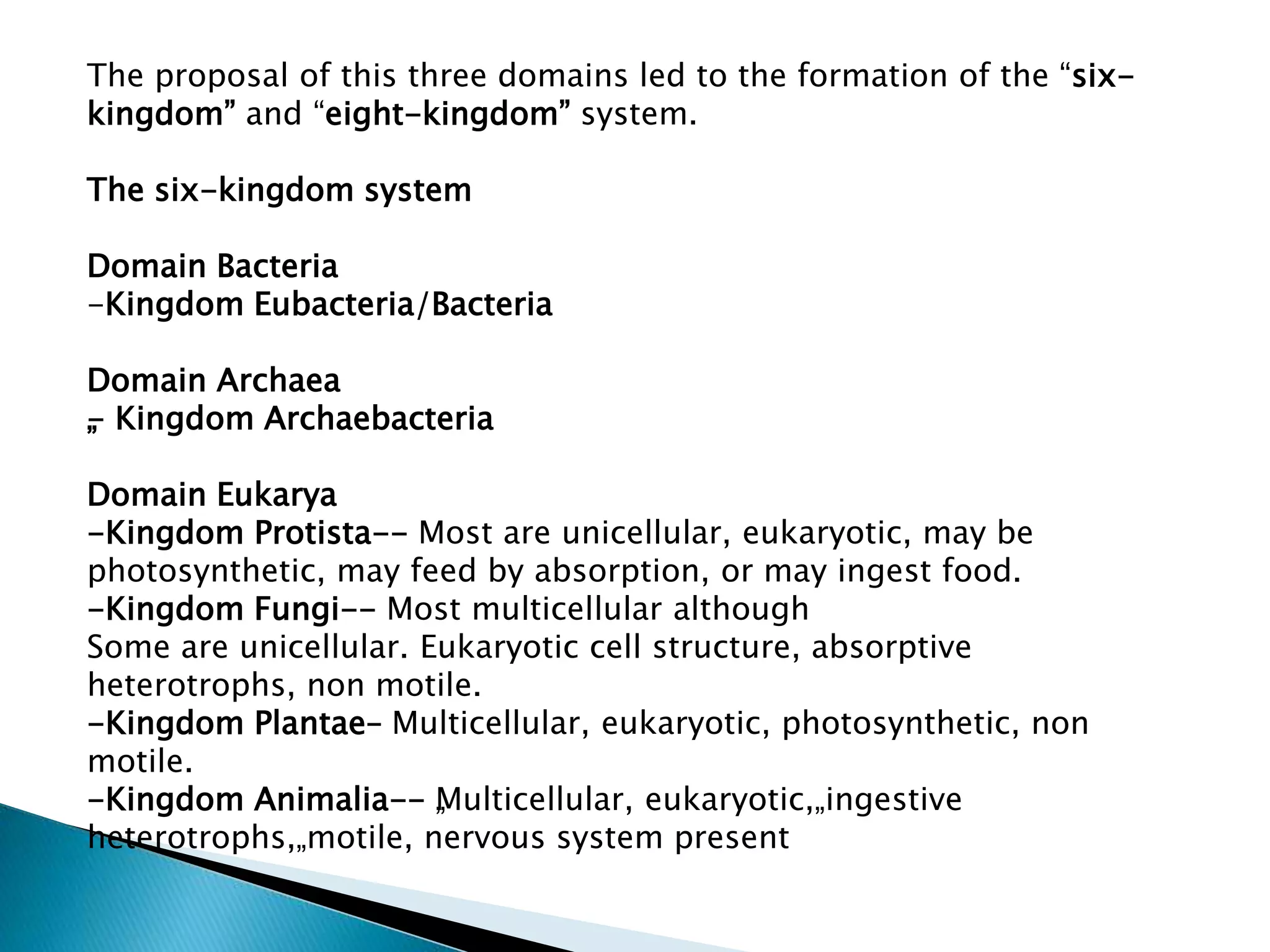
The proposal of this three domains led to the formation of the “sixkingdom” and “eight-kingdom” system.
The six-kingdom system
Domain Bacteria
-Kingdom Eubacteria/Bacteria
Domain Archaea
„ Kingdom Archaebacteria
Domain Eukarya
-Kingdom Protista-- Most are unicellular, eukaryotic, may be
photosynthetic, may feed by absorption, or may ingest food.
-Kingdom Fungi-- Most multicellular although
Some are unicellular. Eukaryotic cell structure, absorptive
heterotrophs, non motile.
-Kingdom Plantae– Multicellular, eukaryotic, photosynthetic, non
motile.
-Kingdom Animalia-- „ ulticellular, eukaryotic,„ingestive
M
heterotrophs,„motile, nervous system present
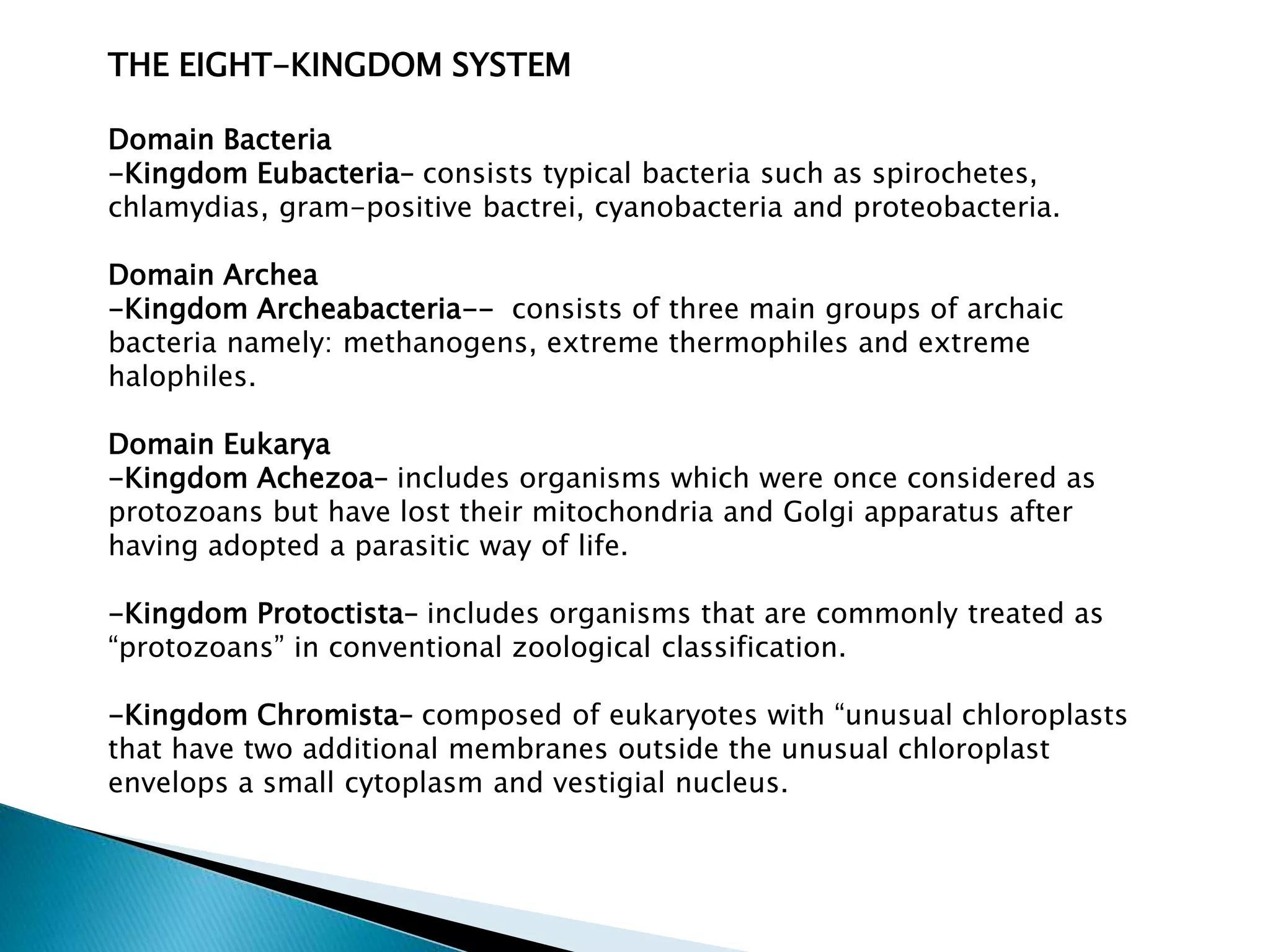
THE EIGHT-KINGDOM SYSTEM
Domain Bacteria
-Kingdom Eubacteria– consists typical bacteria such as spirochetes,
chlamydias, gram-positive bactrei, cyanobacteria and proteobacteria.
Domain Archea
-Kingdom Archeabacteria-- consists of three main groups of archaic
bacteria namely: methanogens, extreme thermophiles and extreme
halophiles.
Domain Eukarya
-Kingdom Achezoa– includes organisms which were once considered as
protozoans but have lost their mitochondria and Golgi apparatus after
having adopted a parasitic way of life.
-Kingdom Protoctista– includes organisms that are commonly treated as
“protozoans” in conventional zoological classification.

-Kingdom Chromista– composed of eukaryotes with “unusual chloroplasts
that have two additional membranes outside the unusual chloroplast
envelops a small cytoplasm and vestigial nucleus.
-Kingdom Plantae– eukaryotes which possess chlorophyll a and b,
in contrast to those which contain chlorophyll c or d, in addition
to chlorophyll a.
-Kingdom Animalia– organisms that are basically phagothrophs.
However, many of them are parasitic.
Ernst Haeckel (1864), and E. Ray Lankester (1877)- outlined the
principal features of the zoologic classification that is used today.

SPECIES- THE BASIC UNIT in biological classification.
-The group of individual which is naturally reproductively isolated
from other such group.
--they are derived from common ancestry and can breed with one
another to produce fertile offspring that resembles the parents.
TAXONOMIC HIERARCHY/CATEGORIES
-Domain
-Kingdom
-Phylum
-Class
-Oder
-Family
-Genus
-Species

Monotypic- where a group contains only one representative
because it is distinct from all others.

USEFUL FEATURES IN CLASSIFICATION
 EMBRYONIC FEATURES– use in classification to differentiate
higher taxa to assess the relationships among phyla which allow
them to be placed in phylogenetic sequence since the strongest
links between phyla and arrangement of phyla together into lines of
decent depend on fundamental processes occurring in the
egg/embryo.
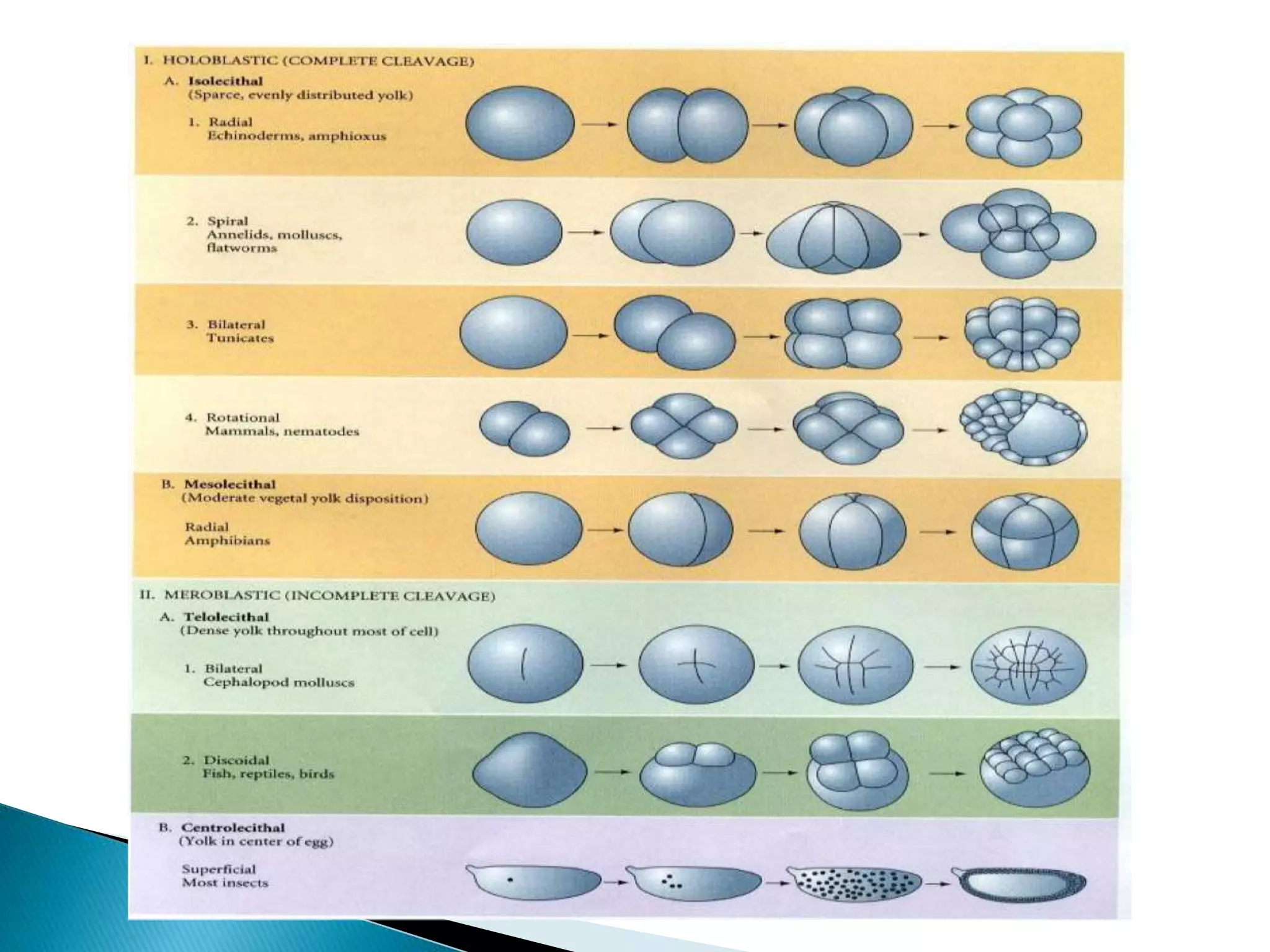
 Types of Eggs in Animals
• Isolecithal/homolecithal– generally small eggs; yolk is equally
distributed throughout the egg.
-undergo a complete cleavage formation during
development resulting to nearly equal-sized blastomeres.
• Telolecithal– yolk is concentrated near the vegetal pole of the
egg.
-cleavage formation depends o the yolk’s amount in the
vegetal pole:
It would be holoblastic if the yolk is not great but will produce
two different-sized blastomeres (micromeres—ectoderm; and
the macromeres—endoderm)
It would be meroblastic if the yolk is great and the cleavage is
restricted to the superficial layer of protoplasm at the animal
pole.
• Centrolecithal– yolk is concentrated in the center with musk of
living protoplasm surrounding it at the outside. The cleavage
here it meroblastic.
 Pattern of Cleavage
• Radial– cleavage planes producing the successive sets of
blastomeres are at right angle to each other and
perpendicular/parallel to the polar axis of the fertilized egg;
this forms an indeterminate cleavage.
• Spiral– cleavage planes tends to be oblique or diagonal to
the polar axis of the egg and successive cleavage produces
blastomeres arranged spirally around the polar axis that each
successive tier of blastomeres rests above the grooves
between the blastomeres’ tier below; produces determinate
cleavage.
 Body Cavity
• Pseudocoelum– persistence into the adult stage of the
embryonic blastocoel cavity found in the gastrula stage; is not
lined by mesoderm.
• Coelum– body cavity which is line by mesoderm (peritoneum
in adult)
-enterocoelus– coelum arises as puches which bud off the
archenteron of the gastrula and subsequently fuses.
-schizocoelus– coelum arises as a split in the mesoderm
which is forming in bands near blastomeres.
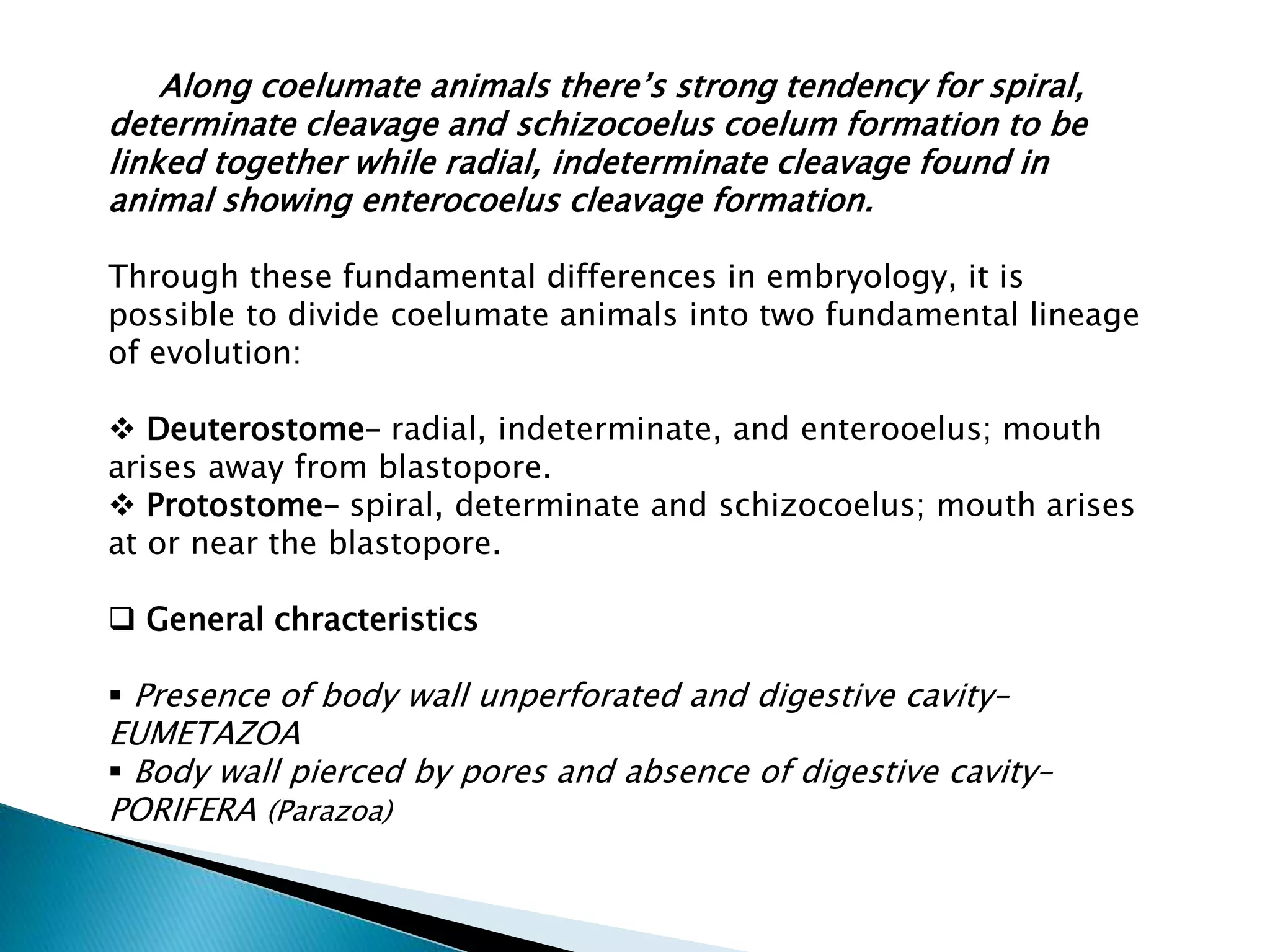
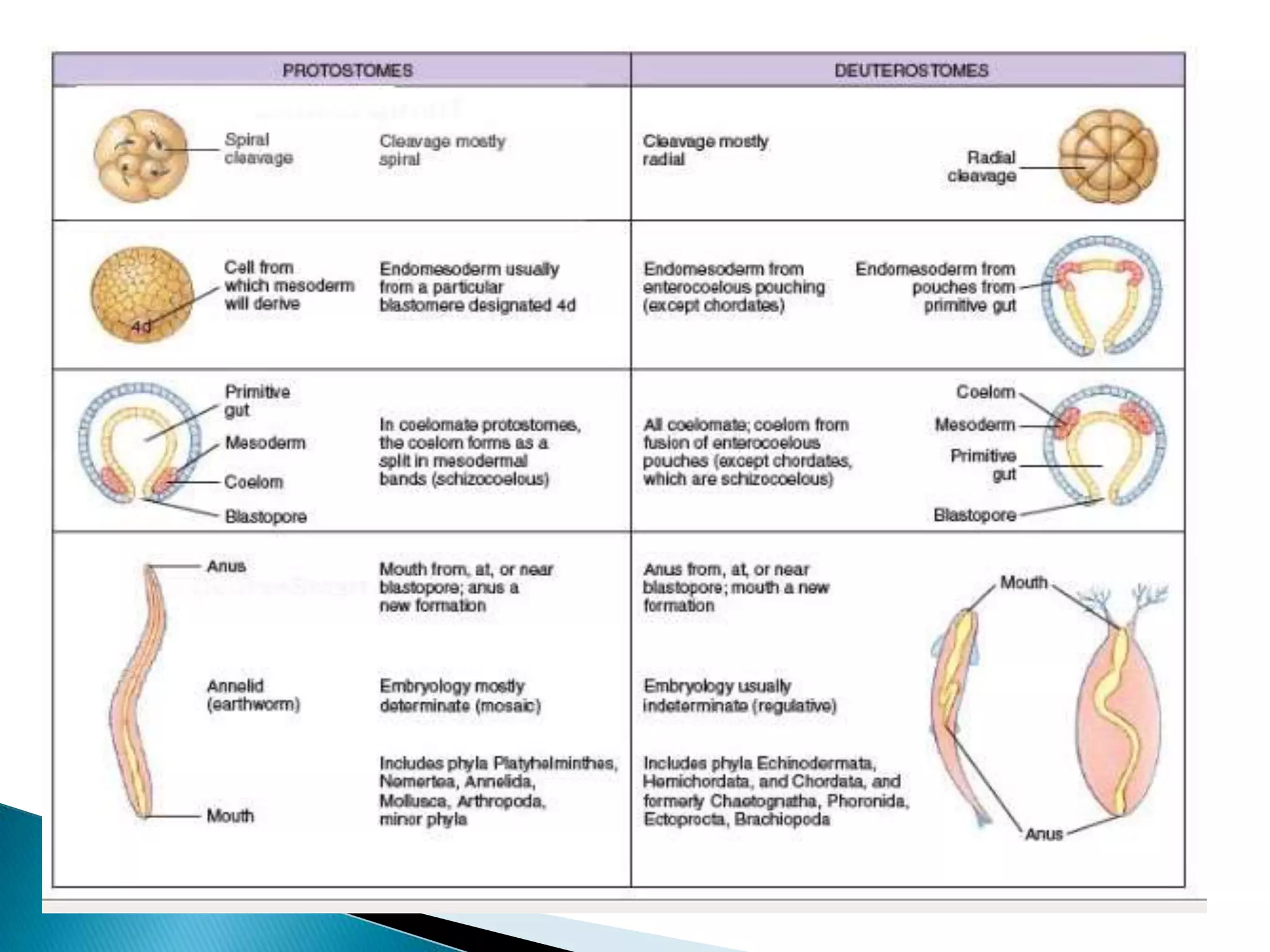
Along coelumate animals there’s strong tendency for spiral,
determinate cleavage and schizocoelus coelum formation to be
linked together while radial, indeterminate cleavage found in
animal showing enterocoelus cleavage formation.
Through these fundamental differences in embryology, it is
possible to divide coelumate animals into two fundamental lineage
of evolution:
 Deuterostome– radial, indeterminate, and enterooelus; mouth
arises away from blastopore.
 Protostome– spiral, determinate and schizocoelus; mouth arises
at or near the blastopore.
 General chracteristics
 Presence of body wall unperforated and digestive cavity–

EUMETAZOA
 Body wall pierced by pores and absence of digestive cavity–
PORIFERA (Parazoa)
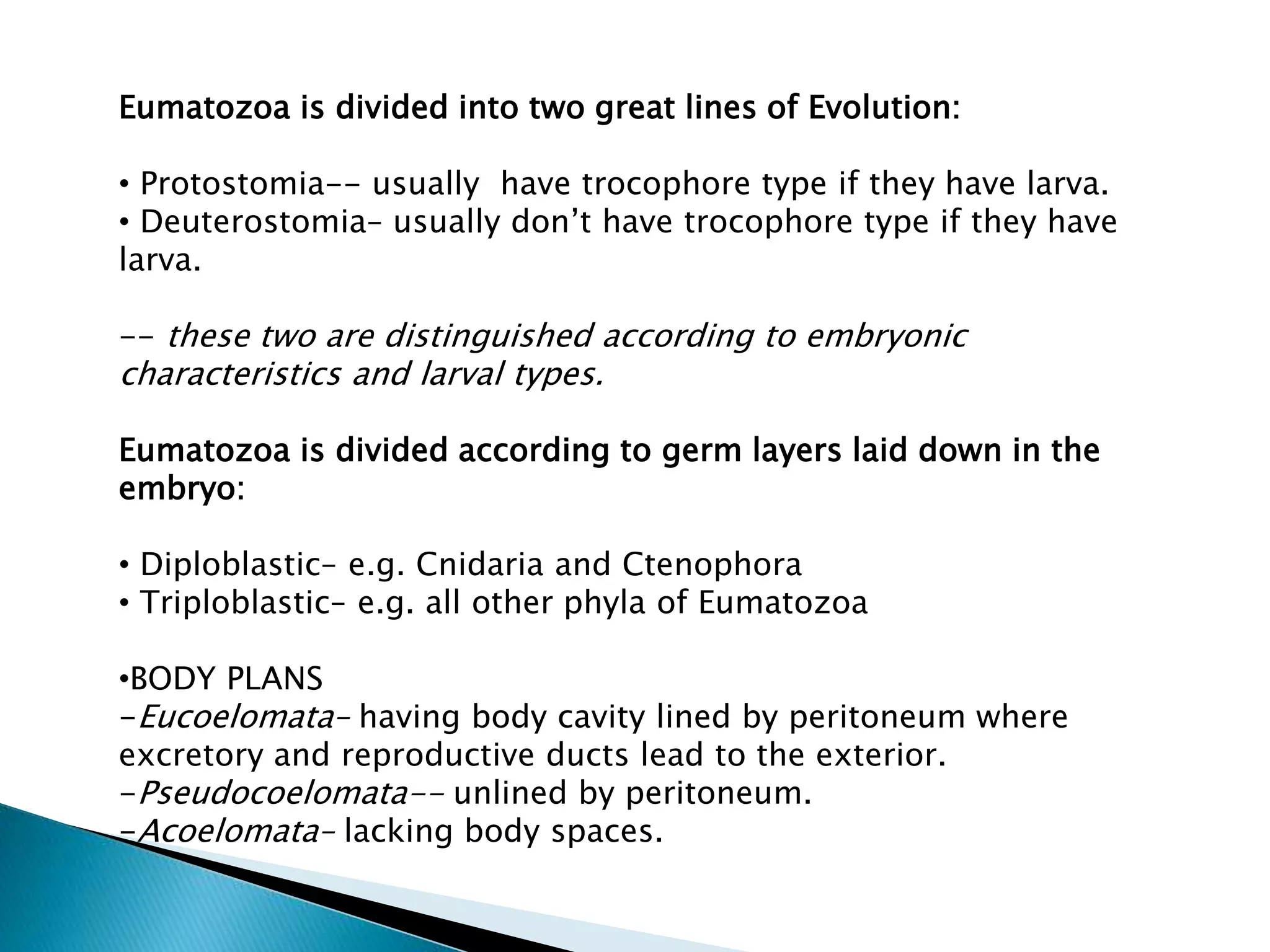
Eumatozoa is divided into two great lines of Evolution:
• Protostomia-- usually have trocophore type if they have larva.
• Deuterostomia– usually don’t have trocophore type if they have
larva.
-- these two are distinguished according to embryonic

characteristics and larval types.

Eumatozoa is divided according to germ layers laid down in the
embryo:
• Diploblastic– e.g. Cnidaria and Ctenophora
• Triploblastic– e.g. all other phyla of Eumatozoa
•BODY PLANS
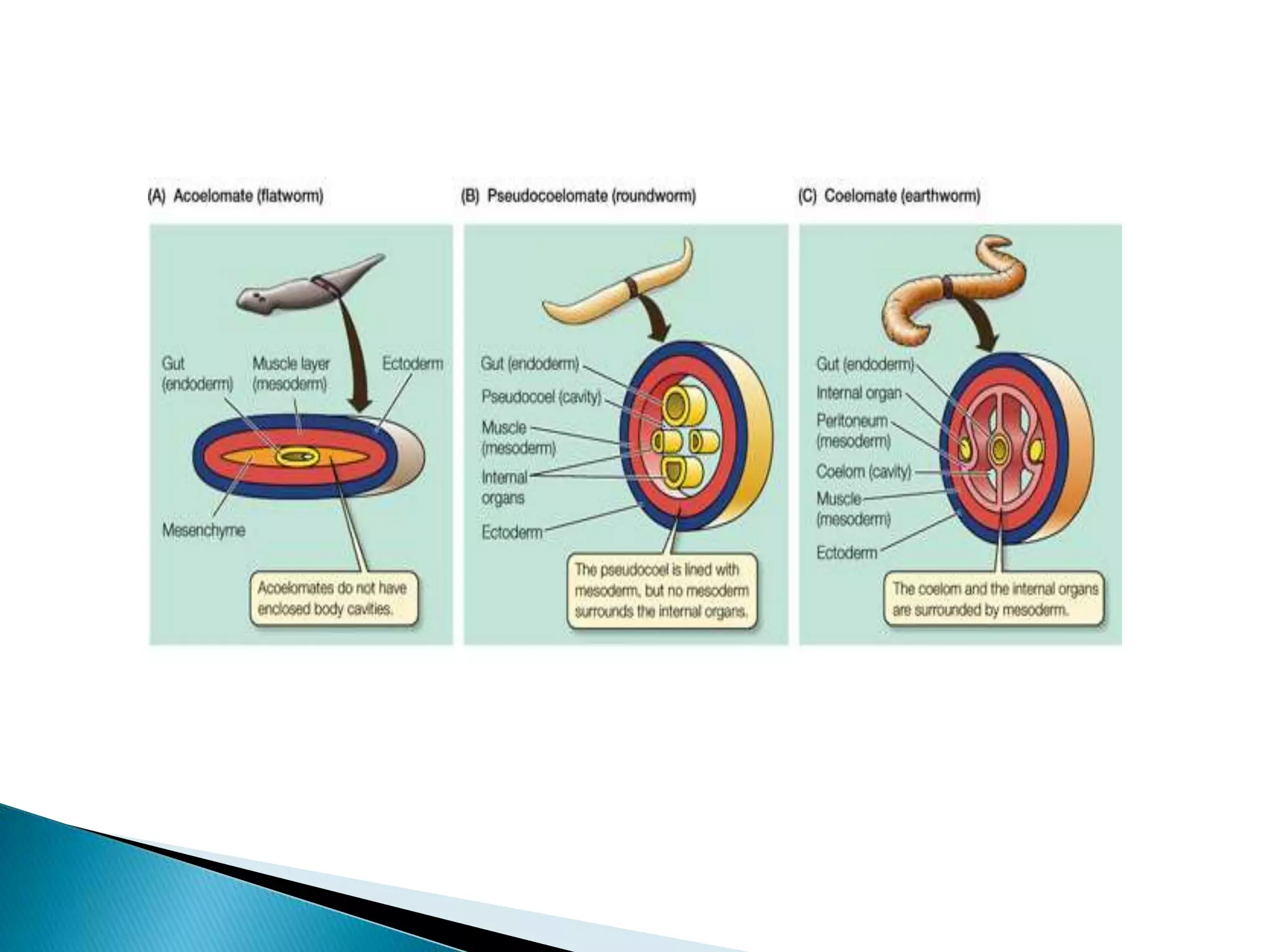
-Eucoelomata– having body cavity lined by peritoneum where
excretory and reproductive ducts lead to the exterior.
-Pseudocoelomata-- unlined by peritoneum.
-Acoelomata– lacking body spaces.
 Presence of Backbone of Vertebrae
• Present vertebrae– vertebrates
• Absent vertebrae– invertebrates

Other Characteristics
 Symmetry
 Assymetrical (protozoans)
 Spherical (few protozoans)
 Radial (cnidarians and adult echinoderms)
 Bilateral (most phyla except the previously mentioned phyla)
 Segmentation
-Chordates have mainly internal segmentation especially humans
-Arthropods have mostly external metamerism
-annelids has conspicous metemerism both externally and
internally.
 Appendages
 Skeleton
 Sex
 Monoecious
Dioecious
 Larvae

NOMENCLATURE
 Common name/vernacular name– the name for animals
in a certain place in which it is commonly known.(e.g.

 Scientific name– name applied to organism as
taxonomic name
-Long descriptive polynomials in Latin (e.g. Turdus
minor cinereo-albus maculatus which means Thrugh
small grayish-white spotted)
- binomial nomenclature (Mimus polyglottis)
-Trinomial (e.g. Passer domesticus domesticus and

Passes domesticus niloticus)
Rules of Scientific Nomenclature (by International Congress
of Zoology– International Rules of Zoological
Nomenclature), 1901 (Revised, 1961)
1.
2.
3.
4.

Zoologic and botanic names are distinct.
No too genera in Animal Kingdom may bear the same name, the same
applies to two species in a genus.
No names are recognized prior to those included by Linnaeus in the

System naturae, 10th edition (1758).

Scientific name must be either Latin/Latinized and preferably printed
in italics.
5. Genus names must be a single word (nominative singular) and begin
with a capital letter.
6. Species names should be a single/compound word beginning with
small letter.
7. The author of the scientific name is the person who first publishes it
in a generally accessible book or periodicals with a recognized
description of the animal.
8.
When a new genus is proposed, the type of species must be
indicated.
9.
A family name is formed by adding –IDEA to the stem of the name
of the type genus and a subfamily name by adding –INAE.
Jonalyn D. Lelis
BSED-2B

Classifiction and Nomenclature of Kingdoms of Life

  • 2.
    Taxonomy- the branchof science concerned with classification, especially of organisms; systematics. 2 IMPORTANT SUBDIVISIONS Classification- arrangement of the kinds of animas in a hierarchy of smaller and larger groups. Nomenclature- procedure of assigning names to the kind and groups of animals to be classified. PURPOSE OF CLASSIFICATION  for convenience  to show relationships based on phylogeny.  distinguish characters that show homology from those that exhibit analogy.
  • 3.
    HISTORICAL BACKGROUND (History ofClassification) • Aristotle- considered as the “Father of Zoology”. -He proposed a way of classifying animals as follows: 1. Enaima (vertebrates), with red blood a. Viviparous 1. Humans 2. Whales 3. other mammals b. Oviparous 1. Birds 2. Amphibians and most reptiles 3. snakes 4. fishes 2. Anaima (invertebrates), no red blood a. Cephalopods b. crustaceans c. insects, spiders, etc. d. other mollusks, echinoderms, etc. e. sponges, cnidarians, etc. John Ray (1627-1705)- the first biologist to have a modern concept of species and to make some efforts to classify a few groups.
  • 4.
    Carolus Linnaeus (1707-1778)-laid the real basis for modern classification and nomenclature. -He first introduced the two-kingdom classification which composed of: •Plants- photosynthetic and generally nonmotile •Animals- heterotrophs and generally motile -In his Systema naturae, he recognized six “classes” of animal kingdom namely: • Mammalia, Aves, Amphibia, Pisces, Insects, and Vermes Hogg (1860) and Ernst Haeckel (1866) formulated the threekingdom classification namely: •Protoctista- all of the “problematic groups”, single- celled organisms. •Plantae (metaphyta) •Animalia(metazoa)
  • 5.
    H. F. Copelandproposed a four-kingdom classification which includes: •Mychota- bacteria and blue-green algae •Protoctista- protozoans, fungi, all nucleate algae except green algae •Animalia •Plantae Cuvier (1769-1832)- divided the animals into four branches: Vertebrata, Mollusca, Articulata, and Radiata in 1829. Another four-kingdom classification was proposed by R. H. Wittaker which composed of: • Monera- unicellular organisms without nuclei • Protista- unicellular organisms with nuclei • Animalia •Plantae
  • 6.
    Revision of thisclassification by Wittaker led to the fivekingdom classification which is commonly use today consisting of: Plantae- photosynthetic and generally nonmotile Animalia- heterotrophs and generally motile Fungi- plant like organism but lack green pigment needed for photosynthesis Moneran - unicellular organisms without nuclei Protista -unicellular organisms with nuclei
  • 7.
    In 1977, anepoch-making discovery was made in the area of bacterial taxonomy that served as foundation of recasting the alignment of taxa in the eukaryotic kingdoms. This resulted to living world being sorted into three supertaxa: the Archaebacteria, Eubacteria and Eukarya. The term “urkingdom” was originally applied to the new taxa. Prof. Carl Whoese introduced the term “domain” and renamed the three major taxa: •Bacteria- Unicellular organisms-- Prokaryotic, may be photosynthetic, chemosynthetic, or feed by absorption • Archea- These bacteria-like organisms posses a differing cell wall composition that allows them to survive extreme conditions such as salt lakes, or hot acidic spring • Eukarya- This domain includes all living organisms that are composed of one or more Eukaryotic cells
  • 8.
    The proposal ofthis three domains led to the formation of the “sixkingdom” and “eight-kingdom” system. The six-kingdom system Domain Bacteria -Kingdom Eubacteria/Bacteria Domain Archaea „ Kingdom Archaebacteria Domain Eukarya -Kingdom Protista-- Most are unicellular, eukaryotic, may be photosynthetic, may feed by absorption, or may ingest food. -Kingdom Fungi-- Most multicellular although Some are unicellular. Eukaryotic cell structure, absorptive heterotrophs, non motile. -Kingdom Plantae– Multicellular, eukaryotic, photosynthetic, non motile. -Kingdom Animalia-- „ ulticellular, eukaryotic,„ingestive M heterotrophs,„motile, nervous system present
  • 9.
    THE EIGHT-KINGDOM SYSTEM DomainBacteria -Kingdom Eubacteria– consists typical bacteria such as spirochetes, chlamydias, gram-positive bactrei, cyanobacteria and proteobacteria. Domain Archea -Kingdom Archeabacteria-- consists of three main groups of archaic bacteria namely: methanogens, extreme thermophiles and extreme halophiles. Domain Eukarya -Kingdom Achezoa– includes organisms which were once considered as protozoans but have lost their mitochondria and Golgi apparatus after having adopted a parasitic way of life. -Kingdom Protoctista– includes organisms that are commonly treated as “protozoans” in conventional zoological classification. -Kingdom Chromista– composed of eukaryotes with “unusual chloroplasts that have two additional membranes outside the unusual chloroplast envelops a small cytoplasm and vestigial nucleus.
  • 10.
    -Kingdom Plantae– eukaryoteswhich possess chlorophyll a and b, in contrast to those which contain chlorophyll c or d, in addition to chlorophyll a. -Kingdom Animalia– organisms that are basically phagothrophs. However, many of them are parasitic. Ernst Haeckel (1864), and E. Ray Lankester (1877)- outlined the principal features of the zoologic classification that is used today. SPECIES- THE BASIC UNIT in biological classification. -The group of individual which is naturally reproductively isolated from other such group. --they are derived from common ancestry and can breed with one another to produce fertile offspring that resembles the parents.
  • 11.
    TAXONOMIC HIERARCHY/CATEGORIES -Domain -Kingdom -Phylum -Class -Oder -Family -Genus -Species Monotypic- wherea group contains only one representative because it is distinct from all others. USEFUL FEATURES IN CLASSIFICATION  EMBRYONIC FEATURES– use in classification to differentiate higher taxa to assess the relationships among phyla which allow them to be placed in phylogenetic sequence since the strongest links between phyla and arrangement of phyla together into lines of decent depend on fundamental processes occurring in the egg/embryo.
  • 12.
     Types ofEggs in Animals • Isolecithal/homolecithal– generally small eggs; yolk is equally distributed throughout the egg. -undergo a complete cleavage formation during development resulting to nearly equal-sized blastomeres. • Telolecithal– yolk is concentrated near the vegetal pole of the egg. -cleavage formation depends o the yolk’s amount in the vegetal pole: It would be holoblastic if the yolk is not great but will produce two different-sized blastomeres (micromeres—ectoderm; and the macromeres—endoderm) It would be meroblastic if the yolk is great and the cleavage is restricted to the superficial layer of protoplasm at the animal pole. • Centrolecithal– yolk is concentrated in the center with musk of living protoplasm surrounding it at the outside. The cleavage here it meroblastic.
  • 13.
     Pattern ofCleavage • Radial– cleavage planes producing the successive sets of blastomeres are at right angle to each other and perpendicular/parallel to the polar axis of the fertilized egg; this forms an indeterminate cleavage. • Spiral– cleavage planes tends to be oblique or diagonal to the polar axis of the egg and successive cleavage produces blastomeres arranged spirally around the polar axis that each successive tier of blastomeres rests above the grooves between the blastomeres’ tier below; produces determinate cleavage.  Body Cavity • Pseudocoelum– persistence into the adult stage of the embryonic blastocoel cavity found in the gastrula stage; is not lined by mesoderm. • Coelum– body cavity which is line by mesoderm (peritoneum in adult) -enterocoelus– coelum arises as puches which bud off the archenteron of the gastrula and subsequently fuses. -schizocoelus– coelum arises as a split in the mesoderm which is forming in bands near blastomeres.
  • 14.
    Along coelumate animalsthere’s strong tendency for spiral, determinate cleavage and schizocoelus coelum formation to be linked together while radial, indeterminate cleavage found in animal showing enterocoelus cleavage formation. Through these fundamental differences in embryology, it is possible to divide coelumate animals into two fundamental lineage of evolution:  Deuterostome– radial, indeterminate, and enterooelus; mouth arises away from blastopore.  Protostome– spiral, determinate and schizocoelus; mouth arises at or near the blastopore.  General chracteristics  Presence of body wall unperforated and digestive cavity– EUMETAZOA  Body wall pierced by pores and absence of digestive cavity– PORIFERA (Parazoa)
  • 15.
    Eumatozoa is dividedinto two great lines of Evolution: • Protostomia-- usually have trocophore type if they have larva. • Deuterostomia– usually don’t have trocophore type if they have larva. -- these two are distinguished according to embryonic characteristics and larval types. Eumatozoa is divided according to germ layers laid down in the embryo: • Diploblastic– e.g. Cnidaria and Ctenophora • Triploblastic– e.g. all other phyla of Eumatozoa •BODY PLANS -Eucoelomata– having body cavity lined by peritoneum where excretory and reproductive ducts lead to the exterior. -Pseudocoelomata-- unlined by peritoneum. -Acoelomata– lacking body spaces.
  • 19.
     Presence ofBackbone of Vertebrae • Present vertebrae– vertebrates • Absent vertebrae– invertebrates Other Characteristics  Symmetry  Assymetrical (protozoans)  Spherical (few protozoans)  Radial (cnidarians and adult echinoderms)  Bilateral (most phyla except the previously mentioned phyla)  Segmentation -Chordates have mainly internal segmentation especially humans -Arthropods have mostly external metamerism -annelids has conspicous metemerism both externally and internally.  Appendages  Skeleton
  • 20.
     Sex  Monoecious Dioecious Larvae NOMENCLATURE  Common name/vernacular name– the name for animals in a certain place in which it is commonly known.(e.g.  Scientific name– name applied to organism as taxonomic name -Long descriptive polynomials in Latin (e.g. Turdus minor cinereo-albus maculatus which means Thrugh small grayish-white spotted) - binomial nomenclature (Mimus polyglottis) -Trinomial (e.g. Passer domesticus domesticus and Passes domesticus niloticus)
  • 21.
    Rules of ScientificNomenclature (by International Congress of Zoology– International Rules of Zoological Nomenclature), 1901 (Revised, 1961) 1. 2. 3. 4. Zoologic and botanic names are distinct. No too genera in Animal Kingdom may bear the same name, the same applies to two species in a genus. No names are recognized prior to those included by Linnaeus in the System naturae, 10th edition (1758). Scientific name must be either Latin/Latinized and preferably printed in italics. 5. Genus names must be a single word (nominative singular) and begin with a capital letter. 6. Species names should be a single/compound word beginning with small letter. 7. The author of the scientific name is the person who first publishes it in a generally accessible book or periodicals with a recognized description of the animal. 8. When a new genus is proposed, the type of species must be indicated. 9. A family name is formed by adding –IDEA to the stem of the name of the type genus and a subfamily name by adding –INAE.
  • 22.