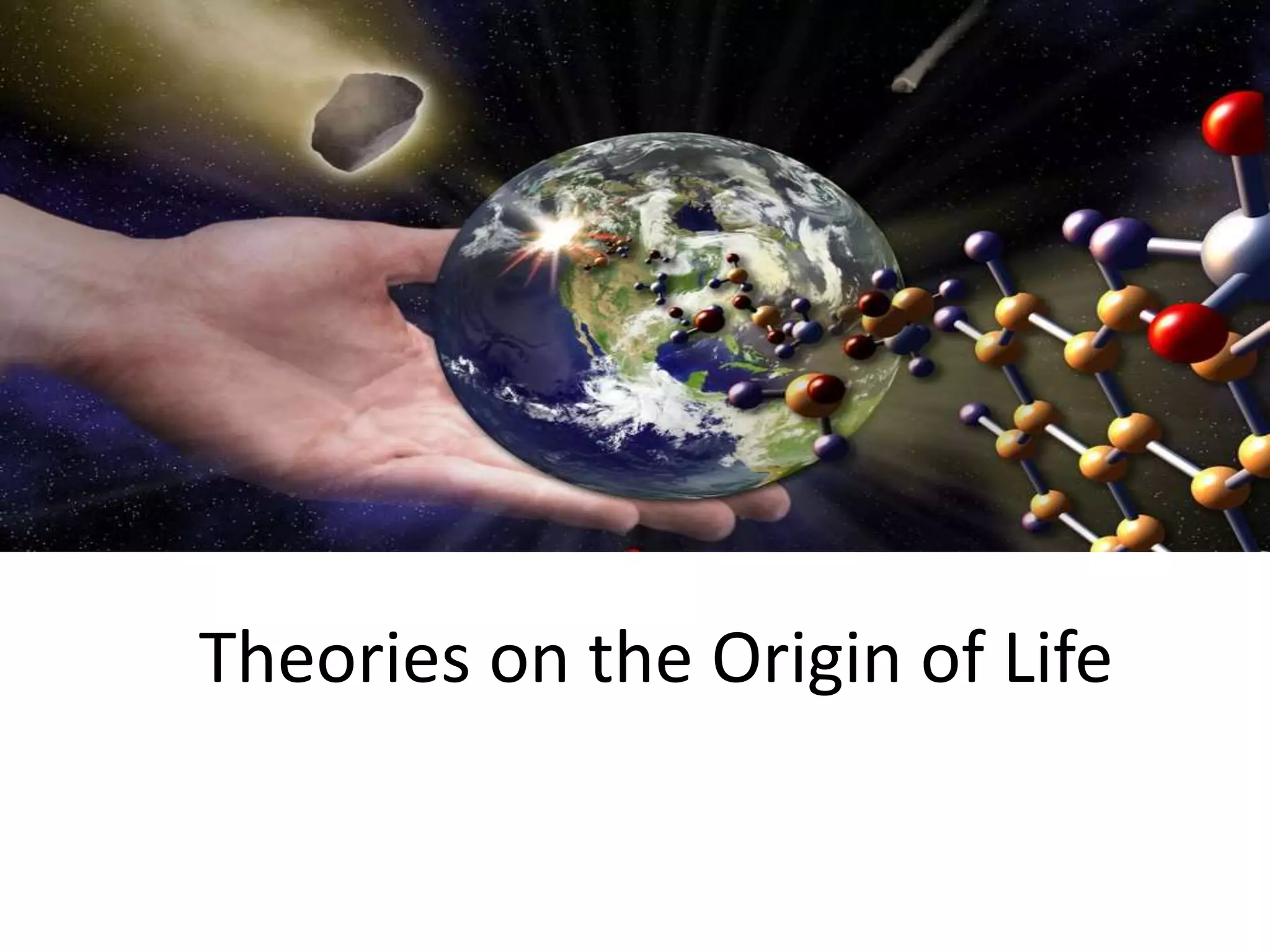
Theories on the Origin of Life
By:
Anna Maria Gracia I. Estardo, RN, MAEd
What is
LIFE?
• Life is defined as “the ability of an organism
to reproduce, grow, produce energy
through chemical reactions to utilize the
outside materials”.
• How life originated on earth?
• How different kinds of organisms are formed
in the world?
Theory of Special Creations
• proposed that life on earth is created by a supernatural
power, the GOD.
• A. All living organisms were created same day [NO
DIFFERENCE IN THEIR APPEARANCE].
• B. They were created in the present form [NO EVOLUTION].
• C. Their bodies and organs are fully developed to meet the
requirement to run the life [NO ADAPTATION]
• OBJECTIONS TO THE THEORY OF SPECIAL
CREATION:
• It was purely based on religious belief.
• There was no experimental evidences to support
the assumptions.
• The age of different fossils proves that living
organism appear on earth in different time frame.
• There's a one-story house where
everything inside is pink: pink walls, pink
doors, pink floors, pink ceilings, pink
windows, pink curtains, pink chairs, and
pink tables. What color are the stairs?
• I'm an odd number. If you take away
one of the letters in my name, I
become even. What number am I?
• What did the
scientist say when
he found 2 atoms of
helium?
Theory of spontaneous generations
• Abiogenesis
• assumes that non-living material in a
spontaneous manner give rise to life.
• EVIDENCES AGAINST THE THEORY OF
SPONTANEOUS GENERATION
• Theory of spontaneous generation was
criticized by Lazzaro Spallanzani, Francisco
Redi and Louis Pasteur.
• He placed meat and fishes in 3 separate jars. Jar
No. 1 was left open, No. 2 was covered with gauze
and the third one was covered with paper. The
meat/fishes decayed in all three jars and attracted
flies. In Jar No. 1, flies entered and laid eggs which
eventually gave birth new larvae. Whereas in Jar
No. 2, flies couldn’t be able to enter and no larve
was found inside the jar. But flies laid eggs on
gauze that produced larvae. This has conclusively
proves that organisms arise from the pre-existed
organism rather than non-living matter.
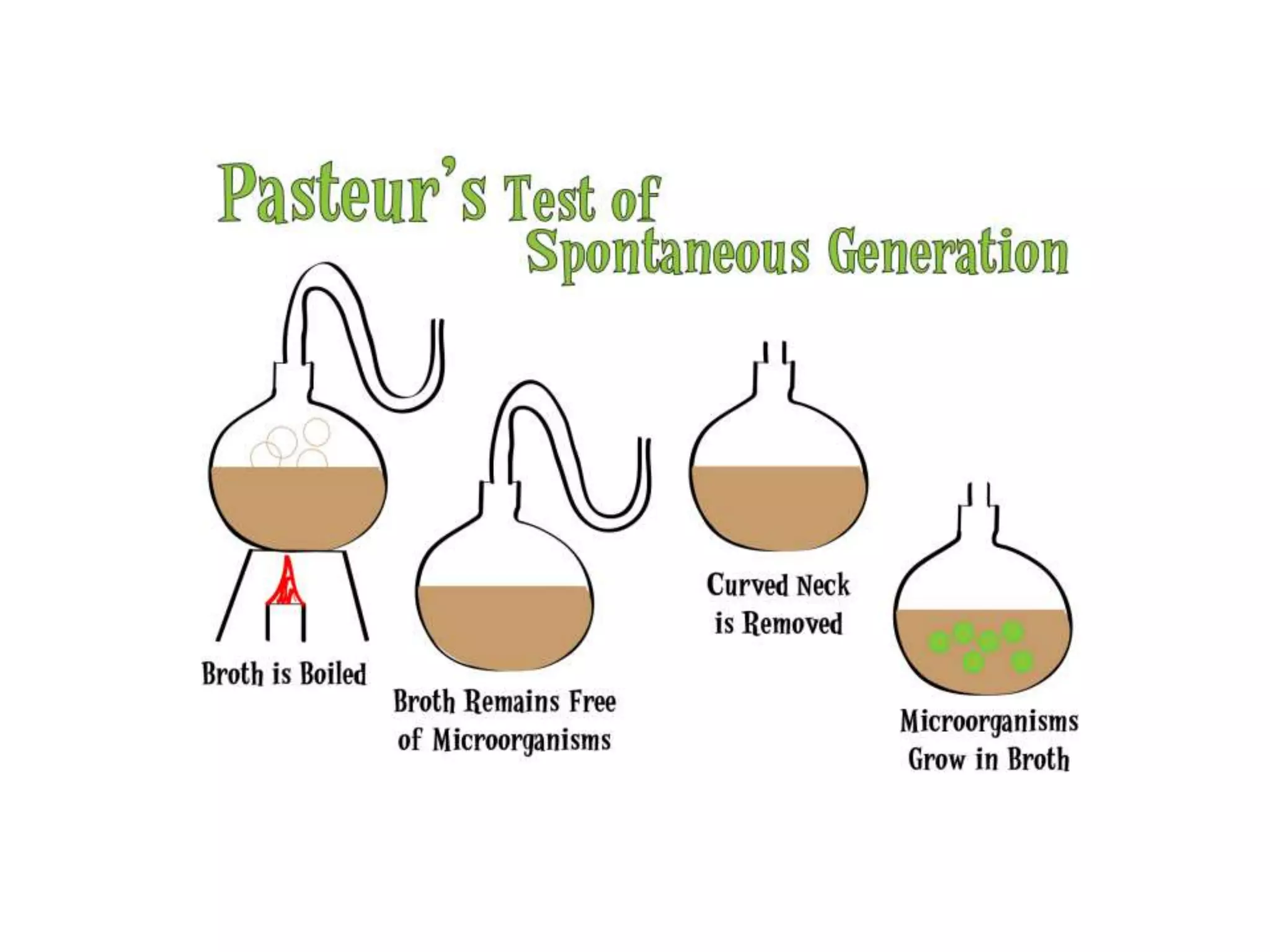
• Pasteur had designed experiment in a flask with
“S” shaped curve tube. He took hay infusion in
the flask and boiled for several minutes. After
cooling, the steam condensed into the lower part
of tube and act as barrier to stop the entry of
microorganisms. No life appeared in the flask for
several months. Analysis of condensed water
indicates appearance of microorganism in the
neck of the tube. Breaking of “S” tube allowed
the growth of microorganisms in the flask.
THEORY OF CATASTROPHISM
• This theory assumes that life is originated by
the creation and it is followed by catastrophe
due to geographical disturbances.
• Each catastrophe destroyed the life
completely whereas each creation forms life
different from the previous one. Hence, each
round of catastrophe/creation is responsible
for evolvment of different types of organisms
on earth.
THEORY OF COSMOZOIC
• The theory assumes that life was present in
the form of resistant spores and appeared on
earth from other planet.
• The theory initially got the support from the
fact that fossils of microorganism were found
in meteorites in 1961.
• 'protoplasm' reached the earth in the form of
spores or germs or other simple particles from
some unknown part of the universe with the
cosmic dust, and subsequently evolved into
various forms of life.
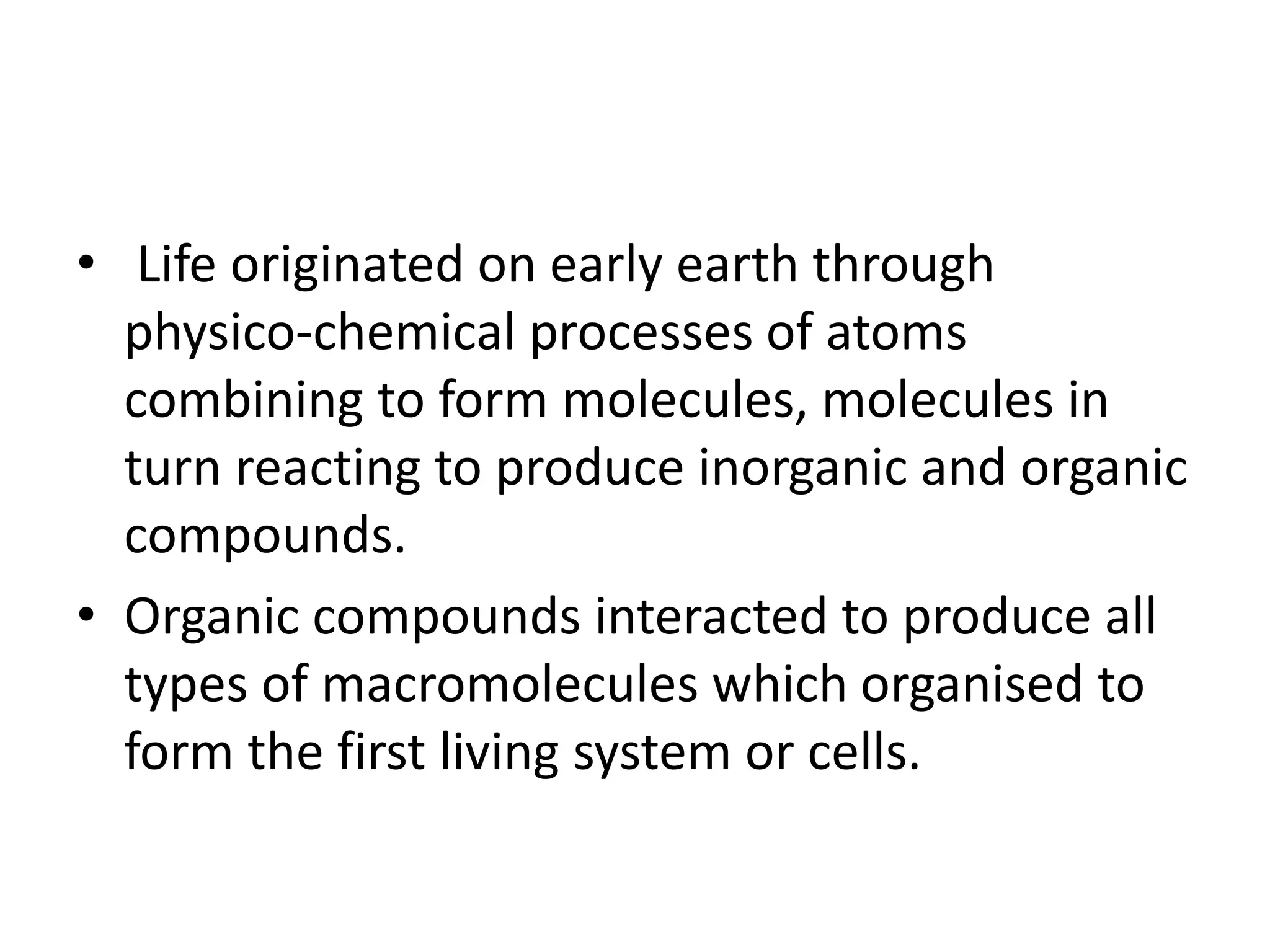
THEORY OF ETERNITY OF LIFE
• This theory assumes that life had no beginning
or end.
• It believes that life has ever been in existence
and it will continue to be so ever.
MODERN THEORY OF LIFE
• theory of primary abiogenesis
• the hypothesis of abiogenesis was proposed
with a condition that the non-living materials
can give rise to life in the condition of
primitive earth.
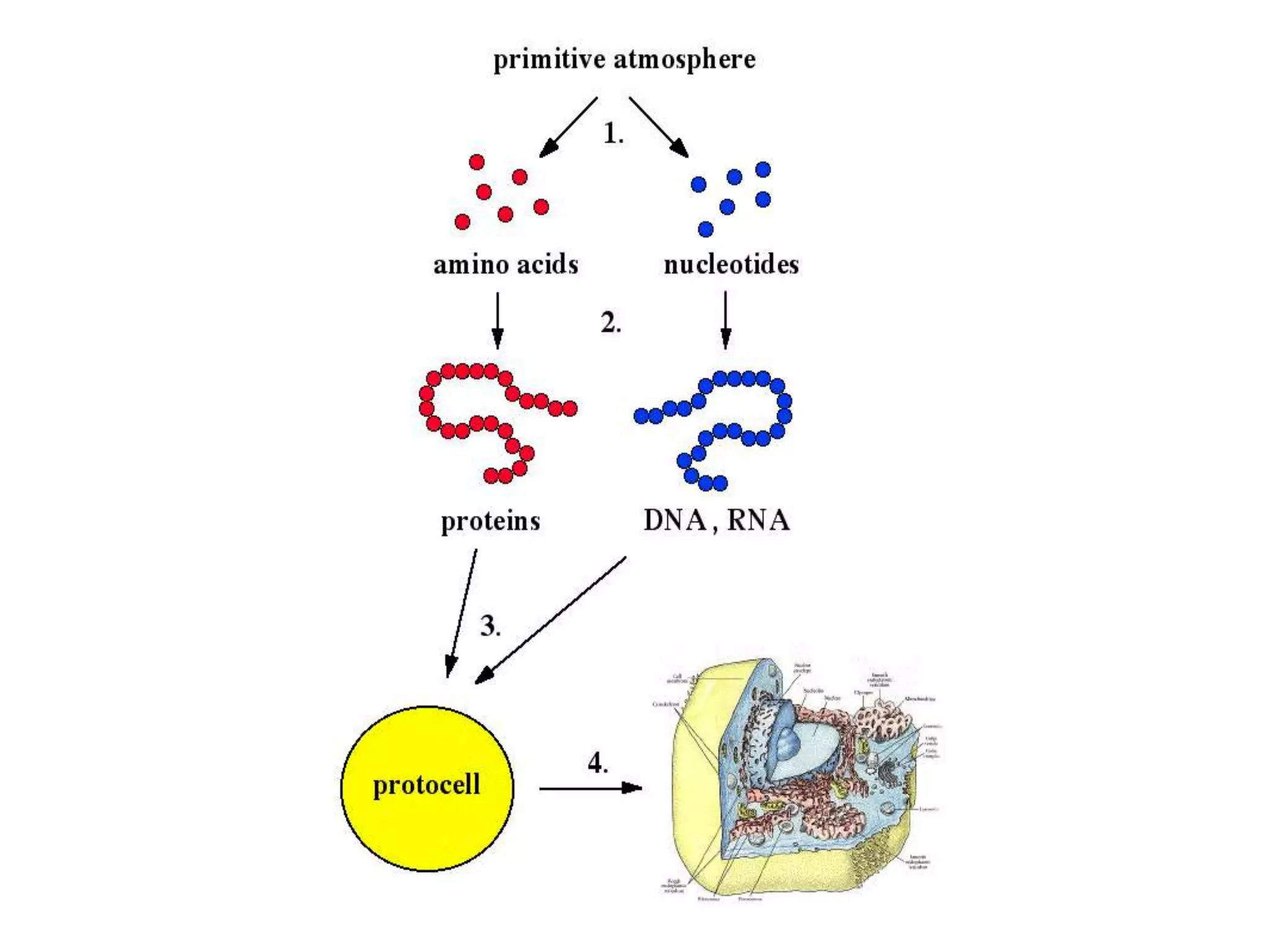
• Life originated on early earth through
physico-chemical processes of atoms
combining to form molecules, molecules in
turn reacting to produce inorganic and organic
compounds.
• Organic compounds interacted to produce all
types of macromolecules which organised to
form the first living system or cells.
Exercise
• Identify the theory
• Explain
• Theory of spontaneous generations
• THEORY OF COSMOZOIC
• THEORY OF CATASTROPHISM
• MODERN THEORY OF LIFE

ZOO1 -Theories on the origin of life

  • 1.
    Theories on theOrigin of Life By: Anna Maria Gracia I. Estardo, RN, MAEd
  • 2.
  • 3.
    • Life isdefined as “the ability of an organism to reproduce, grow, produce energy through chemical reactions to utilize the outside materials”.
  • 4.
    • How lifeoriginated on earth? • How different kinds of organisms are formed in the world?
  • 6.
    Theory of SpecialCreations • proposed that life on earth is created by a supernatural power, the GOD. • A. All living organisms were created same day [NO DIFFERENCE IN THEIR APPEARANCE]. • B. They were created in the present form [NO EVOLUTION]. • C. Their bodies and organs are fully developed to meet the requirement to run the life [NO ADAPTATION]
  • 7.
    • OBJECTIONS TOTHE THEORY OF SPECIAL CREATION: • It was purely based on religious belief. • There was no experimental evidences to support the assumptions. • The age of different fossils proves that living organism appear on earth in different time frame.
  • 8.
    • There's aone-story house where everything inside is pink: pink walls, pink doors, pink floors, pink ceilings, pink windows, pink curtains, pink chairs, and pink tables. What color are the stairs?
  • 9.
    • I'm anodd number. If you take away one of the letters in my name, I become even. What number am I?
  • 10.
    • What didthe scientist say when he found 2 atoms of helium?
  • 11.
    Theory of spontaneousgenerations • Abiogenesis • assumes that non-living material in a spontaneous manner give rise to life.
  • 14.
    • EVIDENCES AGAINSTTHE THEORY OF SPONTANEOUS GENERATION • Theory of spontaneous generation was criticized by Lazzaro Spallanzani, Francisco Redi and Louis Pasteur.
  • 15.
    • He placedmeat and fishes in 3 separate jars. Jar No. 1 was left open, No. 2 was covered with gauze and the third one was covered with paper. The meat/fishes decayed in all three jars and attracted flies. In Jar No. 1, flies entered and laid eggs which eventually gave birth new larvae. Whereas in Jar No. 2, flies couldn’t be able to enter and no larve was found inside the jar. But flies laid eggs on gauze that produced larvae. This has conclusively proves that organisms arise from the pre-existed organism rather than non-living matter.
  • 17.
    • Pasteur haddesigned experiment in a flask with “S” shaped curve tube. He took hay infusion in the flask and boiled for several minutes. After cooling, the steam condensed into the lower part of tube and act as barrier to stop the entry of microorganisms. No life appeared in the flask for several months. Analysis of condensed water indicates appearance of microorganism in the neck of the tube. Breaking of “S” tube allowed the growth of microorganisms in the flask.
  • 19.
    THEORY OF CATASTROPHISM •This theory assumes that life is originated by the creation and it is followed by catastrophe due to geographical disturbances. • Each catastrophe destroyed the life completely whereas each creation forms life different from the previous one. Hence, each round of catastrophe/creation is responsible for evolvment of different types of organisms on earth.
  • 21.
    THEORY OF COSMOZOIC •The theory assumes that life was present in the form of resistant spores and appeared on earth from other planet. • The theory initially got the support from the fact that fossils of microorganism were found in meteorites in 1961.
  • 22.
    • 'protoplasm' reachedthe earth in the form of spores or germs or other simple particles from some unknown part of the universe with the cosmic dust, and subsequently evolved into various forms of life.
  • 24.
    THEORY OF ETERNITYOF LIFE • This theory assumes that life had no beginning or end. • It believes that life has ever been in existence and it will continue to be so ever.
  • 25.
    MODERN THEORY OFLIFE • theory of primary abiogenesis • the hypothesis of abiogenesis was proposed with a condition that the non-living materials can give rise to life in the condition of primitive earth.
  • 26.
    • Life originatedon early earth through physico-chemical processes of atoms combining to form molecules, molecules in turn reacting to produce inorganic and organic compounds. • Organic compounds interacted to produce all types of macromolecules which organised to form the first living system or cells.
  • 28.
    Exercise • Identify thetheory • Explain
  • 30.
    • Theory ofspontaneous generations
  • 32.
    • THEORY OFCOSMOZOIC
  • 34.
    • THEORY OFCATASTROPHISM
  • 36.