LECTURE PRESENTATIONS
For CAMPBELL BIOLOGY, NINTH EDITION
Jane B. Reece, Lisa A. Urry, Michael L. Cain, Steven A. Wasserman, Peter V. Minorsky, Robert B. Jackson
© 2011 Pearson Education, Inc.
Lectures by
Erin Barley
Kathleen Fitzpatrick
Descent with Modification:
A Darwinian View of Life
Chapter 22
Overview: Endless Forms Most Beautiful
• A new era of biology began in 1859 when
Charles Darwin published The Origin of
Species
• The Origin of Species focused biologists’
attention on the great diversity of
organisms
© 2011 Pearson Education, Inc.
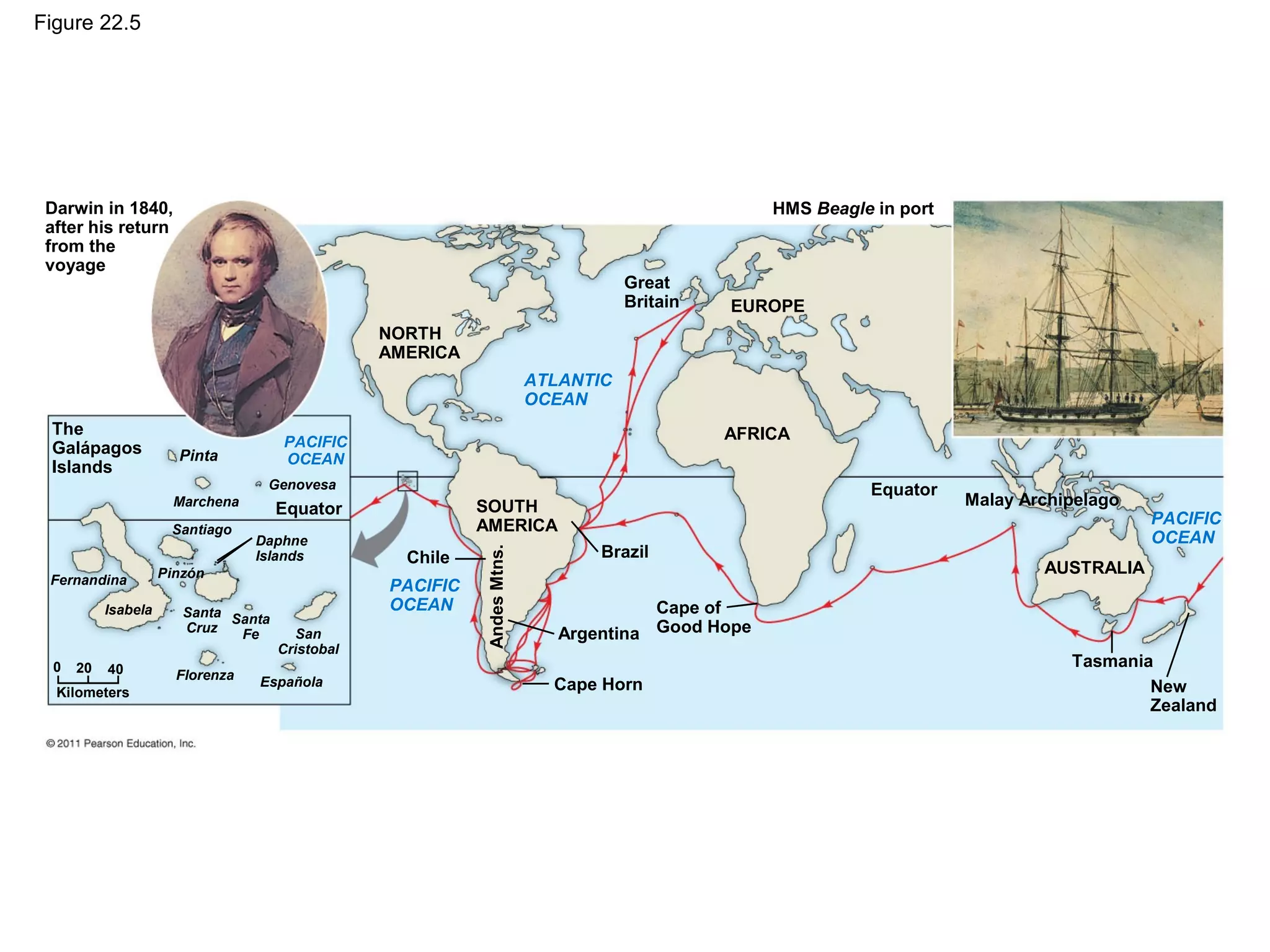
• Darwin noted that current species are
descendants of ancestral species
• Evolution can be defined by Darwin’s
phrase descent with modification
• Evolution can be viewed as both a pattern
and a process
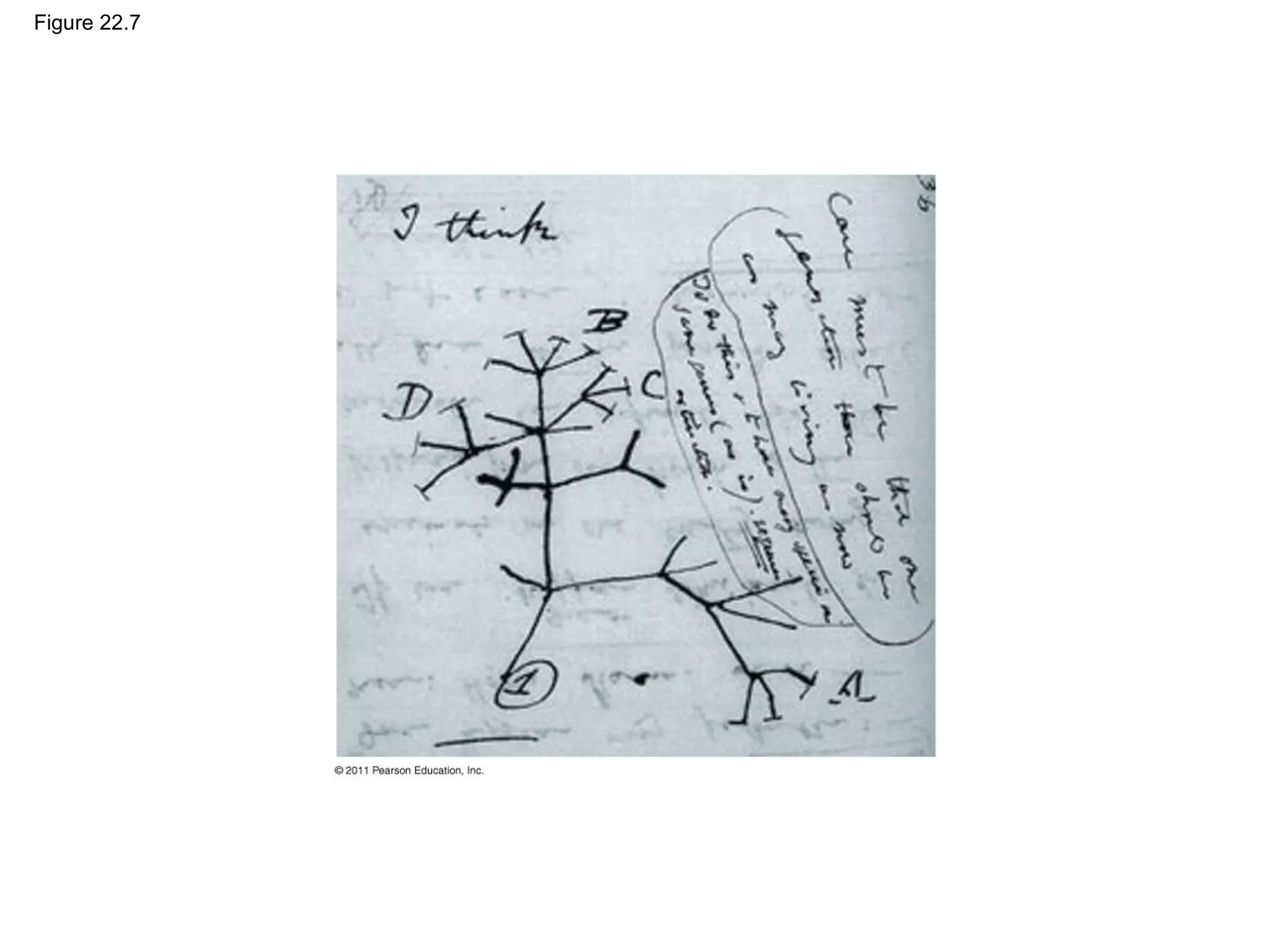
© 2011 Pearson Education, Inc.
• Darwin’s ideas had deep historical roots
The Darwinian revolution challenged
traditional views of a young Earth
inhabited by unchanging species
© 2011 Pearson Education, Inc.
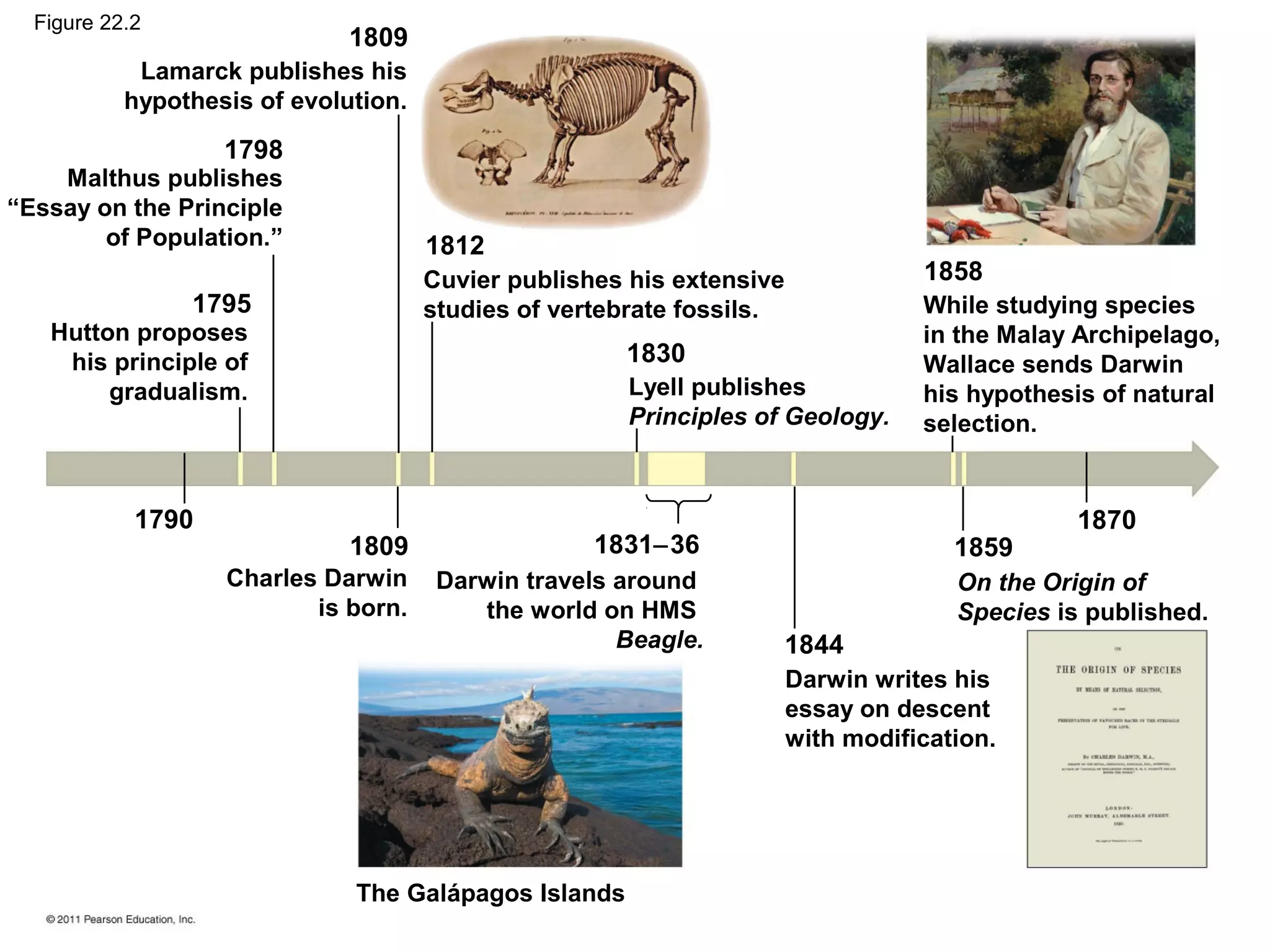
1809
1798
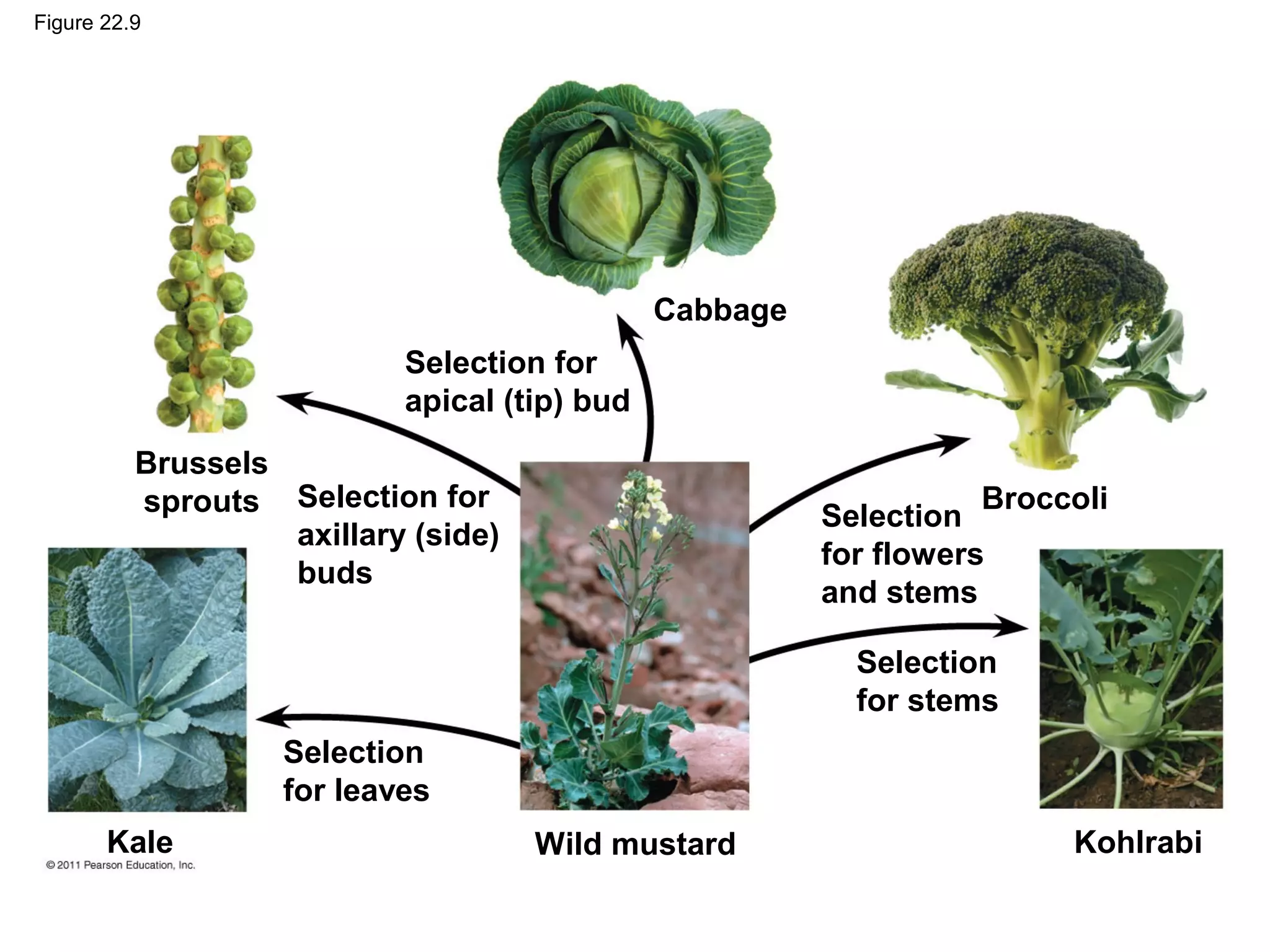
1812
1795
1830
1790
1809 1831−36
1844
1859
1870
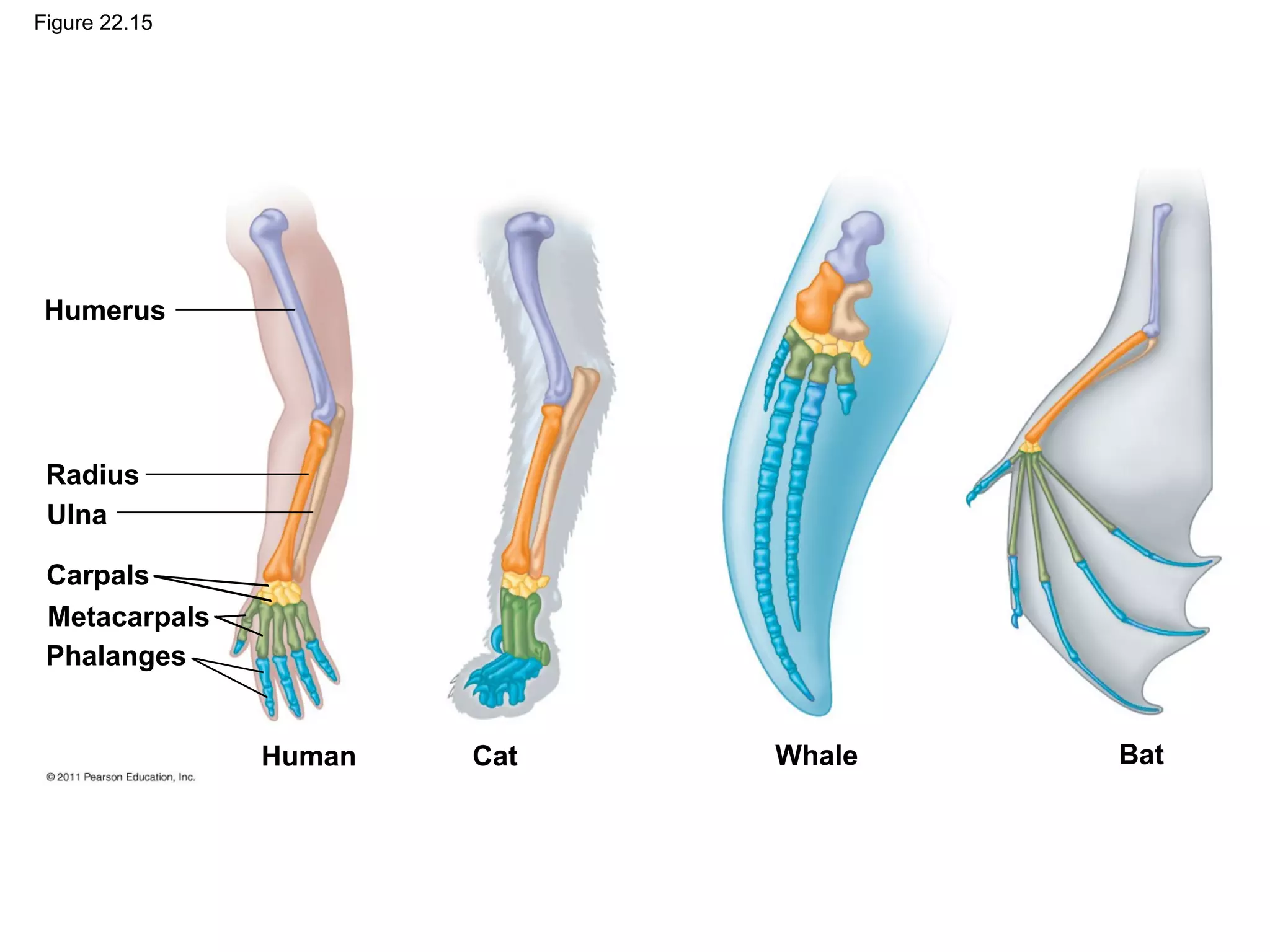
Lamarck publishes his
hypothesis of evolution.
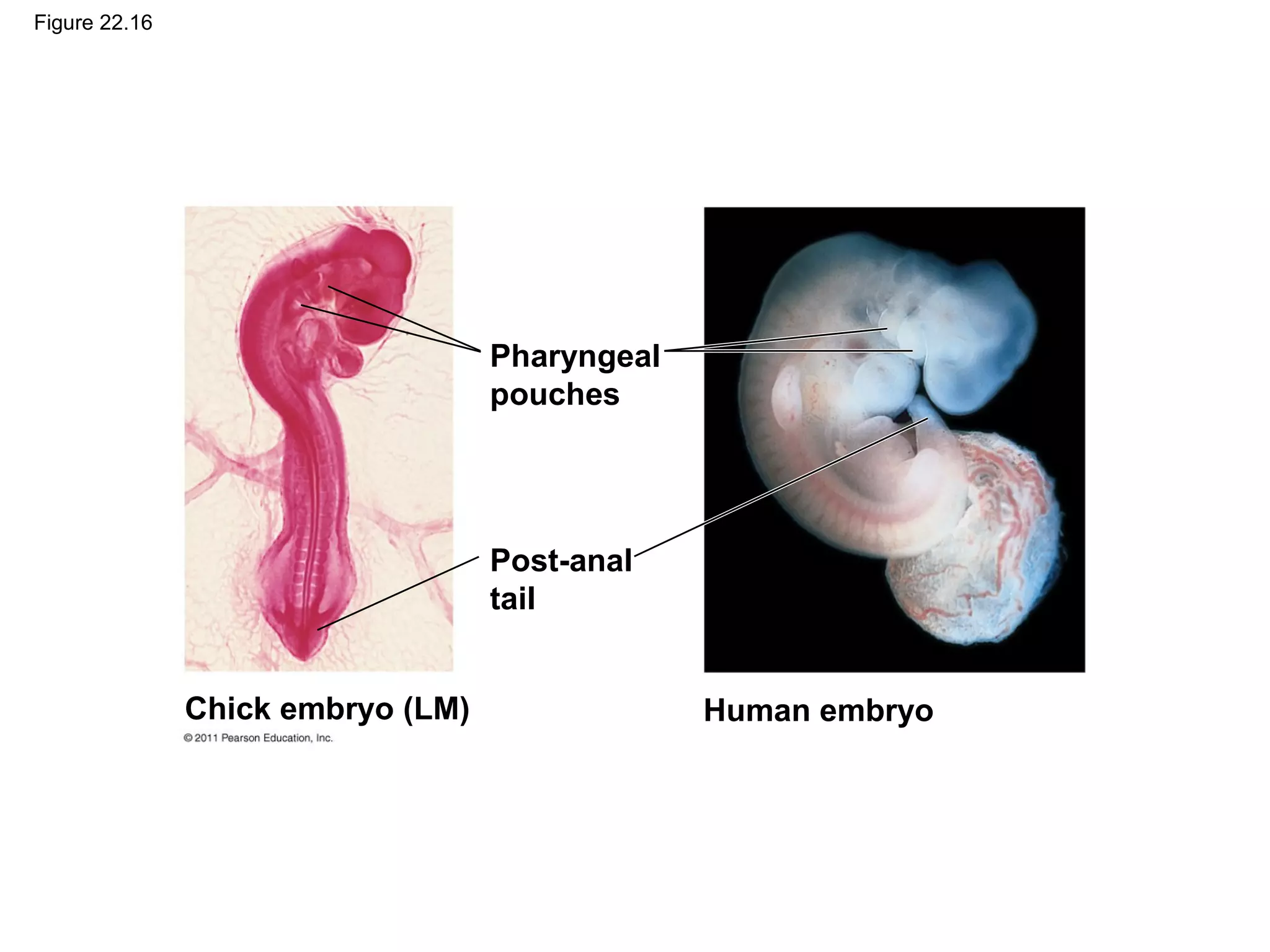
Malthus publishes
“Essay on the Principle
of Population.”
Hutton proposes
his principle of
gradualism.
Charles Darwin
is born.
Darwin travels around
the world on HMS
Beagle.
The Galápagos Islands
Darwin writes his
essay on descent
with modification.
On the Origin of
Species is published.
While studying species
in the Malay Archipelago,
Wallace sends Darwin
his hypothesis of natural
selection.
1858Cuvier publishes his extensive
studies of vertebrate fossils.
Lyell publishes
Principles of Geology.
Figure 22.2
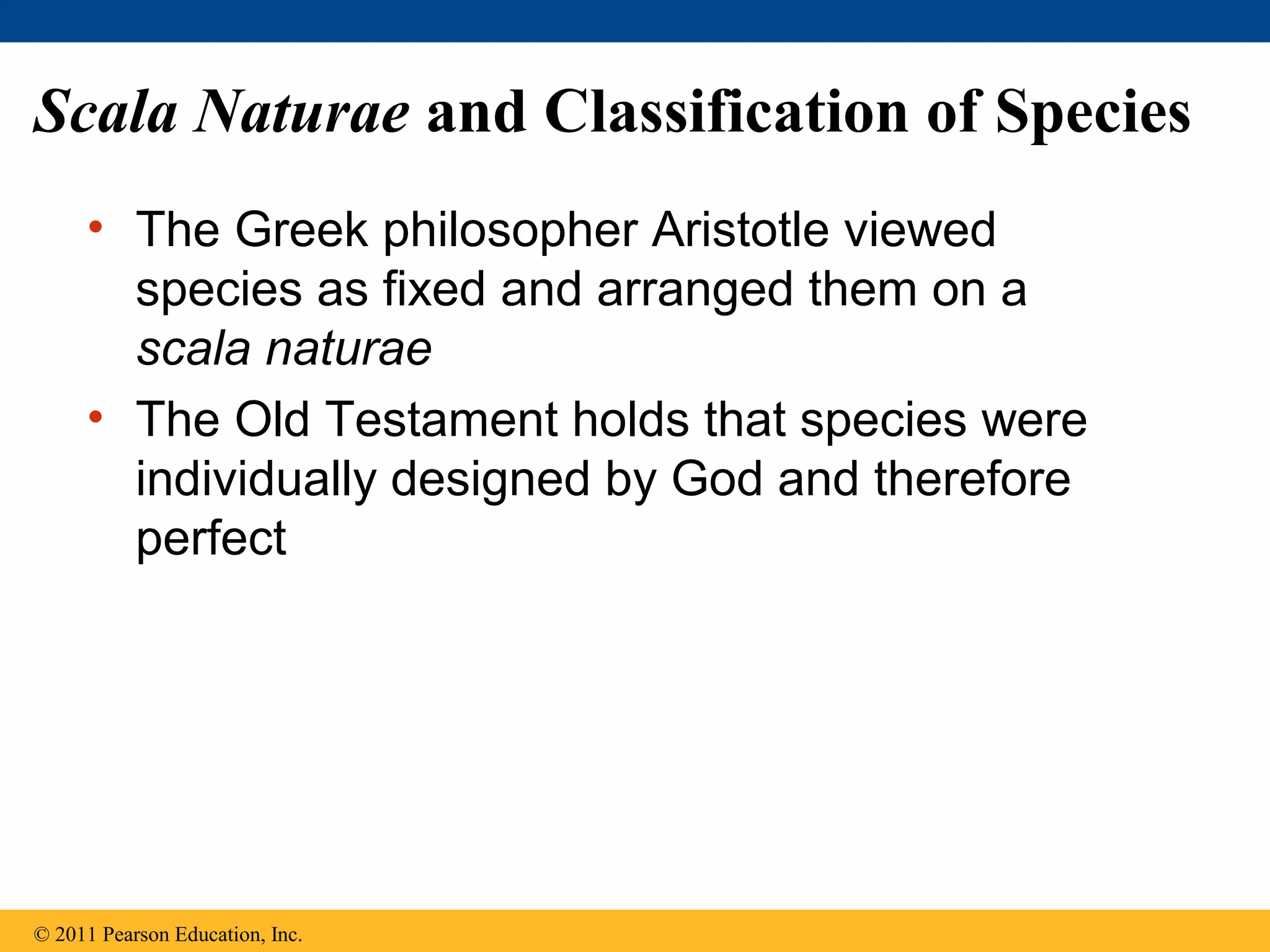
Scala Naturae and Classification of Species
• The Greek philosopher Aristotle viewed
species as fixed and arranged them on a
scala naturae
• The Old Testament holds that species were
individually designed by God and therefore
perfect
© 2011 Pearson Education, Inc.
• Carolus Linnaeus interpreted organismal
adaptations as evidence that the Creator had
designed each species for a specific purpose
• Linnaeus was the founder of taxonomy, the branch
of biology concerned with classifying organisms
• He developed the binomial format for naming
species (for example, Homo sapiens)
© 2011 Pearson Education, Inc.
Ideas About Change over Time
• The study of fossils helped to lay the
groundwork for Darwin’s ideas
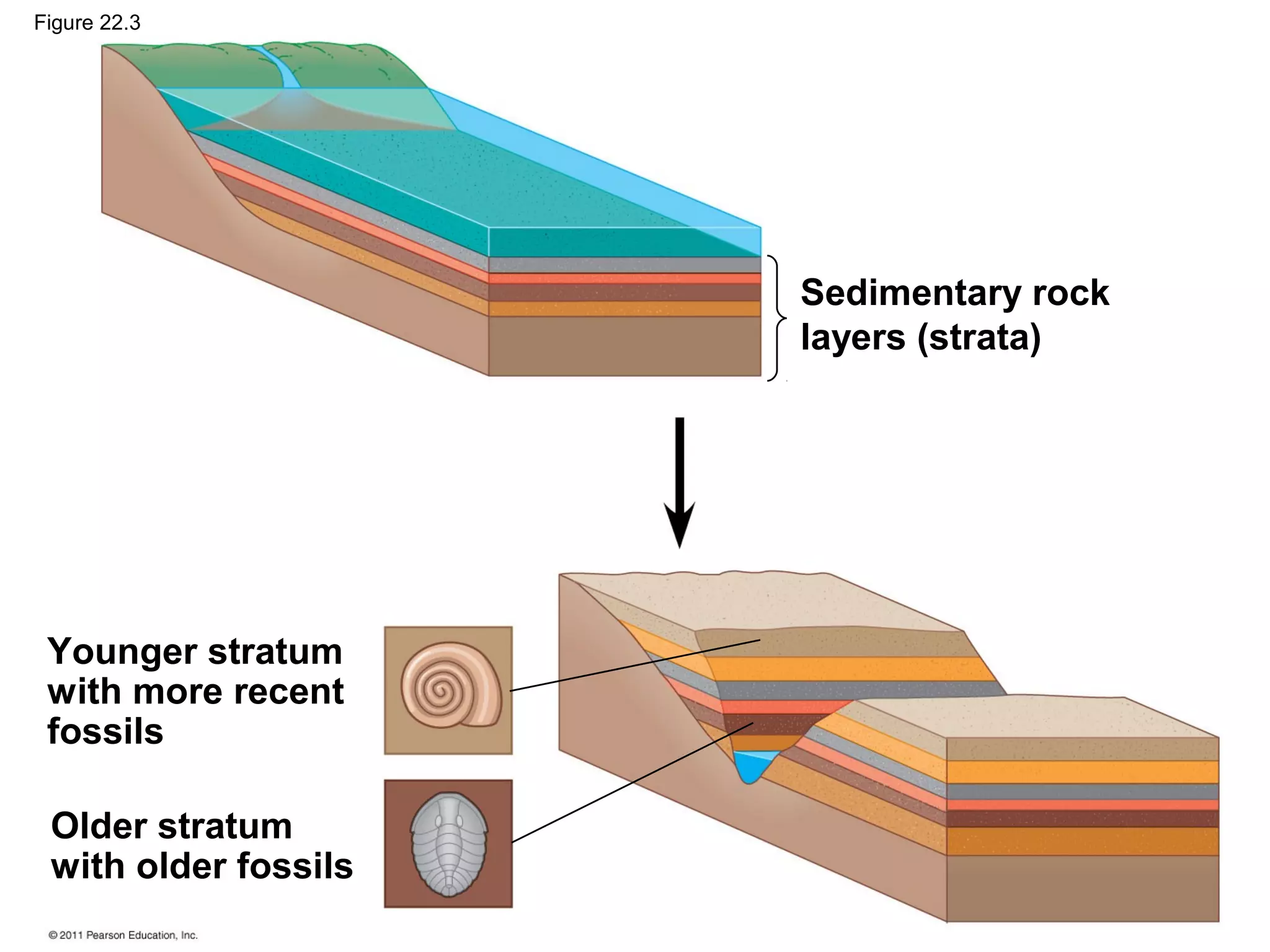
• Fossils are remains or traces of organisms
from the past, usually found in sedimentary
rock, which appears in layers or strata
© 2011 Pearson Education, Inc.
Figure 22.3
Sedimentary rock
layers (strata)
Younger stratum
with more recent
fossils
Older stratum
with older fossils
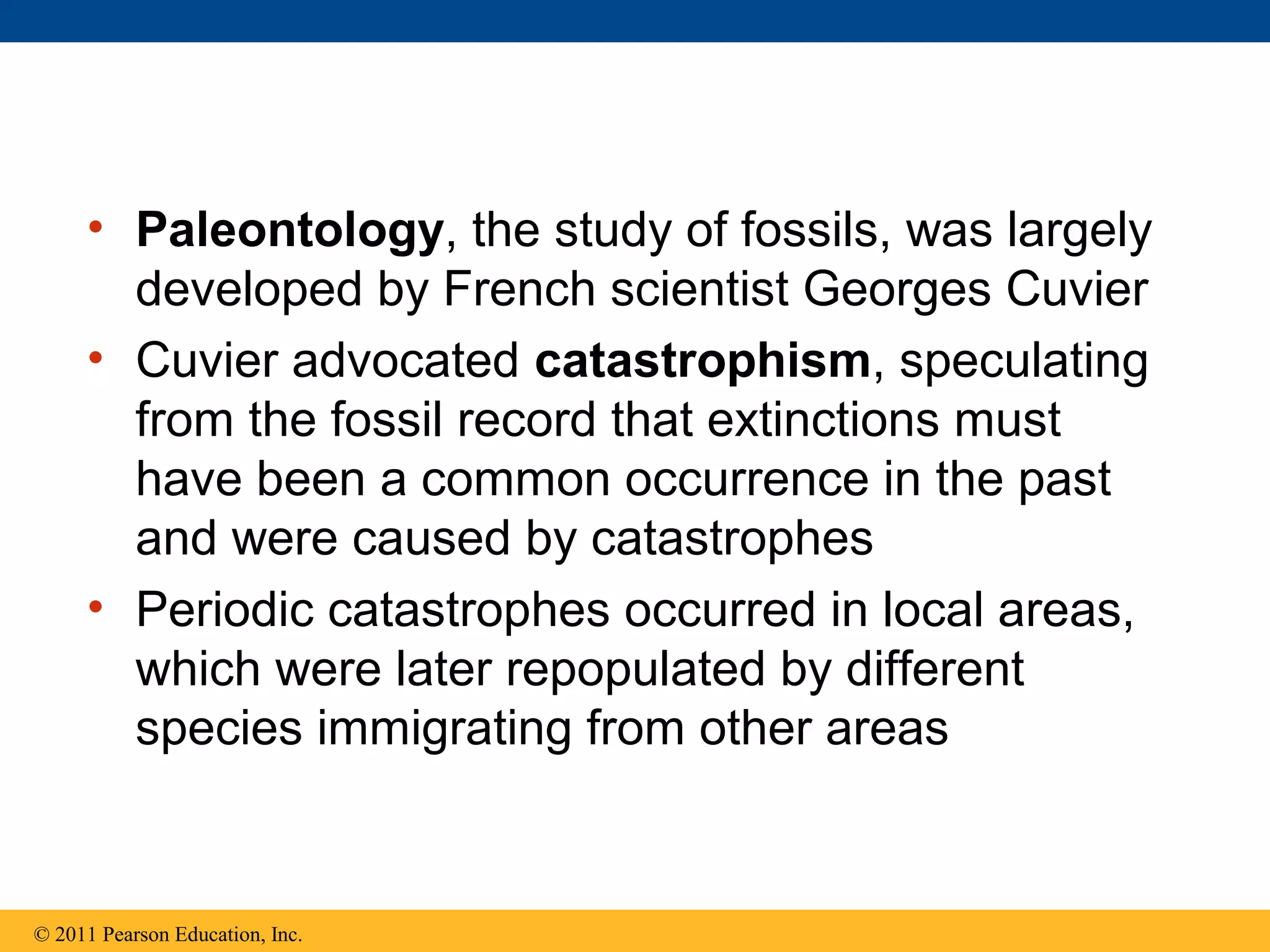
• Paleontology, the study of fossils, was largely
developed by French scientist Georges Cuvier
• Cuvier advocated catastrophism, speculating
from the fossil record that extinctions must
have been a common occurrence in the past
and were caused by catastrophes
• Periodic catastrophes occurred in local areas,
which were later repopulated by different
species immigrating from other areas
© 2011 Pearson Education, Inc.
• Geologists James Hutton and Charles Lyell
perceived that changes in Earth’s surface can
result from slow continuous actions still
operating today, a theory called gradualism
• Lyell’s principle of uniformitarianism states
that the mechanisms of change are constant
over time
• These views strongly influenced Darwin’s
thinking
© 2011 Pearson Education, Inc.
Lamarck’s Hypothesis of Evolution
• Lamarck hypothesized that species evolve
through use and disuse of body parts and the
inheritance of acquired characteristics
• The mechanisms he proposed are unsupported
by evidence
• However, he did propose the first theory of
evolution in 1809, the year Darwin was born
© 2011 Pearson Education, Inc.
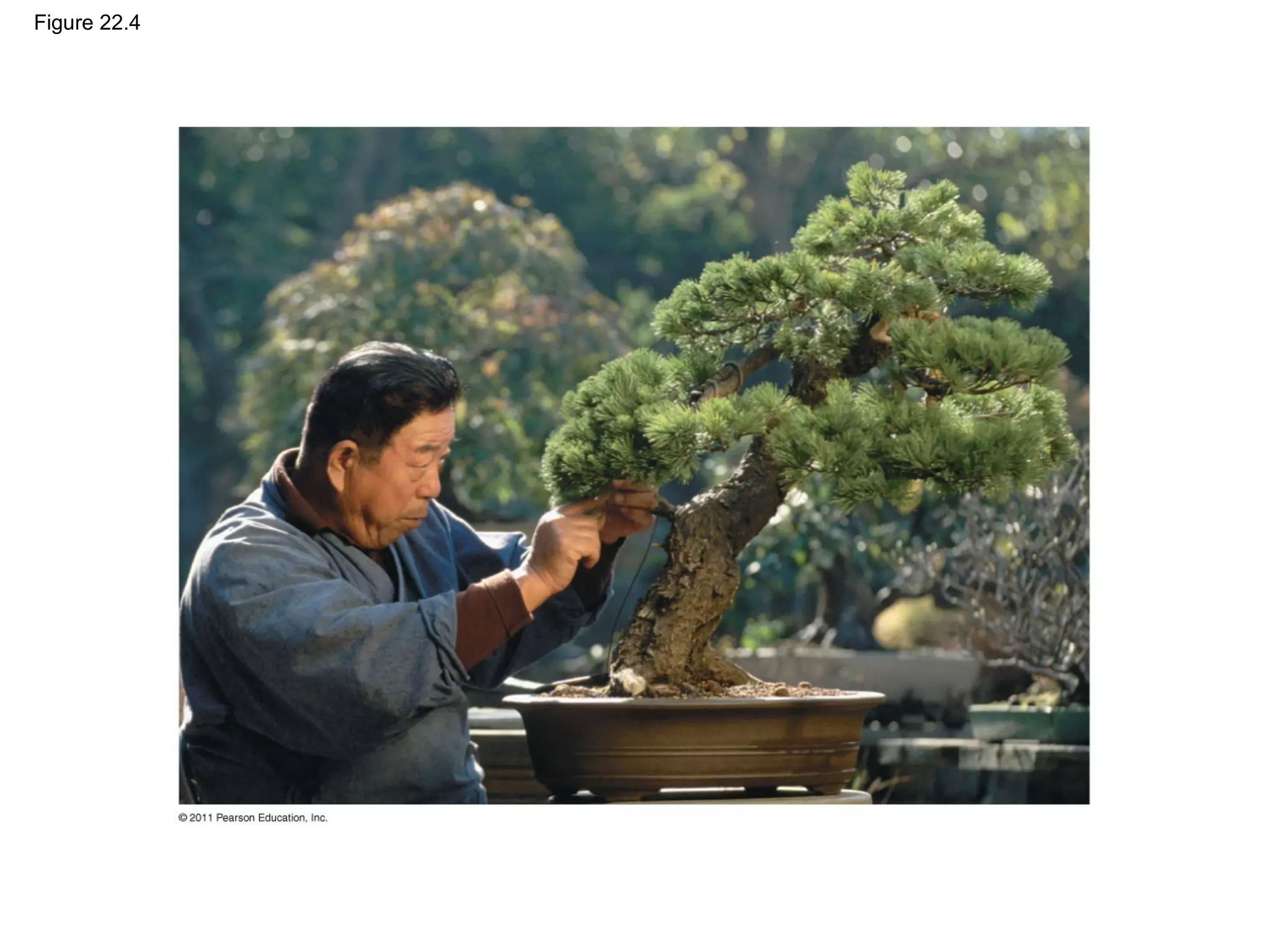
Figure 22.4
• Some doubt about the permanence of species
preceded Darwin’s ideas
Descent with modification by natural
selection explains the adaptations of
organisms and the unity and diversity of life
© 2011 Pearson Education, Inc.
Darwin’s Research
• As a boy and into adulthood, Charles Darwin
had a consuming interest in nature
• Darwin first studied medicine (unsuccessfully),
and then theology at Cambridge University
• After graduating, he took an unpaid position as
naturalist and companion to Captain Robert
FitzRoy for a 5-year around the world voyage
on the Beagle
© 2011 Pearson Education, Inc.
The Voyage of the Beagle
• During his travels on the Beagle, Darwin collected
specimens of South American plants and animals
• He observed that fossils resembled living species
from the same region, and living species
resembled other species from nearby regions
• He experienced an earthquake in Chile and
observed the uplift of rocks
© 2011 Pearson Education, Inc.
• Darwin was influenced by Lyell’s Principles of
Geology and thought that the earth was more than
6000 years old
• His interest in geographic distribution of species
was kindled by a stop at the Galápagos Islands
west of South America
• He hypothesized that species from South America
had colonized the Galápagos and speciated on
the islands
© 2011 Pearson Education, Inc.
Figure 22.5
Darwin in 1840,
after his return
from the
voyage
The
Galápagos
Islands
NORTH
AMERICA
ATLANTIC
OCEAN
PACIFIC
OCEAN
PACIFIC
OCEAN
Pinta
Marchena
Genovesa
Equator
Chile
Santiago
Daphne
Islands
Fernandina
Isabela Santa
Cruz
Santa
Fe San
Cristobal
Española
Kilometers
0 20 40 Florenza
Pinzón
SOUTH
AMERICA
AFRICA
EUROPE
Great
Britain
HMS Beagle in port
Equator
PACIFIC
OCEAN
Malay Archipelago
AUSTRALIA
Tasmania
New
Zealand
Brazil
Argentina
Cape Horn
AndesMtns.
Cape of
Good Hope
Darwin’s Focus on Adaptation
• In reassessing his observations, Darwin
perceived adaptation to the environment and
the origin of new species as closely related
processes
• From studies made years after Darwin’s
voyage, biologists have concluded that this is
what happened to the Galápagos finches
© 2011 Pearson Education, Inc.
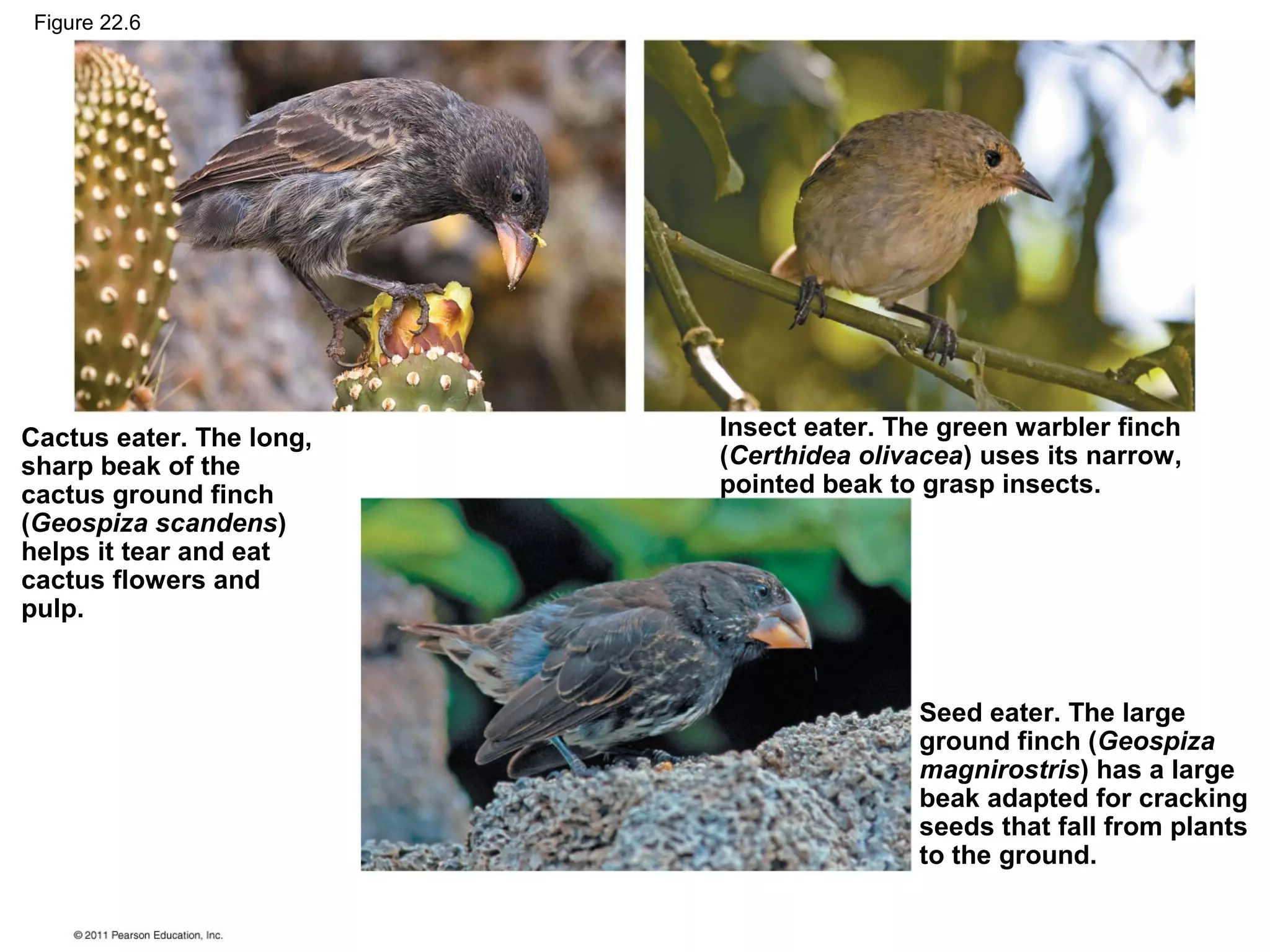
Figure 22.6
Cactus eater. The long,
sharp beak of the
cactus ground finch
(Geospiza scandens)
helps it tear and eat
cactus flowers and
pulp.
Insect eater. The green warbler finch
(Certhidea olivacea) uses its narrow,
pointed beak to grasp insects.
Seed eater. The large
ground finch (Geospiza
magnirostris) has a large
beak adapted for cracking
seeds that fall from plants
to the ground.
• In 1844, Darwin wrote an essay on natural
selection as the mechanism of descent with
modification, but did not introduce his theory
publicly
• Natural selection is a process in which individuals
with favorable inherited traits are more likely to
survive and reproduce
• In June 1858, Darwin received a manuscript from
Alfred Russell Wallace, who had developed a
theory of natural selection similar to Darwin’s
• Darwin quickly finished The Origin of Species and
published it the next year
© 2011 Pearson Education, Inc.
The Origin of Species
• Darwin explained three broad observations:
– The unity of life
– The diversity of life
– The match between organisms and their
environment
© 2011 Pearson Education, Inc.
Descent with Modification
• Darwin never used the word evolution in the
first edition of The Origin of Species
• The phrase descent with modification
summarized Darwin’s perception of the unity
of life
• The phrase refers to the view that all
organisms are related through descent from
an ancestor that lived in the remote past
© 2011 Pearson Education, Inc.
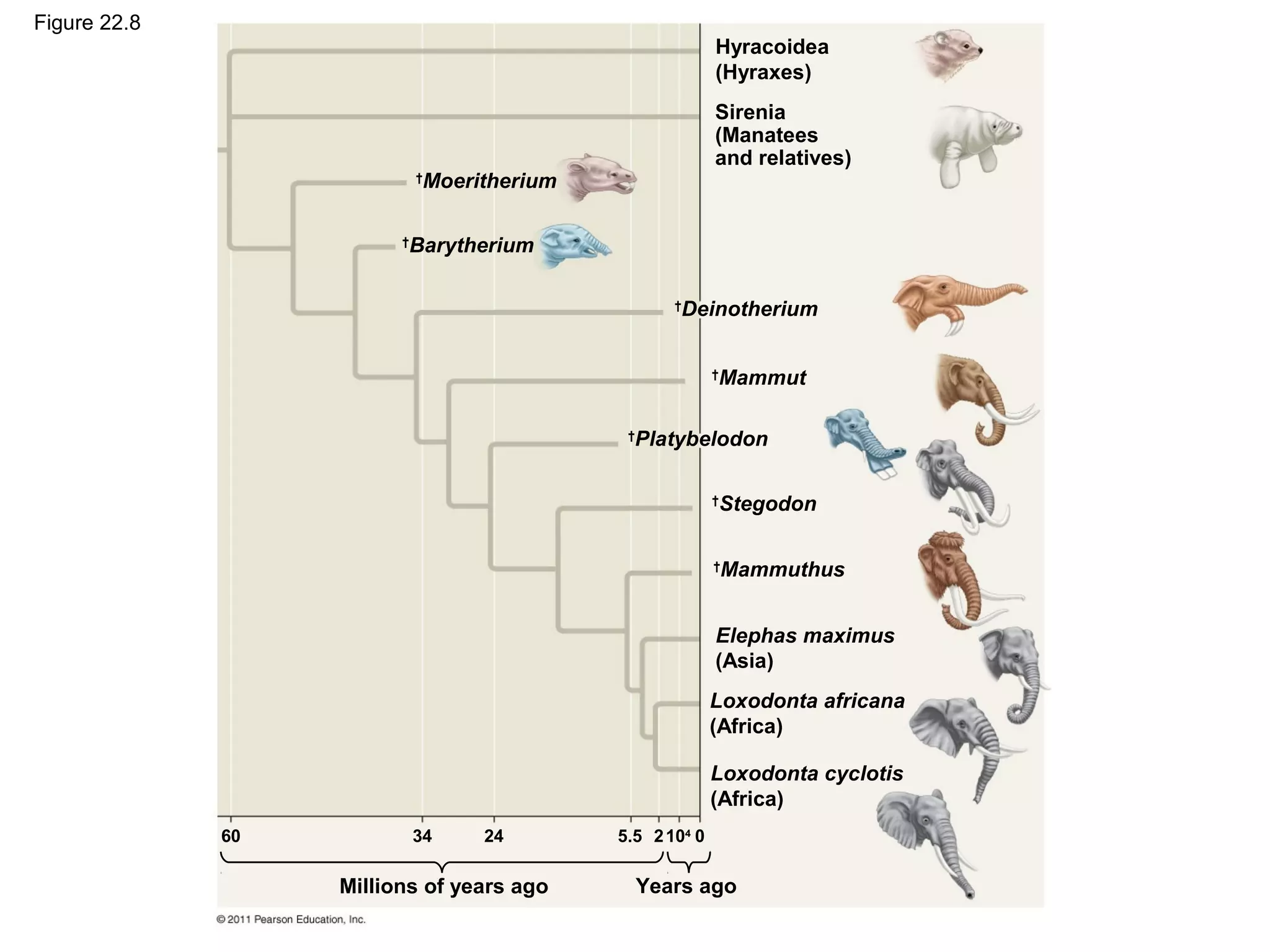
• In the Darwinian view, the history of life is
like a tree with branches representing life’s
diversity
• Darwin’s theory meshed well with the
hierarchy of Linnaeus
© 2011 Pearson Education, Inc.
Figure 22.7
Figure 22.8
Hyracoidea
(Hyraxes)
Sirenia
(Manatees
and relatives)
†
Deinotherium
†
Mammut
†
Platybelodon
†
Stegodon
†
Mammuthus
Elephas maximus
(Asia)
Loxodonta africana
(Africa)
Loxodonta cyclotis
(Africa)
†
Moeritherium
†
Barytherium
60
Millions of years ago
34 24 5.5 2104
0
Years ago
Natural Selection and Adaptation
• Evolutionary biologist Ernst Mayr has dissected
the logic of Darwin’s theory into three inferences
based on five observations
• Observation #1: For any species, population sizes
would increase exponentially if all individuals that
are born reproduced successfully
• Observation #2: Populations tend to be stable in
size, except for seasonal fluctuations
• Observation #3: Resources are limited
• Inference #1: Production of more individuals than
the environment can support leads to a struggle
for existence among individuals of a population,
with only a fraction of their offspring surviving
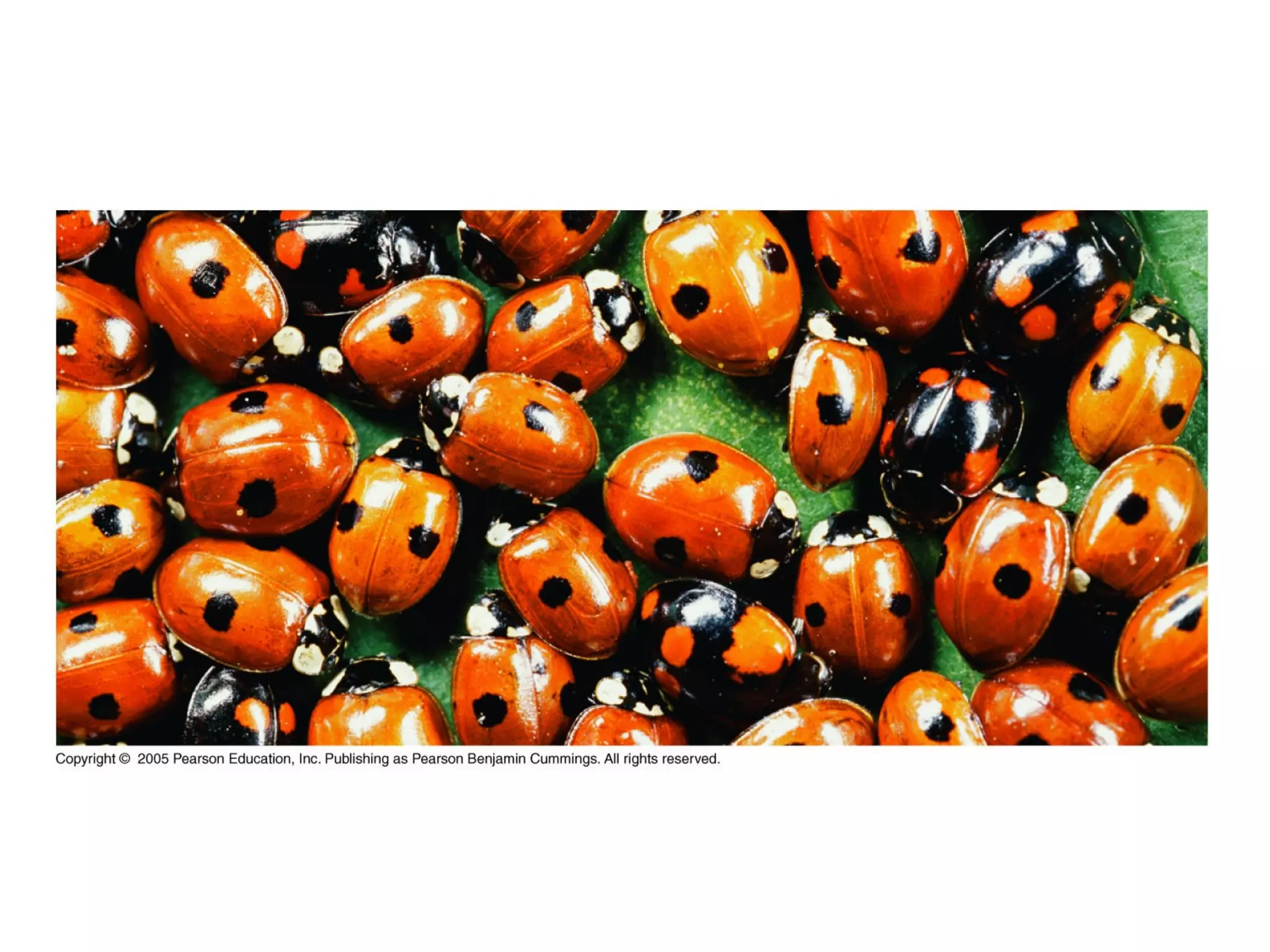
• Observation #4: Members of a population vary
extensively in their characteristics; no two
individuals are exactly alike
• Observation #5: Much of this variation is heritable
• Inference #2: Survival depends in part on inherited
traits; individuals whose inherited traits give them
a high probability of surviving and reproducing are
likely to leave more offspring than other individuals
• Inference #3: This unequal ability of individuals to
survive and reproduce will lead to a gradual
change in a population, with favorable
characteristics accumulating over generations
Artificial Selection, Natural Selection, and
Adaptation
• Darwin noted that humans have modified
other species by selecting and breeding
individuals with desired traits, a process
called artificial selection
© 2011 Pearson Education, Inc.
Figure 22.9
Brussels
sprouts
Kale
Selection
for leaves
Selection for
axillary (side)
buds
Selection for
apical (tip) bud
Cabbage
Broccoli
KohlrabiWild mustard
Selection
for stems
Selection
for flowers
and stems
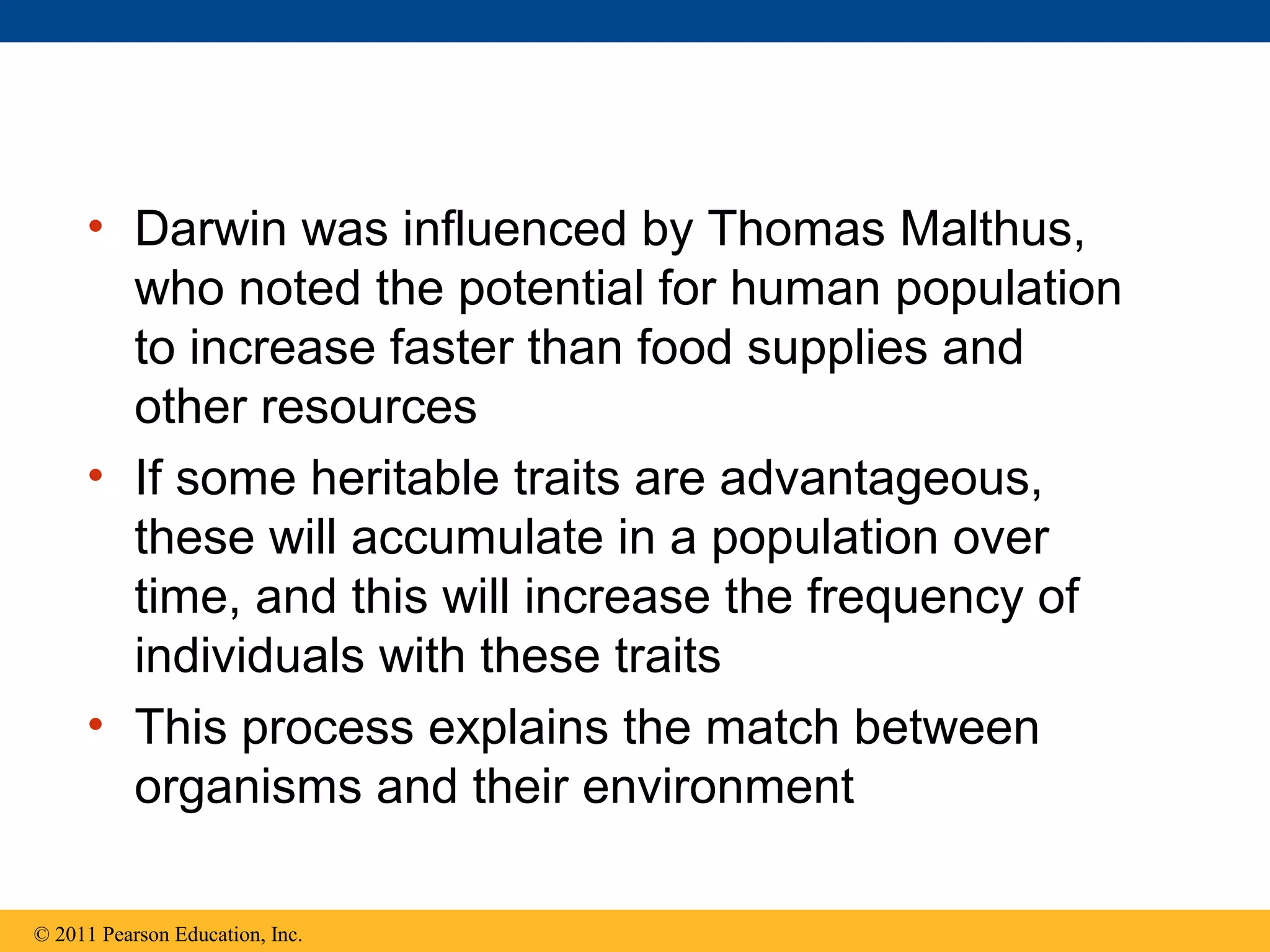
• Darwin was influenced by Thomas Malthus,
who noted the potential for human population
to increase faster than food supplies and
other resources
• If some heritable traits are advantageous,
these will accumulate in a population over
time, and this will increase the frequency of
individuals with these traits
• This process explains the match between
organisms and their environment
© 2011 Pearson Education, Inc.
Natural Selection: A Summary
• Individuals with certain heritable characteristics
survive and reproduce at a higher rate than
other individuals
• Natural selection increases the adaptation of
organisms to their environment over time
• If an environment changes over time, natural
selection may result in adaptation to these new
conditions and may give rise to new species
© 2011 Pearson Education, Inc.
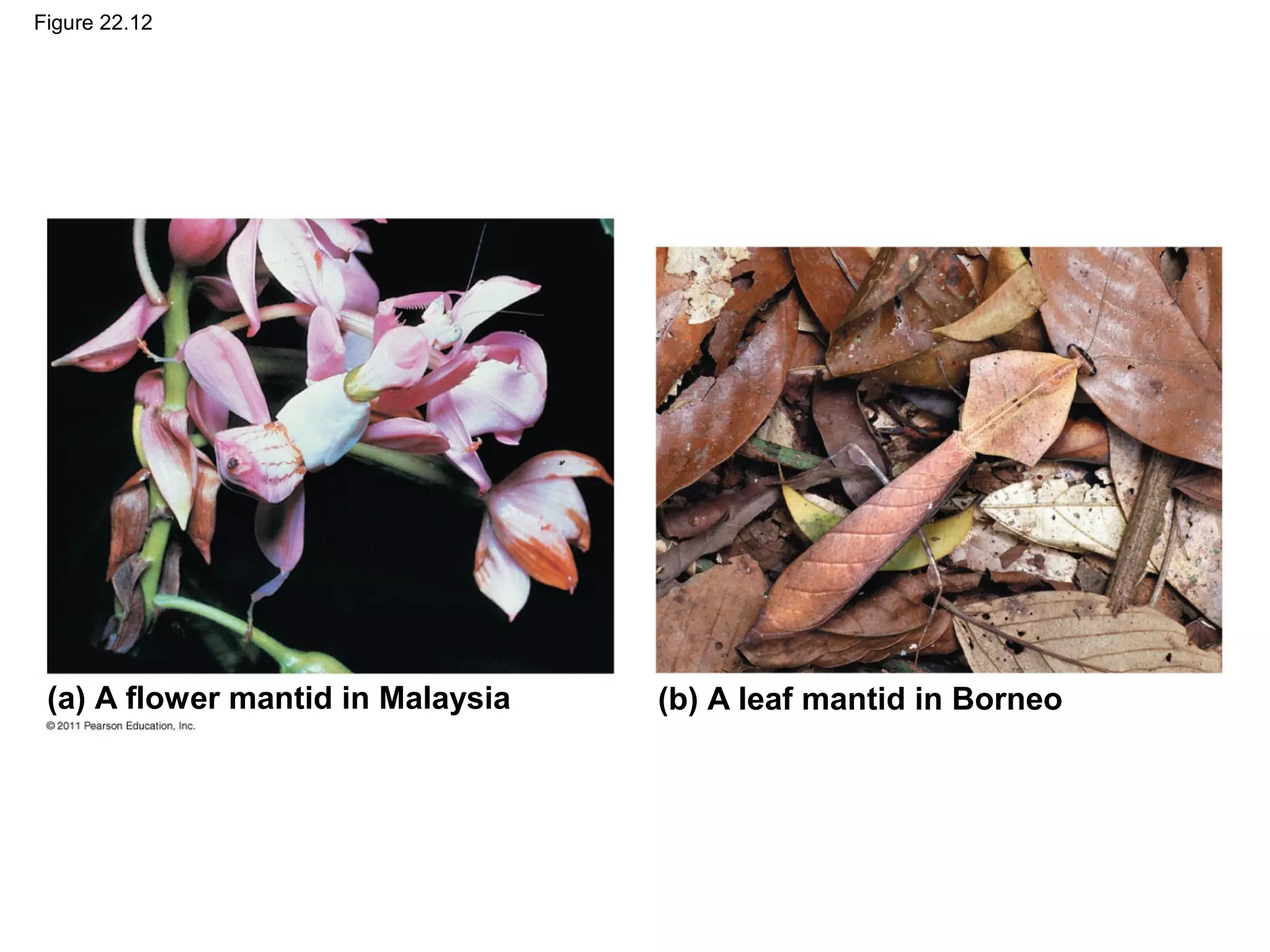
Figure 22.12
(a) A flower mantid in Malaysia (b) A leaf mantid in Borneo
• Note that individuals do not evolve;
populations evolve over time
• Natural selection can only increase or
decrease heritable traits that vary in a
population
• Adaptations vary with different environments
• Natural selection does not create new traits,
but edits or selects for traits already present in
the population
• The local environment determines which traits
will be selected for or selected against in any
specific population
© 2011 Pearson Education, Inc.
Evolution is supported by an overwhelming
amount of scientific evidence
• New discoveries continue to fill the gaps
identified by Darwin in The Origin of Species
© 2011 Pearson Education, Inc.
Homology
• Homology is similarity resulting from common
ancestry
© 2011 Pearson Education, Inc.
Anatomical Homologies
• Homologous structures are anatomical
resemblances that represent variations on a
structural theme present in a common ancestor
© 2011 Pearson Education, Inc.
Figure 22.15
Humerus
Radius
Ulna
Carpals
Metacarpals
Phalanges
Human Cat Whale Bat
• Comparative embryology reveals anatomical
homologies not visible in adult organisms
© 2011 Pearson Education, Inc.
Figure 22.16
Pharyngeal
pouches
Post-anal
tail
Chick embryo (LM) Human embryo
Molecular Homologies
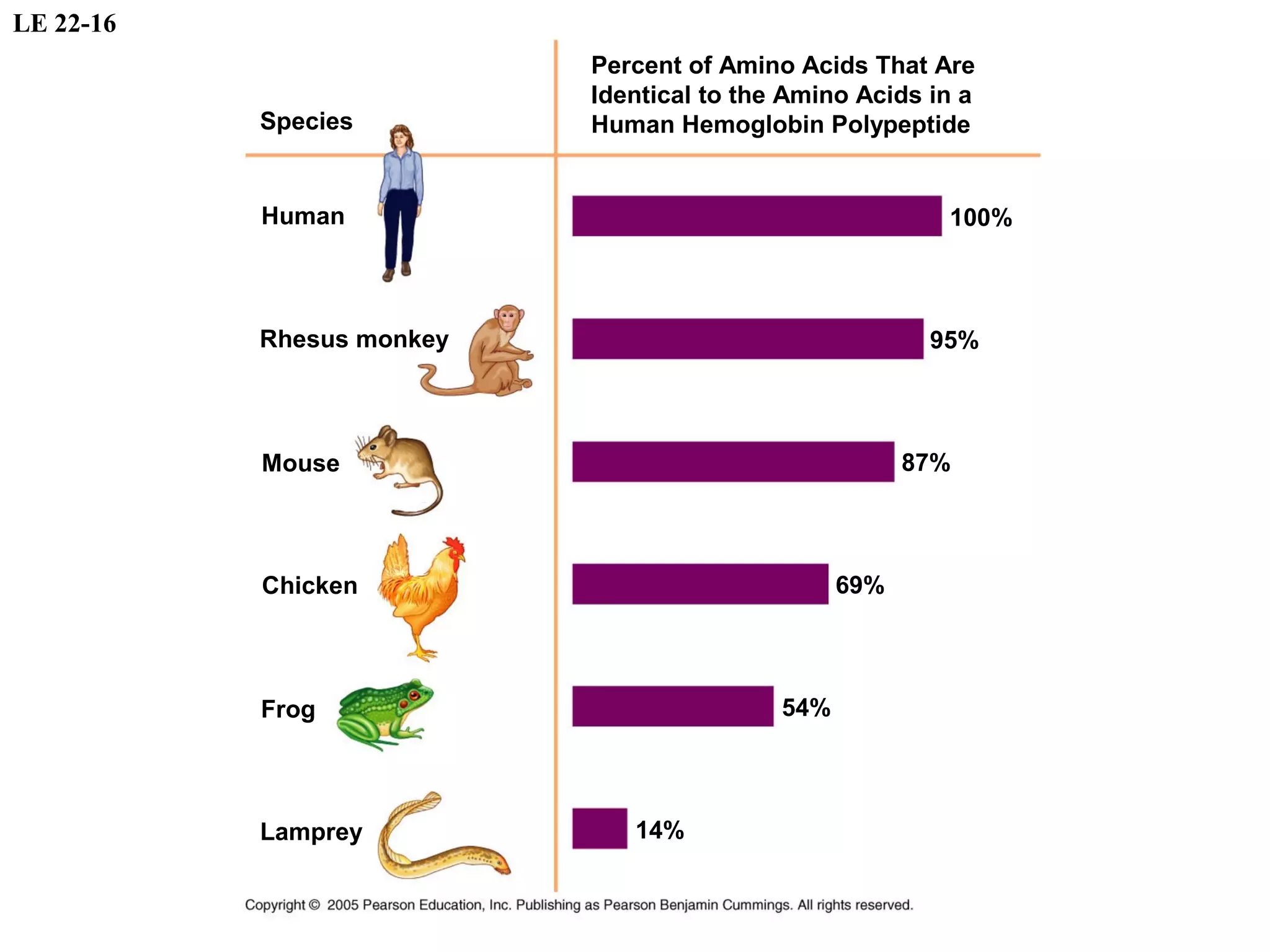
• Examples of homologies at the molecular
level are genes and proteins shared among
organisms inherited from a common ancestor
© 2011 Pearson Education, Inc.
LE 22-16
Percent of Amino Acids That Are
Identical to the Amino Acids in a
Human Hemoglobin Polypeptide
100%
95%
87%
69%
54%
14%
Rhesus monkey
Species
Human
Mouse
Chicken
Frog
Lamprey
A Different Cause of Resemblance:
Convergent Evolution
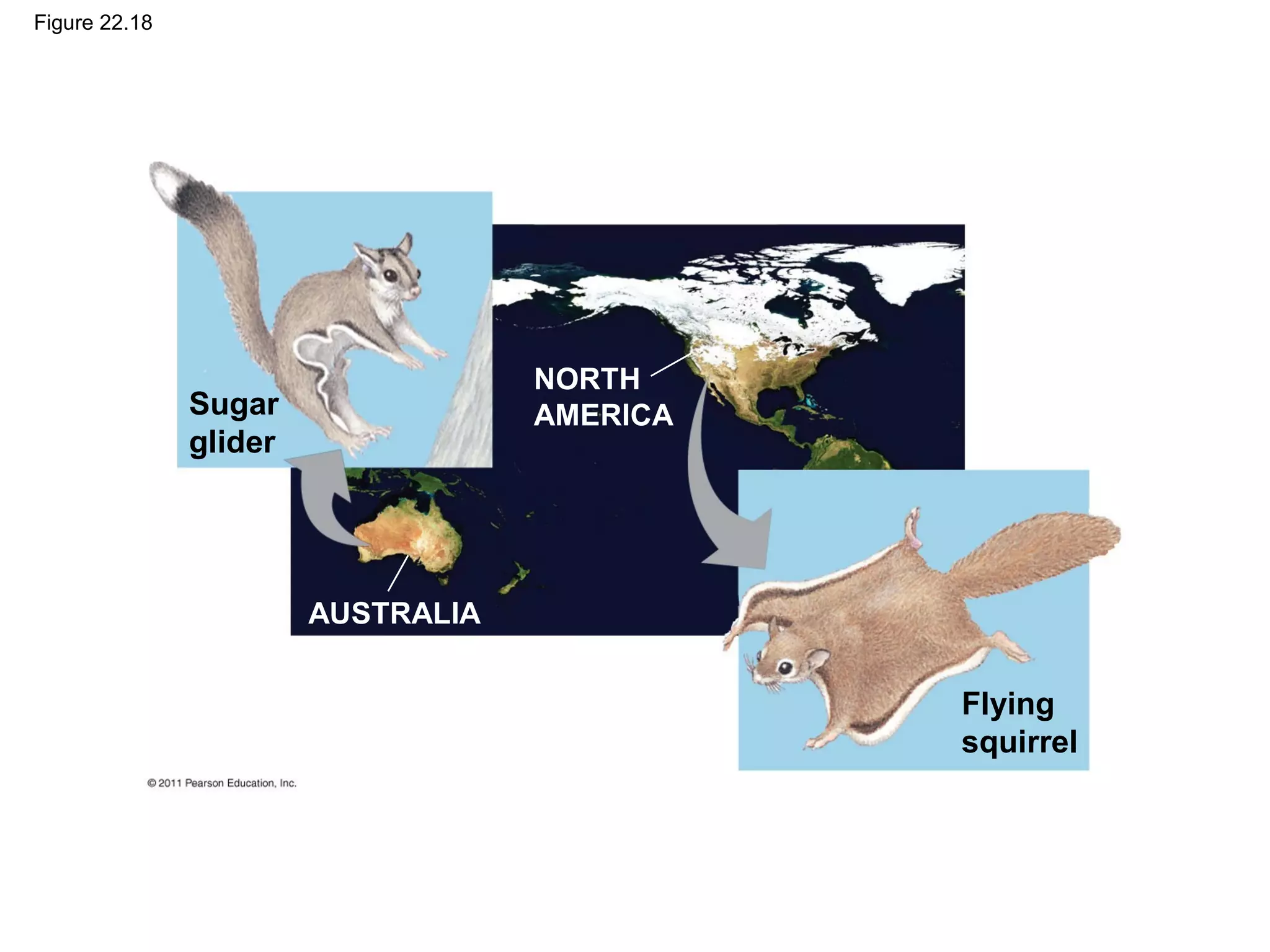
• Convergent evolution is the evolution of
similar, or analogous, features in distantly
related groups
• Analogous traits arise when groups
independently adapt to similar environments
in similar ways
• Convergent evolution does not provide
information about ancestry
© 2011 Pearson Education, Inc.
Figure 22.18
Sugar
glider
Flying
squirrel
NORTH
AMERICA
AUSTRALIA
The Fossil Record
• The fossil record provides evidence of the
extinction of species, the origin of new groups,
and changes within groups over time
© 2011 Pearson Education, Inc.
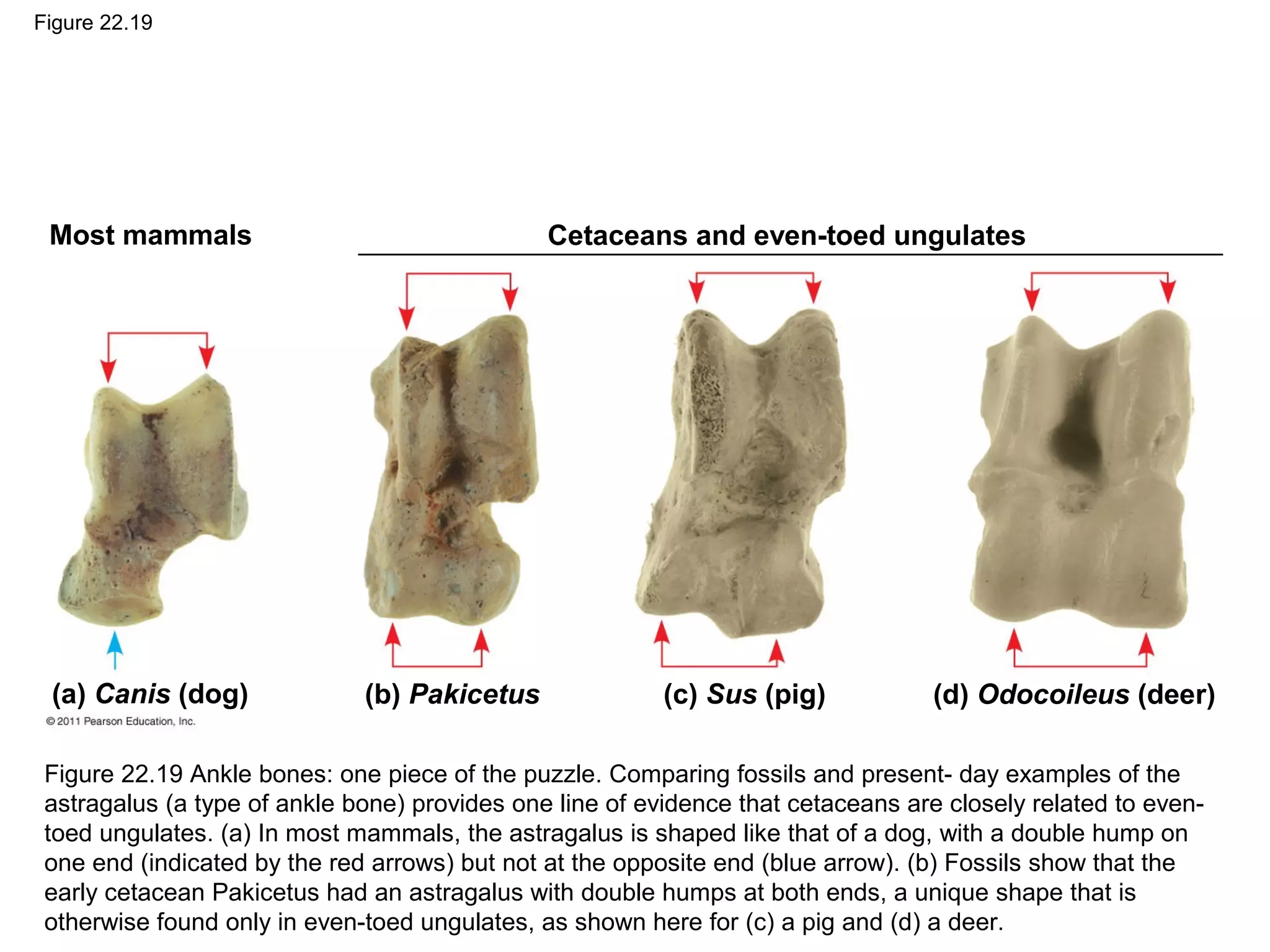
Figure 22.19
Most mammals Cetaceans and even-toed ungulates
(a) Canis (dog) (b) Pakicetus (c) Sus (pig) (d) Odocoileus (deer)
Figure 22.19 Ankle bones: one piece of the puzzle. Comparing fossils and present- day examples of the
astragalus (a type of ankle bone) provides one line of evidence that cetaceans are closely related to even-
toed ungulates. (a) In most mammals, the astragalus is shaped like that of a dog, with a double hump on
one end (indicated by the red arrows) but not at the opposite end (blue arrow). (b) Fossils show that the
early cetacean Pakicetus had an astragalus with double humps at both ends, a unique shape that is
otherwise found only in even-toed ungulates, as shown here for (c) a pig and (d) a deer.
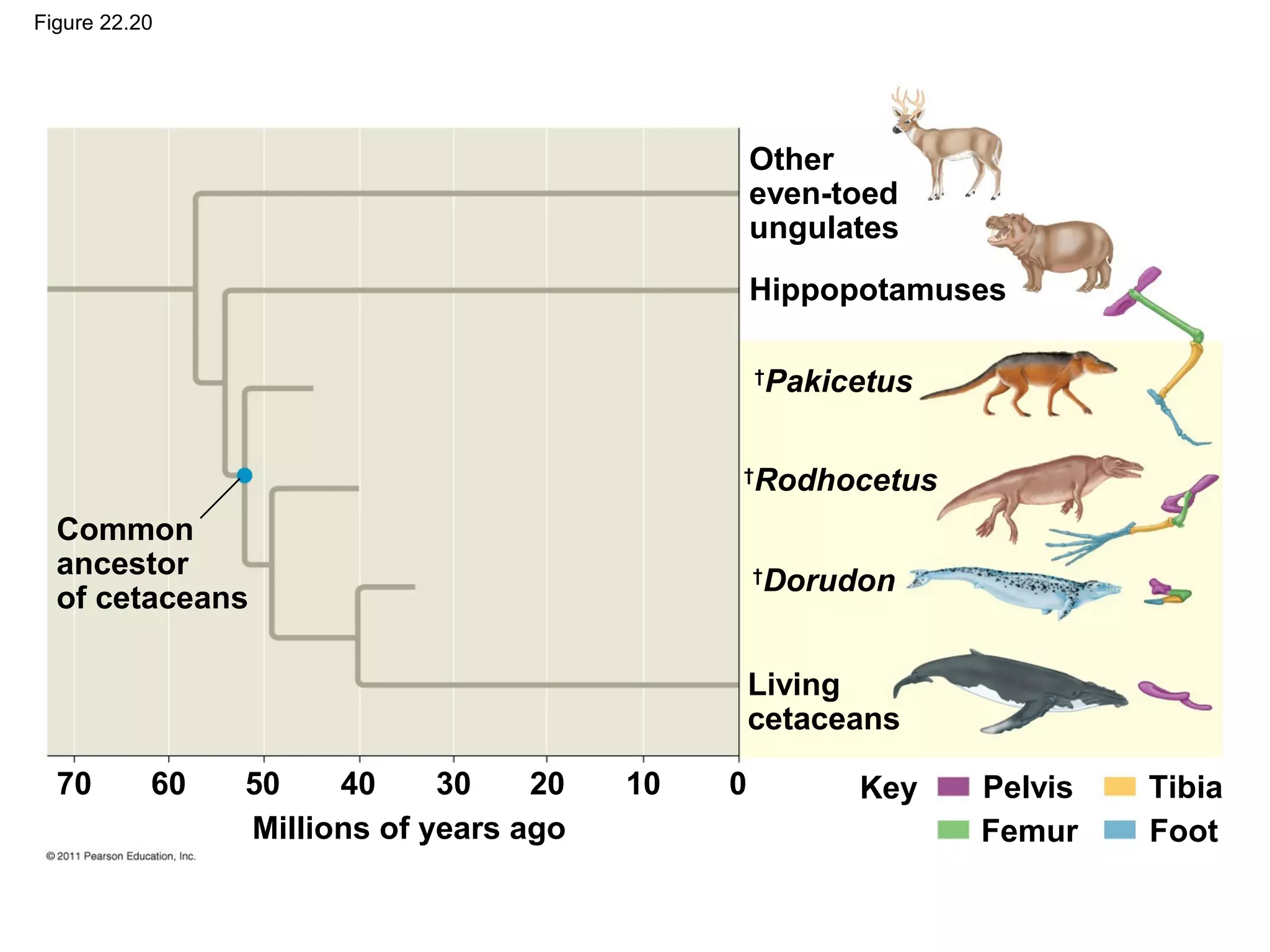
• Fossils can document important transitions
– For example, the transition from land to sea
in the ancestors of cetaceans
© 2011 Pearson Education, Inc.
Figure 22.20
Other
even-toed
ungulates
Hippopotamuses
†
Pakicetus
†
Rodhocetus
†
Dorudon
Living
cetaceans
Common
ancestor
of cetaceans
Millions of years ago
70 Key60 50 40 30 20 10 0 Pelvis Tibia
Femur Foot
Biogeography
• Biogeography, the geographic distribution of
species, provides evidence of evolution
• Earth’s continents were formerly united in a
single large continent called Pangaea, but have
since separated by continental drift
• An understanding of continent movement and
modern distribution of species allows us to
predict when and where different groups
evolved
• The Wallace Line is an example
© 2011 Pearson Education, Inc.

22 descent with modification a darwinian view

  • 1.
    LECTURE PRESENTATIONS For CAMPBELLBIOLOGY, NINTH EDITION Jane B. Reece, Lisa A. Urry, Michael L. Cain, Steven A. Wasserman, Peter V. Minorsky, Robert B. Jackson © 2011 Pearson Education, Inc. Lectures by Erin Barley Kathleen Fitzpatrick Descent with Modification: A Darwinian View of Life Chapter 22
  • 2.
    Overview: Endless FormsMost Beautiful • A new era of biology began in 1859 when Charles Darwin published The Origin of Species • The Origin of Species focused biologists’ attention on the great diversity of organisms © 2011 Pearson Education, Inc.
  • 3.
    • Darwin notedthat current species are descendants of ancestral species • Evolution can be defined by Darwin’s phrase descent with modification • Evolution can be viewed as both a pattern and a process © 2011 Pearson Education, Inc.
  • 4.
    • Darwin’s ideashad deep historical roots The Darwinian revolution challenged traditional views of a young Earth inhabited by unchanging species © 2011 Pearson Education, Inc.
  • 5.
    1809 1798 1812 1795 1830 1790 1809 1831−36 1844 1859 1870 Lamarck publisheshis hypothesis of evolution. Malthus publishes “Essay on the Principle of Population.” Hutton proposes his principle of gradualism. Charles Darwin is born. Darwin travels around the world on HMS Beagle. The Galápagos Islands Darwin writes his essay on descent with modification. On the Origin of Species is published. While studying species in the Malay Archipelago, Wallace sends Darwin his hypothesis of natural selection. 1858Cuvier publishes his extensive studies of vertebrate fossils. Lyell publishes Principles of Geology. Figure 22.2
  • 6.
    Scala Naturae andClassification of Species • The Greek philosopher Aristotle viewed species as fixed and arranged them on a scala naturae • The Old Testament holds that species were individually designed by God and therefore perfect © 2011 Pearson Education, Inc.
  • 7.
    • Carolus Linnaeusinterpreted organismal adaptations as evidence that the Creator had designed each species for a specific purpose • Linnaeus was the founder of taxonomy, the branch of biology concerned with classifying organisms • He developed the binomial format for naming species (for example, Homo sapiens) © 2011 Pearson Education, Inc.
  • 8.
    Ideas About Changeover Time • The study of fossils helped to lay the groundwork for Darwin’s ideas • Fossils are remains or traces of organisms from the past, usually found in sedimentary rock, which appears in layers or strata © 2011 Pearson Education, Inc.
  • 9.
    Figure 22.3 Sedimentary rock layers(strata) Younger stratum with more recent fossils Older stratum with older fossils
  • 10.
    • Paleontology, thestudy of fossils, was largely developed by French scientist Georges Cuvier • Cuvier advocated catastrophism, speculating from the fossil record that extinctions must have been a common occurrence in the past and were caused by catastrophes • Periodic catastrophes occurred in local areas, which were later repopulated by different species immigrating from other areas © 2011 Pearson Education, Inc.
  • 11.
    • Geologists JamesHutton and Charles Lyell perceived that changes in Earth’s surface can result from slow continuous actions still operating today, a theory called gradualism • Lyell’s principle of uniformitarianism states that the mechanisms of change are constant over time • These views strongly influenced Darwin’s thinking © 2011 Pearson Education, Inc.
  • 12.
    Lamarck’s Hypothesis ofEvolution • Lamarck hypothesized that species evolve through use and disuse of body parts and the inheritance of acquired characteristics • The mechanisms he proposed are unsupported by evidence • However, he did propose the first theory of evolution in 1809, the year Darwin was born © 2011 Pearson Education, Inc.
  • 13.
  • 14.
    • Some doubtabout the permanence of species preceded Darwin’s ideas Descent with modification by natural selection explains the adaptations of organisms and the unity and diversity of life © 2011 Pearson Education, Inc.
  • 15.
    Darwin’s Research • Asa boy and into adulthood, Charles Darwin had a consuming interest in nature • Darwin first studied medicine (unsuccessfully), and then theology at Cambridge University • After graduating, he took an unpaid position as naturalist and companion to Captain Robert FitzRoy for a 5-year around the world voyage on the Beagle © 2011 Pearson Education, Inc.
  • 16.
    The Voyage ofthe Beagle • During his travels on the Beagle, Darwin collected specimens of South American plants and animals • He observed that fossils resembled living species from the same region, and living species resembled other species from nearby regions • He experienced an earthquake in Chile and observed the uplift of rocks © 2011 Pearson Education, Inc.
  • 17.
    • Darwin wasinfluenced by Lyell’s Principles of Geology and thought that the earth was more than 6000 years old • His interest in geographic distribution of species was kindled by a stop at the Galápagos Islands west of South America • He hypothesized that species from South America had colonized the Galápagos and speciated on the islands © 2011 Pearson Education, Inc.
  • 18.
    Figure 22.5 Darwin in1840, after his return from the voyage The Galápagos Islands NORTH AMERICA ATLANTIC OCEAN PACIFIC OCEAN PACIFIC OCEAN Pinta Marchena Genovesa Equator Chile Santiago Daphne Islands Fernandina Isabela Santa Cruz Santa Fe San Cristobal Española Kilometers 0 20 40 Florenza Pinzón SOUTH AMERICA AFRICA EUROPE Great Britain HMS Beagle in port Equator PACIFIC OCEAN Malay Archipelago AUSTRALIA Tasmania New Zealand Brazil Argentina Cape Horn AndesMtns. Cape of Good Hope
  • 19.
    Darwin’s Focus onAdaptation • In reassessing his observations, Darwin perceived adaptation to the environment and the origin of new species as closely related processes • From studies made years after Darwin’s voyage, biologists have concluded that this is what happened to the Galápagos finches © 2011 Pearson Education, Inc.
  • 20.
    Figure 22.6 Cactus eater.The long, sharp beak of the cactus ground finch (Geospiza scandens) helps it tear and eat cactus flowers and pulp. Insect eater. The green warbler finch (Certhidea olivacea) uses its narrow, pointed beak to grasp insects. Seed eater. The large ground finch (Geospiza magnirostris) has a large beak adapted for cracking seeds that fall from plants to the ground.
  • 21.
    • In 1844,Darwin wrote an essay on natural selection as the mechanism of descent with modification, but did not introduce his theory publicly • Natural selection is a process in which individuals with favorable inherited traits are more likely to survive and reproduce • In June 1858, Darwin received a manuscript from Alfred Russell Wallace, who had developed a theory of natural selection similar to Darwin’s • Darwin quickly finished The Origin of Species and published it the next year © 2011 Pearson Education, Inc.
  • 22.
    The Origin ofSpecies • Darwin explained three broad observations: – The unity of life – The diversity of life – The match between organisms and their environment © 2011 Pearson Education, Inc.
  • 23.
    Descent with Modification •Darwin never used the word evolution in the first edition of The Origin of Species • The phrase descent with modification summarized Darwin’s perception of the unity of life • The phrase refers to the view that all organisms are related through descent from an ancestor that lived in the remote past © 2011 Pearson Education, Inc.
  • 24.
    • In theDarwinian view, the history of life is like a tree with branches representing life’s diversity • Darwin’s theory meshed well with the hierarchy of Linnaeus © 2011 Pearson Education, Inc.
  • 25.
  • 26.
    Figure 22.8 Hyracoidea (Hyraxes) Sirenia (Manatees and relatives) † Deinotherium † Mammut † Platybelodon † Stegodon † Mammuthus Elephasmaximus (Asia) Loxodonta africana (Africa) Loxodonta cyclotis (Africa) † Moeritherium † Barytherium 60 Millions of years ago 34 24 5.5 2104 0 Years ago
  • 27.
    Natural Selection andAdaptation • Evolutionary biologist Ernst Mayr has dissected the logic of Darwin’s theory into three inferences based on five observations
  • 28.
    • Observation #1:For any species, population sizes would increase exponentially if all individuals that are born reproduced successfully • Observation #2: Populations tend to be stable in size, except for seasonal fluctuations • Observation #3: Resources are limited • Inference #1: Production of more individuals than the environment can support leads to a struggle for existence among individuals of a population, with only a fraction of their offspring surviving
  • 29.
    • Observation #4:Members of a population vary extensively in their characteristics; no two individuals are exactly alike
  • 31.
    • Observation #5:Much of this variation is heritable • Inference #2: Survival depends in part on inherited traits; individuals whose inherited traits give them a high probability of surviving and reproducing are likely to leave more offspring than other individuals • Inference #3: This unequal ability of individuals to survive and reproduce will lead to a gradual change in a population, with favorable characteristics accumulating over generations
  • 32.
    Artificial Selection, NaturalSelection, and Adaptation • Darwin noted that humans have modified other species by selecting and breeding individuals with desired traits, a process called artificial selection © 2011 Pearson Education, Inc.
  • 33.
    Figure 22.9 Brussels sprouts Kale Selection for leaves Selectionfor axillary (side) buds Selection for apical (tip) bud Cabbage Broccoli KohlrabiWild mustard Selection for stems Selection for flowers and stems
  • 34.
    • Darwin wasinfluenced by Thomas Malthus, who noted the potential for human population to increase faster than food supplies and other resources • If some heritable traits are advantageous, these will accumulate in a population over time, and this will increase the frequency of individuals with these traits • This process explains the match between organisms and their environment © 2011 Pearson Education, Inc.
  • 35.
    Natural Selection: ASummary • Individuals with certain heritable characteristics survive and reproduce at a higher rate than other individuals • Natural selection increases the adaptation of organisms to their environment over time • If an environment changes over time, natural selection may result in adaptation to these new conditions and may give rise to new species © 2011 Pearson Education, Inc.
  • 36.
    Figure 22.12 (a) Aflower mantid in Malaysia (b) A leaf mantid in Borneo
  • 37.
    • Note thatindividuals do not evolve; populations evolve over time • Natural selection can only increase or decrease heritable traits that vary in a population • Adaptations vary with different environments • Natural selection does not create new traits, but edits or selects for traits already present in the population • The local environment determines which traits will be selected for or selected against in any specific population © 2011 Pearson Education, Inc.
  • 38.
    Evolution is supportedby an overwhelming amount of scientific evidence • New discoveries continue to fill the gaps identified by Darwin in The Origin of Species © 2011 Pearson Education, Inc.
  • 39.
    Homology • Homology issimilarity resulting from common ancestry © 2011 Pearson Education, Inc.
  • 40.
    Anatomical Homologies • Homologousstructures are anatomical resemblances that represent variations on a structural theme present in a common ancestor © 2011 Pearson Education, Inc.
  • 41.
  • 42.
    • Comparative embryologyreveals anatomical homologies not visible in adult organisms © 2011 Pearson Education, Inc.
  • 43.
  • 44.
    Molecular Homologies • Examplesof homologies at the molecular level are genes and proteins shared among organisms inherited from a common ancestor © 2011 Pearson Education, Inc.
  • 45.
    LE 22-16 Percent ofAmino Acids That Are Identical to the Amino Acids in a Human Hemoglobin Polypeptide 100% 95% 87% 69% 54% 14% Rhesus monkey Species Human Mouse Chicken Frog Lamprey
  • 46.
    A Different Causeof Resemblance: Convergent Evolution • Convergent evolution is the evolution of similar, or analogous, features in distantly related groups • Analogous traits arise when groups independently adapt to similar environments in similar ways • Convergent evolution does not provide information about ancestry © 2011 Pearson Education, Inc.
  • 47.
  • 48.
    The Fossil Record •The fossil record provides evidence of the extinction of species, the origin of new groups, and changes within groups over time © 2011 Pearson Education, Inc.
  • 49.
    Figure 22.19 Most mammalsCetaceans and even-toed ungulates (a) Canis (dog) (b) Pakicetus (c) Sus (pig) (d) Odocoileus (deer) Figure 22.19 Ankle bones: one piece of the puzzle. Comparing fossils and present- day examples of the astragalus (a type of ankle bone) provides one line of evidence that cetaceans are closely related to even- toed ungulates. (a) In most mammals, the astragalus is shaped like that of a dog, with a double hump on one end (indicated by the red arrows) but not at the opposite end (blue arrow). (b) Fossils show that the early cetacean Pakicetus had an astragalus with double humps at both ends, a unique shape that is otherwise found only in even-toed ungulates, as shown here for (c) a pig and (d) a deer.
  • 50.
    • Fossils candocument important transitions – For example, the transition from land to sea in the ancestors of cetaceans © 2011 Pearson Education, Inc.
  • 51.
  • 52.
    Biogeography • Biogeography, thegeographic distribution of species, provides evidence of evolution • Earth’s continents were formerly united in a single large continent called Pangaea, but have since separated by continental drift • An understanding of continent movement and modern distribution of species allows us to predict when and where different groups evolved • The Wallace Line is an example © 2011 Pearson Education, Inc.

Editor's Notes

  • #6 Figure 22.2 The intellectual context of Darwin ’s ideas.
  • #10 Figure 22.3 Formation of sedimentary strata with fossils.
  • #14 Figure 22.4 Acquired traits cannot be inherited.
  • #19 Figure 22.5 The voyage of HMS Beagle.
  • #21 Figure 22.6 Three examples of beak variation in Galápagos finches.
  • #26 Figure 22.7 “I think. . .”
  • #27 Figure 22.8 Descent with modification.
  • #34 Figure 22.9 Artificial selection.
  • #37 Figure 22.12 Camouflage as an example of evolutionary adaptation.
  • #42 Figure 22.15 Mammalian forelimbs: homologous structures.
  • #44 Figure 22.16 Anatomical similarities in vertebrate embryos.
  • #48 Figure 22.18 Convergent evolution.
  • #50 Figure 22.19 Ankle bones: one piece of the puzzle.
  • #52 Figure 22.20 The transition to life in the sea.