Community Ecology
Done by :Sumaiah alghamdi
Submitted to :
Dr. Mai Elobeid
Content
• Introduction & definitions
• The characteristics Of Communities
• Elements Of Communities
• Size & Structure Of Communities
• Patterns Of Community Structure
(Succession)
• Species interactions
• Species interactions types
• References
Introduction & definitions
• Community ecology, study of the
organization and functioning of communities,
which are assemblages of interacting
populations of the species living within a
particular area or habitat.
• Community ecology represents the population
of all species living and interacting in an area at
a particular time.
Introduction & definitions
• Each community has its special limit. Sometimes
the boundary between two communities may be
very sharp or gradual.
• The transitional zone or junction between two or
more diverse communities is called ā€œecotoneā€.
The ecotone harbors a community termed
ecotonal community with organisms of
overlapping communities and some of unique
types.
The characteristics of
communities
• Each biotic community exhibits a number of characteristics,
such as diversity, density, dominance, composition and
stratification.
1)Species Diversity : A biotic community has producer,
consumer & decomposer. Within these species diversities,
some populations influenced more than others in the
community because the share a higher % of energy flow.
2)Growth & Structure: Community is usually described in term
of growth forms.
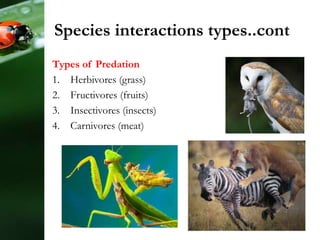
3) Dominance
In each community, one or a few species dominate either
in numbers or in physical characteristics or both over the
other species. The dominant species are called 'Ecological
dominants .
4) Successions
Succession is very important in development of
community. Community develops as a result of directional
change in it with time.
The characteristics of
communities…cont
5) Trophic levels
There are 3 broad trophic levels in a community which are
Producers, Consumers & Decomposers. The food
produced by the green plants is consumed directly or
indirectly by all kinds of animals. So these are known as
Consumers.
• The dead bodies & excreta of both producers &
consumers are decomposed by microbes into simple
substances, these are called the Decomposers of the
community
The characteristics of
communities…cont
Elements Of Communities
Trophic pyramids and the flow of energy Autotrophs and
heterotrophs
All biological communities have a basic structure of interaction
that forms a trophic pyramid.
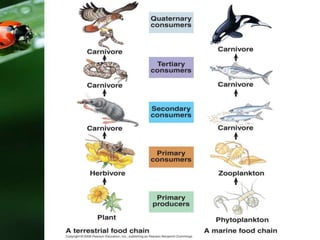
• The trophic pyramid is made up of trophic levels, and food
energy is passed from one level to the next along the food
chain .
• The base of the pyramid is composed of species called
autotrophs, the primary producers of the ecosystem. They
harness solar energy by photosynthesis to make organic
substances from inorganic ones.
• All other organisms in the ecosystem are consumers called
heterotrophs, which either directly or indirectly depend on
the producers for food energy.
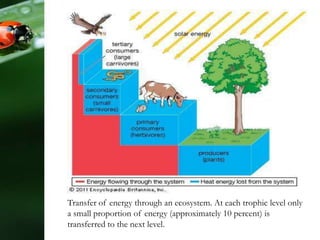
• Within all biological communities, energy at each trophic level
is lost in the form of heat (as much as 80 to 90 percent), as
organisms expend energy for metabolic processes such as
staying warm and digesting food.
• The higher the organism is on the trophic pyramid, the less
energy is available to it; herbivores and detritivores (primary
consumers) have less available energy than plants, and the
carnivores that feed on herbivores and detritivores
(secondary consumers) and those that eat other carnivores
(tertiary consumers) have the least amount of available
energy.
Elements Of Communities
…cont
Elements Of Communities
…cont
The pyramid structure of communities
• The organisms that make up the base level of the
pyramid vary from community to community.
• In terrestrial communities, multicellular plants generally
form the base of the pyramid, whereas in freshwater
lakes a combination of multicellular plants and single-
celled algae constitute the first trophic level
• The trophic structure of the ocean is built on the
phytoplankton
Transfer of energy through an ecosystem. At each trophic level only
a small proportion of energy (approximately 10 percent) is
transferred to the next level.
Elements Of Communities
…cont
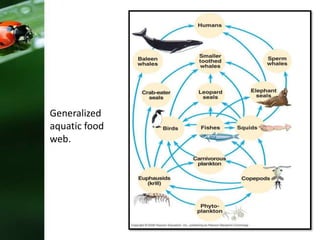
• Food chains and food webs
• Because all species are specialized in their diets, each trophic
pyramid is made up of a series of interconnected feeding
relationships called food chains.
• Species can be grouped according to where in the community
they obtain their food, and groups can be linked together
by food chain, where each link comprises a
different trophic level.
• Food chains combine into highly complex food webs. Even a
simplified food web can show a complicated network of
trophic relationships.
Generalized
aquatic food
web.
Elements Of Communities
…cont
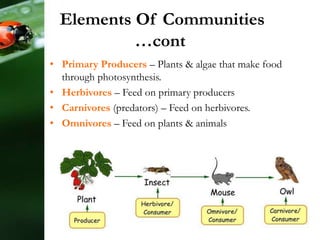
• Primary Producers – Plants & algae that make food
through photosynthesis.
• Herbivores – Feed on primary producers
• Carnivores (predators) – Feed on herbivores.
• Omnivores – Feed on plants & animals
Size & Structure Of Communities
• Size :
• Communities may be small, consisting a few
species populations in a small space, or large,
comprising several species populations in a large
area. Larger once extend over areas of several
thousands of square kms , as forests, other such
as deserts etc.
• Very small sized communities are the groups of
microbes in such micro habitats as leaf surface,
fallen log, litter, soil etc.
Size & Structure Of Communities
Structure:
• The community structures, composition and other
characteristics can be readily described by visual
observation without actual measurement.
• Communities usually categories by the ecologists in
various ways primarily based of habitat features like
water availability, high exposure of light , or other habitat
features.
• For example , depending on the amount of water
availability, plant communities may be hydrophytic
(aquatic habitats), mesophytic (moderately moist soil
habitat) and xerophytic (dry or arid habitat).
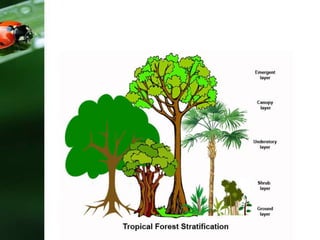
Spatial
the way of ultimate distribution of species relative to each
other. In a particular habitat shared by several species,
each of the species is usually confined to its own
microhabitat or spatial.
For example
the tropical forest trees are stratified into several different
levels ,each level is the habitat of distinct collection of
species
Size & Structure Of
Communities…cont
Temporal
is the timing of appearance and activity of species. These
species Called temporal species
For example
many desert plants and animals are dormant most of the
year. they emerge or germinate in response to seasonal
rains . other plants stick around year around , having
evolved adaptation to resist drought
Size & Structure Of
Communities…cont
Size & Structure Of
Communities…cont
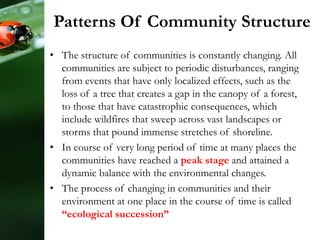
Scale: is the size of a community. provided that the area or
habitat is well defined, a community can be a system of
almost any size, from a drop of water, to a rotting log, to
a forest, to the surface of the Pacific Ocean.
Patterns Of Community Structure
• The structure of communities is constantly changing. All
communities are subject to periodic disturbances, ranging
from events that have only localized effects, such as the
loss of a tree that creates a gap in the canopy of a forest,
to those that have catastrophic consequences, which
include wildfires that sweep across vast landscapes or
storms that pound immense stretches of shoreline.
• In course of very long period of time at many places the
communities have reached a peak stage and attained a
dynamic balance with the environmental changes.
• The process of changing in communities and their
environment at one place in the course of time is called
ā€œecological successionā€
Patterns Of Community Structure
• Succession occurs in predictable stages , at each stage
different species plants and animals may be present
• As succession progresses ,new organisms move in ,
Others may die or move out
• The first species to take hold in an area called Pioneer
species
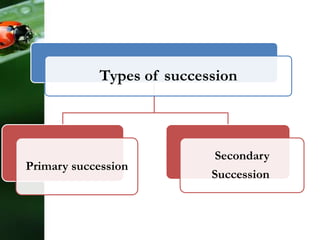
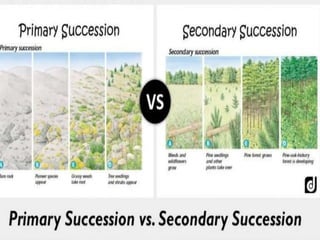
Types of succession
• There are two types of succession have been
distinguished.
Primary and secondary succession
Types of succession
Primary succession
Secondary
Succession
Patterns Of Community Structure
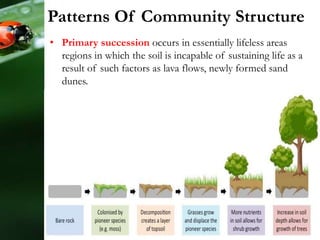
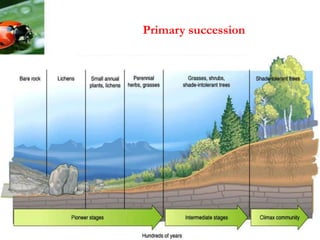
• Primary succession occurs in essentially lifeless areas
regions in which the soil is incapable of sustaining life as a
result of such factors as lava flows, newly formed sand
dunes.
Primary succession
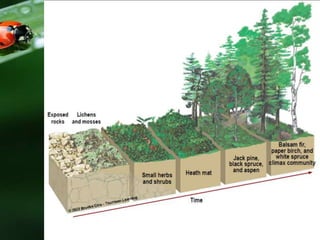
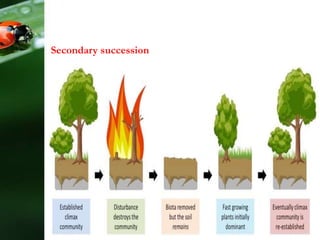
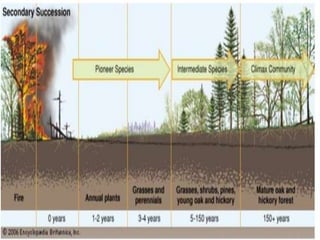
• Secondary succession occurs in areas where a community
that previously existed but has been removed by such as a
fire or a storm which create patches of habitat that are
colonized by early successional species.
• Depending on the extent of the disturbance, some species
may survive, and other species may be recolonized from
nearby habitats, .
• For example, many plant species in fire-prone
environments have seeds that remain dormant within the
soil until the heat of a fire stimulates them to germinate
Patterns Of Community Structure
Secondary succession
Patterns Of Community Structure
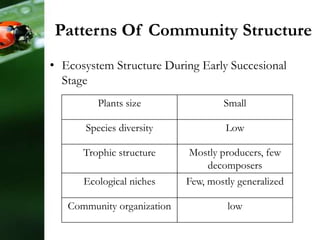
• Ecosystem Structure During Early Succesional
Stage
SmallPlants size
LowSpecies diversity
Mostly producers, few
decomposers
Trophic structure
Few, mostly generalizedEcological niches
lowCommunity organization
• The process of succession
• The sequential progression of species during succession is
not random. At every stage certain species have evolved life
histories to exploit the particular conditions of the
community.
• Initially only a small number of species from surrounding
habitats are capable of thriving in a disturbed habitat.
• As new plant species take hold, they modify the habitat by
altering such things as the amount of shade on the ground or
the mineral composition of the soil.
• These changes allow other species that are better suited to
this modified habitat to succeed the old species. These newer
species are superseded, in turn, by still newer species. A
similar succession of animal species occurs, and interactions
between plants, animals, and environment influence the
pattern and rate of successional change..
Patterns Of Community Structure
Community equilibrium and species diversity
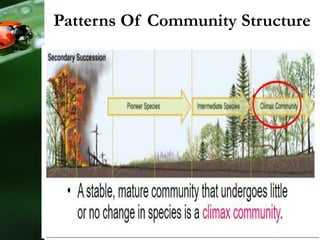
• In some environments, succession reaches a climax,
producing a stable community dominated by a small number
of prominent species. This state of equilibrium, called the
climax community, is thought to result when the web of
biotic interactions becomes so intricate that no other species
can be admitted.
• Diverse communities are healthy communities. Long-term
ecological studies have shown that species-rich communities
are able to recover faster from disturbances than species-poor
communities.
• The relationship between species diversity and community
stability highlights the need to maintain the greatest richness
possible within biological communities.
Patterns Of Community Structure
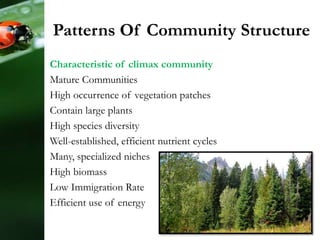
Characteristic of climax community
Mature Communities
High occurrence of vegetation patches
Contain large plants
High species diversity
Well-established, efficient nutrient cycles
Many, specialized niches
High biomass
Low Immigration Rate
Efficient use of energy
Species interactions
• Structures arise within communities as species interact,
and food chains, food webs and other interactive webs
are created.
• As populations of species interact with one another, they
form biological communities. The number of interacting
species in these communities and the complexity of their
relationships exemplify what is meant by the term
ā€œbiodiversity.ā€
Interspecific Interactions And The Organization Of
Communities
• The interactive relationships that arise between populations
of different species form the interactive web of
communities.
• These interactions range from antagonistic to cooperative
and have either positive, negative, or neutral effects on the
species involved.
• In antagonistic relationships the interaction is harm to
individuals of either one or both species.
• In commensal relationships (commensalism) one species
benefits while the other remains unaffected; and in
mutualistic relationships (mutualism) both species benefit.
Species interactions…cont
• The organization and stability of biological communities
results from the mix of the different kinds of interaction.
• These relationships between species are not static; they
are a part of the ongoing process of the evolution of
interactions.
• As interactions between species evolve, relationships may
shift from antagonism to commensalism to mutualism. As
a result, the organization of biological communities is no
more fixed than are the characteristics of the species or
their environments.
Species interactions types
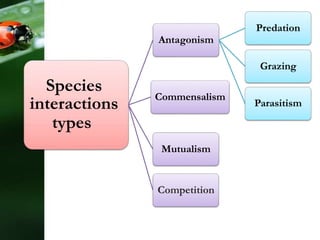
• There are four major types of species interactions.
The four types of species interactions are:
1) antagonism
a) Predation
b) Parasitism
c) Grazing
2) Competition
3) Mutualism
4) Commensalism
Species
interactions
types
Antagonism
Predation
Grazing
Parasitism
Commensalism
Mutualism
Competition
Species interactions types…cont
1) Antagonism
• Although mutualisms are common in all biological
communities, they occur side by side with a wide array of
antagonistic interactions
• One way of understanding the diversity of antagonistic
interactions is through the kinds of hosts or prey that
species attack. Carnivores attack animals, herbivores attack
plants, and fungivores attack fungi. Other species are
omnivorous, attacking a wide range of plants, animals, and
fungi.
• Regardless of the kinds of foods they eat, however, there are
some general patterns in which species interact. Parasitism,
grazing, and predation are the three major ways in which
species feed on one another. .
Species interactions types..cont
a) Predation is a biological interaction where a
predator (an organism, often an animal) kills and eats its
prey (another organism). Predators are adapted and
often highly specialized for hunting.
Specialization in predation
Most predators attack more than one prey species.
Nevertheless, there are some ecological conditions that
have permitted the evolution of highly specialized
predators that attack only a few prey species.
Types of Predation
1. Herbivores (grass)
2. Fructivores (fruits)
3. Insectivores (insects)
4. Carnivores (meat)
Species interactions types..cont
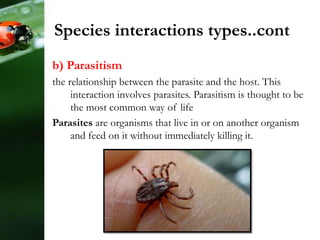
b) Parasitism
the relationship between the parasite and the host. This
interaction involves parasites. Parasitism is thought to be
the most common way of life
Parasites are organisms that live in or on another organism
and feed on it without immediately killing it.
Species interactions types..cont
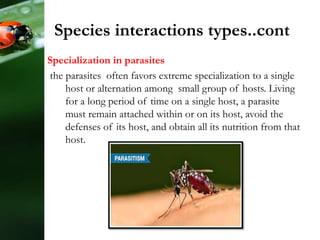
Specialization in parasites
the parasites often favors extreme specialization to a single
host or alternation among small group of hosts. Living
for a long period of time on a single host, a parasite
must remain attached within or on its host, avoid the
defenses of its host, and obtain all its nutrition from that
host.
Species interactions types..cont
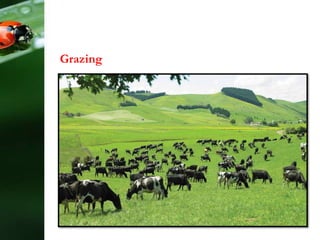
c) Grazing
• Is a method of feeding in which a herbivore feeds on
plants such as grasses, or other multicellular organisms
such as algae.
• Grazing differs from true predation because the organism
being grazed upon is not generally killed.
• Grazing differs from parasitism as the two organisms live
together in a constant state of physical externality
Grazing
2) Competition
• Competition is a powerful form of interaction in the
organization of communities, but it differs from other
interactions in that no species benefits from the
interaction.
• In competitive interactions, species evolve either to avoid
each other, to tolerate the presence of the other, or to
aggressively exclude the other.
Species interactions types..cont
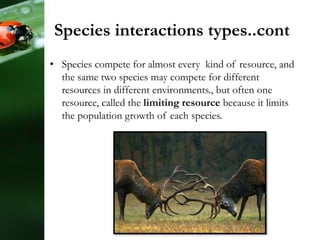
• Species compete for almost every kind of resource, and
the same two species may compete for different
resources in different environments., but often one
resource, called the limiting resource because it limits
the population growth of each species.
Species interactions types..cont
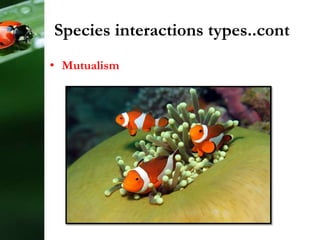
3) Mutualism
a cooperative partnership between two species in which both
species benefit where is one species acts as the host, and the
other plays the role of visitor or resident. Such as Plants are
hosts for insects that pollinate them or eat their fruit and for
microorganisms that attach themselves to their roots.
The pervasiveness of mutualism
Some mutualistic relationships are so pervasive that they affect
almost all life-forms. . Mutualistic associations between
animals and microorganisms are equally important to the
structure of communities.
Species interactions types..cont
• Mutualism
4) Commensalism
Commensalism benefits one organism and the other
organism is neither benefited nor harmed. It occurs
when one organism takes benefits by interacting with
another organism by which the host organism is not
affected.
The commensal organism may depend on its host for food,
shelter, support, transport, or a combination of these.
Species interactions types..cont
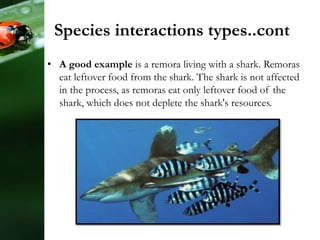
• A good example is a remora living with a shark. Remoras
eat leftover food from the shark. The shark is not affected
in the process, as remoras eat only leftover food of the
shark, which does not deplete the shark's resources.
Species interactions types..cont
References
• http://www.biologydiscussion.com/ecology/community/com
munity-definition-concept-structure-ecology/70721
• https://www.britannica.com/science/community-
ecology/Effect-on-community-structure
• https://socratic.org/questions
• http://ib.bioninja.com.au/options/option-c-ecology-and-
conser/c2-communities-and-ecosyste/ecological-
disturbance.html
• https://slideplayer.com/slide/9961964/
• https://quizlet.com/63795456/
• https://www.nap.edu/read/13393/chapter/4#37
• Legendre, P.; Fortin, M.-J. (1989). "Spatial pattern and
ecological analysis". Plant Ecology. 80 (2): 107–
138. doi:10.1007/BF00048036.
Community ecology
Community ecology

Community ecology

  • 1.
    Community Ecology Done by:Sumaiah alghamdi Submitted to : Dr. Mai Elobeid
  • 2.
    Content • Introduction &definitions • The characteristics Of Communities • Elements Of Communities • Size & Structure Of Communities • Patterns Of Community Structure (Succession) • Species interactions • Species interactions types • References
  • 3.
    Introduction & definitions •Community ecology, study of the organization and functioning of communities, which are assemblages of interacting populations of the species living within a particular area or habitat. • Community ecology represents the population of all species living and interacting in an area at a particular time.
  • 4.
    Introduction & definitions •Each community has its special limit. Sometimes the boundary between two communities may be very sharp or gradual. • The transitional zone or junction between two or more diverse communities is called ā€œecotoneā€. The ecotone harbors a community termed ecotonal community with organisms of overlapping communities and some of unique types.
  • 5.
    The characteristics of communities •Each biotic community exhibits a number of characteristics, such as diversity, density, dominance, composition and stratification. 1)Species Diversity : A biotic community has producer, consumer & decomposer. Within these species diversities, some populations influenced more than others in the community because the share a higher % of energy flow. 2)Growth & Structure: Community is usually described in term of growth forms.
  • 6.
    3) Dominance In eachcommunity, one or a few species dominate either in numbers or in physical characteristics or both over the other species. The dominant species are called 'Ecological dominants . 4) Successions Succession is very important in development of community. Community develops as a result of directional change in it with time. The characteristics of communities…cont
  • 7.
    5) Trophic levels Thereare 3 broad trophic levels in a community which are Producers, Consumers & Decomposers. The food produced by the green plants is consumed directly or indirectly by all kinds of animals. So these are known as Consumers. • The dead bodies & excreta of both producers & consumers are decomposed by microbes into simple substances, these are called the Decomposers of the community The characteristics of communities…cont
  • 8.
    Elements Of Communities Trophicpyramids and the flow of energy Autotrophs and heterotrophs All biological communities have a basic structure of interaction that forms a trophic pyramid. • The trophic pyramid is made up of trophic levels, and food energy is passed from one level to the next along the food chain . • The base of the pyramid is composed of species called autotrophs, the primary producers of the ecosystem. They harness solar energy by photosynthesis to make organic substances from inorganic ones. • All other organisms in the ecosystem are consumers called heterotrophs, which either directly or indirectly depend on the producers for food energy.
  • 9.
    • Within allbiological communities, energy at each trophic level is lost in the form of heat (as much as 80 to 90 percent), as organisms expend energy for metabolic processes such as staying warm and digesting food. • The higher the organism is on the trophic pyramid, the less energy is available to it; herbivores and detritivores (primary consumers) have less available energy than plants, and the carnivores that feed on herbivores and detritivores (secondary consumers) and those that eat other carnivores (tertiary consumers) have the least amount of available energy. Elements Of Communities …cont
  • 10.
    Elements Of Communities …cont Thepyramid structure of communities • The organisms that make up the base level of the pyramid vary from community to community. • In terrestrial communities, multicellular plants generally form the base of the pyramid, whereas in freshwater lakes a combination of multicellular plants and single- celled algae constitute the first trophic level • The trophic structure of the ocean is built on the phytoplankton
  • 11.
    Transfer of energythrough an ecosystem. At each trophic level only a small proportion of energy (approximately 10 percent) is transferred to the next level.
  • 12.
    Elements Of Communities …cont •Food chains and food webs • Because all species are specialized in their diets, each trophic pyramid is made up of a series of interconnected feeding relationships called food chains. • Species can be grouped according to where in the community they obtain their food, and groups can be linked together by food chain, where each link comprises a different trophic level. • Food chains combine into highly complex food webs. Even a simplified food web can show a complicated network of trophic relationships.
  • 13.
  • 15.
    Elements Of Communities …cont •Primary Producers – Plants & algae that make food through photosynthesis. • Herbivores – Feed on primary producers • Carnivores (predators) – Feed on herbivores. • Omnivores – Feed on plants & animals
  • 16.
    Size & StructureOf Communities • Size : • Communities may be small, consisting a few species populations in a small space, or large, comprising several species populations in a large area. Larger once extend over areas of several thousands of square kms , as forests, other such as deserts etc. • Very small sized communities are the groups of microbes in such micro habitats as leaf surface, fallen log, litter, soil etc.
  • 17.
    Size & StructureOf Communities Structure: • The community structures, composition and other characteristics can be readily described by visual observation without actual measurement. • Communities usually categories by the ecologists in various ways primarily based of habitat features like water availability, high exposure of light , or other habitat features. • For example , depending on the amount of water availability, plant communities may be hydrophytic (aquatic habitats), mesophytic (moderately moist soil habitat) and xerophytic (dry or arid habitat).
  • 18.
    Spatial the way ofultimate distribution of species relative to each other. In a particular habitat shared by several species, each of the species is usually confined to its own microhabitat or spatial. For example the tropical forest trees are stratified into several different levels ,each level is the habitat of distinct collection of species Size & Structure Of Communities…cont
  • 20.
    Temporal is the timingof appearance and activity of species. These species Called temporal species For example many desert plants and animals are dormant most of the year. they emerge or germinate in response to seasonal rains . other plants stick around year around , having evolved adaptation to resist drought Size & Structure Of Communities…cont
  • 21.
    Size & StructureOf Communities…cont Scale: is the size of a community. provided that the area or habitat is well defined, a community can be a system of almost any size, from a drop of water, to a rotting log, to a forest, to the surface of the Pacific Ocean.
  • 22.
    Patterns Of CommunityStructure • The structure of communities is constantly changing. All communities are subject to periodic disturbances, ranging from events that have only localized effects, such as the loss of a tree that creates a gap in the canopy of a forest, to those that have catastrophic consequences, which include wildfires that sweep across vast landscapes or storms that pound immense stretches of shoreline. • In course of very long period of time at many places the communities have reached a peak stage and attained a dynamic balance with the environmental changes. • The process of changing in communities and their environment at one place in the course of time is called ā€œecological successionā€
  • 23.
    Patterns Of CommunityStructure • Succession occurs in predictable stages , at each stage different species plants and animals may be present • As succession progresses ,new organisms move in , Others may die or move out • The first species to take hold in an area called Pioneer species Types of succession • There are two types of succession have been distinguished. Primary and secondary succession
  • 24.
    Types of succession Primarysuccession Secondary Succession
  • 25.
    Patterns Of CommunityStructure • Primary succession occurs in essentially lifeless areas regions in which the soil is incapable of sustaining life as a result of such factors as lava flows, newly formed sand dunes.
  • 26.
  • 28.
    • Secondary successionoccurs in areas where a community that previously existed but has been removed by such as a fire or a storm which create patches of habitat that are colonized by early successional species. • Depending on the extent of the disturbance, some species may survive, and other species may be recolonized from nearby habitats, . • For example, many plant species in fire-prone environments have seeds that remain dormant within the soil until the heat of a fire stimulates them to germinate Patterns Of Community Structure
  • 29.
  • 31.
    Patterns Of CommunityStructure • Ecosystem Structure During Early Succesional Stage SmallPlants size LowSpecies diversity Mostly producers, few decomposers Trophic structure Few, mostly generalizedEcological niches lowCommunity organization
  • 33.
    • The processof succession • The sequential progression of species during succession is not random. At every stage certain species have evolved life histories to exploit the particular conditions of the community. • Initially only a small number of species from surrounding habitats are capable of thriving in a disturbed habitat. • As new plant species take hold, they modify the habitat by altering such things as the amount of shade on the ground or the mineral composition of the soil. • These changes allow other species that are better suited to this modified habitat to succeed the old species. These newer species are superseded, in turn, by still newer species. A similar succession of animal species occurs, and interactions between plants, animals, and environment influence the pattern and rate of successional change..
  • 34.
    Patterns Of CommunityStructure Community equilibrium and species diversity • In some environments, succession reaches a climax, producing a stable community dominated by a small number of prominent species. This state of equilibrium, called the climax community, is thought to result when the web of biotic interactions becomes so intricate that no other species can be admitted. • Diverse communities are healthy communities. Long-term ecological studies have shown that species-rich communities are able to recover faster from disturbances than species-poor communities. • The relationship between species diversity and community stability highlights the need to maintain the greatest richness possible within biological communities.
  • 35.
  • 36.
    Patterns Of CommunityStructure Characteristic of climax community Mature Communities High occurrence of vegetation patches Contain large plants High species diversity Well-established, efficient nutrient cycles Many, specialized niches High biomass Low Immigration Rate Efficient use of energy
  • 37.
    Species interactions • Structuresarise within communities as species interact, and food chains, food webs and other interactive webs are created. • As populations of species interact with one another, they form biological communities. The number of interacting species in these communities and the complexity of their relationships exemplify what is meant by the term ā€œbiodiversity.ā€
  • 38.
    Interspecific Interactions AndThe Organization Of Communities • The interactive relationships that arise between populations of different species form the interactive web of communities. • These interactions range from antagonistic to cooperative and have either positive, negative, or neutral effects on the species involved. • In antagonistic relationships the interaction is harm to individuals of either one or both species. • In commensal relationships (commensalism) one species benefits while the other remains unaffected; and in mutualistic relationships (mutualism) both species benefit.
  • 39.
    Species interactions…cont • Theorganization and stability of biological communities results from the mix of the different kinds of interaction. • These relationships between species are not static; they are a part of the ongoing process of the evolution of interactions. • As interactions between species evolve, relationships may shift from antagonism to commensalism to mutualism. As a result, the organization of biological communities is no more fixed than are the characteristics of the species or their environments.
  • 40.
    Species interactions types •There are four major types of species interactions. The four types of species interactions are: 1) antagonism a) Predation b) Parasitism c) Grazing 2) Competition 3) Mutualism 4) Commensalism
  • 41.
  • 42.
    Species interactions types…cont 1)Antagonism • Although mutualisms are common in all biological communities, they occur side by side with a wide array of antagonistic interactions • One way of understanding the diversity of antagonistic interactions is through the kinds of hosts or prey that species attack. Carnivores attack animals, herbivores attack plants, and fungivores attack fungi. Other species are omnivorous, attacking a wide range of plants, animals, and fungi. • Regardless of the kinds of foods they eat, however, there are some general patterns in which species interact. Parasitism, grazing, and predation are the three major ways in which species feed on one another. .
  • 43.
    Species interactions types..cont a)Predation is a biological interaction where a predator (an organism, often an animal) kills and eats its prey (another organism). Predators are adapted and often highly specialized for hunting. Specialization in predation Most predators attack more than one prey species. Nevertheless, there are some ecological conditions that have permitted the evolution of highly specialized predators that attack only a few prey species.
  • 44.
    Types of Predation 1.Herbivores (grass) 2. Fructivores (fruits) 3. Insectivores (insects) 4. Carnivores (meat) Species interactions types..cont
  • 45.
    b) Parasitism the relationshipbetween the parasite and the host. This interaction involves parasites. Parasitism is thought to be the most common way of life Parasites are organisms that live in or on another organism and feed on it without immediately killing it. Species interactions types..cont
  • 46.
    Specialization in parasites theparasites often favors extreme specialization to a single host or alternation among small group of hosts. Living for a long period of time on a single host, a parasite must remain attached within or on its host, avoid the defenses of its host, and obtain all its nutrition from that host. Species interactions types..cont
  • 47.
    Species interactions types..cont c)Grazing • Is a method of feeding in which a herbivore feeds on plants such as grasses, or other multicellular organisms such as algae. • Grazing differs from true predation because the organism being grazed upon is not generally killed. • Grazing differs from parasitism as the two organisms live together in a constant state of physical externality
  • 48.
  • 49.
    2) Competition • Competitionis a powerful form of interaction in the organization of communities, but it differs from other interactions in that no species benefits from the interaction. • In competitive interactions, species evolve either to avoid each other, to tolerate the presence of the other, or to aggressively exclude the other. Species interactions types..cont
  • 50.
    • Species competefor almost every kind of resource, and the same two species may compete for different resources in different environments., but often one resource, called the limiting resource because it limits the population growth of each species. Species interactions types..cont
  • 51.
    3) Mutualism a cooperativepartnership between two species in which both species benefit where is one species acts as the host, and the other plays the role of visitor or resident. Such as Plants are hosts for insects that pollinate them or eat their fruit and for microorganisms that attach themselves to their roots. The pervasiveness of mutualism Some mutualistic relationships are so pervasive that they affect almost all life-forms. . Mutualistic associations between animals and microorganisms are equally important to the structure of communities. Species interactions types..cont
  • 52.
  • 53.
    4) Commensalism Commensalism benefitsone organism and the other organism is neither benefited nor harmed. It occurs when one organism takes benefits by interacting with another organism by which the host organism is not affected. The commensal organism may depend on its host for food, shelter, support, transport, or a combination of these. Species interactions types..cont
  • 54.
    • A goodexample is a remora living with a shark. Remoras eat leftover food from the shark. The shark is not affected in the process, as remoras eat only leftover food of the shark, which does not deplete the shark's resources. Species interactions types..cont
  • 55.
    References • http://www.biologydiscussion.com/ecology/community/com munity-definition-concept-structure-ecology/70721 • https://www.britannica.com/science/community- ecology/Effect-on-community-structure •https://socratic.org/questions • http://ib.bioninja.com.au/options/option-c-ecology-and- conser/c2-communities-and-ecosyste/ecological- disturbance.html • https://slideplayer.com/slide/9961964/ • https://quizlet.com/63795456/ • https://www.nap.edu/read/13393/chapter/4#37 • Legendre, P.; Fortin, M.-J. (1989). "Spatial pattern and ecological analysis". Plant Ecology. 80 (2): 107– 138. doi:10.1007/BF00048036.