ANIMAL REPRODUCTION
Tony Ng
Reproduction
A fundamental biological
process in which new
individual organisms
("offspring") are produced
from their "parents"
Ensures the continuity of
the species
Reproduction
◉ Asexual Reproduction:
Parent produces genetically similar/identical offspring
◉ Sexual Reproduction:
Production of gametes (sex cells) via meiosis
Fusion of male and female gametes (fertilisation)
Fragmentation
Parthenogenesis
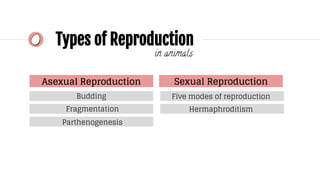
Types of Reproduction
in animals
Sexual ReproductionAsexual Reproduction
Budding Five modes of reproduction
Hermaphroditism
Fragmentation
Parthenogenesis
Types of Reproduction
in animals
Asexual Reproduction
Budding
Organism develops from an
outgrowth due to cell division at a
particular site on parent
E.g. sponges, corals, jellyfish, hydra
Fragmentation
Parthenogenesis
Types of Reproduction
in animals
Asexual Reproduction
Budding
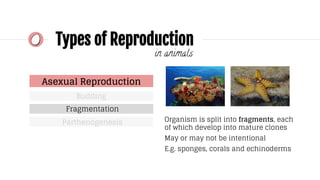
Organism is split into fragments, each
of which develop into mature clones
May or may not be intentional
E.g. sponges, corals and echinoderms
Fragmentation
Parthenogenesis
Types of Reproduction
in animals
Asexual Reproduction
Budding
in animals
Organism (embryo) develops from
an unfertilized egg cell (after
meiosis)
Half clones or full clones
E.g. insects, some reptiles (lizards,
komodo dragon), sharks
Types of Reproduction
in animals
Sexual Reproduction
Five modes of reproduction
Hermaphroditism
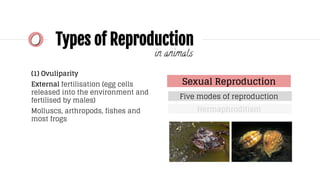
(1) Ovuliparity
External fertilisation (egg cells
released into the environment and
fertilised by males)
Molluscs, arthropods, fishes and
most frogs
Types of Reproduction
in animals
Sexual Reproduction
Five modes of reproduction
Hermaphroditism
(2) Oviparity
- Internal fertilisation
- Lay eggs
- Little embryonic development
in mother
Most fish, amphibians, reptiles, all
birds, monotremes
Types of Reproduction
in animals
Sexual Reproduction
Five modes of reproduction
Hermaphroditism
(3) Ovoviviparity
- Internal fertilisation
- Embryos develop in eggs and
hatch within parent
- Give birth to live young
- No placenta
Some fish, amphibians and reptiles
in animals
Sexual Reproduction
Five modes of reproduction
Hermaphroditism
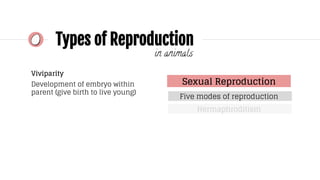
Viviparity
Development of embryo within
parent (give birth to live young)
Types of Reproduction
in animals
Sexual Reproduction
Five modes of reproduction
Hermaphroditism
(4) Histotrophic viviparity
Embryos acquire nutrients from:
1) other tissues (skin/glands)
2) oophagy (feeding on eggs
produced by ovary); e.g. some sharks
3) adelphophagy (fetus feeds on
sibling embryos); e.g. marine snails
and worms, some sharks
Types of Reproduction
in animals
Sexual Reproduction
Five modes of reproduction
Hermaphroditism
(5) Hemotrophic viviparity
Embryo acquires nutrients from
female (often from placenta)
E.g. most mammals
Types of Reproduction
in animals
Sexual Reproduction
Five modes of reproduction
Hermaphroditism
Organism can have both male and
female reproductive organs
(A) Sequential hermaphrodites
Individual born as one sex but can
later change into the opposite sex
(B) Simultaneous hermaphrodites
Individual has both male and female
sexual organs at the same time (A) (B)
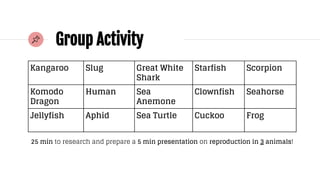
Group Activity
Kangaroo Slug Great White
Shark
Starfish Scorpion
Komodo
Dragon
Human Sea
Anemone
Clownfish Seahorse
Jellyfish Aphid Sea Turtle Cuckoo Frog
25 min to research and prepare a 5 min presentation on reproduction in 3 animals!
Guiding Questions
◉ How does mating take place?
◉ What is/are the method(s) of reproduction?
○ E.g. number of mates? length of gestation? how
does the animal give birth? number of young?
◉ Do parents care for the young?
◉ Any interesting facts?
◉ What are the advantages/disadvantages of such a
method of reproduction?
Thanks!

Animal Reproduction

  • 1.
  • 2.
    Reproduction A fundamental biological processin which new individual organisms ("offspring") are produced from their "parents" Ensures the continuity of the species
  • 3.
    Reproduction ◉ Asexual Reproduction: Parentproduces genetically similar/identical offspring ◉ Sexual Reproduction: Production of gametes (sex cells) via meiosis Fusion of male and female gametes (fertilisation)
  • 4.
    Fragmentation Parthenogenesis Types of Reproduction inanimals Sexual ReproductionAsexual Reproduction Budding Five modes of reproduction Hermaphroditism
  • 5.
    Fragmentation Parthenogenesis Types of Reproduction inanimals Asexual Reproduction Budding Organism develops from an outgrowth due to cell division at a particular site on parent E.g. sponges, corals, jellyfish, hydra
  • 6.
    Fragmentation Parthenogenesis Types of Reproduction inanimals Asexual Reproduction Budding Organism is split into fragments, each of which develop into mature clones May or may not be intentional E.g. sponges, corals and echinoderms
  • 7.
    Fragmentation Parthenogenesis Types of Reproduction inanimals Asexual Reproduction Budding in animals Organism (embryo) develops from an unfertilized egg cell (after meiosis) Half clones or full clones E.g. insects, some reptiles (lizards, komodo dragon), sharks
  • 8.
    Types of Reproduction inanimals Sexual Reproduction Five modes of reproduction Hermaphroditism (1) Ovuliparity External fertilisation (egg cells released into the environment and fertilised by males) Molluscs, arthropods, fishes and most frogs
  • 9.
    Types of Reproduction inanimals Sexual Reproduction Five modes of reproduction Hermaphroditism (2) Oviparity - Internal fertilisation - Lay eggs - Little embryonic development in mother Most fish, amphibians, reptiles, all birds, monotremes
  • 10.
    Types of Reproduction inanimals Sexual Reproduction Five modes of reproduction Hermaphroditism (3) Ovoviviparity - Internal fertilisation - Embryos develop in eggs and hatch within parent - Give birth to live young - No placenta Some fish, amphibians and reptiles
  • 11.
    in animals Sexual Reproduction Fivemodes of reproduction Hermaphroditism Viviparity Development of embryo within parent (give birth to live young) Types of Reproduction
  • 12.
    in animals Sexual Reproduction Fivemodes of reproduction Hermaphroditism (4) Histotrophic viviparity Embryos acquire nutrients from: 1) other tissues (skin/glands) 2) oophagy (feeding on eggs produced by ovary); e.g. some sharks 3) adelphophagy (fetus feeds on sibling embryos); e.g. marine snails and worms, some sharks Types of Reproduction
  • 13.
    in animals Sexual Reproduction Fivemodes of reproduction Hermaphroditism (5) Hemotrophic viviparity Embryo acquires nutrients from female (often from placenta) E.g. most mammals Types of Reproduction
  • 14.
    Types of Reproduction inanimals Sexual Reproduction Five modes of reproduction Hermaphroditism Organism can have both male and female reproductive organs (A) Sequential hermaphrodites Individual born as one sex but can later change into the opposite sex (B) Simultaneous hermaphrodites Individual has both male and female sexual organs at the same time (A) (B)
  • 15.
    Group Activity Kangaroo SlugGreat White Shark Starfish Scorpion Komodo Dragon Human Sea Anemone Clownfish Seahorse Jellyfish Aphid Sea Turtle Cuckoo Frog 25 min to research and prepare a 5 min presentation on reproduction in 3 animals!
  • 16.
    Guiding Questions ◉ Howdoes mating take place? ◉ What is/are the method(s) of reproduction? ○ E.g. number of mates? length of gestation? how does the animal give birth? number of young? ◉ Do parents care for the young? ◉ Any interesting facts? ◉ What are the advantages/disadvantages of such a method of reproduction?
  • 17.