History of Evolutionary Theory Anaximander to Austrian Monks
The Evolutionary Model Evolution is based on two models of population change Mutation—Change In DNA Structure—involves the creation of new life forms Natural selection involves environmental pressures that favor, restrict, or eliminate life forms Other factors may favor population change: gene flow (migration) or genetic drift (changes as the product of chance
Overview of Evolutionary Change First, we look at the history of evolutionary thought from the Greek philosophers to the Darwinist model Then we look at the mechanisms of evolutionary change Biological, Molecular, and Population Genetics Natural Selection Other Mechanisms of Population Change Speciation and Taxonomy
Overview of Evolution of Evolutionary Thought History of Evolutionary Concepts Greek Precursors 17 th  Century Theologians 18 th  Century Catastrophists 18 th  Century Uniformitarians Uniformitarianism of Hutton and Lyell Darwin and Wallace Gregor Mandel Key concepts in evolutionary history Essentialism/Chain of Being Natural Selection/Mutation
Early Theorists: The Classical Greeks Anaximander:  (6 th  Century BC) Argued that men arose from fishes, setting the stage of  He relied on reasoning, not supernatural explanations Plato and Aristotle:  Set the stage for two models of existence Essentialism, or the ideal type of biological lifeforms Great Chain of Being, which placed all lifeforms in a hierarchical system of existence from lowest to highest.
Early Models: Essentialism Essentialism: The ideal reality against which the perceived reality is compared and contrasted   Plato (above) was the first to come up with the ideal entity (including the human), against which the perceived entity was compared  Aristotle (below) also accepted the idea of a perfect universe, but did not accept the dichotomy that Plato posited. Rather, he saw the essential as the properties of each lifeform and other entities.  Greek gods and goddesses represented the ideal human male and female forms, as reflected in sculpture and other representational art. Any deviation from the essential reflected some defect in any lifeform, animal or plant.
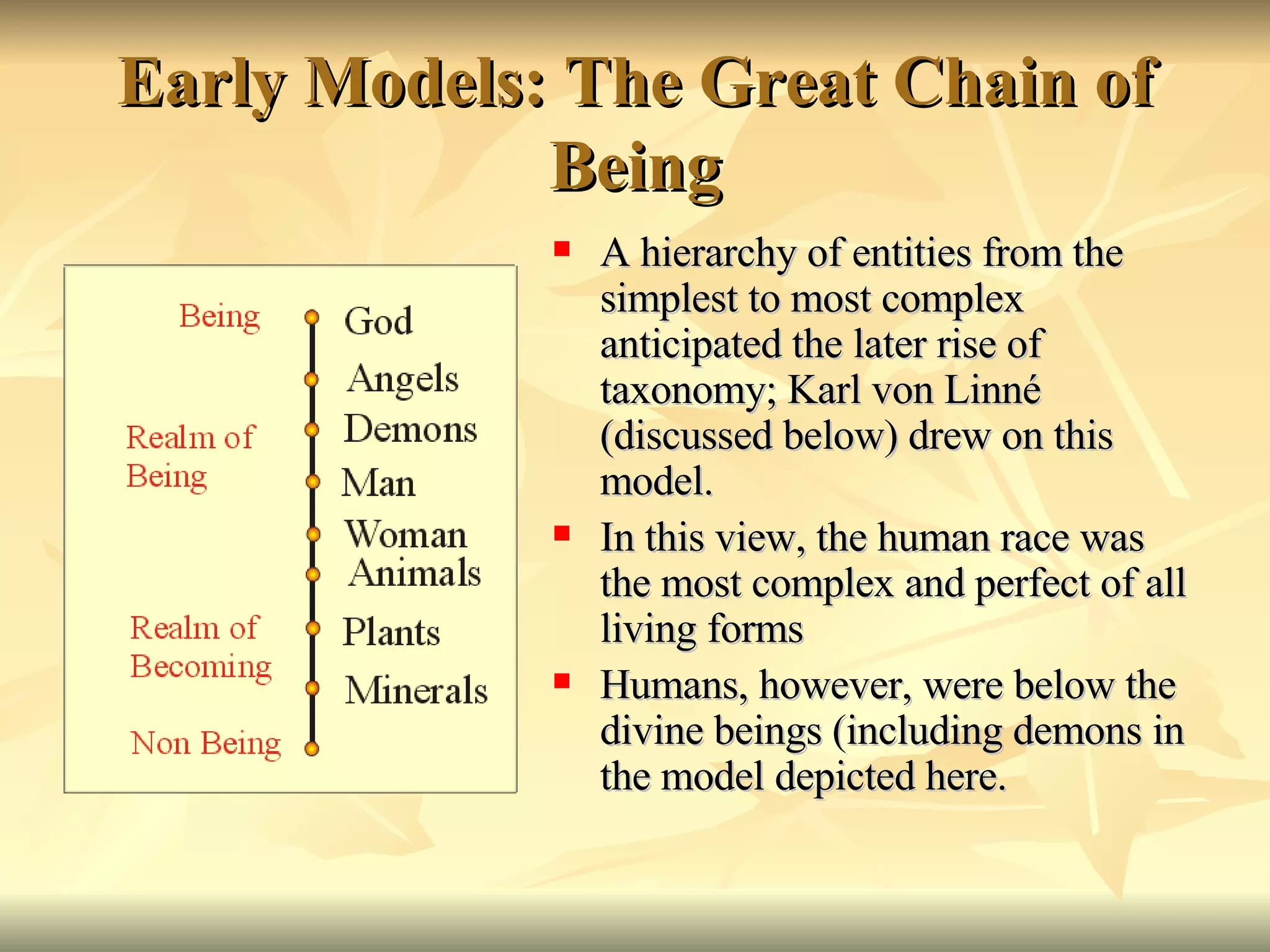
Early Models: The Great Chain of Being A hierarchy of entities from the  simplest to most complex anticipated the later rise of taxonomy; Karl von Linn é (discussed below) drew on this model. In this view, the human race was  the most complex and perfect of all living forms Humans, however, were below the divine beings (including demons in the model depicted here.
Catastrophism Earth’s history is product of sudden change Example: Creation of Earth in six days (upper left), including Adam Example: Flood (Noah’s Ark), which eliminated all life except Noah’s family and the male and female animals he allowed into the ark  Catastrophism does have some basis of reality: an asteroid that struck the earth 65 million years ago (lower left) nearly destroyed all life
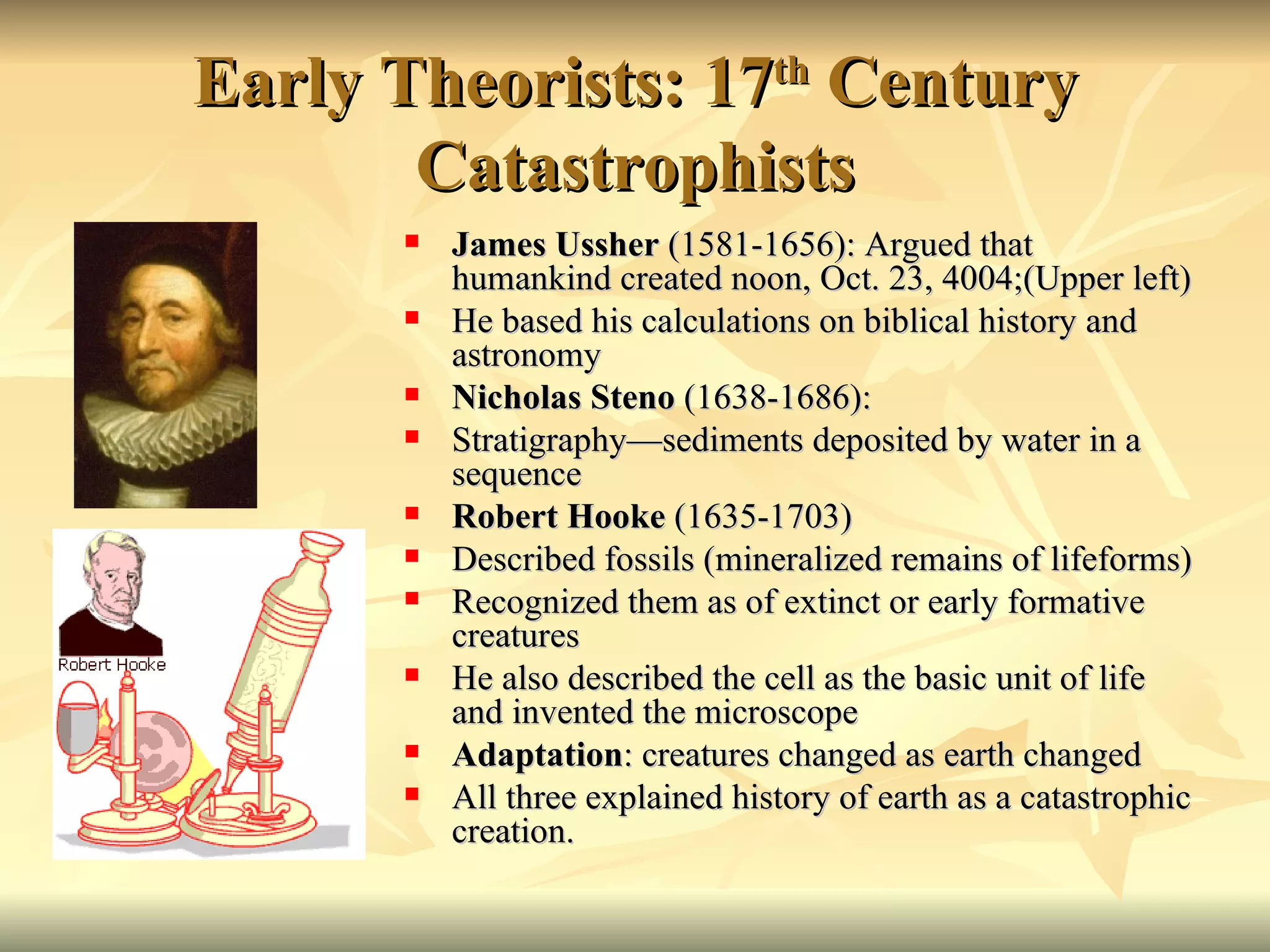
Early Theorists: 17 th  Century Catastrophists James Ussher  (1581-1656): Argued that humankind created noon, Oct. 23, 4004;(Upper left) He based his calculations on biblical history and astronomy Nicholas Steno  (1638-1686): Stratigraphy—sediments deposited by water in a sequence Robert Hooke  (1635-1703) Described fossils (mineralized remains of lifeforms) Recognized them as of extinct or early formative  creatures  He also described the cell as the basic unit of life and invented the microscope Adaptation : creatures changed as earth changed All three explained history of earth as a catastrophic creation.
Early Theorists: 18 th  Century Catastrophists Carolus Linnaeus  (Carl Linn é; 1707-1778)  Inventor of  taxonomy —classification of lifeforms based on similarities and differences (Sample taxonomy next slide) Viewed system as divinely ordained He also classified human races as being of separate species with their own personality traits Georges Cuvier  (1769-1832) Developed the science of comparative anatomy Compared the Anatomy of present lifeforms with those of the fossils forms Catastrophism: He concluded that the lifeforms of the world changed but they did not evolve
Carolus Linnaeus (Linn é)
Early Theorists: 18 th  Century Uniformitarians Uniformitarianism : Processes occur at same rate through time—present and past Georges-Louis Leclerc  (Comte de Buffon; 1707-1788) He observed that the tides and currents of seas are uniform through time He concluded that the earth had to be older than 6000 years James Hutton  (1726-1797): Discovered uniformity in 3 processes: Deposit of strata under oceans Uplifting seabeds to above sea level by volcanic action Land erosion by water, wind, and decay He too concluded that the earth had to be older than 6000 years
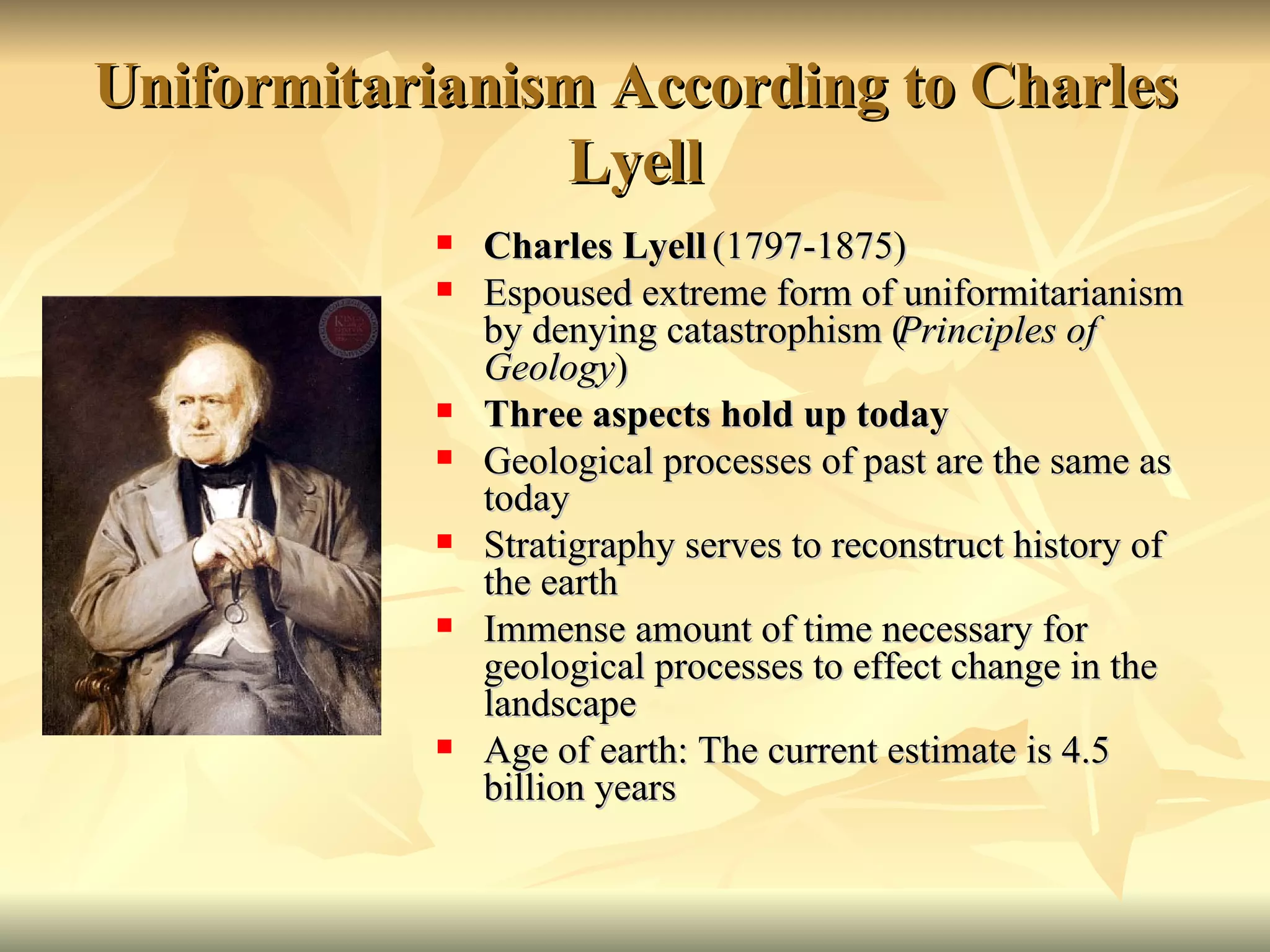
Uniformitarianism According to Charles Lyell Charles Lyell  (1797-1875) Espoused extreme form of uniformitarianism by denying catastrophism ( Principles of Geology ) Three aspects hold up today Geological processes of past are the same as today Stratigraphy serves to reconstruct history of the earth Immense amount of time necessary for geological processes to effect change in the landscape  Age of earth: The current estimate is 4.5 billion years
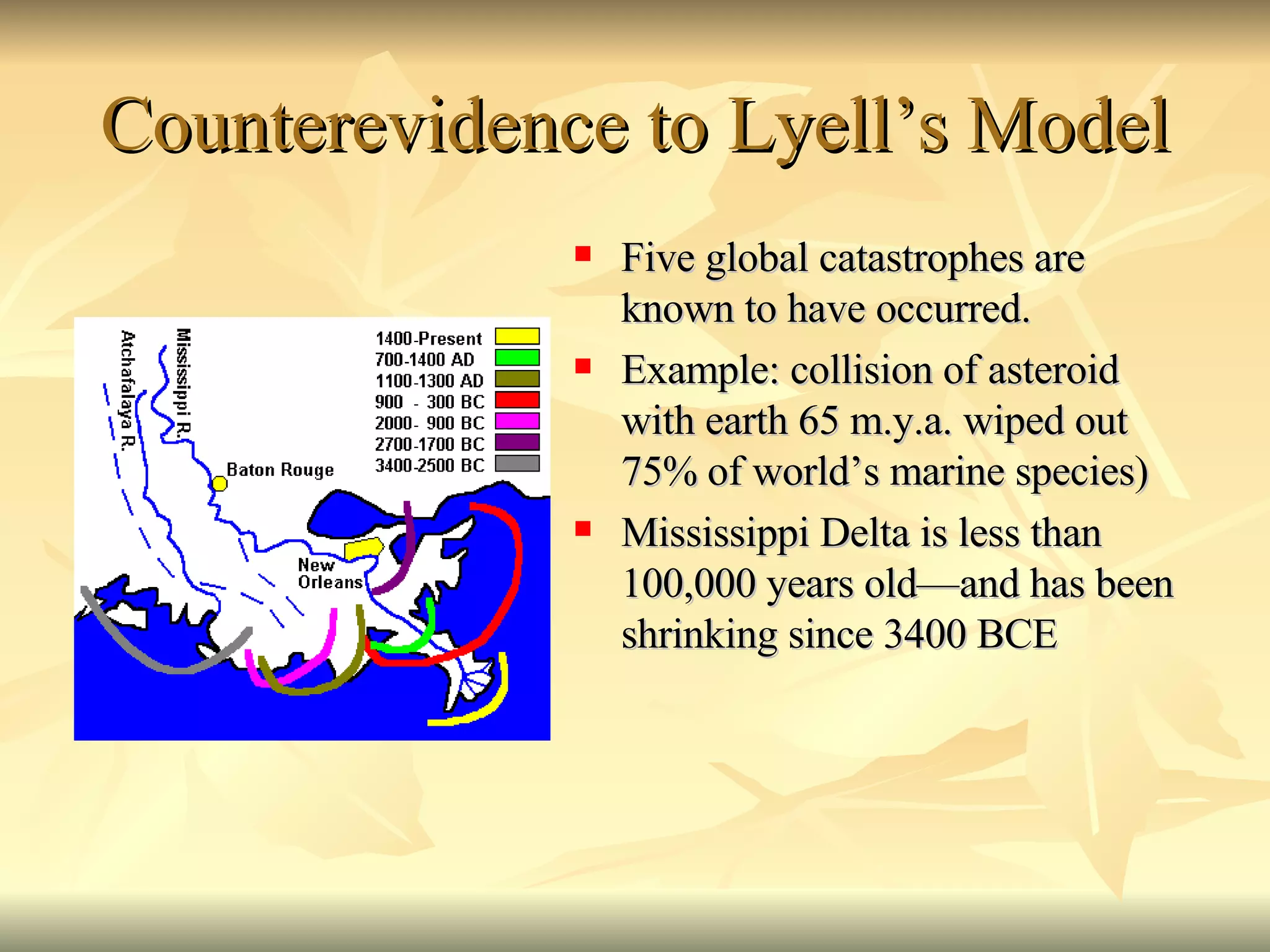
Counterevidence to Lyell’s Model Five global catastrophes are known to have occurred. Example: collision of asteroid with earth 65 m.y.a. wiped out 75% of world’s marine species) Mississippi Delta is less than 100,000 years old—and has been shrinking since 3400 BCE
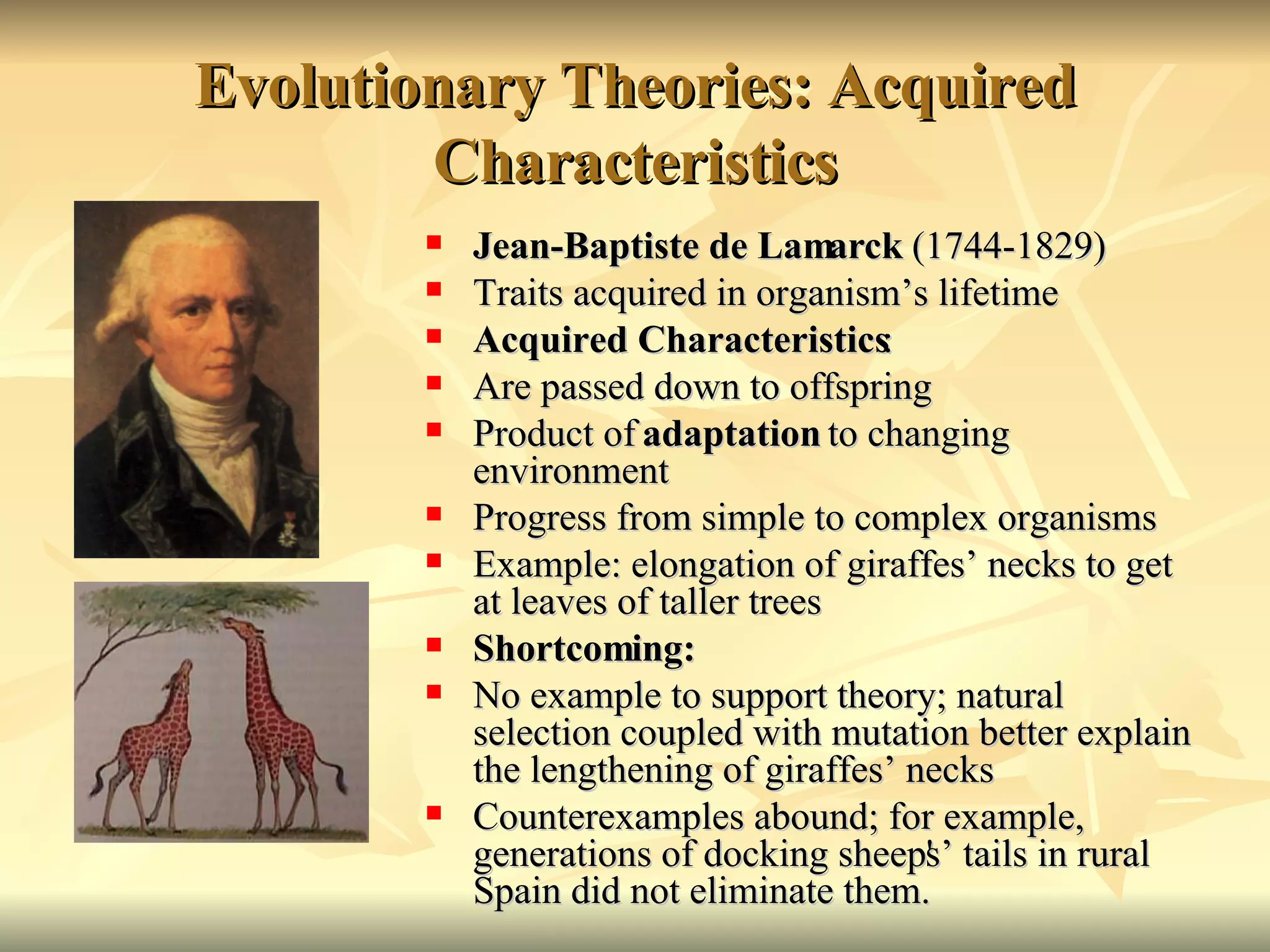
Evolutionary Theories: Acquired Characteristics Jean-Baptiste de Lamarck  (1744-1829) Traits acquired in organism’s lifetime Acquired Characteristics : Are passed down to offspring Product of  adaptation  to changing environment Progress from simple to complex organisms Example: elongation of giraffes’ necks to get at leaves of taller trees Shortcoming: No example to support theory; natural selection coupled with mutation better explain the lengthening of giraffes’ necks Counterexamples abound; for example, generations of docking sheep's’ tails in rural Spain did not eliminate them.
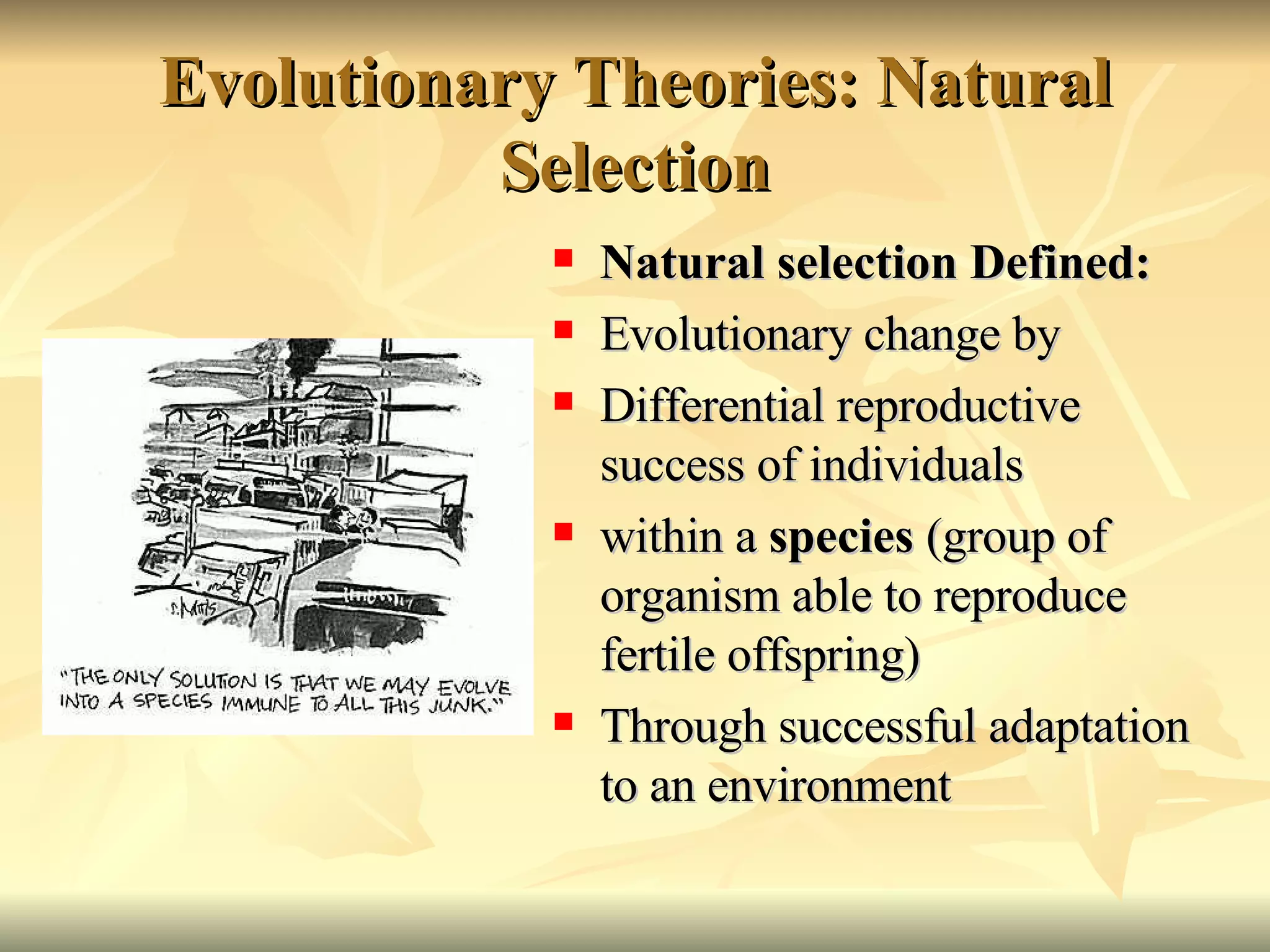
Evolutionary Theories: Natural Selection Natural selection Defined: Evolutionary change by Differential reproductive success of individuals within a  species  (group of organism able to reproduce fertile offspring) Through successful adaptation to an environment
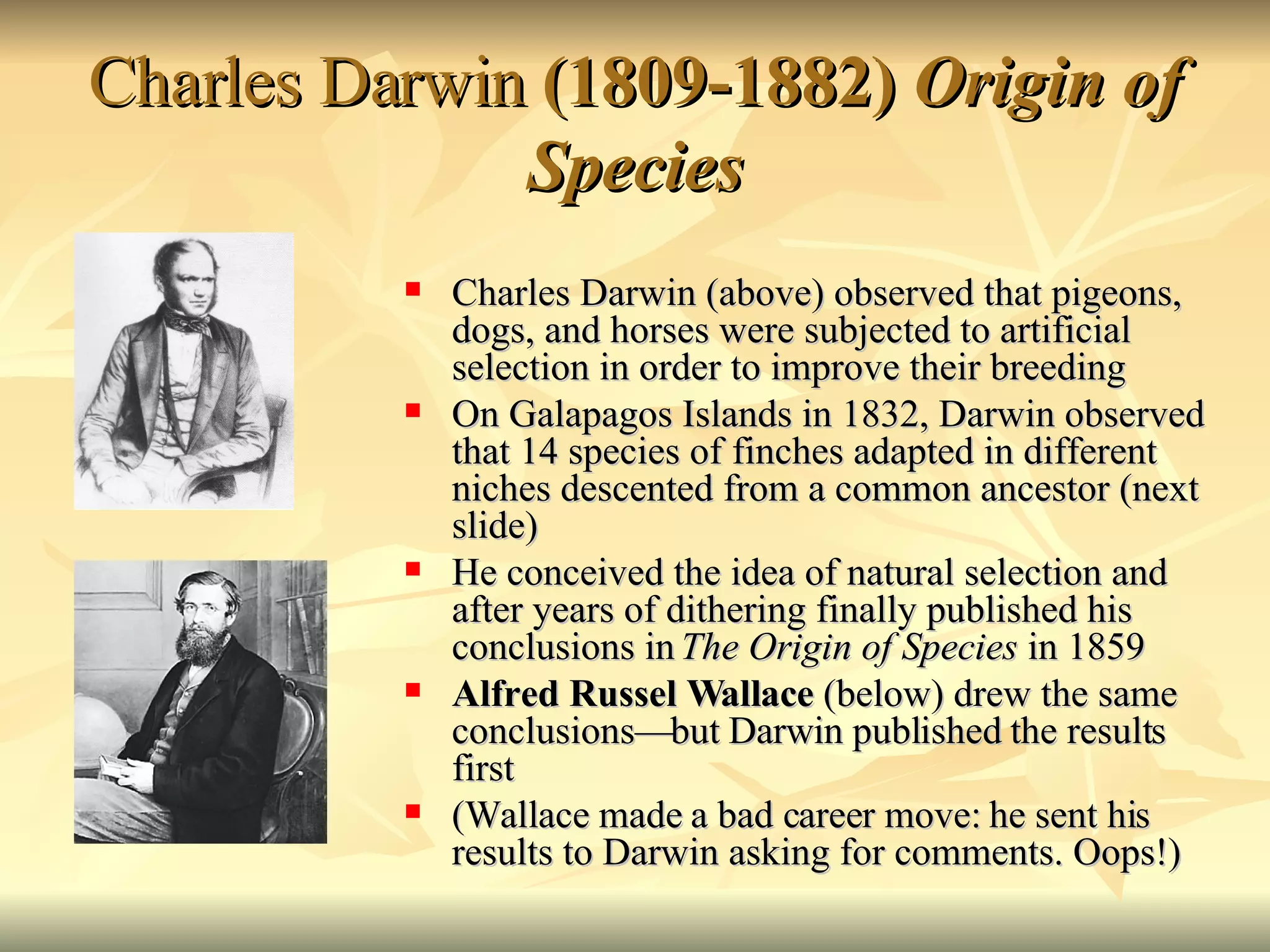
Charles Darwin  (1809-1882)  Origin of Species Charles Darwin (above) observed that pigeons, dogs, and horses were subjected to artificial selection in order to improve their breeding On Galapagos Islands in 1832, Darwin observed that 14 species of finches adapted in different niches descented from a common ancestor (next slide) He conceived the idea of natural selection and after years of dithering finally published his conclusions in  The Origin of Species  in 1859 Alfred Russel Wallace  (below) drew the same conclusions—but Darwin published the results first (Wallace made a bad career move: he sent his results to Darwin asking for comments. Oops!)
Charles Darwin and Natural Selection
Natural Selection: Definition and Implications Variations are already present when selection occurs Natural selection has no particular direction—change is random Therefore, not all evolution is from the simple to the complex Species can and do become extinct New species can and do arise (Darwin had no way of explaining how the originated, however.)  Reproductive isolation makes for new species New species fill new niches, as the finches showed Thus, dark-winged moths filled a new environment in a soot-darkened coal-fired steel city; birds did not pick them off The dark colored pepper moth is to the lower part of the photo
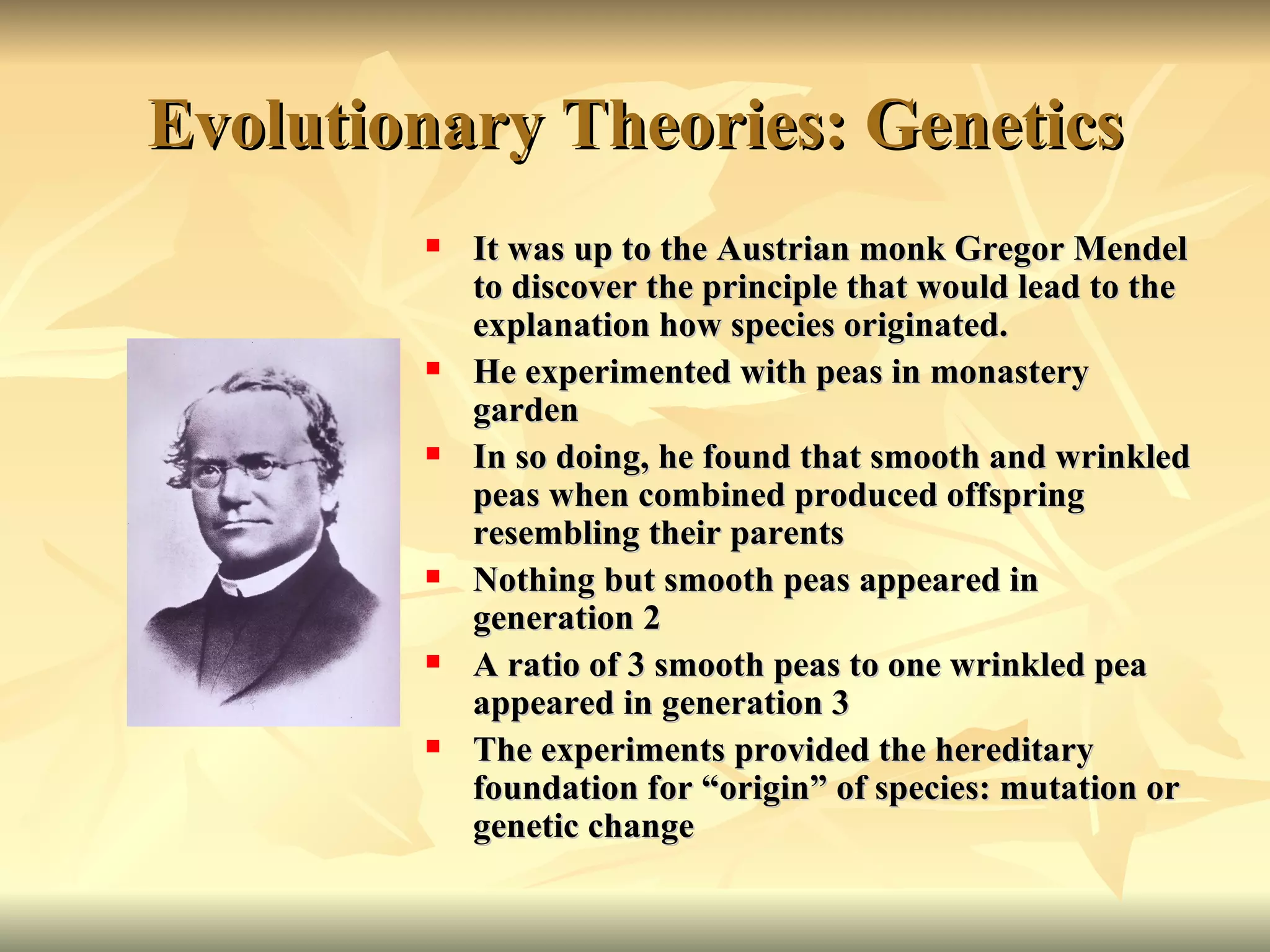
Evolutionary Theories: Genetics It was up to the Austrian monk Gregor Mendel to discover the principle that would lead to the explanation how species originated. He experimented with peas in monastery garden In so doing, he found that smooth and wrinkled peas when combined produced offspring resembling their parents Nothing but smooth peas appeared in generation 2 A ratio of 3 smooth peas to one wrinkled pea appeared in generation 3 The experiments provided the hereditary foundation for “origin” of species: mutation or genetic change
Gregor Mendel and Genetics Mendel experimented with six other traits: color of peas, texture of pea pods, color of flowers He found the same outcomes over three generations The traits were each determined by variants (alleles) of a pair of genes. Mendelian traits were thereby discovered Later, it would be discovered that multiple genes could determine a single trait, such as eye and skin color
Molecular Genetics The final step to understanding origins of species came with the discovery by James Watson (left) and Francis Crick (right) of a double helix molecule that determine traits of all species  Called DNA, they found that mutations could change the traits of a species—any species of a plant or animal. Details of this process are discussed in the next set of slides.
Conclusion Trends in history of evolutionary thought have been reviewed Creationism to evolutionary models of change Catastrophism to uniformitarianism Essentialism to natural selection Chain of being to variation by random mutation Evidence fits evolutionary change better than model of creation How evolutionary change occurs is covered in the next sets of slides.

History of Evolution

  • 1.
    History of EvolutionaryTheory Anaximander to Austrian Monks
  • 2.
    The Evolutionary ModelEvolution is based on two models of population change Mutation—Change In DNA Structure—involves the creation of new life forms Natural selection involves environmental pressures that favor, restrict, or eliminate life forms Other factors may favor population change: gene flow (migration) or genetic drift (changes as the product of chance
  • 3.
    Overview of EvolutionaryChange First, we look at the history of evolutionary thought from the Greek philosophers to the Darwinist model Then we look at the mechanisms of evolutionary change Biological, Molecular, and Population Genetics Natural Selection Other Mechanisms of Population Change Speciation and Taxonomy
  • 4.
    Overview of Evolutionof Evolutionary Thought History of Evolutionary Concepts Greek Precursors 17 th Century Theologians 18 th Century Catastrophists 18 th Century Uniformitarians Uniformitarianism of Hutton and Lyell Darwin and Wallace Gregor Mandel Key concepts in evolutionary history Essentialism/Chain of Being Natural Selection/Mutation
  • 5.
    Early Theorists: TheClassical Greeks Anaximander: (6 th Century BC) Argued that men arose from fishes, setting the stage of He relied on reasoning, not supernatural explanations Plato and Aristotle: Set the stage for two models of existence Essentialism, or the ideal type of biological lifeforms Great Chain of Being, which placed all lifeforms in a hierarchical system of existence from lowest to highest.
  • 6.
    Early Models: EssentialismEssentialism: The ideal reality against which the perceived reality is compared and contrasted Plato (above) was the first to come up with the ideal entity (including the human), against which the perceived entity was compared Aristotle (below) also accepted the idea of a perfect universe, but did not accept the dichotomy that Plato posited. Rather, he saw the essential as the properties of each lifeform and other entities. Greek gods and goddesses represented the ideal human male and female forms, as reflected in sculpture and other representational art. Any deviation from the essential reflected some defect in any lifeform, animal or plant.
  • 7.
    Early Models: TheGreat Chain of Being A hierarchy of entities from the simplest to most complex anticipated the later rise of taxonomy; Karl von Linn é (discussed below) drew on this model. In this view, the human race was the most complex and perfect of all living forms Humans, however, were below the divine beings (including demons in the model depicted here.
  • 8.
    Catastrophism Earth’s historyis product of sudden change Example: Creation of Earth in six days (upper left), including Adam Example: Flood (Noah’s Ark), which eliminated all life except Noah’s family and the male and female animals he allowed into the ark Catastrophism does have some basis of reality: an asteroid that struck the earth 65 million years ago (lower left) nearly destroyed all life
  • 9.
    Early Theorists: 17th Century Catastrophists James Ussher (1581-1656): Argued that humankind created noon, Oct. 23, 4004;(Upper left) He based his calculations on biblical history and astronomy Nicholas Steno (1638-1686): Stratigraphy—sediments deposited by water in a sequence Robert Hooke (1635-1703) Described fossils (mineralized remains of lifeforms) Recognized them as of extinct or early formative creatures He also described the cell as the basic unit of life and invented the microscope Adaptation : creatures changed as earth changed All three explained history of earth as a catastrophic creation.
  • 10.
    Early Theorists: 18th Century Catastrophists Carolus Linnaeus (Carl Linn é; 1707-1778) Inventor of taxonomy —classification of lifeforms based on similarities and differences (Sample taxonomy next slide) Viewed system as divinely ordained He also classified human races as being of separate species with their own personality traits Georges Cuvier (1769-1832) Developed the science of comparative anatomy Compared the Anatomy of present lifeforms with those of the fossils forms Catastrophism: He concluded that the lifeforms of the world changed but they did not evolve
  • 11.
  • 12.
    Early Theorists: 18th Century Uniformitarians Uniformitarianism : Processes occur at same rate through time—present and past Georges-Louis Leclerc (Comte de Buffon; 1707-1788) He observed that the tides and currents of seas are uniform through time He concluded that the earth had to be older than 6000 years James Hutton (1726-1797): Discovered uniformity in 3 processes: Deposit of strata under oceans Uplifting seabeds to above sea level by volcanic action Land erosion by water, wind, and decay He too concluded that the earth had to be older than 6000 years
  • 13.
    Uniformitarianism According toCharles Lyell Charles Lyell (1797-1875) Espoused extreme form of uniformitarianism by denying catastrophism ( Principles of Geology ) Three aspects hold up today Geological processes of past are the same as today Stratigraphy serves to reconstruct history of the earth Immense amount of time necessary for geological processes to effect change in the landscape Age of earth: The current estimate is 4.5 billion years
  • 14.
    Counterevidence to Lyell’sModel Five global catastrophes are known to have occurred. Example: collision of asteroid with earth 65 m.y.a. wiped out 75% of world’s marine species) Mississippi Delta is less than 100,000 years old—and has been shrinking since 3400 BCE
  • 15.
    Evolutionary Theories: AcquiredCharacteristics Jean-Baptiste de Lamarck (1744-1829) Traits acquired in organism’s lifetime Acquired Characteristics : Are passed down to offspring Product of adaptation to changing environment Progress from simple to complex organisms Example: elongation of giraffes’ necks to get at leaves of taller trees Shortcoming: No example to support theory; natural selection coupled with mutation better explain the lengthening of giraffes’ necks Counterexamples abound; for example, generations of docking sheep's’ tails in rural Spain did not eliminate them.
  • 16.
    Evolutionary Theories: NaturalSelection Natural selection Defined: Evolutionary change by Differential reproductive success of individuals within a species (group of organism able to reproduce fertile offspring) Through successful adaptation to an environment
  • 17.
    Charles Darwin (1809-1882) Origin of Species Charles Darwin (above) observed that pigeons, dogs, and horses were subjected to artificial selection in order to improve their breeding On Galapagos Islands in 1832, Darwin observed that 14 species of finches adapted in different niches descented from a common ancestor (next slide) He conceived the idea of natural selection and after years of dithering finally published his conclusions in The Origin of Species in 1859 Alfred Russel Wallace (below) drew the same conclusions—but Darwin published the results first (Wallace made a bad career move: he sent his results to Darwin asking for comments. Oops!)
  • 18.
    Charles Darwin andNatural Selection
  • 19.
    Natural Selection: Definitionand Implications Variations are already present when selection occurs Natural selection has no particular direction—change is random Therefore, not all evolution is from the simple to the complex Species can and do become extinct New species can and do arise (Darwin had no way of explaining how the originated, however.) Reproductive isolation makes for new species New species fill new niches, as the finches showed Thus, dark-winged moths filled a new environment in a soot-darkened coal-fired steel city; birds did not pick them off The dark colored pepper moth is to the lower part of the photo
  • 20.
    Evolutionary Theories: GeneticsIt was up to the Austrian monk Gregor Mendel to discover the principle that would lead to the explanation how species originated. He experimented with peas in monastery garden In so doing, he found that smooth and wrinkled peas when combined produced offspring resembling their parents Nothing but smooth peas appeared in generation 2 A ratio of 3 smooth peas to one wrinkled pea appeared in generation 3 The experiments provided the hereditary foundation for “origin” of species: mutation or genetic change
  • 21.
    Gregor Mendel andGenetics Mendel experimented with six other traits: color of peas, texture of pea pods, color of flowers He found the same outcomes over three generations The traits were each determined by variants (alleles) of a pair of genes. Mendelian traits were thereby discovered Later, it would be discovered that multiple genes could determine a single trait, such as eye and skin color
  • 22.
    Molecular Genetics Thefinal step to understanding origins of species came with the discovery by James Watson (left) and Francis Crick (right) of a double helix molecule that determine traits of all species Called DNA, they found that mutations could change the traits of a species—any species of a plant or animal. Details of this process are discussed in the next set of slides.
  • 23.
    Conclusion Trends inhistory of evolutionary thought have been reviewed Creationism to evolutionary models of change Catastrophism to uniformitarianism Essentialism to natural selection Chain of being to variation by random mutation Evidence fits evolutionary change better than model of creation How evolutionary change occurs is covered in the next sets of slides.