The Descent with Modification
Evolution Life first originated some 3.8 billion years ago. Organisms come to exist by the Transfer of Genetic Material, within a surrounding cell, from one or more parents. Descent may occur through: Simple clonal reproduction Complex sexual reproduction
Lineage Results from “Descent through Time” A set of organisms interconnected through time and space by the transfer of genetic material from parents to offspring.
Modification A component of Evolution  Refers to a change in Genetic Material that is transferred from parent/s to offspring. Such Genetic Material of the offspring is different from the parent/s. Occurred through: Mutation Genetic Recombination
Population and Species The General Units of Evolution Species Groups of Populations that are related to one another by various criteria and have evolutionarily diverged from such other groups. Population A group of individuals of the same species that is usually geographically delimited.
Phylogeny The evolutionary History or pattern of descent of a group of organisms. Commonly represented in a “Cladogram”
Cladogram A hypothesis about the lineages and their evolutionary relationships.
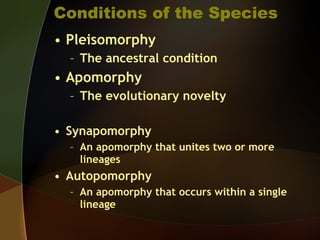
Conditions of the Species Pleisomorphy The ancestral condition Apomorphy The evolutionary novelty Synapomorphy An apomorphy that unites two or more lineages Autopomorphy An apomorphy that occurs within a single lineage
History of Evolution Plato “ The observable world is no more than a shadowy reflection of underlying “ideals” that are true and eternal for all time.”
The Great Chain of Being “The Deity wishing to make this world like the fairest and most perfect of intelligible beings, framed one visible living being containing within itself all other living beings of like nature” -Plato-
Scale of Nature Formed by Aristotle from Plato’s ideal. Represents a link in the progressions from the least, to the most perfect of creatures.
Charles Darwin Described as a man who defied his own social and religious background, not only by espousing a radical concept, but by becoming the instrument that made it acceptable to many of his compatriots.
The Galapagos Islands Where Darwin had a great impact on his thinking about Evolution Particularly Struck by: The absence of insect eating warblers and woodpeckers, but finchers taking their place.  The observation that each island contained its own constellation of species.
Jean-Baptiste de Lamrack Proposed the  Continuity of Species  Variations among organisms originate because of response to the needs of the environment The ability to respond in a particular direction accounts for the adaptation of new features.
Macroevolution The evolutionary changes at the species level and above.
Microevolution Evolution within the population of a species
Types of Evolution Divergent Evolution Convergent Evolution Parallel Evolution
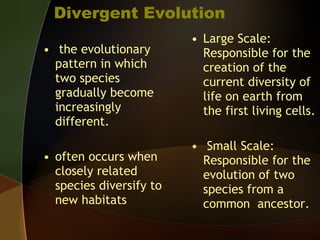
Divergent Evolution   the evolutionary pattern in which two species gradually become increasingly different.   often occurs when closely related species diversify to new habitats   Large Scale: Responsible for the creation of the current diversity of life on earth from the first living cells.   Small Scale: Responsible for the evolution of two species from a common  ancestor.
Convergent Evolution   Takes place when species of different ancestry begin to share analogous traits because of a shared environment or other selection pressure.
Parallel Evolution Occurs when two species evolve independently of each other, maintaining the same level of similarity.    Between unrelated species that do not occupy the same or similar niches in a given habitat.
Plant Evolution
The Green Plants Cellulosic Cell Wall Primary Apomorphy of the Viridiplantae: Chlorophyll B Thylakoids Stacked Grana Starch
Streptophyte Gave rise to the Land Plants Apomorphy Oogamy Charophyte A clade within the Streptophytes  Apomorphy: Plasmodesmata Includes: Coleochaete Charales Land Plants
Embryophyta – Land Plants First colonization of Plants on Land during the Silurian Period (400 mya) Under Streptophytes/Charophytes Apomorphy Embryo/Sporophyte Cuticle Parenchyma Antheridium Archegonium
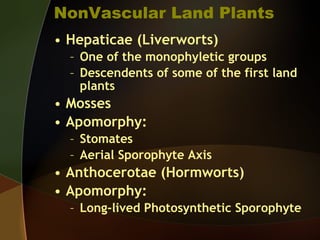
NonVascular Land Plants Hepaticae (Liverworts) One of the monophyletic groups Descendents of some of the first land plants Mosses Apomorphy: Stomates Aerial Sporophyte Axis Anthocerotae (Hormworts) Apomorphy: Long-lived Photosynthetic Sporophyte
Tracheophyta Vascular Land Plants
Apomorphies Independent, long-lived sporophyte Branched sporophyte Lignified secondary walls Sclerenchyma Tracheary Elements (xylem) Sieve Elements (phloem) Endodermis Roots
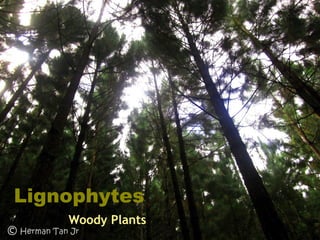
Lignophytes Woody Plants
Apomorphy Possesses the Vascular Cambium Cork Cambium
Spermatophytes Seed Plants, a lineage within the lignophytes Apomorphy: Seed
Angiosperms Pretty Flower Plants
Origin of Angiosperms Earliest definitive fossils of Angiosperms: Dispersed Pollen Grains Earliest Cretaceous Period (140mya) Flower Fossil Record (130mya) Once Angiosperms arose, they rapidly radiated into several, distinct lineages, replacing gymnosperms as the dominant plant life form on earth.
Amborella trichopoda The Best hypothesis for the most basal angiosperm lineage Lacks vessels Possesses unisexual flowers with a spiral perianth Laminar stamens Separate carpels
 
 
Thank You!
Credits (Pictures) Slide 1:  http:// cyphem.deviantart.com /   Slide 6:  http://mikrobi808.deviantart.com/   Slide 17:  http://creativ82.deviantart.com/ Slide 21:  http:// olivianeacsu.deviantart.com /   Other Slides Either found through Google Or Pictured by me… ^_^ Ahehehhehehhe…. Good Luck sa Finals! :D

The descent with modification

  • 1.
    The Descent withModification
  • 2.
    Evolution Life firstoriginated some 3.8 billion years ago. Organisms come to exist by the Transfer of Genetic Material, within a surrounding cell, from one or more parents. Descent may occur through: Simple clonal reproduction Complex sexual reproduction
  • 3.
    Lineage Results from“Descent through Time” A set of organisms interconnected through time and space by the transfer of genetic material from parents to offspring.
  • 4.
    Modification A componentof Evolution Refers to a change in Genetic Material that is transferred from parent/s to offspring. Such Genetic Material of the offspring is different from the parent/s. Occurred through: Mutation Genetic Recombination
  • 5.
    Population and SpeciesThe General Units of Evolution Species Groups of Populations that are related to one another by various criteria and have evolutionarily diverged from such other groups. Population A group of individuals of the same species that is usually geographically delimited.
  • 6.
    Phylogeny The evolutionaryHistory or pattern of descent of a group of organisms. Commonly represented in a “Cladogram”
  • 7.
    Cladogram A hypothesisabout the lineages and their evolutionary relationships.
  • 8.
    Conditions of theSpecies Pleisomorphy The ancestral condition Apomorphy The evolutionary novelty Synapomorphy An apomorphy that unites two or more lineages Autopomorphy An apomorphy that occurs within a single lineage
  • 9.
    History of EvolutionPlato “ The observable world is no more than a shadowy reflection of underlying “ideals” that are true and eternal for all time.”
  • 10.
    The Great Chainof Being “The Deity wishing to make this world like the fairest and most perfect of intelligible beings, framed one visible living being containing within itself all other living beings of like nature” -Plato-
  • 11.
    Scale of NatureFormed by Aristotle from Plato’s ideal. Represents a link in the progressions from the least, to the most perfect of creatures.
  • 12.
    Charles Darwin Describedas a man who defied his own social and religious background, not only by espousing a radical concept, but by becoming the instrument that made it acceptable to many of his compatriots.
  • 13.
    The Galapagos IslandsWhere Darwin had a great impact on his thinking about Evolution Particularly Struck by: The absence of insect eating warblers and woodpeckers, but finchers taking their place. The observation that each island contained its own constellation of species.
  • 14.
    Jean-Baptiste de LamrackProposed the Continuity of Species Variations among organisms originate because of response to the needs of the environment The ability to respond in a particular direction accounts for the adaptation of new features.
  • 15.
    Macroevolution The evolutionarychanges at the species level and above.
  • 16.
    Microevolution Evolution withinthe population of a species
  • 17.
    Types of EvolutionDivergent Evolution Convergent Evolution Parallel Evolution
  • 18.
    Divergent Evolution  the evolutionary pattern in which two species gradually become increasingly different. often occurs when closely related species diversify to new habitats Large Scale: Responsible for the creation of the current diversity of life on earth from the first living cells.   Small Scale: Responsible for the evolution of two species from a common ancestor.
  • 19.
    Convergent Evolution  Takes place when species of different ancestry begin to share analogous traits because of a shared environment or other selection pressure.
  • 20.
    Parallel Evolution Occurswhen two species evolve independently of each other, maintaining the same level of similarity.  Between unrelated species that do not occupy the same or similar niches in a given habitat.
  • 21.
  • 22.
    The Green PlantsCellulosic Cell Wall Primary Apomorphy of the Viridiplantae: Chlorophyll B Thylakoids Stacked Grana Starch
  • 23.
    Streptophyte Gave riseto the Land Plants Apomorphy Oogamy Charophyte A clade within the Streptophytes Apomorphy: Plasmodesmata Includes: Coleochaete Charales Land Plants
  • 24.
    Embryophyta – LandPlants First colonization of Plants on Land during the Silurian Period (400 mya) Under Streptophytes/Charophytes Apomorphy Embryo/Sporophyte Cuticle Parenchyma Antheridium Archegonium
  • 25.
    NonVascular Land PlantsHepaticae (Liverworts) One of the monophyletic groups Descendents of some of the first land plants Mosses Apomorphy: Stomates Aerial Sporophyte Axis Anthocerotae (Hormworts) Apomorphy: Long-lived Photosynthetic Sporophyte
  • 26.
  • 27.
    Apomorphies Independent, long-livedsporophyte Branched sporophyte Lignified secondary walls Sclerenchyma Tracheary Elements (xylem) Sieve Elements (phloem) Endodermis Roots
  • 28.
  • 29.
    Apomorphy Possesses theVascular Cambium Cork Cambium
  • 30.
    Spermatophytes Seed Plants,a lineage within the lignophytes Apomorphy: Seed
  • 31.
  • 32.
    Origin of AngiospermsEarliest definitive fossils of Angiosperms: Dispersed Pollen Grains Earliest Cretaceous Period (140mya) Flower Fossil Record (130mya) Once Angiosperms arose, they rapidly radiated into several, distinct lineages, replacing gymnosperms as the dominant plant life form on earth.
  • 33.
    Amborella trichopoda TheBest hypothesis for the most basal angiosperm lineage Lacks vessels Possesses unisexual flowers with a spiral perianth Laminar stamens Separate carpels
  • 34.
  • 35.
  • 36.
  • 37.
    Credits (Pictures) Slide1: http:// cyphem.deviantart.com / Slide 6: http://mikrobi808.deviantart.com/ Slide 17: http://creativ82.deviantart.com/ Slide 21: http:// olivianeacsu.deviantart.com / Other Slides Either found through Google Or Pictured by me… ^_^ Ahehehhehehhe…. Good Luck sa Finals! :D