SELF EVALUATIONPEER EVALUATIONPATIENT SATISFACTIONUTILIZATION REVIEW&APPLICATION TO NURSING SERVICE
EVALUATIONThe term evaluation is derived from the word ‘valoir’ which means    ‘to be worth’.  Evaluation is the process of judging the value or worth of an individuals achievements or characteristics.Evaluation is a decision making process that leads to suggestions for actions to improve participants’ effectiveness and program efficiency.
SELF EVALUATIONSelf evaluation is defined as judging the quality of one’s work, based on evidence and explicit criteria, for the purpose of doing better work in the future.
   It is one of the best method of performance appraisal, if it can systematically introduce. Self evaluation is the way in which an individual views himself. PURPOSES OF SELF EVALUATIONTo encourage continuing self-evaluation and reflection and to promote an ongoing, innovative approach.
To encourage individual professional growth in areas of interest to the employee
To improve morale and motivation by treating the employee as a professional in charge of his or her own professional growth.CONTD…….To encourage collegiality and discussion about practices among peers in an organization
To support employees as they experiment with approaches that will move them to higher levels of performanceBENEFITS OF SELF EVALUATIONIncreased confidence in their own learning, in trying out new ideas, in changing their practice and in their power to make a difference.Enthusiasm for collaborative working, despite initial anxieties about being observed and receiving feedbackImproved team-work and greater flexibility in their use of their skillsIncreased awareness of new techniques and greater insight into thinkingEnhanced planning skills to ensure more effective task management
TOOLS FOR SELF EVALUATIONStaff annual professional review procedures
Peer supportCoachingJoint preparation of materialsPlanningTeam buildingObservation can involve experts, can be informal or formal procedures. Feedback from such observation is very valuable.
Audit checklist  PEER EVALUATIONPeer review/Evaluation is a process by which employees of the same rank, profession and setting evaluate one another’s job performance against accepted standards.                          O’ Loughlin and Kaulbach
METHODS OF PEER EVALUATIONDirect observationVideotaping  Evaluation of course materialsAnalysis of portfolios
PROCESS OF PEER REVIEWEstablish a policy requiring peer reviewsEstablish criteria for peer evaluationsProcedure for conducting peer evaluationsFaculty chosen to conduct peer evaluations shall be tenured and hold on academic rank higher than that of the faculty member being evaluated
A written report, addressing the criteria, shall be prepared and signed by the evaluatorCONTD……..The department shall archive the written evaluations for use in future evaluations
One copy of the peer evaluation shall be placed in the permanent personnel file of the person being evaluated
All reports of peer evaluations shall be included in the tenure file, and are to be carefully reviewed at the departmentPATIENT SATISFACTION“Patient satisfaction is defined as a health care recipients reaction to salient aspects of the context, process, and result of their service experience.”- Pascoe (1983)“Patient satisfaction is defined as the extent of the resemblance between the expected quality of care and the actual received care.”   - Scarding (1994)
NEED FOR EVALUATING PATIENT SATISFACTION Data about patient satisfaction equips nurses with useful information about the structure, process and outcome of nursing careIt is a requirement for therapeutic treatment and is equivalent to self therapy.  Satisfied patients help themselves get healed faster because they are more willing to comply with treatment and adhere to instructions of health care providers, and thus have a shorter recovery time.
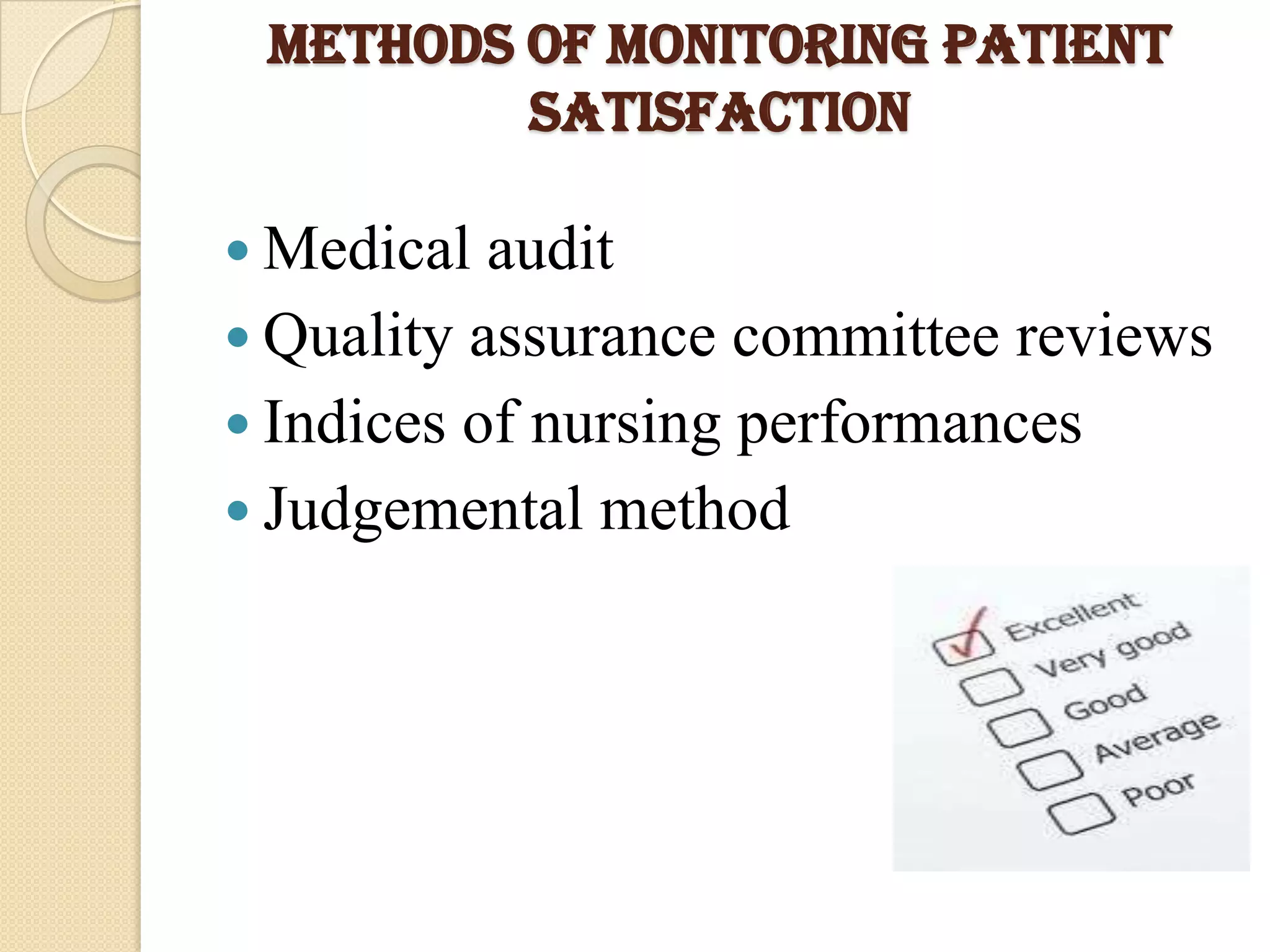
METHODS OF MONITORING PATIENT SATISFACTIONMedical auditQuality assurance committee reviewsIndices of nursing performancesJudgemental method
COMPONENTS OF EVALUATION OF PATIENT SATISFACTIONEvaluation of the programs and activities of various departments including outpatient care, inpatient care, overall health education activities of the hospitalEvaluation of the various resources available in the hospital for effective health careEvaluation of effectiveness of hospital personnel including medical, paramedical, nursing as well as non-medical employees of the hospital.Services are relevant to the needs of the population it serves.
 ULITILISATION REVIEW  The utilisation review program includes determining appropriate hospital length of stay and necessary treatments for various illnesses and conditions and reviewing patient medical records on admission and at intervals during hospitalisation to ensure that the patient receives appropriate care.

AIMS AND OBJECTIVESThe main aim is to curb the exploding health care costs with conservative use of hospitalisation and expensive diagnostic and treatment procedures.They work in liaison with a business organisation to provide healthcare services to the organisation’s employees at discounted rates.Cost containment to limit each patient’s diagnostic and treatment measures to the fewest, least expensive procedures that will relieve patient symptoms, avert costly complications, and return the patient to fullest possible function in the shortest time possible.
UTILISATION REVIEW NURSEA utilization review nurse is a RN who reviews individual medical cases to confirm that they are getting the most appropriate care. They can work for insurance companies, determining whether or not care should be approved in specific situations, and they can also work in hospitals. Members of this profession do need to possess compassion, but they also need to be able to review situations dispassionately to make decisions which are fair, even if they may be uncomfortable. At a hospital, a utilization review nurse examines patient cases if the hospital feels that a patient may not be receiving the appropriate treatment.

CONTD…….In an insurance company, the utilization review nurse inspects claims to determine whether or not they should be paid. The nurse weighs the patient's situation against the policy held by the patient, the standards of the insurance company, and the costs which may be involved in treatment. To work in this field, it is usually necessary to hold a current nursing license, and to have experience in the field.
APPLICATION TO NURSING SERVICES NEED FOR EVALUATIONAccording to WHO, Evaluation of Health services, is the systematic process of determining the extent to which an action or sets of actions were successful in the achievement of predetermined objectives. It involves measurement of adequacy, efficacy, effectiveness and efficiency of the service being evaluated. It renders possible the reallocation of priorities, changes in the assessment of needs, the planning and implementation of care and the management of resources.
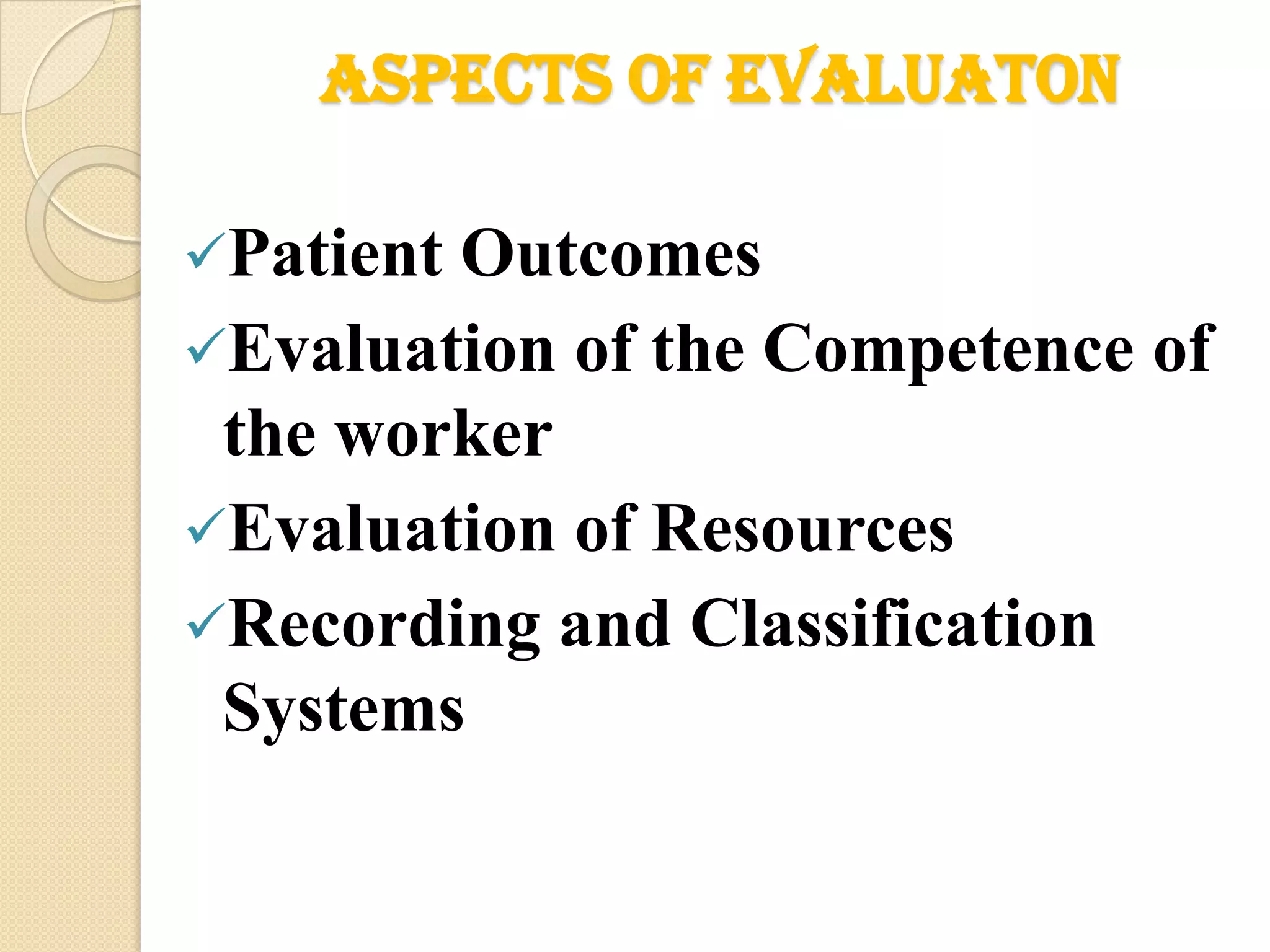
ASPECTS OF EVALUATONPatient Outcomes
Evaluation of the Competence of the worker
Evaluation of Resources
Recording and Classification SystemsPurposes of EvaluationClarify and define objectives.Facilitate the improvement programme.Determine participants progress towards the achievement of the goals of the programme.Facilitates the maintenance of strength and elimination of weakness on the part of participants.Motive the participants.Provide sense of accomplishments (psychological security) for the participants and consumer.
CONTD….Develop more reliable and valid instruments for measurement.Determine the overall value (eg: cost, efficiency) of undertaking for both participants and consumer immediately over long period.Establish and maintain standards to meet legal, professional and academic credentials.
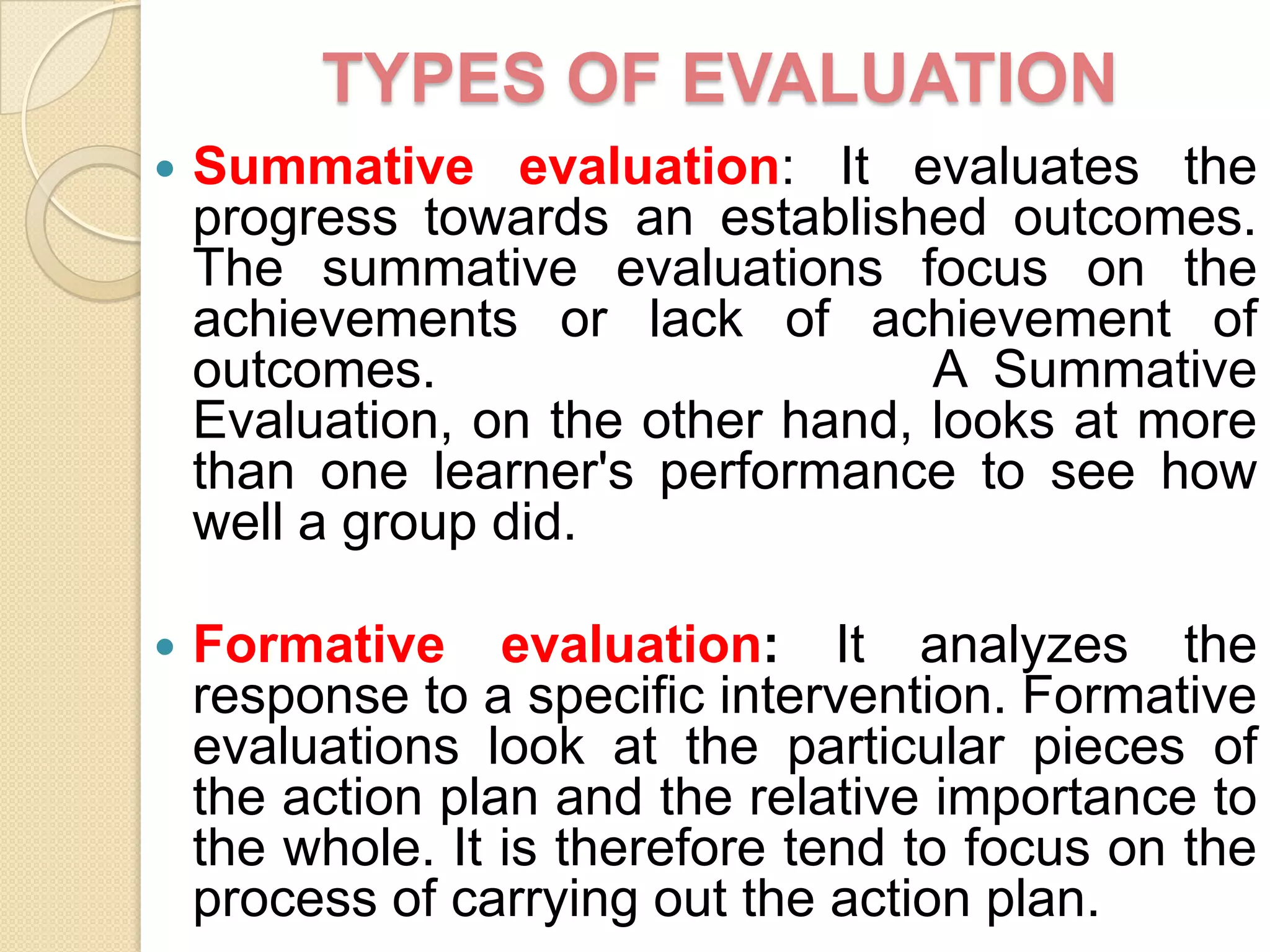
TYPES OF EVALUATIONSummative evaluation: It evaluates the progress towards an established outcomes. The summative evaluations focus on the achievements or lack of achievement of outcomes.                  A Summative Evaluation, on the other hand, looks at more than one learner's performance to see how well a group did.Formative evaluation: It analyzes the response to a specific intervention. Formative evaluations look at the particular pieces of the action plan and the relative importance to the whole. It is therefore tend to focus on the process of carrying out the action plan.
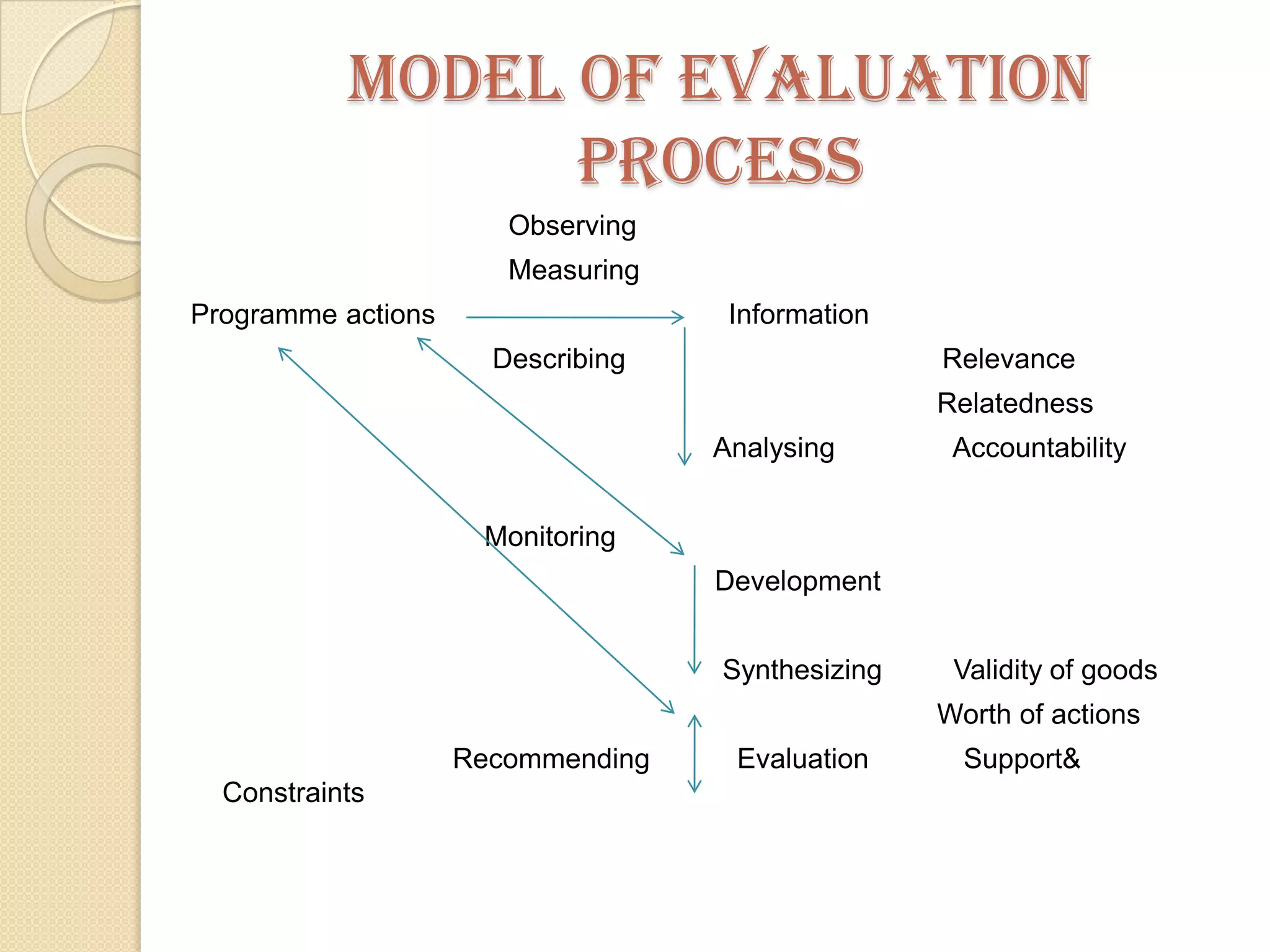
MODEL OF EVALUATION PROCESS                                         Observing                                        MeasuringProgramme actions                                     Information                                      Describing                                        Relevance                                                                                               RelatednessAnalysing               Accountability                                      Monitoring                                                                               Development                                                                    Synthesizing         Validity of goods                                                                                              Worth of actions                                  Recommending           Evaluation            Support& Constraints
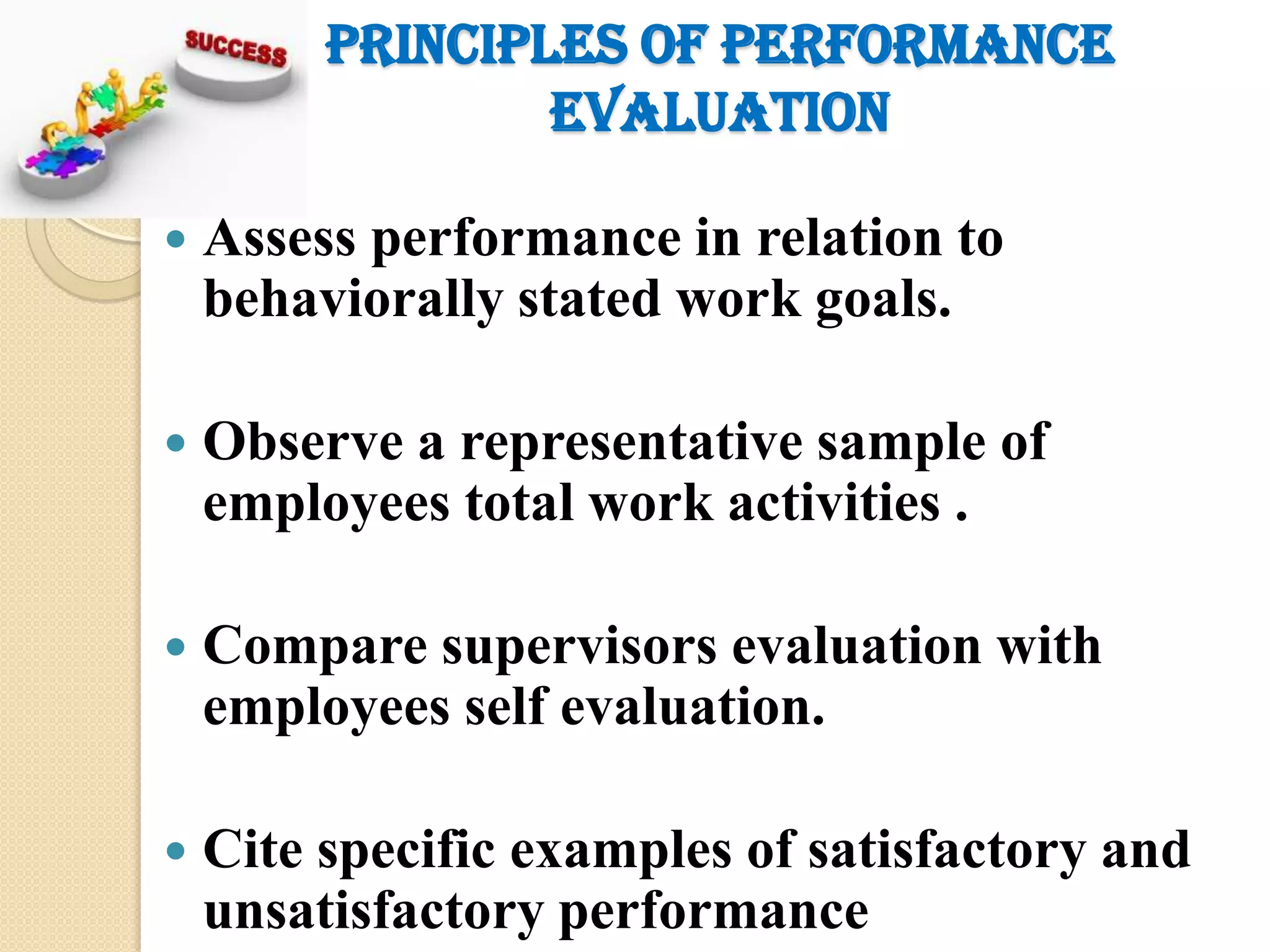
Principles of Performance EvaluationAssess performance in relation to behaviorally stated work goals.Observe a representative sample of employees total work activities .Compare supervisors evaluation with employees self evaluation.Cite specific examples of satisfactory and unsatisfactory performance
CONTD……Indicate which job areas have highest priority for improvement.Evaluation conference should be held in good atmosphere.The purpose of evaluation is to improve work performance and job satisfaction.
Tools of Performance AppraisalTrait rating scales(TRS)Job dimension scales(JDS)Behaviorally anchored rating scales(BARS)ChecklistsEssaysSelf appraisals.Management by objectives.Peer review-performance carried out by peers.
Evaluation as a function of Nursing Management :Fayol defined as “verifying whether everything occurs in conformity with the plan adopted, the instructions issued and principles established. It has for its object to point out weakness and error in order to rectify them and prevent recurrence”.Urwick defines controlling or evaluating as “seeing that everything is being carried out in accordance with the plan which has been adopted, the orders which have been given and the principles which have been laid down.
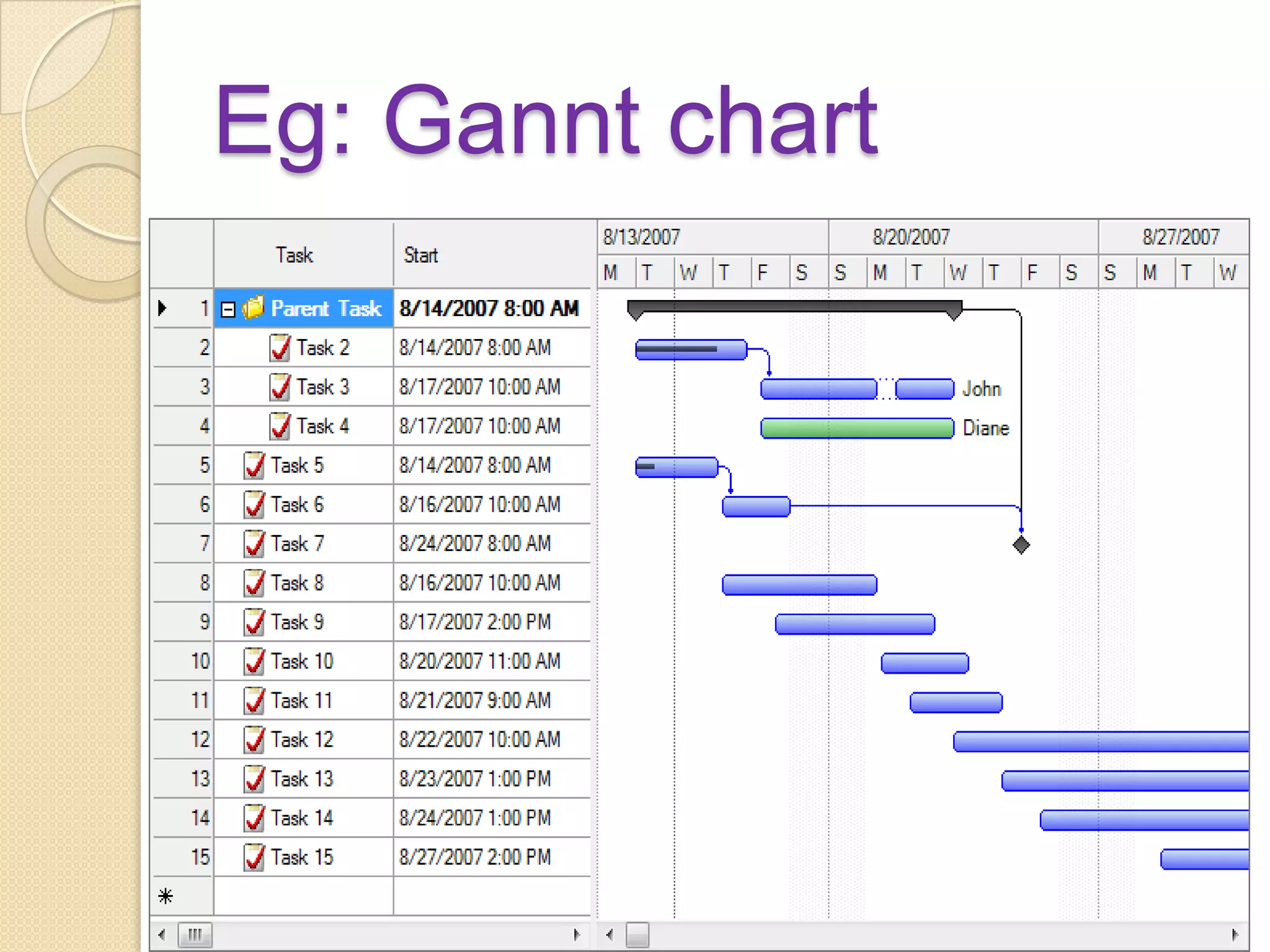
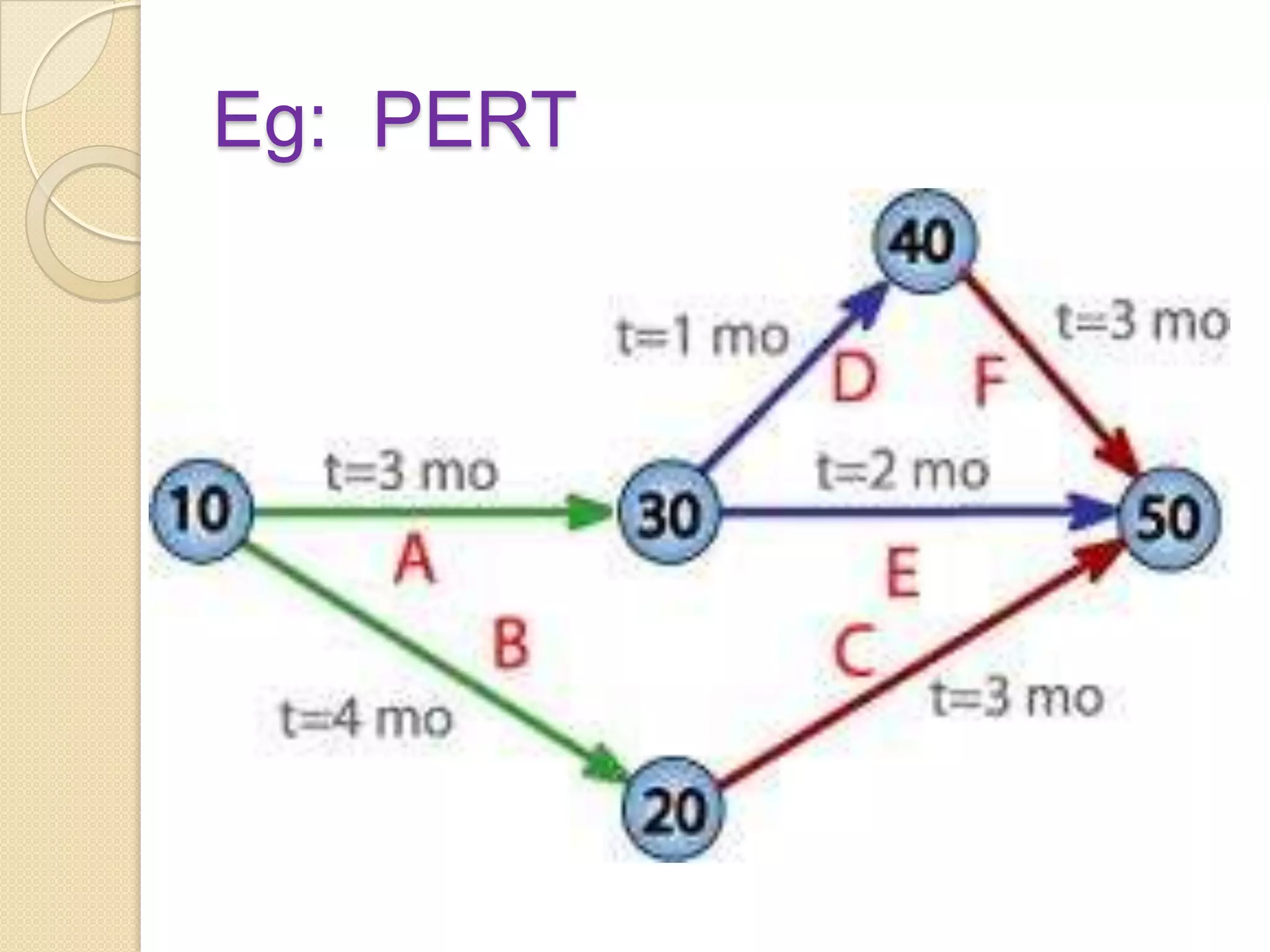
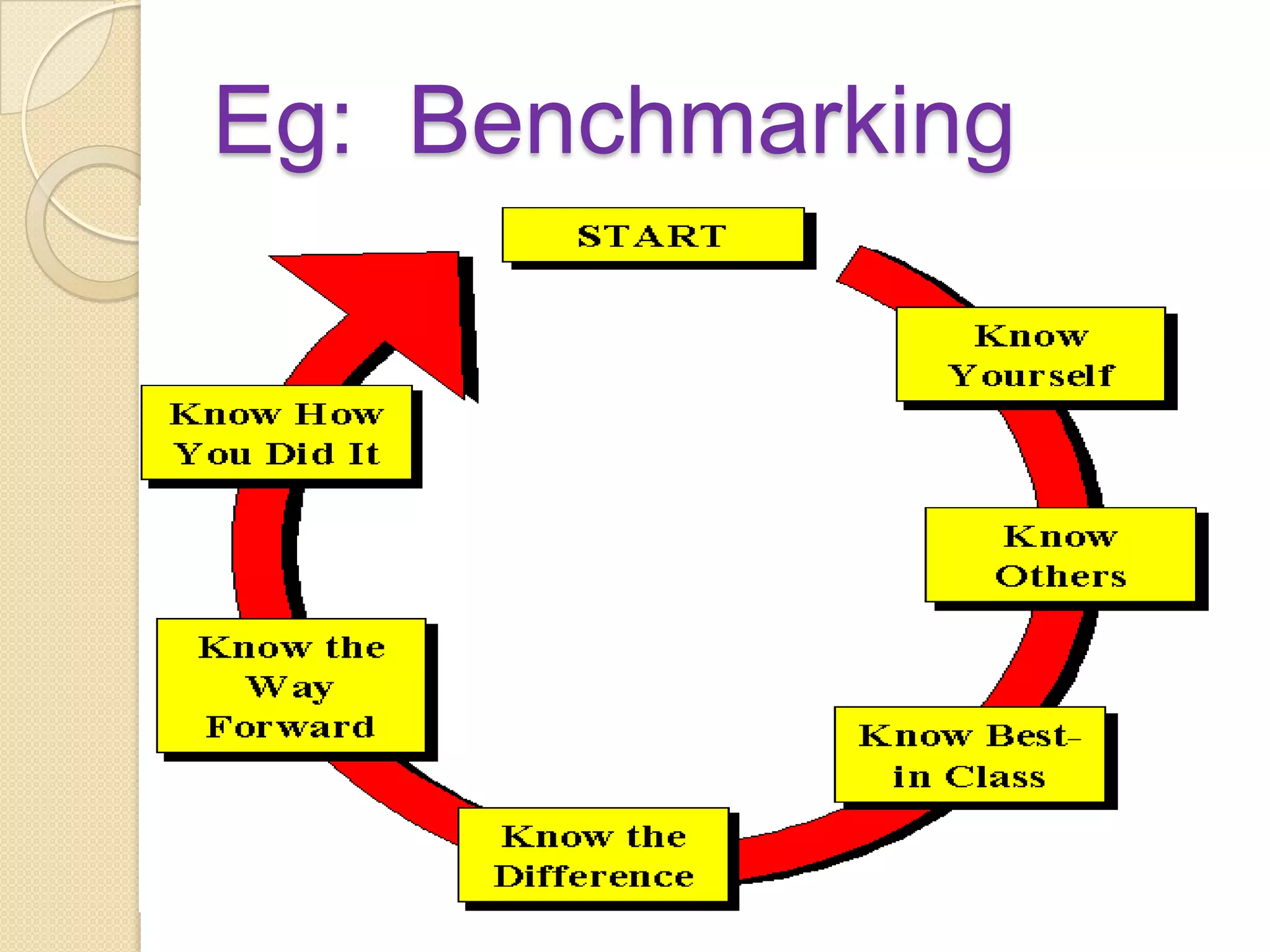
Controlling /Evaluating TechniquesNursing RoundsNursing Operating InstructionsGantt Charts Critical Control Points and MilestonesProgram Evaluation and Review Technique (PERT)BenchmarkingMaster Control PlanEvidence-Based Management

Evaluation ppt

  • 1.
    SELF EVALUATIONPEER EVALUATIONPATIENTSATISFACTIONUTILIZATION REVIEW&APPLICATION TO NURSING SERVICE
  • 2.
    EVALUATIONThe term evaluationis derived from the word ‘valoir’ which means ‘to be worth’. Evaluation is the process of judging the value or worth of an individuals achievements or characteristics.Evaluation is a decision making process that leads to suggestions for actions to improve participants’ effectiveness and program efficiency.
  • 3.
    SELF EVALUATIONSelf evaluationis defined as judging the quality of one’s work, based on evidence and explicit criteria, for the purpose of doing better work in the future.
  • 4.
    It is one of the best method of performance appraisal, if it can systematically introduce. Self evaluation is the way in which an individual views himself. PURPOSES OF SELF EVALUATIONTo encourage continuing self-evaluation and reflection and to promote an ongoing, innovative approach.
  • 5.
    To encourage individualprofessional growth in areas of interest to the employee
  • 6.
    To improve moraleand motivation by treating the employee as a professional in charge of his or her own professional growth.CONTD…….To encourage collegiality and discussion about practices among peers in an organization
  • 7.
    To support employeesas they experiment with approaches that will move them to higher levels of performanceBENEFITS OF SELF EVALUATIONIncreased confidence in their own learning, in trying out new ideas, in changing their practice and in their power to make a difference.Enthusiasm for collaborative working, despite initial anxieties about being observed and receiving feedbackImproved team-work and greater flexibility in their use of their skillsIncreased awareness of new techniques and greater insight into thinkingEnhanced planning skills to ensure more effective task management
  • 8.
    TOOLS FOR SELFEVALUATIONStaff annual professional review procedures
  • 9.
    Peer supportCoachingJoint preparationof materialsPlanningTeam buildingObservation can involve experts, can be informal or formal procedures. Feedback from such observation is very valuable.
  • 10.
    Audit checklist PEER EVALUATIONPeer review/Evaluation is a process by which employees of the same rank, profession and setting evaluate one another’s job performance against accepted standards. O’ Loughlin and Kaulbach
  • 11.
    METHODS OF PEEREVALUATIONDirect observationVideotaping Evaluation of course materialsAnalysis of portfolios
  • 12.
    PROCESS OF PEERREVIEWEstablish a policy requiring peer reviewsEstablish criteria for peer evaluationsProcedure for conducting peer evaluationsFaculty chosen to conduct peer evaluations shall be tenured and hold on academic rank higher than that of the faculty member being evaluated
  • 13.
    A written report,addressing the criteria, shall be prepared and signed by the evaluatorCONTD……..The department shall archive the written evaluations for use in future evaluations
  • 14.
    One copy ofthe peer evaluation shall be placed in the permanent personnel file of the person being evaluated
  • 15.
    All reports ofpeer evaluations shall be included in the tenure file, and are to be carefully reviewed at the departmentPATIENT SATISFACTION“Patient satisfaction is defined as a health care recipients reaction to salient aspects of the context, process, and result of their service experience.”- Pascoe (1983)“Patient satisfaction is defined as the extent of the resemblance between the expected quality of care and the actual received care.” - Scarding (1994)
  • 16.
    NEED FOR EVALUATINGPATIENT SATISFACTION Data about patient satisfaction equips nurses with useful information about the structure, process and outcome of nursing careIt is a requirement for therapeutic treatment and is equivalent to self therapy. Satisfied patients help themselves get healed faster because they are more willing to comply with treatment and adhere to instructions of health care providers, and thus have a shorter recovery time.
  • 17.
    METHODS OF MONITORINGPATIENT SATISFACTIONMedical auditQuality assurance committee reviewsIndices of nursing performancesJudgemental method
  • 18.
    COMPONENTS OF EVALUATIONOF PATIENT SATISFACTIONEvaluation of the programs and activities of various departments including outpatient care, inpatient care, overall health education activities of the hospitalEvaluation of the various resources available in the hospital for effective health careEvaluation of effectiveness of hospital personnel including medical, paramedical, nursing as well as non-medical employees of the hospital.Services are relevant to the needs of the population it serves.
  • 19.
     ULITILISATION REVIEW The utilisation review program includes determining appropriate hospital length of stay and necessary treatments for various illnesses and conditions and reviewing patient medical records on admission and at intervals during hospitalisation to ensure that the patient receives appropriate care.
  • 20.
    AIMS AND OBJECTIVESThemain aim is to curb the exploding health care costs with conservative use of hospitalisation and expensive diagnostic and treatment procedures.They work in liaison with a business organisation to provide healthcare services to the organisation’s employees at discounted rates.Cost containment to limit each patient’s diagnostic and treatment measures to the fewest, least expensive procedures that will relieve patient symptoms, avert costly complications, and return the patient to fullest possible function in the shortest time possible.
  • 21.
    UTILISATION REVIEW NURSEAutilization review nurse is a RN who reviews individual medical cases to confirm that they are getting the most appropriate care. They can work for insurance companies, determining whether or not care should be approved in specific situations, and they can also work in hospitals. Members of this profession do need to possess compassion, but they also need to be able to review situations dispassionately to make decisions which are fair, even if they may be uncomfortable. At a hospital, a utilization review nurse examines patient cases if the hospital feels that a patient may not be receiving the appropriate treatment.
  • 22.
    CONTD…….In an insurancecompany, the utilization review nurse inspects claims to determine whether or not they should be paid. The nurse weighs the patient's situation against the policy held by the patient, the standards of the insurance company, and the costs which may be involved in treatment. To work in this field, it is usually necessary to hold a current nursing license, and to have experience in the field.
  • 23.
    APPLICATION TO NURSINGSERVICES NEED FOR EVALUATIONAccording to WHO, Evaluation of Health services, is the systematic process of determining the extent to which an action or sets of actions were successful in the achievement of predetermined objectives. It involves measurement of adequacy, efficacy, effectiveness and efficiency of the service being evaluated. It renders possible the reallocation of priorities, changes in the assessment of needs, the planning and implementation of care and the management of resources.
  • 24.
  • 25.
    Evaluation of theCompetence of the worker
  • 26.
  • 27.
    Recording and ClassificationSystemsPurposes of EvaluationClarify and define objectives.Facilitate the improvement programme.Determine participants progress towards the achievement of the goals of the programme.Facilitates the maintenance of strength and elimination of weakness on the part of participants.Motive the participants.Provide sense of accomplishments (psychological security) for the participants and consumer.
  • 28.
    CONTD….Develop more reliableand valid instruments for measurement.Determine the overall value (eg: cost, efficiency) of undertaking for both participants and consumer immediately over long period.Establish and maintain standards to meet legal, professional and academic credentials.
  • 29.
    TYPES OF EVALUATIONSummativeevaluation: It evaluates the progress towards an established outcomes. The summative evaluations focus on the achievements or lack of achievement of outcomes. A Summative Evaluation, on the other hand, looks at more than one learner's performance to see how well a group did.Formative evaluation: It analyzes the response to a specific intervention. Formative evaluations look at the particular pieces of the action plan and the relative importance to the whole. It is therefore tend to focus on the process of carrying out the action plan.
  • 30.
    MODEL OF EVALUATIONPROCESS Observing MeasuringProgramme actions Information Describing Relevance RelatednessAnalysing Accountability Monitoring Development Synthesizing Validity of goods Worth of actions Recommending Evaluation Support& Constraints
  • 31.
    Principles of PerformanceEvaluationAssess performance in relation to behaviorally stated work goals.Observe a representative sample of employees total work activities .Compare supervisors evaluation with employees self evaluation.Cite specific examples of satisfactory and unsatisfactory performance
  • 32.
    CONTD……Indicate which jobareas have highest priority for improvement.Evaluation conference should be held in good atmosphere.The purpose of evaluation is to improve work performance and job satisfaction.
  • 33.
    Tools of PerformanceAppraisalTrait rating scales(TRS)Job dimension scales(JDS)Behaviorally anchored rating scales(BARS)ChecklistsEssaysSelf appraisals.Management by objectives.Peer review-performance carried out by peers.
  • 34.
    Evaluation as afunction of Nursing Management :Fayol defined as “verifying whether everything occurs in conformity with the plan adopted, the instructions issued and principles established. It has for its object to point out weakness and error in order to rectify them and prevent recurrence”.Urwick defines controlling or evaluating as “seeing that everything is being carried out in accordance with the plan which has been adopted, the orders which have been given and the principles which have been laid down.
  • 35.
    Controlling /Evaluating TechniquesNursingRoundsNursing Operating InstructionsGantt Charts Critical Control Points and MilestonesProgram Evaluation and Review Technique (PERT)BenchmarkingMaster Control PlanEvidence-Based Management
  • 36.
  • 37.
  • 38.