SUBMITTED TO :
Dr. Shelly
There are two methods to estimate the need for
hospital in a population:

 Analytical method : Taking feedback and
analysis of data collected through survey e.g.
distributing questionnaire.

 Estimation method
Planning (also called forethought/forecasting) is the
process of thinking about and organizing the activities
required to achieve a desired goal.
1.What we expect to do?
        2.Why it will be done ?
        3.Where will it be done ?
        4.When we expect to do it?
        5.Who all are going to do it ?
        6.How will it be done ?

Excellent firms don’t believe in excellence – only in constant improvement and
constant change – Tom Peters
Community interest over individual interest

Preventive services over curative services

Services catering to the weaker sections of the
 community

Rural over Urban

Regionalized Planning
   Geographic Data
   Morbidity & Mortality Status
   Need & Demand
   Details of existing Facilities
   Financial Feasibility
   Demographic Details

        Population Strength
        Sex & Age Ration
        Social Status
        Educational level
Must meet the needs of the patient it is going to
 serve adequately.

It must be in a size and proportions which the
 owners or promoters will be able to build and
 operate
Sound architectural plan
Economic viability
Effective community orientation
Quality patient care
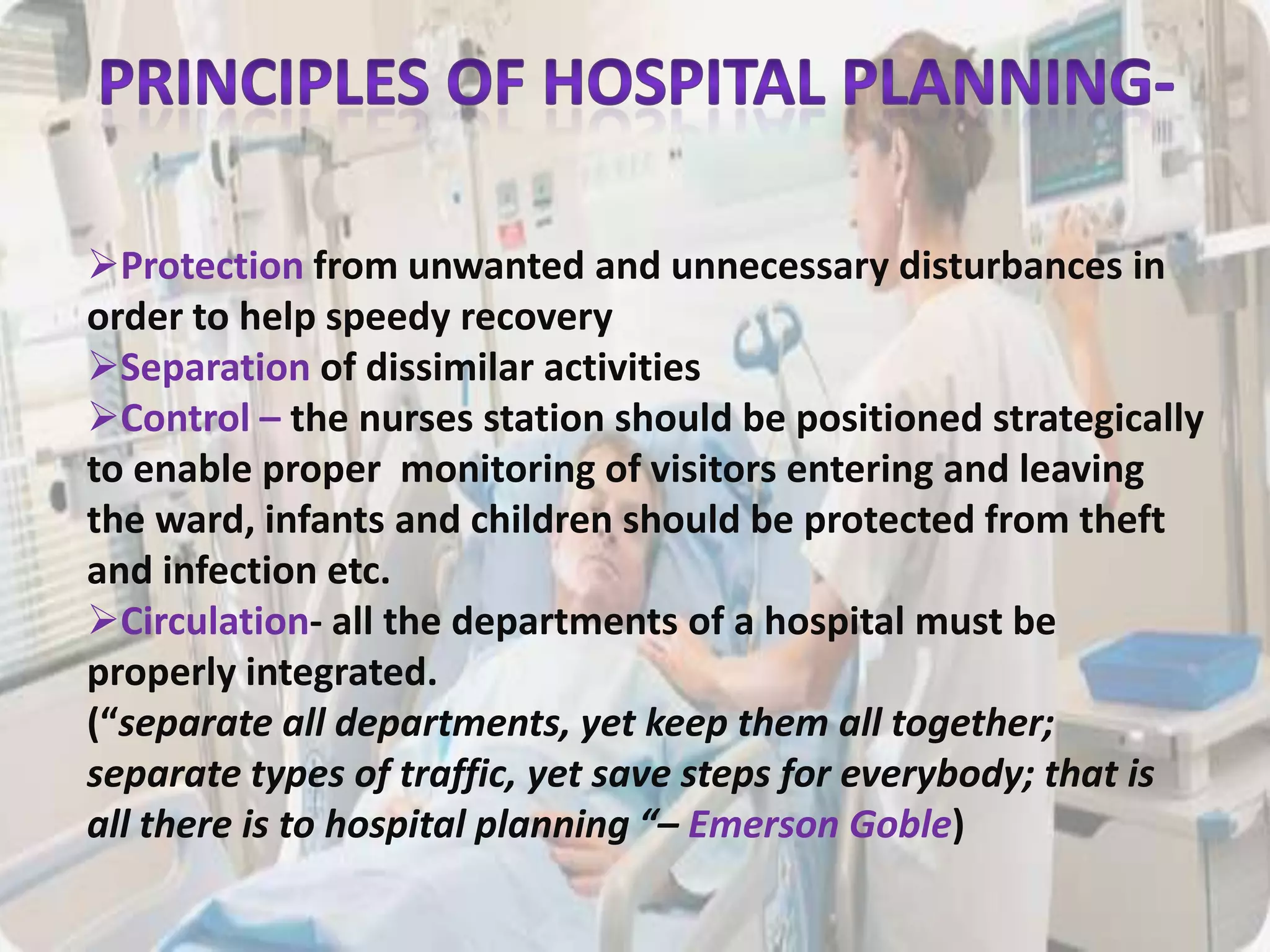
Protection from unwanted and unnecessary disturbances in
order to help speedy recovery
Separation of dissimilar activities
Control – the nurses station should be positioned strategically
to enable proper monitoring of visitors entering and leaving
the ward, infants and children should be protected from theft
and infection etc.
Circulation- all the departments of a hospital must be
properly integrated.
(“separate all departments, yet keep them all together;
separate types of traffic, yet save steps for everybody; that is
all there is to hospital planning “– Emerson Goble)
Needs of the community
       Ease of accessibility
       Range of services offered
       Availability of specialists
       Availability of technology
Study of existing hospital(if any)
Requirements of staff and services
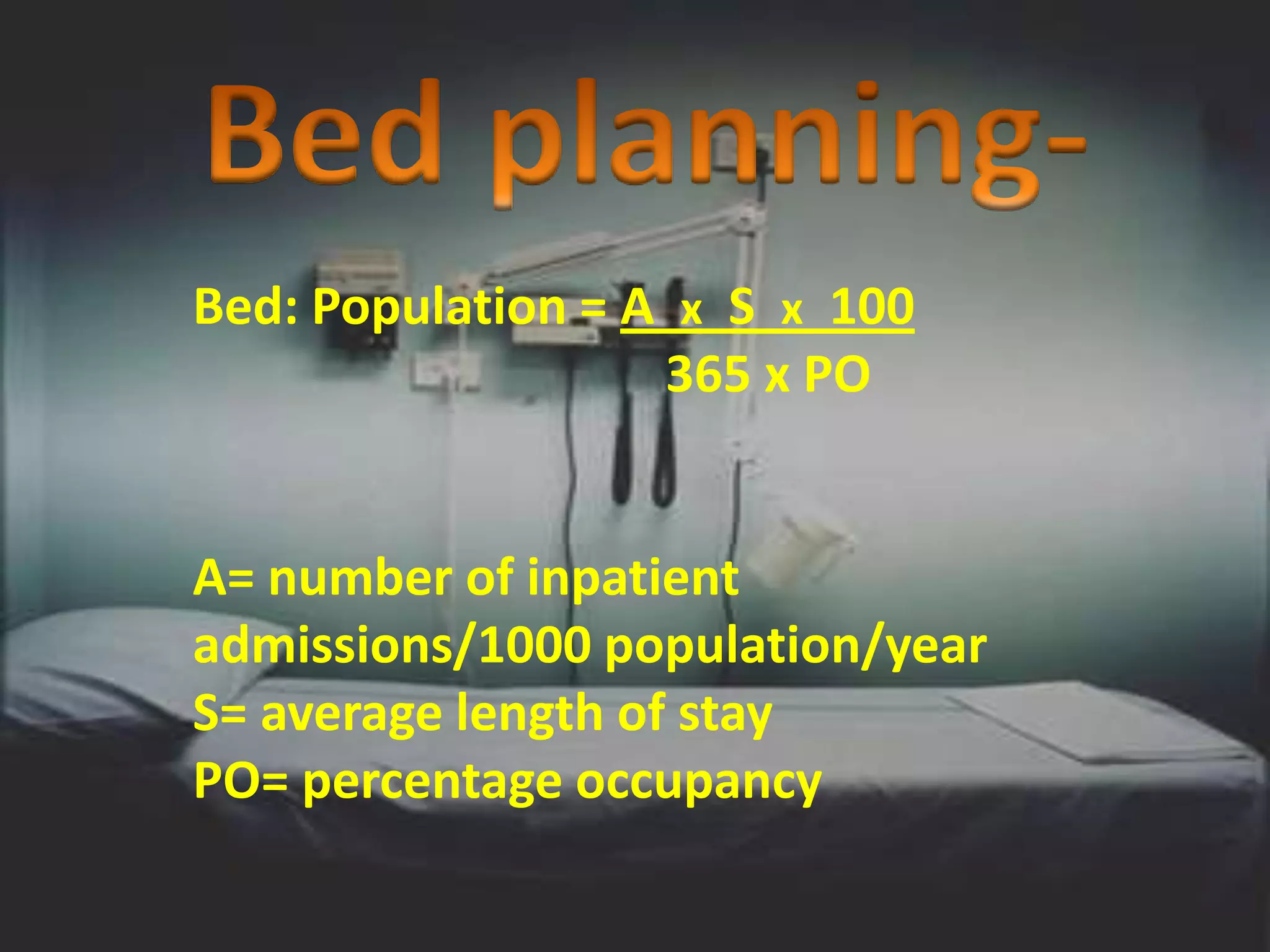
Bed: Population = A x S x 100
                   365 x PO


A= number of inpatient
admissions/1000 population/year
S= average length of stay
PO= percentage occupancy
Planning of finances-
Funds required for constructing, furnishing
 and equipping the hospital.

Operating funds- salaries, loans and
 interest, other maintenance expenses.

Arranging financial assistance-patient fees,
 bed charges, and other modes of revenue
 generation process.
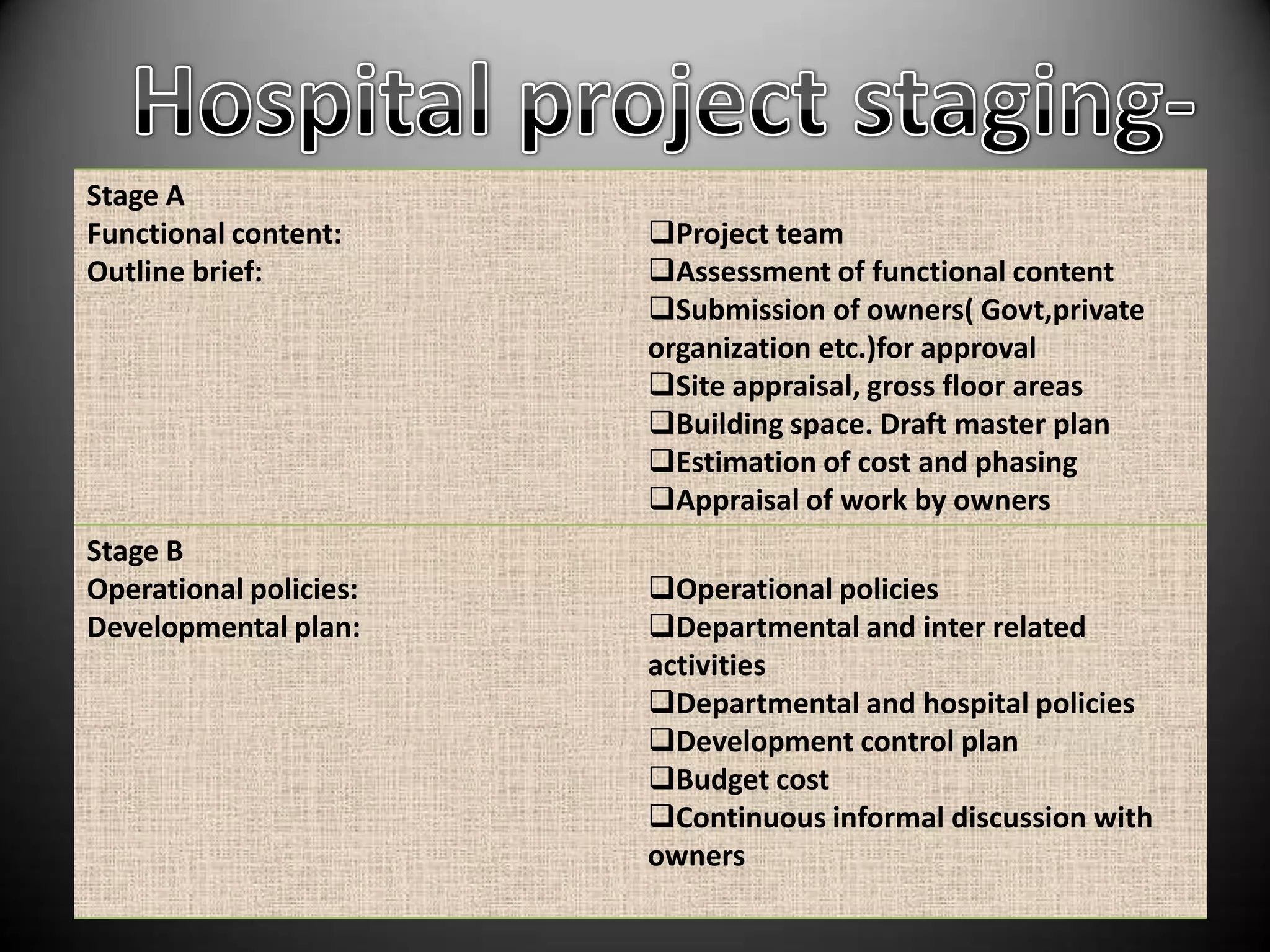
Stage A
Functional content:     Project team
Outline brief:          Assessment of functional content
                        Submission of owners( Govt,private
                        organization etc.)for approval
                        Site appraisal, gross floor areas
                        Building space. Draft master plan
                        Estimation of cost and phasing
                        Appraisal of work by owners
Stage B
Operational policies:   Operational policies
Developmental plan:     Departmental and inter related
                        activities
                        Departmental and hospital policies
                        Development control plan
                        Budget cost
                        Continuous informal discussion with
                        owners
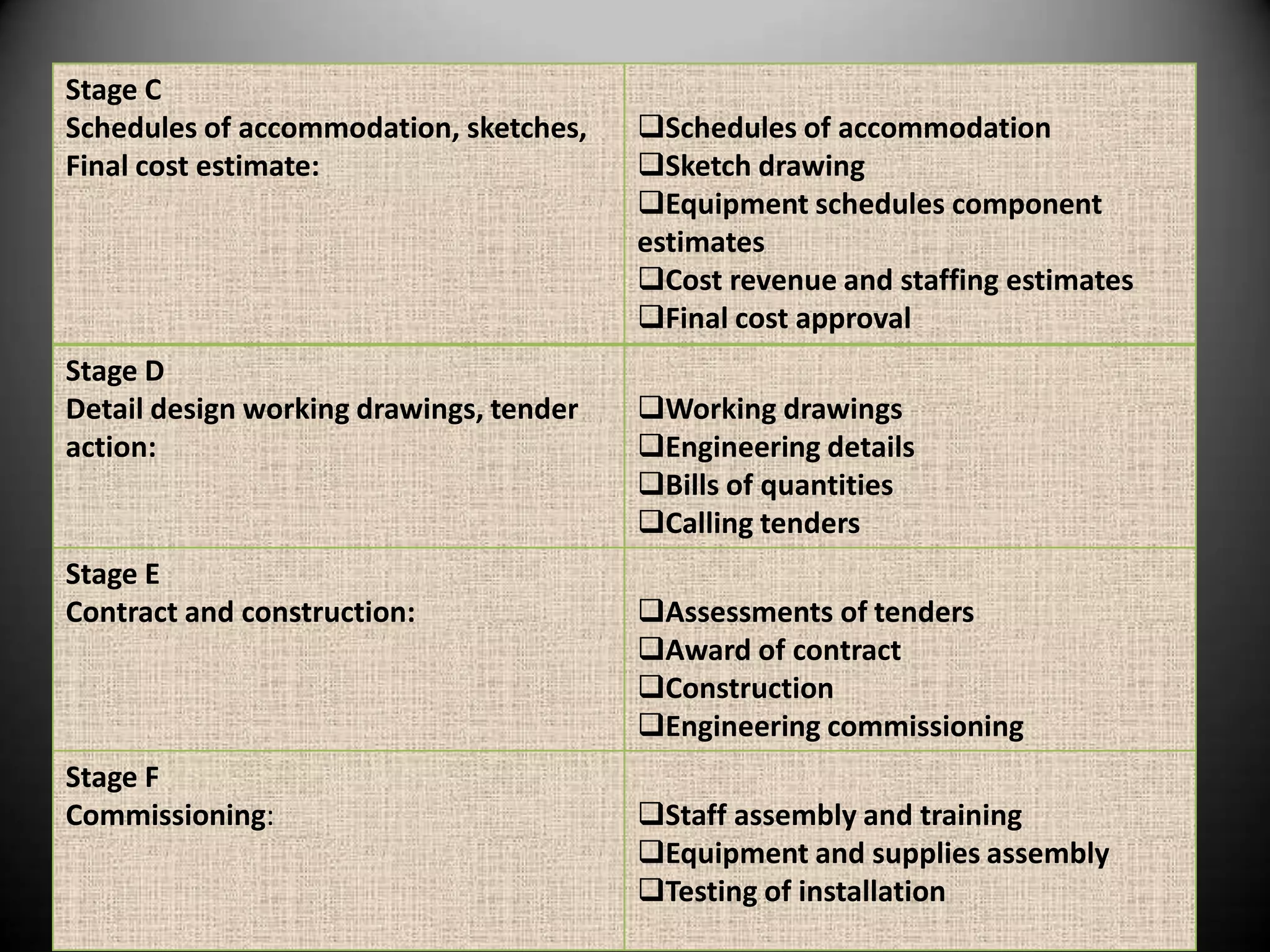
Stage C
Schedules of accommodation, sketches,    Schedules of accommodation
Final cost estimate:                     Sketch drawing
                                         Equipment schedules component
                                         estimates
                                         Cost revenue and staffing estimates
                                         Final cost approval
Stage D
Detail design working drawings, tender   Working drawings
action:                                  Engineering details
                                         Bills of quantities
                                         Calling tenders
Stage E
Contract and construction:               Assessments of tenders
                                         Award of contract
                                         Construction
                                         Engineering commissioning
Stage F
Commissioning:                           Staff assembly and training
                                         Equipment and supplies assembly
                                         Testing of installation
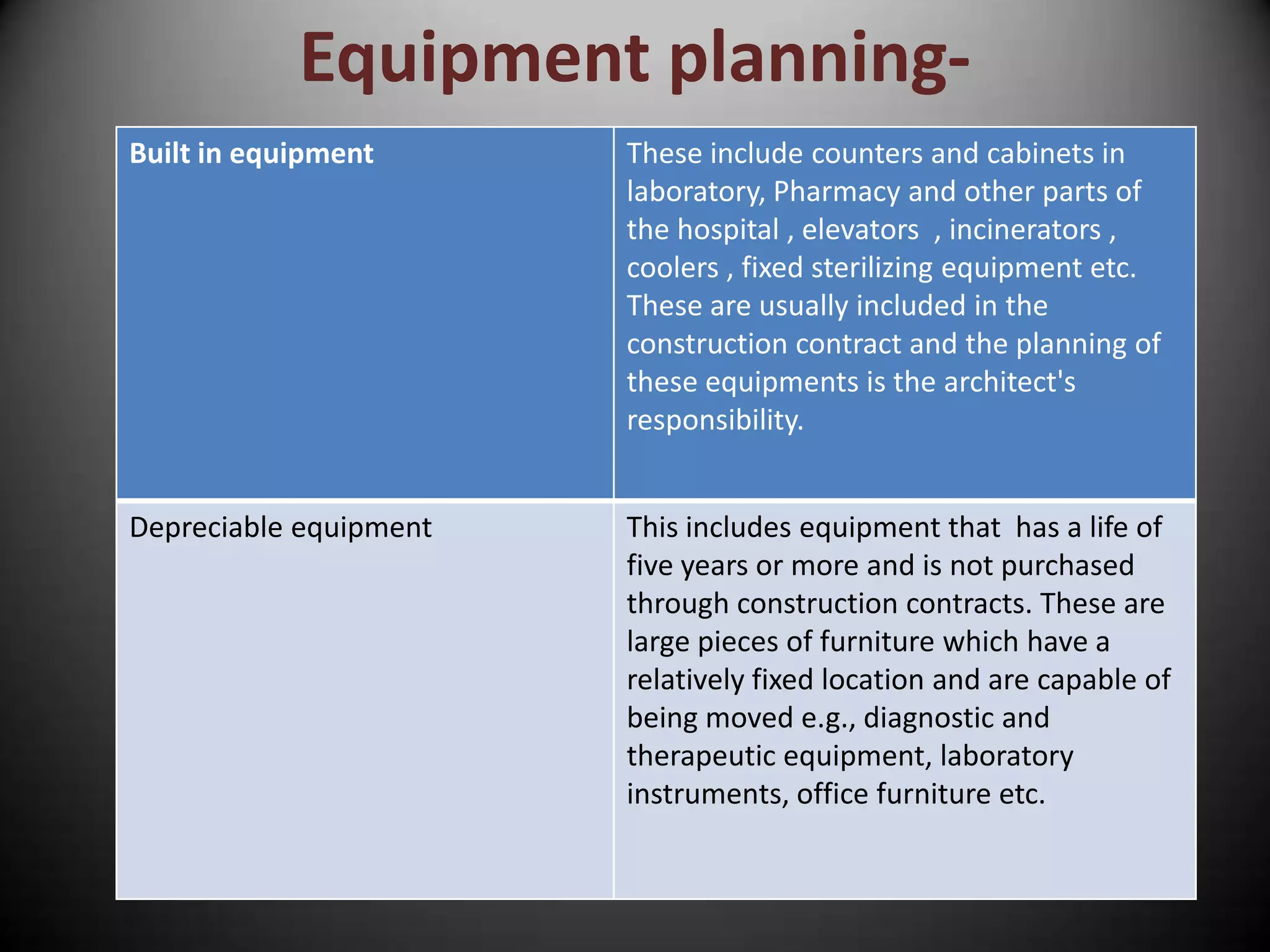
Equipment planning-
Built in equipment      These include counters and cabinets in
                        laboratory, Pharmacy and other parts of
                        the hospital , elevators , incinerators ,
                        coolers , fixed sterilizing equipment etc.
                        These are usually included in the
                        construction contract and the planning of
                        these equipments is the architect's
                        responsibility.


Depreciable equipment   This includes equipment that has a life of
                        five years or more and is not purchased
                        through construction contracts. These are
                        large pieces of furniture which have a
                        relatively fixed location and are capable of
                        being moved e.g., diagnostic and
                        therapeutic equipment, laboratory
                        instruments, office furniture etc.
Non depreciable equipment   These are small items with a low unit
                            cost and life span of less than five years.
                            These are generally under the control of
                            the store room and are bought through
                            other than construction contracts. They
                            include kitchen utencils,surgical
                            instruments,linen,waste baskets etc.
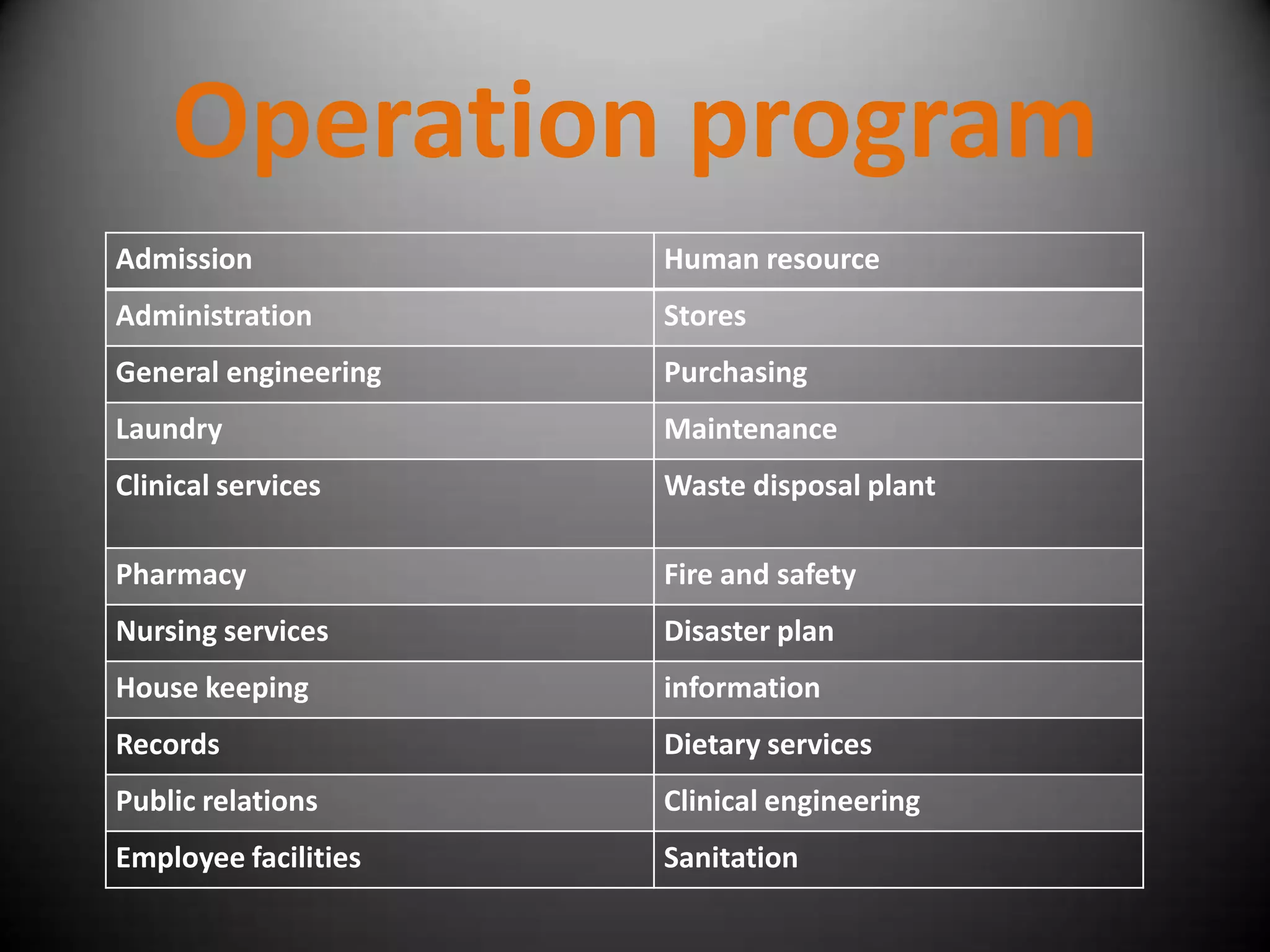
Operation program
Admission             Human resource
Administration        Stores
General engineering   Purchasing
Laundry               Maintenance
Clinical services     Waste disposal plant

Pharmacy              Fire and safety
Nursing services      Disaster plan
House keeping         information
Records               Dietary services
Public relations      Clinical engineering
Employee facilities   Sanitation
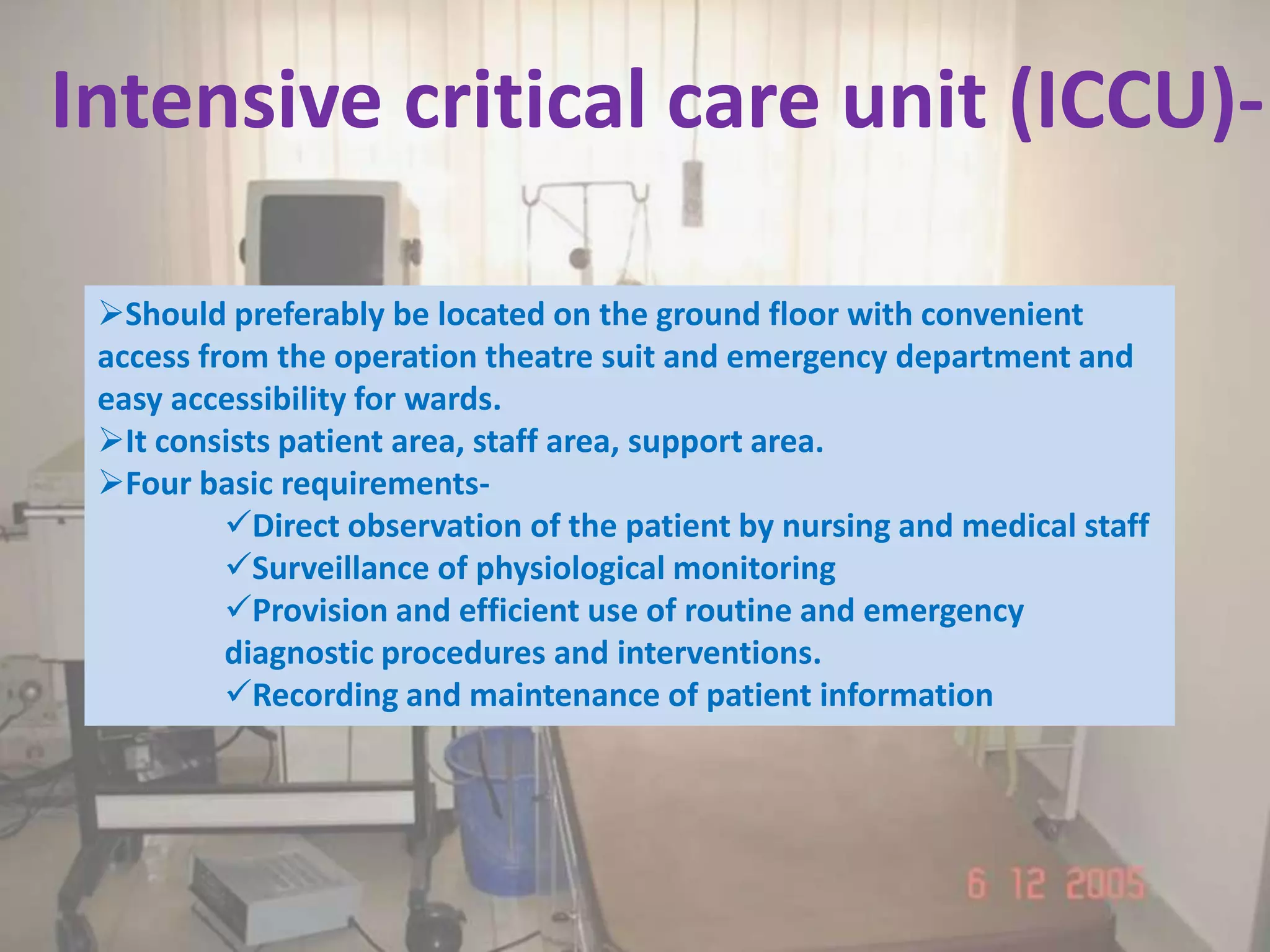
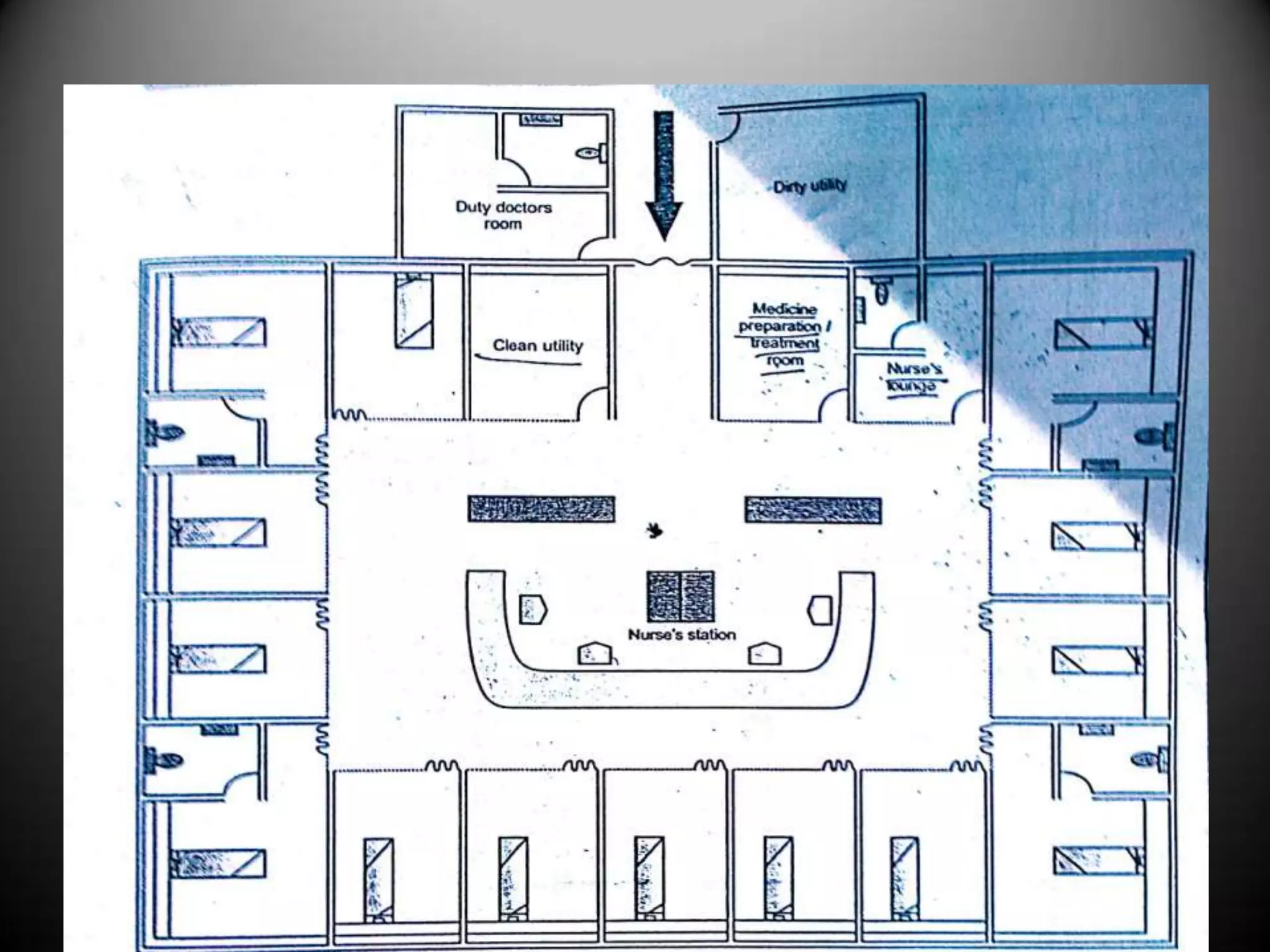
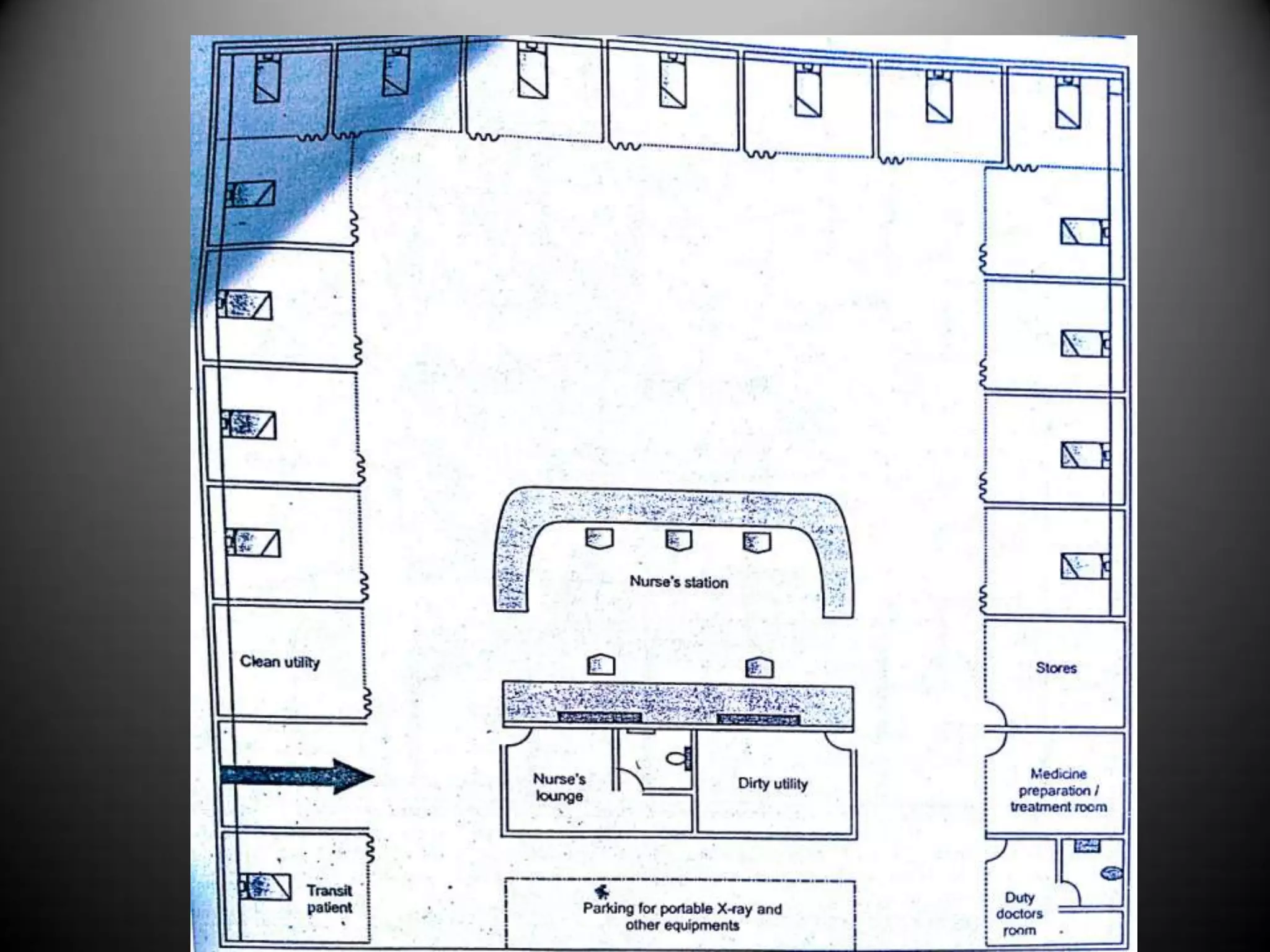
Intensive critical care unit (ICCU)-

 Should preferably be located on the ground floor with convenient
 access from the operation theatre suit and emergency department and
 easy accessibility for wards.
 It consists patient area, staff area, support area.
 Four basic requirements-
          Direct observation of the patient by nursing and medical staff
          Surveillance of physiological monitoring
          Provision and efficient use of routine and emergency
          diagnostic procedures and interventions.
          Recording and maintenance of patient information
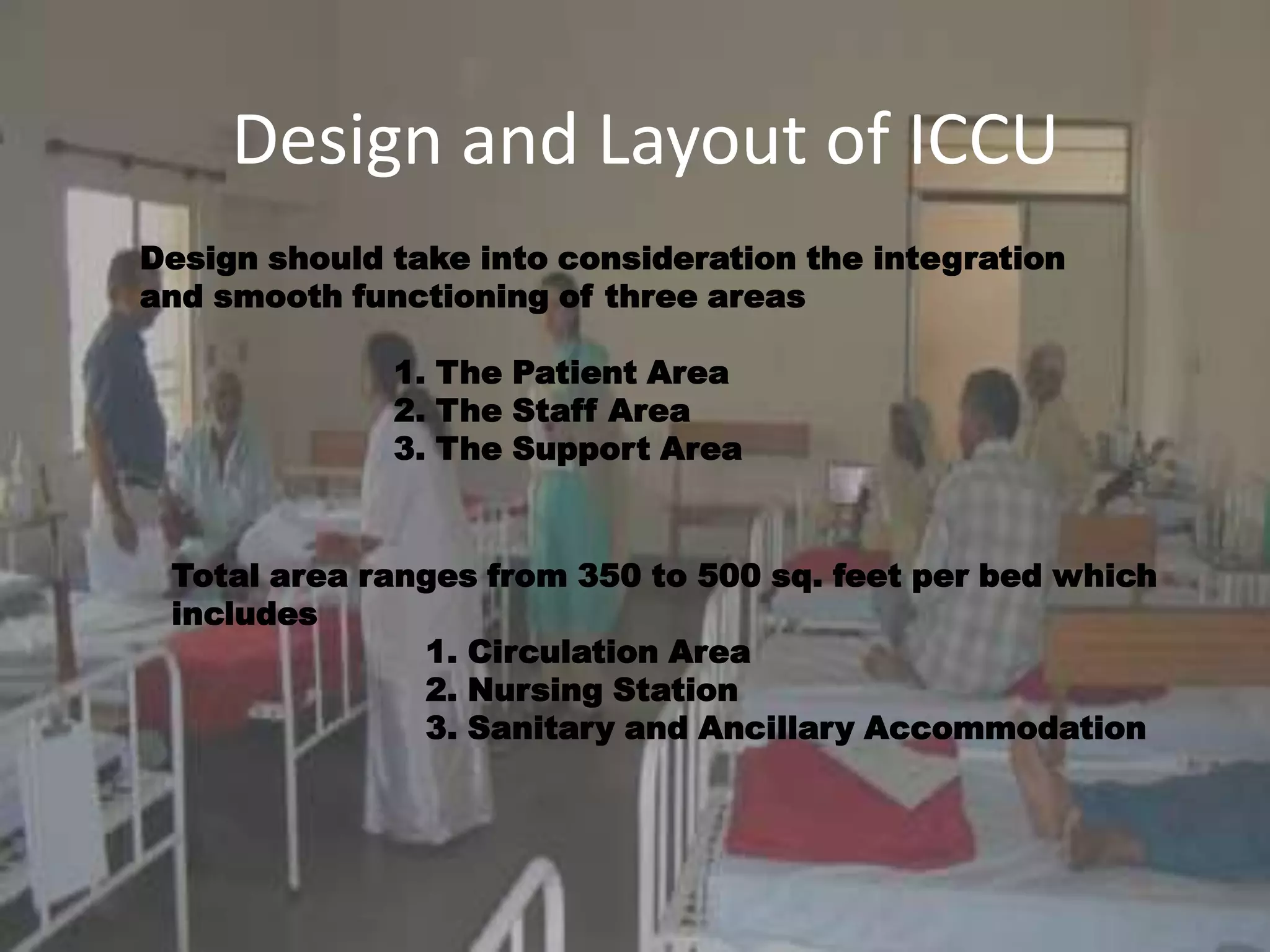
Design and Layout of ICCU
Design should take into consideration the integration
and smooth functioning of three areas

              1. The Patient Area
              2. The Staff Area
              3. The Support Area


 Total area ranges from 350 to 500 sq. feet per bed which
 includes
               1. Circulation Area
               2. Nursing Station
               3. Sanitary and Ancillary Accommodation
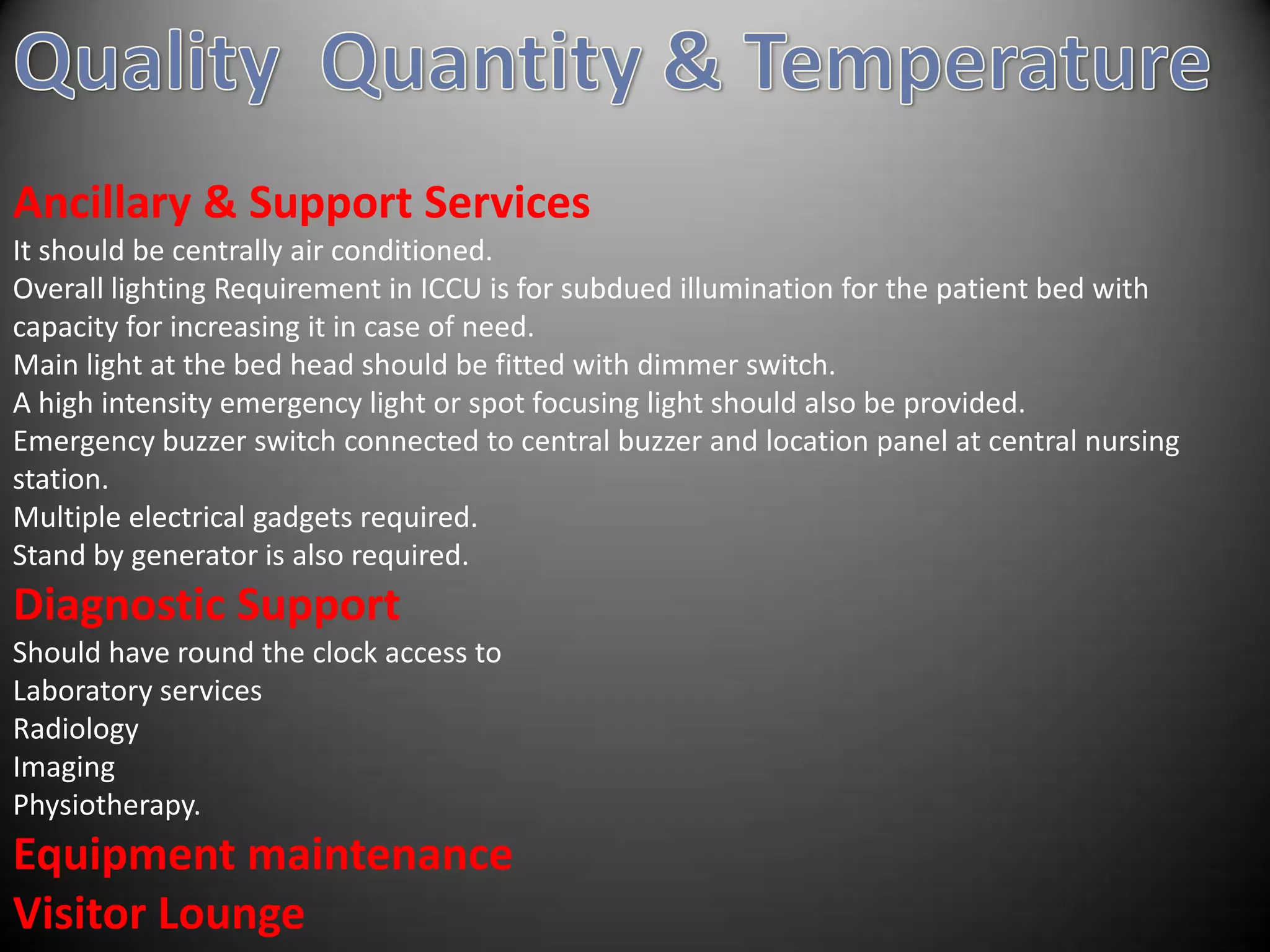
Ancillary & Support Services
It should be centrally air conditioned.
Overall lighting Requirement in ICCU is for subdued illumination for the patient bed with
capacity for increasing it in case of need.
Main light at the bed head should be fitted with dimmer switch.
A high intensity emergency light or spot focusing light should also be provided.
Emergency buzzer switch connected to central buzzer and location panel at central nursing
station.
Multiple electrical gadgets required.
Stand by generator is also required.
Diagnostic Support
Should have round the clock access to
Laboratory services
Radiology
Imaging
Physiotherapy.
Equipment maintenance
Visitor Lounge
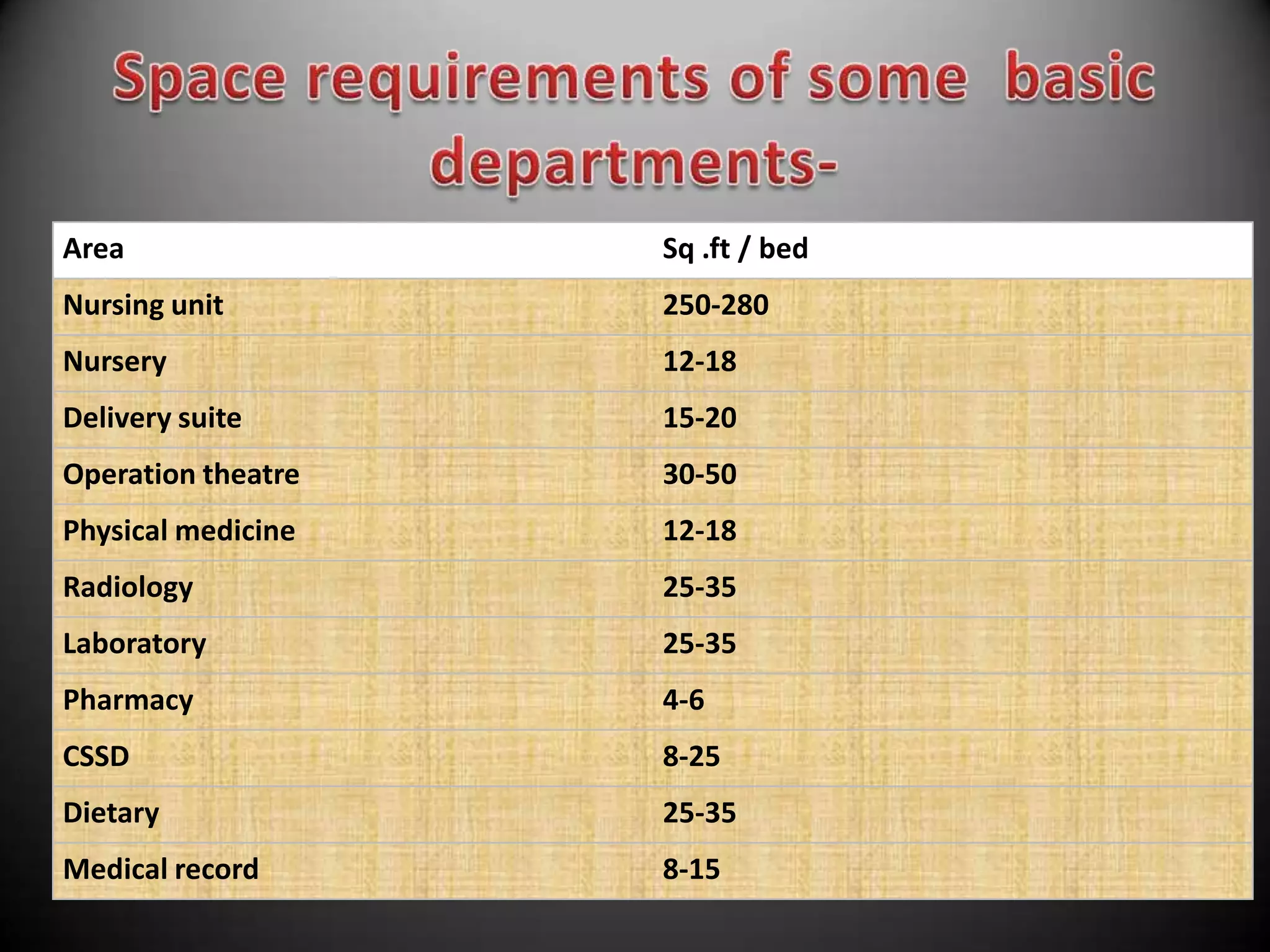
Area                Sq .ft / bed
Nursing unit        250-280
Nursery             12-18
Delivery suite      15-20
Operation theatre   30-50
Physical medicine   12-18
Radiology           25-35
Laboratory          25-35
Pharmacy            4-6
CSSD                8-25
Dietary             25-35
Medical record      8-15
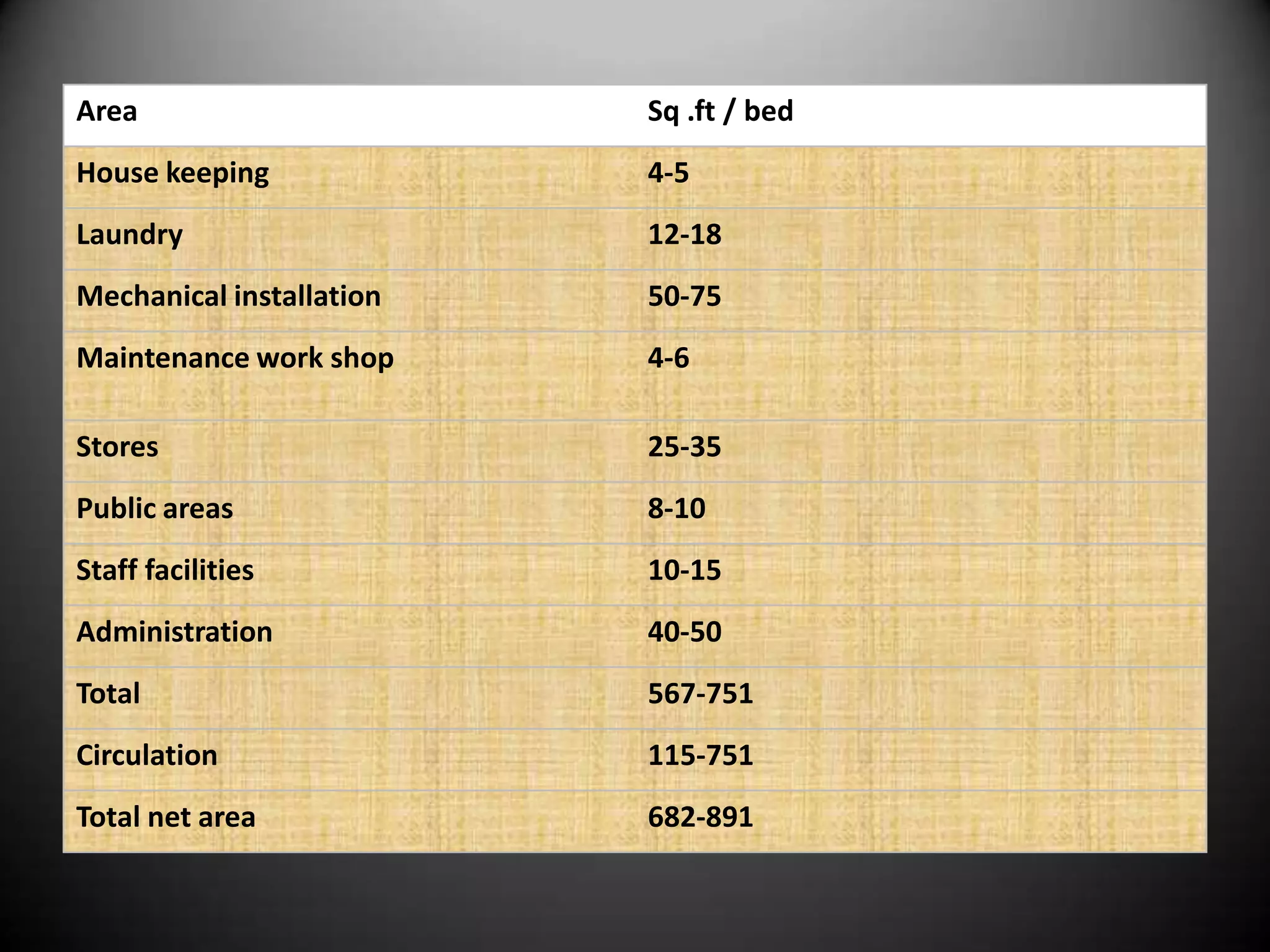
Area                      Sq .ft / bed
House keeping             4-5
Laundry                   12-18
Mechanical installation   50-75
Maintenance work shop     4-6

Stores                    25-35
Public areas              8-10
Staff facilities          10-15
Administration            40-50
Total                     567-751
Circulation               115-751
Total net area            682-891
Hospital administrators and staff have an ongoing
concern with controlling unwanted noise in their
facilities. Patient comfort, employee satisfaction
and environmental concerns are always at the
forefront in the continuous design and
maintenance of a wide array of systems that keep
a medical facility running efficiently.
Quantity
Price
Source
Quality
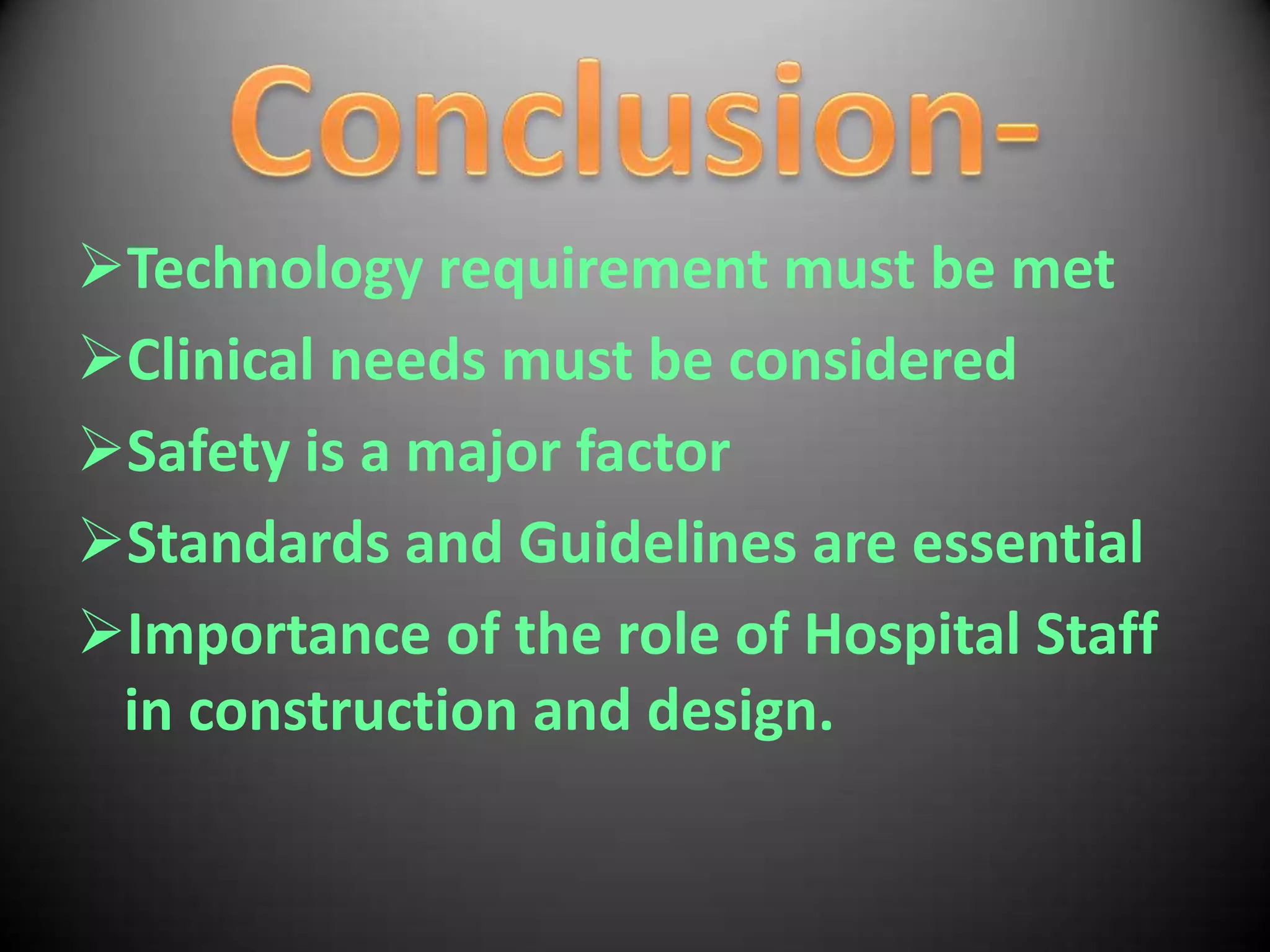
Technology requirement must be met
Clinical needs must be considered
Safety is a major factor
Standards and Guidelines are essential
Importance of the role of Hospital Staff
 in construction and design.
A hospital is a living organism, made up of
many different parts , having different
functions, but all theses must be in due
proportion and relation to each other and to
the environment to produce the desired
result - Dr S Billings
Final hospital planning and layout ppt

Final hospital planning and layout ppt

  • 1.
  • 2.
    There are twomethods to estimate the need for hospital in a population:  Analytical method : Taking feedback and analysis of data collected through survey e.g. distributing questionnaire.  Estimation method
  • 3.
    Planning (also calledforethought/forecasting) is the process of thinking about and organizing the activities required to achieve a desired goal.
  • 4.
    1.What we expectto do? 2.Why it will be done ? 3.Where will it be done ? 4.When we expect to do it? 5.Who all are going to do it ? 6.How will it be done ? Excellent firms don’t believe in excellence – only in constant improvement and constant change – Tom Peters
  • 5.
    Community interest overindividual interest Preventive services over curative services Services catering to the weaker sections of the community Rural over Urban Regionalized Planning
  • 6.
    Geographic Data  Morbidity & Mortality Status  Need & Demand  Details of existing Facilities  Financial Feasibility  Demographic Details Population Strength Sex & Age Ration Social Status Educational level
  • 7.
    Must meet theneeds of the patient it is going to serve adequately. It must be in a size and proportions which the owners or promoters will be able to build and operate
  • 8.
    Sound architectural plan Economicviability Effective community orientation Quality patient care
  • 9.
    Protection from unwantedand unnecessary disturbances in order to help speedy recovery Separation of dissimilar activities Control – the nurses station should be positioned strategically to enable proper monitoring of visitors entering and leaving the ward, infants and children should be protected from theft and infection etc. Circulation- all the departments of a hospital must be properly integrated. (“separate all departments, yet keep them all together; separate types of traffic, yet save steps for everybody; that is all there is to hospital planning “– Emerson Goble)
  • 10.
    Needs of thecommunity Ease of accessibility Range of services offered Availability of specialists Availability of technology Study of existing hospital(if any) Requirements of staff and services
  • 11.
    Bed: Population =A x S x 100 365 x PO A= number of inpatient admissions/1000 population/year S= average length of stay PO= percentage occupancy
  • 12.
    Planning of finances- Fundsrequired for constructing, furnishing and equipping the hospital. Operating funds- salaries, loans and interest, other maintenance expenses. Arranging financial assistance-patient fees, bed charges, and other modes of revenue generation process.
  • 14.
    Stage A Functional content: Project team Outline brief: Assessment of functional content Submission of owners( Govt,private organization etc.)for approval Site appraisal, gross floor areas Building space. Draft master plan Estimation of cost and phasing Appraisal of work by owners Stage B Operational policies: Operational policies Developmental plan: Departmental and inter related activities Departmental and hospital policies Development control plan Budget cost Continuous informal discussion with owners
  • 15.
    Stage C Schedules ofaccommodation, sketches, Schedules of accommodation Final cost estimate: Sketch drawing Equipment schedules component estimates Cost revenue and staffing estimates Final cost approval Stage D Detail design working drawings, tender Working drawings action: Engineering details Bills of quantities Calling tenders Stage E Contract and construction: Assessments of tenders Award of contract Construction Engineering commissioning Stage F Commissioning: Staff assembly and training Equipment and supplies assembly Testing of installation
  • 16.
    Equipment planning- Built inequipment These include counters and cabinets in laboratory, Pharmacy and other parts of the hospital , elevators , incinerators , coolers , fixed sterilizing equipment etc. These are usually included in the construction contract and the planning of these equipments is the architect's responsibility. Depreciable equipment This includes equipment that has a life of five years or more and is not purchased through construction contracts. These are large pieces of furniture which have a relatively fixed location and are capable of being moved e.g., diagnostic and therapeutic equipment, laboratory instruments, office furniture etc.
  • 17.
    Non depreciable equipment These are small items with a low unit cost and life span of less than five years. These are generally under the control of the store room and are bought through other than construction contracts. They include kitchen utencils,surgical instruments,linen,waste baskets etc.
  • 18.
    Operation program Admission Human resource Administration Stores General engineering Purchasing Laundry Maintenance Clinical services Waste disposal plant Pharmacy Fire and safety Nursing services Disaster plan House keeping information Records Dietary services Public relations Clinical engineering Employee facilities Sanitation
  • 19.
    Intensive critical careunit (ICCU)- Should preferably be located on the ground floor with convenient access from the operation theatre suit and emergency department and easy accessibility for wards. It consists patient area, staff area, support area. Four basic requirements- Direct observation of the patient by nursing and medical staff Surveillance of physiological monitoring Provision and efficient use of routine and emergency diagnostic procedures and interventions. Recording and maintenance of patient information
  • 20.
    Design and Layoutof ICCU Design should take into consideration the integration and smooth functioning of three areas 1. The Patient Area 2. The Staff Area 3. The Support Area Total area ranges from 350 to 500 sq. feet per bed which includes 1. Circulation Area 2. Nursing Station 3. Sanitary and Ancillary Accommodation
  • 23.
    Ancillary & SupportServices It should be centrally air conditioned. Overall lighting Requirement in ICCU is for subdued illumination for the patient bed with capacity for increasing it in case of need. Main light at the bed head should be fitted with dimmer switch. A high intensity emergency light or spot focusing light should also be provided. Emergency buzzer switch connected to central buzzer and location panel at central nursing station. Multiple electrical gadgets required. Stand by generator is also required. Diagnostic Support Should have round the clock access to Laboratory services Radiology Imaging Physiotherapy. Equipment maintenance Visitor Lounge
  • 24.
    Area Sq .ft / bed Nursing unit 250-280 Nursery 12-18 Delivery suite 15-20 Operation theatre 30-50 Physical medicine 12-18 Radiology 25-35 Laboratory 25-35 Pharmacy 4-6 CSSD 8-25 Dietary 25-35 Medical record 8-15
  • 25.
    Area Sq .ft / bed House keeping 4-5 Laundry 12-18 Mechanical installation 50-75 Maintenance work shop 4-6 Stores 25-35 Public areas 8-10 Staff facilities 10-15 Administration 40-50 Total 567-751 Circulation 115-751 Total net area 682-891
  • 26.
    Hospital administrators andstaff have an ongoing concern with controlling unwanted noise in their facilities. Patient comfort, employee satisfaction and environmental concerns are always at the forefront in the continuous design and maintenance of a wide array of systems that keep a medical facility running efficiently.
  • 27.
  • 28.
    Technology requirement mustbe met Clinical needs must be considered Safety is a major factor Standards and Guidelines are essential Importance of the role of Hospital Staff in construction and design.
  • 29.
    A hospital isa living organism, made up of many different parts , having different functions, but all theses must be in due proportion and relation to each other and to the environment to produce the desired result - Dr S Billings