PROFESSIONAL ADVANCEMENT
-GreeshmaMinesh
INTRODUCTION
• Continuing professional advancement activities for
nurses are planned and organized learning
experiences, designed to advance personal and
professional development.
• Activities can include the attendance of workshops
or conferences, reading of journal articles and the
undertaking of postgraduate nursing course.
• Professional development maybe undertaken in
the form of postgraduate courses, vocational
education and continuing professional development
DEFINITION
• Continuing professional advancement is defined as
a means by which members of profession maintain
their knowledge & skills & develop qualities in their
professional lives.
• The conscious updating of professional knowledge
& the improvement of professional competence
throughout a persons working life.
• It is a commitment to begin professional, keeping
up to date & continuously seeking to improve.
• It is key to updating a persons career opportunities
OBJECTVES OF PROFESSIONAL
ADVANCEMENT
• To enhance professional growth & development.
• To provide recognition for professional
contributions
• To encourage involvement of bedside nurses in
decision that enhances patient care outcomes
• To provide motivation for direct care nurses to
pursue higher education, certification & other
professional achievements
BENEFITS OF PROFESSIONAL
ADVANCEMENT
• Allows maturity & confidence to develop in
practice It allows the development of expertise
&the refinement of skills
• It allows the nursing workforce to be responsive to
changes in the management of patient & in
meeting emerging care needs.
• It supports role success & job satisfaction
MOTIVATION TO UNDERTAKING
PROFESSIONAL ADVANCEMENT
• Registration
• Employment as a nurse
• Desire to improve standards in practice
• To be the best in what you do
• Added value
• To gain higher qualification
• To enhance personal status
ACHIEVING PROFESSIONAL
ADVANCEMENT
• Post Registration Education-University courses
• Attending Conferences
• Training-On the job training, departmental training
• Secondments short transfer to another department or
organization
• Shadowing, covering colleagues, acting up to a senior role
• Coaching Mentoring(advice taken from experienced &
trusted advisor)
• Reflective practice-acquisition of extended skills
• Reading professional journals e.g. International Journal of
Nursing
• Having knowledge about National & Local Health Policies &
Directives
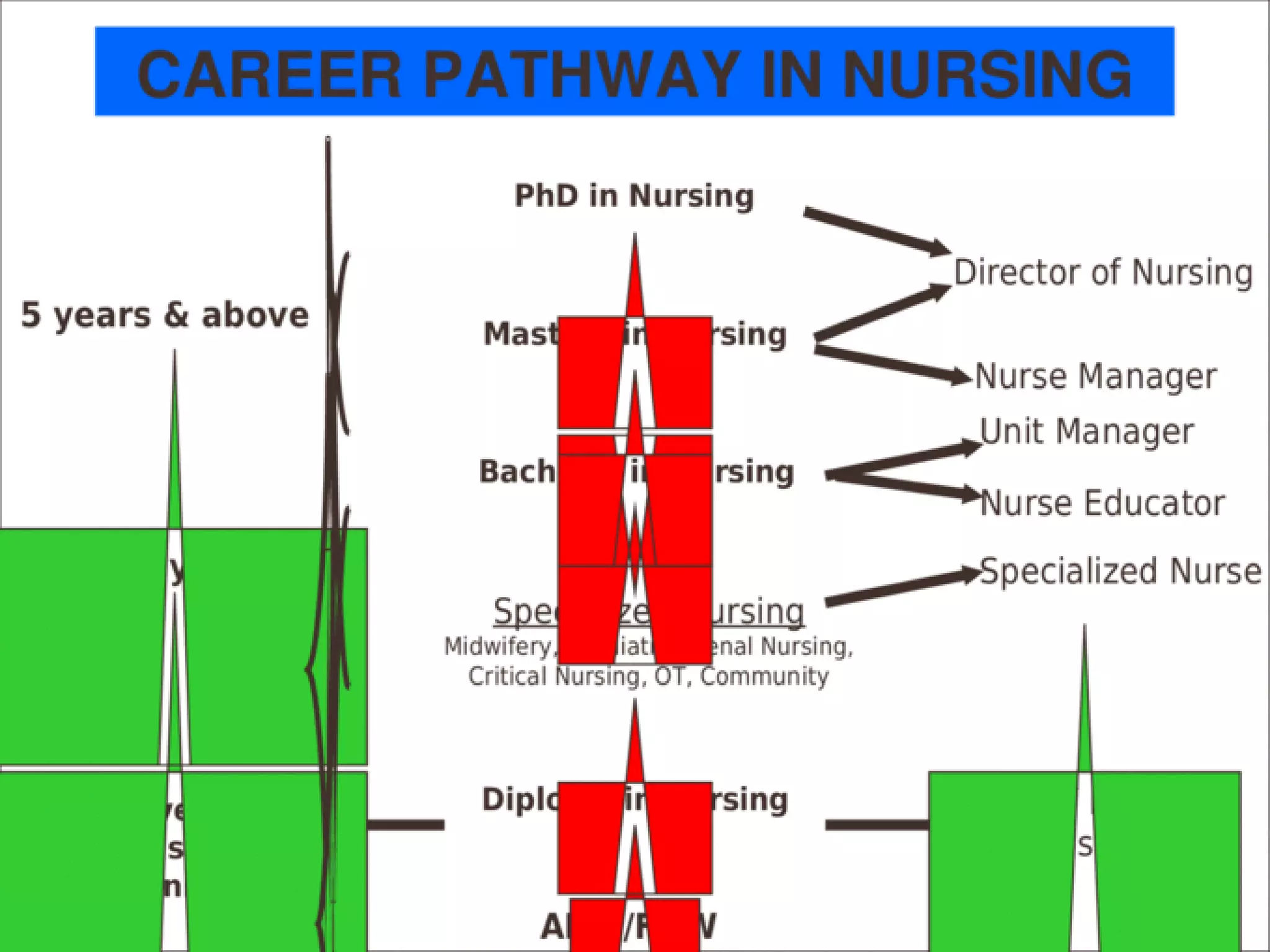
Career opportunities
• For nurse, a wide range of career opportunities are
available as discussed under. For ANM:-
1. Works as a MPHW at sub-centers.
2. With experience & training can be promoted to
lady health visitors.
3. For career development can do DGNM in 3 years
instead of 3½ years.
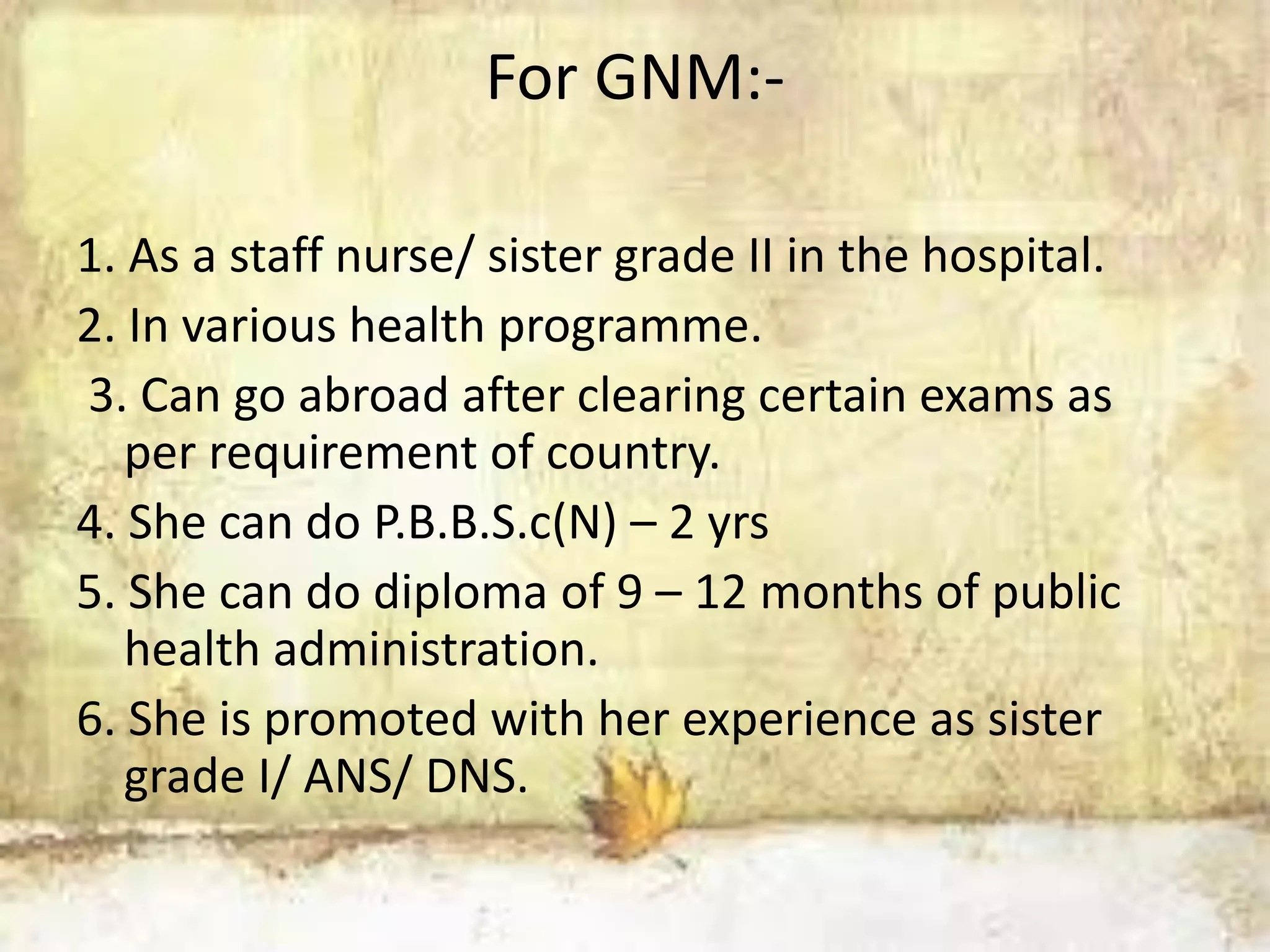
For GNM:-
1. As a staff nurse/ sister grade II in the hospital.
2. In various health programme.
3. Can go abroad after clearing certain exams as
per requirement of country.
4. She can do P.B.B.S.c(N) – 2 yrs
5. She can do diploma of 9 – 12 months of public
health administration.
6. She is promoted with her experience as sister
grade I/ ANS/ DNS.
For B.Sc(N) & P.B.B.Sc(N)
Hospital
• As a staff nurse to give care to patients.
• She is promoted as a sister grade I, A.N.S., D.N.S &
nursing superintendent with experience
Community
• As a public health nurse to prevent, maintain, treat
& rehabilitate the people as per their needs.
• Participates in various health programme.
• She can work industrial nurse, school health nurse
etc.
• She can go abroad to work as a nurse
• She can conduct research
• Work as clinical instructor in school and colleges to
teach nursing programme
• She can do master degree in nursing
• She can do certificate courses of nursing
For M.Sc(N):-
• Work as a lecture, more experience can work as
different cadre.
• As a clinical nurse in hospital with sister grade I
• As a researcher she can conduct research in
various programme
• She can work as public health nurse, district health
nurse, directorate of nursing, state nursing council
registrar, INC president & vice president etc.
• She can do further her M.Phil or Ph.D in
nursing
• She can act as a counselor according to
specialisation in M.Sc(N)
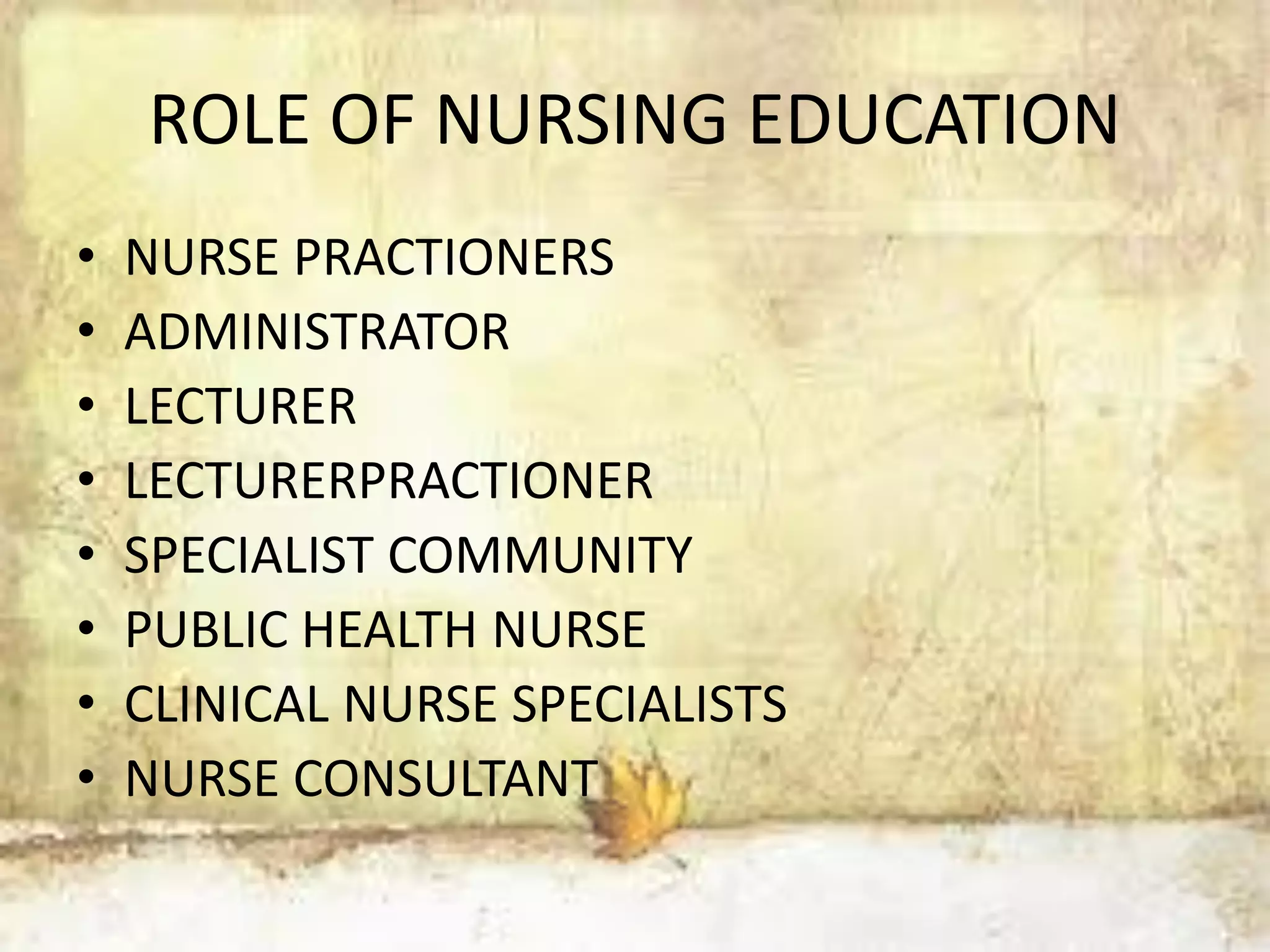
ROLE OF NURSING EDUCATION
• NURSE PRACTIONERS
• ADMINISTRATOR
• LECTURER
• LECTURERPRACTIONER
• SPECIALIST COMMUNITY
• PUBLIC HEALTH NURSE
• CLINICAL NURSE SPECIALISTS
• NURSE CONSULTANT
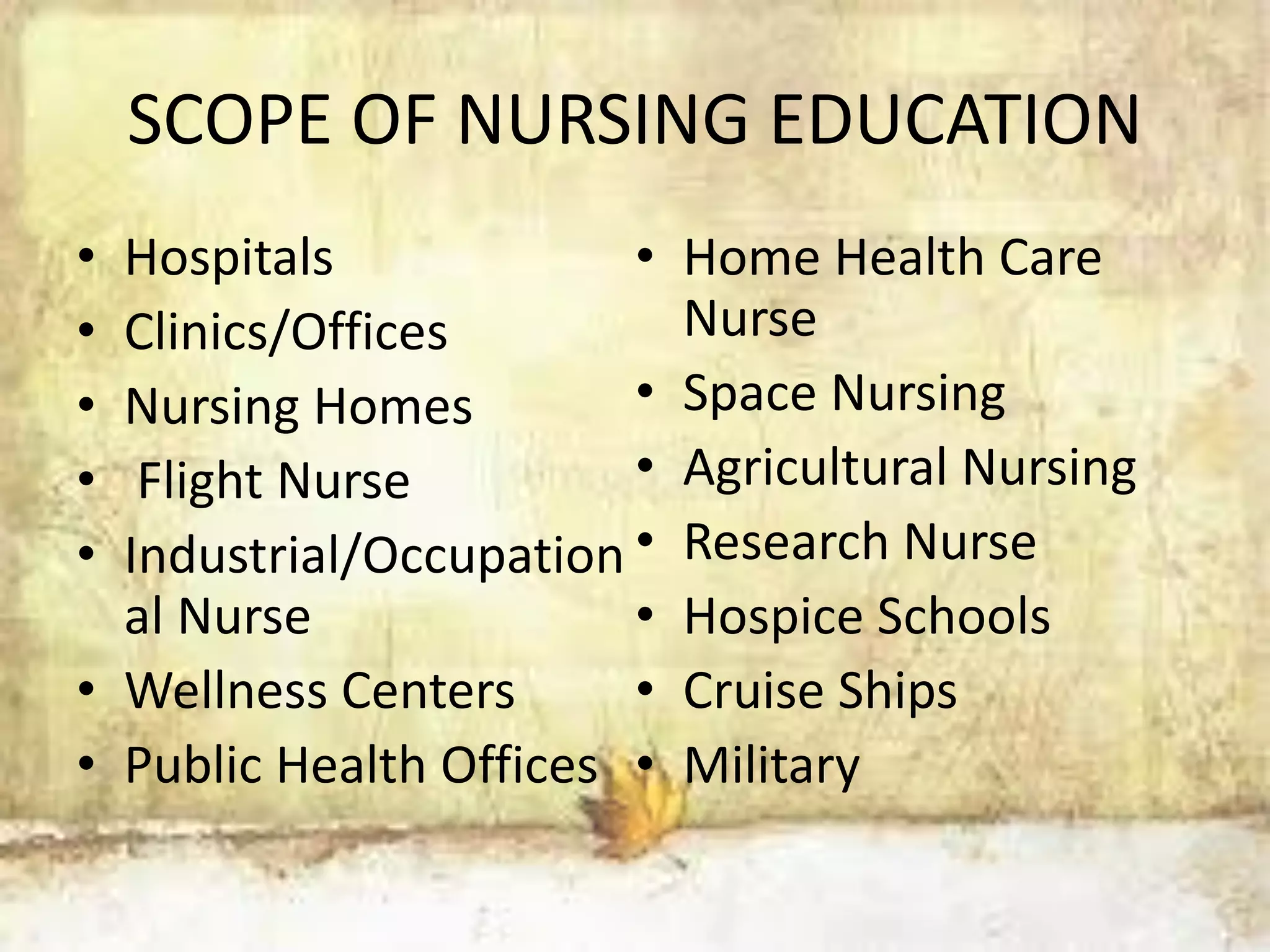
SCOPE OF NURSING EDUCATION
• Hospitals
• Clinics/Offices
• Nursing Homes
• Flight Nurse
• Industrial/Occupation
al Nurse
• Wellness Centers
• Public Health Offices
• Home Health Care
Nurse
• Space Nursing
• Agricultural Nursing
• Research Nurse
• Hospice Schools
• Cruise Ships
• Military
Membership with
professional organizations
Professional Organizations in Nursing
Definition:
• Professional associations have been defined as
groups of people who share a set of professional
values and who decide to join their colleagues to
affect a change. --Poder-Wise (2007)
• The Professional Organization is the one that
provides a means through which efforts can be
channeled with authority because of the number it
represents. --Hunt
Membership Benefits!
• Personal benefits
• Socialization - Networking
• Travel – conferences
• Stay Connected to professional issues
• Scholarships
Professional Benefits!
• Spring Board your Career!
• Political Influence
• Professional Standards
• Credentialing
• Quick Access to Staff experts on Practice
advocacy
• Professional Journals
Membership with professional
organizations: National & International
• Nurses after completion of their diploma or
degree or post graduate or doctorate nursing,
register themselves with state nursing
registration council.
• They get their registration in TNA and various
research from committees.
• During student life they are member of SNA they
have to follow certain criteria and have to meet
the essential requirements of that particular
association.
International Professional
Organizations
• International Council of Nurses (ICN)
• American Nurses Association (ANA)
• Sigma theta Tau International
• National League for Nurses (NLN)
• Commonwealth Nurses Federation
• American Association of Colleges of Nursing (AACN)
• WHO
• UNICEF
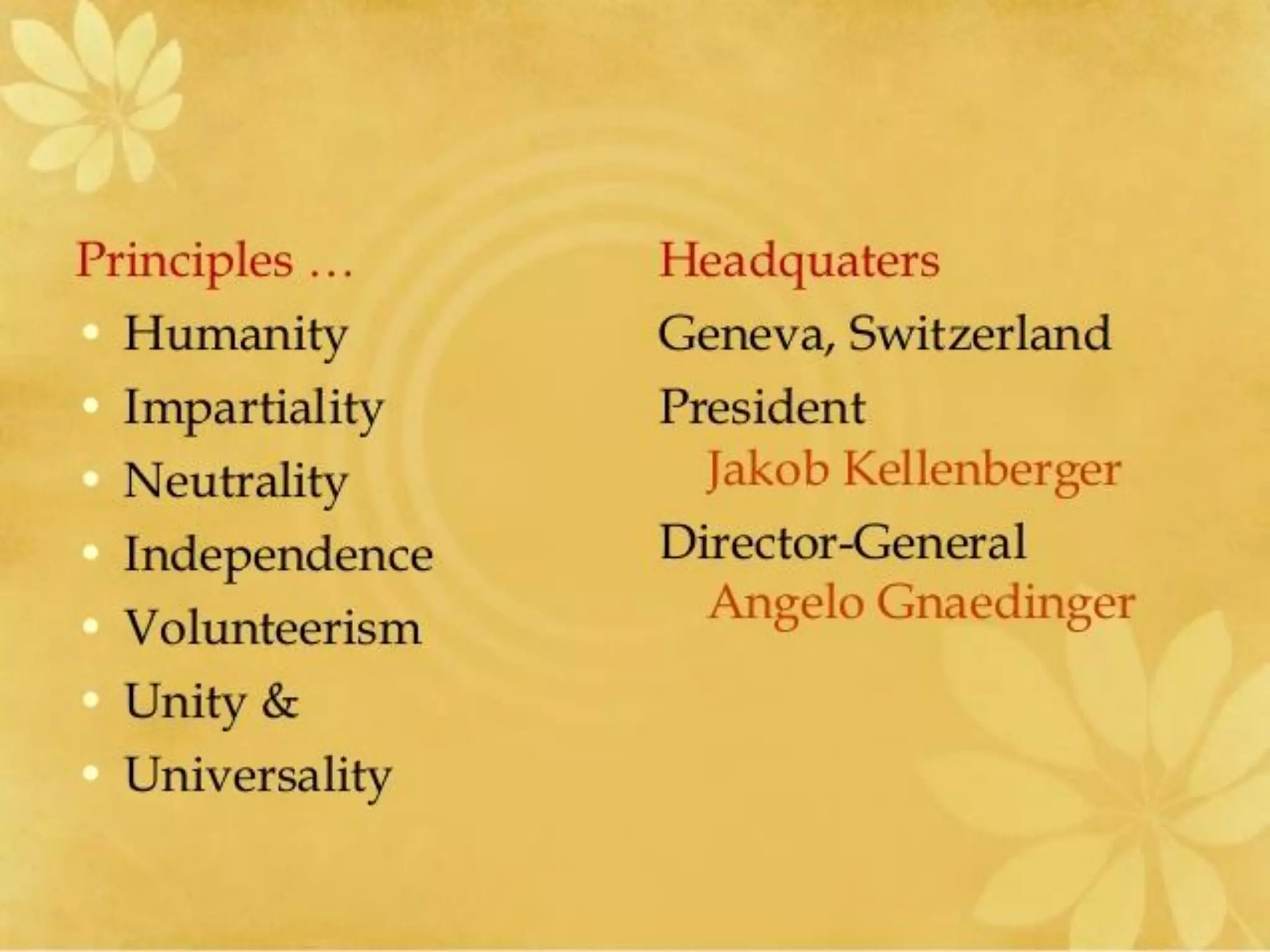
• International Red Cross
International Council of Nurses (ICN)
• World’s largest and widest reaching
International organization
• 130 National Nurses Organizations
• Represents 13 million International Nurses
• Founded 1899
The Three goals are:
• To bring nursing together worldwide
• To advance nurses and nursing worldwide
• To influence health policy.
Core Values:
• Visionary Leadership • Inclusiveness •Flexibility •
Partnership • Achievement
Functions of ICN:
1. Professional Nursing Practice Provides guidelines
and policies for-
• International classification for Nursing Practice
• Education, Management & Research
2.Nursing Regulation:
• Code of ethics • Continuing Education • Regulation
and credentialing
3.Socioeconomic welfare of Nurses
• Occupational Health • HRM • Career development
4. Partnerships and Alliances
American Nurses Association
• The only full service professional organization
• Representing the RNs of USA
Functions:
• Policy development
• Organizations partnership
• Lobbying
• Publications and Newsletters
 The American Nurse
 American Nurse Today
Sigma theta Tau International
• Honor society of Nursing – 1922
• Storgé, Tharsos and Timé meaning "love,"
"courage" and "honor
• Organizational Mission
“….support the learning, knowledge,
and professional development of nurses
committed to making a difference in health
worldwide.”
Membership
• By invitation
• Baccalaureate and graduate nursing students who
demonstrate excellence in scholarship
• Nurse leaders exhibiting exceptional achievements
in nursing.
Core Areas
• Education
• Leadership
• Career development
• Evidence-based nursing
• Research and scholarship
Publications
• Journal of Nursing Scholarship
• Reflections on Nursing Leadership
• WORLD views on Evidence-Based Nursing
• Chapter Leader Emphasis
• STTI connect
• Scholarly books on a wide range of topics in
nursing Virginia Henderson International
Nursing Library
National League for Nursing NLN
Created in 1893 - The 1st Nursing organization
in USA..
“the establishment and maintenance of a
universal standard of training” for nursing
Mission
“…..promotes excellence in nursing education
to build a strong and diverse nursing
workforce”
• Functions Core Values
• CARING
• INTEGRITY
• DIVERSITY
• EXCELLENCE
• Leaders in nursing Education
• Commitment to members
• Champion for nurse educators
• Advancement of the Science of Nursing
Education
Commonwealth Nurses Federation
• Organized in 1973, operates in six regions of the
commonwealth countries
• Objectives:
• Influence health policy throughout the
commonwealth
• Develop nursing networks
• Enhance nursing education
• Improve nursing standards and competence
• Strengthen nursing leadership
American Association of collegesof
Nursing
• “Serves the public interest by setting standards,
providing resources, and developing the
leadership capacity of member schools to advance
nursing education, research, and practice”
Participation in research activities
• Nurses after completion of graduation,
masters and doctorate in nursing, participates
in research activities.
• Conduct nursing researches in administration,
clinical and community field to update the
knowledge with latest information.
• These researches provide the bases for
improvement in nursing techniques.
• Publication: Journals, Newspapers Nurse
after conducting researches and can get their
research article published in journals. Articles
can be published by nurses in newspaper
related to various diseases to create
awareness among public about latest
information. Nowadays there are a number of
journals, in which nurses have written their
research articles.

Professional advancement in nursing

  • 1.
  • 2.
    INTRODUCTION • Continuing professionaladvancement activities for nurses are planned and organized learning experiences, designed to advance personal and professional development. • Activities can include the attendance of workshops or conferences, reading of journal articles and the undertaking of postgraduate nursing course. • Professional development maybe undertaken in the form of postgraduate courses, vocational education and continuing professional development
  • 3.
    DEFINITION • Continuing professionaladvancement is defined as a means by which members of profession maintain their knowledge & skills & develop qualities in their professional lives. • The conscious updating of professional knowledge & the improvement of professional competence throughout a persons working life. • It is a commitment to begin professional, keeping up to date & continuously seeking to improve. • It is key to updating a persons career opportunities
  • 4.
    OBJECTVES OF PROFESSIONAL ADVANCEMENT •To enhance professional growth & development. • To provide recognition for professional contributions • To encourage involvement of bedside nurses in decision that enhances patient care outcomes • To provide motivation for direct care nurses to pursue higher education, certification & other professional achievements
  • 5.
    BENEFITS OF PROFESSIONAL ADVANCEMENT •Allows maturity & confidence to develop in practice It allows the development of expertise &the refinement of skills • It allows the nursing workforce to be responsive to changes in the management of patient & in meeting emerging care needs. • It supports role success & job satisfaction
  • 6.
    MOTIVATION TO UNDERTAKING PROFESSIONALADVANCEMENT • Registration • Employment as a nurse • Desire to improve standards in practice • To be the best in what you do • Added value • To gain higher qualification • To enhance personal status
  • 7.
    ACHIEVING PROFESSIONAL ADVANCEMENT • PostRegistration Education-University courses • Attending Conferences • Training-On the job training, departmental training • Secondments short transfer to another department or organization • Shadowing, covering colleagues, acting up to a senior role • Coaching Mentoring(advice taken from experienced & trusted advisor) • Reflective practice-acquisition of extended skills • Reading professional journals e.g. International Journal of Nursing • Having knowledge about National & Local Health Policies & Directives
  • 8.
    Career opportunities • Fornurse, a wide range of career opportunities are available as discussed under. For ANM:- 1. Works as a MPHW at sub-centers. 2. With experience & training can be promoted to lady health visitors. 3. For career development can do DGNM in 3 years instead of 3½ years.
  • 9.
    For GNM:- 1. Asa staff nurse/ sister grade II in the hospital. 2. In various health programme. 3. Can go abroad after clearing certain exams as per requirement of country. 4. She can do P.B.B.S.c(N) – 2 yrs 5. She can do diploma of 9 – 12 months of public health administration. 6. She is promoted with her experience as sister grade I/ ANS/ DNS.
  • 10.
    For B.Sc(N) &P.B.B.Sc(N) Hospital • As a staff nurse to give care to patients. • She is promoted as a sister grade I, A.N.S., D.N.S & nursing superintendent with experience Community • As a public health nurse to prevent, maintain, treat & rehabilitate the people as per their needs. • Participates in various health programme. • She can work industrial nurse, school health nurse etc.
  • 11.
    • She cango abroad to work as a nurse • She can conduct research • Work as clinical instructor in school and colleges to teach nursing programme • She can do master degree in nursing • She can do certificate courses of nursing
  • 12.
    For M.Sc(N):- • Workas a lecture, more experience can work as different cadre. • As a clinical nurse in hospital with sister grade I • As a researcher she can conduct research in various programme • She can work as public health nurse, district health nurse, directorate of nursing, state nursing council registrar, INC president & vice president etc.
  • 13.
    • She cando further her M.Phil or Ph.D in nursing • She can act as a counselor according to specialisation in M.Sc(N)
  • 14.
    ROLE OF NURSINGEDUCATION • NURSE PRACTIONERS • ADMINISTRATOR • LECTURER • LECTURERPRACTIONER • SPECIALIST COMMUNITY • PUBLIC HEALTH NURSE • CLINICAL NURSE SPECIALISTS • NURSE CONSULTANT
  • 16.
    SCOPE OF NURSINGEDUCATION • Hospitals • Clinics/Offices • Nursing Homes • Flight Nurse • Industrial/Occupation al Nurse • Wellness Centers • Public Health Offices • Home Health Care Nurse • Space Nursing • Agricultural Nursing • Research Nurse • Hospice Schools • Cruise Ships • Military
  • 17.
  • 18.
    Professional Organizations inNursing Definition: • Professional associations have been defined as groups of people who share a set of professional values and who decide to join their colleagues to affect a change. --Poder-Wise (2007) • The Professional Organization is the one that provides a means through which efforts can be channeled with authority because of the number it represents. --Hunt
  • 19.
    Membership Benefits! • Personalbenefits • Socialization - Networking • Travel – conferences • Stay Connected to professional issues • Scholarships
  • 20.
    Professional Benefits! • SpringBoard your Career! • Political Influence • Professional Standards • Credentialing • Quick Access to Staff experts on Practice advocacy • Professional Journals
  • 21.
    Membership with professional organizations:National & International • Nurses after completion of their diploma or degree or post graduate or doctorate nursing, register themselves with state nursing registration council. • They get their registration in TNA and various research from committees. • During student life they are member of SNA they have to follow certain criteria and have to meet the essential requirements of that particular association.
  • 22.
  • 23.
    • International Councilof Nurses (ICN) • American Nurses Association (ANA) • Sigma theta Tau International • National League for Nurses (NLN) • Commonwealth Nurses Federation • American Association of Colleges of Nursing (AACN) • WHO • UNICEF • International Red Cross
  • 24.
    International Council ofNurses (ICN) • World’s largest and widest reaching International organization • 130 National Nurses Organizations • Represents 13 million International Nurses • Founded 1899
  • 25.
    The Three goalsare: • To bring nursing together worldwide • To advance nurses and nursing worldwide • To influence health policy. Core Values: • Visionary Leadership • Inclusiveness •Flexibility • Partnership • Achievement
  • 26.
    Functions of ICN: 1.Professional Nursing Practice Provides guidelines and policies for- • International classification for Nursing Practice • Education, Management & Research 2.Nursing Regulation: • Code of ethics • Continuing Education • Regulation and credentialing 3.Socioeconomic welfare of Nurses • Occupational Health • HRM • Career development 4. Partnerships and Alliances
  • 27.
    American Nurses Association •The only full service professional organization • Representing the RNs of USA Functions: • Policy development • Organizations partnership • Lobbying • Publications and Newsletters  The American Nurse  American Nurse Today
  • 28.
    Sigma theta TauInternational • Honor society of Nursing – 1922 • Storgé, Tharsos and Timé meaning "love," "courage" and "honor • Organizational Mission “….support the learning, knowledge, and professional development of nurses committed to making a difference in health worldwide.”
  • 29.
    Membership • By invitation •Baccalaureate and graduate nursing students who demonstrate excellence in scholarship • Nurse leaders exhibiting exceptional achievements in nursing. Core Areas • Education • Leadership • Career development • Evidence-based nursing • Research and scholarship
  • 30.
    Publications • Journal ofNursing Scholarship • Reflections on Nursing Leadership • WORLD views on Evidence-Based Nursing • Chapter Leader Emphasis • STTI connect • Scholarly books on a wide range of topics in nursing Virginia Henderson International Nursing Library
  • 31.
    National League forNursing NLN Created in 1893 - The 1st Nursing organization in USA.. “the establishment and maintenance of a universal standard of training” for nursing Mission “…..promotes excellence in nursing education to build a strong and diverse nursing workforce”
  • 32.
    • Functions CoreValues • CARING • INTEGRITY • DIVERSITY • EXCELLENCE • Leaders in nursing Education • Commitment to members • Champion for nurse educators • Advancement of the Science of Nursing Education
  • 33.
    Commonwealth Nurses Federation •Organized in 1973, operates in six regions of the commonwealth countries • Objectives: • Influence health policy throughout the commonwealth • Develop nursing networks • Enhance nursing education • Improve nursing standards and competence • Strengthen nursing leadership
  • 35.
    American Association ofcollegesof Nursing • “Serves the public interest by setting standards, providing resources, and developing the leadership capacity of member schools to advance nursing education, research, and practice”
  • 41.
    Participation in researchactivities • Nurses after completion of graduation, masters and doctorate in nursing, participates in research activities. • Conduct nursing researches in administration, clinical and community field to update the knowledge with latest information. • These researches provide the bases for improvement in nursing techniques.
  • 42.
    • Publication: Journals,Newspapers Nurse after conducting researches and can get their research article published in journals. Articles can be published by nurses in newspaper related to various diseases to create awareness among public about latest information. Nowadays there are a number of journals, in which nurses have written their research articles.