



 Performance   Appraisal (PA) refers to all
  those procedures that are used to
  evaluate the
  personality, performance, potential, etc
  of its group members.
 PA is an objective assessment of an
  individual’s performance against well
  defined benchmarks.
 It is a step by step process
 It examines the employee strengths and
  weaknesses
 Scientific and objective study
 Ongoing and continuous process
 Secure information for making correct
  decisions on employees
 Provide  feedback about employees
 Provide database
 Diagnose the Strengths & Weaknesses of
  individuals
 Provide coaching, counseling, career
  planning to subordinates
 Develop positive relation and reduce
  grievances
 Facilitates research in personnel
  management
 Mutual  trust
 Clear objectives
 Standardizations
 Training
 Job relatedness
 Documentation
 Feedback and participation
 Post appraisal review
Create  a culture of excellence that
  inspires every employee to improve
  and lend himself or herself to be
  assessed
Align organizational objectives to
 individual aspirations
Clear growth paths for talented
 individuals
Provide new challenges to rejuvenate
 careers
 Empower   employees to make decisions
  without the fear of failing
 Debureaucratise the organisation
  structure for easy flow of information
 Every  Idea Gets An Ear
 All types of employees on the Google
  campus are encouraged to contribute
  business ideas. This inform Tech ideas to
  non-tech ideas. Everyone at Google is
  encouraged to listen, consider, and if it
  makes sense implement new, fresh, and
  innovative ideas. In fact, the Google
  shuttle was created by an employee who
  saw a need, researched it, presented it to
  senior management and Google just
  implemented it. includes engineers and
  other employees raging
 Benefits Equal Productivity
 With the best benefits, generally comes
  the best talent. When all things are equal
  salary wise, potential employees will look
  to benefits to make the final decision.
  When Larry Page was creating the Google
  vision, he put careful thought to the
  benefits his employees would have and
  what effect that would have on the
  productivity of Google. The Google
  benefits enable employees to focus on
  work and innovation which has proven to
  increase productivity.
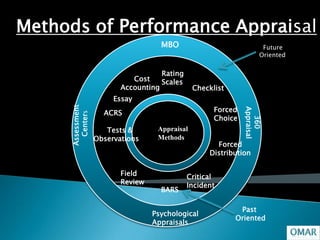
Methods of Performance Appraisal
                                    MBO                               Future
                                                                     Oriented


                                    Rating
                            Cost    Scales
                         Accounting            Checklist
                       Essay
                                                     Forced
     Assessment


                                                              Appraisal
                    ACRS
       Centers


                                                     Choice


                                                                360
                     Tests &       Appraisal
                  Observations     Methods
                                                     Forced
                                                   Distribution

                         Field               Critical
                         Review              Incident
                                    BARS

                                                            Past
                                  Psychological
                                                           Oriented
                                  Appraisals
I.Past Orientation Method
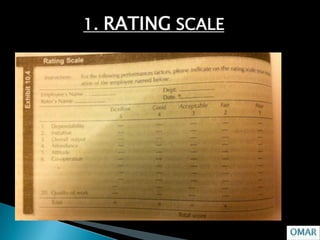
Simplest and most popular technique
Consists of several numerical scales,
 each representing job traits
Ranges from excellent to poor
Number of points may be linked to
 salary increments
 Adaptability ( nearly every type of job )
 Relatively low cost
 Less time consuming
 No training required
1. RATING SCALE
DISADVANTAGES


 Raters biases influence

 Numerical rating is unclear
 Checklist of statements on traits of
  employees and job
 Sent to HR department
 Rater does only reporting
ADVANTAGES

 Economy
 Ease of administration
 Limited training of rater
 Objectivity
DISADVANTAGES


Raters Biases ( Halo Effect )
Misinterpretation
Improper use by HR
 Department
Does not allow rater to give
 relative ratings
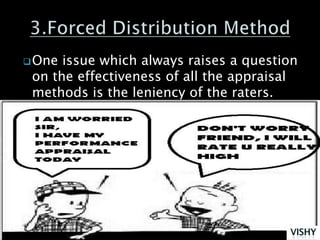
 One issue which always raises a question
 on the effectiveness of all the appraisal
 methods is the leniency of the raters.
   The Forced Distribution method is an
    attempt to do away with that problem.
    Here, the rater is forced to rate on all
    points on the rating scale.
   There is an assumption that employee
    performance level conforms to a normal
    statistical distribution.
Example

 The following points may exist in a
 rating scale-excellent, good, average,
 below average and unsatisfactory and
 the rater would be expected to distribute
 his ratings on a percentage basis i.e.
 excellent-10%, good-20%, average-40%,
 below average-20% and unsatisfactory-
 10%.
   The critical incidents method is based on
    actual job behaviour.
   The method focuses on certain critical
    behaviours of an employee that makes all
    the difference between effective and non
    effective performance of a job. Such
    incidents are recorded by the superiors as
    and when they occur
 BASED ON ACTUAL JOB BEHAVIOUR
 GIVING JOB RELATED FEEDBACK TO THE
   RATEE IS EASY
 REDUCES BIAS, IF RATERS
  RECORD INCIDENTS THOUGHOUT THE
  RATING PERIOD
 MORE CHANCES FOR THE RATEE TO
 IMPROVE AS THEY LEARN MORE
 PRECISELY WHAT IS EXPECTED OF THEM
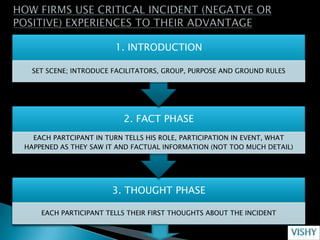
1. INTRODUCTION

  SET SCENE; INTRODUCE FACILITATORS, GROUP, PURPOSE AND GROUND RULES


                         2. FACT PHASE
  EACH PARTCIPANT IN TURN TELLS HIS ROLE, PARTICIPATION IN EVENT, WHAT
HAPPENED AS THEY SAW IT AND FACTUAL INFORMATION (NOT TOO MUCH DETAIL)


                      3. THOUGHT PHASE

    EACH PARTICIPANT TELLS THEIR FIRST THOUGHTS ABOUT THE INCIDENT
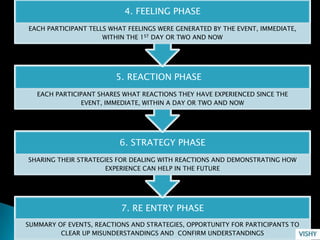
4. FEELING PHASE
EACH PARTICIPANT TELLS WHAT FEELINGS WERE GENERATED BY THE EVENT, IMMEDIATE,
                     WITHIN THE 1ST DAY OR TWO AND NOW


                         5. REACTION PHASE
   EACH PARTICIPANT SHARES WHAT REACTIONS THEY HAVE EXPERIENCED SINCE THE
                EVENT, IMMEDIATE, WITHIN A DAY OR TWO AND NOW


                          6. STRATEGY PHASE
SHARING THEIR STRATEGIES FOR DEALING WITH REACTIONS AND DEMONSTRATING HOW
                      EXPERIENCE CAN HELP IN THE FUTURE


                          7. RE ENTRY PHASE
SUMMARY OF EVENTS, REACTIONS AND STRATEGIES, OPPORTUNITY FOR PARTICIPANTS TO
         CLEAR UP MISUNDERSTANDINGS AND CONFIRM UNDERSTANDINGS
   NEGATIVE INCIDENTS MORE NOTICEABLE
    THAN POSITIVE ONES
   THE RECORDING OF INCIDENTS IS AT TIMES
     DONE INEFFICIENTLY
   OVERLY CLOSE SUPERVISION MAY RESULT
   IN AN ANNUAL PERFORMANCE REVIEW, THE
     FEEDBACK MAY BE TOO MUCH AT ONE TIME
 Cost Accounting Method evaluates
  performance from the monetary returns the
  employee yields to his/her organisation.
 Performance of the employee is based on
 the established relationship between cost
 and benefit.
 Cost accounting method of evaluation has
   vast potential as increasingly firms are
   converting their training departments into
   profit centers.
    The superiors rank their subordinates
    in the order of their merit, starting
    from the best to worst.
   Useful in deciding merit pay increases,
    promotions, organisational rewards.
   Ease of administration and explanation.
 This method compares each employee with
 all others in the group, one at a time. After
 all the comparisons on the basis of the
 overall comparisons, the employees are
 given the final rankings.

 Pairedcomparison method helps make the
 ranting method more precise. For every trait
 (quality of work, quality etc), Pairs are made
 and every subordinate is compared with
 every other subordinate.
 MBO
 Psychological
              appraisals
 Assessment centers
“  Management by Objectives (MBO) is a process
  of agreeing upon objectives within an
  organization so that management and
  employees agree to the objectives, understand
  what they are, and work hand-to-hand towards
  the achievement of the set objectives.”
 An MBO, evaluates employee job performance in
  terms of the extent to which the employee
  achieved each of his or her goals during a
  specified period of time
–Goals can be both objective and subjective
–Commonly used for managers and professionals
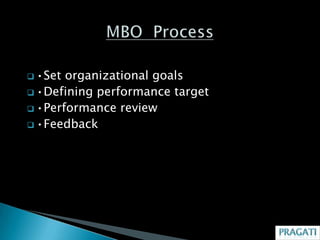
 •Set organizational goals
 •Defining performance target
 •Performance review
 •Feedback
 These   appraisals involve assessment of
  the intellectual abilities, emotional
  stability, reason and analytical skills,
  sociability, etc.
 These methods can be useful when
  taking decisions about placement of
  employees, development and training.
 Psychological appraisals focus on future
  potential and not actual performance.
 An assessment centre is a central
 location where managers come together
 to have their participation in job related
 exercises evaluation by trained
 observers. Mostly used for executive
 hiring, assessment centers are now
 being used for evaluating or supervisory
 potential.
 Cost effective only in large organizations.
 Assessment is strongly influenced by the
  participant’s interpersonal skills
 Unhealthy sense of competition
 Demoralize employees
 The360 degree technique is understood
 as systematic collection of performance
 data on an individual or group, derived
 from a number of stake holders.
 Analysis   may be ineffective due to personal
  biases
 Time Consuming
 Negative effect on the employee’s
  performance
Performance appraisal is a method that encourages
  high levels of employees’ performance. The
  evaluation system helps to identify employees with
  reward performance equitably and determine
  employee’s need for training. Also, it provides a
  competitive edge to an organization in the
  following ways
 Improving performance
 Ensuring legal compliance
 Minimizing job dissatisfaction and turnover
Performance appraisal

Performance appraisal

  • 3.
     Performance Appraisal (PA) refers to all those procedures that are used to evaluate the personality, performance, potential, etc of its group members.  PA is an objective assessment of an individual’s performance against well defined benchmarks.
  • 4.
     It isa step by step process  It examines the employee strengths and weaknesses  Scientific and objective study  Ongoing and continuous process  Secure information for making correct decisions on employees
  • 5.
     Provide feedback about employees  Provide database  Diagnose the Strengths & Weaknesses of individuals  Provide coaching, counseling, career planning to subordinates  Develop positive relation and reduce grievances  Facilitates research in personnel management
  • 9.
     Mutual trust  Clear objectives  Standardizations  Training  Job relatedness  Documentation  Feedback and participation  Post appraisal review
  • 10.
    Create aculture of excellence that inspires every employee to improve and lend himself or herself to be assessed Align organizational objectives to individual aspirations Clear growth paths for talented individuals Provide new challenges to rejuvenate careers
  • 11.
     Empower employees to make decisions without the fear of failing  Debureaucratise the organisation structure for easy flow of information
  • 12.
     Every Idea Gets An Ear  All types of employees on the Google campus are encouraged to contribute business ideas. This inform Tech ideas to non-tech ideas. Everyone at Google is encouraged to listen, consider, and if it makes sense implement new, fresh, and innovative ideas. In fact, the Google shuttle was created by an employee who saw a need, researched it, presented it to senior management and Google just implemented it. includes engineers and other employees raging
  • 13.
     Benefits EqualProductivity  With the best benefits, generally comes the best talent. When all things are equal salary wise, potential employees will look to benefits to make the final decision. When Larry Page was creating the Google vision, he put careful thought to the benefits his employees would have and what effect that would have on the productivity of Google. The Google benefits enable employees to focus on work and innovation which has proven to increase productivity.
  • 15.
    Methods of PerformanceAppraisal MBO Future Oriented Rating Cost Scales Accounting Checklist Essay Forced Assessment Appraisal ACRS Centers Choice 360 Tests & Appraisal Observations Methods Forced Distribution Field Critical Review Incident BARS Past Psychological Oriented Appraisals
  • 17.
    I.Past Orientation Method Simplestand most popular technique Consists of several numerical scales, each representing job traits Ranges from excellent to poor Number of points may be linked to salary increments
  • 18.
     Adaptability (nearly every type of job )  Relatively low cost  Less time consuming  No training required
  • 19.
  • 20.
    DISADVANTAGES Raters biasesinfluence Numerical rating is unclear
  • 21.
     Checklist ofstatements on traits of employees and job  Sent to HR department  Rater does only reporting
  • 22.
    ADVANTAGES  Economy  Easeof administration  Limited training of rater  Objectivity
  • 23.
    DISADVANTAGES Raters Biases (Halo Effect ) Misinterpretation Improper use by HR Department Does not allow rater to give relative ratings
  • 24.
     One issuewhich always raises a question on the effectiveness of all the appraisal methods is the leniency of the raters.
  • 25.
    The Forced Distribution method is an attempt to do away with that problem.  Here, the rater is forced to rate on all points on the rating scale.  There is an assumption that employee performance level conforms to a normal statistical distribution.
  • 26.
    Example  The followingpoints may exist in a rating scale-excellent, good, average, below average and unsatisfactory and the rater would be expected to distribute his ratings on a percentage basis i.e. excellent-10%, good-20%, average-40%, below average-20% and unsatisfactory- 10%.
  • 27.
    The critical incidents method is based on actual job behaviour.  The method focuses on certain critical behaviours of an employee that makes all the difference between effective and non effective performance of a job. Such incidents are recorded by the superiors as and when they occur
  • 28.
     BASED ONACTUAL JOB BEHAVIOUR  GIVING JOB RELATED FEEDBACK TO THE RATEE IS EASY  REDUCES BIAS, IF RATERS RECORD INCIDENTS THOUGHOUT THE RATING PERIOD  MORE CHANCES FOR THE RATEE TO IMPROVE AS THEY LEARN MORE PRECISELY WHAT IS EXPECTED OF THEM
  • 29.
    1. INTRODUCTION SET SCENE; INTRODUCE FACILITATORS, GROUP, PURPOSE AND GROUND RULES 2. FACT PHASE EACH PARTCIPANT IN TURN TELLS HIS ROLE, PARTICIPATION IN EVENT, WHAT HAPPENED AS THEY SAW IT AND FACTUAL INFORMATION (NOT TOO MUCH DETAIL) 3. THOUGHT PHASE EACH PARTICIPANT TELLS THEIR FIRST THOUGHTS ABOUT THE INCIDENT
  • 30.
    4. FEELING PHASE EACHPARTICIPANT TELLS WHAT FEELINGS WERE GENERATED BY THE EVENT, IMMEDIATE, WITHIN THE 1ST DAY OR TWO AND NOW 5. REACTION PHASE EACH PARTICIPANT SHARES WHAT REACTIONS THEY HAVE EXPERIENCED SINCE THE EVENT, IMMEDIATE, WITHIN A DAY OR TWO AND NOW 6. STRATEGY PHASE SHARING THEIR STRATEGIES FOR DEALING WITH REACTIONS AND DEMONSTRATING HOW EXPERIENCE CAN HELP IN THE FUTURE 7. RE ENTRY PHASE SUMMARY OF EVENTS, REACTIONS AND STRATEGIES, OPPORTUNITY FOR PARTICIPANTS TO CLEAR UP MISUNDERSTANDINGS AND CONFIRM UNDERSTANDINGS
  • 31.
    NEGATIVE INCIDENTS MORE NOTICEABLE THAN POSITIVE ONES  THE RECORDING OF INCIDENTS IS AT TIMES DONE INEFFICIENTLY  OVERLY CLOSE SUPERVISION MAY RESULT  IN AN ANNUAL PERFORMANCE REVIEW, THE FEEDBACK MAY BE TOO MUCH AT ONE TIME
  • 32.
     Cost AccountingMethod evaluates performance from the monetary returns the employee yields to his/her organisation.  Performance of the employee is based on the established relationship between cost and benefit.  Cost accounting method of evaluation has vast potential as increasingly firms are converting their training departments into profit centers.
  • 33.
    The superiors rank their subordinates in the order of their merit, starting from the best to worst.
  • 34.
    Useful in deciding merit pay increases, promotions, organisational rewards.  Ease of administration and explanation.
  • 35.
     This methodcompares each employee with all others in the group, one at a time. After all the comparisons on the basis of the overall comparisons, the employees are given the final rankings.  Pairedcomparison method helps make the ranting method more precise. For every trait (quality of work, quality etc), Pairs are made and every subordinate is compared with every other subordinate.
  • 36.
     MBO  Psychological appraisals  Assessment centers
  • 37.
    “ Managementby Objectives (MBO) is a process of agreeing upon objectives within an organization so that management and employees agree to the objectives, understand what they are, and work hand-to-hand towards the achievement of the set objectives.”  An MBO, evaluates employee job performance in terms of the extent to which the employee achieved each of his or her goals during a specified period of time –Goals can be both objective and subjective –Commonly used for managers and professionals
  • 38.
     •Set organizationalgoals  •Defining performance target  •Performance review  •Feedback
  • 39.
     These appraisals involve assessment of the intellectual abilities, emotional stability, reason and analytical skills, sociability, etc.  These methods can be useful when taking decisions about placement of employees, development and training.  Psychological appraisals focus on future potential and not actual performance.
  • 40.
     An assessmentcentre is a central location where managers come together to have their participation in job related exercises evaluation by trained observers. Mostly used for executive hiring, assessment centers are now being used for evaluating or supervisory potential.
  • 41.
     Cost effectiveonly in large organizations.  Assessment is strongly influenced by the participant’s interpersonal skills  Unhealthy sense of competition  Demoralize employees
  • 42.
     The360 degreetechnique is understood as systematic collection of performance data on an individual or group, derived from a number of stake holders.
  • 43.
     Analysis may be ineffective due to personal biases  Time Consuming  Negative effect on the employee’s performance
  • 44.
    Performance appraisal isa method that encourages high levels of employees’ performance. The evaluation system helps to identify employees with reward performance equitably and determine employee’s need for training. Also, it provides a competitive edge to an organization in the following ways  Improving performance  Ensuring legal compliance  Minimizing job dissatisfaction and turnover