Managing
Performance Appraisal

     QU, MBA


    1st, April, 2009
  Dr Hend Al Muftah
Session Plan
   Introduction
   Practice of Performance Appraisal (PA)
   Contemporary PA
   Problems related to PA
   PA @ QU
• Why do employees need
  performance reviews?
• Why do managers and supervisors
  need performance appraisals?
• Why do organizations need
  performance appraisals?
Introduction
  The practice of PA has undergone
   many major changes over the last
   decades, which was driven by large-
   scale organizational changes
       Restructuring

       Move   to teamwork
       TQM

       BPR

       Cultural   change
Key terms

   Performance… relationship between a person‟s
    capabilities and what the person actually achieves, usually
    related to a person‟s job.

   Performance management…..…A broad term that has
    come to stand for the set of practices through which work is
    defined and reviewed, capabilities are developed, and
    rewards are distributed…” (Morhamn & Morhamn, 1995).

   Performance Appraisal…a process for reviewing the
    past performance of an employee, and agreeing future
    objectives and development activities.
Appraisal – what is it?


•A Measure of performance
 (actual vs. planned)

•A Conclusion of continuous

 feedback


•A step towards development
Practice of PA - Scope
   PA has become a common HR practice in high
    performance jobs especially within financial,
    sales and customer care sectors, especially
    within profit-making organizations.

   It is equally practiced in private and public
    organizations such as government authorities,
    schools, universities, hospitals, banks etc.,
    etc.,

   Still „contingent‟ and „peripheral‟ workers are
    mostly left out of appraisal schemes
Practice of PA – Advantages and
           Disadvantages
Advantage
- PA can bring coherence (integration) within
  the organization (i.e. performance → reward
  → development → succession)

Disadvantages
- Integration plans are often too ambitious

- Using past information to predict future
  performance can be misleading
Practice of PA – Uses of PA

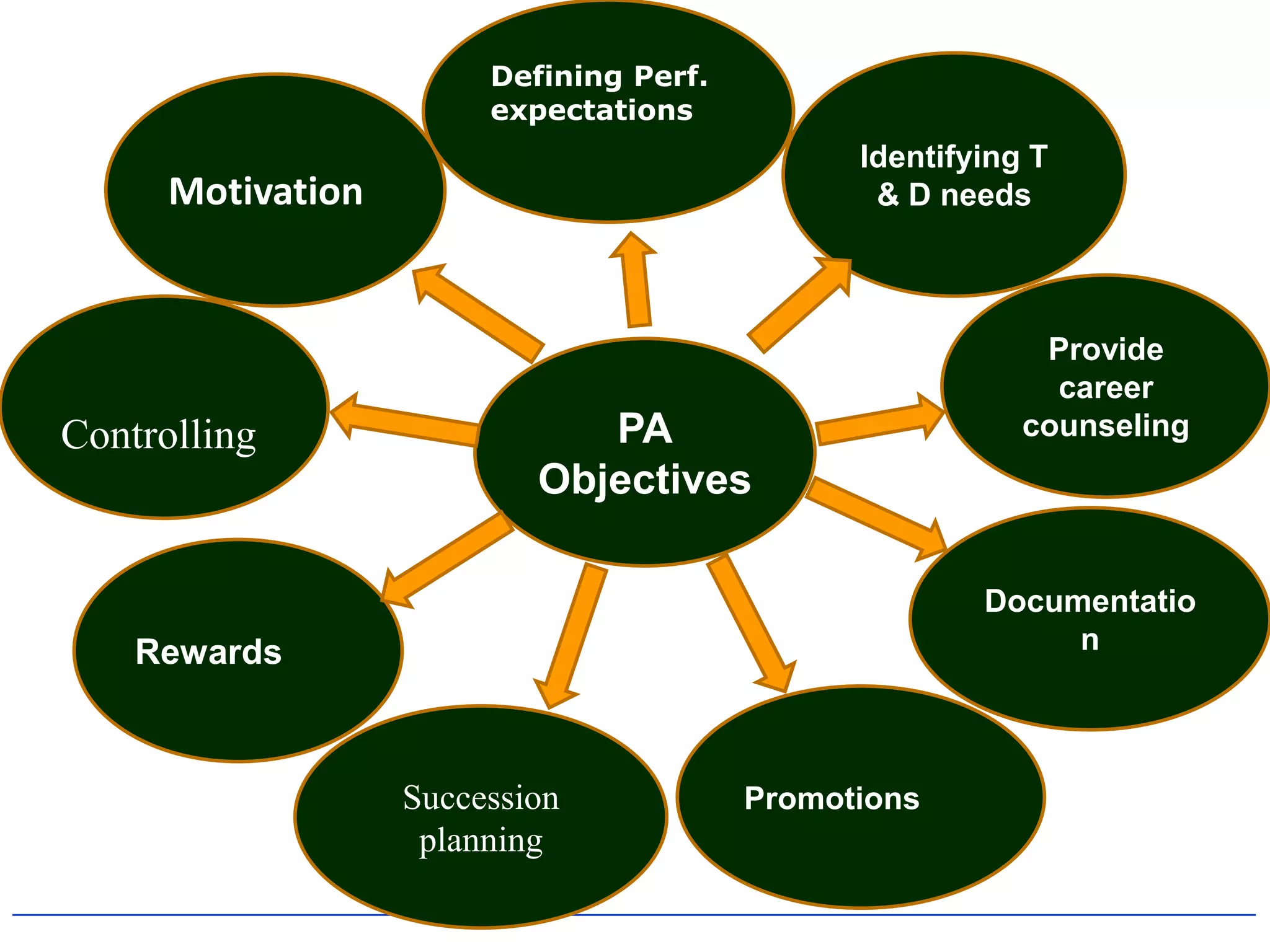
Application of PA can be for the following
purposes:

   Defining (and clarifying) performance
    expectations
   Identifying training and development needs
   Providing career counseling
   Help with succession planning
   Facilitating communications and involvement
   Allocating rewards and determining
    promotion
   Motivating and controlling employees
Defining Perf.
                        expectations
                                               Identifying T
      Motivation                                & D needs


                                                           Provide
                                                            career
Controlling                   PA                          counseling
                           Objectives

                                                       Documentatio
    Rewards                                                 n


                   Succession            Promotions
                    planning
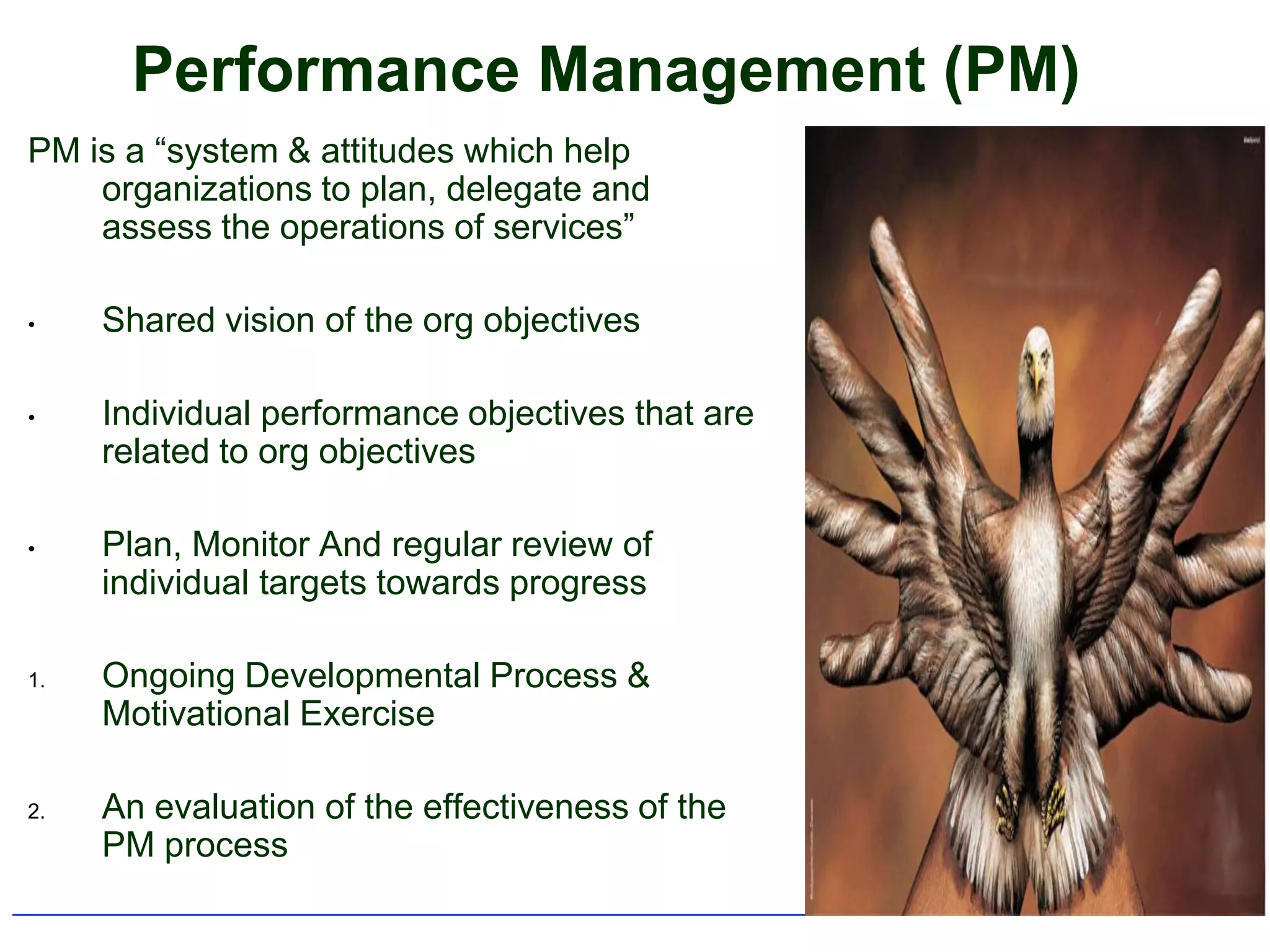
Performance Management (PM)
PM is a “system & attitudes which help
    organizations to plan, delegate and
    assess the operations of services”

•    Shared vision of the org objectives

•    Individual performance objectives that are
     related to org objectives

•    Plan, Monitor And regular review of
     individual targets towards progress

1.   Ongoing Developmental Process &
     Motivational Exercise

2.   An evaluation of the effectiveness of the
     PM process
How is Appraisal Conducted?

   Set the organization‟s goals
   Set the departmental goals
   Set & Discuss individual
    goals
   Define expected results
   Performance reviews
   Provide feedback
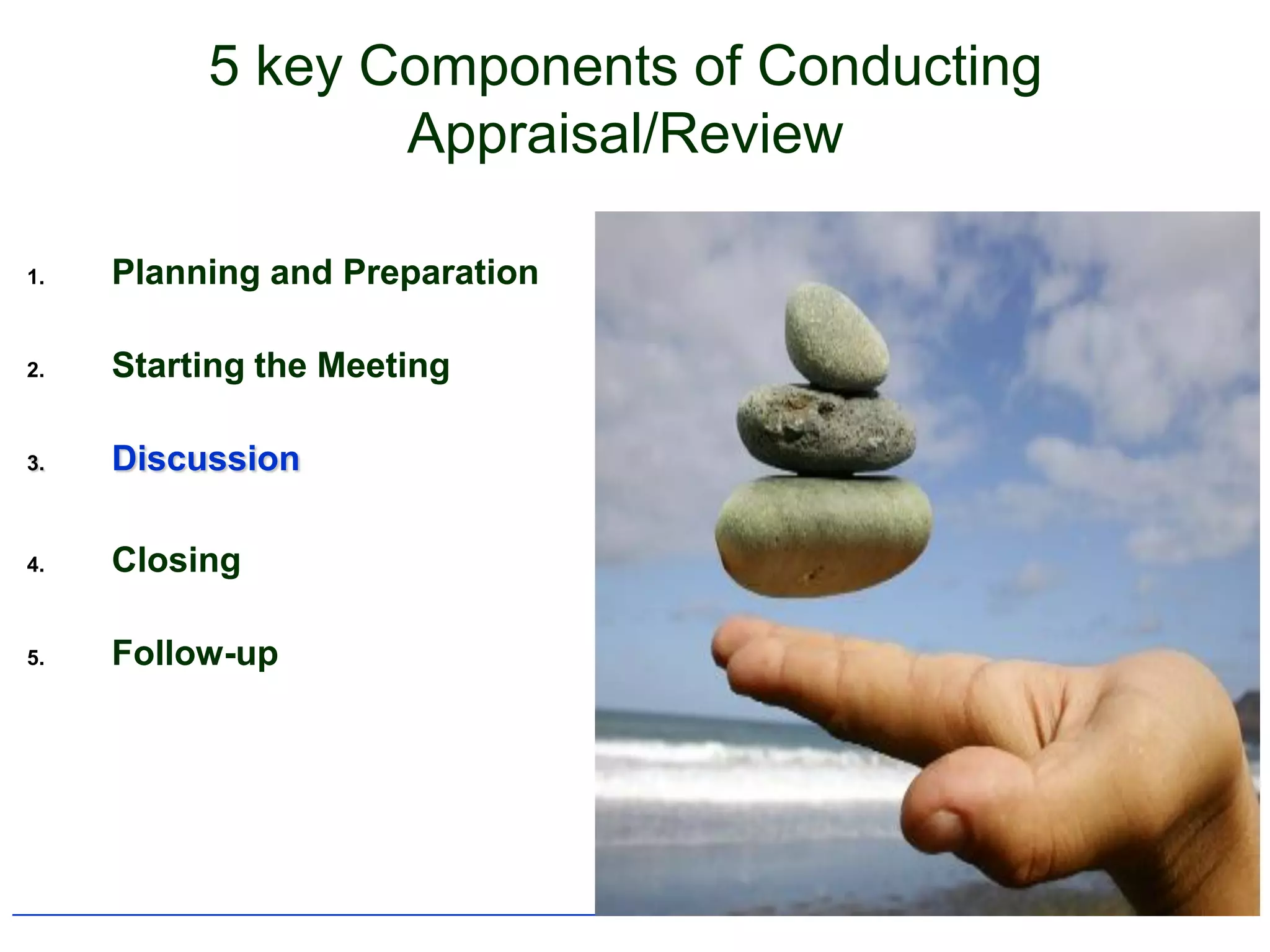
5 key Components of Conducting
                 Appraisal/Review

1.   Planning and Preparation

2.   Starting the Meeting

3.   Discussion

4.   Closing

5.   Follow-up
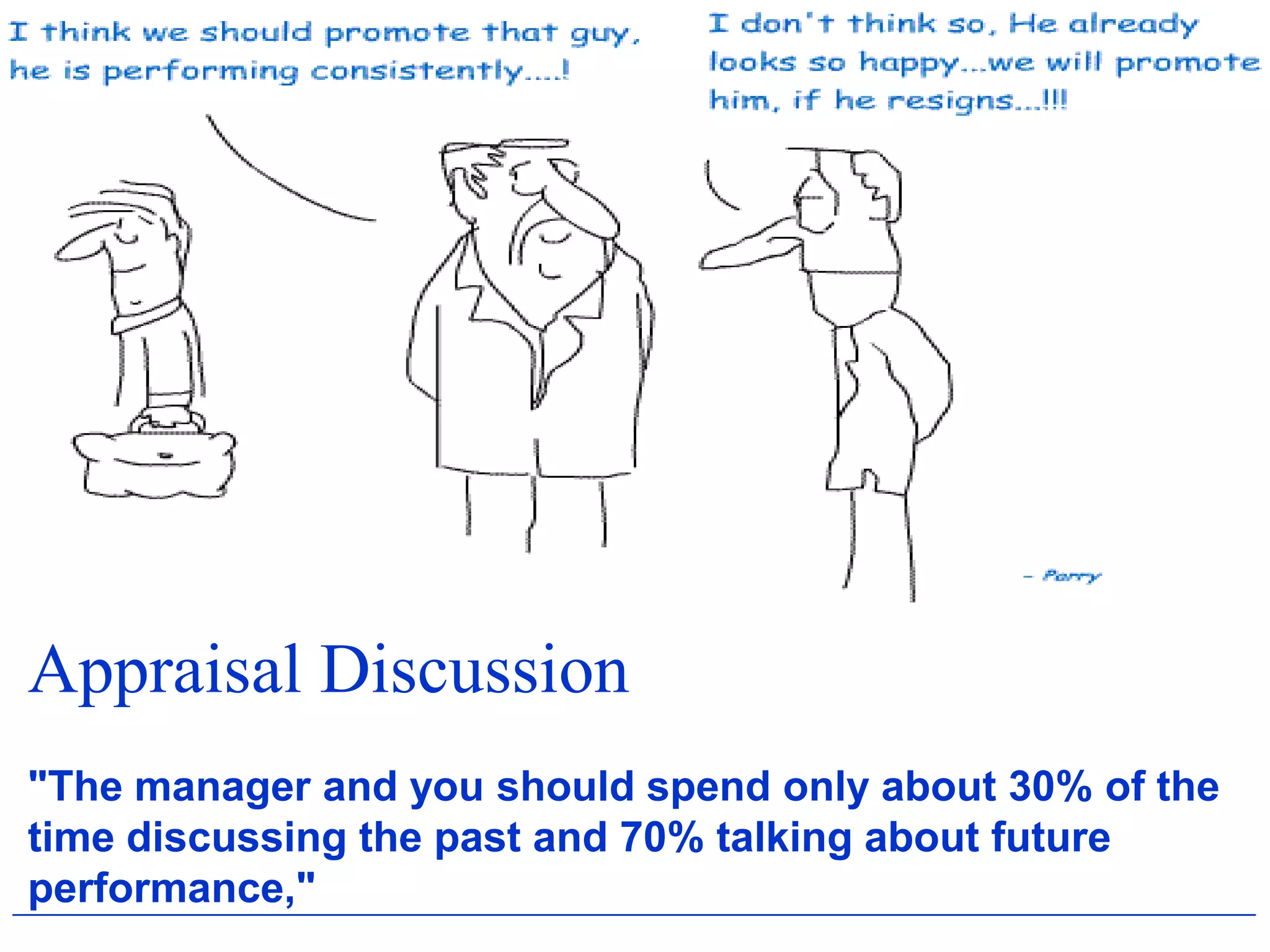
Appraisal Discussion
"The manager and you should spend only about 30% of the
time discussing the past and 70% talking about future
performance,"
PA as Managerial Control
PA have become very important
 managerial tool in motivating &
 controlling staff
PA is seen as a tool in maintaining staff
 loyalty & commitment
PA provides managers with opportunity
 to reinforce corporate values and culture
Thus, it is a strategic instrument in the
 control process
Contemporary PA

-   Upward Appraisal System: Involves
    employees rating their manager‟s
    performance & often leads to improved
    leadership and employee empowerment

-   Customer Appraisal: where organization is
    setting its employees performance standards
    base on customer surveys (e.g. customer
    care card, telephone surveys, focus groups,
    interviews, postal surveys)
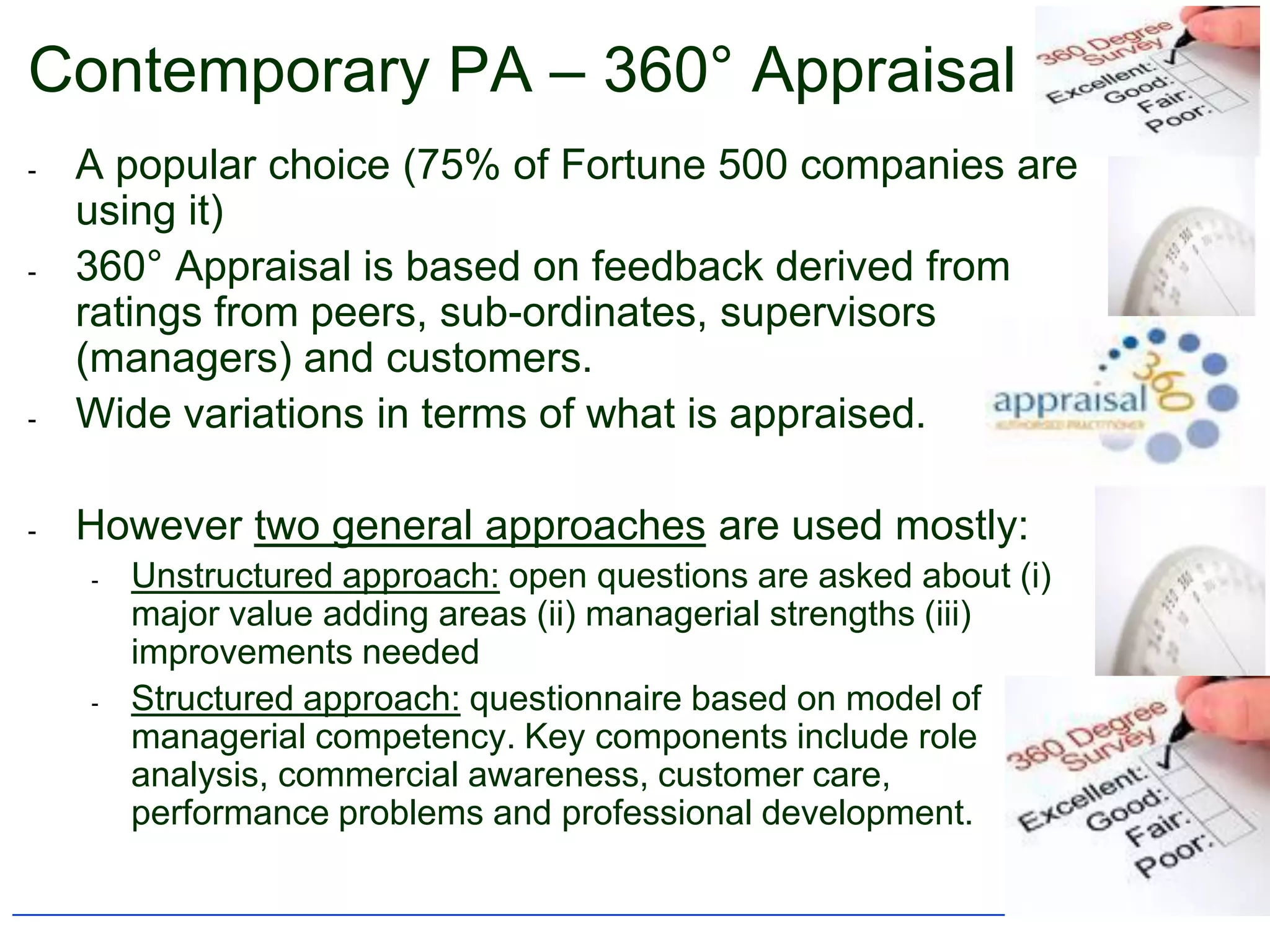
Contemporary PA – 360° Appraisal
-   A popular choice (75% of Fortune 500 companies are
    using it)
-   360° Appraisal is based on feedback derived from
    ratings from peers, sub-ordinates, supervisors
    (managers) and customers.
-   Wide variations in terms of what is appraised.

-   However two general approaches are used mostly:
    -   Unstructured approach: open questions are asked about (i)
        major value adding areas (ii) managerial strengths (iii)
        improvements needed
    -   Structured approach: questionnaire based on model of
        managerial competency. Key components include role
        analysis, commercial awareness, customer care,
        performance problems and professional development.
Contemporary PA – Advantages of 360°
    Appraisal
-   Multiple raters give a wide
    perspective to evaluation
-   Whole some feedback to the
    manager and the managed

    However cost and time requirements
    for 360° Appraisal are high. Hence
    HR Consultants are making lucrative
    careers out of it
Problems related to PA
 Most employees (both managers and
    managed) hate PA (most disliked this
    activity – WHY?).
   PAs over promised and under deliver
   Most managers are not trained to conduct
    PAs. Hence they use their gut feeling and
    focus on negativity.
   PAs are subject to political manipulation
    („who is the daddy‟ effect).
   Paperwork related to PAs is excessive
PM @ QU
                 2007-08


The process of quantifying, reviewing,
reporting, and enhancing performance
levels
What are the major benefits to QU?


   Enforcing a fair and consistent
    performance appraisal system
   Fostering personal growth and career
    development for QU staff
   Supporting QU “Attracting & Retaining
    Employees” objective
   Enhancing QU performance through
    linking individual objectives to University
    objectives
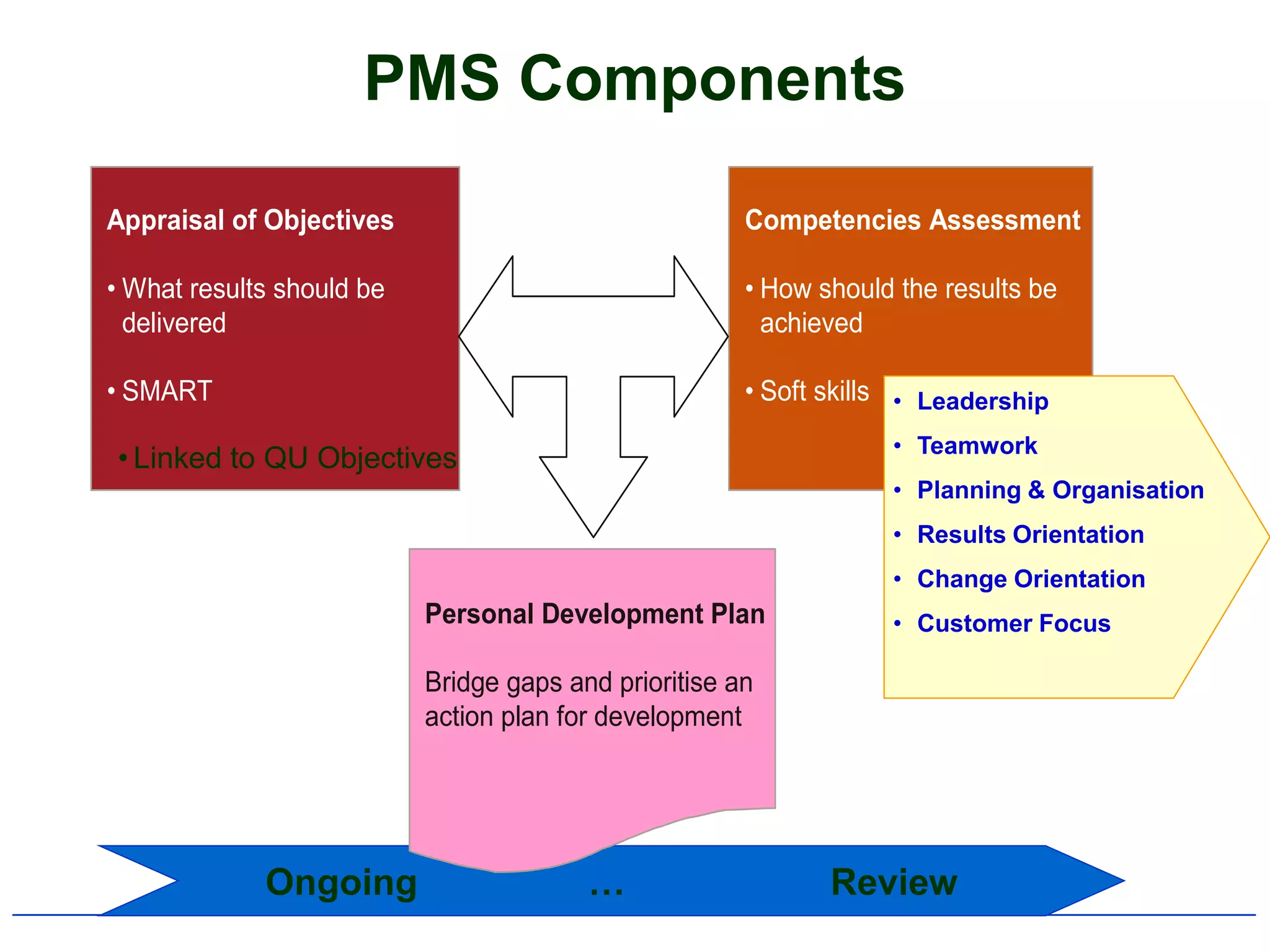
PMS Components

Appraisal of Objectives                                Competencies Assessment

• What results should be                               • How should the results be
  delivered                                              achieved

• SMART                                                • Soft skills • Leadership
                                                                   • Teamwork
• Linked to QU Objectives
                                                                   • Planning & Organisation
                                                                   • Results Orientation
                                                                   • Change Orientation
                           Personal Development Plan               • Customer Focus

                           Bridge gaps and prioritise an
                           action plan for development


             Ongoing                     …                    Review
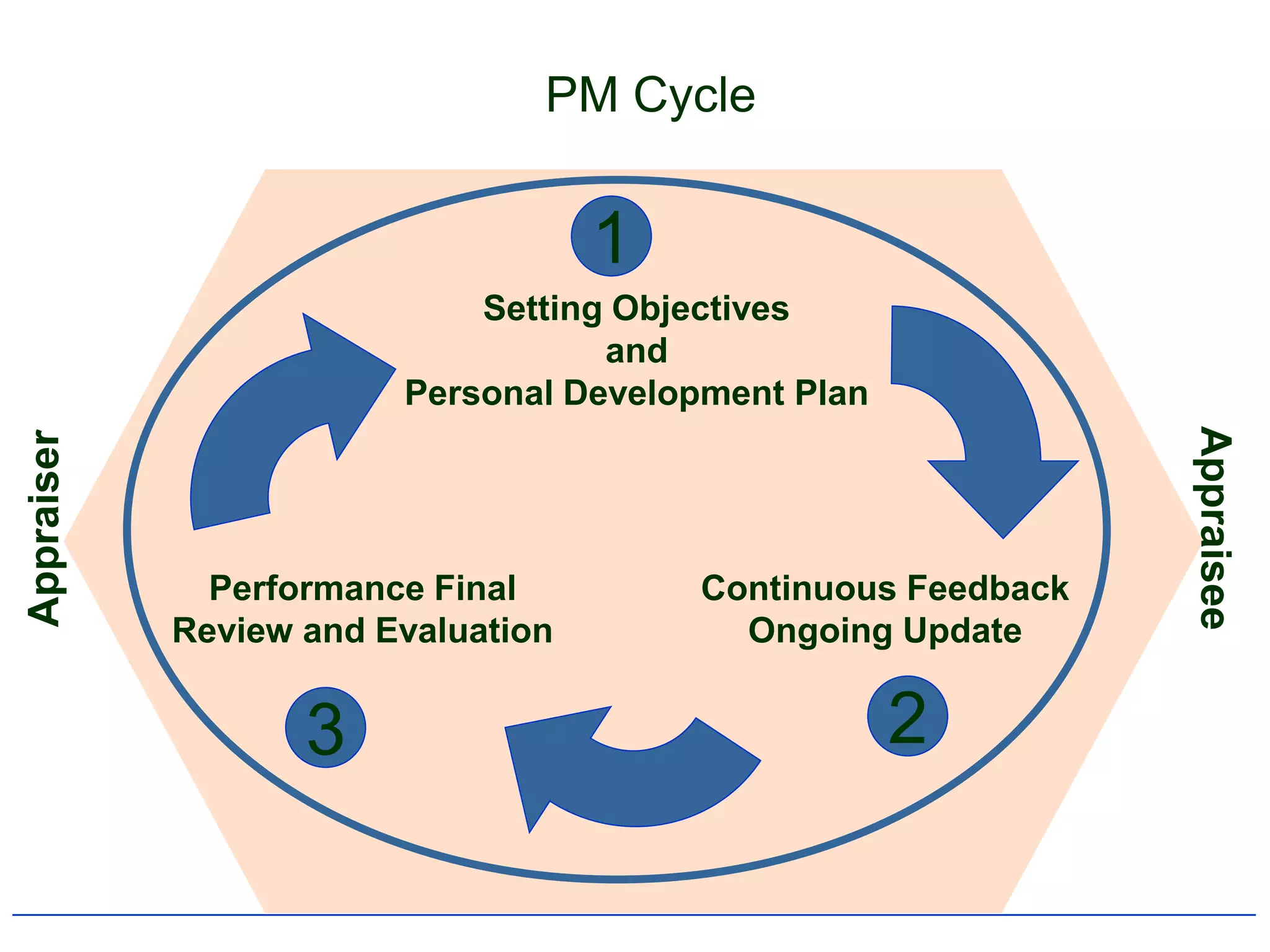
PM Cycle


                                    1
                            Setting Objectives
                                   and
                        Personal Development Plan


                                                              Appraisee
Appraiser


              Performance Final         Continuous Feedback
            Review and Evaluation         Ongoing Update


                   3                                2
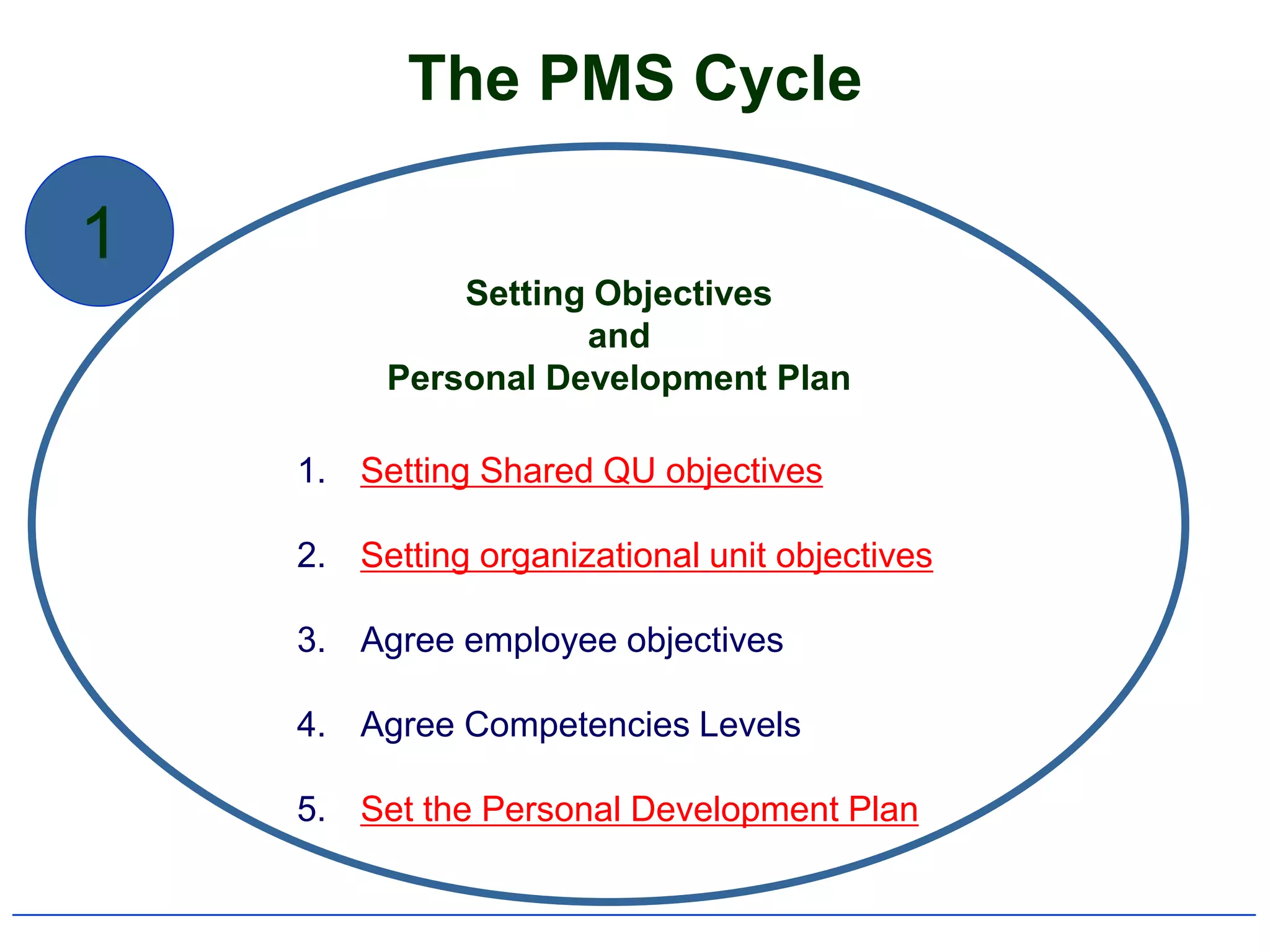
The PMS Cycle

1
             Setting Objectives
                    and
         Personal Development Plan

    1. Setting Shared QU objectives

    2. Setting organizational unit objectives

    3. Agree employee objectives

    4. Agree Competencies Levels

    5. Set the Personal Development Plan
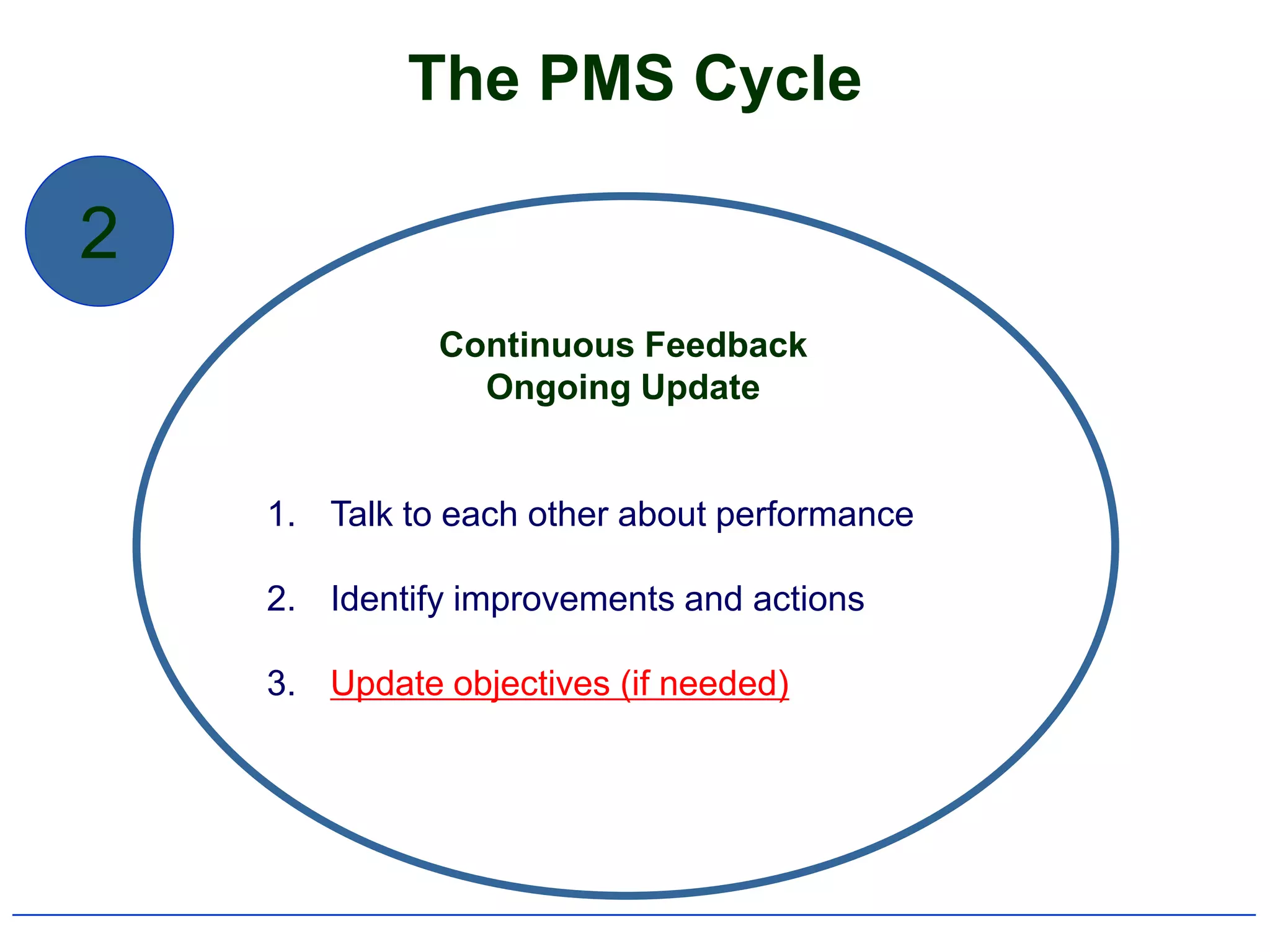
The PMS Cycle

2
              Continuous Feedback
                Ongoing Update


    1. Talk to each other about performance

    2. Identify improvements and actions

    3. Update objectives (if needed)
The PMS Cycle

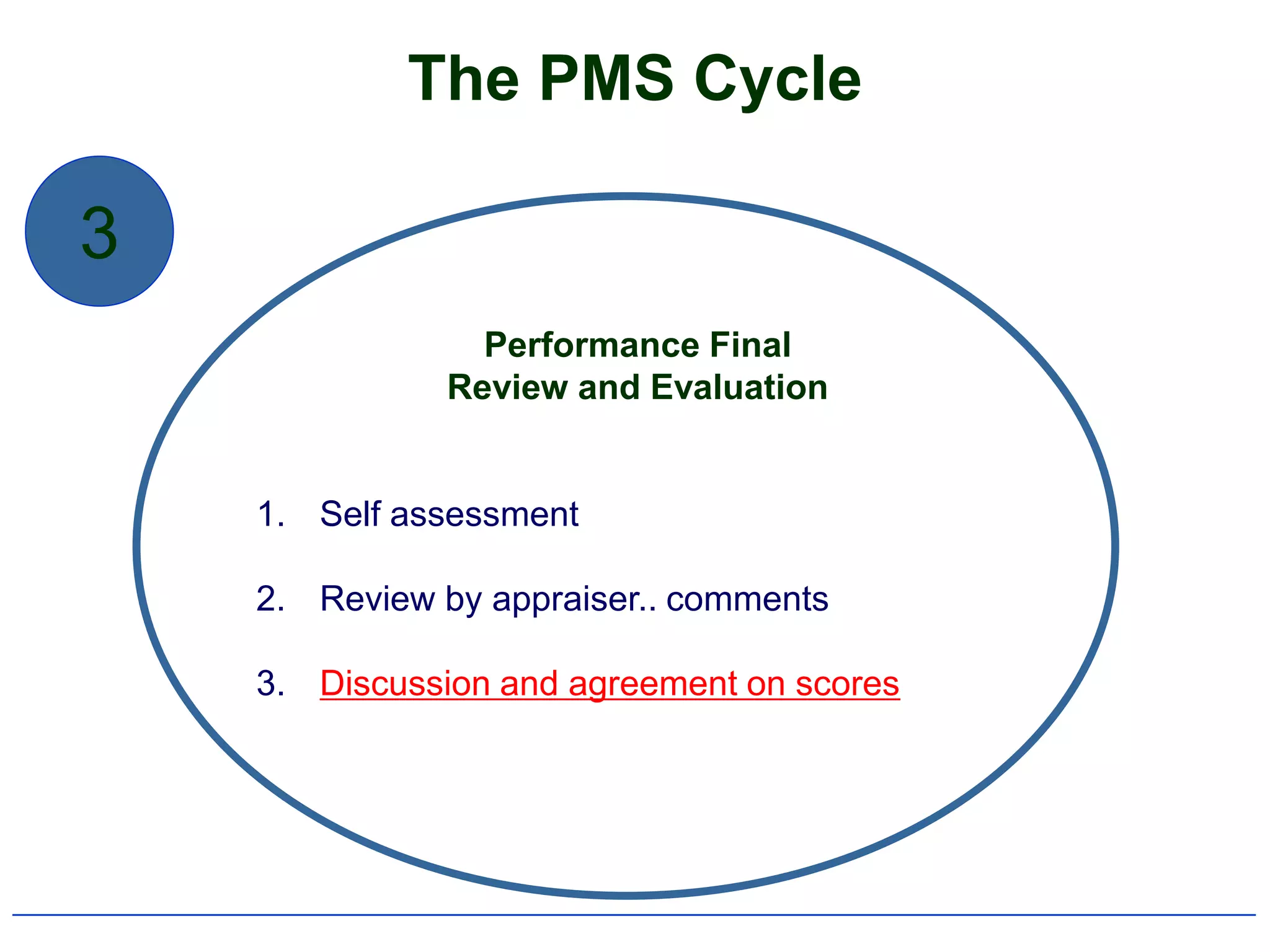
3
                Performance Final
              Review and Evaluation


    1. Self assessment

    2. Review by appraiser.. comments

    3. Discussion and agreement on scores
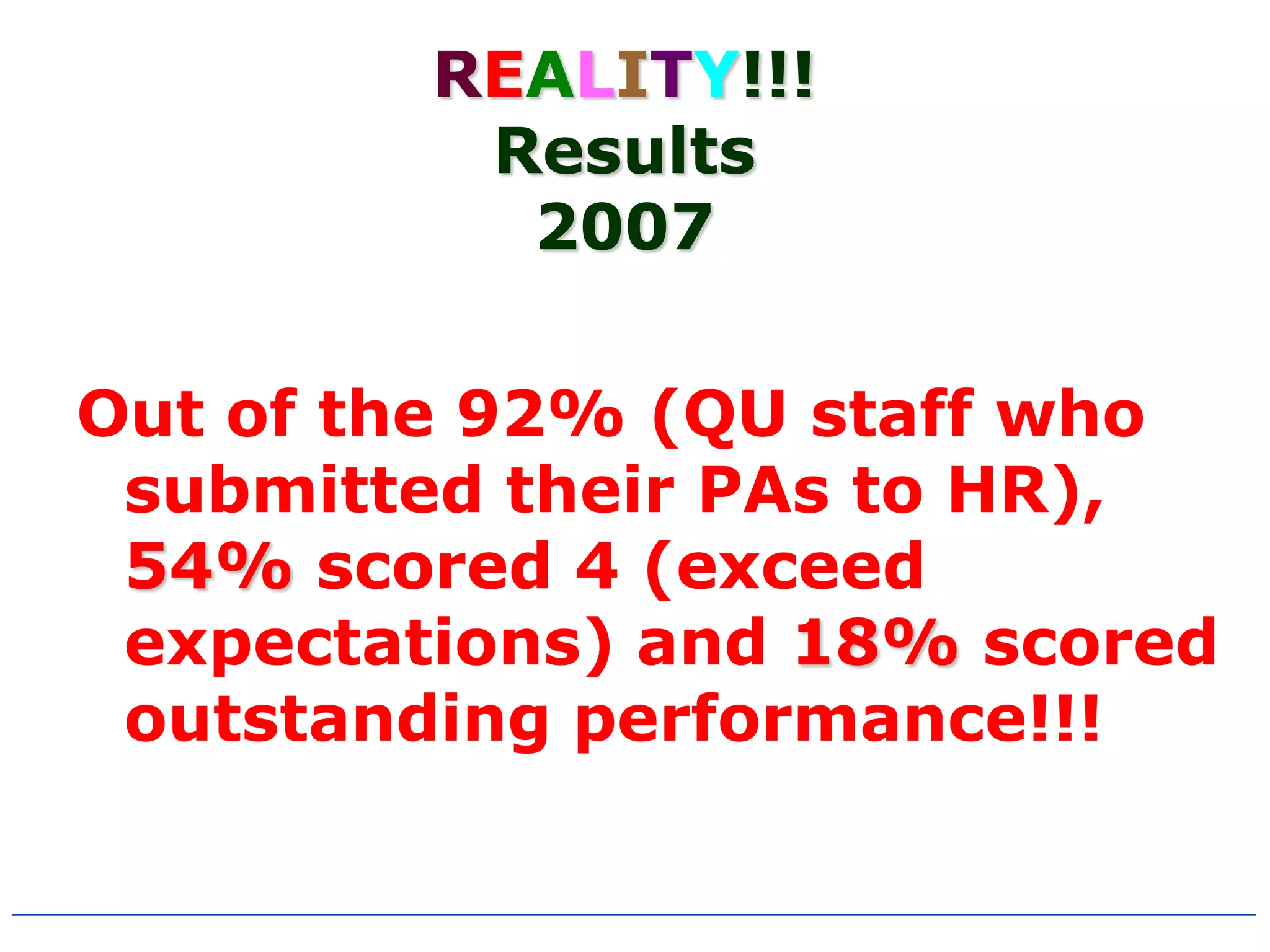
REALITY!!!
          Results
           2007

Out of the 92% (QU staff who
 submitted their PAs to HR),
 54% scored 4 (exceed
 expectations) and 18% scored
 outstanding performance!!!
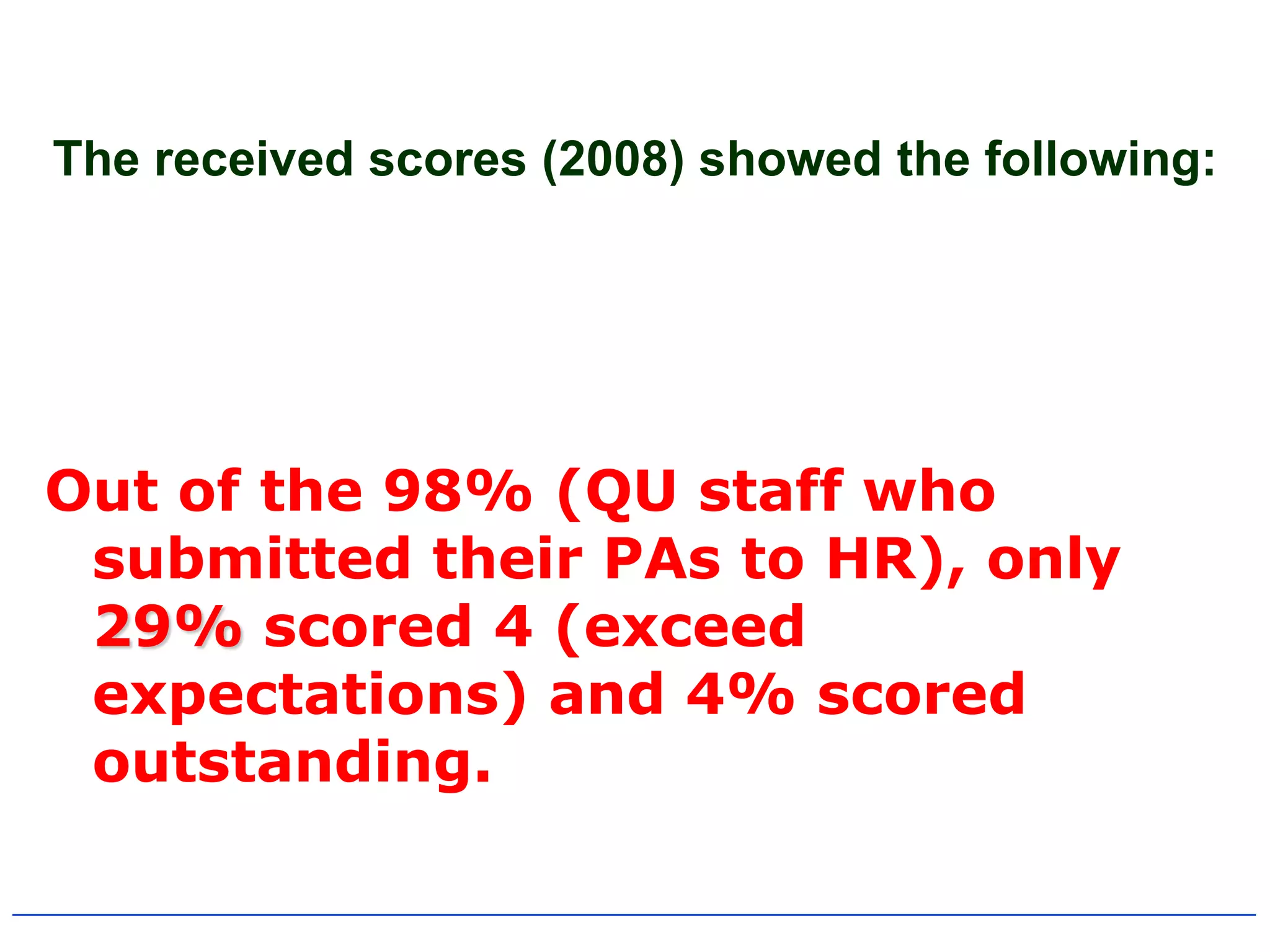
The received scores (2008) showed the following:


Out of the 98% (QU staff who
 submitted their PAs to HR), only
 29% scored 4 (exceed
 expectations) and 4% scored
 outstanding.
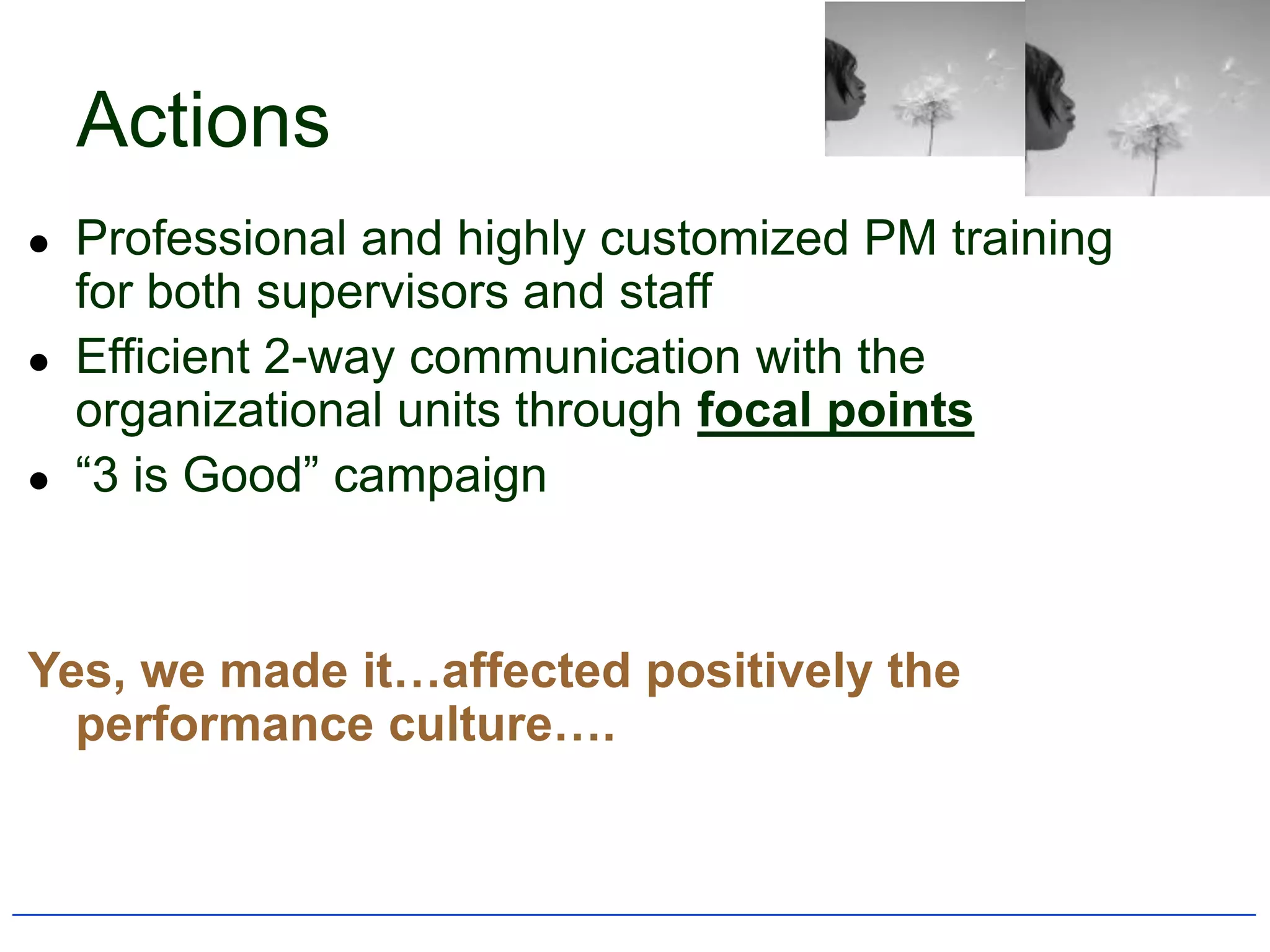
Actions
   Professional and highly customized PM training
    for both supervisors and staff
   Efficient 2-way communication with the
    organizational units through focal points
   “3 is Good” campaign


Yes, we made it…affected positively the
  performance culture….
Positives
   Awareness about QU objectives.
   Awareness about department objectives.
   Awareness about individual objectives and self
    initiatives.
   Understanding of job responsibilities.
   Understanding the job competencies.
The PM system will NOT:

 Solve all our organizational problems
 Change the organizational culture

 Make the organization fairer or staff happier

                        Why not?
Because PM system is a tool and tools don‟t make
  things happen….
                       People do!!!
People just like you, with the right tool in hands and
  the right attitude in mind!
KEY MESSAGE

   THERE IS NO RIGHT WAY OF MANAGING
    PERFORMANCE

   THERE ARE NO UNIVERSAL SOLUTION TO PM
    PROBLEMS AND EACH ORGANIZATION MUST,
    THROUGH A PROCESS OF DIAGNOSIS,
    ACTION, EVALUATION AND LEARNING,
    DEVELOP ITS OWN STRATEGY AND
    PRACTICES
LESSONS LEARNED

Generally, PM proved it success as effective tool towards
  changing performance culture within QU, specifically:


   Emphasizing development, NOT evaluation, culture
   Documentation
   2-way communication (effective continuous feedback)
   Everyone should know what to do, and what NOT to do
   Everyone contribute
   Everyone develops the necessary skills
   Managers must have the necessary skills
   Managers must monitor and measure
THANK YOU

  Q&A

Managing performance appriasal at QU changing culture

  • 1.
    Managing Performance Appraisal QU, MBA 1st, April, 2009 Dr Hend Al Muftah
  • 2.
    Session Plan  Introduction  Practice of Performance Appraisal (PA)  Contemporary PA  Problems related to PA  PA @ QU
  • 3.
    • Why doemployees need performance reviews? • Why do managers and supervisors need performance appraisals? • Why do organizations need performance appraisals?
  • 4.
    Introduction Thepractice of PA has undergone many major changes over the last decades, which was driven by large- scale organizational changes  Restructuring  Move to teamwork  TQM  BPR  Cultural change
  • 5.
    Key terms  Performance… relationship between a person‟s capabilities and what the person actually achieves, usually related to a person‟s job.  Performance management…..…A broad term that has come to stand for the set of practices through which work is defined and reviewed, capabilities are developed, and rewards are distributed…” (Morhamn & Morhamn, 1995).  Performance Appraisal…a process for reviewing the past performance of an employee, and agreeing future objectives and development activities.
  • 6.
    Appraisal – whatis it? •A Measure of performance (actual vs. planned) •A Conclusion of continuous feedback •A step towards development
  • 7.
    Practice of PA- Scope  PA has become a common HR practice in high performance jobs especially within financial, sales and customer care sectors, especially within profit-making organizations.  It is equally practiced in private and public organizations such as government authorities, schools, universities, hospitals, banks etc., etc.,  Still „contingent‟ and „peripheral‟ workers are mostly left out of appraisal schemes
  • 8.
    Practice of PA– Advantages and Disadvantages Advantage - PA can bring coherence (integration) within the organization (i.e. performance → reward → development → succession) Disadvantages - Integration plans are often too ambitious - Using past information to predict future performance can be misleading
  • 9.
    Practice of PA– Uses of PA Application of PA can be for the following purposes:  Defining (and clarifying) performance expectations  Identifying training and development needs  Providing career counseling  Help with succession planning  Facilitating communications and involvement  Allocating rewards and determining promotion  Motivating and controlling employees
  • 10.
    Defining Perf. expectations Identifying T Motivation & D needs Provide career Controlling PA counseling Objectives Documentatio Rewards n Succession Promotions planning
  • 11.
    Performance Management (PM) PMis a “system & attitudes which help organizations to plan, delegate and assess the operations of services” • Shared vision of the org objectives • Individual performance objectives that are related to org objectives • Plan, Monitor And regular review of individual targets towards progress 1. Ongoing Developmental Process & Motivational Exercise 2. An evaluation of the effectiveness of the PM process
  • 12.
    How is AppraisalConducted?  Set the organization‟s goals  Set the departmental goals  Set & Discuss individual goals  Define expected results  Performance reviews  Provide feedback
  • 13.
    5 key Componentsof Conducting Appraisal/Review 1. Planning and Preparation 2. Starting the Meeting 3. Discussion 4. Closing 5. Follow-up
  • 14.
    Appraisal Discussion "The managerand you should spend only about 30% of the time discussing the past and 70% talking about future performance,"
  • 15.
    PA as ManagerialControl PA have become very important managerial tool in motivating & controlling staff PA is seen as a tool in maintaining staff loyalty & commitment PA provides managers with opportunity to reinforce corporate values and culture Thus, it is a strategic instrument in the control process
  • 16.
    Contemporary PA - Upward Appraisal System: Involves employees rating their manager‟s performance & often leads to improved leadership and employee empowerment - Customer Appraisal: where organization is setting its employees performance standards base on customer surveys (e.g. customer care card, telephone surveys, focus groups, interviews, postal surveys)
  • 17.
    Contemporary PA –360° Appraisal - A popular choice (75% of Fortune 500 companies are using it) - 360° Appraisal is based on feedback derived from ratings from peers, sub-ordinates, supervisors (managers) and customers. - Wide variations in terms of what is appraised. - However two general approaches are used mostly: - Unstructured approach: open questions are asked about (i) major value adding areas (ii) managerial strengths (iii) improvements needed - Structured approach: questionnaire based on model of managerial competency. Key components include role analysis, commercial awareness, customer care, performance problems and professional development.
  • 18.
    Contemporary PA –Advantages of 360° Appraisal - Multiple raters give a wide perspective to evaluation - Whole some feedback to the manager and the managed However cost and time requirements for 360° Appraisal are high. Hence HR Consultants are making lucrative careers out of it
  • 19.
    Problems related toPA  Most employees (both managers and managed) hate PA (most disliked this activity – WHY?).  PAs over promised and under deliver  Most managers are not trained to conduct PAs. Hence they use their gut feeling and focus on negativity.  PAs are subject to political manipulation („who is the daddy‟ effect).  Paperwork related to PAs is excessive
  • 20.
    PM @ QU 2007-08 The process of quantifying, reviewing, reporting, and enhancing performance levels
  • 21.
    What are themajor benefits to QU?  Enforcing a fair and consistent performance appraisal system  Fostering personal growth and career development for QU staff  Supporting QU “Attracting & Retaining Employees” objective  Enhancing QU performance through linking individual objectives to University objectives
  • 22.
    PMS Components Appraisal ofObjectives Competencies Assessment • What results should be • How should the results be delivered achieved • SMART • Soft skills • Leadership • Teamwork • Linked to QU Objectives • Planning & Organisation • Results Orientation • Change Orientation Personal Development Plan • Customer Focus Bridge gaps and prioritise an action plan for development Ongoing … Review
  • 23.
    PM Cycle 1 Setting Objectives and Personal Development Plan Appraisee Appraiser Performance Final Continuous Feedback Review and Evaluation Ongoing Update 3 2
  • 24.
    The PMS Cycle 1 Setting Objectives and Personal Development Plan 1. Setting Shared QU objectives 2. Setting organizational unit objectives 3. Agree employee objectives 4. Agree Competencies Levels 5. Set the Personal Development Plan
  • 25.
    The PMS Cycle 2 Continuous Feedback Ongoing Update 1. Talk to each other about performance 2. Identify improvements and actions 3. Update objectives (if needed)
  • 26.
    The PMS Cycle 3 Performance Final Review and Evaluation 1. Self assessment 2. Review by appraiser.. comments 3. Discussion and agreement on scores
  • 27.
    REALITY!!! Results 2007 Out of the 92% (QU staff who submitted their PAs to HR), 54% scored 4 (exceed expectations) and 18% scored outstanding performance!!!
  • 28.
    The received scores(2008) showed the following: Out of the 98% (QU staff who submitted their PAs to HR), only 29% scored 4 (exceed expectations) and 4% scored outstanding.
  • 29.
    Actions  Professional and highly customized PM training for both supervisors and staff  Efficient 2-way communication with the organizational units through focal points  “3 is Good” campaign Yes, we made it…affected positively the performance culture….
  • 30.
    Positives  Awareness about QU objectives.  Awareness about department objectives.  Awareness about individual objectives and self initiatives.  Understanding of job responsibilities.  Understanding the job competencies.
  • 31.
    The PM systemwill NOT:  Solve all our organizational problems  Change the organizational culture  Make the organization fairer or staff happier Why not? Because PM system is a tool and tools don‟t make things happen…. People do!!! People just like you, with the right tool in hands and the right attitude in mind!
  • 32.
    KEY MESSAGE  THERE IS NO RIGHT WAY OF MANAGING PERFORMANCE  THERE ARE NO UNIVERSAL SOLUTION TO PM PROBLEMS AND EACH ORGANIZATION MUST, THROUGH A PROCESS OF DIAGNOSIS, ACTION, EVALUATION AND LEARNING, DEVELOP ITS OWN STRATEGY AND PRACTICES
  • 33.
    LESSONS LEARNED Generally, PMproved it success as effective tool towards changing performance culture within QU, specifically:  Emphasizing development, NOT evaluation, culture  Documentation  2-way communication (effective continuous feedback)  Everyone should know what to do, and what NOT to do  Everyone contribute  Everyone develops the necessary skills  Managers must have the necessary skills  Managers must monitor and measure
  • 34.