Adult Learning
• Adult education, distinct from child
education, is a practice in which adults
engage in systematic and sustained self-
educating activities in order to gain new
forms of knowledge, skills, attitudes, or
values.
• The entire range of formal, non-formal and
informal learning activities undertaken
by adults and out of school youth, which
result in the acquisition of new knowledge,
skills and attitude.
Definition
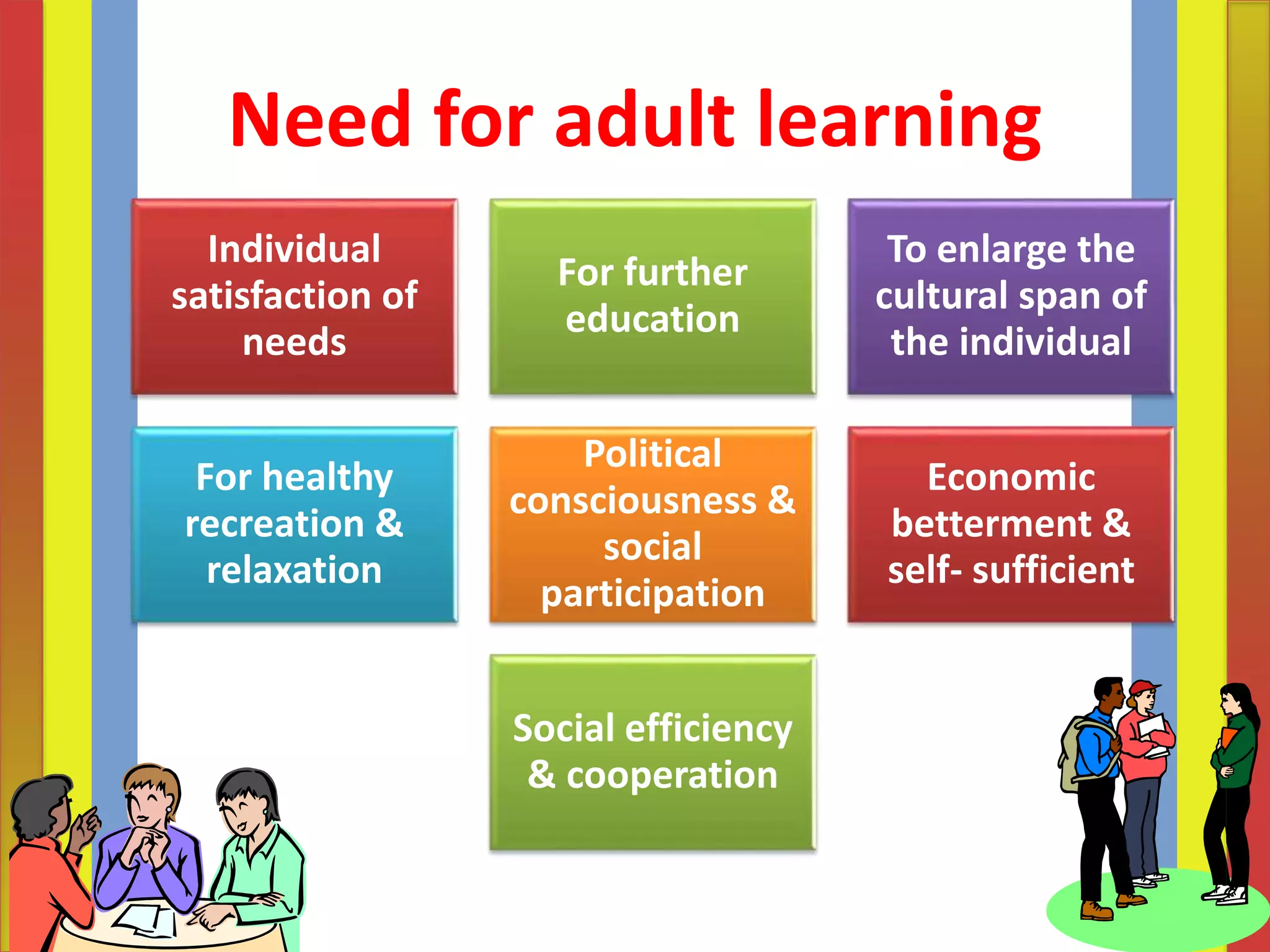
Individual
satisfaction of
needs
For further
education
To enlarge the
cultural span of
the individual
For healthy
recreation &
relaxation
Political
consciousness &
social
participation
Economic
betterment &
self- sufficient
Social efficiency
& cooperation
Need for adult learning
General
aims
Functional
aims
Aims of adult learning
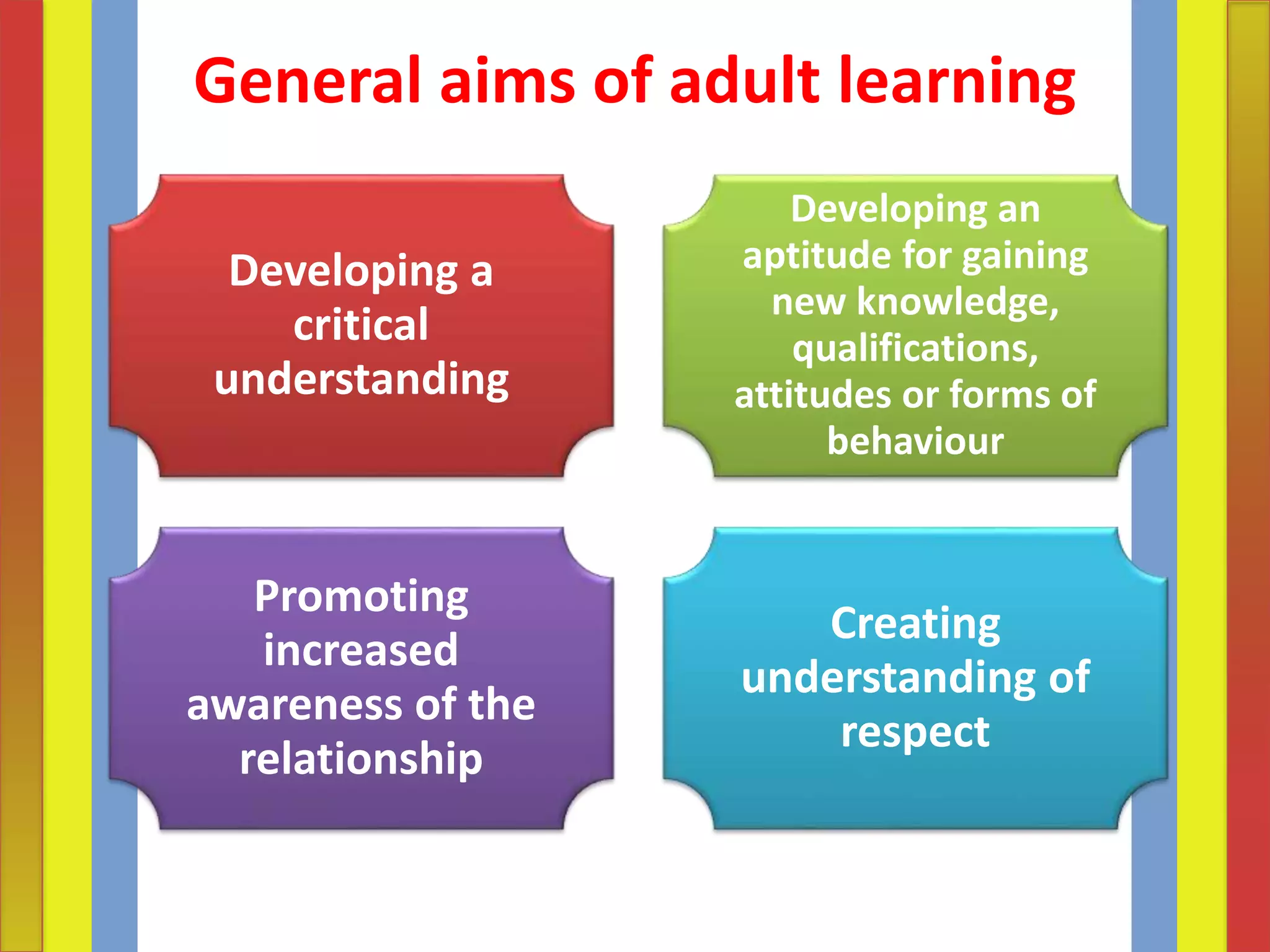
Developing a
critical
understanding
Developing an
aptitude for gaining
new knowledge,
qualifications,
attitudes or forms of
behaviour
Promoting
increased
awareness of the
relationship
Creating
understanding of
respect
General aims of adult learning
To provide functional
literacy
To provide further
education
To provide in service, on
the job, vocational &
professional training
Functional aims of adult learning
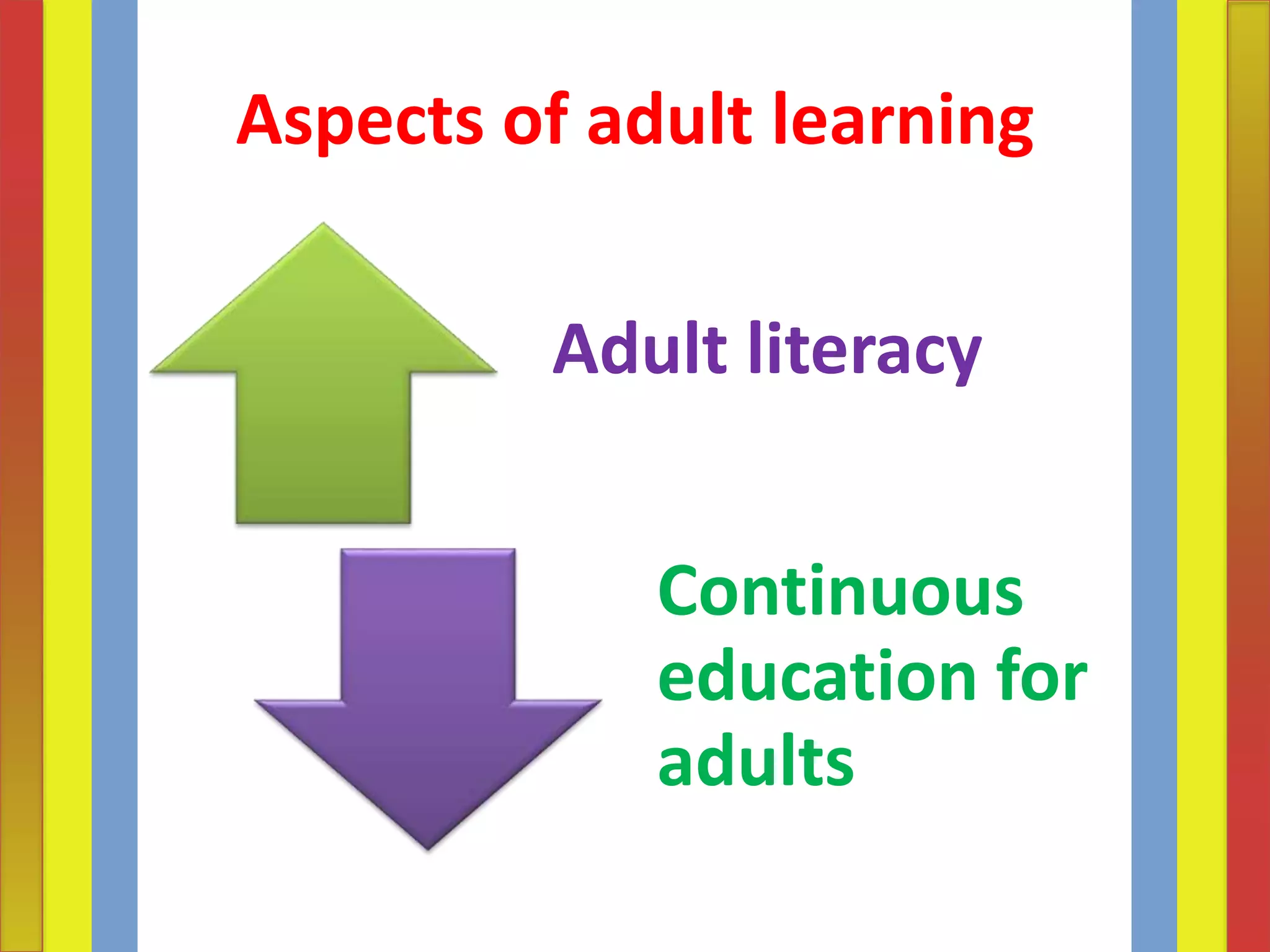
Adult literacy
Continuous
education for
adults
Aspects of adult learning
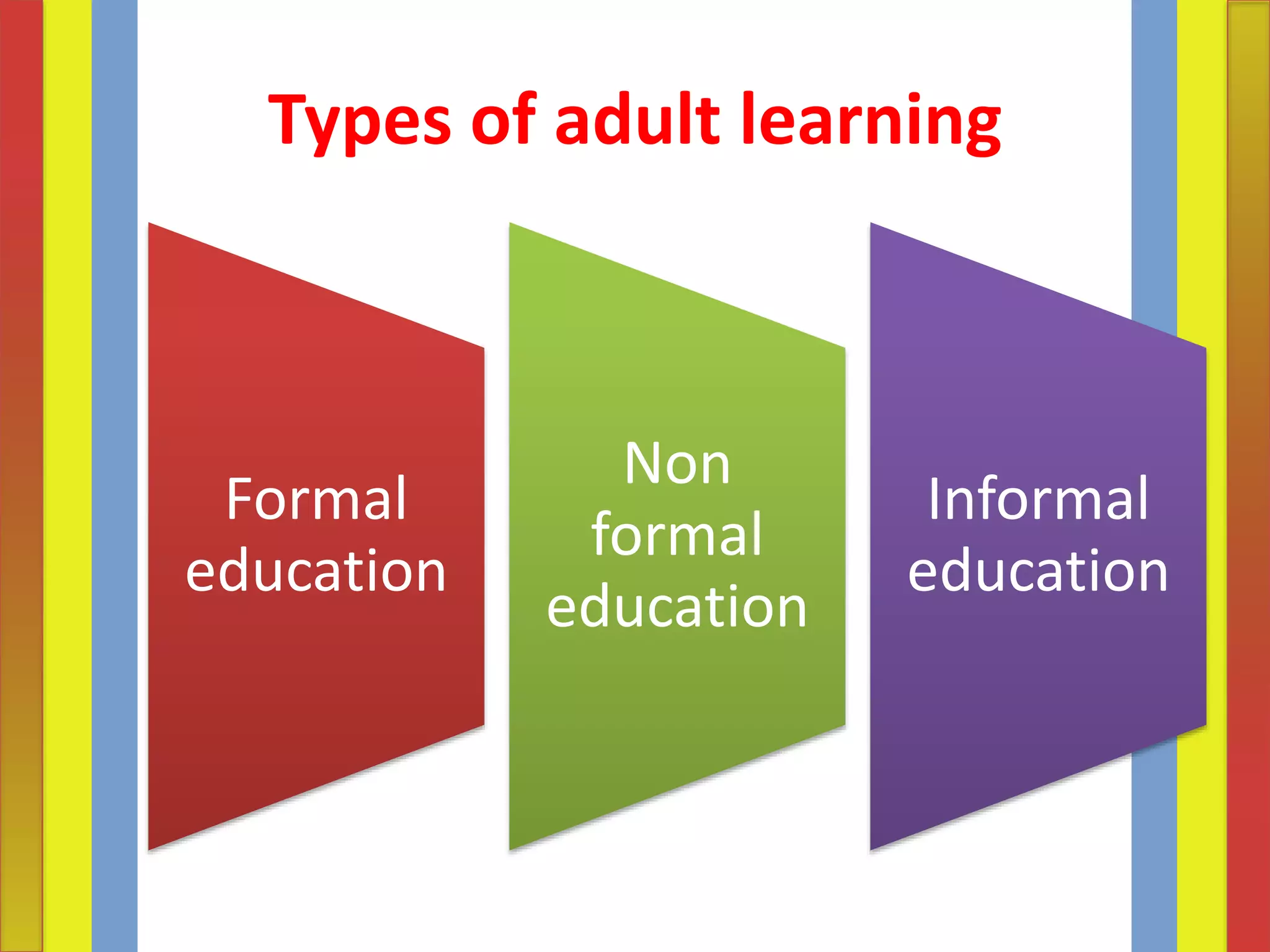
Formal
education
Non
formal
education
Informal
education
Types of adult learning
• Malcolm Shepherd Knowles (1913 – 1997) was
an American educator well known for the use of
the term Andragogy as synonymous to the adult
education.
Principles of adult learning
is the art and science of adult learning,
it is refers to any form of adult learning.
Andragogy in Greek means the man-
leading in comparison to pedagogy,
which in Greek means child-leading.
Andragogy
Autonomous & self‐directed
Principles of adult learning
Brings experiences & knowledge to each
learning activity
Contd..
Relevancy‐oriented & practical
Contd..
Goal oriented
Contd..
Problem oriented & want to apply their
knowledge
Contd..
Motivated by intrinsic & extrinsic factors
Contd..
Are pressed for time.
Contd..
Have different learning styles.
Contd..
Use all the senses
Contd..
Likes to be respected
Contd..
• Social
relationship
• External
expectation
• Social welfare
• Personal
advancement
• Stimulation/
escape
• Cognitive
interest
Stephen Lieb (1991)
(Factors of motivation)
Needs assessment
Safety
Sound relationship
Sequence of content & reinforcement
Praxis
Respect for learners
Clear role & role development
Cognitive, affective & psychomotor aspect
Team work
Active engagement of the learner
The learner should be accountable
Vella’s principles of learning
Barriers of adult learning
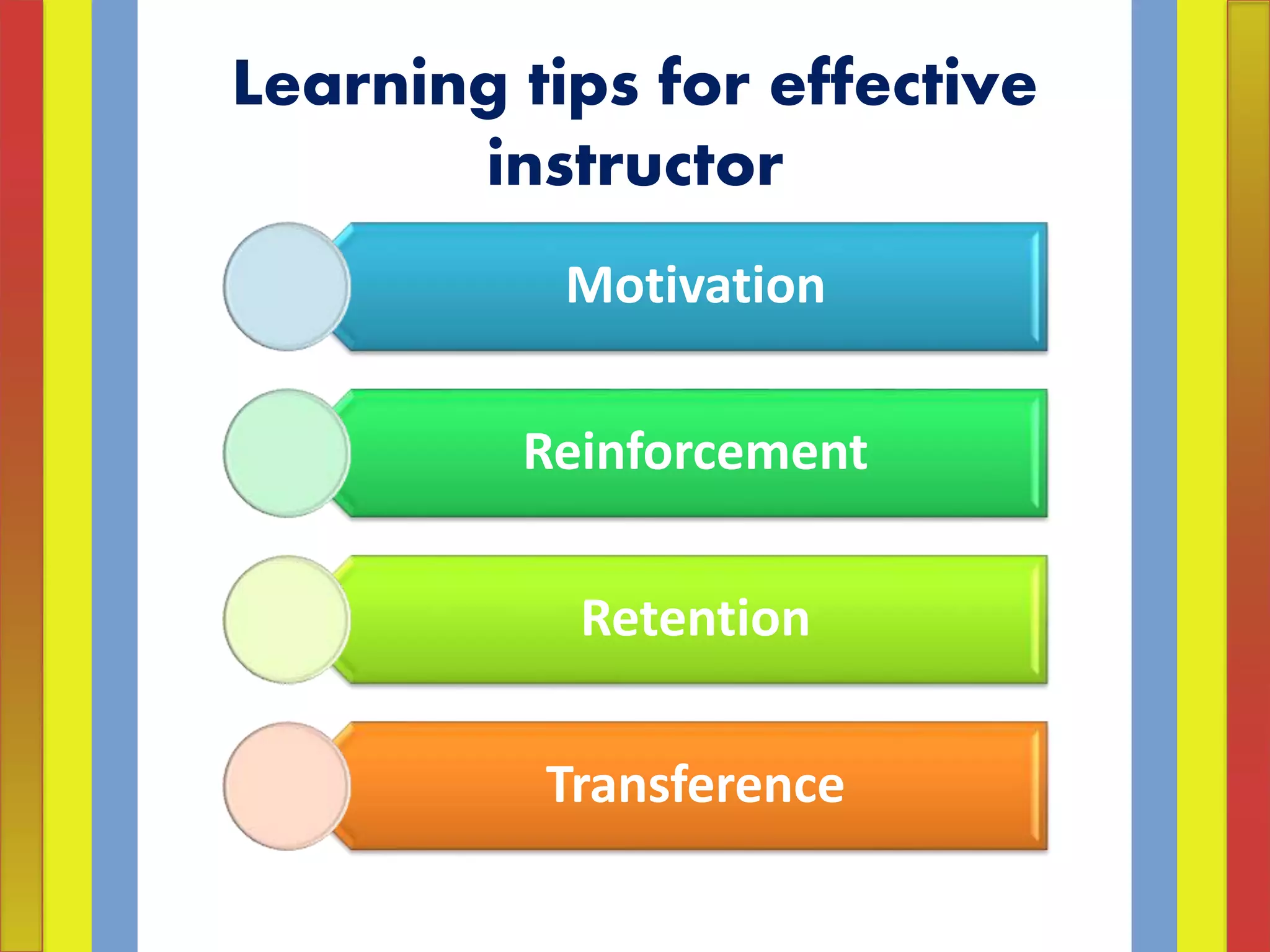
Motivation
Reinforcement
Retention
Transference
Learning tips for effective
instructor
Assessment of
learning needs
Introduction
To help in
educational
planning/future
planning of
training.
It encourages
trainee to
become aware
of his/her own
limits.
To identify
short comings
in trainee’s
performance.
To find out
trainees
individual
learning needs.
Purposes
Identifying learning
needs
Prioritizing needs
Need analysis
Process
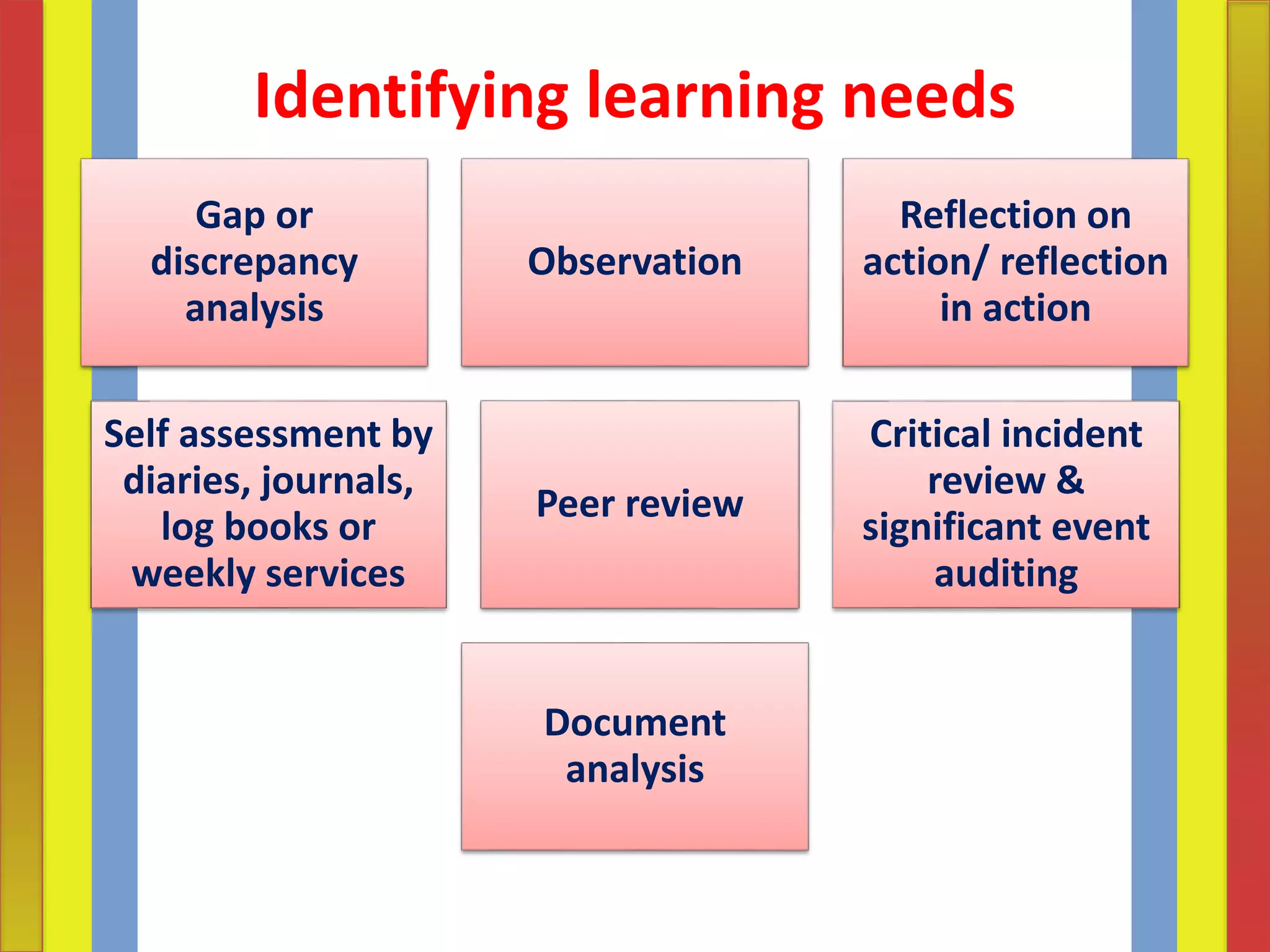
Gap or
discrepancy
analysis
Observation
Reflection on
action/ reflection
in action
Self assessment by
diaries, journals,
log books or
weekly services
Peer review
Critical incident
review &
significant event
auditing
Document
analysis
Identifying learning needs
Prioritizing needs
Need analysis
Thank you so
much for your
attention..

Adult learning