SELF EVALUATION
PEER EVALUATION
PATIENT SATISFACTION
UTILIZATION REVIEW
Submitted by,
Teena Jose
II M.Sc nursing
Holy Cross College of
Nursing,Kottiyam,
Kollam
SELF EVALUATION,
PEER EVALUATION,
PATIENT SATISFACTION,
UTILISATION REVIEW
Objectives….
DEFINITION
Self evaluation is defined as
judging the quality of one’s
work, based on evidence
and explicit criteria, for
the purpose of doing
better work in the future.
PURPOSES
• To encourage continuing
self-evaluation and
reflection and to
promote an ongoing,
innovative approach.
• To encourage individual
professional growth in
areas of interest to the
employee
• To improve morale and
motivation by treating
the employee as a
professional in charge of
his or her own
professional growth.
• To encourage collegiality
and discussion about
practices among peers in
an organization
• To support employees
as they experiment
with approaches that
will move them to
higher levels of
performance
BENEFITS OF SELF
EVALUATION
• Increased confidence
• Enthusiasm
• Improved team-work and
greater flexibility
• awareness of new
techniques
• Enhanced planning skills
TOOLS FOR SELF EVALUATION
• Staff annual
professional review
procedures
• Peer support
• Coaching
• Joint preparation of
materials
• Planning
• Team building
• Observation
• Audit checklist
Staff annual professional
review
Coaching
DEMERITS
• Reluctant to fill the
self appraisal forms
• The self assessments
are not always
accurate.
• Conflict between the
employees’ ratings and
their supervisors’
rating.
PEER EVALUATION
DEFINITION
• “Peer review is a process by which
employees of the same rank, profession,
and setting evaluate one another’s job
performance against accepted standards.”
- O’ Loughlin and Kaulbach
SUCCESS OF PEER EVALUATION
DEPENDS ON
• Short but objective
method
• Trained observers
• Constructive feedback
for faulty development
• Open communication
and trust
METHODS OF PEER
EVALUATION
• Direct observation
• Videotaping
• Evaluation of course
materials
• Analysis of portfolios
PROCESS OF PEER REVIEW
• Establish a policy
requiring peer reviews
• Establish criteria for
peer evaluations
• Procedure for
conducting peer
evaluations
Faculty chosen to conduct
peer evaluations shall be
tenured and hold on academic
rank higher than that of the
faculty member being
evaluated
A written report, addressing
the criteria, shall be prepared
and signed by the evaluator
The department shall archive
the written evaluations for
use in future evaluations
• One copy of the peer
evaluation shall be placed in
the permanent personnel
file of the person being
evaluated
• All reports of peer
evaluations shall be
included in the tenure file,
and are to be carefully
reviewed at the
department
ADVANTAGES:
• Improves team work
• Encourage group
members involvement
and responsibilities
• Encourage peers to
reflects on their role
and contribution to the
process of group work.
• Focuses on the development of
judgement skills
• Provides more relevant feed back to the
students as it is generated by their
peers.
• Give opportunities for the hidden
leaders to be selected
DISADVANTAGES
• Threats to
friendship bias
• Time consuming
• Artificially inflated.
• Peers feels ill
equipped to
undertake the
assessment.
• Reluctance to make
judgment regarding
their peers
PATIENT SATISFACTION
DEFINITION
• “Patient satisfaction is
defined as a health
care recipients reaction
to salient aspects of
the context, process,
and result of their
service experience.”
-Pascoe,1983
NEED FOR EVALUATING
PATIENT SATISFACTION
• Data about patient
satisfaction equips
nurses with useful
information about the
structure, process and
outcome of nursing
care
• It is a requirement for
therapeutic treatment and
is equivalent to self
therapy. Satisfied
patients help themselves
get healed faster because
they are more willing to
comply with treatment
and adhere to instructions
of health care providers,
and thus have a shorter
recovery time.
METHODS OF MONITORING
PATIENT SATISFACTION
• Medical audit
• Quality assurance
committee reviews
• Indices of nursing
performances
• Judgemental method
COMPONENTS OF EVALUATION
OF PATIENT SATISFACTION
• Evaluation of the programs
and activities of various
departments including
outpatient care, inpatient
care, overall health education
activities of the hospital
• Evaluation of the various
resources available in the
hospital for effective health
care
• Evaluation of
effectiveness of hospital
personnel including
medical, paramedical,
nursing as well as non-
medical employees of the
hospital.
• Services are relevant to
the needs of the
population it serves.

STRENGTHS / ADVANTAGES
• Cost effective.
• Specific segments can be
easily targeted.
• Wider sample distribution
possible.
• Encourages high response
rate.
• Visuals may be used.
• Little bias.

• Patient/client anonymity.
• Respondents given time to
complete.
• Can use validated survey
instruments.
• Qualitative comments can be
included.
• Can be administered by
independent external agencies
WEAKNESSES/DISADVANTAGES
• Difficulties associated
with procuring an accurate
list of client/patient
details.
• No opportunity for
explanation or follow up
questions.
• Potential to excludes
sections of the population.
• Provides limited
opportunities for large
numbers of community
members to participate in
the process.
• Does not allow for the
exchange of ideas and
discussion.
• Reliability dependent on
timing.
ULITILISATION REVIEW
AIMS AND OBJECTIVES
• The main aim is to reduce
the health care costs
• They work in liaison with a
business organisation to
provide healthcare services
to the organisation’s
employees at discounted
rates.
• Cost control to limit each
patient’s diagnostic and
treatment measures to
the fewest, least
expensive procedures
that will relieve patient
symptoms, costly
complications, and return
the patient to fullest
possible function in the
shortest time possible.
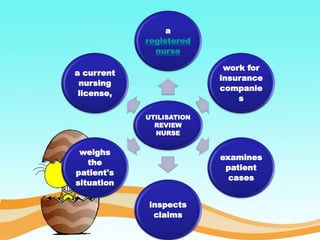
Who is a utilization review
nurse..???
UTILISATION
REVIEW
NURSE
a
registered
nurse
work for
insurance
companie
s
examines
patient
cases
inspects
claims
weighs
the
patient's
situation
a current
nursing
license,
TYPES OF UTILIZATION
REVIEWS
ESSENTIAL FUNCTIONS OF
UTILIZATION REVIEW NURSE
• Obtains and evaluates medical
records for in-patient
admissions to determine if
required documentation is
present.
• Obtains appropriate records
as required and initiates
Physician Advisories as
necessary for unwarranted
admissions.
• Conducts on-going reviews
and discusses care changes
with attending physicians
and others.
• Formulates and documents
discharge plans.
• Provides on-going
consultation and coordination
with multiple services within
the hospital to ensure
efficient use of hospital
resources
• Identifies pay source problems
and provides intervention for
appropriate referrals
• Coordinates with admitting
office to avoid inappropriate
admissions.
• Coordinates with clinic areas in
scheduling specialized tests
with other health care
providers, assessing pay source
and authorizing payment under
Medically Indigent Adult
program as necessary.
• Reviews and approves
surgery schedule to ensure
elective procedures are
authorized.
• Coordinates with
correctional facilities to
determine appropriate use
of elective procedures,
durable medical goods and
other services.
RESEARCH STUDY
• A study was conducted on ‘Impact of Regular
Nursing Rounds on Patient Satisfaction with
Nursing Care’ by Reza Negarandeh et al on July
2014. The purpose of the study was to determine the
impact of regular nursing rounds on patient
satisfaction with nursing care.
• This was a controlled clinical trial in which
100 hospitalized patients in a medical
surgical ward were allocated to control and
experimental groups through convenience
sampling. The experimental group
received regular nursing rounds every 1–2
hours
• Routine care was performed for the control group.
Patient satisfaction with the quality of nursing care
was assessed on the second and fifth days of
hospitalization in both groups using Patient
Satisfaction with Nursing Care Quality Questionnaire.
It results On the second day, patient satisfaction
scores of the two groups had no significant difference
(p = .499).
• However, the intervention was
associated with statistically
significant increased patient
satisfaction in the experimental
group compared to the control
group (p < .001). It concludes
Implementing regular nursing
rounds had a positive impact on
patient satisfaction. This
method may hence improve
patient-nurse interactions and
promote the quality of nursing
care and patient satisfaction.
REFERENCES
• BOOKS
• Deepak. K. A comprehensive text book on
nursing management. I edition. Emmess
publication: 2013.
• Basavanthappa BT. Nursing
administration. Jaypee brothers; New
Delhi: 2000
• Neelam kumari. Management of nursing
services andeducation. III edition. Pee Vee
publication: 2011.
• B.M. Sakharkar. Principles of hospital
administration and planning. III edition.
Jaypee publication:2006.
• JOURNALS
• Asian Nursing Research, December
2014Volume 8, Issue 4, Pages 282–285 –
URL:http://www.asian-
nursingresearch.com/article/S1976-
1317(14)00069-3/abstract
• NET
• http://www.google.selfevaluation.com.
• http://www.google.pubmed.com
self evaluation,peer evaluation,patient satisfaction and utilization review

self evaluation,peer evaluation,patient satisfaction and utilization review

  • 1.
    SELF EVALUATION PEER EVALUATION PATIENTSATISFACTION UTILIZATION REVIEW Submitted by, Teena Jose II M.Sc nursing Holy Cross College of Nursing,Kottiyam, Kollam
  • 3.
    SELF EVALUATION, PEER EVALUATION, PATIENTSATISFACTION, UTILISATION REVIEW
  • 4.
  • 6.
    DEFINITION Self evaluation isdefined as judging the quality of one’s work, based on evidence and explicit criteria, for the purpose of doing better work in the future.
  • 7.
    PURPOSES • To encouragecontinuing self-evaluation and reflection and to promote an ongoing, innovative approach. • To encourage individual professional growth in areas of interest to the employee
  • 8.
    • To improvemorale and motivation by treating the employee as a professional in charge of his or her own professional growth. • To encourage collegiality and discussion about practices among peers in an organization
  • 9.
    • To supportemployees as they experiment with approaches that will move them to higher levels of performance
  • 10.
    BENEFITS OF SELF EVALUATION •Increased confidence • Enthusiasm • Improved team-work and greater flexibility • awareness of new techniques • Enhanced planning skills
  • 11.
    TOOLS FOR SELFEVALUATION • Staff annual professional review procedures • Peer support • Coaching • Joint preparation of materials • Planning • Team building • Observation • Audit checklist
  • 12.
  • 13.
  • 14.
    DEMERITS • Reluctant tofill the self appraisal forms • The self assessments are not always accurate. • Conflict between the employees’ ratings and their supervisors’ rating.
  • 15.
  • 16.
    DEFINITION • “Peer reviewis a process by which employees of the same rank, profession, and setting evaluate one another’s job performance against accepted standards.” - O’ Loughlin and Kaulbach
  • 17.
    SUCCESS OF PEEREVALUATION DEPENDS ON • Short but objective method • Trained observers • Constructive feedback for faulty development • Open communication and trust
  • 18.
    METHODS OF PEER EVALUATION •Direct observation • Videotaping • Evaluation of course materials • Analysis of portfolios
  • 19.
    PROCESS OF PEERREVIEW • Establish a policy requiring peer reviews • Establish criteria for peer evaluations • Procedure for conducting peer evaluations
  • 20.
    Faculty chosen toconduct peer evaluations shall be tenured and hold on academic rank higher than that of the faculty member being evaluated A written report, addressing the criteria, shall be prepared and signed by the evaluator The department shall archive the written evaluations for use in future evaluations
  • 21.
    • One copyof the peer evaluation shall be placed in the permanent personnel file of the person being evaluated • All reports of peer evaluations shall be included in the tenure file, and are to be carefully reviewed at the department
  • 22.
    ADVANTAGES: • Improves teamwork • Encourage group members involvement and responsibilities • Encourage peers to reflects on their role and contribution to the process of group work.
  • 23.
    • Focuses onthe development of judgement skills • Provides more relevant feed back to the students as it is generated by their peers. • Give opportunities for the hidden leaders to be selected
  • 24.
    DISADVANTAGES • Threats to friendshipbias • Time consuming • Artificially inflated. • Peers feels ill equipped to undertake the assessment. • Reluctance to make judgment regarding their peers
  • 25.
  • 26.
    DEFINITION • “Patient satisfactionis defined as a health care recipients reaction to salient aspects of the context, process, and result of their service experience.” -Pascoe,1983
  • 27.
    NEED FOR EVALUATING PATIENTSATISFACTION • Data about patient satisfaction equips nurses with useful information about the structure, process and outcome of nursing care
  • 28.
    • It isa requirement for therapeutic treatment and is equivalent to self therapy. Satisfied patients help themselves get healed faster because they are more willing to comply with treatment and adhere to instructions of health care providers, and thus have a shorter recovery time.
  • 29.
    METHODS OF MONITORING PATIENTSATISFACTION • Medical audit • Quality assurance committee reviews • Indices of nursing performances • Judgemental method
  • 30.
    COMPONENTS OF EVALUATION OFPATIENT SATISFACTION • Evaluation of the programs and activities of various departments including outpatient care, inpatient care, overall health education activities of the hospital • Evaluation of the various resources available in the hospital for effective health care
  • 31.
    • Evaluation of effectivenessof hospital personnel including medical, paramedical, nursing as well as non- medical employees of the hospital. • Services are relevant to the needs of the population it serves.
  • 32.
    STRENGTHS / ADVANTAGES •Cost effective. • Specific segments can be easily targeted. • Wider sample distribution possible. • Encourages high response rate. • Visuals may be used.
  • 33.
    • Little bias. •Patient/client anonymity. • Respondents given time to complete. • Can use validated survey instruments. • Qualitative comments can be included. • Can be administered by independent external agencies
  • 34.
    WEAKNESSES/DISADVANTAGES • Difficulties associated withprocuring an accurate list of client/patient details. • No opportunity for explanation or follow up questions. • Potential to excludes sections of the population.
  • 35.
    • Provides limited opportunitiesfor large numbers of community members to participate in the process. • Does not allow for the exchange of ideas and discussion. • Reliability dependent on timing.
  • 36.
  • 37.
    AIMS AND OBJECTIVES •The main aim is to reduce the health care costs • They work in liaison with a business organisation to provide healthcare services to the organisation’s employees at discounted rates.
  • 38.
    • Cost controlto limit each patient’s diagnostic and treatment measures to the fewest, least expensive procedures that will relieve patient symptoms, costly complications, and return the patient to fullest possible function in the shortest time possible.
  • 39.
    Who is autilization review nurse..???
  • 40.
  • 41.
  • 42.
    ESSENTIAL FUNCTIONS OF UTILIZATIONREVIEW NURSE • Obtains and evaluates medical records for in-patient admissions to determine if required documentation is present. • Obtains appropriate records as required and initiates Physician Advisories as necessary for unwarranted admissions.
  • 43.
    • Conducts on-goingreviews and discusses care changes with attending physicians and others. • Formulates and documents discharge plans. • Provides on-going consultation and coordination with multiple services within the hospital to ensure efficient use of hospital resources
  • 44.
    • Identifies paysource problems and provides intervention for appropriate referrals • Coordinates with admitting office to avoid inappropriate admissions. • Coordinates with clinic areas in scheduling specialized tests with other health care providers, assessing pay source and authorizing payment under Medically Indigent Adult program as necessary.
  • 45.
    • Reviews andapproves surgery schedule to ensure elective procedures are authorized. • Coordinates with correctional facilities to determine appropriate use of elective procedures, durable medical goods and other services.
  • 46.
    RESEARCH STUDY • Astudy was conducted on ‘Impact of Regular Nursing Rounds on Patient Satisfaction with Nursing Care’ by Reza Negarandeh et al on July 2014. The purpose of the study was to determine the impact of regular nursing rounds on patient satisfaction with nursing care.
  • 47.
    • This wasa controlled clinical trial in which 100 hospitalized patients in a medical surgical ward were allocated to control and experimental groups through convenience sampling. The experimental group received regular nursing rounds every 1–2 hours
  • 48.
    • Routine carewas performed for the control group. Patient satisfaction with the quality of nursing care was assessed on the second and fifth days of hospitalization in both groups using Patient Satisfaction with Nursing Care Quality Questionnaire. It results On the second day, patient satisfaction scores of the two groups had no significant difference (p = .499).
  • 49.
    • However, theintervention was associated with statistically significant increased patient satisfaction in the experimental group compared to the control group (p < .001). It concludes Implementing regular nursing rounds had a positive impact on patient satisfaction. This method may hence improve patient-nurse interactions and promote the quality of nursing care and patient satisfaction.
  • 50.
    REFERENCES • BOOKS • Deepak.K. A comprehensive text book on nursing management. I edition. Emmess publication: 2013. • Basavanthappa BT. Nursing administration. Jaypee brothers; New Delhi: 2000 • Neelam kumari. Management of nursing services andeducation. III edition. Pee Vee publication: 2011.
  • 51.
    • B.M. Sakharkar.Principles of hospital administration and planning. III edition. Jaypee publication:2006. • JOURNALS • Asian Nursing Research, December 2014Volume 8, Issue 4, Pages 282–285 – URL:http://www.asian- nursingresearch.com/article/S1976- 1317(14)00069-3/abstract • NET • http://www.google.selfevaluation.com. • http://www.google.pubmed.com