DISCIPLINE
DISCIPLINEDISCIPLINE SERVICE RULESSELF DISCIPLINECONSTRUCTIVE VERSUS DESTRUCTIVE DISCIPLINEPROBLEM EMPLOYEE, DISCIPLINARY PROCEEDING ENQUIRY.
MEANINGThe word “discipline” is derived from the Latin word “disciplina”, which means teaching, learning and growing.  Megginson offer three distinct meaning of the word discipline:Self-discipline
Necessary condition of orderly behavior
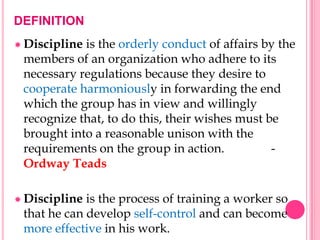
Act of training and punishing.DEFINITIONDiscipline is the orderly conduct of affairs by the members of an organization who adhere to its necessary regulations because they desire to cooperate harmoniously in forwarding the end which the group has in view and willingly recognize that, to do this, their wishes must be brought into a reasonable unison with the requirements on the group in action.               -       Ordway Teads
Discipline is the process of training a worker so that he can develop self-control and can become more effective in his work.OBJECTIVES OF DISCIPLINE:To obtain a willing acceptance of the rules, regulations and procedures of an organization so that organizational goals may be attained.
To impart an element of certainty despite several differences in informal behaviours pattern and other related changes in an organization.
To develop among the employees a spirit of tolerance and a desire to make adjustments. Cont...To give and seek direction and responsibility
To create an atmosphere of respect for the human personality and human relations
To increase the working efficiency and morale of the employees so that their productivity is stepped up the cost of production improved.TYPES OF DISCIPLINE 1. Self controlled discipline : In self controlled discipline the employee brings her or his behavior in to agreement with the organizations official behavior code, ie the employee regulate their activities for the common good of the organization. As a result the human beings are induced to work for a peak performance under self controlled discipline.
2. Enforced Discipline : Is a managerial action enforces employee compliance with organization’s rules and regulations. ie it is a common discipline imposed from the top here the manager exercises his authority to compel the employees to behave in a particular wayINDISCIPLINE:-	   Indiscipline means disorderliness, insubordination and not following the rules and regulation of an organization. 	The symptoms of indiscipline are change in the normal behaviour, absenteeism, apathy, go-slow at work, increase in number and severity of grievances, persistent and continuous demand for overtime allowance, and lack of concern for performance.Causes of indiscipline:-Non-placement of the right person on the right jobUndesirable behaviour of senior officials.Faulty evaluation of persons and situations by executives leads of favoritism.Lack of upward communication.Leadership which is weak, flexible, incompetent and distrustful.
Defective supervision and an absence of good supervisors who know good techniques, who are in a position to appreciate critically the efforts or their subordinates.Lack of properly drawn rules and regulations.Workers’ personal problems, their fears, apprehensions, hopes and aspirations; and their lack of confidence in and their inability to adjust with their superior and equals.Worker’s reactions to rigidity and multiplicity of rules and their improper interpretation.Intolerably bad working conditions.
Inborn tendencies to flout rules.Absence of enlightened, sympathetic and scientific management.Errors of judgement on the part of the supervisor or the top management.Improper co-ordination, delegation of authority and fixing of responsibility.Discrimination based on caste, colour, creed, sex, language, and place in matters of selection, promotion, transfer, placement and discrimination in imposing penalties and handling out rewards.
APPROACHES TO DISCIPLINE:-		The different approaches to discipline include;Human relation approach: In human relation approach the employee is. helped to correct his deviationsHuman resources approach: Under the human resources approach, the employee is treated as resource and the act of indiscipline are dealt by considering the failure in the area of development, maintenance and utilization of human resources.
Group discipline approach: The group as a whole sets the standards of discipline, and punishments for the deviations. The individual employees are awarded punishments for their violation under the group discipline approach.Leadership approach: In this approach, every supervisor administers the rules of discipline and guides, trains and controls the subordinates regarding disciplinary rules.
Judicial approach: In judicial approach, indisciplinary cases are dealt on the basis of legislation and court decisions. 	The Industrial Employment Act, 1946, to a certain extent, prescribed the correct procedure that should be followed before awarding punishment to an employee in India.
PRINCIPLES FOR MAINTENANCE OF DISCIPLINE:-The most important principles to be observed in the maintenance of discipline have been outlined by Yoder, Heneman, Turnbull and Harold Stone. They are:All the rules should be framed in co-operation and collaboration with the representatives of employees.
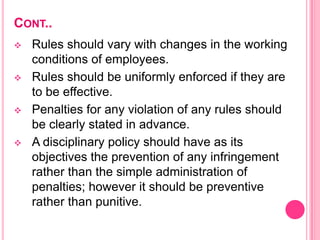
All the rules should be appraised at frequent and regular interval to ensure that they are, and continue to be, appropriate, sensible and useful.Cont..Rules should vary with changes in the working conditions of employees.
Rules should be uniformly enforced if they are to be effective.
Penalties for any violation of any rules should be clearly stated in advance.
A disciplinary policy should have as its objectives the prevention of any infringement rather than the simple administration of penalties; however it should be preventive rather than punitive.Extreme caution should be exercised to ensure that infringements are not encouraged.
If violations of a particular rule are fairly frequent, the circumstances surrounding them should be carefully investigated and studied in order to discover the cause or causes of such violations.
Recidivism must be expected. Some offenders would almost certainly violate rules more often than others. These cases should be carefully considered so that their causes may be discovered.
Definite and precise provisions for appeal and review of all disciplinary actions should be expressly mentioned in the employees’ handbook or collective agreements.ASPECTS OF DISCIPLINE:-Positive aspect: Employees believe in and support discipline and adhere to the rules, regulations and desired standards of behaviour. Discipline takes the form of positive support and reinforcement for approved actions and its aim is to help the individual in moulding his behaviour and developing him in a corrective and supportive manner. This type of approach is called positive approach or constructive discipline or self-discipline.
 			Positive discipline takes place whenever the organizational climate is marked by aspect such as payment of adequate remuneration and incentives, appreciation of performance and reinforcement of approved personnel behaviour or actions etc. 	which will motivate employees to adhere to certain rules and regulations or exercise self-control and work to the maximum possible extent.
Negative aspect:Employees sometimes do not believe in and support discipline. As such, they do not adhere to rules, regulations and desired standards of behaviour.  As such, disciplinary programmeforces and constraints the employees to obey orders and function in accordance with set rules and regulations through warnings, penalties and other forms of punishment. This approach to discipline is called negative approach or corrective approach or punitive approach.
This approach is also called autocratic approach as the subordinates are given no role in formulating the rules and they are not told why they are punished. Punishment, penalties, demotions and transfers provide or establish a climate which demotivate and deleadthe employees.
SERVICE RULES Service law is an important field of law. It is essential that those concerned with the administration of service matters know the correct procedure to deal with them according to law. The expression ‘condition of service’ means all those conditions which regulate the holding of a post by the person right from the time of his/her appointment till his/her retirement, and even beyond it in matters like pension.
EFFECTIVE RULES OF DISCIPLINE:-McGregor (1967) developed a set of rules for enforcing discipline so as to make it as fair and growth producing as possible. These rules were called “hot stove rules” because they can be compared to someone touching a hot stove..
The following rules explain his theory:All individuals must be forewarned that if they touch the hot stove (i.e., break a rule), they will be burned (punished or disciplined). They must know the rule beforehand and be aware of the punishment If the individual touches the stoves (i.e., breaks a rule), there will be immediate consequences (getting burned). All discipline should be administered immediately after rules are broken.
If the individual touches the stove again, they will again be burned. Therefore, there is consistency. Each time, the rule is broken; there are immediate and consistent consequences.If any other individual touches the hot stove, they will also get burned. Discipline must be impartial and everyone must be treated in the same manner if the rule breaking is the same.
The highest level and most effective form of discipline is self-discipline.  		Ideally, all employees should have adequate self-control and should be self-directed in their pursuit of organizational goals.
Definition:	Self discipline is best defined as the ability to regulate ones conductby principle and sound judgment, rather than by impulse, desire, or social custom. 	Self discipline can be considered a type of selective training, creating new habits of thought, action, and speech toward improving yourself and reaching goals.
The Five Pillars of self discipline AcceptanceWillpowerHard workIndustry Persistence. 	If you take the first letters of each word you get the acronym “A WHIP”- since many people associate self discipline with whipping themselves into shape.
To be self disciplined: Get yourself organizedDon’t constantly seek to be entertained Be on time Keep your word Do the most difficult tasks firstFinish what you startAccept correction Practice self denial Welcome responsibility
Health Care Education Associates (1987) identified four factors that must be present to foster a climate of self-discipline.Employee awareness and understanding of rules and regulations that govern behaviour-The rules and regulation must be clearly written and communicated. Young and Hayne (1988) stated that the most common reason for unsatisfactory work performance is that the employee thinks they are performing satisfactorily. In other words the employee does not know there is a problem.
There must exist an atmosphere of mutual trust- Manager must believe that employees are capable of and actively seeking self-discipline. Likewise employees must perceive the manager as honest and trustworthy. Employees lack the security for self-discipline if they do not trust their manager’s motives.Formal authority must be used judiciously-Approximately one-half of grievance cases appealed before an arbitrator by labour unions involved disciplinary action. In about one-half of those cases, management either reversed or modified its decision when the individual’s appeal was upheld.Employees should identify with the goals of the organization-When the employees accept the goals and objectives of an organization, they are more likely to accept the standards of conduct deemed acceptable by the organization.
CONSTRUCTIVE VERSUS DESTRUCTIVE DISCIPLINE:-Destructive discipline: Scientific management viewed discipline as a necessary means for controlling an “unmotivated and self-centered work force.”Cautionary written warnings of termination were rampant and the employee was always alert to an impending penalty or termination. This “big stick” approach to management focused on eliminating all behavior that could be considered in conflict with organizational goals, without regard for employee growth.
This method may succeed on a short-term basis; it is demotivating and reduces productivity over the long term. This occurs because individuals will achieve only at the level they feel is necessary to avoid punishment. This approach is also destructive and demoralizing as discipline is often administered arbitrarily, and is unfair either in the application of rules or in the resulting punishment.
Constructive discipline: Constructive discipline is used as a means of helping the employee grow, and not as punitive measure. The primary emphasis in constructive discipline is in assisting employees to behave in a manner that allows them to be self-directed in meeting organizational goals. Employees can focus energy on meeting organizational goals; they must feel secure in the workplace. This security develops only when staff knows and understand organizational rules and penalties and when rules are applied in a fair and consistent manner. In an environment that promotes constructive discipline, employees are generally self-disciplined to conform to established rules and regulations and the primary role of the manager becomes that of coordinator and helper, rather than enforcer.
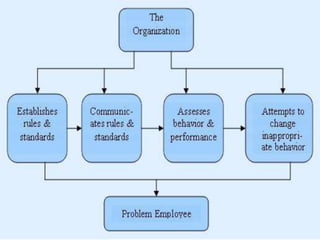
PROBLEM EMPLOYEE:-	Problem employees are those employees who create problems within the organization. Substance abusers, angry or withdrawn workers, personnel with excessive absenteeism, and the terminating employees provide challenges to nurse managers. In each case the nurse manager must be alert to the symptoms of problems, help the employee solve the problem, and evaluate the results.
Problems of the employee includes following:- Minor problems : example;late attendance or absence from duty without permission or leave.leaving work place without permissionsmoking or eating in prohibited areas and patient areas.laziness inefficiency or careless workPenalty: Warning, Fine, Suspension without pay and allowance up to 4 days
Major problems:example;Using hospital facilities unauthorized for personal gainRefusal to accept or obey an order, using indecent languagesGross negligence or neglect of workPenalty:Suspension without pay and allowances for a period up to 30 days, Stoppage of one or more increments, Demotion to lower post, Dismissal.
Types of problem employee:-Substance abusersAngry or withdrawn employeesDecreased productivityAbsenteeismTerminating employees
DICIPLINARY PROCEDURE:-The following steps should be taken into consideration:Accurate statement of the problem- The first step is to ascertain the problem by seeking answer to the following questions:Does this case call for a disciplinary action?What exactly is the nature of the violation or offence?Under what condition did it occur?Which individual or individuals were involved in it?When or how often, did the violation occur?Collecting facts bearing on the case- Before any action is taken in a case, it is essential to gather all the facts about it. A thorough examination of the case should be made within the stipulated time limit.
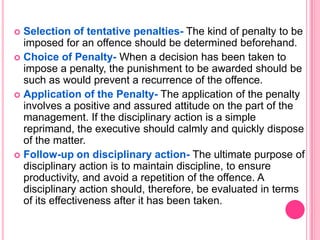
Selection of tentative penalties-The kind of penalty to be imposed for an offence should be determined beforehand.Choice of Penalty-When a decision has been taken to impose a penalty, the punishment to be awarded should be such as would prevent a recurrence of the offence.Application of the Penalty-The application of the penalty involves a positive and assured attitude on the part of the management. If the disciplinary action is a simple reprimand, the executive should calmly and quickly dispose of the matter.Follow-up on disciplinary action- The ultimate purpose of disciplinary action is to maintain discipline, to ensure productivity, and avoid a repetition of the offence. A disciplinary action should, therefore, be evaluated in terms of its effectiveness after it has been taken.
BASIC INGREDIENT FOR A DISCIPLINARY ACTION:-		The principle ingredients of a sound disciplinary system are:Location of responsibility Proper formulation and communication of rulesRules and regulations should be reasonableEqual treatmentDisciplinary action should be taken in PrivateImportance of promptness in taking Disciplinary action
Innocence is presumedGet the factsAction should be taken in cool atmosphere:Natural justiceAfter a disciplinary action has been taken the Supervisor should treat his subordinate in a normal mannerDon’t back down when you are rightNegative Motivation should be handled in a positive manner

Discipline

  • 1.
  • 3.
    DISCIPLINEDISCIPLINE SERVICE RULESSELFDISCIPLINECONSTRUCTIVE VERSUS DESTRUCTIVE DISCIPLINEPROBLEM EMPLOYEE, DISCIPLINARY PROCEEDING ENQUIRY.
  • 4.
    MEANINGThe word “discipline”is derived from the Latin word “disciplina”, which means teaching, learning and growing. Megginson offer three distinct meaning of the word discipline:Self-discipline
  • 5.
    Necessary condition oforderly behavior
  • 6.
    Act of trainingand punishing.DEFINITIONDiscipline is the orderly conduct of affairs by the members of an organization who adhere to its necessary regulations because they desire to cooperate harmoniously in forwarding the end which the group has in view and willingly recognize that, to do this, their wishes must be brought into a reasonable unison with the requirements on the group in action. - Ordway Teads
  • 7.
    Discipline is theprocess of training a worker so that he can develop self-control and can become more effective in his work.OBJECTIVES OF DISCIPLINE:To obtain a willing acceptance of the rules, regulations and procedures of an organization so that organizational goals may be attained.
  • 8.
    To impart anelement of certainty despite several differences in informal behaviours pattern and other related changes in an organization.
  • 9.
    To develop amongthe employees a spirit of tolerance and a desire to make adjustments. Cont...To give and seek direction and responsibility
  • 10.
    To create anatmosphere of respect for the human personality and human relations
  • 11.
    To increase theworking efficiency and morale of the employees so that their productivity is stepped up the cost of production improved.TYPES OF DISCIPLINE 1. Self controlled discipline : In self controlled discipline the employee brings her or his behavior in to agreement with the organizations official behavior code, ie the employee regulate their activities for the common good of the organization. As a result the human beings are induced to work for a peak performance under self controlled discipline.
  • 12.
    2. Enforced Discipline: Is a managerial action enforces employee compliance with organization’s rules and regulations. ie it is a common discipline imposed from the top here the manager exercises his authority to compel the employees to behave in a particular wayINDISCIPLINE:- Indiscipline means disorderliness, insubordination and not following the rules and regulation of an organization. The symptoms of indiscipline are change in the normal behaviour, absenteeism, apathy, go-slow at work, increase in number and severity of grievances, persistent and continuous demand for overtime allowance, and lack of concern for performance.Causes of indiscipline:-Non-placement of the right person on the right jobUndesirable behaviour of senior officials.Faulty evaluation of persons and situations by executives leads of favoritism.Lack of upward communication.Leadership which is weak, flexible, incompetent and distrustful.
  • 13.
    Defective supervision andan absence of good supervisors who know good techniques, who are in a position to appreciate critically the efforts or their subordinates.Lack of properly drawn rules and regulations.Workers’ personal problems, their fears, apprehensions, hopes and aspirations; and their lack of confidence in and their inability to adjust with their superior and equals.Worker’s reactions to rigidity and multiplicity of rules and their improper interpretation.Intolerably bad working conditions.
  • 14.
    Inborn tendencies toflout rules.Absence of enlightened, sympathetic and scientific management.Errors of judgement on the part of the supervisor or the top management.Improper co-ordination, delegation of authority and fixing of responsibility.Discrimination based on caste, colour, creed, sex, language, and place in matters of selection, promotion, transfer, placement and discrimination in imposing penalties and handling out rewards.
  • 15.
    APPROACHES TO DISCIPLINE:- Thedifferent approaches to discipline include;Human relation approach: In human relation approach the employee is. helped to correct his deviationsHuman resources approach: Under the human resources approach, the employee is treated as resource and the act of indiscipline are dealt by considering the failure in the area of development, maintenance and utilization of human resources.
  • 16.
    Group discipline approach:The group as a whole sets the standards of discipline, and punishments for the deviations. The individual employees are awarded punishments for their violation under the group discipline approach.Leadership approach: In this approach, every supervisor administers the rules of discipline and guides, trains and controls the subordinates regarding disciplinary rules.
  • 17.
    Judicial approach: Injudicial approach, indisciplinary cases are dealt on the basis of legislation and court decisions. The Industrial Employment Act, 1946, to a certain extent, prescribed the correct procedure that should be followed before awarding punishment to an employee in India.
  • 18.
    PRINCIPLES FOR MAINTENANCEOF DISCIPLINE:-The most important principles to be observed in the maintenance of discipline have been outlined by Yoder, Heneman, Turnbull and Harold Stone. They are:All the rules should be framed in co-operation and collaboration with the representatives of employees.
  • 19.
    All the rulesshould be appraised at frequent and regular interval to ensure that they are, and continue to be, appropriate, sensible and useful.Cont..Rules should vary with changes in the working conditions of employees.
  • 20.
    Rules should beuniformly enforced if they are to be effective.
  • 21.
    Penalties for anyviolation of any rules should be clearly stated in advance.
  • 22.
    A disciplinary policyshould have as its objectives the prevention of any infringement rather than the simple administration of penalties; however it should be preventive rather than punitive.Extreme caution should be exercised to ensure that infringements are not encouraged.
  • 23.
    If violations ofa particular rule are fairly frequent, the circumstances surrounding them should be carefully investigated and studied in order to discover the cause or causes of such violations.
  • 24.
    Recidivism must beexpected. Some offenders would almost certainly violate rules more often than others. These cases should be carefully considered so that their causes may be discovered.
  • 25.
    Definite and preciseprovisions for appeal and review of all disciplinary actions should be expressly mentioned in the employees’ handbook or collective agreements.ASPECTS OF DISCIPLINE:-Positive aspect: Employees believe in and support discipline and adhere to the rules, regulations and desired standards of behaviour. Discipline takes the form of positive support and reinforcement for approved actions and its aim is to help the individual in moulding his behaviour and developing him in a corrective and supportive manner. This type of approach is called positive approach or constructive discipline or self-discipline.
  • 26.
    Positive disciplinetakes place whenever the organizational climate is marked by aspect such as payment of adequate remuneration and incentives, appreciation of performance and reinforcement of approved personnel behaviour or actions etc. which will motivate employees to adhere to certain rules and regulations or exercise self-control and work to the maximum possible extent.
  • 27.
    Negative aspect:Employees sometimesdo not believe in and support discipline. As such, they do not adhere to rules, regulations and desired standards of behaviour. As such, disciplinary programmeforces and constraints the employees to obey orders and function in accordance with set rules and regulations through warnings, penalties and other forms of punishment. This approach to discipline is called negative approach or corrective approach or punitive approach.
  • 28.
    This approach isalso called autocratic approach as the subordinates are given no role in formulating the rules and they are not told why they are punished. Punishment, penalties, demotions and transfers provide or establish a climate which demotivate and deleadthe employees.
  • 29.
    SERVICE RULES Servicelaw is an important field of law. It is essential that those concerned with the administration of service matters know the correct procedure to deal with them according to law. The expression ‘condition of service’ means all those conditions which regulate the holding of a post by the person right from the time of his/her appointment till his/her retirement, and even beyond it in matters like pension.
  • 30.
    EFFECTIVE RULES OFDISCIPLINE:-McGregor (1967) developed a set of rules for enforcing discipline so as to make it as fair and growth producing as possible. These rules were called “hot stove rules” because they can be compared to someone touching a hot stove..
  • 31.
    The following rulesexplain his theory:All individuals must be forewarned that if they touch the hot stove (i.e., break a rule), they will be burned (punished or disciplined). They must know the rule beforehand and be aware of the punishment If the individual touches the stoves (i.e., breaks a rule), there will be immediate consequences (getting burned). All discipline should be administered immediately after rules are broken.
  • 32.
    If the individualtouches the stove again, they will again be burned. Therefore, there is consistency. Each time, the rule is broken; there are immediate and consistent consequences.If any other individual touches the hot stove, they will also get burned. Discipline must be impartial and everyone must be treated in the same manner if the rule breaking is the same.
  • 33.
    The highest leveland most effective form of discipline is self-discipline. Ideally, all employees should have adequate self-control and should be self-directed in their pursuit of organizational goals.
  • 34.
    Definition: Self discipline isbest defined as the ability to regulate ones conductby principle and sound judgment, rather than by impulse, desire, or social custom. Self discipline can be considered a type of selective training, creating new habits of thought, action, and speech toward improving yourself and reaching goals.
  • 35.
    The Five Pillarsof self discipline AcceptanceWillpowerHard workIndustry Persistence. If you take the first letters of each word you get the acronym “A WHIP”- since many people associate self discipline with whipping themselves into shape.
  • 36.
    To be selfdisciplined: Get yourself organizedDon’t constantly seek to be entertained Be on time Keep your word Do the most difficult tasks firstFinish what you startAccept correction Practice self denial Welcome responsibility
  • 37.
    Health Care EducationAssociates (1987) identified four factors that must be present to foster a climate of self-discipline.Employee awareness and understanding of rules and regulations that govern behaviour-The rules and regulation must be clearly written and communicated. Young and Hayne (1988) stated that the most common reason for unsatisfactory work performance is that the employee thinks they are performing satisfactorily. In other words the employee does not know there is a problem.
  • 38.
    There must existan atmosphere of mutual trust- Manager must believe that employees are capable of and actively seeking self-discipline. Likewise employees must perceive the manager as honest and trustworthy. Employees lack the security for self-discipline if they do not trust their manager’s motives.Formal authority must be used judiciously-Approximately one-half of grievance cases appealed before an arbitrator by labour unions involved disciplinary action. In about one-half of those cases, management either reversed or modified its decision when the individual’s appeal was upheld.Employees should identify with the goals of the organization-When the employees accept the goals and objectives of an organization, they are more likely to accept the standards of conduct deemed acceptable by the organization.
  • 39.
    CONSTRUCTIVE VERSUS DESTRUCTIVEDISCIPLINE:-Destructive discipline: Scientific management viewed discipline as a necessary means for controlling an “unmotivated and self-centered work force.”Cautionary written warnings of termination were rampant and the employee was always alert to an impending penalty or termination. This “big stick” approach to management focused on eliminating all behavior that could be considered in conflict with organizational goals, without regard for employee growth.
  • 40.
    This method maysucceed on a short-term basis; it is demotivating and reduces productivity over the long term. This occurs because individuals will achieve only at the level they feel is necessary to avoid punishment. This approach is also destructive and demoralizing as discipline is often administered arbitrarily, and is unfair either in the application of rules or in the resulting punishment.
  • 41.
    Constructive discipline: Constructivediscipline is used as a means of helping the employee grow, and not as punitive measure. The primary emphasis in constructive discipline is in assisting employees to behave in a manner that allows them to be self-directed in meeting organizational goals. Employees can focus energy on meeting organizational goals; they must feel secure in the workplace. This security develops only when staff knows and understand organizational rules and penalties and when rules are applied in a fair and consistent manner. In an environment that promotes constructive discipline, employees are generally self-disciplined to conform to established rules and regulations and the primary role of the manager becomes that of coordinator and helper, rather than enforcer.
  • 43.
    PROBLEM EMPLOYEE:- Problem employeesare those employees who create problems within the organization. Substance abusers, angry or withdrawn workers, personnel with excessive absenteeism, and the terminating employees provide challenges to nurse managers. In each case the nurse manager must be alert to the symptoms of problems, help the employee solve the problem, and evaluate the results.
  • 44.
    Problems of theemployee includes following:- Minor problems : example;late attendance or absence from duty without permission or leave.leaving work place without permissionsmoking or eating in prohibited areas and patient areas.laziness inefficiency or careless workPenalty: Warning, Fine, Suspension without pay and allowance up to 4 days
  • 45.
    Major problems:example;Using hospitalfacilities unauthorized for personal gainRefusal to accept or obey an order, using indecent languagesGross negligence or neglect of workPenalty:Suspension without pay and allowances for a period up to 30 days, Stoppage of one or more increments, Demotion to lower post, Dismissal.
  • 46.
    Types of problememployee:-Substance abusersAngry or withdrawn employeesDecreased productivityAbsenteeismTerminating employees
  • 48.
    DICIPLINARY PROCEDURE:-The followingsteps should be taken into consideration:Accurate statement of the problem- The first step is to ascertain the problem by seeking answer to the following questions:Does this case call for a disciplinary action?What exactly is the nature of the violation or offence?Under what condition did it occur?Which individual or individuals were involved in it?When or how often, did the violation occur?Collecting facts bearing on the case- Before any action is taken in a case, it is essential to gather all the facts about it. A thorough examination of the case should be made within the stipulated time limit.
  • 49.
    Selection of tentativepenalties-The kind of penalty to be imposed for an offence should be determined beforehand.Choice of Penalty-When a decision has been taken to impose a penalty, the punishment to be awarded should be such as would prevent a recurrence of the offence.Application of the Penalty-The application of the penalty involves a positive and assured attitude on the part of the management. If the disciplinary action is a simple reprimand, the executive should calmly and quickly dispose of the matter.Follow-up on disciplinary action- The ultimate purpose of disciplinary action is to maintain discipline, to ensure productivity, and avoid a repetition of the offence. A disciplinary action should, therefore, be evaluated in terms of its effectiveness after it has been taken.
  • 50.
    BASIC INGREDIENT FORA DISCIPLINARY ACTION:- The principle ingredients of a sound disciplinary system are:Location of responsibility Proper formulation and communication of rulesRules and regulations should be reasonableEqual treatmentDisciplinary action should be taken in PrivateImportance of promptness in taking Disciplinary action
  • 51.
    Innocence is presumedGetthe factsAction should be taken in cool atmosphere:Natural justiceAfter a disciplinary action has been taken the Supervisor should treat his subordinate in a normal mannerDon’t back down when you are rightNegative Motivation should be handled in a positive manner