
NURSING AUDIT
   DR. N. C. DAS
NURSING AUDIT
With the implementation of CPA professional
accountability to an enlightened public can no
longer be ignored by nursing staff.
“Quality nursing care” has become essential on
day to day functioning.
Nursing audit is a way of ensuring quality nursing
care.

Nursing audit is a detailed review and evaluation
of selected clinical records by qualified
professional personnel to identify, examine, or
verify the performance of certain specified aspects
of nursing care by using established criteria.
HISTORY OF NURSING AUDIT
One of first ever clinical audits was undertaken by Florence
Nightingale during the Crimean war of 1853-1855.
On arrival at the medical barracks hospital in Scutari in
1854, Florence was pained by the unsanitary conditions and
high mortality rates among injured or ill soldiers.
She and her team of 38 nurses applied strict sanitary
routines and standards of hygiene to the hospital and
equipment,
Florence's gift of statistic kept meticulous records of the
mortality rates among the hospital patients.
Another famous figure who advocated clinical audit
was Ernest Codman (1869–1940) by monitoring surgical
outcomes .
Whilst Codman's 'clinical' approach is in contrast with
Nightingale's ‘epidemiological' audits, both methods serve to
highlight the different methodologies that can be used in the
process of providing quality patient care.
Before 1955 very little was known about the concept
of nursing audit.
First report of Nursing audit of the hospital
published in 1955.
For the next 15 years, nursing audit is reported from
study or record on the last decade.
The program is reviewed from record nursing plan,
nurses notes, patient condition, nursing care.
PURPOSES OF NURSING AUDIT

1.Evaluating Nursing care given,
2. Achieves deserved and feasible
quality of nursing care,
3. Stimulant to better records,
4. Focuses on care provided and
not on care provider,
5. Contributes to research.
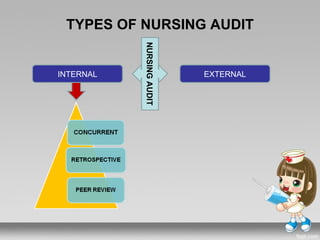
TYPES OF NURSING AUDIT


           NURSING AUDIT
INTERNAL                   EXTERNAL
TYPES OF NURSING AUDIT
1) Internal auditing:
Internal auditing is a control technique performed
by an external auditor who is an employee of the
organization. He makes an independent appraisal
the policies, plans and points the deficits in the
policies or plans and give suggestion for eliminating
deficits
2) external auditing:
it is an independent appraisal of the organizations
financial account and statements. The external
auditor is a qualifed person who has to certify the
annual pprofit and loss account and prepare a
balance street after carefull examination of the
relevant books of accounts and documents
INTERNAL AUDIT
•   RETROSPECTIVE EVALUATION : Retrospective audit is a
method for evaluating the quality of nursing care by examining
the nursing care as it is reflected in the patient care records for
discharged patients.
• In this type of audit specific behaviors are described then they
are converted into questions and the examiner looks for answers
in the record.
For example the examiner looks through the patient's records
and asks :
a. Was the problem solving process used in planning nursing care?
b. Whether patient data collected in a systematic manner?
c. Was a description of patient's pre-hospital routines included?
d. Laboratory test results used in planning care?
e. Did the nurse perform physical assessment?
f. How was information used?
g. Were nursing diagnosis stated?
h. Did nurse write nursing orders? And so on.
II. CONCURRENT AUDIT : It is performed during ongoing
nursing care.
The evaluations conducted on behalf of patients who are still
undergoing care.
It includes assessing the patient at the bedside in relation to
pre-determined criteria,
Interviewing the staff responsible for this care .
Reviewing the patients record and care plan.
III. PEER REVIEW : In nurse peer review nurses functioning in
the same capacity that is peer’s appraise the quality of care or
practice performed by others equally qualified nurses.
•The peer review is based on pre-established standards or
criteria.
There are two types of peer reviews:
a) individual peer review; focuses on the performance of an
individual nurse.
b) nursing audit; focuses on evaluating nursing care through the
review of records.
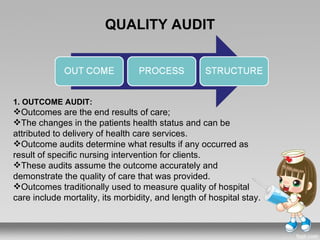
QUALITY AUDIT


1. OUTCOME AUDIT:
Outcomes are the end results of care;
The changes in the patients health status and can be
attributed to delivery of health care services.
Outcome audits determine what results if any occurred as
result of specific nursing intervention for clients.
These audits assume the outcome accurately and
demonstrate the quality of care that was provided.
Outcomes traditionally used to measure quality of hospital
care include mortality, its morbidity, and length of hospital stay.
2. PROCESS AUDIT:
Process audits are used to measure the process of care or how
the care was carried out.
Process audit is task oriented and focus on whether or not
practice standards are being fulfilled.
These audits assumed that a relationship exists between the
quality of the nurse and quality of care provided.
3. STRUCTURE AUDIT:
Structure audit monitors the structure or setting in which patient
care is provided.
Such as the finances, nursing service, medical records and
environment.
This audit assumes that a relationship exists between quality
care and appropriate structure.
These above audits can occur retrospectively, concurrently and
prospectively.
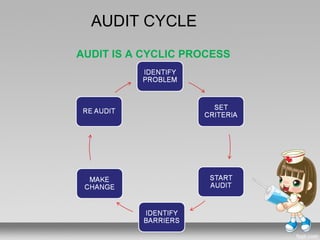
AUDIT CYCLE
AUDIT IS A CYCLIC PROCESS
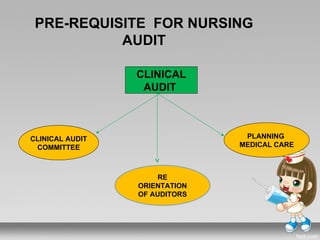
PRE-REQUISITE FOR NURSING
           AUDIT

                 CLINICAL
                  AUDIT


CLINICAL AUDIT                  PLANNING
 COMMITTEE                     MEDICAL CARE


                     RE
                 ORIENTATION
                 OF AUDITORS
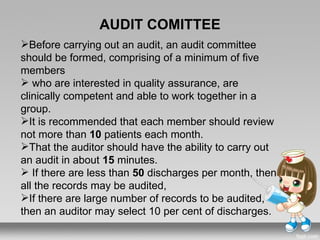
AUDIT COMITTEE
Before carrying out an audit, an audit committee
should be formed, comprising of a minimum of five
members
 who are interested in quality assurance, are
clinically competent and able to work together in a
group.
It is recommended that each member should review
not more than 10 patients each month.
That the auditor should have the ability to carry out
an audit in about 15 minutes.
 If there are less than 50 discharges per month, then
all the records may be audited,
If there are large number of records to be audited,
then an auditor may select 10 per cent of discharges.
RE ORIENTATION OF AUDITORS
a. A detailed discussion of the seven components of
criteria.
b. A group discussion to see how the group rates the
care received using the notes of a patient who has
been discharged,
c. These should be anonymous and should reflect a
total period of care not exceeding two weeks in
length
d. Each individual auditor should then undertake the
same exercise as above.
e. This is followed by a meeting of the whole
committee who compare and discuss its findings, and
finally reach a consensus of opinion on each of the
components.
PLANNING MEDICAL CARE
a. Collects patient data in a systematic manner,
. includes description of patients pre-hospital
routines,
 has information about the severity of illness,
 has information regarding lab tests,
 has information regarding vital signs,
 Has information from physical assessment etc.
b. State nurses diagnosis,
c. Writes nursing orders,
d. Suggests immediate and long term care,
e. Implements the nursing care plan,
f. Plans health teaching for patients and students,
g. Evaluates the plan of care at own level,
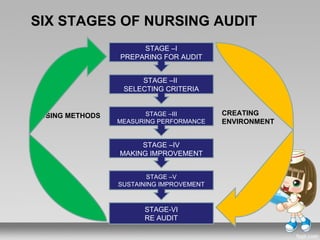
SIX STAGES OF NURSING AUDIT
                      STAGE –I
                 PREPARING FOR AUDIT


                      STAGE –II
                  SELECTING CRITERIA


 USING METHODS          STAGE –III        CREATING
                 MEASURING PERFORMANCE    ENVIRONMENT


                      STAGE –IV
                 MAKING IMPROVEMENT


                        STAGE –V
                 SUSTAINING IMPROVEMENT


                       STAGE-VI
                       RE AUDIT
SELECTING A TOPIC


-starting point
-careful thought and planning
- There seems little point in trying to audit
a rare condition, with an insignificant
outcome
PLANNING AUDIT

Involve ALL the people concern.
 Fix time and Plan resources
Access the evidence/data
Methodology to be followed
Pilot study
Report for Action
Re-audit
All activities should be documented.
DEVELOPING CRITERIA
1. Define patient population.
2. Identify a time framework for measuring outcomes of care,
3.Identify commonly recurring nursing problems presented by the defined
patient population,
4. State patient outcome criteria,
5. State acceptable degree of goal achievement,
6. Specify the source of information.
7. Design and type of tool
Points to be remembered:
a. Quality assurance must be a priority,
b. Those responsible must implement a programme not only a tool,
c. A coordinator should develop and evaluate quality assurance
activities,
d. Roles and responsibilities must be delivered,
e. Nurses must be informed about the process and the results of the
programme,
f. Data must be reliable,
g. Adequate orientation of data collection is essential,
h. Quality data should be annualized and used by nursing
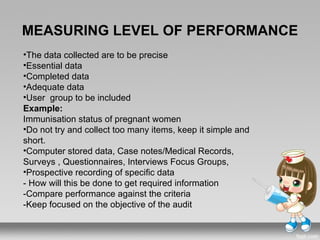
MEASURING LEVEL OF PERFORMANCE
•The data collected are to be precise
•Essential data
•Completed data
•Adequate data
•User group to be included
Example:
Immunisation status of pregnant women
•Do not try and collect too many items, keep it simple and
short.
•Computer stored data, Case notes/Medical Records,
Surveys , Questionnaires, Interviews Focus Groups,
•Prospective recording of specific data
- How will this be done to get required information
-Compare performance against the criteria
-Keep focused on the objective of the audit
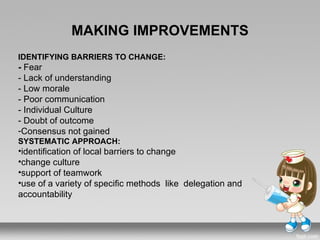
MAKING IMPROVEMENTS
IDENTIFYING BARRIERS TO CHANGE:
- Fear
- Lack of understanding
- Low morale
- Poor communication
- Individual Culture
- Doubt of outcome
-Consensus not gained
SYSTEMATIC APPROACH:
•identification of local barriers to change
•change culture
•support of teamwork
•use of a variety of specific methods like delegation and
accountability
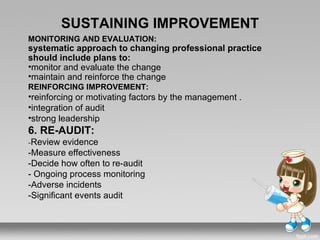
SUSTAINING IMPROVEMENT
MONITORING AND EVALUATION:
systematic approach to changing professional practice
should include plans to:
•monitor and evaluate the change
•maintain and reinforce the change
REINFORCING IMPROVEMENT:
•reinforcing or motivating factors by the management .
•integration of audit
•strong leadership
6. RE-AUDIT:
-Review evidence
-Measure effectiveness
-Decide how often to re-audit
- Ongoing process monitoring
-Adverse incidents
-Significant events audit
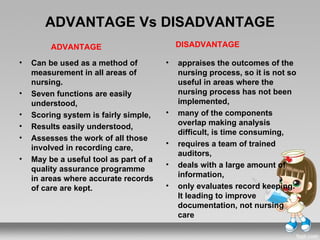
ADVANTAGE Vs DISADVANTAGE
         ADVANTAGE                          DISADVANTAGE

•   Can be used as a method of          •   appraises the outcomes of the
    measurement in all areas of             nursing process, so it is not so
    nursing.                                useful in areas where the
•   Seven functions are easily              nursing process has not been
    understood,                             implemented,
•   Scoring system is fairly simple,    •   many of the components
•   Results easily understood,              overlap making analysis
                                            difficult, is time consuming,
•   Assesses the work of all those
                                        •   requires a team of trained
    involved in recording care,
                                            auditors,
•   May be a useful tool as part of a
                                        •   deals with a large amount of
    quality assurance programme
                                            information,
    in areas where accurate records
    of care are kept.                   •   only evaluates record keeping.
                                            It leading to improve
                                            documentation, not nursing
                                            care
CONCLUSION

A profession dedicated for the
quality of its service to patients
constitutes the heart of its
responsibility to the public.
An audit helps to ensure that the
quality of nursing care desired and
feasible is achieved.
This concept is often referred to as
quality assurance.
hospiad

                      Hospital Administration Made Easy


               http//hospiad.blogspot.com
    An effort solely to help students and aspirants
       in their attempt to become a successful
               Hospital Administrator.
                                                      DR. N. C. DAS
Nursing Audit

Nursing Audit

  • 1.
    NURSING AUDIT DR. N. C. DAS
  • 2.
    NURSING AUDIT With theimplementation of CPA professional accountability to an enlightened public can no longer be ignored by nursing staff. “Quality nursing care” has become essential on day to day functioning. Nursing audit is a way of ensuring quality nursing care. Nursing audit is a detailed review and evaluation of selected clinical records by qualified professional personnel to identify, examine, or verify the performance of certain specified aspects of nursing care by using established criteria.
  • 3.
    HISTORY OF NURSINGAUDIT One of first ever clinical audits was undertaken by Florence Nightingale during the Crimean war of 1853-1855. On arrival at the medical barracks hospital in Scutari in 1854, Florence was pained by the unsanitary conditions and high mortality rates among injured or ill soldiers. She and her team of 38 nurses applied strict sanitary routines and standards of hygiene to the hospital and equipment, Florence's gift of statistic kept meticulous records of the mortality rates among the hospital patients. Another famous figure who advocated clinical audit was Ernest Codman (1869–1940) by monitoring surgical outcomes . Whilst Codman's 'clinical' approach is in contrast with Nightingale's ‘epidemiological' audits, both methods serve to highlight the different methodologies that can be used in the process of providing quality patient care.
  • 4.
    Before 1955 verylittle was known about the concept of nursing audit. First report of Nursing audit of the hospital published in 1955. For the next 15 years, nursing audit is reported from study or record on the last decade. The program is reviewed from record nursing plan, nurses notes, patient condition, nursing care.
  • 5.
    PURPOSES OF NURSINGAUDIT 1.Evaluating Nursing care given, 2. Achieves deserved and feasible quality of nursing care, 3. Stimulant to better records, 4. Focuses on care provided and not on care provider, 5. Contributes to research.
  • 6.
    TYPES OF NURSINGAUDIT NURSING AUDIT INTERNAL EXTERNAL
  • 7.
    TYPES OF NURSINGAUDIT 1) Internal auditing: Internal auditing is a control technique performed by an external auditor who is an employee of the organization. He makes an independent appraisal the policies, plans and points the deficits in the policies or plans and give suggestion for eliminating deficits 2) external auditing: it is an independent appraisal of the organizations financial account and statements. The external auditor is a qualifed person who has to certify the annual pprofit and loss account and prepare a balance street after carefull examination of the relevant books of accounts and documents
  • 8.
    INTERNAL AUDIT • RETROSPECTIVE EVALUATION : Retrospective audit is a method for evaluating the quality of nursing care by examining the nursing care as it is reflected in the patient care records for discharged patients. • In this type of audit specific behaviors are described then they are converted into questions and the examiner looks for answers in the record. For example the examiner looks through the patient's records and asks : a. Was the problem solving process used in planning nursing care? b. Whether patient data collected in a systematic manner? c. Was a description of patient's pre-hospital routines included? d. Laboratory test results used in planning care? e. Did the nurse perform physical assessment? f. How was information used? g. Were nursing diagnosis stated? h. Did nurse write nursing orders? And so on.
  • 9.
    II. CONCURRENT AUDIT: It is performed during ongoing nursing care. The evaluations conducted on behalf of patients who are still undergoing care. It includes assessing the patient at the bedside in relation to pre-determined criteria, Interviewing the staff responsible for this care . Reviewing the patients record and care plan. III. PEER REVIEW : In nurse peer review nurses functioning in the same capacity that is peer’s appraise the quality of care or practice performed by others equally qualified nurses. •The peer review is based on pre-established standards or criteria. There are two types of peer reviews: a) individual peer review; focuses on the performance of an individual nurse. b) nursing audit; focuses on evaluating nursing care through the review of records.
  • 10.
    QUALITY AUDIT 1. OUTCOMEAUDIT: Outcomes are the end results of care; The changes in the patients health status and can be attributed to delivery of health care services. Outcome audits determine what results if any occurred as result of specific nursing intervention for clients. These audits assume the outcome accurately and demonstrate the quality of care that was provided. Outcomes traditionally used to measure quality of hospital care include mortality, its morbidity, and length of hospital stay.
  • 11.
    2. PROCESS AUDIT: Processaudits are used to measure the process of care or how the care was carried out. Process audit is task oriented and focus on whether or not practice standards are being fulfilled. These audits assumed that a relationship exists between the quality of the nurse and quality of care provided. 3. STRUCTURE AUDIT: Structure audit monitors the structure or setting in which patient care is provided. Such as the finances, nursing service, medical records and environment. This audit assumes that a relationship exists between quality care and appropriate structure. These above audits can occur retrospectively, concurrently and prospectively.
  • 12.
    AUDIT CYCLE AUDIT ISA CYCLIC PROCESS
  • 13.
    PRE-REQUISITE FOR NURSING AUDIT CLINICAL AUDIT CLINICAL AUDIT PLANNING COMMITTEE MEDICAL CARE RE ORIENTATION OF AUDITORS
  • 14.
    AUDIT COMITTEE Before carryingout an audit, an audit committee should be formed, comprising of a minimum of five members  who are interested in quality assurance, are clinically competent and able to work together in a group. It is recommended that each member should review not more than 10 patients each month. That the auditor should have the ability to carry out an audit in about 15 minutes.  If there are less than 50 discharges per month, then all the records may be audited, If there are large number of records to be audited, then an auditor may select 10 per cent of discharges.
  • 15.
    RE ORIENTATION OFAUDITORS a. A detailed discussion of the seven components of criteria. b. A group discussion to see how the group rates the care received using the notes of a patient who has been discharged, c. These should be anonymous and should reflect a total period of care not exceeding two weeks in length d. Each individual auditor should then undertake the same exercise as above. e. This is followed by a meeting of the whole committee who compare and discuss its findings, and finally reach a consensus of opinion on each of the components.
  • 16.
    PLANNING MEDICAL CARE a.Collects patient data in a systematic manner, . includes description of patients pre-hospital routines,  has information about the severity of illness,  has information regarding lab tests,  has information regarding vital signs,  Has information from physical assessment etc. b. State nurses diagnosis, c. Writes nursing orders, d. Suggests immediate and long term care, e. Implements the nursing care plan, f. Plans health teaching for patients and students, g. Evaluates the plan of care at own level,
  • 17.
    SIX STAGES OFNURSING AUDIT STAGE –I PREPARING FOR AUDIT STAGE –II SELECTING CRITERIA USING METHODS STAGE –III CREATING MEASURING PERFORMANCE ENVIRONMENT STAGE –IV MAKING IMPROVEMENT STAGE –V SUSTAINING IMPROVEMENT STAGE-VI RE AUDIT
  • 18.
    SELECTING A TOPIC -startingpoint -careful thought and planning - There seems little point in trying to audit a rare condition, with an insignificant outcome
  • 19.
    PLANNING AUDIT Involve ALLthe people concern.  Fix time and Plan resources Access the evidence/data Methodology to be followed Pilot study Report for Action Re-audit All activities should be documented.
  • 20.
    DEVELOPING CRITERIA 1. Definepatient population. 2. Identify a time framework for measuring outcomes of care, 3.Identify commonly recurring nursing problems presented by the defined patient population, 4. State patient outcome criteria, 5. State acceptable degree of goal achievement, 6. Specify the source of information. 7. Design and type of tool Points to be remembered: a. Quality assurance must be a priority, b. Those responsible must implement a programme not only a tool, c. A coordinator should develop and evaluate quality assurance activities, d. Roles and responsibilities must be delivered, e. Nurses must be informed about the process and the results of the programme, f. Data must be reliable, g. Adequate orientation of data collection is essential, h. Quality data should be annualized and used by nursing
  • 21.
    MEASURING LEVEL OFPERFORMANCE •The data collected are to be precise •Essential data •Completed data •Adequate data •User group to be included Example: Immunisation status of pregnant women •Do not try and collect too many items, keep it simple and short. •Computer stored data, Case notes/Medical Records, Surveys , Questionnaires, Interviews Focus Groups, •Prospective recording of specific data - How will this be done to get required information -Compare performance against the criteria -Keep focused on the objective of the audit
  • 22.
    MAKING IMPROVEMENTS IDENTIFYING BARRIERSTO CHANGE: - Fear - Lack of understanding - Low morale - Poor communication - Individual Culture - Doubt of outcome -Consensus not gained SYSTEMATIC APPROACH: •identification of local barriers to change •change culture •support of teamwork •use of a variety of specific methods like delegation and accountability
  • 23.
    SUSTAINING IMPROVEMENT MONITORING ANDEVALUATION: systematic approach to changing professional practice should include plans to: •monitor and evaluate the change •maintain and reinforce the change REINFORCING IMPROVEMENT: •reinforcing or motivating factors by the management . •integration of audit •strong leadership 6. RE-AUDIT: -Review evidence -Measure effectiveness -Decide how often to re-audit - Ongoing process monitoring -Adverse incidents -Significant events audit
  • 24.
    ADVANTAGE Vs DISADVANTAGE ADVANTAGE DISADVANTAGE • Can be used as a method of • appraises the outcomes of the measurement in all areas of nursing process, so it is not so nursing. useful in areas where the • Seven functions are easily nursing process has not been understood, implemented, • Scoring system is fairly simple, • many of the components • Results easily understood, overlap making analysis difficult, is time consuming, • Assesses the work of all those • requires a team of trained involved in recording care, auditors, • May be a useful tool as part of a • deals with a large amount of quality assurance programme information, in areas where accurate records of care are kept. • only evaluates record keeping. It leading to improve documentation, not nursing care
  • 25.
    CONCLUSION A profession dedicatedfor the quality of its service to patients constitutes the heart of its responsibility to the public. An audit helps to ensure that the quality of nursing care desired and feasible is achieved. This concept is often referred to as quality assurance.
  • 26.
    hospiad Hospital Administration Made Easy http//hospiad.blogspot.com An effort solely to help students and aspirants in their attempt to become a successful Hospital Administrator. DR. N. C. DAS