Dr. Harish Chopra
Professor
Department of Chemistry
SLIET, LONGOWAL
Electrocyclic reactions are a class of pericyclic
reactions in which a conjugated polyene inter-
converts with an unsaturated cyclic compound
containing one less carbon–carbon double bond than
the polyene. The reactions can be promoted
thermally or photo-chemically and take place with a
very high degree of stereo-selectivity.
The difference in energy between the open-chain
and closed-ring isomers in electrocyclic reactions
are usually not high. Thus, partial conversion of
the more stable isomers in this reactions to the
less stable forms may easily occur.
E.g. cis,cis-2,4-hexadiene converted to trans,
trans- 2,4-hexadiene via two electrocyclic steps
 In a Thermal Reaction, an open-chain system
containing 4n π electrons, the orbital symmetry of the
highest occupied molecule orbital (HOMO) is such that
a bonding interaction between the ends must involve
overlap between orbital envelopes on opposite faces of
the system and this can only be achieved in a
CONROTATORY process.
 In open systems containing (4n + 2) π electrons,
terminal bonding interaction within ground-state
molecules requires overlap of orbital envelopes on the
same face of the system, attainable only by
DISROTATORY displacements.
 In a PHOTOCHEMICAL REACTION an electron in the
HOMO of the reactant is promoted to an excited state
leading to a reversal of terminal symmetry relationships
and stereo-specificity.
Buta-1,3-diene has 4 -electrons in the ground
state and thus proceeds through a
conrotatory ring-closing mechanism.
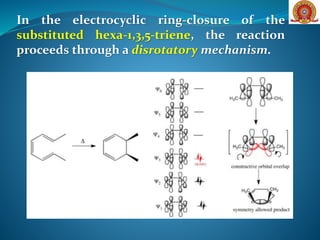
In the electrocyclic ring-closure of the
substituted hexa-1,3,5-triene, the reaction
proceeds through a disrotatory mechanism.
In the case of a photochemically driven
electrocyclic ring-closure of buta-1,3-diene,
electronic promotion causes to become the
HOMO and the reaction mechanism must be
disrotatory..
A molecular orbital correlation diagram
correlates molecular orbitals of the starting
materials and the product based upon
conservation of symmetry.
If a symmetry element is present throughout
the reaction mechanism (reactant, transition
state, and product), it is called a conserved
symmetry element.
The transition state of a conrotatory
closure has C2 symmetry, whereas
the transition state of a disrotatory
opening has mirror symmetry.
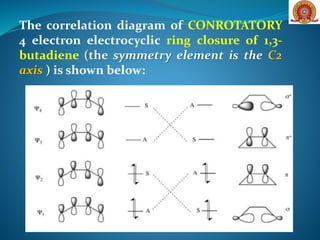
The correlation diagram of CONROTATORY
4 electron electrocyclic ring closure of 1,3-
butadiene (the symmetry element is the C2
axis ) is shown below:
The correlation diagram of DISROTATORY 4
electron electrocyclic ring closure of 1,3-
butadiene (the symmetry element is the σ
mirror plane) is shown below :
Thermal and Photochemical Cyclizations of
1,3,5-Hexatrienes.
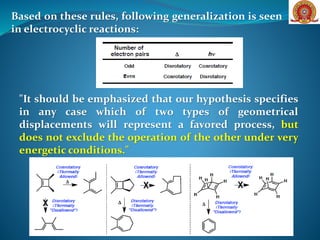
Based on these rules, following generalization is seen
in electrocyclic reactions:
"It should be emphasized that our hypothesis specifies
in any case which of two types of geometrical
displacements will represent a favored process, but
does not exclude the operation of the other under very
energetic conditions."
Electrocyclic reactions in Reactants with
Odd number of Atoms
DISROTATORY If
reactant is a cation
(two electrons), the
reaction is
ALLOWED because
y1 and s orbitals
have the same
symmetry.
However, if the
chain is an anion
(four electrons), an
excited state would
be produced and the
reaction is
FORBIDDEN.
CONTOTATORY PROCESS:
Allowed: Anion
Forbidden: Cation
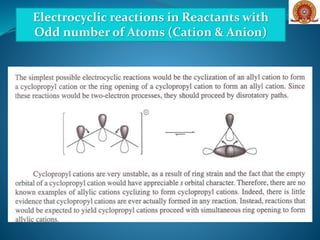
Electrocyclic reactions in Reactants with
Odd number of Atoms (Cation & Anion)
Electrocyclic reactions in Reactants with
Odd number of Atoms (Cation & Anion)
The ring opening of
cyclopropyl derivatives to
allylic cations do proceed
in DISROTATORY fashion.
At higher temperature,
cation 6a isomerize to 6b,
which in turn, as the
temperature is raised,
isomerizes to the least
crowded cation, 6c.
Electrocyclic reactions in Reactants with
Odd number of Atoms (Cation & Anion)
Electrocyclic reactions in Reactants with
Odd number of Atoms (Cation & Anion)
Electrocyclic reactions in Reactants with
Odd number of Atoms (Cation & Anion)
Electrocyclic reactions in Reactants with
Odd number of Atoms (Cation & Anion)
[Formation and Cyclization of Dipolar Molecules]
Electrocyclic reactions in Reactants with
Odd number of Atoms (Cation & Anion)
[Formation and Cyclization of Dipolar Molecules]
The reaction
proceeds through
CONROTATORY
PROCESS
Electrocyclic reactions in Reactants with
Odd number of Atoms (Cation & Anion)
[Formation and Cyclization of Dipolar Molecules]
Electrocyclic reactions
[Photochemical Cyclizations]
Electrocyclic reactions
[Photochemical Cyclizations]
Electrocyclic reactions
[Photochemical Cyclizations]
STEREOSPECIFIC REACTIONS
Electrocyclic reactions
[Photochemical Cyclizations]
NON-STEREOSPECIFIC REACTIONS
1,3-Butadiene cyclize on photo-irradiation with UV light
with wavelengths above 220 nm to form the predicted
DISROTATORY ring closure products
Electrocyclic reactions
[Photochemical Cyclizations]
NON-STEREOSPECIFIC REACTIONS
Examples of Electrocyclic reactions
Ring-opening of the aldehyde, formed by oxidation of
the alcohol, occurs to give the diene with>97% isomeric
purity, in which the aldehyde rather than the alkyl
group has rotated ‘inward’
Ring-opening of Benzocyclobutenes
to o-Quinodimethanes.
Synthesis of the steroid estrone, the
benzocyclobutane, prepared by a cobaltmediated
cyclotrimerization, was converted on heating to
the o-quinodimethane, which undergoes
cycloaddition to the tetracycle.
E,Z,E-triene 340 is converted to the cis product
341 with >99.5% diastereomeric purity,
indicating a completely stereospecific
THERMAL DISROTATORY electrocyclization. The
isomeric E,Z,Z-triene 342 is converted to the trans
product 343. In this latter case the product 344
(derived from the diene 343 by a 1,5-hydrogen
shift) is also produced and the triene 342 has
been found to interconvert readily with the
Z,Z,Z-isomer by consecutive 1,7-hydrogen shifts.
Electrocyclic Cyclization of 1,3,5-Hexatrienes
In the synthesis of the carbazole hyellazole 346,
the divinyl-indole 345 was heated to promote
electrocyclization, followed by dehydrogenation
with palladium on charcoal to give hyellazole.
The parent substrate, stilbene can be converted to
phenanthrene, a process that involves conrotatory
electrocyclization under photochemical conditions
Examples of Electrocyclic reactions
In a synthesis of cervinomycin A,
photochemical electrocyclization of the
mixture of E- and Z-diaryl alkenes 347 gave
the polycyclic aromatic compound 348 after
oxidation with iodine.
Examples of Electrocyclic reactions
The cyclization of a pentadienyl cation to a
cyclopentenyl cation offers a useful entry to
five-membered carbocyclic compounds. One
such reaction is the Nazarov cyclization of
divinyl ketones. The Nazarov cyclization is a 4-
electron cyclization and occurs thermally by a
conrotatory process. The stereochemical outcome
across the new carbon–carbon bond is often
obscured by the loss of a proton at one of these
centres during the cyclopentenone formation
Examples of Electrocyclic reactions
Thank You

Electrocyclic reactions

  • 1.
    Dr. Harish Chopra Professor Departmentof Chemistry SLIET, LONGOWAL
  • 2.
    Electrocyclic reactions area class of pericyclic reactions in which a conjugated polyene inter- converts with an unsaturated cyclic compound containing one less carbon–carbon double bond than the polyene. The reactions can be promoted thermally or photo-chemically and take place with a very high degree of stereo-selectivity.
  • 3.
    The difference inenergy between the open-chain and closed-ring isomers in electrocyclic reactions are usually not high. Thus, partial conversion of the more stable isomers in this reactions to the less stable forms may easily occur. E.g. cis,cis-2,4-hexadiene converted to trans, trans- 2,4-hexadiene via two electrocyclic steps
  • 6.
     In aThermal Reaction, an open-chain system containing 4n π electrons, the orbital symmetry of the highest occupied molecule orbital (HOMO) is such that a bonding interaction between the ends must involve overlap between orbital envelopes on opposite faces of the system and this can only be achieved in a CONROTATORY process.  In open systems containing (4n + 2) π electrons, terminal bonding interaction within ground-state molecules requires overlap of orbital envelopes on the same face of the system, attainable only by DISROTATORY displacements.  In a PHOTOCHEMICAL REACTION an electron in the HOMO of the reactant is promoted to an excited state leading to a reversal of terminal symmetry relationships and stereo-specificity.
  • 7.
    Buta-1,3-diene has 4-electrons in the ground state and thus proceeds through a conrotatory ring-closing mechanism.
  • 8.
    In the electrocyclicring-closure of the substituted hexa-1,3,5-triene, the reaction proceeds through a disrotatory mechanism.
  • 9.
    In the caseof a photochemically driven electrocyclic ring-closure of buta-1,3-diene, electronic promotion causes to become the HOMO and the reaction mechanism must be disrotatory..
  • 10.
    A molecular orbitalcorrelation diagram correlates molecular orbitals of the starting materials and the product based upon conservation of symmetry. If a symmetry element is present throughout the reaction mechanism (reactant, transition state, and product), it is called a conserved symmetry element. The transition state of a conrotatory closure has C2 symmetry, whereas the transition state of a disrotatory opening has mirror symmetry.
  • 11.
    The correlation diagramof CONROTATORY 4 electron electrocyclic ring closure of 1,3- butadiene (the symmetry element is the C2 axis ) is shown below:
  • 12.
    The correlation diagramof DISROTATORY 4 electron electrocyclic ring closure of 1,3- butadiene (the symmetry element is the σ mirror plane) is shown below :
  • 13.
    Thermal and PhotochemicalCyclizations of 1,3,5-Hexatrienes.
  • 14.
    Based on theserules, following generalization is seen in electrocyclic reactions: "It should be emphasized that our hypothesis specifies in any case which of two types of geometrical displacements will represent a favored process, but does not exclude the operation of the other under very energetic conditions."
  • 15.
    Electrocyclic reactions inReactants with Odd number of Atoms DISROTATORY If reactant is a cation (two electrons), the reaction is ALLOWED because y1 and s orbitals have the same symmetry. However, if the chain is an anion (four electrons), an excited state would be produced and the reaction is FORBIDDEN. CONTOTATORY PROCESS: Allowed: Anion Forbidden: Cation
  • 16.
    Electrocyclic reactions inReactants with Odd number of Atoms (Cation & Anion)
  • 17.
    Electrocyclic reactions inReactants with Odd number of Atoms (Cation & Anion) The ring opening of cyclopropyl derivatives to allylic cations do proceed in DISROTATORY fashion. At higher temperature, cation 6a isomerize to 6b, which in turn, as the temperature is raised, isomerizes to the least crowded cation, 6c.
  • 18.
    Electrocyclic reactions inReactants with Odd number of Atoms (Cation & Anion)
  • 19.
    Electrocyclic reactions inReactants with Odd number of Atoms (Cation & Anion)
  • 20.
    Electrocyclic reactions inReactants with Odd number of Atoms (Cation & Anion)
  • 21.
    Electrocyclic reactions inReactants with Odd number of Atoms (Cation & Anion) [Formation and Cyclization of Dipolar Molecules]
  • 22.
    Electrocyclic reactions inReactants with Odd number of Atoms (Cation & Anion) [Formation and Cyclization of Dipolar Molecules] The reaction proceeds through CONROTATORY PROCESS
  • 23.
    Electrocyclic reactions inReactants with Odd number of Atoms (Cation & Anion) [Formation and Cyclization of Dipolar Molecules]
  • 24.
  • 25.
  • 26.
  • 27.
    Electrocyclic reactions [Photochemical Cyclizations] NON-STEREOSPECIFICREACTIONS 1,3-Butadiene cyclize on photo-irradiation with UV light with wavelengths above 220 nm to form the predicted DISROTATORY ring closure products
  • 28.
  • 29.
    Examples of Electrocyclicreactions Ring-opening of the aldehyde, formed by oxidation of the alcohol, occurs to give the diene with>97% isomeric purity, in which the aldehyde rather than the alkyl group has rotated ‘inward’
  • 30.
    Ring-opening of Benzocyclobutenes too-Quinodimethanes. Synthesis of the steroid estrone, the benzocyclobutane, prepared by a cobaltmediated cyclotrimerization, was converted on heating to the o-quinodimethane, which undergoes cycloaddition to the tetracycle.
  • 31.
    E,Z,E-triene 340 isconverted to the cis product 341 with >99.5% diastereomeric purity, indicating a completely stereospecific THERMAL DISROTATORY electrocyclization. The isomeric E,Z,Z-triene 342 is converted to the trans product 343. In this latter case the product 344 (derived from the diene 343 by a 1,5-hydrogen shift) is also produced and the triene 342 has been found to interconvert readily with the Z,Z,Z-isomer by consecutive 1,7-hydrogen shifts. Electrocyclic Cyclization of 1,3,5-Hexatrienes
  • 32.
    In the synthesisof the carbazole hyellazole 346, the divinyl-indole 345 was heated to promote electrocyclization, followed by dehydrogenation with palladium on charcoal to give hyellazole. The parent substrate, stilbene can be converted to phenanthrene, a process that involves conrotatory electrocyclization under photochemical conditions Examples of Electrocyclic reactions
  • 33.
    In a synthesisof cervinomycin A, photochemical electrocyclization of the mixture of E- and Z-diaryl alkenes 347 gave the polycyclic aromatic compound 348 after oxidation with iodine. Examples of Electrocyclic reactions
  • 34.
    The cyclization ofa pentadienyl cation to a cyclopentenyl cation offers a useful entry to five-membered carbocyclic compounds. One such reaction is the Nazarov cyclization of divinyl ketones. The Nazarov cyclization is a 4- electron cyclization and occurs thermally by a conrotatory process. The stereochemical outcome across the new carbon–carbon bond is often obscured by the loss of a proton at one of these centres during the cyclopentenone formation Examples of Electrocyclic reactions
  • 35.