
ELECTRON SPIN RESONANCE SPECTROSCOPY
BY
Dr. Suman Pattanayak
Associate Professor
Department of Pharma Analysis & QA.
Vijaya Institute of Pharmaceutical Sciences for Women
IV B. Pharm/ I Sem
Pharmaceutical Analysis
Introduction
Also known as….
 Electron Paramagnetic Resonance (EPR)
 Electron Magnetic Resonance (EMR)
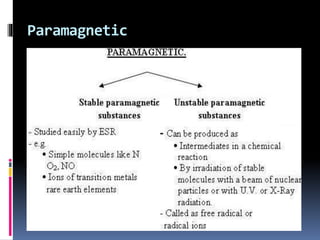
The molecule which contain unpaired electrons
are paramagnetic species or free radical
species discovered by ZAVOISKII in 1944.
What Is ESR???
 It is a branch of absorption spectroscopy in
which radiation having frequency in
microwave region is absorbed by
paramagnetic substance to induce transition
between magnetic energy level of electron
with unpaired spin.
 Magnetic energy splitting is done by applying
a static magnetic field.
ESR Phenomenon Is Shown By...
 Atoms having an odd number of electrons.
 Ions having partly filled inner electron shells.
 Molecule that carry angular momentum of
electronic origin.
 Free radicals having unpaired electrons.
 Molecule with paired electrons and zero
magnetic field
Diamagnetic
 Molecules with unpaired electrons and magnetic
moment-
Paramagnetic
Basic Principle Of ESR……………
The unpaired electrons are excited to a high
energy state under the magnetic field by the
absorption of microwave.The excited
electron changes its direction of spin and
relaxes into the ground state by emitting
phonons.
Microwave absorption is measured as a
function of the magnetic field by ESR
spectroscopy.
Spin Spin Splitting
(Hyperfine Splitting)
 Magnetic resonance can also occur without an
external magnetic field from interaction of the
electron and nuclear spin. Such resonance produces
fine and hyperfine structure of atomic spectra.
 The nuclei of atoms in a molecule or complex often
have magnetic moment which produces a local
magnetic field at the electron.The interaction
between an unpaired electron an nuclei with non
zero nuclear spin is called the hyperfine interaction.
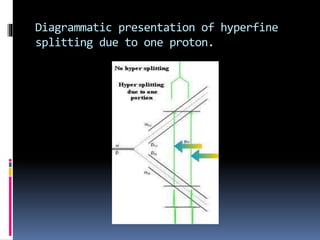
This leads to splitting of the ESR line and is known as
hyperfine spectrum
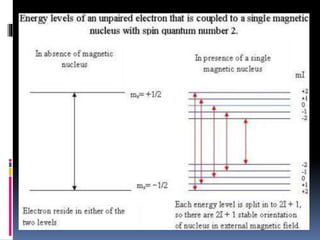
Diagrammatic presentation of hyperfine
splitting due to one proton.
The dipole-dipole
interaction
 For a large concentration of electronic spins,
the electronic magnetic moments also
interact appreciably with each other, and this
can alter considerably theESR spectra.
 The interaction is mediated by the dipolar
field associated with the magnetic moment
 The dipolar interaction induces therefore a
broadening of the resonance line, which
increases with the concentration of dipole
moments.
ESR spectrometer
We need four essential components to build an
ESR spectrometer:
 A monochromatic microwave source
 A waveguide for guiding the microwave
power to the sample
 A cavity designed to ensure a proper coupling
between the sample and the incoming wave.
 A detector for microwave power to detect the
response of the sample to microwave
irradiation.
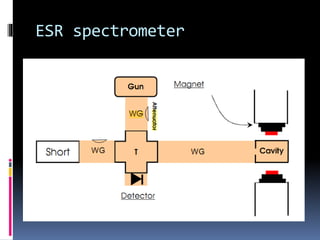
ESR spectrometer
Microwave parts
 A gun oscillator is a monochromatic source
of microwave.Tuning of the frequency is
achieved by slowly turning the screw on the
top of the metallic case of the oscillator.The
frequency can be read out with the frequency
counter located next to the source.
 A calibrated attenuator is use to control the
level of microwave power from the source.
T-hybrid
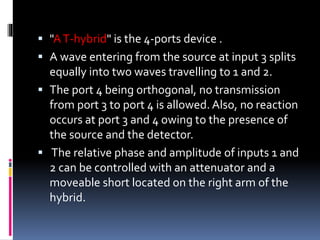
 "AT-hybrid" is the 4-ports device .
 A wave entering from the source at input 3 splits
equally into two waves travelling to 1 and 2.
 The port 4 being orthogonal, no transmission
from port 3 to port 4 is allowed. Also, no reaction
occurs at port 3 and 4 owing to the presence of
the source and the detector.
 The relative phase and amplitude of inputs 1 and
2 can be controlled with an attenuator and a
moveable short located on the right arm of the
hybrid.
 The detector is a crystal rectifier (diode) which
consists of a semi-conducting material.The incident
microwave power causes the current to flow.
 The waveguide is a rectangular opened-ended
metallic tube delimiting a dielectric media in which
electromagnetic waves propagate according to
Maxwell equations.
 Boundary conditions have to be fulfilledby the
electrical and magnetic components of the wave on
the metalliwalls. Consequently the propagation is
restricted to a set of modes occurring at well-
defined frequencies which are the characteristic
values other wave equation.
 The cavity is a closed metallic box with an iris
to allow the microwave to couple in and out
 Any cavity possesses resonant frequencies at
which the energy stored reaches large values.
 These frequencies are related to the
dimensions of the cavity.
Applications:
All application of ESR is based on three aspects,
which are,
 Study of free radicals,
 Investigation of molecules in the triple state,
and
 Study of inorganic compounds.
Study of free radicals
 Even in very low concentration of sample ESR
can study via free radicals.
 It is also applied in determination of structure
of organics and inorganics free radicals.
 The intensity of ESR signal is directly
proportional to the no. of free radicals
present.
 Hence using ESR we can measure relative
concentration of free radicals.
Investigation of molecules
in the triple state
 A triple state molecule has a total spin S=1 so
that, its multiplicity can be given as 2S+1=3.
 While free radicals with S=½ has an odd no.
of unpaired electrons.
 A triple state molecule has an even no. of
electrons two of them unpaired.
 In triple state molecule the unpaired
electrons must interact whereas in diradical,
the unpaired electrons do not interact for
they are a great distance apart.
Study of inorganic compounds
 ESR is very successful in the study of inorganic
compounds.
 The ESR studies may be used in knowing the exact
structures of solvated metal ions.
 ESR is used in the study of catalysts. ESR is used in
the determination of oxidation state of metal.
 eg. Copper is found to be divalent in copper protein
complexes whereas it is found to be monovalent in
some biologically active copper complexes.
 The information of unpaired electrons is very useful
in various aspects in applications of ESR.
 Like, Spin labels, Structural determination, and
Reaction velocities and reaction mechanisms.
The various applications of ESR spectroscopy
are grouped in to two categories.
1.Analytical applications
2.Biological applications
Analytical applications:
 Mn+2 ions can be measured and detected even when present
in trace quantities.
 The method is very rapid and can be measured in aqueous
solution over the range from 10-6 M to 0.1M.
 ESR method has proved to be a rapid and convenient
method for determination ofVanadium in petroleum
products.
 ESR can also be used to estimate Cu(II), Cr(II),
Gadolinium(III), Fe(III) andTi(III).
 The ESR spectroscopy has been used to estimate
polynuclear hydrocarbons, which are first, converted in to
radical cations and then absorbed in the surface of an
activated silica-alumina catalyst.
Biological systems:
 From the ESR studies of variety of biological system
such as, leaves, seeds, and tissue preparation, it is
found that a definite, correlation exists between the
concentration of free radicals and the metabolic
activity of the plant material.
 ESR has studied the presence of free radicals in
healthy and diseased tissues.
 Most of the oxidative enzymes function via one
electron redox reaction involving the production of
either enzyme bound free radicals or by a change in
the valence state of transition metal ion.This has been
conformed by ESR studies.
 Much of the ESR work on photosynthesis has been
carried out with photosynthetic bacteria.The
oxidation of bacteriochlorophyll in vitro produces an
ESR signal.
4. b.pharm esr jntu pharmacy

4. b.pharm esr jntu pharmacy

  • 1.
    ELECTRON SPIN RESONANCESPECTROSCOPY BY Dr. Suman Pattanayak Associate Professor Department of Pharma Analysis & QA. Vijaya Institute of Pharmaceutical Sciences for Women IV B. Pharm/ I Sem Pharmaceutical Analysis
  • 2.
    Introduction Also known as…. Electron Paramagnetic Resonance (EPR)  Electron Magnetic Resonance (EMR) The molecule which contain unpaired electrons are paramagnetic species or free radical species discovered by ZAVOISKII in 1944.
  • 3.
    What Is ESR??? It is a branch of absorption spectroscopy in which radiation having frequency in microwave region is absorbed by paramagnetic substance to induce transition between magnetic energy level of electron with unpaired spin.  Magnetic energy splitting is done by applying a static magnetic field.
  • 4.
    ESR Phenomenon IsShown By...  Atoms having an odd number of electrons.  Ions having partly filled inner electron shells.  Molecule that carry angular momentum of electronic origin.  Free radicals having unpaired electrons.  Molecule with paired electrons and zero magnetic field Diamagnetic  Molecules with unpaired electrons and magnetic moment-
  • 5.
  • 6.
    Basic Principle OfESR…………… The unpaired electrons are excited to a high energy state under the magnetic field by the absorption of microwave.The excited electron changes its direction of spin and relaxes into the ground state by emitting phonons. Microwave absorption is measured as a function of the magnetic field by ESR spectroscopy.
  • 7.
    Spin Spin Splitting (HyperfineSplitting)  Magnetic resonance can also occur without an external magnetic field from interaction of the electron and nuclear spin. Such resonance produces fine and hyperfine structure of atomic spectra.  The nuclei of atoms in a molecule or complex often have magnetic moment which produces a local magnetic field at the electron.The interaction between an unpaired electron an nuclei with non zero nuclear spin is called the hyperfine interaction. This leads to splitting of the ESR line and is known as hyperfine spectrum
  • 9.
    Diagrammatic presentation ofhyperfine splitting due to one proton.
  • 10.
    The dipole-dipole interaction  Fora large concentration of electronic spins, the electronic magnetic moments also interact appreciably with each other, and this can alter considerably theESR spectra.  The interaction is mediated by the dipolar field associated with the magnetic moment  The dipolar interaction induces therefore a broadening of the resonance line, which increases with the concentration of dipole moments.
  • 11.
    ESR spectrometer We needfour essential components to build an ESR spectrometer:  A monochromatic microwave source  A waveguide for guiding the microwave power to the sample  A cavity designed to ensure a proper coupling between the sample and the incoming wave.  A detector for microwave power to detect the response of the sample to microwave irradiation.
  • 12.
  • 13.
    Microwave parts  Agun oscillator is a monochromatic source of microwave.Tuning of the frequency is achieved by slowly turning the screw on the top of the metallic case of the oscillator.The frequency can be read out with the frequency counter located next to the source.  A calibrated attenuator is use to control the level of microwave power from the source.
  • 14.
  • 15.
     "AT-hybrid" isthe 4-ports device .  A wave entering from the source at input 3 splits equally into two waves travelling to 1 and 2.  The port 4 being orthogonal, no transmission from port 3 to port 4 is allowed. Also, no reaction occurs at port 3 and 4 owing to the presence of the source and the detector.  The relative phase and amplitude of inputs 1 and 2 can be controlled with an attenuator and a moveable short located on the right arm of the hybrid.
  • 16.
     The detectoris a crystal rectifier (diode) which consists of a semi-conducting material.The incident microwave power causes the current to flow.  The waveguide is a rectangular opened-ended metallic tube delimiting a dielectric media in which electromagnetic waves propagate according to Maxwell equations.  Boundary conditions have to be fulfilledby the electrical and magnetic components of the wave on the metalliwalls. Consequently the propagation is restricted to a set of modes occurring at well- defined frequencies which are the characteristic values other wave equation.
  • 17.
     The cavityis a closed metallic box with an iris to allow the microwave to couple in and out  Any cavity possesses resonant frequencies at which the energy stored reaches large values.  These frequencies are related to the dimensions of the cavity.
  • 18.
    Applications: All application ofESR is based on three aspects, which are,  Study of free radicals,  Investigation of molecules in the triple state, and  Study of inorganic compounds.
  • 19.
    Study of freeradicals  Even in very low concentration of sample ESR can study via free radicals.  It is also applied in determination of structure of organics and inorganics free radicals.  The intensity of ESR signal is directly proportional to the no. of free radicals present.  Hence using ESR we can measure relative concentration of free radicals.
  • 20.
    Investigation of molecules inthe triple state  A triple state molecule has a total spin S=1 so that, its multiplicity can be given as 2S+1=3.  While free radicals with S=½ has an odd no. of unpaired electrons.  A triple state molecule has an even no. of electrons two of them unpaired.  In triple state molecule the unpaired electrons must interact whereas in diradical, the unpaired electrons do not interact for they are a great distance apart.
  • 21.
    Study of inorganiccompounds  ESR is very successful in the study of inorganic compounds.  The ESR studies may be used in knowing the exact structures of solvated metal ions.  ESR is used in the study of catalysts. ESR is used in the determination of oxidation state of metal.  eg. Copper is found to be divalent in copper protein complexes whereas it is found to be monovalent in some biologically active copper complexes.  The information of unpaired electrons is very useful in various aspects in applications of ESR.  Like, Spin labels, Structural determination, and Reaction velocities and reaction mechanisms.
  • 22.
    The various applicationsof ESR spectroscopy are grouped in to two categories. 1.Analytical applications 2.Biological applications
  • 23.
    Analytical applications:  Mn+2ions can be measured and detected even when present in trace quantities.  The method is very rapid and can be measured in aqueous solution over the range from 10-6 M to 0.1M.  ESR method has proved to be a rapid and convenient method for determination ofVanadium in petroleum products.  ESR can also be used to estimate Cu(II), Cr(II), Gadolinium(III), Fe(III) andTi(III).  The ESR spectroscopy has been used to estimate polynuclear hydrocarbons, which are first, converted in to radical cations and then absorbed in the surface of an activated silica-alumina catalyst.
  • 24.
    Biological systems:  Fromthe ESR studies of variety of biological system such as, leaves, seeds, and tissue preparation, it is found that a definite, correlation exists between the concentration of free radicals and the metabolic activity of the plant material.  ESR has studied the presence of free radicals in healthy and diseased tissues.  Most of the oxidative enzymes function via one electron redox reaction involving the production of either enzyme bound free radicals or by a change in the valence state of transition metal ion.This has been conformed by ESR studies.  Much of the ESR work on photosynthesis has been carried out with photosynthetic bacteria.The oxidation of bacteriochlorophyll in vitro produces an ESR signal.