Electron Spin Resonance
Spectroscopy
or
It’s fun to flip electrons!
Electron Paramagnetic Resonance spectroscopy
Electron Spin Resonance spectroscopy
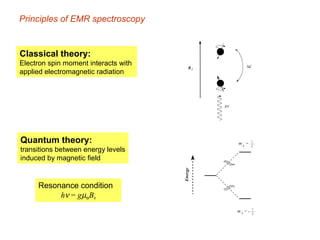
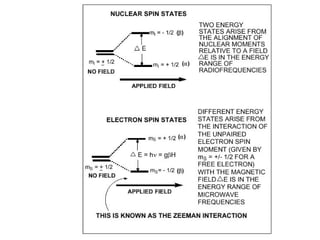
Principles of EMR spectroscopy
B 0
∆E
hν
Classical theory:
Electron spin moment interacts with
applied electromagnetic radiation
m s = —
1
2
m s
= —
1
2
-
Energy
Quantum theory:
transitions between energy levels
induced by magnetic field
Resonance condition
hν = gµBB0
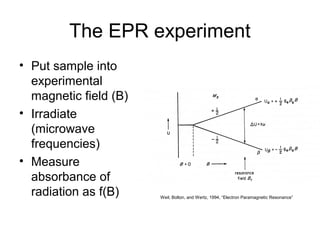
The EPR experiment
• Put sample into
experimental
magnetic field (B)
• Irradiate
(microwave
frequencies)
• Measure
absorbance of
radiation as f(B) Weil, Bolton, and Wertz, 1994, “Electron Paramagnetic Resonance”
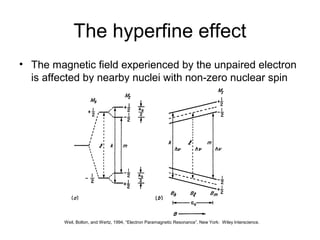
The hyperfine effect
• The magnetic field experienced by the unpaired electron
is affected by nearby nuclei with non-zero nuclear spin
Weil, Bolton, and Wertz, 1994, “Electron Paramagnetic Resonance”, New York: Wiley Interscience.
Hyperfine splitting of EPR spectra
• The magnitude of the splitting and the
number of lines depend upon:
– The nuclear spin of the interacting nucleus
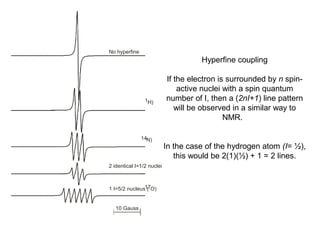
• # of lines = 2n(I + ½) so I = ½ gives 2 lines, etc.
– The nuclear gyromagnetic ratio
– The magnitude of the interaction between the
electronic spin and the nuclear spin
• Magnitude of the splitting typically decreases
greatly with increasing numbers of bonds between
the nucleus and unpaired electron
10 Gauss
No hyperfine
1H)
14N)
2 identical I=1/2 nuclei
1 I=5/2 nucleus (17O)
Hyperfine coupling
If the electron is surrounded by n spin-
active nuclei with a spin quantum
number of I, then a (2nI+1) line pattern
will be observed in a similar way to
NMR.
In the case of the hydrogen atom (I= ½),
this would be 2(1)(½) + 1 = 2 lines.
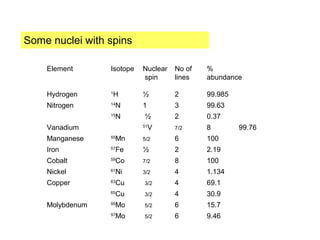
Some nuclei with spins
Element Isotope Nuclear No of %
spin lines abundance
Hydrogen 1
H ½ 2 99.985
Nitrogen 14
N 1 3 99.63
15
N ½ 2 0.37
Vanadium 51
V 7/2 8 99.76
Manganese 55
Mn 5/2 6 100
Iron 57
Fe ½ 2 2.19
Cobalt 59
Co 7/2 8 100
Nickel 61
Ni 3/2 4 1.134
Copper 63
Cu 3/2 4 69.1
65
Cu 3/2 4 30.9
Molybdenum 95
Mo 5/2 6 15.7
97
Mo 5/2 6 9.46
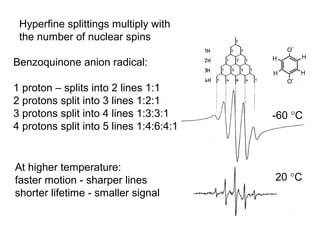
Hyperfine splittings multiply with
the number of nuclear spins
O
.
O-
H
H
H
H
Benzoquinone anion radical:
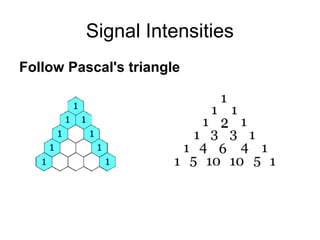
1 proton – splits into 2 lines 1:1
2 protons split into 3 lines 1:2:1
3 protons split into 4 lines 1:3:3:1
4 protons split into 5 lines 1:4:6:4:1
-60 °C
20 °C
At higher temperature:
faster motion - sharper lines
shorter lifetime - smaller signal
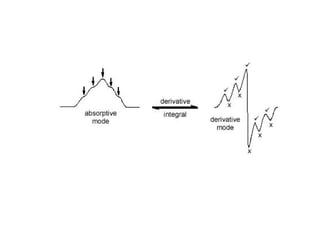
0
0.5
1
1.5
2
2.5
2900 3000 3100 3200 3300 3400 3500 3600 3700
Gauss
A
-1.5
-1
-0.5
0
0.5
1
1.5
2900 3000 3100 3200 3300 3400 3500 3600 3700
Gauss
dA/dB
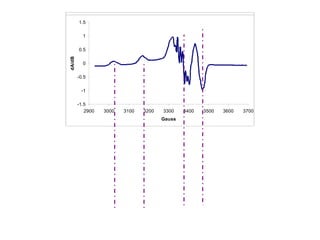
Prushan Example
SS
N N
OO
B
FF
Cu
[Cu(Thyclops)]+
+
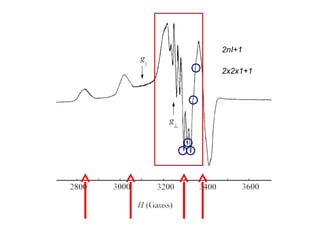
77 K Cryogenic ESR Spectrum of [Cu(Thyclops)]ClO4
in MeOH
Prushan, M. J.; Addison, A. W.; Butcher, R. J.; Thompson, L. K. “Copper(II) Complex Tetradentate Thioether-Oxime Ligands” Inorganica Chimica
Acta, 358, 3449-3456 (2005).
2nI+1
2x2x1+1
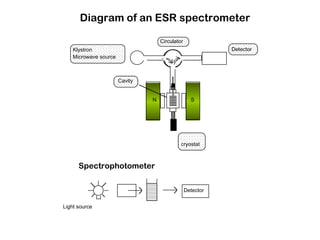
N S
Klystron
Microwave source
Detector
Cavity
cryostat
Circulator
Diagram of an ESR spectrometer
Spectrophotometer
Light source
Detector
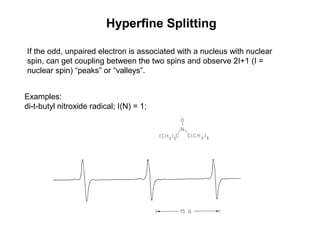
If the odd, unpaired electron is associated with a nucleus with nuclear
spin, can get coupling between the two spins and observe 2I+1 (I =
nuclear spin) “peaks” or “valleys”.
Examples:
di-t-butyl nitroxide radical; I(N) = 1;
Hyperfine Splitting
vanadyl [V=O]2+
complex; I (V) = 7/2; 2(7/2) + 1 = 8 peaks
Hyperfine Splitting
Signal Intensities
Follow Pascal's triangle
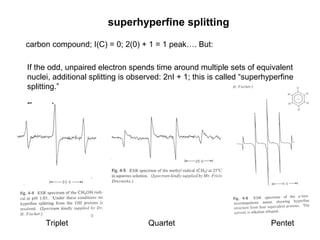
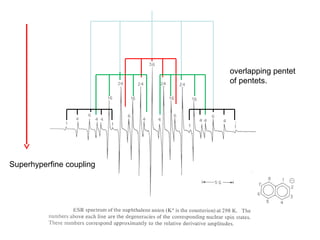
superhyperfine splitting
carbon compound; I(C) = 0; 2(0) + 1 = 1 peak…. But:
If the odd, unpaired electron spends time around multiple sets of equivalent
nuclei, additional splitting is observed: 2nI + 1; this is called “superhyperfine
splitting.”
Examples:
Triplet Quartet Pentet
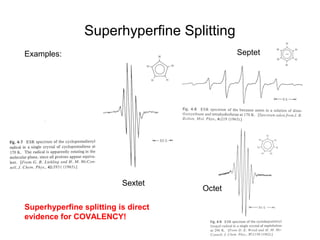
Superhyperfine Splitting
Examples:
Sextet
Septet
Octet
Superhyperfine splitting is direct
evidence for COVALENCY!
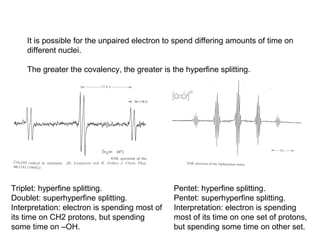
It is possible for the unpaired electron to spend differing amounts of time on
different nuclei.
The greater the covalency, the greater is the hyperfine splitting.
Triplet: hyperfine splitting.
Doublet: superhyperfine splitting.
Interpretation: electron is spending most of
its time on CH2 protons, but spending
some time on –OH.
Pentet: hyperfine splitting.
Pentet: superhyperfine splitting.
Interpretation: electron is spending
most of its time on one set of protons,
but spending some time on other set.
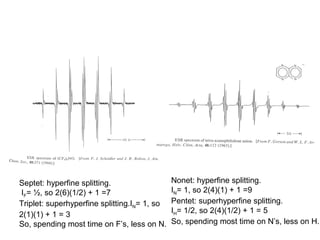
Septet: hyperfine splitting.
IF= ½, so 2(6)(1/2) + 1 =7
Triplet: superhyperfine splitting.IN= 1, so
2(1)(1) + 1 = 3
So, spending most time on F’s, less on N.
Nonet: hyperfine splitting.
IN= 1, so 2(4)(1) + 1 =9
Pentet: superhyperfine splitting.
IH= 1/2, so 2(4)(1/2) + 1 = 5
So, spending most time on N’s, less on H.
Superhyperfine coupling
overlapping pentet
of pentets.
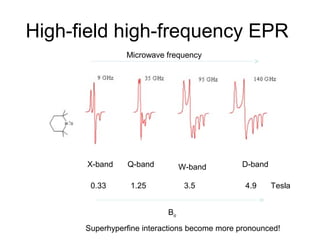
High-field high-frequency EPR
X-band Q-band W-band D-band
0.33 1.25 3.5 4.9 Tesla
Bo
Microwave frequency
Superhyperfine interactions become more pronounced!
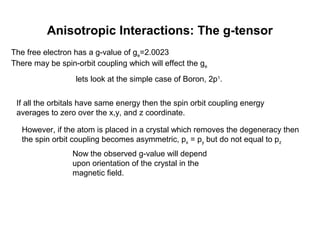
Anisotropic Interactions: The g-tensor
The free electron has a g-value of ge=2.0023
There may be spin-orbit coupling which will effect the ge
lets look at the simple case of Boron, 2p1
.
If all the orbitals have same energy then the spin orbit coupling energy
averages to zero over the x,y, and z coordinate.
However, if the atom is placed in a crystal which removes the degeneracy then
the spin orbit coupling becomes asymmetric, px = py but do not equal to pz
Now the observed g-value will depend
upon orientation of the crystal in the
magnetic field.
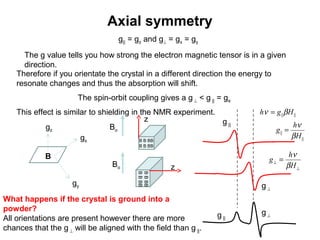
Axial symmetry
g|| = gz and g⊥ = gx = gy
The g value tells you how strong the electron magnetic tensor is in a given
direction.
Therefore if you orientate the crystal in a different direction the energy to
resonate changes and thus the absorption will shift.
This effect is similar to shielding in the NMR experiment.
The spin-orbit coupling gives a g ⊥ < g || = ge
B
gz
gy
gx B B BB
B B BB
BBBB
BBBB
g ||
g ||
g ⊥
g ⊥
|||| Hgh βν =
||
||
H
h
g
β
ν
=
⊥
⊥ =
H
h
g
β
ν
What happens if the crystal is ground into a
powder?
All orientations are present however there are more
chances that the g ⊥ will be aligned with the field than g ||.
Bo
Bo
z
z
ESR spectra of [Cu(MeTtoxBF2)]BF4 in
1:10 BuOH–DMF.
(a) Room temperature (295 K) fluid
spectrum (9.464 GHz). (b) 77 K cryogenic
glass spectrum (9.147 GHz).
Prushan, M. J.; Addison, A. W.*; Butcher, R. J.; "Pentadentate
Thioether Oxime Macrocyclic and Quasi-Macrocyclic Complexes of
Copper(II) and Nickel(II)" Inorganica Chimica Acta, 300-302, 992-1003
(2000).

electron spin resonance spectroscopy ( EPR/ESR)

  • 1.
  • 2.
    Electron Paramagnetic Resonancespectroscopy Electron Spin Resonance spectroscopy
  • 3.
    Principles of EMRspectroscopy B 0 ∆E hν Classical theory: Electron spin moment interacts with applied electromagnetic radiation m s = — 1 2 m s = — 1 2 - Energy Quantum theory: transitions between energy levels induced by magnetic field Resonance condition hν = gµBB0
  • 5.
    The EPR experiment •Put sample into experimental magnetic field (B) • Irradiate (microwave frequencies) • Measure absorbance of radiation as f(B) Weil, Bolton, and Wertz, 1994, “Electron Paramagnetic Resonance”
  • 6.
    The hyperfine effect •The magnetic field experienced by the unpaired electron is affected by nearby nuclei with non-zero nuclear spin Weil, Bolton, and Wertz, 1994, “Electron Paramagnetic Resonance”, New York: Wiley Interscience.
  • 7.
    Hyperfine splitting ofEPR spectra • The magnitude of the splitting and the number of lines depend upon: – The nuclear spin of the interacting nucleus • # of lines = 2n(I + ½) so I = ½ gives 2 lines, etc. – The nuclear gyromagnetic ratio – The magnitude of the interaction between the electronic spin and the nuclear spin • Magnitude of the splitting typically decreases greatly with increasing numbers of bonds between the nucleus and unpaired electron
  • 8.
    10 Gauss No hyperfine 1H) 14N) 2identical I=1/2 nuclei 1 I=5/2 nucleus (17O) Hyperfine coupling If the electron is surrounded by n spin- active nuclei with a spin quantum number of I, then a (2nI+1) line pattern will be observed in a similar way to NMR. In the case of the hydrogen atom (I= ½), this would be 2(1)(½) + 1 = 2 lines.
  • 9.
    Some nuclei withspins Element Isotope Nuclear No of % spin lines abundance Hydrogen 1 H ½ 2 99.985 Nitrogen 14 N 1 3 99.63 15 N ½ 2 0.37 Vanadium 51 V 7/2 8 99.76 Manganese 55 Mn 5/2 6 100 Iron 57 Fe ½ 2 2.19 Cobalt 59 Co 7/2 8 100 Nickel 61 Ni 3/2 4 1.134 Copper 63 Cu 3/2 4 69.1 65 Cu 3/2 4 30.9 Molybdenum 95 Mo 5/2 6 15.7 97 Mo 5/2 6 9.46
  • 10.
    Hyperfine splittings multiplywith the number of nuclear spins O . O- H H H H Benzoquinone anion radical: 1 proton – splits into 2 lines 1:1 2 protons split into 3 lines 1:2:1 3 protons split into 4 lines 1:3:3:1 4 protons split into 5 lines 1:4:6:4:1 -60 °C 20 °C At higher temperature: faster motion - sharper lines shorter lifetime - smaller signal
  • 12.
    0 0.5 1 1.5 2 2.5 2900 3000 31003200 3300 3400 3500 3600 3700 Gauss A -1.5 -1 -0.5 0 0.5 1 1.5 2900 3000 3100 3200 3300 3400 3500 3600 3700 Gauss dA/dB
  • 13.
    Prushan Example SS N N OO B FF Cu [Cu(Thyclops)]+ + 77K Cryogenic ESR Spectrum of [Cu(Thyclops)]ClO4 in MeOH Prushan, M. J.; Addison, A. W.; Butcher, R. J.; Thompson, L. K. “Copper(II) Complex Tetradentate Thioether-Oxime Ligands” Inorganica Chimica Acta, 358, 3449-3456 (2005).
  • 14.
  • 15.
    N S Klystron Microwave source Detector Cavity cryostat Circulator Diagramof an ESR spectrometer Spectrophotometer Light source Detector
  • 16.
    If the odd,unpaired electron is associated with a nucleus with nuclear spin, can get coupling between the two spins and observe 2I+1 (I = nuclear spin) “peaks” or “valleys”. Examples: di-t-butyl nitroxide radical; I(N) = 1; Hyperfine Splitting
  • 17.
    vanadyl [V=O]2+ complex; I(V) = 7/2; 2(7/2) + 1 = 8 peaks Hyperfine Splitting
  • 18.
  • 19.
    superhyperfine splitting carbon compound;I(C) = 0; 2(0) + 1 = 1 peak…. But: If the odd, unpaired electron spends time around multiple sets of equivalent nuclei, additional splitting is observed: 2nI + 1; this is called “superhyperfine splitting.” Examples: Triplet Quartet Pentet
  • 20.
  • 21.
    It is possiblefor the unpaired electron to spend differing amounts of time on different nuclei. The greater the covalency, the greater is the hyperfine splitting. Triplet: hyperfine splitting. Doublet: superhyperfine splitting. Interpretation: electron is spending most of its time on CH2 protons, but spending some time on –OH. Pentet: hyperfine splitting. Pentet: superhyperfine splitting. Interpretation: electron is spending most of its time on one set of protons, but spending some time on other set.
  • 22.
    Septet: hyperfine splitting. IF=½, so 2(6)(1/2) + 1 =7 Triplet: superhyperfine splitting.IN= 1, so 2(1)(1) + 1 = 3 So, spending most time on F’s, less on N. Nonet: hyperfine splitting. IN= 1, so 2(4)(1) + 1 =9 Pentet: superhyperfine splitting. IH= 1/2, so 2(4)(1/2) + 1 = 5 So, spending most time on N’s, less on H.
  • 23.
  • 24.
    High-field high-frequency EPR X-bandQ-band W-band D-band 0.33 1.25 3.5 4.9 Tesla Bo Microwave frequency Superhyperfine interactions become more pronounced!
  • 25.
    Anisotropic Interactions: Theg-tensor The free electron has a g-value of ge=2.0023 There may be spin-orbit coupling which will effect the ge lets look at the simple case of Boron, 2p1 . If all the orbitals have same energy then the spin orbit coupling energy averages to zero over the x,y, and z coordinate. However, if the atom is placed in a crystal which removes the degeneracy then the spin orbit coupling becomes asymmetric, px = py but do not equal to pz Now the observed g-value will depend upon orientation of the crystal in the magnetic field.
  • 26.
    Axial symmetry g|| =gz and g⊥ = gx = gy The g value tells you how strong the electron magnetic tensor is in a given direction. Therefore if you orientate the crystal in a different direction the energy to resonate changes and thus the absorption will shift. This effect is similar to shielding in the NMR experiment. The spin-orbit coupling gives a g ⊥ < g || = ge B gz gy gx B B BB B B BB BBBB BBBB g || g || g ⊥ g ⊥ |||| Hgh βν = || || H h g β ν = ⊥ ⊥ = H h g β ν What happens if the crystal is ground into a powder? All orientations are present however there are more chances that the g ⊥ will be aligned with the field than g ||. Bo Bo z z
  • 27.
    ESR spectra of[Cu(MeTtoxBF2)]BF4 in 1:10 BuOH–DMF. (a) Room temperature (295 K) fluid spectrum (9.464 GHz). (b) 77 K cryogenic glass spectrum (9.147 GHz). Prushan, M. J.; Addison, A. W.*; Butcher, R. J.; "Pentadentate Thioether Oxime Macrocyclic and Quasi-Macrocyclic Complexes of Copper(II) and Nickel(II)" Inorganica Chimica Acta, 300-302, 992-1003 (2000).