EPR
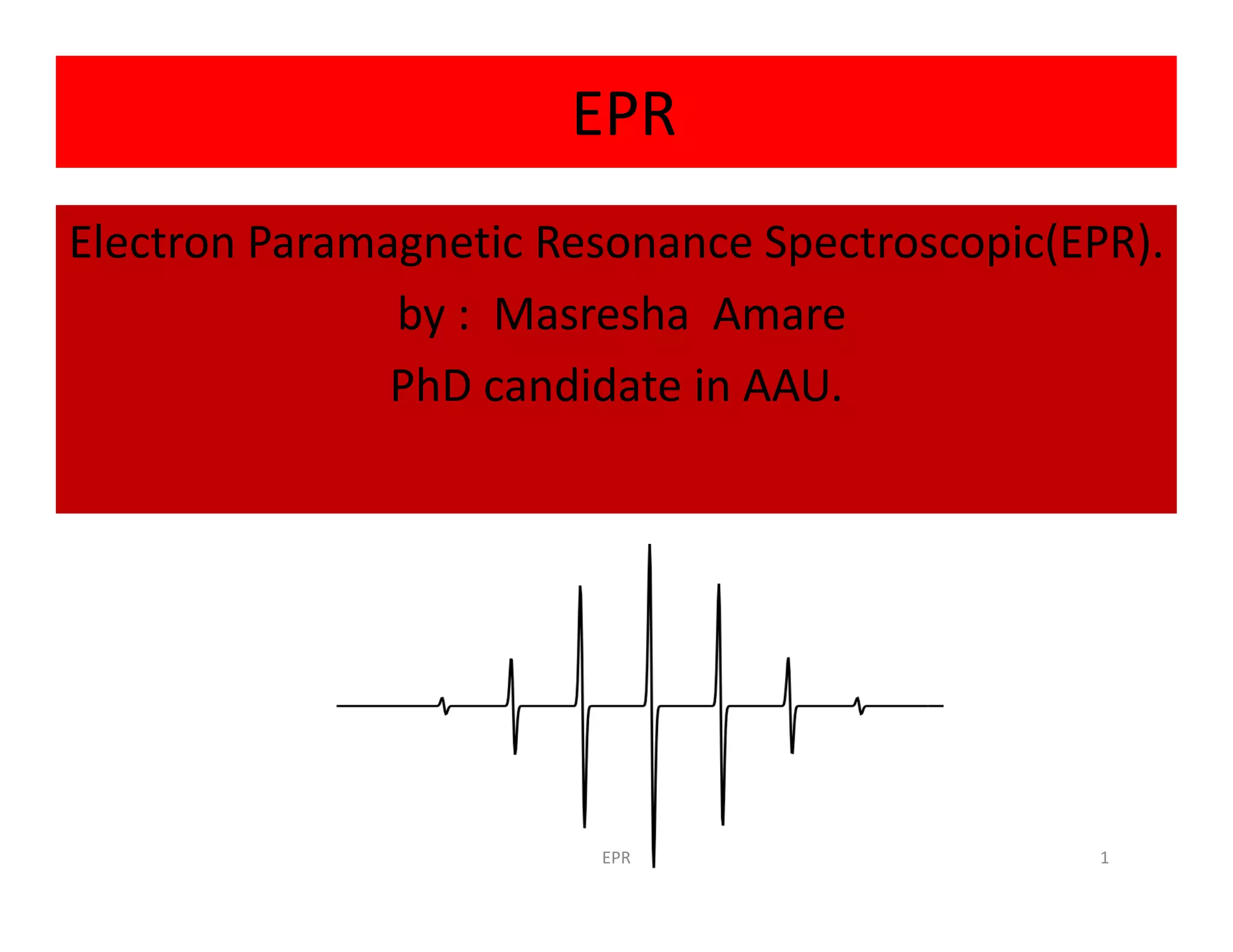
Electron Paramagnetic Resonance Spectroscopic(EPR).
by : Masresha Amare
PhD candidate in AAU.
1EPR
Outline
Introduction
Principle of EPR
The Zeeman effect
The Hyperfine EffectThe Hyperfine Effect
Super- hyperfine splitting
2EPR
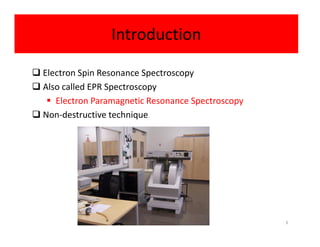
Introduction
 Electron Spin Resonance Spectroscopy
 Also called EPR Spectroscopy
 Electron Paramagnetic Resonance Spectroscopy
 Non-destructive technique
3EPR
What compounds can you analyze?
 Applicable for species with one or more unpaired electrons
 Free radicals
 Transition metal compounds
 Useful for unstable paramagnetic compounds generated in
situsitu
 Electrochemical oxidation or reduction
4EPR
Energy of Transitions
ESR measures the transition between the electron
spin energy levels
 Transition induced by the appropriate frequency
radiationradiation
Required frequency of radiation dependent upon
strength of magnetic field
 Common field strength 0.34 and 1.24 T
 9.5 and 35 GHz
 Microwave region
5EPR
Energy of Transitions
The absorption of energy causes a transition of an
electron from a lower energy state to a higher energy
state.
 In EPR spectroscopy the radiation used is in the In EPR spectroscopy the radiation used is in the
gigahertz range.
 Unlike most traditional spectroscopy techniques, in
EPR spectroscopy the frequency of the radiation is
held constant while the magnetic field is varied in
order to obtain an absorption spectrum.
6EPR
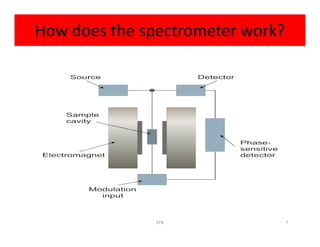
How does the spectrometer work?
7EPR
How does the spectrometer work?
The radiation source usually used is called a klystron
 They are high power microwave sources which have
low-noise characteristics and thus give high
sensitivity
A majority of EPR spectrometers operate at
approximately 9.5 GHz, which corresponds to about
32 mm ( X-band)
The radiation may be incident on the sample
continuously or pulsed
8EPR
How does the spectrometer work?
The sample is placed in a resonant cavity which
admits microwaves through an iris.
 The cavity is located in the middle of an
electromagnet and helps to amplify the weak signals
from the sample.from the sample.
Numerous types of solid-state diodes are sensitive to
microwave energy
Absorption lines are detected when the separation of
the energy levels is equal to the energy of the
incident microwave.
9EPR
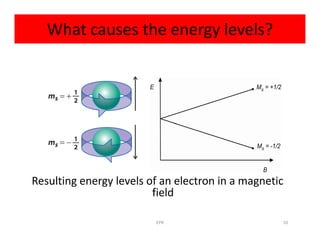
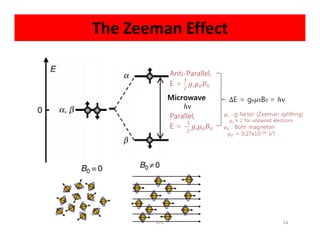
What causes the energy levels?
Resulting energy levels of an electron in a magnetic
field
10EPR
What causes the energy levels?
When an electron is placed within an applied
magnetic field, Bo, the two possible spin states of the
electron have different energies (Zeeman effect)
 The lower energy state occurs when the magnetic
moment of the electron is aligned with the magneticmoment of the electron is aligned with the magnetic
field.
The two states are labeled by the projection of the
electron spin, MS, on the direction of the magnetic
field, where MS = -1/2 is parallel and MS = +1/2 is anti
parallel state
11EPR
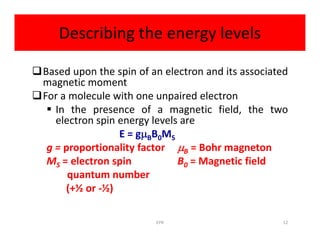
Describing the energy levels
Based upon the spin of an electron and its associated
magnetic moment
For a molecule with one unpaired electron
 In the presence of a magnetic field, the two
electron spin energy levels areelectron spin energy levels are
E = gBB0MS
g = proportionality factor B = Bohr magneton
MS = electron spin B0 = Magnetic field
quantum number
(+½ or -½)
12EPR
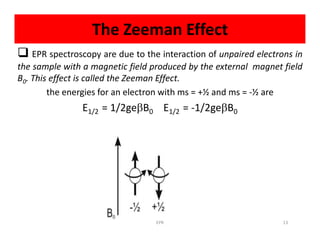
The Zeeman Effect
 EPR spectroscopy are due to the interaction of unpaired electrons in
the sample with a magnetic field produced by the external magnet field
B0. This effect is called the Zeeman Effect.
the energies for an electron with ms = +½ and ms = -½ are
E1/2 = 1/2geB0 E1/2 = -1/2geB0
13EPR
The Zeeman Effect
14EPR
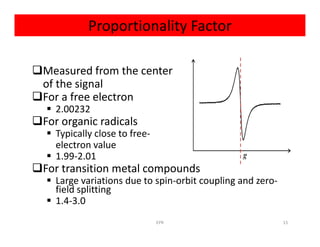
Proportionality Factor
Measured from the center
of the signal
For a free electron
 2.00232
For organic radicalsFor organic radicals
 Typically close to free-
electron value
 1.99-2.01
For transition metal compounds
 Large variations due to spin-orbit coupling and zero-
field splitting
 1.4-3.0
15EPR
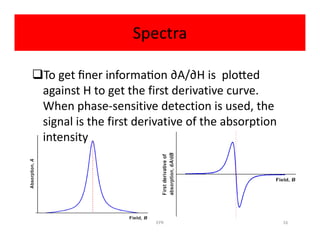
Spectra
To get finer informa on ∂A/∂H is plo ed
against H to get the first derivative curve.
When phase-sensitive detection is used, the
signal is the first derivative of the absorptionsignal is the first derivative of the absorption
intensity
EPR 16
Hyperfine Interactions
EPR signal is ‘split’ by neighboring nuclei
 Called hyperfine interactions
Can be used to provide informationCan be used to provide information
 Number and identity of nuclei
 Distance from unpaired electron
Interactions with neighboring nuclei
E = gmBB0MS + aMsmI
a = hyperfine coupling constant
mI = nuclear spin quantum number 17EPR
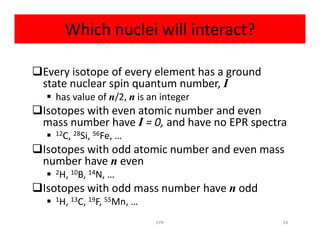
Which nuclei will interact?
Every isotope of every element has a ground
state nuclear spin quantum number, I
 has value of n/2, n is an integer
Isotopes with even atomic number and even
mass number have I = 0, and have no EPR spectramass number have I = 0, and have no EPR spectra
 12C, 28Si, 56Fe, …
Isotopes with odd atomic number and even mass
number have n even
 2H, 10B, 14N, …
Isotopes with odd mass number have n odd
 1H, 13C, 19F, 55Mn, …
18EPR
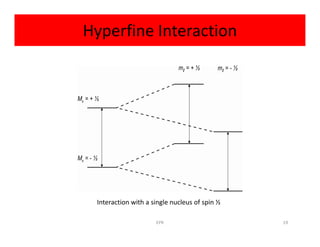
Hyperfine Interaction
Interaction with a single nucleus of spin ½
19EPR
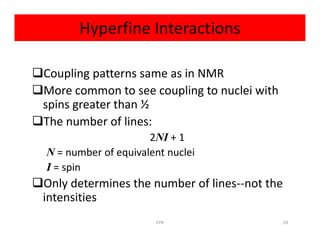
Hyperfine Interactions
Coupling patterns same as in NMR
More common to see coupling to nuclei with
spins greater than ½
The number of lines:The number of lines:
2NI + 1
N = number of equivalent nuclei
I = spin
Only determines the number of lines--not the
intensities
20EPR
Hyperfine Interactions
Relative intensities determined by the number
of interacting nuclei
If only one nucleus interacting
 All lines have equal intensity All lines have equal intensity
If multiple nuclei interacting
 Distributions derived based upon spin
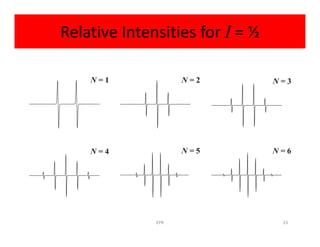
 For spin ½ (most common), intensities follow
binomial distribution
21EPR
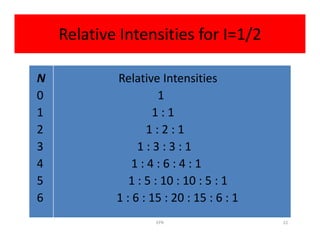
Relative Intensities for I=1/2
N Relative Intensities
0 1
1 1 : 1
2 1 : 2 : 12 1 : 2 : 1
3 1 : 3 : 3 : 1
4 1 : 4 : 6 : 4 : 1
5 1 : 5 : 10 : 10 : 5 : 1
6 1 : 6 : 15 : 20 : 15 : 6 : 1
22EPR
Relative Intensities for I = ½
23EPR
Relative Intensities for I = 1
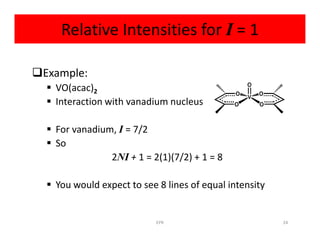
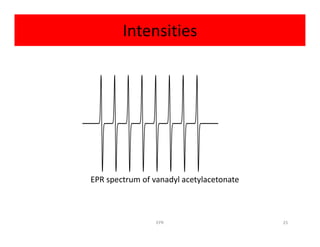
Example:
 VO(acac)2
 Interaction with vanadium nucleus
 For vanadium, I = 7/2 For vanadium, I = 7/2
 So
2NI + 1 = 2(1)(7/2) + 1 = 8
 You would expect to see 8 lines of equal intensity
24EPR
Intensities
EPR spectrum of vanadyl acetylacetonate
25EPR
Hyperfine Interactions
Example:
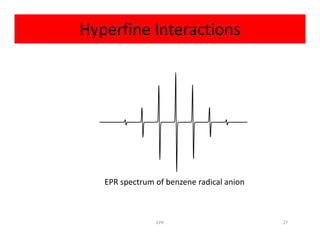
 Radical anion of benzene [C6H6]-
 Electron is delocalized over all six carbon atoms
• Exhibits coupling to six equivalent hydrogen atoms• Exhibits coupling to six equivalent hydrogen atoms
 So
2NI + 1 = 2(6)(1/2) + 1 = 7
 So spectrum should be seven lines with relative
intensities 1:6:15:20:15:6:1
26EPR
Hyperfine Interactions
EPR spectrum of benzene radical anion
27EPR
Superhyperfine splitting
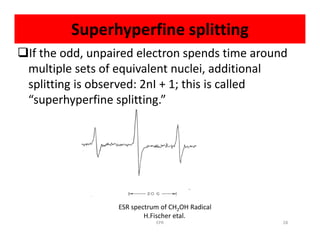
If the odd, unpaired electron spends time around
multiple sets of equivalent nuclei, additional
splitting is observed: 2nI + 1; this is called
“superhyperfine splitting.”
ESR spectrum of CH2OH Radical
H.Fischer etal.
28EPR
superhyperfine splitting
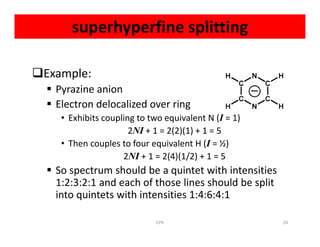
Example:
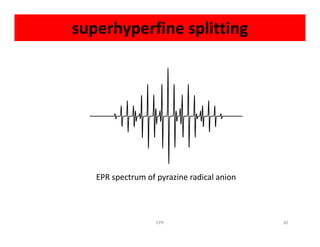
 Pyrazine anion
 Electron delocalized over ring
• Exhibits coupling to two equivalent N (I = 1)
2NI + 1 = 2(2)(1) + 1 = 5
• Then couples to four equivalent H (I = ½)
2NI + 1 = 2(4)(1/2) + 1 = 5
 So spectrum should be a quintet with intensities
1:2:3:2:1 and each of those lines should be split
into quintets with intensities 1:4:6:4:1
29EPR
superhyperfine splitting
EPR spectrum of pyrazine radical anion
30EPR
superhyperfine splitting
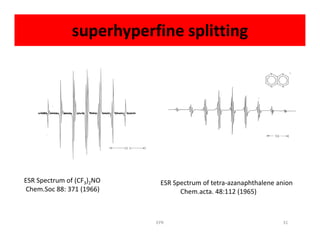
ESR Spectrum of (CF3)2NO
Chem.Soc 88: 371 (1966)
ESR Spectrum of tetra-azanaphthalene anion
Chem.acta. 48:112 (1965)
31EPR
superhyperfine splitting
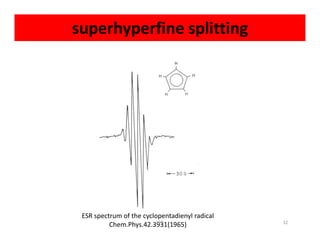
ESR spectrum of the cyclopentadienyl radical
Chem.Phys.42.3931(1965) 32EPR
Conclusions
 Analysis of paramagnetic compounds
 Compliment to NMR
 Examination of hyperfine interactions
 Provides information on number and type of Provides information on number and type of
nuclei coupled to the electrons
 Indicates the extent to which the unpaired
electrons are delocalized
EPR 33
THANK YOUTHANK YOU
EPR 34

EPR spectroscopy.

  • 1.
    EPR Electron Paramagnetic ResonanceSpectroscopic(EPR). by : Masresha Amare PhD candidate in AAU. 1EPR
  • 2.
    Outline Introduction Principle of EPR TheZeeman effect The Hyperfine EffectThe Hyperfine Effect Super- hyperfine splitting 2EPR
  • 3.
    Introduction  Electron SpinResonance Spectroscopy  Also called EPR Spectroscopy  Electron Paramagnetic Resonance Spectroscopy  Non-destructive technique 3EPR
  • 4.
    What compounds canyou analyze?  Applicable for species with one or more unpaired electrons  Free radicals  Transition metal compounds  Useful for unstable paramagnetic compounds generated in situsitu  Electrochemical oxidation or reduction 4EPR
  • 5.
    Energy of Transitions ESRmeasures the transition between the electron spin energy levels  Transition induced by the appropriate frequency radiationradiation Required frequency of radiation dependent upon strength of magnetic field  Common field strength 0.34 and 1.24 T  9.5 and 35 GHz  Microwave region 5EPR
  • 6.
    Energy of Transitions Theabsorption of energy causes a transition of an electron from a lower energy state to a higher energy state.  In EPR spectroscopy the radiation used is in the In EPR spectroscopy the radiation used is in the gigahertz range.  Unlike most traditional spectroscopy techniques, in EPR spectroscopy the frequency of the radiation is held constant while the magnetic field is varied in order to obtain an absorption spectrum. 6EPR
  • 7.
    How does thespectrometer work? 7EPR
  • 8.
    How does thespectrometer work? The radiation source usually used is called a klystron  They are high power microwave sources which have low-noise characteristics and thus give high sensitivity A majority of EPR spectrometers operate at approximately 9.5 GHz, which corresponds to about 32 mm ( X-band) The radiation may be incident on the sample continuously or pulsed 8EPR
  • 9.
    How does thespectrometer work? The sample is placed in a resonant cavity which admits microwaves through an iris.  The cavity is located in the middle of an electromagnet and helps to amplify the weak signals from the sample.from the sample. Numerous types of solid-state diodes are sensitive to microwave energy Absorption lines are detected when the separation of the energy levels is equal to the energy of the incident microwave. 9EPR
  • 10.
    What causes theenergy levels? Resulting energy levels of an electron in a magnetic field 10EPR
  • 11.
    What causes theenergy levels? When an electron is placed within an applied magnetic field, Bo, the two possible spin states of the electron have different energies (Zeeman effect)  The lower energy state occurs when the magnetic moment of the electron is aligned with the magneticmoment of the electron is aligned with the magnetic field. The two states are labeled by the projection of the electron spin, MS, on the direction of the magnetic field, where MS = -1/2 is parallel and MS = +1/2 is anti parallel state 11EPR
  • 12.
    Describing the energylevels Based upon the spin of an electron and its associated magnetic moment For a molecule with one unpaired electron  In the presence of a magnetic field, the two electron spin energy levels areelectron spin energy levels are E = gBB0MS g = proportionality factor B = Bohr magneton MS = electron spin B0 = Magnetic field quantum number (+½ or -½) 12EPR
  • 13.
    The Zeeman Effect EPR spectroscopy are due to the interaction of unpaired electrons in the sample with a magnetic field produced by the external magnet field B0. This effect is called the Zeeman Effect. the energies for an electron with ms = +½ and ms = -½ are E1/2 = 1/2geB0 E1/2 = -1/2geB0 13EPR
  • 14.
  • 15.
    Proportionality Factor Measured fromthe center of the signal For a free electron  2.00232 For organic radicalsFor organic radicals  Typically close to free- electron value  1.99-2.01 For transition metal compounds  Large variations due to spin-orbit coupling and zero- field splitting  1.4-3.0 15EPR
  • 16.
    Spectra To get finerinforma on ∂A/∂H is plo ed against H to get the first derivative curve. When phase-sensitive detection is used, the signal is the first derivative of the absorptionsignal is the first derivative of the absorption intensity EPR 16
  • 17.
    Hyperfine Interactions EPR signalis ‘split’ by neighboring nuclei  Called hyperfine interactions Can be used to provide informationCan be used to provide information  Number and identity of nuclei  Distance from unpaired electron Interactions with neighboring nuclei E = gmBB0MS + aMsmI a = hyperfine coupling constant mI = nuclear spin quantum number 17EPR
  • 18.
    Which nuclei willinteract? Every isotope of every element has a ground state nuclear spin quantum number, I  has value of n/2, n is an integer Isotopes with even atomic number and even mass number have I = 0, and have no EPR spectramass number have I = 0, and have no EPR spectra  12C, 28Si, 56Fe, … Isotopes with odd atomic number and even mass number have n even  2H, 10B, 14N, … Isotopes with odd mass number have n odd  1H, 13C, 19F, 55Mn, … 18EPR
  • 19.
    Hyperfine Interaction Interaction witha single nucleus of spin ½ 19EPR
  • 20.
    Hyperfine Interactions Coupling patternssame as in NMR More common to see coupling to nuclei with spins greater than ½ The number of lines:The number of lines: 2NI + 1 N = number of equivalent nuclei I = spin Only determines the number of lines--not the intensities 20EPR
  • 21.
    Hyperfine Interactions Relative intensitiesdetermined by the number of interacting nuclei If only one nucleus interacting  All lines have equal intensity All lines have equal intensity If multiple nuclei interacting  Distributions derived based upon spin  For spin ½ (most common), intensities follow binomial distribution 21EPR
  • 22.
    Relative Intensities forI=1/2 N Relative Intensities 0 1 1 1 : 1 2 1 : 2 : 12 1 : 2 : 1 3 1 : 3 : 3 : 1 4 1 : 4 : 6 : 4 : 1 5 1 : 5 : 10 : 10 : 5 : 1 6 1 : 6 : 15 : 20 : 15 : 6 : 1 22EPR
  • 23.
  • 24.
    Relative Intensities forI = 1 Example:  VO(acac)2  Interaction with vanadium nucleus  For vanadium, I = 7/2 For vanadium, I = 7/2  So 2NI + 1 = 2(1)(7/2) + 1 = 8  You would expect to see 8 lines of equal intensity 24EPR
  • 25.
    Intensities EPR spectrum ofvanadyl acetylacetonate 25EPR
  • 26.
    Hyperfine Interactions Example:  Radicalanion of benzene [C6H6]-  Electron is delocalized over all six carbon atoms • Exhibits coupling to six equivalent hydrogen atoms• Exhibits coupling to six equivalent hydrogen atoms  So 2NI + 1 = 2(6)(1/2) + 1 = 7  So spectrum should be seven lines with relative intensities 1:6:15:20:15:6:1 26EPR
  • 27.
    Hyperfine Interactions EPR spectrumof benzene radical anion 27EPR
  • 28.
    Superhyperfine splitting If theodd, unpaired electron spends time around multiple sets of equivalent nuclei, additional splitting is observed: 2nI + 1; this is called “superhyperfine splitting.” ESR spectrum of CH2OH Radical H.Fischer etal. 28EPR
  • 29.
    superhyperfine splitting Example:  Pyrazineanion  Electron delocalized over ring • Exhibits coupling to two equivalent N (I = 1) 2NI + 1 = 2(2)(1) + 1 = 5 • Then couples to four equivalent H (I = ½) 2NI + 1 = 2(4)(1/2) + 1 = 5  So spectrum should be a quintet with intensities 1:2:3:2:1 and each of those lines should be split into quintets with intensities 1:4:6:4:1 29EPR
  • 30.
    superhyperfine splitting EPR spectrumof pyrazine radical anion 30EPR
  • 31.
    superhyperfine splitting ESR Spectrumof (CF3)2NO Chem.Soc 88: 371 (1966) ESR Spectrum of tetra-azanaphthalene anion Chem.acta. 48:112 (1965) 31EPR
  • 32.
    superhyperfine splitting ESR spectrumof the cyclopentadienyl radical Chem.Phys.42.3931(1965) 32EPR
  • 33.
    Conclusions  Analysis ofparamagnetic compounds  Compliment to NMR  Examination of hyperfine interactions  Provides information on number and type of Provides information on number and type of nuclei coupled to the electrons  Indicates the extent to which the unpaired electrons are delocalized EPR 33
  • 34.