Presentation title:
Presented by: Muhammad Ayyan Khan
Reductive Elimination
Reactions
Contents
1. Definition
2. Mechanism
3. Examples
4. Application
5. References
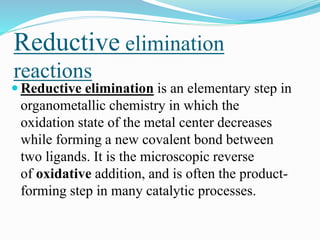
Reductive elimination
reactions
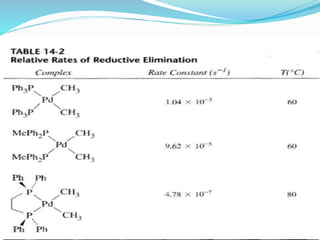
 Reductive elimination is an elementary step in
organometallic chemistry in which the
oxidation state of the metal center decreases
while forming a new covalent bond between
two ligands. It is the microscopic reverse
of oxidative addition, and is often the product-
forming step in many catalytic processes.
A reductive elimination reaction is one in which the
oxidation state of the metal decreases by two units and
the coordination number of the metal decreases
Oxidative addition and reductive elimination reactions
are, in principle, reversible. However, in practice, one
direction is normally thermodynamically favoured over
the other. Oxidative addition and reductive elimination
reactions play a major role in many catalytic processes
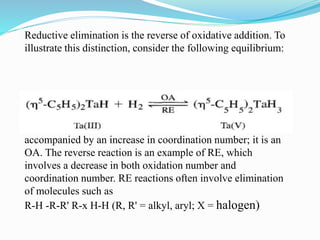
Reductive elimination is the reverse of oxidative addition. To
illustrate this distinction, consider the following equilibrium:
The forward reaction involves formal oxidation of the metal,
accompanied by an increase in coordination number; it is an
OA. The reverse reaction is an example of RE, which
involves a decrease in both oxidation number and
coordination number. RE reactions often involve elimination
of molecules such as
R-H -R-R' R-x H-H (R, R' = alkyl, aryl; X = halogen)
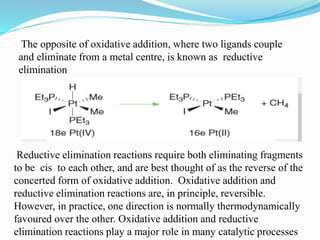
The opposite of oxidative addition, where two ligands couple
and eliminate from a metal centre, is known as reductive
elimination
Reductive elimination reactions require both eliminating fragments
to be cis to each other, and are best thought of as the reverse of the
concerted form of oxidative addition. Oxidative addition and
reductive elimination reactions are, in principle, reversible.
However, in practice, one direction is normally thermodynamically
favoured over the other. Oxidative addition and reductive
elimination reactions play a major role in many catalytic processes
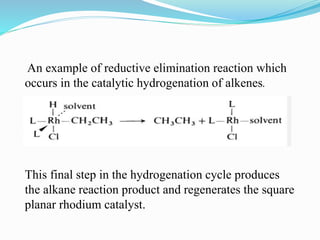
An example of reductive elimination reaction which
occurs in the catalytic hydrogenation of alkenes.
This final step in the hydrogenation cycle produces
the alkane reaction product and regenerates the square
planar rhodium catalyst.
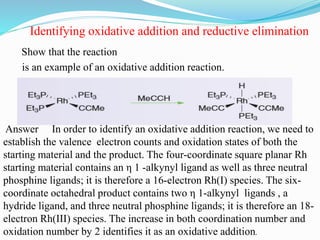
Show that the reaction
Identifying oxidative addition and reductive elimination
is an example of an oxidative addition reaction.
Answer In order to identify an oxidative addition reaction, we need to
establish the valence electron counts and oxidation states of both the
starting material and the product. The four-coordinate square planar Rh
starting material contains an η 1 -alkynyl ligand as well as three neutral
phosphine ligands; it is therefore a 16-electron Rh(I) species. The six-
coordinate octahedral product contains two η 1-alkynyl ligands , a
hydride ligand, and three neutral phosphine ligands; it is therefore an 18-
electron Rh(III) species. The increase in both coordination number and
oxidation number by 2 identifies it as an oxidative addition.
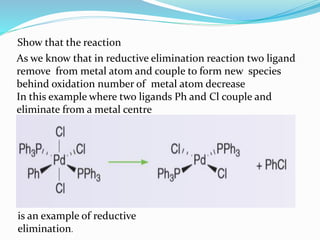
Show that the reaction
is an example of reductive
elimination.
As we know that in reductive elimination reaction two ligand
remove from metal atom and couple to form new species
behind oxidation number of metal atom decrease
In this example where two ligands Ph and Cl couple and
eliminate from a metal centre
APPLICATIONS
 A reductive elimination is used to produce product
and regenerate the catalyst.
Reductive elimination has found widespread application
in academia and industry, most notable
being hydrogenation, the Monsanto acetic acid
process,hydroformylation,and cross-coupling reactions.In
many of these catalytic cycles, reductive elimination is
the product forming step and regenerates the catalyst;
however, in the Heck reactionand Wacker
process, reductive elimination is involved only in catalyst
regeneration, as the products in these reactions are
formed via β–hydride elimination.
Refrence:
1.Inorganic Chemistry, 6th Edition by ‘’Shriver and
Atkins’’
2.Coordination Chemistry by
‘’Fred Basolo and Ronald C.
Johnson’’
THANK YOU

Reductive elimination reactions

  • 1.
    Presentation title: Presented by:Muhammad Ayyan Khan Reductive Elimination Reactions
  • 2.
    Contents 1. Definition 2. Mechanism 3.Examples 4. Application 5. References
  • 3.
    Reductive elimination reactions  Reductiveelimination is an elementary step in organometallic chemistry in which the oxidation state of the metal center decreases while forming a new covalent bond between two ligands. It is the microscopic reverse of oxidative addition, and is often the product- forming step in many catalytic processes.
  • 4.
    A reductive eliminationreaction is one in which the oxidation state of the metal decreases by two units and the coordination number of the metal decreases Oxidative addition and reductive elimination reactions are, in principle, reversible. However, in practice, one direction is normally thermodynamically favoured over the other. Oxidative addition and reductive elimination reactions play a major role in many catalytic processes
  • 5.
    Reductive elimination isthe reverse of oxidative addition. To illustrate this distinction, consider the following equilibrium: The forward reaction involves formal oxidation of the metal, accompanied by an increase in coordination number; it is an OA. The reverse reaction is an example of RE, which involves a decrease in both oxidation number and coordination number. RE reactions often involve elimination of molecules such as R-H -R-R' R-x H-H (R, R' = alkyl, aryl; X = halogen)
  • 6.
    The opposite ofoxidative addition, where two ligands couple and eliminate from a metal centre, is known as reductive elimination Reductive elimination reactions require both eliminating fragments to be cis to each other, and are best thought of as the reverse of the concerted form of oxidative addition. Oxidative addition and reductive elimination reactions are, in principle, reversible. However, in practice, one direction is normally thermodynamically favoured over the other. Oxidative addition and reductive elimination reactions play a major role in many catalytic processes
  • 7.
    An example ofreductive elimination reaction which occurs in the catalytic hydrogenation of alkenes. This final step in the hydrogenation cycle produces the alkane reaction product and regenerates the square planar rhodium catalyst.
  • 9.
    Show that thereaction Identifying oxidative addition and reductive elimination is an example of an oxidative addition reaction. Answer In order to identify an oxidative addition reaction, we need to establish the valence electron counts and oxidation states of both the starting material and the product. The four-coordinate square planar Rh starting material contains an η 1 -alkynyl ligand as well as three neutral phosphine ligands; it is therefore a 16-electron Rh(I) species. The six- coordinate octahedral product contains two η 1-alkynyl ligands , a hydride ligand, and three neutral phosphine ligands; it is therefore an 18- electron Rh(III) species. The increase in both coordination number and oxidation number by 2 identifies it as an oxidative addition.
  • 10.
    Show that thereaction is an example of reductive elimination. As we know that in reductive elimination reaction two ligand remove from metal atom and couple to form new species behind oxidation number of metal atom decrease In this example where two ligands Ph and Cl couple and eliminate from a metal centre
  • 11.
    APPLICATIONS  A reductiveelimination is used to produce product and regenerate the catalyst. Reductive elimination has found widespread application in academia and industry, most notable being hydrogenation, the Monsanto acetic acid process,hydroformylation,and cross-coupling reactions.In many of these catalytic cycles, reductive elimination is the product forming step and regenerates the catalyst; however, in the Heck reactionand Wacker process, reductive elimination is involved only in catalyst regeneration, as the products in these reactions are formed via β–hydride elimination.
  • 12.
    Refrence: 1.Inorganic Chemistry, 6thEdition by ‘’Shriver and Atkins’’ 2.Coordination Chemistry by ‘’Fred Basolo and Ronald C. Johnson’’
  • 13.