
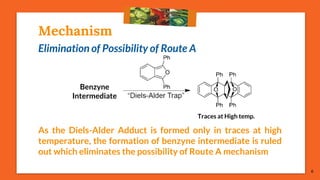
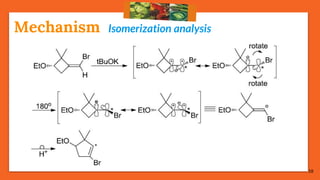
![Mechanism
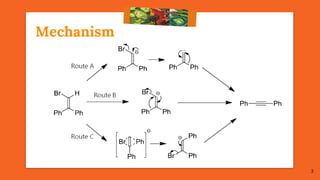
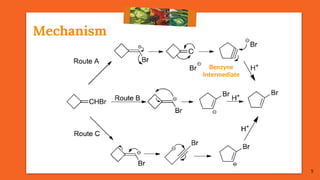
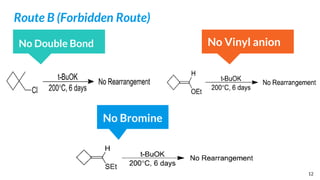
Only Possibility of Route B
[through Anionic 1,2-Sigmatropic Rearrangement]
But, as per Woodward-Hoffmann symmetry rule, the anionic 1,2-
Sigmatropic rearrangement is 4-electron process and is
FORBIDDEN.
8](https://image.slidesharecdn.com/fbwrearrangement-200522154352/85/Fbw-rearrangement-8-320.jpg)
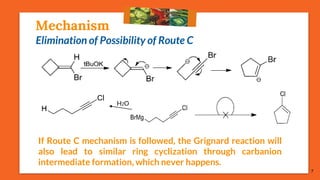
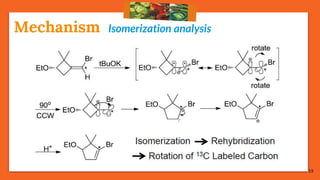
![Mechanism
Orbital Symmetry conversion in a pericyclic reaction
[Woodward-Hoffmann Rule]
9
1,2-Sigmatropic
rearrangement may
be symmetrically
FORBIDDEN but
thermodynamically it
is a ALLOWED
process](https://image.slidesharecdn.com/fbwrearrangement-200522154352/85/Fbw-rearrangement-9-320.jpg)
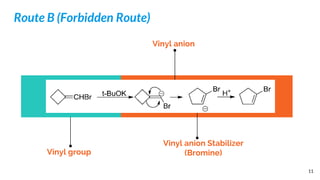
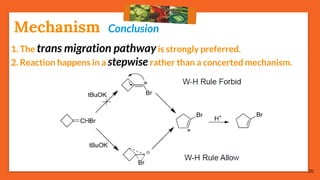
![14
If reaction follows
Route B,
it must have:
Strong Base
Vinyl Anion
Halogen
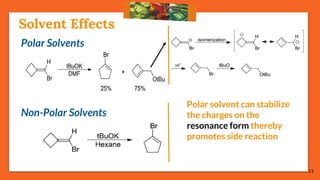
Non-Polar Solvents
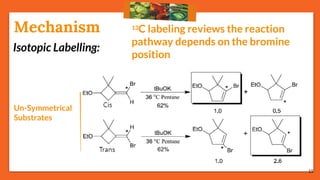
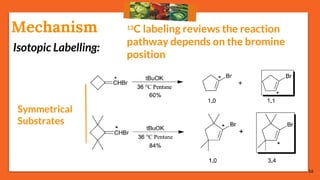
[A] Bromine attach to terminal carbon
Route B (Forbidden Route):
[B] Bromine partially attach to vinyl group
Mechanism](https://image.slidesharecdn.com/fbwrearrangement-200522154352/85/Fbw-rearrangement-14-320.jpg)
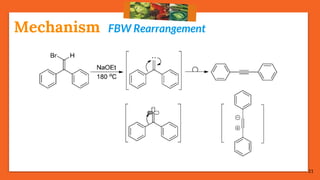
![17
Cis-Trans IsomerizationMechanism
75% reactions prefer: Path [B], the migrating path
25% reactions prefer: Path [A], the re-hybridization path](https://image.slidesharecdn.com/fbwrearrangement-200522154352/85/Fbw-rearrangement-17-320.jpg)
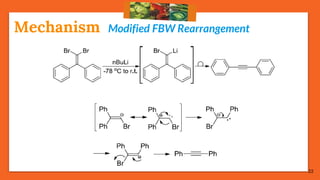
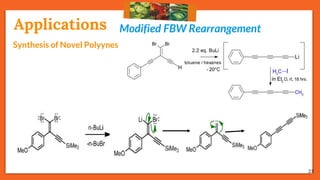
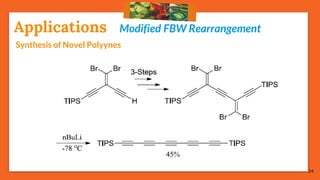
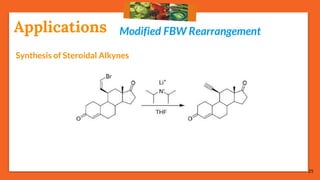
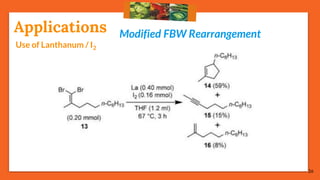
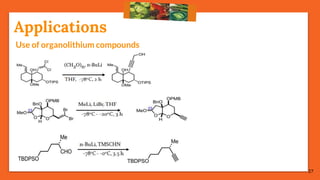


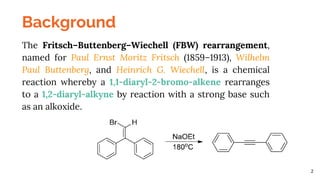
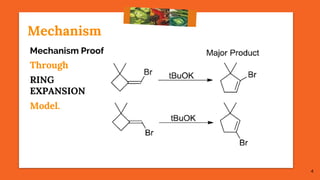
The Fritsch-Buttenberg-Wiechell rearrangement is a chemical reaction that transforms a 1,1-diaryl-2-bromo-alkene into a 1,2-diaryl-alkyne via a strong base, with detailed mechanisms discussed. Various pathways and their thermodynamic feasibility are analyzed, noting that the preferred reaction route is a stepwise trans migration process rather than concerted mechanisms. Applications of the modified rearrangement include the synthesis of novel polyynes and steroidal alkynes.

![WAGNER-MEERWEIN REARRANGEMENT 123 [Autosaved].pptx](https://cdn.slidesharecdn.com/ss_thumbnails/wagner-meerweinrearrangement123autosaved-230919083558-487cc6f5-thumbnail.jpg?width=640&height=640&fit=bounds)
![SMILES REARRANGEMENT [REACTION AND MECHANISM]](https://cdn.slidesharecdn.com/ss_thumbnails/58-191219140707-thumbnail.jpg?width=640&height=640&fit=bounds)


![Photoisomerisation of aromaric compounds [recovered]](https://cdn.slidesharecdn.com/ss_thumbnails/photoisomerisationofaromariccompoundsrecovered-210612142707-thumbnail.jpg?width=640&height=640&fit=bounds)


![Cycloaddition reactions [2+2]](https://cdn.slidesharecdn.com/ss_thumbnails/cycloadditionreactions22-200522152644-thumbnail.jpg?width=640&height=640&fit=bounds)


