EE5517: Optical Engineering
Erbium Doped Fiber Laser
Wenwen Zhao, Shuvan Prashant, Taishi Zhang, Kain Lu Low, Naomi Nandakumar
National University of Singapore (NUS)
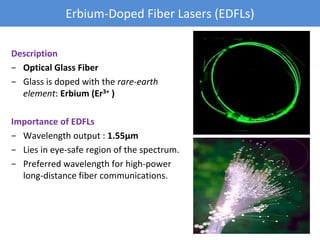
Erbium-Doped Fiber Lasers (EDFLs)
Description
− Optical Glass Fiber
− Glass is doped with the rare-earth
element: Erbium (Er3+ )
Importance of EDFLs
− Wavelength output : 1.55μm
− Lies in eye-safe region of the spectrum.
− Preferred wavelength for high-power
long-distance fiber communications.
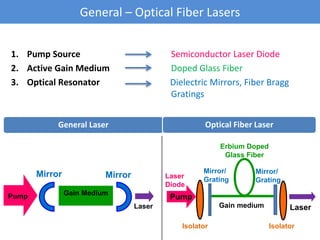
1. Pump Source Semiconductor Laser Diode
2. Active Gain Medium Doped Glass Fiber
3. Optical Resonator Dielectric Mirrors, Fiber Bragg
Gratings
General – Optical Fiber Lasers
General Laser Optical Fiber Laser
Gain Medium
MirrorMirror
Pump
Laser
Erbium Doped
Glass Fiber
LaserGain medium
Mirror/
Grating
Pump
Isolator Isolator
Mirror/
Grating
Laser
Diode
Material of Fiber and Rare-Earth doping
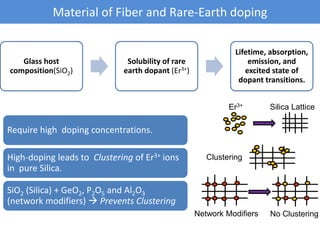
Require high doping concentrations.
High-doping leads to Clustering of Er3+ ions
in pure Silica.
SiO2 (Silica) + GeO2, P2O5 and Al2O3
(network modifiers)  Prevents Clustering
Glass host
composition(SiO2)
Solubility of rare
earth dopant (Er3+)
Lifetime, absorption,
emission, and
excited state of
dopant transitions.
Silica LatticeEr3+
Clustering
Network Modifiers No Clustering
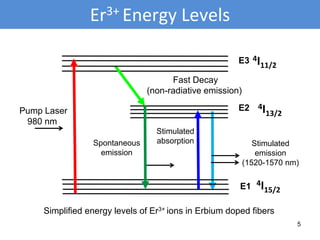
Er3+ Energy Levels
5
Pump Laser
980 nm
Fast Decay
(non-radiative emission)
E1
E2
E3 4I11/2
4I13/2
4I15/2
Spontaneous
emission
Stimulated
emission
(1520-1570 nm)
Stimulated
absorption
Simplified energy levels of Er3+ ions in Erbium doped fibers
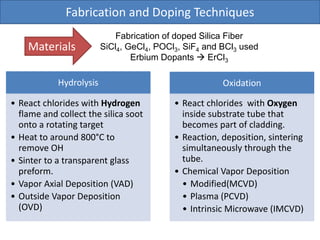
Hydrolysis
• React chlorides with Hydrogen
flame and collect the silica soot
onto a rotating target
• Heat to around 800°C to
remove OH
• Sinter to a transparent glass
preform.
• Vapor Axial Deposition (VAD)
• Outside Vapor Deposition
(OVD)
Oxidation
• React chlorides with Oxygen
inside substrate tube that
becomes part of cladding.
• Reaction, deposition, sintering
simultaneously through the
tube.
• Chemical Vapor Deposition
• Modified(MCVD)
• Plasma (PCVD)
• Intrinsic Microwave (IMCVD)
Fabrication of doped Silica Fiber
SiCl4, GeCl4, POCl3, SiF4 and BCl3 used
Erbium Dopants  ErCl3
Fabrication and Doping Techniques
Materials
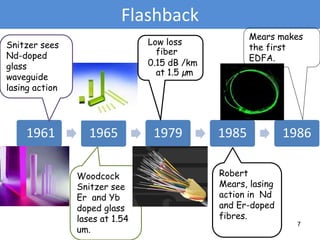
Flashback
1961 1965 1979 1985 1986
7
Snitzer sees
Nd-doped
glass
waveguide
lasing action
Woodcock
Snitzer see
Er and Yb
doped glass
lases at 1.54
um.
Robert
Mears, lasing
action in Nd
and Er-doped
fibres.
Mears makes
the first
EDFA.
Low loss
fiber
0.15 dB /km
at 1.5 µm
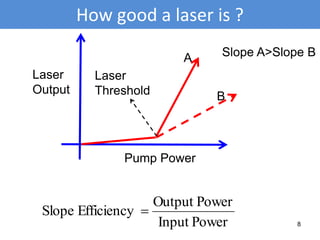
How good a laser is ?
8
Laser
Threshold
PowerInput
PowerOutput
EfficiencySlope 
Laser
Output
Pump Power
A
B
Slope A>Slope B
Motivation for EDFL
1.55µm region emission
Silica fiber low loss window
9
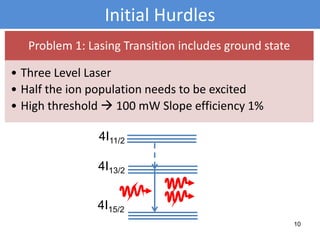
Initial Hurdles
Problem 1: Lasing Transition includes ground state
• Three Level Laser
• Half the ion population needs to be excited
• High threshold  100 mW Slope efficiency 1%
10
4I11/2
4I13/2
4I15/2
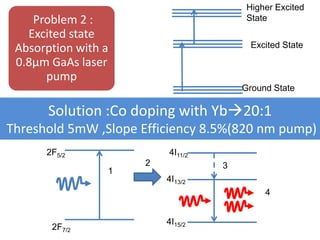
Solution :Co doping with Yb20:1
Threshold 5mW ,Slope Efficiency 8.5%(820 nm pump)
2F7/2
2F5/2
1
2
4I11/2
4I13/2
4I15/2
3
4
Problem 2 :
Excited state
Absorption with a
0.8µm GaAs laser
pump
Excited State
Ground State
Higher Excited
State
Evolution of EDFLs
No absorption at 0.98 or 1.48 µm
Semiconductor lasers were developed for this purpose
First Commercial 1.55 µm Lasers
1989 980 pumped EDFL exhibited slope efficiency of 58%
close to Quantum limit of 63%
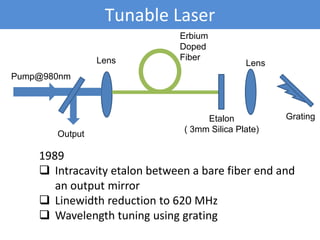
Tunable Laser
Pump@980nm
Output
Lens Lens
Etalon
( 3mm Silica Plate)
Grating
Erbium
Doped
Fiber
1989
 Intracavity etalon between a bare fiber end and
an output mirror
 Linewidth reduction to 620 MHz
 Wavelength tuning using grating
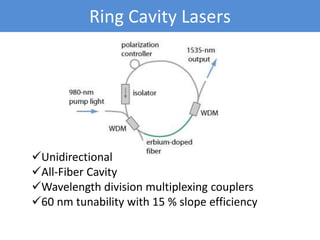
Ring Cavity Lasers
Unidirectional
All-Fiber Cavity
Wavelength division multiplexing couplers
60 nm tunability with 15 % slope efficiency
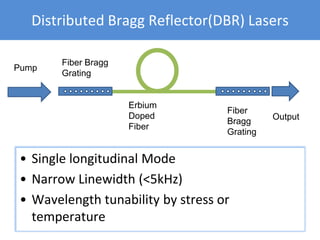
Distributed Bragg Reflector(DBR) Lasers
Fiber Bragg
Grating
Output
Erbium
Doped
Fiber
Pump
Fiber
Bragg
Grating
• Single longitudinal Mode
• Narrow Linewidth (<5kHz)
• Wavelength tunability by stress or
temperature
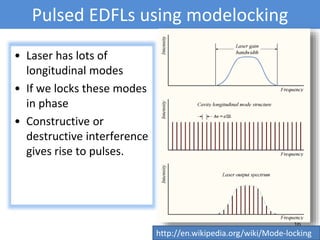
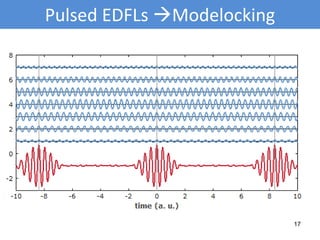
Pulsed EDFLs using modelocking
• Laser has lots of
longitudinal modes
• If we locks these modes
in phase
• Constructive or
destructive interference
gives rise to pulses.
16
http://en.wikipedia.org/wiki/Mode-locking
Pulsed EDFLs Modelocking
17
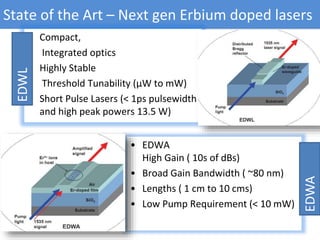
State of the Art – Next gen Erbium doped lasers
• Compact,
• Integrated optics
• Highly Stable
• Threshold Tunability (μW to mW)
• Short Pulse Lasers (< 1ps pulsewidth
and high peak powers 13.5 W)
• EDWA
High Gain ( 10s of dBs)
• Broad Gain Bandwidth ( ~80 nm)
• Lengths ( 1 cm to 10 cms)
• Low Pump Requirement (< 10 mW)
EDWL
EDWA
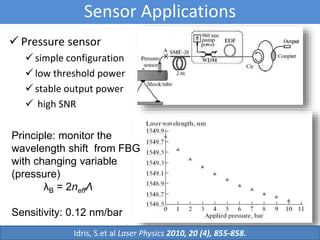
 Pressure sensor
 simple configuration
 low threshold power
 stable output power
 high SNR
Sensor Applications
Principle: monitor the
wavelength shift from FBG
with changing variable
(pressure)
λB = 2neffΛ
Sensitivity: 0.12 nm/bar
Idris, S.et al Laser Physics 2010, 20 (4), 855-858.
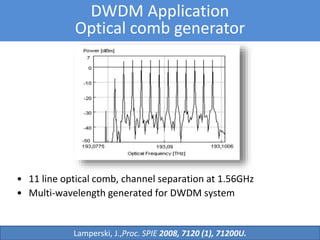
• 11 line optical comb, channel separation at 1.56GHz
• Multi-wavelength generated for DWDM system
DWDM Application
Optical comb generator
Lamperski, J.,Proc. SPIE 2008, 7120 (1), 71200U.
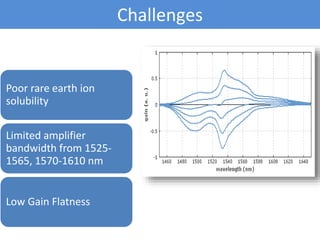
Challenges
Poor rare earth ion
solubility
Limited amplifier
bandwidth from 1525-
1565, 1570-1610 nm
Low Gain Flatness
Conclusion
• Erbium doped fibers have revolutionized the
fiber communications by creating a source for
silica low-loss window at 1.55 μm.
• Next generation erbium doped waveguide
lasers will be integrated onto single chips
enabling compact and efficient
communications.
22
References
• Ainslie, B.J.; , Lightwave Technology, Journal of ,
1991, 9(2),220-227.
• Mears, R. J.; Baker, S. R., Optical and Quantum
Electronics 1992, 24 (5), 517-538.
• Govind P, A., Chapter 5 - Fiber Lasers. In
Applications of Nonlinear Fiber Optics, Academic
Press: San Diego, 2001; pp 201-262.
• Bradley, J. D. B.; Pollnau, M., Laser & Photonics
Reviews 2011, 5 (3), 368-403.
• Rare-Earth-Doped Fiber Lasers and Amplifiers,
Revised and Expanded, CRC Press: 2001
• http://www.rp-photonics.com
23
Appendix
24
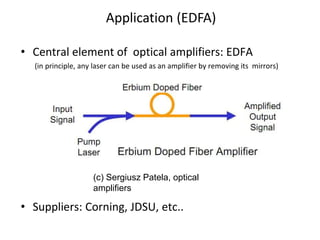
• Central element of optical amplifiers: EDFA
(in principle, any laser can be used as an amplifier by removing its mirrors)
• Suppliers: Corning, JDSU, etc..
Application (EDFA)
(c) Sergiusz Patela, optical
amplifiers
Application (EDFA)
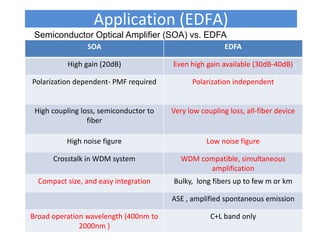
SOA EDFA
High gain (20dB) Even high gain available (30dB-40dB)
Polarization dependent- PMF required Polarization independent
High coupling loss, semiconductor to
fiber
Very low coupling loss, all-fiber device
High noise figure Low noise figure
Crosstalk in WDM system WDM compatible, simultaneous
amplification
Compact size, and easy integration Bulky, long fibers up to few m or km
ASE , amplified spontaneous emission
Broad operation wavelength (400nm to
2000nm )
C+L band only
Semiconductor Optical Amplifier (SOA) vs. EDFA
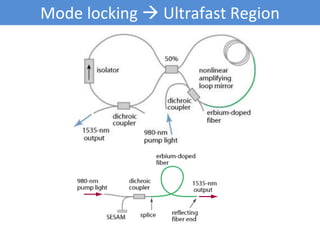
Mode locking  Ultrafast Region
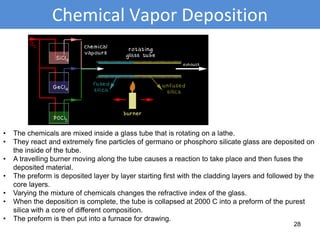
Chemical Vapor Deposition
28
• The chemicals are mixed inside a glass tube that is rotating on a lathe.
• They react and extremely fine particles of germano or phosphoro silicate glass are deposited on
the inside of the tube.
• A travelling burner moving along the tube causes a reaction to take place and then fuses the
deposited material.
• The preform is deposited layer by layer starting first with the cladding layers and followed by the
core layers.
• Varying the mixture of chemicals changes the refractive index of the glass.
• When the deposition is complete, the tube is collapsed at 2000 C into a preform of the purest
silica with a core of different composition.
• The preform is then put into a furnace for drawing.
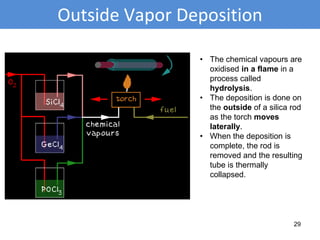
Outside Vapor Deposition
29
• The chemical vapours are
oxidised in a flame in a
process called
hydrolysis.
• The deposition is done on
the outside of a silica rod
as the torch moves
laterally.
• When the deposition is
complete, the rod is
removed and the resulting
tube is thermally
collapsed.
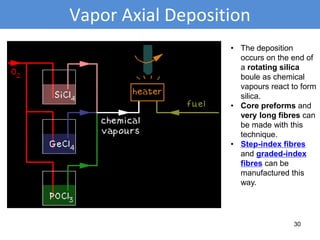
Vapor Axial Deposition
30
• The deposition
occurs on the end of
a rotating silica
boule as chemical
vapours react to form
silica.
• Core preforms and
very long fibres can
be made with this
technique.
• Step-index fibres
and graded-index
fibres can be
manufactured this
way.

Erbium Doped Fiber Lasers

  • 1.
    EE5517: Optical Engineering ErbiumDoped Fiber Laser Wenwen Zhao, Shuvan Prashant, Taishi Zhang, Kain Lu Low, Naomi Nandakumar National University of Singapore (NUS)
  • 2.
    Erbium-Doped Fiber Lasers(EDFLs) Description − Optical Glass Fiber − Glass is doped with the rare-earth element: Erbium (Er3+ ) Importance of EDFLs − Wavelength output : 1.55μm − Lies in eye-safe region of the spectrum. − Preferred wavelength for high-power long-distance fiber communications.
  • 3.
    1. Pump SourceSemiconductor Laser Diode 2. Active Gain Medium Doped Glass Fiber 3. Optical Resonator Dielectric Mirrors, Fiber Bragg Gratings General – Optical Fiber Lasers General Laser Optical Fiber Laser Gain Medium MirrorMirror Pump Laser Erbium Doped Glass Fiber LaserGain medium Mirror/ Grating Pump Isolator Isolator Mirror/ Grating Laser Diode
  • 4.
    Material of Fiberand Rare-Earth doping Require high doping concentrations. High-doping leads to Clustering of Er3+ ions in pure Silica. SiO2 (Silica) + GeO2, P2O5 and Al2O3 (network modifiers)  Prevents Clustering Glass host composition(SiO2) Solubility of rare earth dopant (Er3+) Lifetime, absorption, emission, and excited state of dopant transitions. Silica LatticeEr3+ Clustering Network Modifiers No Clustering
  • 5.
    Er3+ Energy Levels 5 PumpLaser 980 nm Fast Decay (non-radiative emission) E1 E2 E3 4I11/2 4I13/2 4I15/2 Spontaneous emission Stimulated emission (1520-1570 nm) Stimulated absorption Simplified energy levels of Er3+ ions in Erbium doped fibers
  • 6.
    Hydrolysis • React chlorideswith Hydrogen flame and collect the silica soot onto a rotating target • Heat to around 800°C to remove OH • Sinter to a transparent glass preform. • Vapor Axial Deposition (VAD) • Outside Vapor Deposition (OVD) Oxidation • React chlorides with Oxygen inside substrate tube that becomes part of cladding. • Reaction, deposition, sintering simultaneously through the tube. • Chemical Vapor Deposition • Modified(MCVD) • Plasma (PCVD) • Intrinsic Microwave (IMCVD) Fabrication of doped Silica Fiber SiCl4, GeCl4, POCl3, SiF4 and BCl3 used Erbium Dopants  ErCl3 Fabrication and Doping Techniques Materials
  • 7.
    Flashback 1961 1965 19791985 1986 7 Snitzer sees Nd-doped glass waveguide lasing action Woodcock Snitzer see Er and Yb doped glass lases at 1.54 um. Robert Mears, lasing action in Nd and Er-doped fibres. Mears makes the first EDFA. Low loss fiber 0.15 dB /km at 1.5 µm
  • 8.
    How good alaser is ? 8 Laser Threshold PowerInput PowerOutput EfficiencySlope  Laser Output Pump Power A B Slope A>Slope B
  • 9.
    Motivation for EDFL 1.55µmregion emission Silica fiber low loss window 9
  • 10.
    Initial Hurdles Problem 1:Lasing Transition includes ground state • Three Level Laser • Half the ion population needs to be excited • High threshold  100 mW Slope efficiency 1% 10 4I11/2 4I13/2 4I15/2
  • 11.
    Solution :Co dopingwith Yb20:1 Threshold 5mW ,Slope Efficiency 8.5%(820 nm pump) 2F7/2 2F5/2 1 2 4I11/2 4I13/2 4I15/2 3 4 Problem 2 : Excited state Absorption with a 0.8µm GaAs laser pump Excited State Ground State Higher Excited State
  • 12.
    Evolution of EDFLs Noabsorption at 0.98 or 1.48 µm Semiconductor lasers were developed for this purpose First Commercial 1.55 µm Lasers 1989 980 pumped EDFL exhibited slope efficiency of 58% close to Quantum limit of 63%
  • 13.
    Tunable Laser Pump@980nm Output Lens Lens Etalon (3mm Silica Plate) Grating Erbium Doped Fiber 1989  Intracavity etalon between a bare fiber end and an output mirror  Linewidth reduction to 620 MHz  Wavelength tuning using grating
  • 14.
    Ring Cavity Lasers Unidirectional All-FiberCavity Wavelength division multiplexing couplers 60 nm tunability with 15 % slope efficiency
  • 15.
    Distributed Bragg Reflector(DBR)Lasers Fiber Bragg Grating Output Erbium Doped Fiber Pump Fiber Bragg Grating • Single longitudinal Mode • Narrow Linewidth (<5kHz) • Wavelength tunability by stress or temperature
  • 16.
    Pulsed EDFLs usingmodelocking • Laser has lots of longitudinal modes • If we locks these modes in phase • Constructive or destructive interference gives rise to pulses. 16 http://en.wikipedia.org/wiki/Mode-locking
  • 17.
  • 18.
    State of theArt – Next gen Erbium doped lasers • Compact, • Integrated optics • Highly Stable • Threshold Tunability (μW to mW) • Short Pulse Lasers (< 1ps pulsewidth and high peak powers 13.5 W) • EDWA High Gain ( 10s of dBs) • Broad Gain Bandwidth ( ~80 nm) • Lengths ( 1 cm to 10 cms) • Low Pump Requirement (< 10 mW) EDWL EDWA
  • 19.
     Pressure sensor simple configuration  low threshold power  stable output power  high SNR Sensor Applications Principle: monitor the wavelength shift from FBG with changing variable (pressure) λB = 2neffΛ Sensitivity: 0.12 nm/bar Idris, S.et al Laser Physics 2010, 20 (4), 855-858.
  • 20.
    • 11 lineoptical comb, channel separation at 1.56GHz • Multi-wavelength generated for DWDM system DWDM Application Optical comb generator Lamperski, J.,Proc. SPIE 2008, 7120 (1), 71200U.
  • 21.
    Challenges Poor rare earthion solubility Limited amplifier bandwidth from 1525- 1565, 1570-1610 nm Low Gain Flatness
  • 22.
    Conclusion • Erbium dopedfibers have revolutionized the fiber communications by creating a source for silica low-loss window at 1.55 μm. • Next generation erbium doped waveguide lasers will be integrated onto single chips enabling compact and efficient communications. 22
  • 23.
    References • Ainslie, B.J.;, Lightwave Technology, Journal of , 1991, 9(2),220-227. • Mears, R. J.; Baker, S. R., Optical and Quantum Electronics 1992, 24 (5), 517-538. • Govind P, A., Chapter 5 - Fiber Lasers. In Applications of Nonlinear Fiber Optics, Academic Press: San Diego, 2001; pp 201-262. • Bradley, J. D. B.; Pollnau, M., Laser & Photonics Reviews 2011, 5 (3), 368-403. • Rare-Earth-Doped Fiber Lasers and Amplifiers, Revised and Expanded, CRC Press: 2001 • http://www.rp-photonics.com 23
  • 24.
  • 25.
    • Central elementof optical amplifiers: EDFA (in principle, any laser can be used as an amplifier by removing its mirrors) • Suppliers: Corning, JDSU, etc.. Application (EDFA) (c) Sergiusz Patela, optical amplifiers
  • 26.
    Application (EDFA) SOA EDFA Highgain (20dB) Even high gain available (30dB-40dB) Polarization dependent- PMF required Polarization independent High coupling loss, semiconductor to fiber Very low coupling loss, all-fiber device High noise figure Low noise figure Crosstalk in WDM system WDM compatible, simultaneous amplification Compact size, and easy integration Bulky, long fibers up to few m or km ASE , amplified spontaneous emission Broad operation wavelength (400nm to 2000nm ) C+L band only Semiconductor Optical Amplifier (SOA) vs. EDFA
  • 27.
    Mode locking Ultrafast Region
  • 28.
    Chemical Vapor Deposition 28 •The chemicals are mixed inside a glass tube that is rotating on a lathe. • They react and extremely fine particles of germano or phosphoro silicate glass are deposited on the inside of the tube. • A travelling burner moving along the tube causes a reaction to take place and then fuses the deposited material. • The preform is deposited layer by layer starting first with the cladding layers and followed by the core layers. • Varying the mixture of chemicals changes the refractive index of the glass. • When the deposition is complete, the tube is collapsed at 2000 C into a preform of the purest silica with a core of different composition. • The preform is then put into a furnace for drawing.
  • 29.
    Outside Vapor Deposition 29 •The chemical vapours are oxidised in a flame in a process called hydrolysis. • The deposition is done on the outside of a silica rod as the torch moves laterally. • When the deposition is complete, the rod is removed and the resulting tube is thermally collapsed.
  • 30.
    Vapor Axial Deposition 30 •The deposition occurs on the end of a rotating silica boule as chemical vapours react to form silica. • Core preforms and very long fibres can be made with this technique. • Step-index fibres and graded-index fibres can be manufactured this way.