T YPES OF


    PREPARED BY
    V.REVATHIAMBIKA
    LECTURER IN PHYSICS
7/28/2012
INTRODUCTION OF LASER
   L – LIGHT

   A – AMPLIFICATION

   S – STIMULATED

   E – EMISSION

   R - REDIATION

   A. L. SCHAWLOW and C. H. TOWNES IN 1958
                                              2
   RUBY LASER by T. H. MAIMANN IN 1960
7/28/2012
BASIC IDEA

   Consider a group of atoms exposed stream
    of photons, each with energy h . Let us
    assume two energy levels E1
    and E2 of an atom.
       During transition from one energy state to another, the
        light is absorbed (or) emitted by particles. Under this
        action, 3 processes can occur.
       They are,
           Stimulated absorption
                                                                  3
           Spontaneous emission

           Stimulated emission
7/28/2012
    MECHANISMS OF LIGHT EMISSION
For atomic systems in thermal equilibrium with their
surrounding, the emission of light is the result of:
Absorption
And subsequently, spontaneous emission of energy
There is another process whereby the atom in an upper energy
level can be triggered or stimulated in phase with the an
incoming photon. This process is:
Stimulated emission
It is an important process for laser action

Therefore 3 process          1.   Absorption
of light emission:
                             2.   Spontaneous Emission 4
                             3.   Stimulated Emission
LASER FUNDAMENTALS
                                                                  7/28/2012


   The light emitted from a laser is monochromatic, that is, it is of one
    color/wavelength. In contrast, ordinary white light is a combination of many
    colors (or wavelengths) of light.
   Lasers emit light that is highly directional, that is, laser light is emitted as a
    relatively narrow beam in a specific direction. Ordinary light, such as from a
    light bulb, is emitted in many directions away from the source.
   The light from a laser is said to be coherent, which means that the
    wavelengths of the laser light are in phase in space and time. Ordinary light
    can be a mixture of many wavelengths.

    These three properties of laser light are what can make it more
    hazardous than ordinary light. Laser light can deposit a lot of energy
    within a small area.

                                                                                         5
7/28/2012


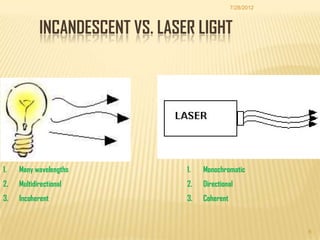
            INCANDESCENT VS. LASER LIGHT


1.   Many wavelengths            1.   Monochromatic
2.   Multidirectional            2.   Directional
3.   Incoherent                  3.   Coherent


                                                             6
7/28/2012


 COMMON COMPONENTS OF ALL LASERS
1.   Active Medium
     The active medium may be solid crystals such as ruby or Nd:YAG, liquid dyes, gases like CO2 or
     Helium/Neon, or semiconductors such as GaAs. Active mediums contain atoms whose electrons may be
     excited to a metastable energy level by an energy source.
2.   Excitation Mechanism
     Excitation mechanisms pump energy into the active medium by one or more of three basic methods;
     optical, electrical or chemical.
3.   High Reflectance Mirror
     A mirror which reflects essentially 100% of the laser light.
4.   Partially Transmissive Mirror
     A mirror which reflects less than 100% of the laser light and transmits the remainder.


                                                                                                        7
LASER COMPONENTS


                                                                                                     7/28/2012
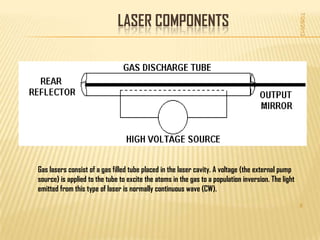
Gas lasers consist of a gas filled tube placed in the laser cavity. A voltage (the external pump
source) is applied to the tube to excite the atoms in the gas to a population inversion. The light
emitted from this type of laser is normally continuous wave (CW).

                                                                                                     8
LASING ACTION


                                                                                                   7/28/2012
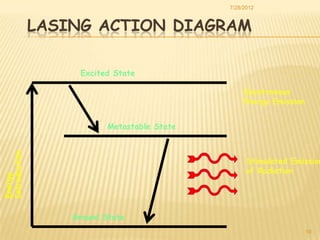
1.   Energy is applied to a medium raising electrons to an unstable energy level.
2.   These atoms spontaneously decay to a relatively long-lived, lower energy, metastable state.
3.   A population inversion is achieved when the majority of atoms have reached this metastable
     state.
4.   Lasing action occurs when an electron spontaneously returns to its ground state and produces
     a photon.
5.   If the energy from this photon is of the precise wavelength, it will stimulate the production of
     another photon of the same wavelength and resulting in a cascading effect.
6.   The highly reflective mirror and partially reflective mirror continue the reaction by directing
     photons back through the medium along the long axis of the laser.
7.   The partially reflective mirror allows the transmission of a small amount of coherent radiation
     that we observe as the “beam”.
8.   Laser radiation will continue as long as energy is applied to the lasing medium.


                                                                                                   9
7/28/2012


               LASING ACTION DIAGRAM

                    Excited State

                                                   Spontaneous
                                                   Energy Emission


                           Metastable State
Introduction


                                                    Stimulated Emission
                                                    of Radiation
Energy


                   Ground State
                                                                     10
7/28/2012
   PRINCIPLE OF LASER ACTION

 Due to stimulated emission the photons
 multiply in each step giving rise to an
 intense beam of photons that are
 coherent and moving in the same
 direction . hence the Light Is Amplified
 By Stimulated Emission Of Radiation

                                       11
7/28/2012
           PUMPING METHODS

   OPTICAL PUMPING

   DIRECT ELECTRON EXCITATION

   INELASTIC ATOM – ATOM
    COLLISION

   DIRECT CONVERSION
                                 12
   CHEMICAL PROCESS
PROPERTIES OF LASER
   Monochromatic
    Concentrate in a narrow range of wavelengths
    (one specific colour).

   Coherent
    All the emitted photons bear a constant phase
    relationship with each other in both time and
    phase

   Directional
    A very tight beam which is very strong and
    concentrated.
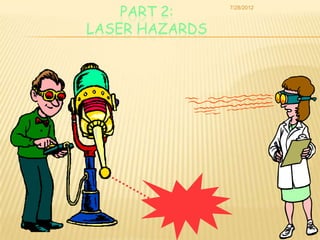
PART 2:     7/28/2012


LASER HAZARDS


                            14
TYPES OF LASER HAZARDS


                                                                                             7/28/2012
1.   Eye : Acute exposure of the eye to lasers of certain wavelengths and power can
     cause corneal or retinal burns (or both). Chronic exposure to excessive levels may
     cause corneal or lenticular opacities (cataracts) or retinal injury.
2.   Skin : Acute exposure to high levels of optical radiation may cause skin burns; while
     carcinogenesis may occur for ultraviolet wavelengths (290-320 nm).
3.   Chemical : Some lasers require hazardous or toxic substances to operate (i.e.,
     chemical dye, Excimer lasers).
4.   Electrical : Most lasers utilize high voltages that can be lethal.
5.   Fire : The solvents used in dye lasers are flammable. High voltage pulse or flash
     lamps may cause ignition. Flammable materials may be ignited by direct beams or
     specular reflections from high power continuous wave (CW) infrared lasers.


                                                                                         15
7/28/2012

                            LASER CLASS

The following criteria are used to classify lasers:
1. Wavelength. If the laser is designed to emit multiple wavelengths the
   classification is based on the most hazardous wavelength.
2. For continuous wave (CW) or repetitively pulsed lasers the average power
   output (Watts) and limiting exposure time inherent in the design are
   considered.
3. For pulsed lasers the total energy per pulse (Joule), pulse duration,
   pulse repetition frequency and emergent beam radiant exposure are
   considered.

                                                                           16
7/28/2012


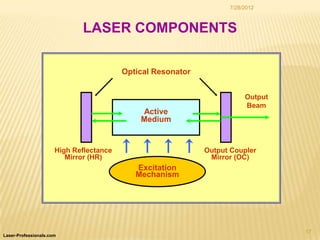
                             LASER COMPONENTS

                                         Optical Resonator


                                                                        Output
                                                                        Beam
                                             Active
                                             Medium


                      High Reflectance                       Output Coupler
                         Mirror (HR)                          Mirror (OC)
                                            Excitation
                                            Mechanism


                                                                                 17
Laser-Professionals.com
7/28/2012


            18
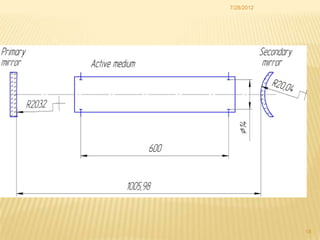
OPTICAL RESONATOR

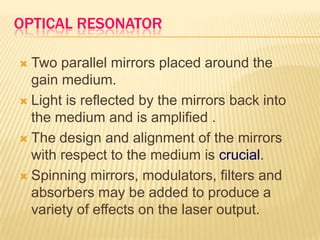
 Two parallel mirrors placed around the
  gain medium.
 Light is reflected by the mirrors back into
  the medium and is amplified .
 The design and alignment of the mirrors
  with respect to the medium is crucial.
 Spinning mirrors, modulators, filters and
  absorbers may be added to produce a
  variety of effects on the laser output.
COMPARISON CHART FOR ALL THE LASERS

Character   Nd-YAG laser                 He-Ne laser   CO2 laser       Semiconduct
istics                                                                 or (Ga-As)
                                                                       laser
Type        Doped insulator              Gas laser     Molecular       Semiconductor
            laser(solid state laser)                   gas laser       laser
Active      Yttrium Aluminium Garnet Mixture of        Mixture of   P-N junction
medium      (y3Al5O12)               Helium and        CO2, N2 and diode
                                     Neon in the       Helium (or)
                                     ratio 10:1        water vapour
Active      Neodymium(Nd3+ ions)         Neon          CO2             Recombination
centre                                                                 of electrons &
                                                                       holes
Pumping     Optical pumping              Electrical    Electric        Direct pumping
method                                   pumping       disharge
                                                       method
Optical     Ends of the rods polished    Pair of       Metallic        Junction of
resonator   with silver and two          concave       mrror of gold   diopdes-
            mirrors. One of them is to   mirrors       (or) silicon    polished
            totally reflected and the                  mirrors
7/28/2012


TYPICAL APPLICATION OF LASER

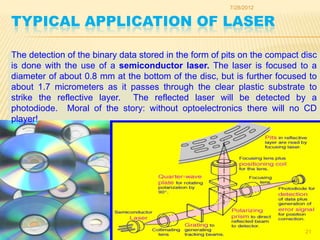
The detection of the binary data stored in the form of pits on the compact disc
is done with the use of a semiconductor laser. The laser is focused to a
diameter of about 0.8 mm at the bottom of the disc, but is further focused to
about 1.7 micrometers as it passes through the clear plastic substrate to
strike the reflective layer. The reflected laser will be detected by a
photodiode. Moral of the story: without optoelectronics there will no CD
player!


                                                                            21
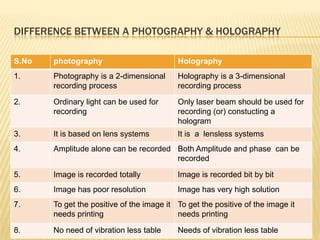
DIFFERENCE BETWEEN A PHOTOGRAPHY & HOLOGRAPHY

S.No   photography                         Holography
1.     Photography is a 2-dimensional      Holography is a 3-dimensional
       recording process                   recording process

2.     Ordinary light can be used for      Only laser beam should be used for
       recording                           recording (or) constucting a
                                           hologram
3.     It is based on lens systems         It is a lensless systems
4.     Amplitude alone can be recorded Both Amplitude and phase can be
                                       recorded

5.     Image is recorded totally           Image is recorded bit by bit
6.     Image has poor resolution           Image has very high solution
7.     To get the positive of the image it To get the positive of the image it
       needs printing                      needs printing

8.     No need of vibration less table     Needs of vibration less table
7/28/2012


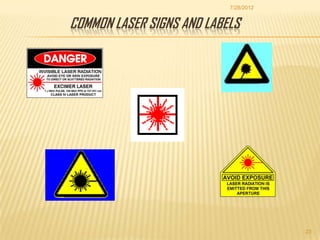
COMMON LASER SIGNS AND LABELS


                                       23
7/28/2012


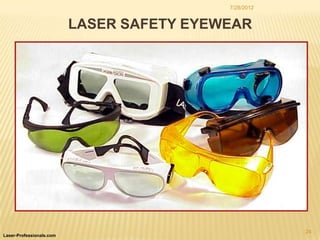
                          LASER SAFETY EYEWEAR


                                                       24
Laser-Professionals.com
7/28/2012


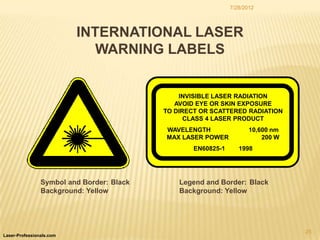
                          INTERNATIONAL LASER
                             WARNING LABELS


                                               INVISIBLE LASER RADIATION
                                              AVOID EYE OR SKIN EXPOSURE
                                           TO DIRECT OR SCATTERED RADIATION
                                                 CLASS 4 LASER PRODUCT
                                           WAVELENGTH                 10,600 nm
                                           MAX LASER POWER                200 W
                                                   EN60825-1      1998


                Symbol and Border: Black       Legend and Border: Black
                Background: Yellow             Background: Yellow


                                                                                  25
Laser-Professionals.com
7/28/2012


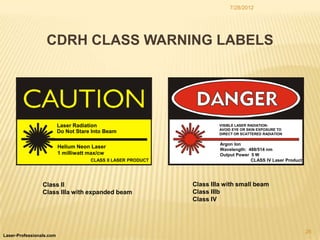
                  CDRH CLASS WARNING LABELS


                          Laser Radiation                               VISIBLE LASER RADIATION-
                                                                        AVOID EYE OR SKIN EXPOSURE TO
                          Do Not Stare Into Beam                        DIRECT OR SCATTERED RADIATION

                                                                        Argon Ion
                          Helium Neon Laser                             Wavelength: 488/514 nm
                          1 milliwatt max/cw                            Output Power 5 W
                                      CLASS II LASER PRODUCT                         CLASS IV Laser Product


                 Class II                                      Class IIIa with small beam
                 Class IIIa with expanded beam                 Class IIIb
                                                               Class IV


                                                                                                              26
Laser-Professionals.com

Types of laser

  • 1.
    T YPES OF PREPARED BY V.REVATHIAMBIKA LECTURER IN PHYSICS
  • 2.
    7/28/2012 INTRODUCTION OF LASER  L – LIGHT  A – AMPLIFICATION  S – STIMULATED  E – EMISSION  R - REDIATION  A. L. SCHAWLOW and C. H. TOWNES IN 1958 2  RUBY LASER by T. H. MAIMANN IN 1960
  • 3.
    7/28/2012 BASIC IDEA  Consider a group of atoms exposed stream of photons, each with energy h . Let us assume two energy levels E1 and E2 of an atom.  During transition from one energy state to another, the light is absorbed (or) emitted by particles. Under this action, 3 processes can occur.  They are,  Stimulated absorption 3  Spontaneous emission  Stimulated emission
  • 4.
    7/28/2012 MECHANISMS OF LIGHT EMISSION For atomic systems in thermal equilibrium with their surrounding, the emission of light is the result of: Absorption And subsequently, spontaneous emission of energy There is another process whereby the atom in an upper energy level can be triggered or stimulated in phase with the an incoming photon. This process is: Stimulated emission It is an important process for laser action Therefore 3 process 1. Absorption of light emission: 2. Spontaneous Emission 4 3. Stimulated Emission
  • 5.
    LASER FUNDAMENTALS 7/28/2012  The light emitted from a laser is monochromatic, that is, it is of one color/wavelength. In contrast, ordinary white light is a combination of many colors (or wavelengths) of light.  Lasers emit light that is highly directional, that is, laser light is emitted as a relatively narrow beam in a specific direction. Ordinary light, such as from a light bulb, is emitted in many directions away from the source.  The light from a laser is said to be coherent, which means that the wavelengths of the laser light are in phase in space and time. Ordinary light can be a mixture of many wavelengths. These three properties of laser light are what can make it more hazardous than ordinary light. Laser light can deposit a lot of energy within a small area. 5
  • 6.
    7/28/2012 INCANDESCENT VS. LASER LIGHT 1. Many wavelengths 1. Monochromatic 2. Multidirectional 2. Directional 3. Incoherent 3. Coherent 6
  • 7.
    7/28/2012 COMMON COMPONENTSOF ALL LASERS 1. Active Medium The active medium may be solid crystals such as ruby or Nd:YAG, liquid dyes, gases like CO2 or Helium/Neon, or semiconductors such as GaAs. Active mediums contain atoms whose electrons may be excited to a metastable energy level by an energy source. 2. Excitation Mechanism Excitation mechanisms pump energy into the active medium by one or more of three basic methods; optical, electrical or chemical. 3. High Reflectance Mirror A mirror which reflects essentially 100% of the laser light. 4. Partially Transmissive Mirror A mirror which reflects less than 100% of the laser light and transmits the remainder. 7
  • 8.
    LASER COMPONENTS 7/28/2012 Gas lasers consist of a gas filled tube placed in the laser cavity. A voltage (the external pump source) is applied to the tube to excite the atoms in the gas to a population inversion. The light emitted from this type of laser is normally continuous wave (CW). 8
  • 9.
    LASING ACTION 7/28/2012 1. Energy is applied to a medium raising electrons to an unstable energy level. 2. These atoms spontaneously decay to a relatively long-lived, lower energy, metastable state. 3. A population inversion is achieved when the majority of atoms have reached this metastable state. 4. Lasing action occurs when an electron spontaneously returns to its ground state and produces a photon. 5. If the energy from this photon is of the precise wavelength, it will stimulate the production of another photon of the same wavelength and resulting in a cascading effect. 6. The highly reflective mirror and partially reflective mirror continue the reaction by directing photons back through the medium along the long axis of the laser. 7. The partially reflective mirror allows the transmission of a small amount of coherent radiation that we observe as the “beam”. 8. Laser radiation will continue as long as energy is applied to the lasing medium. 9
  • 10.
    7/28/2012 LASING ACTION DIAGRAM Excited State Spontaneous Energy Emission Metastable State Introduction Stimulated Emission of Radiation Energy Ground State 10
  • 11.
    7/28/2012 PRINCIPLE OF LASER ACTION  Due to stimulated emission the photons multiply in each step giving rise to an intense beam of photons that are coherent and moving in the same direction . hence the Light Is Amplified By Stimulated Emission Of Radiation 11
  • 12.
    7/28/2012 PUMPING METHODS  OPTICAL PUMPING  DIRECT ELECTRON EXCITATION  INELASTIC ATOM – ATOM COLLISION  DIRECT CONVERSION 12  CHEMICAL PROCESS
  • 13.
    PROPERTIES OF LASER  Monochromatic Concentrate in a narrow range of wavelengths (one specific colour).  Coherent All the emitted photons bear a constant phase relationship with each other in both time and phase  Directional A very tight beam which is very strong and concentrated.
  • 14.
    PART 2: 7/28/2012 LASER HAZARDS 14
  • 15.
    TYPES OF LASERHAZARDS 7/28/2012 1. Eye : Acute exposure of the eye to lasers of certain wavelengths and power can cause corneal or retinal burns (or both). Chronic exposure to excessive levels may cause corneal or lenticular opacities (cataracts) or retinal injury. 2. Skin : Acute exposure to high levels of optical radiation may cause skin burns; while carcinogenesis may occur for ultraviolet wavelengths (290-320 nm). 3. Chemical : Some lasers require hazardous or toxic substances to operate (i.e., chemical dye, Excimer lasers). 4. Electrical : Most lasers utilize high voltages that can be lethal. 5. Fire : The solvents used in dye lasers are flammable. High voltage pulse or flash lamps may cause ignition. Flammable materials may be ignited by direct beams or specular reflections from high power continuous wave (CW) infrared lasers. 15
  • 16.
    7/28/2012 LASER CLASS The following criteria are used to classify lasers: 1. Wavelength. If the laser is designed to emit multiple wavelengths the classification is based on the most hazardous wavelength. 2. For continuous wave (CW) or repetitively pulsed lasers the average power output (Watts) and limiting exposure time inherent in the design are considered. 3. For pulsed lasers the total energy per pulse (Joule), pulse duration, pulse repetition frequency and emergent beam radiant exposure are considered. 16
  • 17.
    7/28/2012 LASER COMPONENTS Optical Resonator Output Beam Active Medium High Reflectance Output Coupler Mirror (HR) Mirror (OC) Excitation Mechanism 17 Laser-Professionals.com
  • 18.
  • 19.
    OPTICAL RESONATOR  Twoparallel mirrors placed around the gain medium.  Light is reflected by the mirrors back into the medium and is amplified .  The design and alignment of the mirrors with respect to the medium is crucial.  Spinning mirrors, modulators, filters and absorbers may be added to produce a variety of effects on the laser output.
  • 20.
    COMPARISON CHART FORALL THE LASERS Character Nd-YAG laser He-Ne laser CO2 laser Semiconduct istics or (Ga-As) laser Type Doped insulator Gas laser Molecular Semiconductor laser(solid state laser) gas laser laser Active Yttrium Aluminium Garnet Mixture of Mixture of P-N junction medium (y3Al5O12) Helium and CO2, N2 and diode Neon in the Helium (or) ratio 10:1 water vapour Active Neodymium(Nd3+ ions) Neon CO2 Recombination centre of electrons & holes Pumping Optical pumping Electrical Electric Direct pumping method pumping disharge method Optical Ends of the rods polished Pair of Metallic Junction of resonator with silver and two concave mrror of gold diopdes- mirrors. One of them is to mirrors (or) silicon polished totally reflected and the mirrors
  • 21.
    7/28/2012 TYPICAL APPLICATION OFLASER The detection of the binary data stored in the form of pits on the compact disc is done with the use of a semiconductor laser. The laser is focused to a diameter of about 0.8 mm at the bottom of the disc, but is further focused to about 1.7 micrometers as it passes through the clear plastic substrate to strike the reflective layer. The reflected laser will be detected by a photodiode. Moral of the story: without optoelectronics there will no CD player! 21
  • 22.
    DIFFERENCE BETWEEN APHOTOGRAPHY & HOLOGRAPHY S.No photography Holography 1. Photography is a 2-dimensional Holography is a 3-dimensional recording process recording process 2. Ordinary light can be used for Only laser beam should be used for recording recording (or) constucting a hologram 3. It is based on lens systems It is a lensless systems 4. Amplitude alone can be recorded Both Amplitude and phase can be recorded 5. Image is recorded totally Image is recorded bit by bit 6. Image has poor resolution Image has very high solution 7. To get the positive of the image it To get the positive of the image it needs printing needs printing 8. No need of vibration less table Needs of vibration less table
  • 23.
  • 24.
    7/28/2012 LASER SAFETY EYEWEAR 24 Laser-Professionals.com
  • 25.
    7/28/2012 INTERNATIONAL LASER WARNING LABELS INVISIBLE LASER RADIATION AVOID EYE OR SKIN EXPOSURE TO DIRECT OR SCATTERED RADIATION CLASS 4 LASER PRODUCT WAVELENGTH 10,600 nm MAX LASER POWER 200 W EN60825-1 1998 Symbol and Border: Black Legend and Border: Black Background: Yellow Background: Yellow 25 Laser-Professionals.com
  • 26.
    7/28/2012 CDRH CLASS WARNING LABELS Laser Radiation VISIBLE LASER RADIATION- AVOID EYE OR SKIN EXPOSURE TO Do Not Stare Into Beam DIRECT OR SCATTERED RADIATION Argon Ion Helium Neon Laser Wavelength: 488/514 nm 1 milliwatt max/cw Output Power 5 W CLASS II LASER PRODUCT CLASS IV Laser Product Class II Class IIIa with small beam Class IIIa with expanded beam Class IIIb Class IV 26 Laser-Professionals.com