MAHAVEER INSTITUTE OF SCIENCE & TECHNOLOGY
Vyasapuri, Bandlaguda, Post Keshavgiri, Hyd-
500005
Microwave and Optical Communications
Unit-5 Optical Communications
(UNIT-5, JNTUH)
By
NENAVATH RAVI KUMAR
Assistant Professor
ECE Department
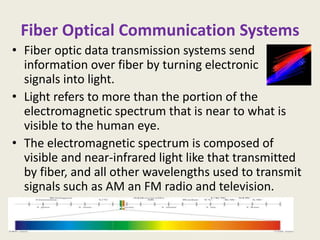
Fiber Optical Communication Systems
• Fiber optic data transmission systems send
information over fiber by turning electronic
signals into light.
• Light refers to more than the portion of the
electromagnetic spectrum that is near to what is
visible to the human eye.
• The electromagnetic spectrum is composed of
visible and near-infrared light like that transmitted
by fiber, and all other wavelengths used to transmit
signals such as AM an FM radio and television.
Basics of Optical Fibre Communication
An Optical Fiber Communication System consists
of
• Transmitter
– Optical source (LED or Laser diode) + driver circuit
• Optical Fibre
– Single mode fibre, or
– Multimode fibre
• Receiver
– Photodetector PIN or APD + receiver circuit
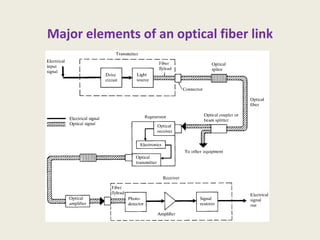
Major elements of an optical fiber link
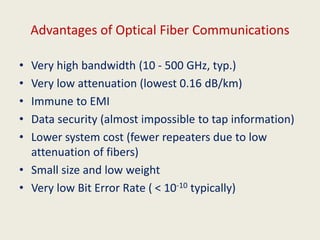
Advantages of Optical Fiber Communications
• Very high bandwidth (10 - 500 GHz, typ.)
• Very low attenuation (lowest 0.16 dB/km)
• Immune to EMI
• Data security (almost impossible to tap information)
• Lower system cost (fewer repeaters due to low
attenuation of fibers)
• Small size and low weight
• Very low Bit Error Rate ( < 10-10 typically)
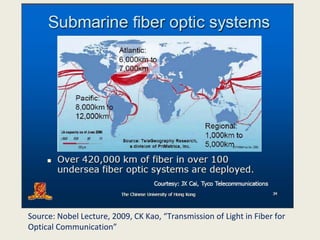
Source: Nobel Lecture, 2009, CK Kao, “Transmission of Light in Fiber for
Optical Communication”
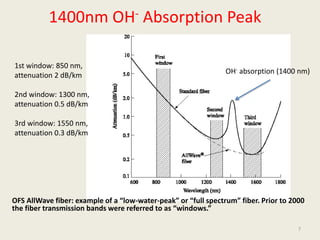
1400nm OH- Absorption Peak
OFS AllWave fiber: example of a “low-water-peak” or “full spectrum” fiber. Prior to 2000
the fiber transmission bands were referred to as “windows.”
7
OH- absorption (1400 nm)
1st window: 850 nm,
attenuation 2 dB/km
2nd window: 1300 nm,
attenuation 0.5 dB/km
3rd window: 1550 nm,
attenuation 0.3 dB/km
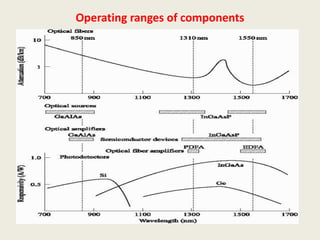
Operating ranges of components
Optical Fibers
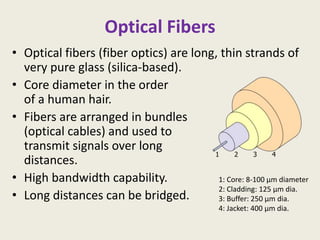
• Optical fibers (fiber optics) are long, thin strands of
very pure glass (silica-based).
• Core diameter in the order
of a human hair.
• Fibers are arranged in bundles
(optical cables) and used to
transmit signals over long
distances.
• High bandwidth capability.
• Long distances can be bridged.
1: Core: 8-100 µm diameter
2: Cladding: 125 µm dia.
3: Buffer: 250 µm dia.
4: Jacket: 400 µm dia.
PRINCIPLE OF LIGHT PROPAGATION THROUGH A
FIBRE
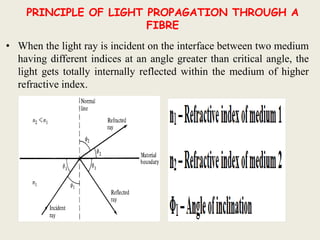
• When the light ray is incident on the interface between two medium
having different indices at an angle greater than critical angle, the
light gets totally internally reflected within the medium of higher
refractive index.
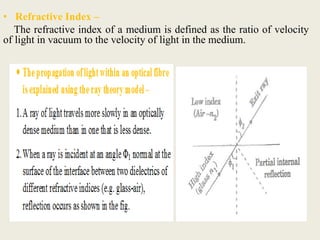
• Refractive Index –
The refractive index of a medium is defined as the ratio of velocity
of light in vacuum to the velocity of light in the medium.
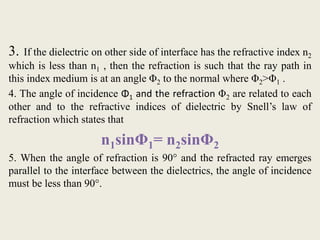
3. If the dielectric on other side of interface has the refractive index n2
which is less than n1 , then the refraction is such that the ray path in
this index medium is at an angle Φ2 to the normal where Φ2>Φ1 .
4. The angle of incidence Φ1 and the refraction Φ2 are related to each
other and to the refractive indices of dielectric by Snell’s law of
refraction which states that
n1sinΦ1= n2sinΦ2
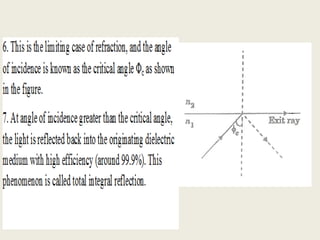
5. When the angle of refraction is 90° and the refracted ray emerges
parallel to the interface between the dielectrics, the angle of incidence
must be less than 90°.
CONDITIONS TO ACHIEVE TOTAL INTERNAL
REFLECTION
The phenomenon of total internal reflection occurs at the interface
between two dielectrics of different refractive indices only when,
 Light is incident on the dielectric of lower index from the dielectric
of higher index.
 The angle of incidence exceeds the critical value.
DIFFERENT TYPES OF FIBRES AND THEIR PROPERTIES
• Based on fibers used in communication they
are classified into:
1. Step index fiber
a. Single mode
b. Multimode
2. Graded index fiber
a. Multimode
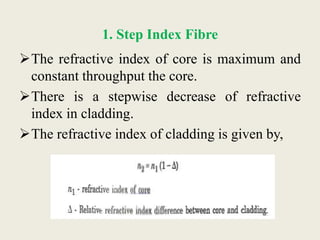
1. Step Index Fibre
The refractive index of core is maximum and
constant throughput the core.
There is a stepwise decrease of refractive
index in cladding.
The refractive index of cladding is given by,
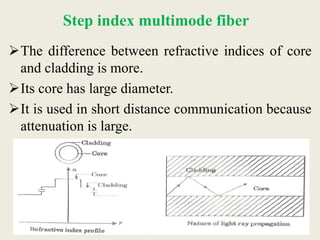
Step index multimode fiber
The difference between refractive indices of core
and cladding is more.
Its core has large diameter.
It is used in short distance communication because
attenuation is large.
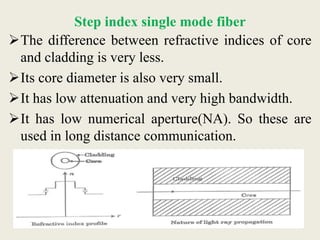
Step index single mode fiber
The difference between refractive indices of core
and cladding is very less.
Its core diameter is also very small.
It has low attenuation and very high bandwidth.
It has low numerical aperture(NA). So these are
used in long distance communication.
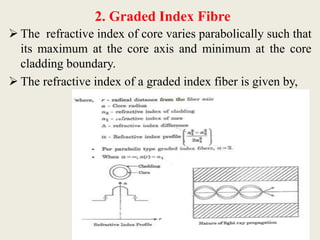
2. Graded Index Fibre
 The refractive index of core varies parabolically such that
its maximum at the core axis and minimum at the core
cladding boundary.
 The refractive index of a graded index fiber is given by,
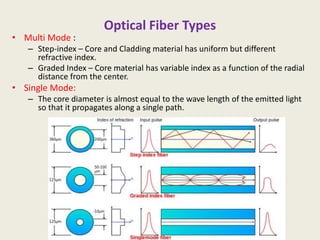
Optical Fiber Types
• Multi Mode :
– Step-index – Core and Cladding material has uniform but different
refractive index.
– Graded Index – Core material has variable index as a function of the radial
distance from the center.
• Single Mode:
– The core diameter is almost equal to the wave length of the emitted light
so that it propagates along a single path.
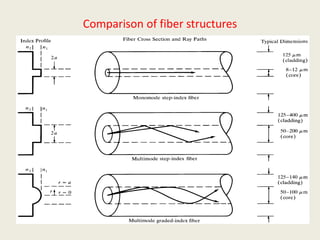
Comparison of fiber structures
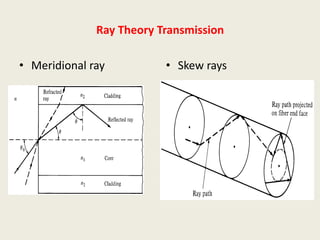
Ray Theory Transmission
• Meridional ray • Skew rays
Attenuation
• Signal attenuation (loss) is a measure of power received
with respect to power sent.
• Silica-based glass fibers have losses of about 0.2 dB/km
(i.e. 95% launched power remains after 1 km of fiber
transmission).
• Drawback on fibers: if only a little section develops a high
attenuation, the whole fiber is lost.
• Signal attenuation within optical fibers is usually
expressed in the logarithmic unit of the decibel (dB).
• The decibel is defined for a particular optical wavelength
as the ratio of the output optical power Po from the fiber
to the input optical power Pi into the fiber (Po Pi)
Loss[dB]= -10×log10
Pout
Pin
æ
è
ç
ö
ø
÷
Fiber Attenuation: Absorption
• The optical power is lost as heat in the fiber. Loss mechanism is
related to both the material composition and the fabrication
process for the fiber.
• The light absorption can be intrinsic (due to the material
components of the glass) or extrinsic (due to impurities introduced
into the glass during fabrication).
• Intrinsic absorptions can be due to electron transitions within the
glass molecules (UV absorption) or due to molecular vibrations
(infrared absorptions).
• Major extrinsic loss is caused by absorption due to water (as the
hydroxyl or OH- ions) introduced in the glass fiber during fiber
pulling by means of oxyhydrogen flame.
– The lowest attenuation for typical silica-based fibers occurs at
wavelength 1550 nm, about 0.2 dB/km, approaching the minimum
possible attenuation at this wavelength.
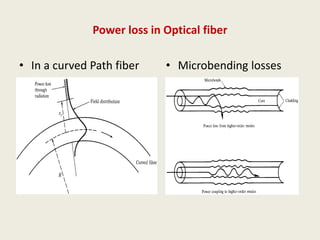
Power loss in Optical fiber
• In a curved Path fiber • Microbending losses
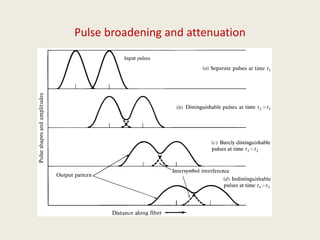
Pulse broadening and attenuation
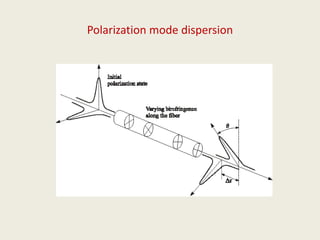
Polarization mode dispersion
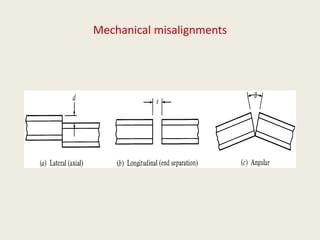
Mechanical misalignments
Light-Emitting Diodes (LEDs)
• For photonic communications requiring data rate 100-200 Mb/s with
multimode fiber with tens of microwatts, LEDs are usually the best
choice.
• LED configurations being used in photonic communications:
1- Surface Emitters (Front Emitters)
2- Edge Emitters
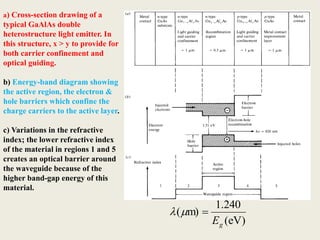
a) Cross-section drawing of a
typical GaAlAs double
heterostructure light emitter. In
this structure, x > y to provide for
both carrier confinement and
optical guiding.
b) Energy-band diagram showing
the active region, the electron &
hole barriers which confine the
charge carriers to the active layer.
c) Variations in the refractive
index; the lower refractive index
of the material in regions 1 and 5
creates an optical barrier around
the waveguide because of the
higher band-gap energy of this
material.
)
eV
(
240
.
1
m)
(
g
E



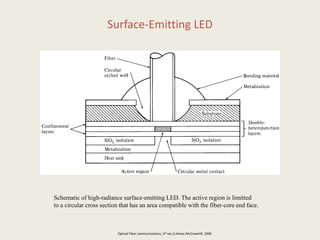
Surface-Emitting LED
Optical Fiber communications, 3rd ed.,G.Keiser,McGrawHill, 2000
Schematic of high-radiance surface-emitting LED. The active region is limitted
to a circular cross section that has an area compatible with the fiber-core end face.
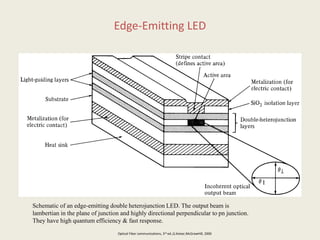
Edge-Emitting LED
Schematic of an edge-emitting double heterojunction LED. The output beam is
lambertian in the plane of junction and highly directional perpendicular to pn junction.
They have high quantum efficiency & fast response.
Optical Fiber communications, 3rd ed.,G.Keiser,McGrawHill, 2000
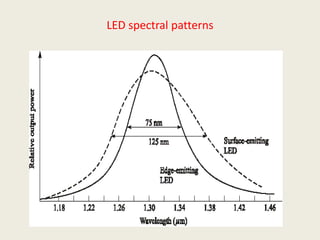
LED spectral patterns
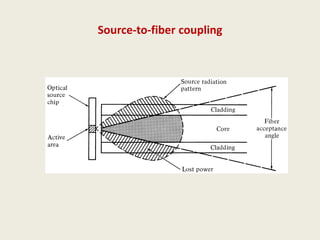
Source-to-fiber coupling
• A laser is a device that generates light by a process
called STIMULATED EMISSION.
• The acronym LASER stands for Light Amplification by
Stimulated Emission of Radiation
• Semiconducting lasers are multilayer semiconductor
devices that generates a coherent beam of
monochromatic light by laser action. A coherent
beam resulted which all of the photons are in phase.
Definition of laser
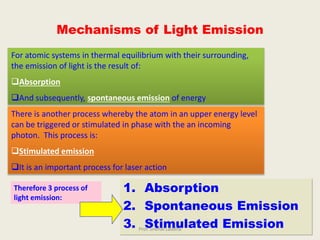
1. Absorption
2. Spontaneous Emission
3. Stimulated Emission
Mechanisms of Light Emission
For atomic systems in thermal equilibrium with their surrounding,
the emission of light is the result of:
Absorption
And subsequently, spontaneous emission of energy
There is another process whereby the atom in an upper energy level
can be triggered or stimulated in phase with the an incoming
photon. This process is:
Stimulated emission
It is an important process for laser action
Therefore 3 process of
light emission:
Prof. Snehal Laddha
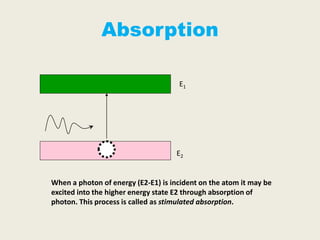
Absorption
E1
E2
When a photon of energy (E2-E1) is incident on the atom it may be
excited into the higher energy state E2 through absorption of
photon. This process is called as stimulated absorption.
Spontaneous Emission
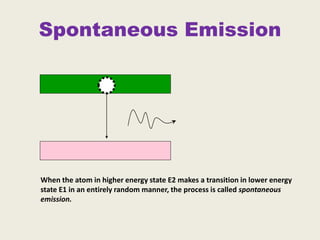
When the atom in higher energy state E2 makes a transition in lower energy
state E1 in an entirely random manner, the process is called spontaneous
emission.
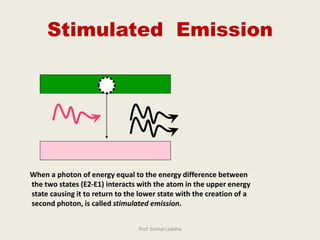
Stimulated Emission
When a photon of energy equal to the energy difference between
the two states (E2-E1) interacts with the atom in the upper energy
state causing it to return to the lower state with the creation of a
second photon, is called stimulated emission.
Prof. Snehal Laddha
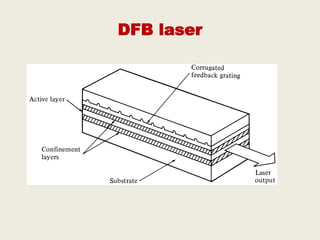
DFB laser
• LED is chosen for many applications using
multimode fibers
• The lasers tends to find more use as a single
mode device in single mode fibers.
LED & LASER APPLICATIONS
Prof. Snehal Laddha
• Lasers are all around us in many places you
might not realize. Besides being useful for
pure science like in a physics lab, lasers are
found in many real-world applications.
• The grocery store
• The Doctor’s office
• Manufacturing
• Telecommunication
• The Moon
• Weapons
Optital detectors
• An optital detector is a device that converts light
signals into electrical signals, which can then be
amplified and processed.
• Optical detectors are typically made of semiconducting
materials that absorb photons (light particles) and
generate electrons and holes.
• Type of Optical Detector
There are several types of photodiodes, including PIN
photodiodes, avalanche photodiodes (APDs), and
photomultiplier tubes (PMTs), each with different
properties which make them suitable for different
applications.
PIN Photodiode
• Between p-region and n-region, another layer
named intrinsic layer is added to widen the
depletion zone, increasing the probability that
photons directly being a
• Hence the name of the device is p-i-n photo-
diode bsorbed in this layer.
• . This causes the diffusion current to remain low
and, hence, enhance the speed of the device.
• The pin-diode is (as seen from the circuit) is
basically a photon to current converter which
may be replaced by a constant current source in
parallel to an ideal diode in its equivalent circuit
and hence is a current controlled device
Reverse-biased pin photodiode
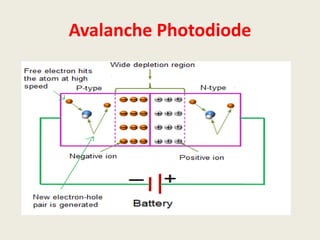
Avalanche Photodiode
• Avalanche Photodiode or APD which is a variation of
PIN diodes with internal gain.
• Unlike photomultipliers, however, which uses multiple
dynodes to accelerate and duplicate electrons, APD's
gain mechanism works by applying a large voltage to
the electron-hole pairs converted from photons so that
they collide with other atoms, knocking more electrons
out of them.
• These new electrons can further collide with more
atoms, hence rapidly generating more current in the
Avalanche process.
Avalanche Photodiode
Advantages of optical detectors
• Optical detectors are highly sensitive to light and can
detect very low levels of light.
• Optical detectors have a wide bandwidth, which makes
them suitable for high-speed communication systems.
• They have a low noise level, which means that the
signal-to-noise ratio is high, and the information
transmitted is more accurate.
• Optical detectors are highly reliable and can operate
for long periods of time without any maintenance.
• They consume very little power, making them suitable
for use in low-power devices.
Disadvantages of optical detectors
• Optical detectors can be expensive compared to
electronic detectors.
• They have a limited dynamic range, which means they
cannot detect signals that are too strong or too weak.
• Optical detectors are sensitive to changes in
temperature, which can affect their performance.
• Fabricating optical detectors can be complex, requiring
specialized equipment and expertise.
• Optical detectors require careful alignment to ensure
that the light is directed correctly and efficiently.
B.Tech ECE IV Year I Sem, MWOC UNIT 5  Optical CommunicationsUNIT 5 MWOC.pptx

B.Tech ECE IV Year I Sem, MWOC UNIT 5 Optical CommunicationsUNIT 5 MWOC.pptx

  • 1.
    MAHAVEER INSTITUTE OFSCIENCE & TECHNOLOGY Vyasapuri, Bandlaguda, Post Keshavgiri, Hyd- 500005 Microwave and Optical Communications Unit-5 Optical Communications (UNIT-5, JNTUH) By NENAVATH RAVI KUMAR Assistant Professor ECE Department
  • 2.
    Fiber Optical CommunicationSystems • Fiber optic data transmission systems send information over fiber by turning electronic signals into light. • Light refers to more than the portion of the electromagnetic spectrum that is near to what is visible to the human eye. • The electromagnetic spectrum is composed of visible and near-infrared light like that transmitted by fiber, and all other wavelengths used to transmit signals such as AM an FM radio and television.
  • 3.
    Basics of OpticalFibre Communication An Optical Fiber Communication System consists of • Transmitter – Optical source (LED or Laser diode) + driver circuit • Optical Fibre – Single mode fibre, or – Multimode fibre • Receiver – Photodetector PIN or APD + receiver circuit
  • 4.
    Major elements ofan optical fiber link
  • 5.
    Advantages of OpticalFiber Communications • Very high bandwidth (10 - 500 GHz, typ.) • Very low attenuation (lowest 0.16 dB/km) • Immune to EMI • Data security (almost impossible to tap information) • Lower system cost (fewer repeaters due to low attenuation of fibers) • Small size and low weight • Very low Bit Error Rate ( < 10-10 typically)
  • 6.
    Source: Nobel Lecture,2009, CK Kao, “Transmission of Light in Fiber for Optical Communication”
  • 7.
    1400nm OH- AbsorptionPeak OFS AllWave fiber: example of a “low-water-peak” or “full spectrum” fiber. Prior to 2000 the fiber transmission bands were referred to as “windows.” 7 OH- absorption (1400 nm) 1st window: 850 nm, attenuation 2 dB/km 2nd window: 1300 nm, attenuation 0.5 dB/km 3rd window: 1550 nm, attenuation 0.3 dB/km
  • 8.
  • 9.
    Optical Fibers • Opticalfibers (fiber optics) are long, thin strands of very pure glass (silica-based). • Core diameter in the order of a human hair. • Fibers are arranged in bundles (optical cables) and used to transmit signals over long distances. • High bandwidth capability. • Long distances can be bridged. 1: Core: 8-100 µm diameter 2: Cladding: 125 µm dia. 3: Buffer: 250 µm dia. 4: Jacket: 400 µm dia.
  • 10.
    PRINCIPLE OF LIGHTPROPAGATION THROUGH A FIBRE • When the light ray is incident on the interface between two medium having different indices at an angle greater than critical angle, the light gets totally internally reflected within the medium of higher refractive index.
  • 11.
    • Refractive Index– The refractive index of a medium is defined as the ratio of velocity of light in vacuum to the velocity of light in the medium.
  • 12.
    3. If thedielectric on other side of interface has the refractive index n2 which is less than n1 , then the refraction is such that the ray path in this index medium is at an angle Φ2 to the normal where Φ2>Φ1 . 4. The angle of incidence Φ1 and the refraction Φ2 are related to each other and to the refractive indices of dielectric by Snell’s law of refraction which states that n1sinΦ1= n2sinΦ2 5. When the angle of refraction is 90° and the refracted ray emerges parallel to the interface between the dielectrics, the angle of incidence must be less than 90°.
  • 14.
    CONDITIONS TO ACHIEVETOTAL INTERNAL REFLECTION The phenomenon of total internal reflection occurs at the interface between two dielectrics of different refractive indices only when,  Light is incident on the dielectric of lower index from the dielectric of higher index.  The angle of incidence exceeds the critical value.
  • 15.
    DIFFERENT TYPES OFFIBRES AND THEIR PROPERTIES • Based on fibers used in communication they are classified into: 1. Step index fiber a. Single mode b. Multimode 2. Graded index fiber a. Multimode
  • 16.
    1. Step IndexFibre The refractive index of core is maximum and constant throughput the core. There is a stepwise decrease of refractive index in cladding. The refractive index of cladding is given by,
  • 17.
    Step index multimodefiber The difference between refractive indices of core and cladding is more. Its core has large diameter. It is used in short distance communication because attenuation is large.
  • 18.
    Step index singlemode fiber The difference between refractive indices of core and cladding is very less. Its core diameter is also very small. It has low attenuation and very high bandwidth. It has low numerical aperture(NA). So these are used in long distance communication.
  • 19.
    2. Graded IndexFibre  The refractive index of core varies parabolically such that its maximum at the core axis and minimum at the core cladding boundary.  The refractive index of a graded index fiber is given by,
  • 20.
    Optical Fiber Types •Multi Mode : – Step-index – Core and Cladding material has uniform but different refractive index. – Graded Index – Core material has variable index as a function of the radial distance from the center. • Single Mode: – The core diameter is almost equal to the wave length of the emitted light so that it propagates along a single path.
  • 21.
  • 22.
    Ray Theory Transmission •Meridional ray • Skew rays
  • 23.
    Attenuation • Signal attenuation(loss) is a measure of power received with respect to power sent. • Silica-based glass fibers have losses of about 0.2 dB/km (i.e. 95% launched power remains after 1 km of fiber transmission). • Drawback on fibers: if only a little section develops a high attenuation, the whole fiber is lost. • Signal attenuation within optical fibers is usually expressed in the logarithmic unit of the decibel (dB). • The decibel is defined for a particular optical wavelength as the ratio of the output optical power Po from the fiber to the input optical power Pi into the fiber (Po Pi) Loss[dB]= -10×log10 Pout Pin æ è ç ö ø ÷
  • 24.
    Fiber Attenuation: Absorption •The optical power is lost as heat in the fiber. Loss mechanism is related to both the material composition and the fabrication process for the fiber. • The light absorption can be intrinsic (due to the material components of the glass) or extrinsic (due to impurities introduced into the glass during fabrication). • Intrinsic absorptions can be due to electron transitions within the glass molecules (UV absorption) or due to molecular vibrations (infrared absorptions). • Major extrinsic loss is caused by absorption due to water (as the hydroxyl or OH- ions) introduced in the glass fiber during fiber pulling by means of oxyhydrogen flame. – The lowest attenuation for typical silica-based fibers occurs at wavelength 1550 nm, about 0.2 dB/km, approaching the minimum possible attenuation at this wavelength.
  • 25.
    Power loss inOptical fiber • In a curved Path fiber • Microbending losses
  • 26.
  • 27.
  • 28.
  • 29.
    Light-Emitting Diodes (LEDs) •For photonic communications requiring data rate 100-200 Mb/s with multimode fiber with tens of microwatts, LEDs are usually the best choice. • LED configurations being used in photonic communications: 1- Surface Emitters (Front Emitters) 2- Edge Emitters
  • 30.
    a) Cross-section drawingof a typical GaAlAs double heterostructure light emitter. In this structure, x > y to provide for both carrier confinement and optical guiding. b) Energy-band diagram showing the active region, the electron & hole barriers which confine the charge carriers to the active layer. c) Variations in the refractive index; the lower refractive index of the material in regions 1 and 5 creates an optical barrier around the waveguide because of the higher band-gap energy of this material. ) eV ( 240 . 1 m) ( g E   
  • 31.
    Surface-Emitting LED Optical Fibercommunications, 3rd ed.,G.Keiser,McGrawHill, 2000 Schematic of high-radiance surface-emitting LED. The active region is limitted to a circular cross section that has an area compatible with the fiber-core end face.
  • 32.
    Edge-Emitting LED Schematic ofan edge-emitting double heterojunction LED. The output beam is lambertian in the plane of junction and highly directional perpendicular to pn junction. They have high quantum efficiency & fast response. Optical Fiber communications, 3rd ed.,G.Keiser,McGrawHill, 2000
  • 33.
  • 34.
  • 35.
    • A laseris a device that generates light by a process called STIMULATED EMISSION. • The acronym LASER stands for Light Amplification by Stimulated Emission of Radiation • Semiconducting lasers are multilayer semiconductor devices that generates a coherent beam of monochromatic light by laser action. A coherent beam resulted which all of the photons are in phase. Definition of laser
  • 36.
    1. Absorption 2. SpontaneousEmission 3. Stimulated Emission Mechanisms of Light Emission For atomic systems in thermal equilibrium with their surrounding, the emission of light is the result of: Absorption And subsequently, spontaneous emission of energy There is another process whereby the atom in an upper energy level can be triggered or stimulated in phase with the an incoming photon. This process is: Stimulated emission It is an important process for laser action Therefore 3 process of light emission: Prof. Snehal Laddha
  • 37.
    Absorption E1 E2 When a photonof energy (E2-E1) is incident on the atom it may be excited into the higher energy state E2 through absorption of photon. This process is called as stimulated absorption.
  • 38.
    Spontaneous Emission When theatom in higher energy state E2 makes a transition in lower energy state E1 in an entirely random manner, the process is called spontaneous emission.
  • 39.
    Stimulated Emission When aphoton of energy equal to the energy difference between the two states (E2-E1) interacts with the atom in the upper energy state causing it to return to the lower state with the creation of a second photon, is called stimulated emission. Prof. Snehal Laddha
  • 40.
  • 41.
    • LED ischosen for many applications using multimode fibers • The lasers tends to find more use as a single mode device in single mode fibers. LED & LASER APPLICATIONS Prof. Snehal Laddha
  • 42.
    • Lasers areall around us in many places you might not realize. Besides being useful for pure science like in a physics lab, lasers are found in many real-world applications. • The grocery store • The Doctor’s office • Manufacturing • Telecommunication • The Moon • Weapons
  • 43.
    Optital detectors • Anoptital detector is a device that converts light signals into electrical signals, which can then be amplified and processed. • Optical detectors are typically made of semiconducting materials that absorb photons (light particles) and generate electrons and holes. • Type of Optical Detector There are several types of photodiodes, including PIN photodiodes, avalanche photodiodes (APDs), and photomultiplier tubes (PMTs), each with different properties which make them suitable for different applications.
  • 44.
    PIN Photodiode • Betweenp-region and n-region, another layer named intrinsic layer is added to widen the depletion zone, increasing the probability that photons directly being a • Hence the name of the device is p-i-n photo- diode bsorbed in this layer. • . This causes the diffusion current to remain low and, hence, enhance the speed of the device. • The pin-diode is (as seen from the circuit) is basically a photon to current converter which may be replaced by a constant current source in parallel to an ideal diode in its equivalent circuit and hence is a current controlled device
  • 45.
  • 46.
    Avalanche Photodiode • AvalanchePhotodiode or APD which is a variation of PIN diodes with internal gain. • Unlike photomultipliers, however, which uses multiple dynodes to accelerate and duplicate electrons, APD's gain mechanism works by applying a large voltage to the electron-hole pairs converted from photons so that they collide with other atoms, knocking more electrons out of them. • These new electrons can further collide with more atoms, hence rapidly generating more current in the Avalanche process.
  • 47.
  • 48.
    Advantages of opticaldetectors • Optical detectors are highly sensitive to light and can detect very low levels of light. • Optical detectors have a wide bandwidth, which makes them suitable for high-speed communication systems. • They have a low noise level, which means that the signal-to-noise ratio is high, and the information transmitted is more accurate. • Optical detectors are highly reliable and can operate for long periods of time without any maintenance. • They consume very little power, making them suitable for use in low-power devices.
  • 49.
    Disadvantages of opticaldetectors • Optical detectors can be expensive compared to electronic detectors. • They have a limited dynamic range, which means they cannot detect signals that are too strong or too weak. • Optical detectors are sensitive to changes in temperature, which can affect their performance. • Fabricating optical detectors can be complex, requiring specialized equipment and expertise. • Optical detectors require careful alignment to ensure that the light is directed correctly and efficiently.