1
Erbium Doped Fiber
Amplifiers
MEC
2
Contents
• Optical Amplifier Types.
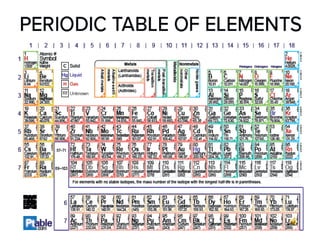
• Rare Earth Elements.
• Erbium Doped Fiber Amplifiers.
- Invention.
- Working.
- Configurations.
- Applications.
- Merits and Demerits.
3
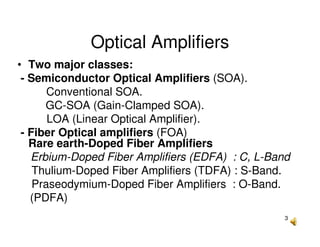
Optical Amplifiers
• Two major classes:
- Semiconductor Optical Amplifiers (SOA).
Conventional SOA.
GC-SOA (Gain-Clamped SOA).
LOA (Linear Optical Amplifier).
- Fiber Optical amplifiers (FOA)
Rare earth-Doped Fiber Amplifiers
Erbium-Doped Fiber Amplifiers (EDFA) : C, L-Band
Thulium-Doped Fiber Amplifiers (TDFA) : S-Band.
Praseodymium-Doped Fiber Amplifiers : O-Band.
(PDFA)
4
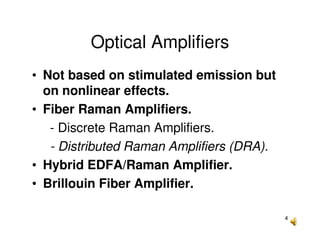
Optical Amplifiers
• Not based on stimulated emission but
on nonlinear effects.
• Fiber Raman Amplifiers.
- Discrete Raman Amplifiers.
- Distributed Raman Amplifiers (DRA).
• Hybrid EDFA/Raman Amplifier.
• Brillouin Fiber Amplifier.
5
6
7
Rare Earth Elements
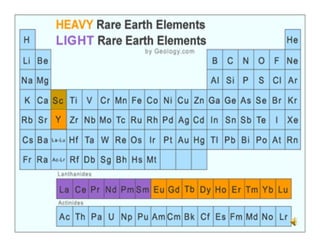
• 17 rare-earth elements : cerium (Ce),
dysprosium (Dy), erbium (Er), europium (Eu),
gadolinium (Gd), holmium (Ho),
lanthanum (La), lutetium (Lu),
neodymium (Nd), praseodymium (Pr),
promethium (Pm), samarium (Sm),
scandium (Sc), terbium (Tb), thulium (Tm),
ytterbium (Yb), and yttrium (Y).
• Often found in minerals with thorium (Th),
and less commonly uranium (U).
8
Rare Earth Elements
• Tend to occur in the same ore deposits as
lanthanides.
• Exhibit similar chemical properties, but
have different electronic and magnetic
properties.
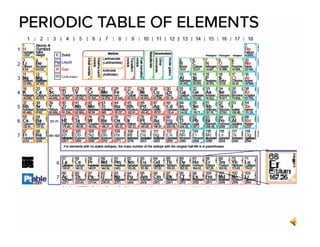
• 15 rare earth elements or lanthanides
occupy penultimate row of the periodic
table.
9
Rare Earth Elements
• From lanthanum (La) atomic number 57 to
lutetium atomic number 71.
• Ionization of rare earths normally takes
place to form a trivalent state.
• Major dopants for fiber lasers - neodymium
(Nd3+) & erbium (Er3+).
• Crystalline and glass waveguiding
structures doped with rare earth ions (e.g.
neodymium) used as optical communication
sources.
10
Rare Earth Elements
• Dopants for fiber lasers - neodymium (Nd3+)
and erbium (Er3+).
• Yttrium–aluminum–garnet (Y3Al5O12) doped
with rare earth metal ion neodymium (Nd3+)
to form Nd : YAG structure.
• Nd : YAG laser - Nd3+ provides a four-level
scheme with significant lasing outputs at
0.90, 1.06 and 1.32 µm.
• Er3+ gives a three-level scheme with major
lasing transitions at 0.80, 0.98 and 1.55 µm.
11
Rare Earth Elements
• Glasses form the host materials for rare earth
doped fiber lasers.
• Rare earth ions are impurities, act as network
modifiers or are interstitially located within the
glass network.
• Neodymium and erbium doped silica fiber
lasers employ co-dopants like phosphorus
pentoxide (P2O5), germania (e.g. GeO2,
GeCl4) or alumina (Al2O5), low dopant levels
(400 ppm).
12
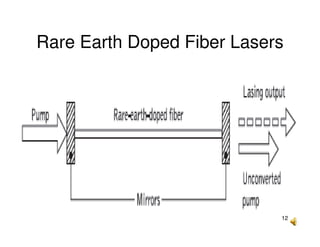
Rare Earth Doped Fiber Lasers
13
Doped Fiber Amplifiers
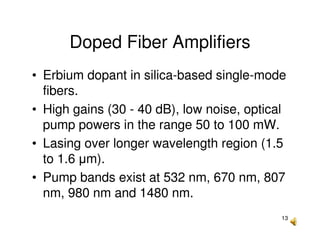
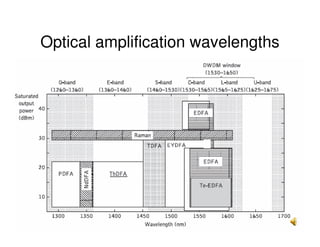
• Erbium dopant in silica-based single-mode
fibers.
• High gains (30 - 40 dB), low noise, optical
pump powers in the range 50 to 100 mW.
• Lasing over longer wavelength region (1.5
to 1.6 µm).
• Pump bands exist at 532 nm, 670 nm, 807
nm, 980 nm and 1480 nm.
14
Doped Fiber Amplifiers
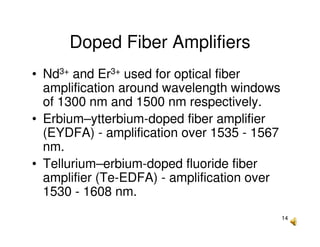
• Nd3+ and Er3+ used for optical fiber
amplification around wavelength windows
of 1300 nm and 1500 nm respectively.
• Erbium–ytterbium-doped fiber amplifier
(EYDFA) - amplification over 1535 - 1567
nm.
• Tellurium–erbium-doped fluoride fiber
amplifier (Te-EDFA) - amplification over
1530 - 1608 nm.
15
Doped Fiber Amplifiers
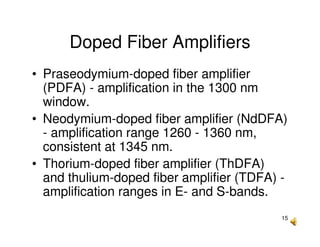
• Praseodymium-doped fiber amplifier
(PDFA) - amplification in the 1300 nm
window.
• Neodymium-doped fiber amplifier (NdDFA)
- amplification range 1260 - 1360 nm,
consistent at 1345 nm.
• Thorium-doped fiber amplifier (ThDFA)
and thulium-doped fiber amplifier (TDFA) -
amplification ranges in E- and S-bands.
16
17
Erbium Doped Fiber Amplifier
• Dr. Emmanuel Desurvire, Dr. Randy Giles
and Prof. David Payne - men behind
Erbium-Doped Fibre Amplifier (EDFA).
• Worked together at Bell Laboratories, New
Jersey, USA, Payne was at Southampton
University.
• Prof. Payne - first to publish a paper (1987)
on erbium-doped fibre amplifiers Dr.
Desurvire and Dr. Giles - first to make it a
working tool - Millennium Prize Laureates
2008.
18
Erbium Doped Fiber Amplifier
19
Erbium Doped Fiber Amplifier
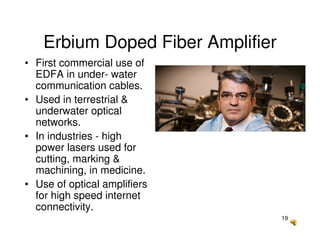
• First commercial use of
EDFA in under- water
communication cables.
• Used in terrestrial &
underwater optical
networks.
• In industries - high
power lasers used for
cutting, marking &
machining, in medicine.
• Use of optical amplifiers
for high speed internet
connectivity.
20
Erbium Doped Fiber Amplifier
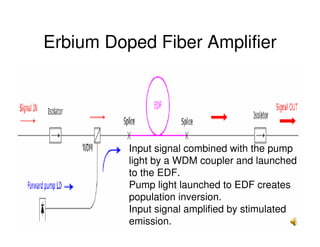
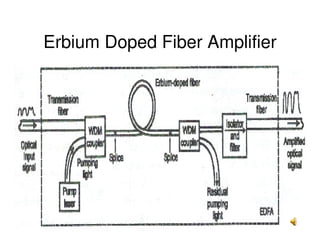
Input signal combined with the pump
light by a WDM coupler and launched
to the EDF.
Pump light launched to EDF creates
population inversion.
Input signal amplified by stimulated
emission.
21
Erbium Doped Fiber Amplifier
22
Erbium Doped Fiber Amplifier
• Amplification depends on material gain of
a relatively short section (1 to 100 m) of
the fiber.
• Aluminium co-doping to broaden spectral
bandwidth to around 40 nm.
• Spectral bandwidth may be restricted to
around 300 GHz (2.4 nm).
• Spectral dependence on gain not always
constant due to excited state absorption.
23
Erbium Doped Fiber Amplifier
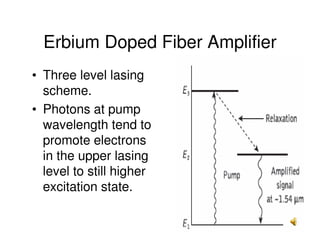
• Three level lasing
scheme.
• Photons at pump
wavelength tend to
promote electrons
in the upper lasing
level to still higher
excitation state.
24
Excited State Absorption
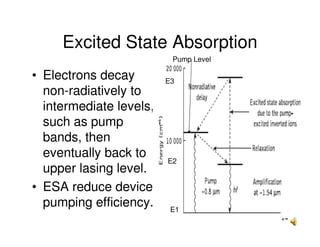
• Electrons decay
non-radiatively to
intermediate levels,
such as pump
bands, then
eventually back to
upper lasing level.
• ESA reduce device
pumping efficiency.
Pump Level
E1
E2
E3
25
Excited State Absorption
• ESA necessitates pump at a higher power
to obtain a specific gain.
• ESA present at 807 nm pump band.
• Reduction of ESA – change the location of
energy levels.
- co- doping erbium–silica fiber amplifier
with compounds like P2O5.
- pump at a wavelength which does not
cause population of an excited state.
26
Excited State Absorption
- change the glass technology, lase
with fluorozirconate host glass.
• Amplification obtained in erbium-doped
multimode fluorozirconate fiber using
488 nm pump for gain at 1.525 µm
wavelength.
• Improved efficiency with 980 and 1480
nm pump wavelengths.
27
Excited State Absorption
• 980 nm displays high efficiency
(twice the dB/W gain figure of 1480
nm wavelength) but pump sources
not readily available.
• Working at 1480 nm facilitated by
semiconductor and solid-state laser
sources.
28
Erbium Doped Fiber Amplifier
• Bandwidth potential of rare-earth-doped
fiber - choose appropriate doping element.
• Flatter gain and increased bandwidth.
• Each material possesses different
absorption–emission properties
• Not possible to construct a single rare
earth doped fiber amplifier for amplification
at all fiber bands.
29
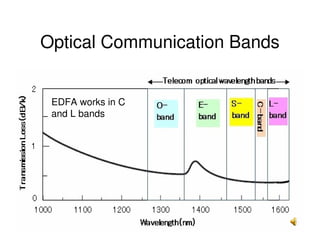
Optical Communication Bands
EDFA works in C
and L bands
30
Optical amplification wavelengths
31
EDFA Characteristics
• Saturated output power - maximum output
power from an amplifier when sufficient
signal input power (typically around 0 dBm
or higher) is launched to the amplifier.
• Small-signal gain - gain when signal power
launched to the amplifier is very small
(typically around -30 dBm).
• Noise figure – measure of degradation of
SNR.
32
EDFA Characteristics
• Gain flatness - each of the WDM channels
has a different gain value, variation is the
gain flatness.
• Gain variation accumulated in EDFA
chains, results in large signal power
differences between WDM channels.
• Gain flatness improved by modification of
glass composition of EDF (higher
Aluminium concentration) / incorporation of
external gain-flattening optical filter.
33
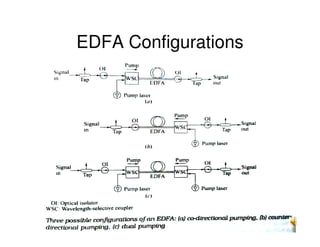
EDFA Configurations
34
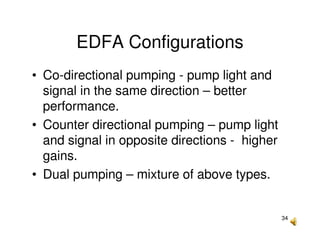
EDFA Configurations
• Co-directional pumping - pump light and
signal in the same direction – better
performance.
• Counter directional pumping – pump light
and signal in opposite directions - higher
gains.
• Dual pumping – mixture of above types.
35
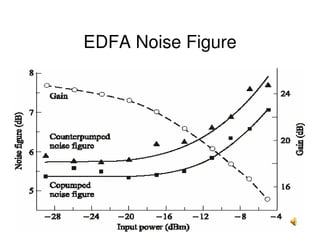
EDFA Noise Figure
36
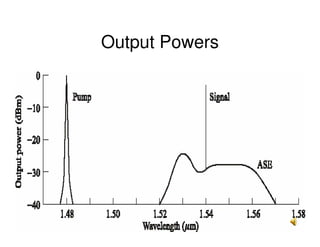
Output Powers
37
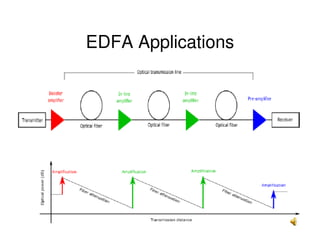
EDFA Applications
38
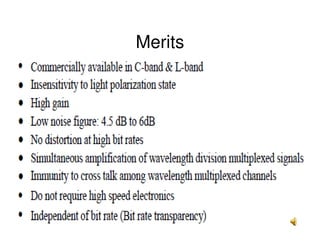
Merits
39
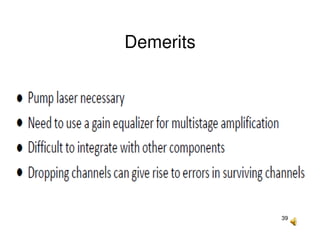
Demerits
40
Erbium-based Micro Fiber Amplifier
(EMFA)
• Uses erbium-doped glass - high optical
gain over just a few fiber centimeters.
• Uses Er3+-doped phosphate glass that
supports higher doping concentrations of
erbium ions.
• High gain of 15 dB within 1530 - 1565 nm.
• > 12 dBm output signal power.
41
Thank You

Erbium doped fiber amplifiers

  • 1.
  • 2.
    2 Contents • Optical AmplifierTypes. • Rare Earth Elements. • Erbium Doped Fiber Amplifiers. - Invention. - Working. - Configurations. - Applications. - Merits and Demerits.
  • 3.
    3 Optical Amplifiers • Twomajor classes: - Semiconductor Optical Amplifiers (SOA). Conventional SOA. GC-SOA (Gain-Clamped SOA). LOA (Linear Optical Amplifier). - Fiber Optical amplifiers (FOA) Rare earth-Doped Fiber Amplifiers Erbium-Doped Fiber Amplifiers (EDFA) : C, L-Band Thulium-Doped Fiber Amplifiers (TDFA) : S-Band. Praseodymium-Doped Fiber Amplifiers : O-Band. (PDFA)
  • 4.
    4 Optical Amplifiers • Notbased on stimulated emission but on nonlinear effects. • Fiber Raman Amplifiers. - Discrete Raman Amplifiers. - Distributed Raman Amplifiers (DRA). • Hybrid EDFA/Raman Amplifier. • Brillouin Fiber Amplifier.
  • 5.
  • 6.
  • 7.
    7 Rare Earth Elements •17 rare-earth elements : cerium (Ce), dysprosium (Dy), erbium (Er), europium (Eu), gadolinium (Gd), holmium (Ho), lanthanum (La), lutetium (Lu), neodymium (Nd), praseodymium (Pr), promethium (Pm), samarium (Sm), scandium (Sc), terbium (Tb), thulium (Tm), ytterbium (Yb), and yttrium (Y). • Often found in minerals with thorium (Th), and less commonly uranium (U).
  • 8.
    8 Rare Earth Elements •Tend to occur in the same ore deposits as lanthanides. • Exhibit similar chemical properties, but have different electronic and magnetic properties. • 15 rare earth elements or lanthanides occupy penultimate row of the periodic table.
  • 9.
    9 Rare Earth Elements •From lanthanum (La) atomic number 57 to lutetium atomic number 71. • Ionization of rare earths normally takes place to form a trivalent state. • Major dopants for fiber lasers - neodymium (Nd3+) & erbium (Er3+). • Crystalline and glass waveguiding structures doped with rare earth ions (e.g. neodymium) used as optical communication sources.
  • 10.
    10 Rare Earth Elements •Dopants for fiber lasers - neodymium (Nd3+) and erbium (Er3+). • Yttrium–aluminum–garnet (Y3Al5O12) doped with rare earth metal ion neodymium (Nd3+) to form Nd : YAG structure. • Nd : YAG laser - Nd3+ provides a four-level scheme with significant lasing outputs at 0.90, 1.06 and 1.32 µm. • Er3+ gives a three-level scheme with major lasing transitions at 0.80, 0.98 and 1.55 µm.
  • 11.
    11 Rare Earth Elements •Glasses form the host materials for rare earth doped fiber lasers. • Rare earth ions are impurities, act as network modifiers or are interstitially located within the glass network. • Neodymium and erbium doped silica fiber lasers employ co-dopants like phosphorus pentoxide (P2O5), germania (e.g. GeO2, GeCl4) or alumina (Al2O5), low dopant levels (400 ppm).
  • 12.
    12 Rare Earth DopedFiber Lasers
  • 13.
    13 Doped Fiber Amplifiers •Erbium dopant in silica-based single-mode fibers. • High gains (30 - 40 dB), low noise, optical pump powers in the range 50 to 100 mW. • Lasing over longer wavelength region (1.5 to 1.6 µm). • Pump bands exist at 532 nm, 670 nm, 807 nm, 980 nm and 1480 nm.
  • 14.
    14 Doped Fiber Amplifiers •Nd3+ and Er3+ used for optical fiber amplification around wavelength windows of 1300 nm and 1500 nm respectively. • Erbium–ytterbium-doped fiber amplifier (EYDFA) - amplification over 1535 - 1567 nm. • Tellurium–erbium-doped fluoride fiber amplifier (Te-EDFA) - amplification over 1530 - 1608 nm.
  • 15.
    15 Doped Fiber Amplifiers •Praseodymium-doped fiber amplifier (PDFA) - amplification in the 1300 nm window. • Neodymium-doped fiber amplifier (NdDFA) - amplification range 1260 - 1360 nm, consistent at 1345 nm. • Thorium-doped fiber amplifier (ThDFA) and thulium-doped fiber amplifier (TDFA) - amplification ranges in E- and S-bands.
  • 16.
  • 17.
    17 Erbium Doped FiberAmplifier • Dr. Emmanuel Desurvire, Dr. Randy Giles and Prof. David Payne - men behind Erbium-Doped Fibre Amplifier (EDFA). • Worked together at Bell Laboratories, New Jersey, USA, Payne was at Southampton University. • Prof. Payne - first to publish a paper (1987) on erbium-doped fibre amplifiers Dr. Desurvire and Dr. Giles - first to make it a working tool - Millennium Prize Laureates 2008.
  • 18.
  • 19.
    19 Erbium Doped FiberAmplifier • First commercial use of EDFA in under- water communication cables. • Used in terrestrial & underwater optical networks. • In industries - high power lasers used for cutting, marking & machining, in medicine. • Use of optical amplifiers for high speed internet connectivity.
  • 20.
    20 Erbium Doped FiberAmplifier Input signal combined with the pump light by a WDM coupler and launched to the EDF. Pump light launched to EDF creates population inversion. Input signal amplified by stimulated emission.
  • 21.
  • 22.
    22 Erbium Doped FiberAmplifier • Amplification depends on material gain of a relatively short section (1 to 100 m) of the fiber. • Aluminium co-doping to broaden spectral bandwidth to around 40 nm. • Spectral bandwidth may be restricted to around 300 GHz (2.4 nm). • Spectral dependence on gain not always constant due to excited state absorption.
  • 23.
    23 Erbium Doped FiberAmplifier • Three level lasing scheme. • Photons at pump wavelength tend to promote electrons in the upper lasing level to still higher excitation state.
  • 24.
    24 Excited State Absorption •Electrons decay non-radiatively to intermediate levels, such as pump bands, then eventually back to upper lasing level. • ESA reduce device pumping efficiency. Pump Level E1 E2 E3
  • 25.
    25 Excited State Absorption •ESA necessitates pump at a higher power to obtain a specific gain. • ESA present at 807 nm pump band. • Reduction of ESA – change the location of energy levels. - co- doping erbium–silica fiber amplifier with compounds like P2O5. - pump at a wavelength which does not cause population of an excited state.
  • 26.
    26 Excited State Absorption -change the glass technology, lase with fluorozirconate host glass. • Amplification obtained in erbium-doped multimode fluorozirconate fiber using 488 nm pump for gain at 1.525 µm wavelength. • Improved efficiency with 980 and 1480 nm pump wavelengths.
  • 27.
    27 Excited State Absorption •980 nm displays high efficiency (twice the dB/W gain figure of 1480 nm wavelength) but pump sources not readily available. • Working at 1480 nm facilitated by semiconductor and solid-state laser sources.
  • 28.
    28 Erbium Doped FiberAmplifier • Bandwidth potential of rare-earth-doped fiber - choose appropriate doping element. • Flatter gain and increased bandwidth. • Each material possesses different absorption–emission properties • Not possible to construct a single rare earth doped fiber amplifier for amplification at all fiber bands.
  • 29.
  • 30.
  • 31.
    31 EDFA Characteristics • Saturatedoutput power - maximum output power from an amplifier when sufficient signal input power (typically around 0 dBm or higher) is launched to the amplifier. • Small-signal gain - gain when signal power launched to the amplifier is very small (typically around -30 dBm). • Noise figure – measure of degradation of SNR.
  • 32.
    32 EDFA Characteristics • Gainflatness - each of the WDM channels has a different gain value, variation is the gain flatness. • Gain variation accumulated in EDFA chains, results in large signal power differences between WDM channels. • Gain flatness improved by modification of glass composition of EDF (higher Aluminium concentration) / incorporation of external gain-flattening optical filter.
  • 33.
  • 34.
    34 EDFA Configurations • Co-directionalpumping - pump light and signal in the same direction – better performance. • Counter directional pumping – pump light and signal in opposite directions - higher gains. • Dual pumping – mixture of above types.
  • 35.
  • 36.
  • 37.
  • 38.
  • 39.
  • 40.
    40 Erbium-based Micro FiberAmplifier (EMFA) • Uses erbium-doped glass - high optical gain over just a few fiber centimeters. • Uses Er3+-doped phosphate glass that supports higher doping concentrations of erbium ions. • High gain of 15 dB within 1530 - 1565 nm. • > 12 dBm output signal power.
  • 41.