Rutherford Backscattering Modeling
Algorithms
Shuvan Prashant
PC5209 Coursework
Nuclear Instruments and Methods in Physics Research B9 (1985) 344-351
Motivation
• RBS analysis algorithms though accurate but
computationally intensive
• Takes a lot of time on small computers
• Rapid simulation with good assumptions can fit
the RBS spectra with reasonable accuracy
Computers are useless. They can only give you answers.
Pablo Picasso
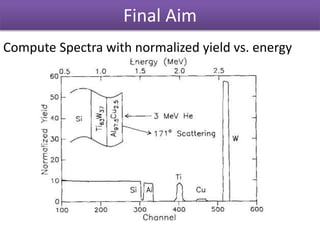
Final Aim
Compute Spectra with normalized yield vs. energy
Assumptions
• Sample  stack of sublayers
• Sublayer  uniform composition and fixed
energy loss function(E dependent only)
• Sublayer should not be too thick
• Elastic Scattering
• Screening for low energies can be incorporated
• Detector resolution  Gaussian convolution
• Straggling  intensive but possible
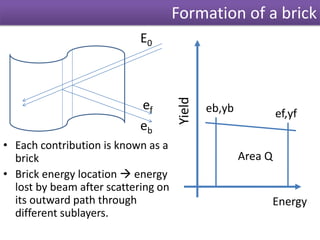
Formation of a brick
• Each contribution is known as a
brick
• Brick energy location  energy
lost by beam after scattering on
its outward path through
different sublayers.
Yield
Energy
Area Q
eb,yb ef,yf
ef
eb
E0
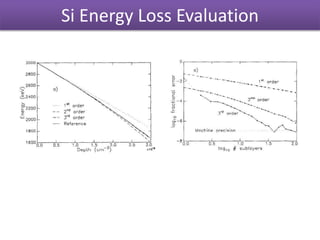
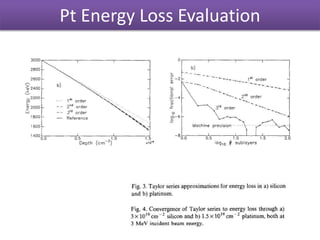
Energy Loss Evaluation
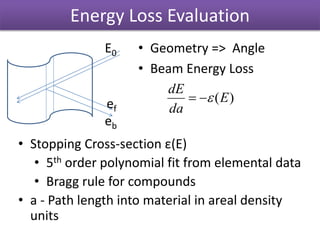
• Geometry => Angle
• Beam Energy Loss
ef
eb
E0
)(E
da
dE

• Stopping Cross-section ε(E)
• 5th order polynomial fit from elemental data
• Bragg rule for compounds
• a - Path length into material in areal density
units
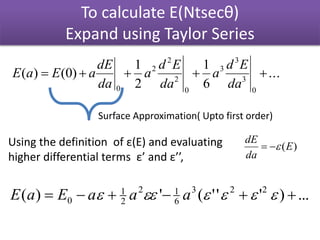
To calculate E(Ntsecθ)
Expand using Taylor Series
...
6
1
2
1
)0()(
0
3
3
3
0
2
2
2
0

da
Ed
a
da
Ed
a
da
dE
aEaE
Surface Approximation( Upto first order)
...)'''(')( 223
6
12
2
1
0   aaaEaE
Using the definition of ε(E) and evaluating
higher differential terms ε’ and ε’’,
)(E
da
dE

Energy Location
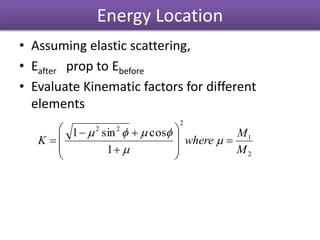
• Assuming elastic scattering,
• Eafter prop to Ebefore
• Evaluate Kinematic factors for different
elements
2
1
2
22
1
cossin1
M
M
whereK 










 


Building Spectrum
• Superpose contributions from each isotope in
sublayer in the sample
• Spectrum Calculation involves
– Energy Loss evaluation in each sublayer
– Final Interpolation of the spectrum
• Shape of the brick Trapezoidal bricks may
have kinks if the sublayers are thick
• Area not accurate
• How can we solve this ?
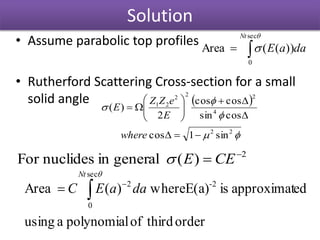
Solution
• Assume parabolic top profiles
• Rutherford Scattering Cross-section for a small
solid angle



sec
0
))((Area
Nt
daaE
 




22
4
222
21
sin1cos
cossin
coscos
2
)(










where
E
eZZ
E
2
)(generalinnuclidesFor 
 CEE
orderthirdofpolynomialausing
edapproximatisE(a)where)(Area 2-
sec
0
2



Nt
daaEC
Height Estimation
)()()]([
)(
)(
cos)]([
)(
EKEKEwhere
E
E
E
Ex
y
AAAi
layers out
in
Ai
iAA






 
Screening Effects can be accounted
keVwhere
aE
p
EE R 4/3
21ZZ0.049
a
p
)1)(()( 


For high Z elements and 2MeV beam, the deviation of cross-section
is about 2% .
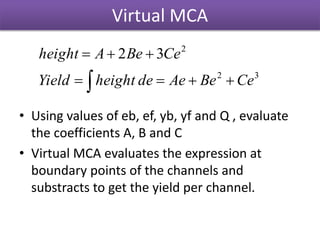
Virtual MCA
• Using values of eb, ef, yb, yf and Q , evaluate
the coefficients A, B and C
• Virtual MCA evaluates the expression at
boundary points of the channels and
substracts to get the yield per channel.
32
2
32
CeBeAedeheightYield
CeBeAheight



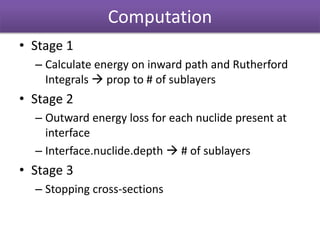
Computation
• Stage 1
– Calculate energy on inward path and Rutherford
Integrals  prop to # of sublayers
• Stage 2
– Outward energy loss for each nuclide present at
interface
– Interface.nuclide.depth  # of sublayers
• Stage 3
– Stopping cross-sections
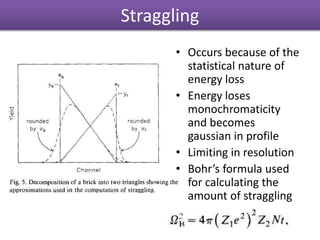
Straggling
• Occurs because of the
statistical nature of
energy loss
• Energy loses
monochromaticity
and becomes
gaussian in profile
• Limiting in resolution
• Bohr’s formula used
for calculating the
amount of straggling
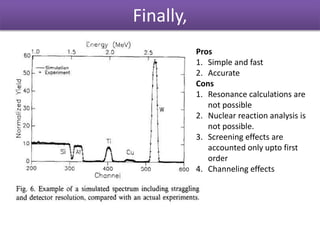
Finally,
Pros
1. Simple and fast
2. Accurate
Cons
1. Resonance calculations are
not possible
2. Nuclear reaction analysis is
not possible.
3. Screening effects are
accounted only upto first
order
4. Channeling effects
Thanks for your attention
• Q & A
Si Energy Loss Evaluation
Pt Energy Loss Evaluation

Rutherford Back-Scattering(RBS) Modeling Algorithms

  • 1.
    Rutherford Backscattering Modeling Algorithms ShuvanPrashant PC5209 Coursework Nuclear Instruments and Methods in Physics Research B9 (1985) 344-351
  • 2.
    Motivation • RBS analysisalgorithms though accurate but computationally intensive • Takes a lot of time on small computers • Rapid simulation with good assumptions can fit the RBS spectra with reasonable accuracy Computers are useless. They can only give you answers. Pablo Picasso
  • 3.
    Final Aim Compute Spectrawith normalized yield vs. energy
  • 4.
    Assumptions • Sample stack of sublayers • Sublayer  uniform composition and fixed energy loss function(E dependent only) • Sublayer should not be too thick • Elastic Scattering • Screening for low energies can be incorporated • Detector resolution  Gaussian convolution • Straggling  intensive but possible
  • 5.
    Formation of abrick • Each contribution is known as a brick • Brick energy location  energy lost by beam after scattering on its outward path through different sublayers. Yield Energy Area Q eb,yb ef,yf ef eb E0
  • 6.
    Energy Loss Evaluation •Geometry => Angle • Beam Energy Loss ef eb E0 )(E da dE  • Stopping Cross-section ε(E) • 5th order polynomial fit from elemental data • Bragg rule for compounds • a - Path length into material in areal density units
  • 7.
    To calculate E(Ntsecθ) Expandusing Taylor Series ... 6 1 2 1 )0()( 0 3 3 3 0 2 2 2 0  da Ed a da Ed a da dE aEaE Surface Approximation( Upto first order) ...)'''(')( 223 6 12 2 1 0   aaaEaE Using the definition of ε(E) and evaluating higher differential terms ε’ and ε’’, )(E da dE 
  • 8.
    Energy Location • Assumingelastic scattering, • Eafter prop to Ebefore • Evaluate Kinematic factors for different elements 2 1 2 22 1 cossin1 M M whereK               
  • 9.
    Building Spectrum • Superposecontributions from each isotope in sublayer in the sample • Spectrum Calculation involves – Energy Loss evaluation in each sublayer – Final Interpolation of the spectrum • Shape of the brick Trapezoidal bricks may have kinks if the sublayers are thick • Area not accurate • How can we solve this ?
  • 10.
    Solution • Assume parabolictop profiles • Rutherford Scattering Cross-section for a small solid angle    sec 0 ))((Area Nt daaE       22 4 222 21 sin1cos cossin coscos 2 )(           where E eZZ E 2 )(generalinnuclidesFor   CEE orderthirdofpolynomialausing edapproximatisE(a)where)(Area 2- sec 0 2    Nt daaEC
  • 11.
    Height Estimation )()()]([ )( )( cos)]([ )( EKEKEwhere E E E Ex y AAAi layers out in Ai iAA        Screening Effects can be accounted keVwhere aE p EE R 4/3 21ZZ0.049 a p )1)(()(    For high Z elements and 2MeV beam, the deviation of cross-section is about 2% .
  • 12.
    Virtual MCA • Usingvalues of eb, ef, yb, yf and Q , evaluate the coefficients A, B and C • Virtual MCA evaluates the expression at boundary points of the channels and substracts to get the yield per channel. 32 2 32 CeBeAedeheightYield CeBeAheight   
  • 13.
    Computation • Stage 1 –Calculate energy on inward path and Rutherford Integrals  prop to # of sublayers • Stage 2 – Outward energy loss for each nuclide present at interface – Interface.nuclide.depth  # of sublayers • Stage 3 – Stopping cross-sections
  • 14.
    Straggling • Occurs becauseof the statistical nature of energy loss • Energy loses monochromaticity and becomes gaussian in profile • Limiting in resolution • Bohr’s formula used for calculating the amount of straggling
  • 15.
    Finally, Pros 1. Simple andfast 2. Accurate Cons 1. Resonance calculations are not possible 2. Nuclear reaction analysis is not possible. 3. Screening effects are accounted only upto first order 4. Channeling effects
  • 16.
    Thanks for yourattention • Q & A
  • 17.
    Si Energy LossEvaluation
  • 18.
    Pt Energy LossEvaluation

Editor's Notes

  • #7 Ion beam traverses the sublayers before and after scattering