LASERS
AND
FIBER OPTICS
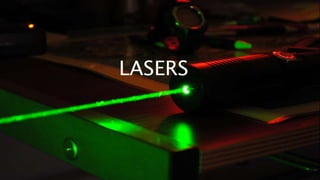
LASERS
WHAT ARE LASERS ?
The word LASER is an acronym for Light Amplification
through Stimulated Emission of Radiation. It is a
device that emits light through a process of optical
amplification.
A laser differs from other sources of light, it emits
light that is:
• Monochromatic
• Coherent
• Collimated
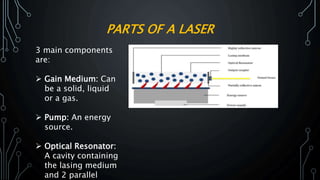
PARTS OF A LASER
3 main components
are:
 Gain Medium: Can
be a solid, liquid
or a gas.
 Pump: An energy
source.
 Optical Resonator:
A cavity containing
the lasing medium
and 2 parallel
WORKING OF A LASER
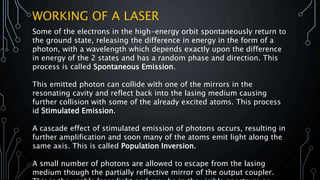
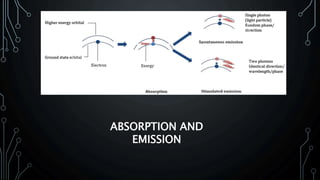
Some of the electrons in the high-energy orbit spontaneously return to
the ground state, releasing the difference in energy in the form of a
photon, with a wavelength which depends exactly upon the difference
in energy of the 2 states and has a random phase and direction. This
process is called Spontaneous Emission.
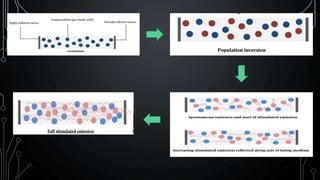
This emitted photon can collide with one of the mirrors in the
resonating cavity and reflect back into the lasing medium causing
further collision with some of the already excited atoms. This process
id Stimulated Emission.
A cascade effect of stimulated emission of photons occurs, resulting in
further amplification and soon many of the atoms emit light along the
same axis. This is called Population Inversion.
A small number of photons are allowed to escape from the lasing
medium though the partially reflective mirror of the output coupler.
ABSORPTION AND
EMISSION
TYPES OF LASERS
Gas Lasers
Fibre Lasers
Liquid Lasers
Semiconductor Lasers
GAS LASERS
• A laser in which an electric
current is discharged through
a gas to produce coherent
light.
• Different type of gases for
different purposes.
• Examples:
o 𝑪𝑶𝟐 laser - Cutting &
Welding.
oHeNe laser - Oscillates over
160 wavelengths.
LIQUID LASERS
• A laser which uses liquids as
an active medium. The liquids
are also called as dyes.
• Some commonly used dyes
are:
Sodium, Fluorescein,
Rhodamine B and Rhodamine
6G.
• These lasers are commonly
used for medical purpose as
a research tool.
FIBER LASERS
• Light is guided due to
the total internal
reflection in a single
mode optical fibre.
• Erbium and Ytterbium ions
are common active species
in such lasers.
• Used for cutting, marking
welding, cleaning and
texturing.
SEMICONDUCTOR
LASERS
• These lasers are diodes that
are electrically pumped.
• Recombination of charge
carriers brings optical gain.
Reflection from ends of
crystal forms an optical
resonator.
• Used for transmitting digital
data since it can pulsate and
for Optic cable
communication.
FIBER OPTICS
INTRODUCTION
An fiber optic or optical fiber is a flexible , transparent fiber made of high
quality glass (silica) or plastic , slightly thicker than a human hair.
Optical fibers are widely used in fiber-optic communications, which permits
transmission over longer distances and at higher bandwidths (data rates) than other
forms of communication.
Fibers are used instead of metal wires because signals travel along them with less
loss and are also safe to electromagnetic interference.
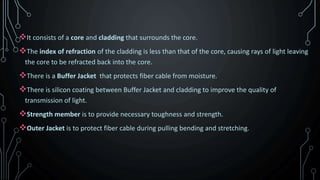
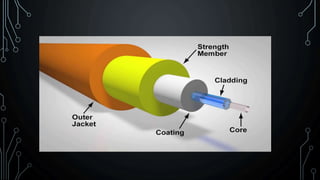
It consists of a core and cladding that surrounds the core.
The index of refraction of the cladding is less than that of the core, causing rays of light leaving
the core to be refracted back into the core.
There is a Buffer Jacket that protects fiber cable from moisture.
There is silicon coating between Buffer Jacket and cladding to improve the quality of
transmission of light.
Strength member is to provide necessary toughness and strength.
Outer Jacket is to protect fiber cable during pulling bending and stretching.
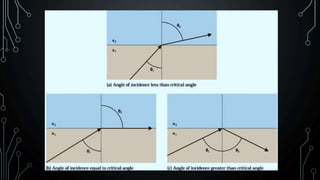
TOTAL INTERNAL REFLECTION
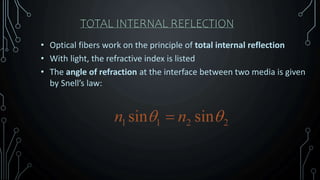
• Optical fibers work on the principle of total internal reflection
• With light, the refractive index is listed
• The angle of refraction at the interface between two media is given
by Snell’s law:
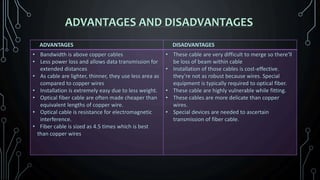
ADVANTAGES AND DISADVANTAGES
ADVANTAGES DISADVANTAGES
• Bandwidth is above copper cables
• Less power loss and allows data transmission for
extended distances
• As cable are lighter, thinner, they use less area as
compared to copper wires
• Installation is extremely easy due to less weight.
• Optical fiber cable are often made cheaper than
equivalent lengths of copper wire.
• Optical cable is resistance for electromagnetic
interference.
• Fiber cable is sized as 4.5 times which is best
than copper wires
• These cable are very difficult to merge so there’ll
be loss of beam within cable
• Installation of those cables is cost-effective.
they’re not as robust because wires. Special
equipment is typically required to optical fiber.
• These cable are highly vulnerable while fitting.
• These cables are more delicate than copper
wires.
• Special devices are needed to ascertain
transmission of fiber cable.
APPLICATIONS
Fibers can be used under sea communication
Fibers are used in military applications such as aircrafts, ships , tanks etc.
Fibers are used in public utility organization like railways, TV transmission etc.
Fibers are used in LAN systems of offices, industrial, plants and colleges etc.
Fibers are used in telecommunication such as voice telephones, video phones
telegraph services, message services and data network.
THANK YOU

LASERS.pptx

  • 1.
  • 3.
  • 4.
    WHAT ARE LASERS? The word LASER is an acronym for Light Amplification through Stimulated Emission of Radiation. It is a device that emits light through a process of optical amplification. A laser differs from other sources of light, it emits light that is: • Monochromatic • Coherent • Collimated
  • 5.
    PARTS OF ALASER 3 main components are:  Gain Medium: Can be a solid, liquid or a gas.  Pump: An energy source.  Optical Resonator: A cavity containing the lasing medium and 2 parallel
  • 6.
    WORKING OF ALASER Some of the electrons in the high-energy orbit spontaneously return to the ground state, releasing the difference in energy in the form of a photon, with a wavelength which depends exactly upon the difference in energy of the 2 states and has a random phase and direction. This process is called Spontaneous Emission. This emitted photon can collide with one of the mirrors in the resonating cavity and reflect back into the lasing medium causing further collision with some of the already excited atoms. This process id Stimulated Emission. A cascade effect of stimulated emission of photons occurs, resulting in further amplification and soon many of the atoms emit light along the same axis. This is called Population Inversion. A small number of photons are allowed to escape from the lasing medium though the partially reflective mirror of the output coupler.
  • 7.
  • 9.
    TYPES OF LASERS GasLasers Fibre Lasers Liquid Lasers Semiconductor Lasers
  • 10.
    GAS LASERS • Alaser in which an electric current is discharged through a gas to produce coherent light. • Different type of gases for different purposes. • Examples: o 𝑪𝑶𝟐 laser - Cutting & Welding. oHeNe laser - Oscillates over 160 wavelengths. LIQUID LASERS • A laser which uses liquids as an active medium. The liquids are also called as dyes. • Some commonly used dyes are: Sodium, Fluorescein, Rhodamine B and Rhodamine 6G. • These lasers are commonly used for medical purpose as a research tool.
  • 11.
    FIBER LASERS • Lightis guided due to the total internal reflection in a single mode optical fibre. • Erbium and Ytterbium ions are common active species in such lasers. • Used for cutting, marking welding, cleaning and texturing. SEMICONDUCTOR LASERS • These lasers are diodes that are electrically pumped. • Recombination of charge carriers brings optical gain. Reflection from ends of crystal forms an optical resonator. • Used for transmitting digital data since it can pulsate and for Optic cable communication.
  • 12.
  • 13.
    INTRODUCTION An fiber opticor optical fiber is a flexible , transparent fiber made of high quality glass (silica) or plastic , slightly thicker than a human hair. Optical fibers are widely used in fiber-optic communications, which permits transmission over longer distances and at higher bandwidths (data rates) than other forms of communication. Fibers are used instead of metal wires because signals travel along them with less loss and are also safe to electromagnetic interference.
  • 14.
    It consists ofa core and cladding that surrounds the core. The index of refraction of the cladding is less than that of the core, causing rays of light leaving the core to be refracted back into the core. There is a Buffer Jacket that protects fiber cable from moisture. There is silicon coating between Buffer Jacket and cladding to improve the quality of transmission of light. Strength member is to provide necessary toughness and strength. Outer Jacket is to protect fiber cable during pulling bending and stretching.
  • 16.
    TOTAL INTERNAL REFLECTION •Optical fibers work on the principle of total internal reflection • With light, the refractive index is listed • The angle of refraction at the interface between two media is given by Snell’s law:
  • 18.
    ADVANTAGES AND DISADVANTAGES ADVANTAGESDISADVANTAGES • Bandwidth is above copper cables • Less power loss and allows data transmission for extended distances • As cable are lighter, thinner, they use less area as compared to copper wires • Installation is extremely easy due to less weight. • Optical fiber cable are often made cheaper than equivalent lengths of copper wire. • Optical cable is resistance for electromagnetic interference. • Fiber cable is sized as 4.5 times which is best than copper wires • These cable are very difficult to merge so there’ll be loss of beam within cable • Installation of those cables is cost-effective. they’re not as robust because wires. Special equipment is typically required to optical fiber. • These cable are highly vulnerable while fitting. • These cables are more delicate than copper wires. • Special devices are needed to ascertain transmission of fiber cable.
  • 19.
    APPLICATIONS Fibers can beused under sea communication Fibers are used in military applications such as aircrafts, ships , tanks etc. Fibers are used in public utility organization like railways, TV transmission etc. Fibers are used in LAN systems of offices, industrial, plants and colleges etc. Fibers are used in telecommunication such as voice telephones, video phones telegraph services, message services and data network.
  • 20.