Network Management
for Wireless Sensor Networks
Zena Mohammed
Network Management Requirements
Example of Management Architecture: MANNA
Other Issues Related to Network Management
• Naming
• Localization
Outline
Introduction
Traditional Network Management Models
Network Management Design Issues
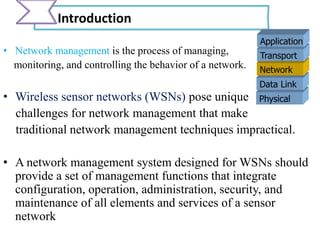
• Network management is the process of managing,
monitoring, and controlling the behavior of a network.
• Wireless sensor networks (WSNs) pose unique
challenges for network management that make
traditional network management techniques impractical.
• A network management system designed for WSNs should
provide a set of management functions that integrate
configuration, operation, administration, security, and
maintenance of all elements and services of a sensor
network
Introduction
Physical
Data Link
Network
Transport
Application
A computer communication network generally consists of three
components:
o Physical devices
• Links (wireless or wired link),
• Network nodes (hub, bridge, switch, or router), and
• Terminals and Servers;
o Protocol; and
o Information that is being carried, including applications.
The collaboration of physical devices and network protocols forms the
underpinning support for the applications. However, the physical devices and
protocols are not sufficient to support effective operation of a communications
network; network management (NM) tools and techniques are also required to
help provision network services and ensure cooperation of entities in the
network.
Network Management Requirements
the reasons for management functions are manifold
and may be summarized as follows:
1. There are many heterogeneous devices and software entities that
comprise the network, and some may fail.
2. Optimization of system performance as a distributed system require
NM to collaborate in the process.
3. For most networks, NM functions can be used to gather and analyze
the behavior of user interaction during network interface, which is
very important in planning the long-term evolution of network
capacity and its performance.
3.1Simple Network Management Protocol
 For managing networks, SNMP is broadly use today.
 It includes three components:
 Network Management System (NMS),
 Managed Elements, and
 Agents.
Role of NMS :
o NMS is a set of applications that monitor and/or control managed elements.
o NMS can request management information/attributes from the agent.
o NMS present the results to NM users in figures/tables form.
o NMS can also set attributes within the agent.
Traditional Network Management Models
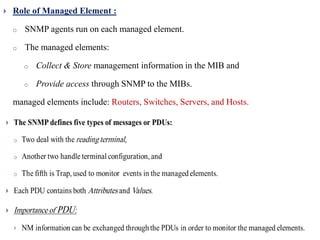
 Role of Managed Element :
o SNMP agents run on each managed element.
o The managed elements:
o Collect & Store management information in the MIB and
o Provide access through SNMP to the MIBs.
managed elements include: Routers, Switches, Servers, and Hosts.
Advantages of SNMP:
o Its very simple and widely deployment.
o In SNMP version 3 it can obtain more information by a pair of PDUs such as
(GetBulkRequest and GetResponse).
Disadvantages of SNMP :
o It consumes considerable bandwidth since it often gets only one piece of
management information at a time: GetRequest (GetNextRequest) and
GetResponse.
o Due to the usually large number of managed elements, large bandwidth
consumption still exists.
o It only manages network elements; it does not support network-level
management.
3.2 Telecom Operation Map
o It is based on the Service management Network management process models.
o TOM presents a model for telecommunications management for network and service
management and a view of ‘‘operations.’’
o IDEA: To introduce processes comprising operations and their automation.
o TOM only provides a framework for service management.
Levels / Layers
o Horizontally Layers for service management
o Service Fulfilment,
o Service Assurance, and
o Service Billing.
o Vertical Layers for service management:
o Network and Systems Management,
o Service Development and Operations, and
• Several issues must be addressed carefully before designing
network management tools for WSNs. To begin with, the
management functions required for WSNs should first be identified
Basic Issues:
o Power efficiency
o Data centric
o Data aggregation
o Attribute-based Addressing
o Locationing systems, and
o External Networks
Network Management Design Issues
Which factors should be consider while designing a
Network Management Protocol ?
o Management solutions should be energy efficient, using as little wireless
bandwidth as possible since communication is highly energy demanding.
o Management solutions should be scalable. This is especially important
since it future WSNs may consist of tens to thousands of nodes.
o Management solutions should be simple and practical since WSNs are
resource-constrained distributed systems.
o MIB for WSNs should contain a general information model for sensor nodes,
features of WSNs, and WSN applications.
o Management solutions for WSNs should provide a general interface
to the applications since applications can perform better when able to access
management information.
o Management solutions should be implementable as middleware.
WSN Communications Architecture
Sensor field
Sensor nodes
Internet
Sink
Manager Node
Sensing node
Sensor nodes can be
data originators and
data routers
• MANNA (a Management Architecture for Wireless Sensor Networks ) is a policy-
based management system that collects dynamic management information , maps
this into WSN models, and executes management functions and services based on
WSN models.
MANNA defines the following managed object classes:
1. Network (information on network behavior and features such as data delivery
model, network structure, and mobility)
2. Managed Elements(such as sensor nodes)
3. Equipment (the physical components of sensor nodes)
4. System (information on operating system)
5. Environment (the environment the WSN is running),
6. Phenomenon, and
7. Connection.
. Example of Management Architecture: MANNA
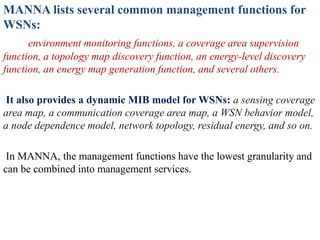
MANNA lists several common management functions for
WSNs:
environment monitoring functions, a coverage area supervision
function, a topology map discovery function, an energy-level discovery
function, an energy map generation function, and several others.
It also provides a dynamic MIB model for WSNs: a sensing coverage
area map, a communication coverage area map, a WSN behavior model,
a node dependence model, network topology, residual energy, and so on.
In MANNA, the management functions have the lowest granularity and
can be combined into management services.
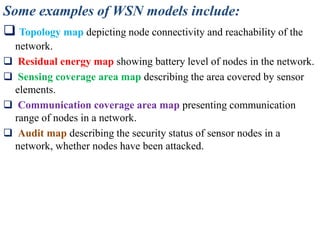
Some examples of WSN models include:
 Topology map depicting node connectivity and reachability of the
network.
 Residual energy map showing battery level of nodes in the network.
 Sensing coverage area map describing the area covered by sensor
elements.
 Communication coverage area map presenting communication
range of nodes in a network.
 Audit map describing the security status of sensor nodes in a
network, whether nodes have been attacked.
There are several other issues related to sensor network management,
the most important being
o naming,
o localization,
o maintenance, and
o fault tolerance.
. Other Issues Related to Network Management
 Naming is the scheme used to identify a sensor node.
An efficient naming scheme can lower computation overhead and make routing
protocol energy efficient.
 Localization schemes determine the location of sensor nodes since such
information is important for some sensor applications.
 The maintenance issue may involve actions such as replacing batteries, keeping
connectivity, and configuring sensor nodes.
-The maintenance activity is used to maintain normal operation of the entire
network for as long as possible.
 Several factors can cause faults in network operation, including hardware and
software error. Therefore, different schemes must be implemented to provide fault
tolerance.
4.1 Naming
Naming is the scheme used to identify a sensor node.
• An efficient naming scheme can lower computation overhead
and make routing protocol energy efficient.
There are two traditional approaches to naming:
o low level: naming such as node addresses is typically
application independent but topology and location dependent
o high level: naming is usually application dependent
and location independent.
High-level naming is built on the top of low-level naming.
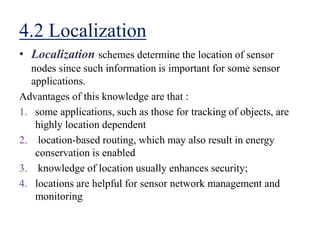
4.2 Localization
• Localization schemes determine the location of sensor
nodes since such information is important for some sensor
applications.
Advantages of this knowledge are that :
1. some applications, such as those for tracking of objects, are
highly location dependent
2. location-based routing, which may also result in energy
conservation is enabled
3. knowledge of location usually enhances security;
4. locations are helpful for sensor network management and
monitoring
5. locations stimulate the creation of new applications
6. sensor nodes that move can be controlled through knowledge of their
location and
7. for applications with low-level naming and/or data-centric WSNs,
knowledge of location information is absolutely necessary.
• Localization classification
Localization Algorithm
Centralized Schemes Distributed Schemes
Range-free SchemesRange-based Scheme
o Centralized Scheme
o In this scheme Sensor nodes send control messages to a central node whose
location is known.
o The central node then computes the location of every sensor node and informs the
nodes of their locations.
o Distributed Scheme
o Each sensor node determines its own location independently.
o The distributed localization can be further grouped into:
o Range-based schemes and
o Range-free schemes.
o In the range-based approach, some range information, such as time of arrival,
angle of arrival, or time difference of arrival is required.
o The range-free algorithms works as follows:
o Several seed nodes are distributed in WSNs.
o Seed nodes know their own locations, and they periodically broadcast a control
message with their location information.
o Sensor nodes that receive these control messages can then estimate their own
locations.
CLUSTERING IN WSN
• Clusters: grouping of sensors that performing similar tasks are
known as clusters.
• Hierarchical clustering is the efficient way to utilize the energy in an
efficient manner.
• In hierarchical cluster, it contains Cluster Head, Regular Nodes and
Base Station.
• After the cluster head is selected, it collects the data from all of its
member nodes and aggregates it in order to eliminate the redundancy.
Thus it limits the amount of data transmission to Base Station, hence
remaining energy level is increased and network lifetime is
maximized.
• the optimal number of cluster head that would lead to minimize the
average energy spends in the network for each round.
Cluster-head Election using Fuzzy Logic for
Wireless Sensor Networks
• Cluster Head (CH) election is the process to select a node within the
cluster as a leader node. A CH is responsible for not only the general
request but also assisting the general nodes to route the sensed data to
the target nodes.
• A Fuzzy Logic approach to cluster-head election is proposed based on
four descriptors:
– remain energy - energy level available in each node
– concentration - number of nodes present in the local distance r
vicinity
– centrality- a value which classifies the nodes based the energy
concentration on cluster heads is distributed.
– neighbor distance -the sum of distances between the node and the
nodes which is within r distance
Fuzzy c-means algorithm: the fuzzy c-means (FCM)
algorithm is one of the most widely used methods in fuzzy
clustering.
• An extension of k-means
• Hierarchical, k-means generates partitions
– each data point can only be assigned in one cluster
• Fuzzy c-means allows data points to be assigned
into more than one cluster
– each data point has a degree of membership (or
probability) of belonging to each cluster
Fuzzy C Means Algorithm
Worked out Example
• Input: Number of Objects = 6 Number of clusters = 2
X Y C1 C2
1 6 0.8 0.2
2 5 0.9 0.1
3 8 0.7 0.3
4 4 0.3 0.7
5 7 0.5 0.5
6 9 0.2 0.8
Cluster 1 Cluster 2
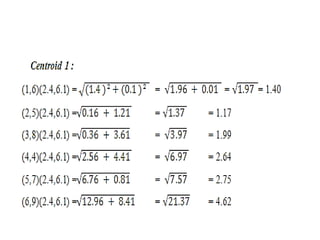
Datapoint Distance Datapoint Distance
(1,6) 1.40 (1,6) 3.88
(2,5) 1.17 (2,5) 3.32
(3,8) 1.99 (3,8) 2.16
(4,4) 2.64 (4,4) 2.91
(5,7) 2.75 (5,7) 0.28
(6,9) 4.62 (6,9) 2.50
• Now the New Membership value is
Step 5 : Now continue this process until get the same
centroids.
X Y C1 C2
1 6 0.7 0.3
2 5 0.6 0.4
3 8 0.5 0.5
4 4 0.5 0.5
5 7 0.1 0.9
6 9 0.3 0.7
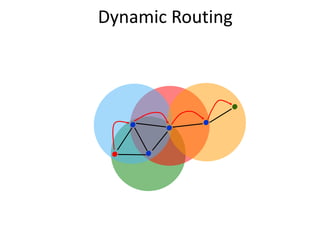
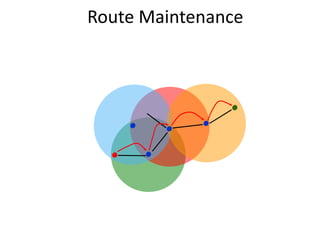
Dynamic Topology
Node mobility has a great
effect on the designing of
routing protocols
Node mobility creates a
dynamic topology, i.e.,
changes in the connectivity
between the nodes
Mobility in Ad Hoc Networks
Dynamic Routing
Route Maintenance
• .
A node senses something “interesting”Neighbor sends a REQ listing all of the data
it would like to acquire
Sensor broadcasts dataNeighbors aggregate data and broadcast
(advertise) meta-data
SPIN-BC
The process repeats itself across the network
DATA
REQ
ADV
It sends meta-data to neighbors
• .
SPIN-BC
I am tired
I need to
sleep …
Advertise meta-data
Request data
Send data
Advertise
Advertise
Nodes do need not to
participate in the
process
Request data
Send data
Send data
Advertise
meta-data
Request data
Send data
Gradient represents both direction towards data matching
and status of demand with desired update rate
Probability  1/energy cost
The choice of path is made locally at every node for
every packet
Uses application-aware communication primitives
expressed in terms of named data
Consumer of data initiates interest in data with certain
attributes
Nodes diffuse the interest towards producers via a
sequence of local interactions
This process sets up gradients in the network to draw
events matching the interest
Collect energy metrics along the wayEvery route has a probability of being chosen
Directed Diffusion
Sink
Source
Four-legged
animal
Reinforcement and negative reinforcement used
to converge to efficient distribution
Has built-in tolerance to nodes moving
out of range or dying
Directed Diffusion
Source
Sink
Some Applications of WSNs
Battlefield
Detection, classification and tracking
Examples: AWAIRS
(UCLA & Rockwell Science Center)
Examples:
ZebraNet (Princeton)
Seabird monitoring in Maine’s Great
Duck Island (Berkeley & Intel)
Habitat Monitoring Micro-climate and wildlife monitoring
Some Applications of WSNs
 Structural, seismic
Bridges, highways, buildings
Examples: Coronado Bridge San Diego
(UCSD), Factory Building (UCLA)
 Smart roads
Traffic monitoring, accident detection,
recovery assistance
Examples: ATON project (UCSD)
highway
camera microphone
 Contaminants detection
Examples: Multipurpose Sensor Program
(Boise State University)

Network Mnagement for WSN

  • 1.
    Network Management for WirelessSensor Networks Zena Mohammed
  • 2.
    Network Management Requirements Exampleof Management Architecture: MANNA Other Issues Related to Network Management • Naming • Localization Outline Introduction Traditional Network Management Models Network Management Design Issues
  • 3.
    • Network managementis the process of managing, monitoring, and controlling the behavior of a network. • Wireless sensor networks (WSNs) pose unique challenges for network management that make traditional network management techniques impractical. • A network management system designed for WSNs should provide a set of management functions that integrate configuration, operation, administration, security, and maintenance of all elements and services of a sensor network Introduction Physical Data Link Network Transport Application
  • 4.
    A computer communicationnetwork generally consists of three components: o Physical devices • Links (wireless or wired link), • Network nodes (hub, bridge, switch, or router), and • Terminals and Servers; o Protocol; and o Information that is being carried, including applications. The collaboration of physical devices and network protocols forms the underpinning support for the applications. However, the physical devices and protocols are not sufficient to support effective operation of a communications network; network management (NM) tools and techniques are also required to help provision network services and ensure cooperation of entities in the network. Network Management Requirements
  • 5.
    the reasons formanagement functions are manifold and may be summarized as follows: 1. There are many heterogeneous devices and software entities that comprise the network, and some may fail. 2. Optimization of system performance as a distributed system require NM to collaborate in the process. 3. For most networks, NM functions can be used to gather and analyze the behavior of user interaction during network interface, which is very important in planning the long-term evolution of network capacity and its performance.
  • 6.
    3.1Simple Network ManagementProtocol  For managing networks, SNMP is broadly use today.  It includes three components:  Network Management System (NMS),  Managed Elements, and  Agents. Role of NMS : o NMS is a set of applications that monitor and/or control managed elements. o NMS can request management information/attributes from the agent. o NMS present the results to NM users in figures/tables form. o NMS can also set attributes within the agent. Traditional Network Management Models
  • 7.
     Role ofManaged Element : o SNMP agents run on each managed element. o The managed elements: o Collect & Store management information in the MIB and o Provide access through SNMP to the MIBs. managed elements include: Routers, Switches, Servers, and Hosts.
  • 8.
    Advantages of SNMP: oIts very simple and widely deployment. o In SNMP version 3 it can obtain more information by a pair of PDUs such as (GetBulkRequest and GetResponse). Disadvantages of SNMP : o It consumes considerable bandwidth since it often gets only one piece of management information at a time: GetRequest (GetNextRequest) and GetResponse. o Due to the usually large number of managed elements, large bandwidth consumption still exists. o It only manages network elements; it does not support network-level management.
  • 9.
    3.2 Telecom OperationMap o It is based on the Service management Network management process models. o TOM presents a model for telecommunications management for network and service management and a view of ‘‘operations.’’ o IDEA: To introduce processes comprising operations and their automation. o TOM only provides a framework for service management. Levels / Layers o Horizontally Layers for service management o Service Fulfilment, o Service Assurance, and o Service Billing. o Vertical Layers for service management: o Network and Systems Management, o Service Development and Operations, and
  • 10.
    • Several issuesmust be addressed carefully before designing network management tools for WSNs. To begin with, the management functions required for WSNs should first be identified Basic Issues: o Power efficiency o Data centric o Data aggregation o Attribute-based Addressing o Locationing systems, and o External Networks Network Management Design Issues
  • 11.
    Which factors shouldbe consider while designing a Network Management Protocol ? o Management solutions should be energy efficient, using as little wireless bandwidth as possible since communication is highly energy demanding. o Management solutions should be scalable. This is especially important since it future WSNs may consist of tens to thousands of nodes. o Management solutions should be simple and practical since WSNs are resource-constrained distributed systems. o MIB for WSNs should contain a general information model for sensor nodes, features of WSNs, and WSN applications. o Management solutions for WSNs should provide a general interface to the applications since applications can perform better when able to access management information. o Management solutions should be implementable as middleware.
  • 12.
    WSN Communications Architecture Sensorfield Sensor nodes Internet Sink Manager Node Sensing node Sensor nodes can be data originators and data routers
  • 13.
    • MANNA (aManagement Architecture for Wireless Sensor Networks ) is a policy- based management system that collects dynamic management information , maps this into WSN models, and executes management functions and services based on WSN models. MANNA defines the following managed object classes: 1. Network (information on network behavior and features such as data delivery model, network structure, and mobility) 2. Managed Elements(such as sensor nodes) 3. Equipment (the physical components of sensor nodes) 4. System (information on operating system) 5. Environment (the environment the WSN is running), 6. Phenomenon, and 7. Connection. . Example of Management Architecture: MANNA
  • 14.
    MANNA lists severalcommon management functions for WSNs: environment monitoring functions, a coverage area supervision function, a topology map discovery function, an energy-level discovery function, an energy map generation function, and several others. It also provides a dynamic MIB model for WSNs: a sensing coverage area map, a communication coverage area map, a WSN behavior model, a node dependence model, network topology, residual energy, and so on. In MANNA, the management functions have the lowest granularity and can be combined into management services.
  • 15.
    Some examples ofWSN models include:  Topology map depicting node connectivity and reachability of the network.  Residual energy map showing battery level of nodes in the network.  Sensing coverage area map describing the area covered by sensor elements.  Communication coverage area map presenting communication range of nodes in a network.  Audit map describing the security status of sensor nodes in a network, whether nodes have been attacked.
  • 16.
    There are severalother issues related to sensor network management, the most important being o naming, o localization, o maintenance, and o fault tolerance. . Other Issues Related to Network Management
  • 17.
     Naming isthe scheme used to identify a sensor node. An efficient naming scheme can lower computation overhead and make routing protocol energy efficient.  Localization schemes determine the location of sensor nodes since such information is important for some sensor applications.  The maintenance issue may involve actions such as replacing batteries, keeping connectivity, and configuring sensor nodes. -The maintenance activity is used to maintain normal operation of the entire network for as long as possible.  Several factors can cause faults in network operation, including hardware and software error. Therefore, different schemes must be implemented to provide fault tolerance.
  • 18.
    4.1 Naming Naming isthe scheme used to identify a sensor node. • An efficient naming scheme can lower computation overhead and make routing protocol energy efficient. There are two traditional approaches to naming: o low level: naming such as node addresses is typically application independent but topology and location dependent o high level: naming is usually application dependent and location independent. High-level naming is built on the top of low-level naming.
  • 19.
    4.2 Localization • Localizationschemes determine the location of sensor nodes since such information is important for some sensor applications. Advantages of this knowledge are that : 1. some applications, such as those for tracking of objects, are highly location dependent 2. location-based routing, which may also result in energy conservation is enabled 3. knowledge of location usually enhances security; 4. locations are helpful for sensor network management and monitoring
  • 20.
    5. locations stimulatethe creation of new applications 6. sensor nodes that move can be controlled through knowledge of their location and 7. for applications with low-level naming and/or data-centric WSNs, knowledge of location information is absolutely necessary.
  • 21.
    • Localization classification LocalizationAlgorithm Centralized Schemes Distributed Schemes Range-free SchemesRange-based Scheme
  • 22.
    o Centralized Scheme oIn this scheme Sensor nodes send control messages to a central node whose location is known. o The central node then computes the location of every sensor node and informs the nodes of their locations. o Distributed Scheme o Each sensor node determines its own location independently. o The distributed localization can be further grouped into: o Range-based schemes and o Range-free schemes.
  • 23.
    o In therange-based approach, some range information, such as time of arrival, angle of arrival, or time difference of arrival is required. o The range-free algorithms works as follows: o Several seed nodes are distributed in WSNs. o Seed nodes know their own locations, and they periodically broadcast a control message with their location information. o Sensor nodes that receive these control messages can then estimate their own locations.
  • 24.
    CLUSTERING IN WSN •Clusters: grouping of sensors that performing similar tasks are known as clusters. • Hierarchical clustering is the efficient way to utilize the energy in an efficient manner. • In hierarchical cluster, it contains Cluster Head, Regular Nodes and Base Station. • After the cluster head is selected, it collects the data from all of its member nodes and aggregates it in order to eliminate the redundancy. Thus it limits the amount of data transmission to Base Station, hence remaining energy level is increased and network lifetime is maximized. • the optimal number of cluster head that would lead to minimize the average energy spends in the network for each round.
  • 25.
    Cluster-head Election usingFuzzy Logic for Wireless Sensor Networks • Cluster Head (CH) election is the process to select a node within the cluster as a leader node. A CH is responsible for not only the general request but also assisting the general nodes to route the sensed data to the target nodes. • A Fuzzy Logic approach to cluster-head election is proposed based on four descriptors: – remain energy - energy level available in each node – concentration - number of nodes present in the local distance r vicinity – centrality- a value which classifies the nodes based the energy concentration on cluster heads is distributed. – neighbor distance -the sum of distances between the node and the nodes which is within r distance
  • 26.
    Fuzzy c-means algorithm:the fuzzy c-means (FCM) algorithm is one of the most widely used methods in fuzzy clustering. • An extension of k-means • Hierarchical, k-means generates partitions – each data point can only be assigned in one cluster • Fuzzy c-means allows data points to be assigned into more than one cluster – each data point has a degree of membership (or probability) of belonging to each cluster
  • 27.
    Fuzzy C MeansAlgorithm
  • 28.
    Worked out Example •Input: Number of Objects = 6 Number of clusters = 2 X Y C1 C2 1 6 0.8 0.2 2 5 0.9 0.1 3 8 0.7 0.3 4 4 0.3 0.7 5 7 0.5 0.5 6 9 0.2 0.8
  • 33.
    Cluster 1 Cluster2 Datapoint Distance Datapoint Distance (1,6) 1.40 (1,6) 3.88 (2,5) 1.17 (2,5) 3.32 (3,8) 1.99 (3,8) 2.16 (4,4) 2.64 (4,4) 2.91 (5,7) 2.75 (5,7) 0.28 (6,9) 4.62 (6,9) 2.50
  • 38.
    • Now theNew Membership value is Step 5 : Now continue this process until get the same centroids. X Y C1 C2 1 6 0.7 0.3 2 5 0.6 0.4 3 8 0.5 0.5 4 4 0.5 0.5 5 7 0.1 0.9 6 9 0.3 0.7
  • 39.
    Dynamic Topology Node mobilityhas a great effect on the designing of routing protocols Node mobility creates a dynamic topology, i.e., changes in the connectivity between the nodes
  • 40.
    Mobility in AdHoc Networks
  • 41.
  • 42.
  • 43.
    • . A nodesenses something “interesting”Neighbor sends a REQ listing all of the data it would like to acquire Sensor broadcasts dataNeighbors aggregate data and broadcast (advertise) meta-data SPIN-BC The process repeats itself across the network DATA REQ ADV It sends meta-data to neighbors
  • 44.
    • . SPIN-BC I amtired I need to sleep … Advertise meta-data Request data Send data Advertise Advertise Nodes do need not to participate in the process Request data Send data Send data Advertise meta-data Request data Send data
  • 45.
    Gradient represents bothdirection towards data matching and status of demand with desired update rate Probability  1/energy cost The choice of path is made locally at every node for every packet Uses application-aware communication primitives expressed in terms of named data Consumer of data initiates interest in data with certain attributes Nodes diffuse the interest towards producers via a sequence of local interactions This process sets up gradients in the network to draw events matching the interest Collect energy metrics along the wayEvery route has a probability of being chosen Directed Diffusion Sink Source Four-legged animal
  • 46.
    Reinforcement and negativereinforcement used to converge to efficient distribution Has built-in tolerance to nodes moving out of range or dying Directed Diffusion Source Sink
  • 47.
    Some Applications ofWSNs Battlefield Detection, classification and tracking Examples: AWAIRS (UCLA & Rockwell Science Center) Examples: ZebraNet (Princeton) Seabird monitoring in Maine’s Great Duck Island (Berkeley & Intel) Habitat Monitoring Micro-climate and wildlife monitoring
  • 48.
    Some Applications ofWSNs  Structural, seismic Bridges, highways, buildings Examples: Coronado Bridge San Diego (UCSD), Factory Building (UCLA)  Smart roads Traffic monitoring, accident detection, recovery assistance Examples: ATON project (UCSD) highway camera microphone  Contaminants detection Examples: Multipurpose Sensor Program (Boise State University)