PRESENTED BY,
P. Divya,
Reg.No: 16304005,
M.Tech – 1st year,
Department of Electronics Enginerring,
Poundicherry University.
1
ADAPTIVE LINEAR
EQUALIZER
2
Adaptive linear equalization
 The equalizers are designed to be adjustable to the channel
response and for time variant channels to be adaptive to the
time variations in the channel response .
 Typically employed in high-speed communication systems,
which do not use differential modulation schemes or
frequency division multiplexing.
3
Cont…
 The equalizer is the most expensive component of a data
demodulator and can consume over 80% of the total
computations needed to demodulate a given signal .
 Adaptive equalizers compensate for signal distortion
attributed to inter-symbol interference (ISI), which is caused
by multipath within time-dispersive channels.
4
Time nature of adaptive linear equalizer
Adaptive filter assumes that the channel is time variant and tries
to design an equalizer filter whose coefficients are also time
variant according to the change of the channel and also try to
eliminate ISI and additive noise at each time . The implicit
assumption of adaptive equalizer is that the channel is varying
slowly.
5
Linear vs. non-linear equalizer
techniques
Two general categories
 linear
 nonlinear equalization
Linear:
No feedback path to adapt the equalizer , the equalization is linear.
Non linear:
feed back to change the subsequent outputs of the equalizer the
equalization is non-linear.
6
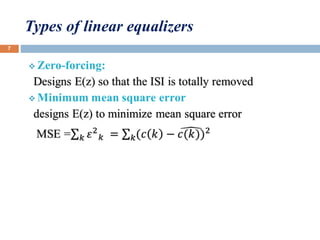
Types of linear equalizers
7
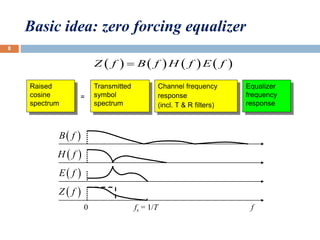
Basic idea: zero forcing equalizer
Raised
cosine
spectrum
Transmitted
symbol
spectrum
Channel frequency
response
(incl. T & R filters)
Equalizer
frequency
response
=
       Z f B f H f E f
0 ffs = 1/T
 B f
 H f
 E f
 Z f
8
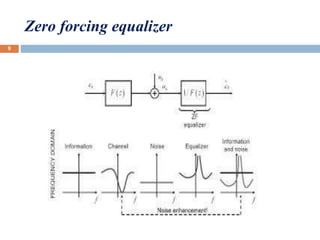
Zero forcing equalizer
9
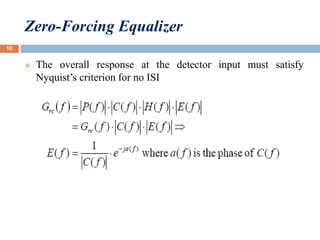
Zero-Forcing Equalizer
 The overall response at the detector input must satisfy
Nyquist’s criterion for no ISI
10
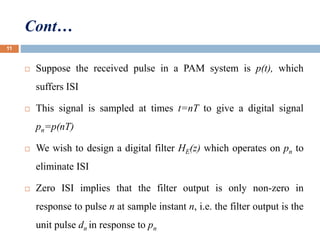
Cont…
 Suppose the received pulse in a PAM system is p(t), which
suffers ISI
 This signal is sampled at times t=nT to give a digital signal
pn=p(nT)
 We wish to design a digital filter HE(z) which operates on pn to
eliminate ISI
 Zero ISI implies that the filter output is only non-zero in
response to pulse n at sample instant n, i.e. the filter output is the
unit pulse dn in response to pn
11
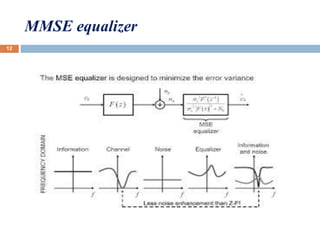
MMSE equalizer
12
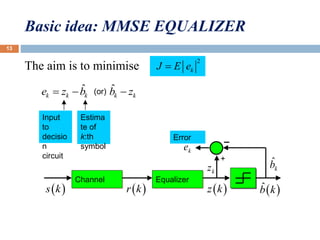
Basic idea: MMSE EQUALIZER
The aim is to minimise
2
kJ E e
ˆ ˆ
k k k k ke z b b z  (or)
EqualizerChannel
kz
ˆ
kb
ke
 r k s k
+
Estima
te of
k:th
symbol
Input
to
decisio
n
circuit
 z k  ˆb k
Error
13
Cont…
MMSE formulation
HE(z)
xn yn
an
- E[(.)2]
For a ‘fixed’ equaliser E[(.)2] is minimised by adjusting the
coefficients of HE(z). Effectively we have a trade off between
noise enhancement and ISI.
14
Cont….
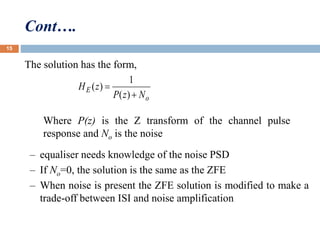
The solution has the form,
o
E
NzP
zH


)(
1
)(
– equaliser needs knowledge of the noise PSD
– If No=0, the solution is the same as the ZFE
– When noise is present the ZFE solution is modified to make a
trade-off between ISI and noise amplification
Where P(z) is the Z transform of the channel pulse
response and No is the noise
15
Advantages and disadvantages of adaptive
linear equalizer
Advantages:
 Optimal approximation for the Channel- once
calculated it could feed the Equalizer taps.
Disadvantages:
 Heavy processing( due to matrix inversion which
itself is a challenge)
 Not adaptive ( calculated periodically which is not
good for varying channels)
16
Applications of adaptive equalizer
 Noise cancellation
 Hands- free earphones
 Aircraft headphones
17
18
Introduction
 In digital communication , increasing data rates
through band limited channels introduce inter
symbol interference.
 (ISI) drastically deteriorates the received signal.
 It is necessary for the optimal receiver to deal with this
phenomenon in order to achieve acceptable
performance.
19
 In digital communication, turbo equalizer is a type
of receiver used to receive a message corrupted by a
communication channel with inter symbol interference.
 Turbo equalizer uses turbo codes.
 Turbo equalizer is also called turbo decoder if the channel is
viewed as convolution code.
Cont …
20
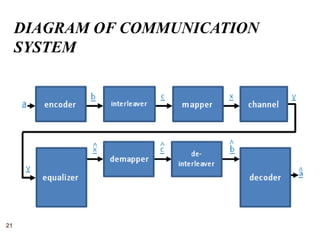
DIAGRAM OF COMMUNICATION
SYSTEM
21
Overview
 The basic element In transmitter contains-
1.Encoder 2.Interleaver
3.Mapper 4.channel
ENCODER - It takes binary data sequence and produce output
which contains redundant information in addition with the data
which protect it from error during transmission. Here
redundant information is produced by convolution codes.
22
Interleaver
 The goal of forward error correction code is to protect the data
from single bit error or short burst error that occur due to noise
in the channel. To ensure that such error occur at random and
to avoid long burst error interleaver is used to randomize order
of code bit before transmission.
23
Mapper
 The process of mapping binary bits into channel is done by mapper. In
this binary data are converted into electrical signal then it is mapped
into channel.
 The above method of data transmission does not work well because
while passing the data through channel the problem of inter symbol
interference . When the channel is dispersive in nature the receiver need
to compensate the channel effect before applying decoding algorithm
to ECC. This channel equalization technique reduces ISI.
24
Receiver section
 Receiver has the task of optimally estimating the data that was
transmitted.
 Receiver estimate the data such that there is minimum bit error rate.
Receiver takes into account the ECC, the inter leaver, the symbol
mapping, and knowledge of the channel. With so many factors
involved, the complexity of receiver increases.
 The complexity increases exponentially as length of data increases.
25
 In most of the receiver, for observed data, channel effect is known
and then the estimate is made about transmitted channel symbol that
best fit the observed data.
 In this process for increasing the performance equalizer is used for
minimizing the mean square error and symbol error rate by
maximizing likelihood of the observation in the channel.
 Once the transmitted channel symbols have been estimated, they
can be de mapped into their associated code bits, deinterleaved, and
then decoded using a BER optimal decoder for the ECC.
Cont…
26
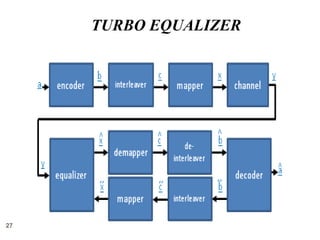
TURBO EQUALIZER
27
 The difference between a turbo equalizer and a
standard equalizer is the feedback loop from the
decoder to the equalizer.
 In turbo equalizer when soft information is passed
into algorithm such information is never formed
based on information passed into algorithm
concerning the same. Equalizer and decoder tells new
information to each other.
Cont…
28
The forward / backward algorithm
- 29
-
For Receiver , the Forward / Backward Algorithm is
often used for equalization and decoding.
As this algorithm is a basic building block for our
turbo equilization setup
• for equalization
• for decoding
Applications
 Turbo equalization can improve SC-FDMA performance .
It helps in transmission over frequency selective fading
channel.
 TURBO equalization receiver are used for GSM radio
access network using QAM modulation for overcoming
dispersion of prior information.
 Turbo equalization technique is used for packet data
transmission.
 Turbo equalization technique used for 8-psk modulation
scheme in mobile TDMA communication system.
30
CONCLUSION
 Turbo equalizer reduces inter symbol interference(ISI).
 MMSE approach reduces complexity .
 MMSE approach require few more iteration than BER
approach.
 MAP turbo equalizer can handle S/N ratio more than
other approaches.
31
32

linear equalizer and turbo equalizer

  • 1.
    PRESENTED BY, P. Divya, Reg.No:16304005, M.Tech – 1st year, Department of Electronics Enginerring, Poundicherry University. 1
  • 2.
  • 3.
    Adaptive linear equalization The equalizers are designed to be adjustable to the channel response and for time variant channels to be adaptive to the time variations in the channel response .  Typically employed in high-speed communication systems, which do not use differential modulation schemes or frequency division multiplexing. 3
  • 4.
    Cont…  The equalizeris the most expensive component of a data demodulator and can consume over 80% of the total computations needed to demodulate a given signal .  Adaptive equalizers compensate for signal distortion attributed to inter-symbol interference (ISI), which is caused by multipath within time-dispersive channels. 4
  • 5.
    Time nature ofadaptive linear equalizer Adaptive filter assumes that the channel is time variant and tries to design an equalizer filter whose coefficients are also time variant according to the change of the channel and also try to eliminate ISI and additive noise at each time . The implicit assumption of adaptive equalizer is that the channel is varying slowly. 5
  • 6.
    Linear vs. non-linearequalizer techniques Two general categories  linear  nonlinear equalization Linear: No feedback path to adapt the equalizer , the equalization is linear. Non linear: feed back to change the subsequent outputs of the equalizer the equalization is non-linear. 6
  • 7.
    Types of linearequalizers 7
  • 8.
    Basic idea: zeroforcing equalizer Raised cosine spectrum Transmitted symbol spectrum Channel frequency response (incl. T & R filters) Equalizer frequency response =        Z f B f H f E f 0 ffs = 1/T  B f  H f  E f  Z f 8
  • 9.
  • 10.
    Zero-Forcing Equalizer  Theoverall response at the detector input must satisfy Nyquist’s criterion for no ISI 10
  • 11.
    Cont…  Suppose thereceived pulse in a PAM system is p(t), which suffers ISI  This signal is sampled at times t=nT to give a digital signal pn=p(nT)  We wish to design a digital filter HE(z) which operates on pn to eliminate ISI  Zero ISI implies that the filter output is only non-zero in response to pulse n at sample instant n, i.e. the filter output is the unit pulse dn in response to pn 11
  • 12.
  • 13.
    Basic idea: MMSEEQUALIZER The aim is to minimise 2 kJ E e ˆ ˆ k k k k ke z b b z  (or) EqualizerChannel kz ˆ kb ke  r k s k + Estima te of k:th symbol Input to decisio n circuit  z k  ˆb k Error 13
  • 14.
    Cont… MMSE formulation HE(z) xn yn an -E[(.)2] For a ‘fixed’ equaliser E[(.)2] is minimised by adjusting the coefficients of HE(z). Effectively we have a trade off between noise enhancement and ISI. 14
  • 15.
    Cont…. The solution hasthe form, o E NzP zH   )( 1 )( – equaliser needs knowledge of the noise PSD – If No=0, the solution is the same as the ZFE – When noise is present the ZFE solution is modified to make a trade-off between ISI and noise amplification Where P(z) is the Z transform of the channel pulse response and No is the noise 15
  • 16.
    Advantages and disadvantagesof adaptive linear equalizer Advantages:  Optimal approximation for the Channel- once calculated it could feed the Equalizer taps. Disadvantages:  Heavy processing( due to matrix inversion which itself is a challenge)  Not adaptive ( calculated periodically which is not good for varying channels) 16
  • 17.
    Applications of adaptiveequalizer  Noise cancellation  Hands- free earphones  Aircraft headphones 17
  • 18.
  • 19.
    Introduction  In digitalcommunication , increasing data rates through band limited channels introduce inter symbol interference.  (ISI) drastically deteriorates the received signal.  It is necessary for the optimal receiver to deal with this phenomenon in order to achieve acceptable performance. 19
  • 20.
     In digitalcommunication, turbo equalizer is a type of receiver used to receive a message corrupted by a communication channel with inter symbol interference.  Turbo equalizer uses turbo codes.  Turbo equalizer is also called turbo decoder if the channel is viewed as convolution code. Cont … 20
  • 21.
  • 22.
    Overview  The basicelement In transmitter contains- 1.Encoder 2.Interleaver 3.Mapper 4.channel ENCODER - It takes binary data sequence and produce output which contains redundant information in addition with the data which protect it from error during transmission. Here redundant information is produced by convolution codes. 22
  • 23.
    Interleaver  The goalof forward error correction code is to protect the data from single bit error or short burst error that occur due to noise in the channel. To ensure that such error occur at random and to avoid long burst error interleaver is used to randomize order of code bit before transmission. 23
  • 24.
    Mapper  The processof mapping binary bits into channel is done by mapper. In this binary data are converted into electrical signal then it is mapped into channel.  The above method of data transmission does not work well because while passing the data through channel the problem of inter symbol interference . When the channel is dispersive in nature the receiver need to compensate the channel effect before applying decoding algorithm to ECC. This channel equalization technique reduces ISI. 24
  • 25.
    Receiver section  Receiverhas the task of optimally estimating the data that was transmitted.  Receiver estimate the data such that there is minimum bit error rate. Receiver takes into account the ECC, the inter leaver, the symbol mapping, and knowledge of the channel. With so many factors involved, the complexity of receiver increases.  The complexity increases exponentially as length of data increases. 25
  • 26.
     In mostof the receiver, for observed data, channel effect is known and then the estimate is made about transmitted channel symbol that best fit the observed data.  In this process for increasing the performance equalizer is used for minimizing the mean square error and symbol error rate by maximizing likelihood of the observation in the channel.  Once the transmitted channel symbols have been estimated, they can be de mapped into their associated code bits, deinterleaved, and then decoded using a BER optimal decoder for the ECC. Cont… 26
  • 27.
  • 28.
     The differencebetween a turbo equalizer and a standard equalizer is the feedback loop from the decoder to the equalizer.  In turbo equalizer when soft information is passed into algorithm such information is never formed based on information passed into algorithm concerning the same. Equalizer and decoder tells new information to each other. Cont… 28
  • 29.
    The forward /backward algorithm - 29 - For Receiver , the Forward / Backward Algorithm is often used for equalization and decoding. As this algorithm is a basic building block for our turbo equilization setup • for equalization • for decoding
  • 30.
    Applications  Turbo equalizationcan improve SC-FDMA performance . It helps in transmission over frequency selective fading channel.  TURBO equalization receiver are used for GSM radio access network using QAM modulation for overcoming dispersion of prior information.  Turbo equalization technique is used for packet data transmission.  Turbo equalization technique used for 8-psk modulation scheme in mobile TDMA communication system. 30
  • 31.
    CONCLUSION  Turbo equalizerreduces inter symbol interference(ISI).  MMSE approach reduces complexity .  MMSE approach require few more iteration than BER approach.  MAP turbo equalizer can handle S/N ratio more than other approaches. 31
  • 32.