UNIT-2
I. Introduction
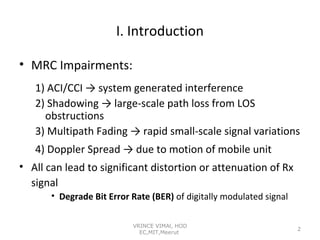
• MRC Impairments:
1) ACI/CCI → system generated interference
2) Shadowing → large-scale path loss from LOS
obstructions
3) Multipath Fading → rapid small-scale signal variations
4) Doppler Spread → due to motion of mobile unit
• All can lead to significant distortion or attenuation of Rx
signal
• Degrade Bit Error Rate (BER) of digitally modulated signal
VRINCE VIMAl, HOD
EC,MIT,Meerut

2
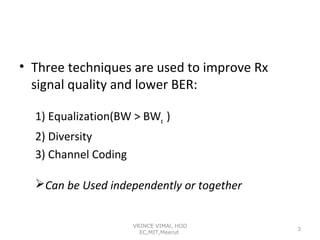
• Three techniques are used to improve Rx
signal quality and lower BER:
1) Equalization(BW > BWc )
2) Diversity
3) Channel Coding
Can be Used independently or together
VRINCE VIMAl, HOD
EC,MIT,Meerut

3
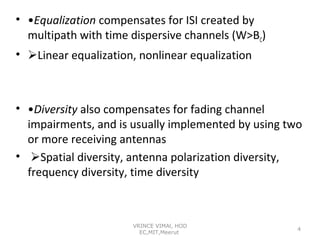
• •Equalization compensates for ISI created by
multipath with time dispersive channels (W>BC)
• Linear equalization, nonlinear equalization

• •Diversity also compensates for fading channel
impairments, and is usually implemented by using two
or more receiving antennas
• Spatial diversity, antenna polarization diversity,
frequency diversity, time diversity

VRINCE VIMAl, HOD
EC,MIT,Meerut

4
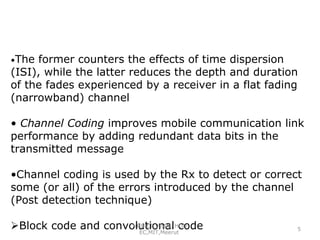
•The

former counters the effects of time dispersion
(ISI), while the latter reduces the depth and duration
of the fades experienced by a receiver in a flat fading
(narrowband) channel
• Channel Coding improves mobile communication link
performance by adding redundant data bits in the
transmitted message
•Channel coding is used by the Rx to detect or correct
some (or all) of the errors introduced by the channel
(Post detection technique)
VRINCE VIMAl, code
Block code and convolutionalHOD
EC,MIT,Meerut

5
Equalization Techniques
• The term equalization can be used to describe any signal
processing operation that minimizes ISI [2]
• Two operation modes for an adaptive equalizer: training
and tracking
•Three factors affect the time spanning over which an
equalizer converges: equalizer algorithm, equalizer
structure and time rate of change of the multipath radio
channel
•TDMA wireless systems are particularly well suited for
equalizers

VRINCE VIMAl, HOD
EC,MIT,Meerut

6
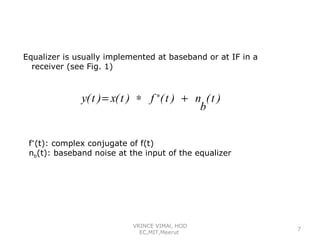
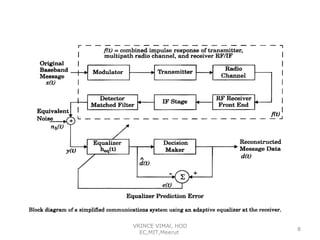
Equalizer is usually implemented at baseband or at IF in a
receiver (see Fig. 1)

y( t ) = x( t ) ∗ f ∗( t ) + n ( t )
b
f*(t): complex conjugate of f(t)
nb(t): baseband noise at the input of the equalizer

VRINCE VIMAl, HOD
EC,MIT,Meerut

7
VRINCE VIMAl, HOD
EC,MIT,Meerut

8
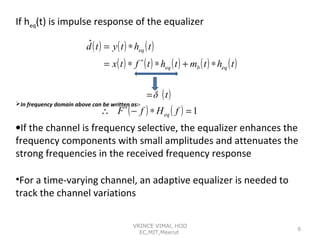
If heq(t) is impulse response of the equalizer
ˆ
d ( t ) = y ( t ) ∗ heq ( t )
= x ( t ) ∗ f ∗ ( t ) ∗ heq ( t ) + mb ( t ) ∗ heq ( t )

In frequency domain above can be written as:∗

= δ (t)

∴ F ( − f ) ∗ H eq ( f ) = 1

•If the channel is frequency selective, the equalizer enhances the
frequency components with small amplitudes and attenuates the
strong frequencies in the received frequency response
•For a time-varying channel, an adaptive equalizer is needed to
track the channel variations
VRINCE VIMAl, HOD
EC,MIT,Meerut

9
• These techniques improve mobile radio link
performance
 Effectiveness of each varies widely in practical
wireless systems
 Cost & complexity are also important issues
• Complexity in mobile vs. in base station

VRINCE VIMAl, HOD
EC,MIT,Meerut

10
III. Diversity Techniques

• Diversity : Primary goal is to reduce depth &
duration of small-scale fades
– Spatial or antenna diversity → most common
• Use multiple Rx antennas in mobile or base station
• Why would this be helpful?

• Even small antenna separation (∝ λ ) changes phase
of signal → constructive /destructive nature is
changed

– Other diversity types → polarization, frequency,
& time
VRINCE VIMAl, HOD
EC,MIT,Meerut

11
• Exploits random behavior of MRC
– Goal is to make use of several independent
(uncorrelated) received signal paths
– Why is this necessary?

• Select path with best SNR or combine
multiple paths → improve overall SNR
performance

VRINCE VIMAl, HOD
EC,MIT,Meerut

12
• Microscopic diversity → combat small-scale
fading
– Most widely used
– Use multiple antennas separated in space
• At a mobile, signals are independent if separation > λ / 2
• But it is not practical to have a mobile with multiple
antennas separated by λ / 2 (7.5 cm apart at 2 GHz)
• Can have multiple receiving antennas at base stations, but
must be separated on the order of ten wavelengths (1 to 5
meters).
VRINCE VIMAl, HOD
EC,MIT,Meerut

13
– Since reflections occur near receiver, independent
signals spread out a lot before they reach the base
station.
– a typical antenna configuration for 120 degree
sectoring.
– For each sector, a transmit antenna is in the center,
with two diversity receiving antennas on each side.
– If one radio path undergoes a deep fade, another
independent path may have a strong signal.
– By having more than one path one select from, both
the instantaneous and average SNRs at the receiver
may be improved
VRINCE VIMAl, HOD
EC,MIT,Meerut

14
• Spatial or Antenna Diversity → 4 basic types
 M independent branches
 Variable gain & phase at each branch → G∠ θ
 Each branch has same average SNR:

Eb
SNR = Γ =
N0
γi

 Instantaneous SNR = γ i, the pdf of



1
p (γ i ) = e
Γ

−γ i
Γ

γ i ≥ 0 (6.155)

is MSNR & the probability that any branch have I SNR less
γ

γ

1
Pr [ γ i ≤ γ ] = ∫ p(γ i ) d γ i = ∫ e
Γ
0
0

−γ i
Γ

dγ i = 1 − e

−γ
Γ

15
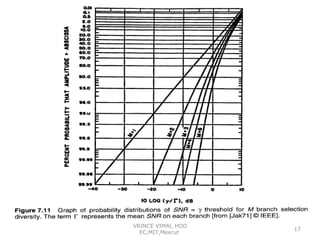
 The probability that all M independent diversity branches Rx
signal which are simultaneously less than some specific SNR
threshold γ

Pr [ γ 1 ,...γ M ≤ γ ] = (1 − e −γ / Γ ) M = PM (γ )
Pr [ γ i > γ ] = 1 − PM (γ ) = 1 − (1 − e −γ / Γ ) M
 The pdf of

γ
:

d
M
pM (γ ) =
PM (γ ) = ( 1 − e −γ
dγ
Γ

)

Γ M −1

e −γ

Γ

 Average SNR improvement offered by selection diversity
∞

∞

0

0

γ = ∫ γ pM (γ )d γ = Γ ∫ Mx ( 1 − e − x )

M −1

e − x dx, x = γ Γ

M
γ
1
=∑
Γ k =1 k

16
VRINCE VIMAl, HOD
EC,MIT,Meerut

17
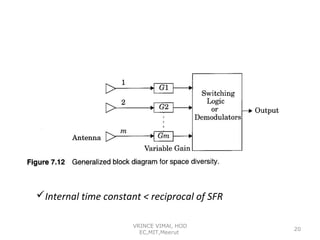
• Space diversity methods:
1) Selection diversity
2) Feedback diversity
3) Maximal radio combining
4) Equal gain diversity

VRINCE VIMAl, HOD
EC,MIT,Meerut

18
1) Selection Diversity → simple & cheap
 Rx selects branch with highest instantaneous SNR
• new selection made at a time that is the reciprocal of the
fading rate
• this will cause the system to stay with the current signal
until it is likely the signal has faded
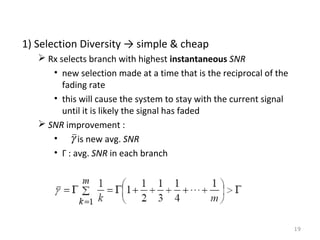
 SNR improvement :
• γ is new avg. SNR
• Γ : avg. SNR in each branch

19
Internal time constant < reciprocal of SFR
VRINCE VIMAl, HOD
EC,MIT,Meerut

20
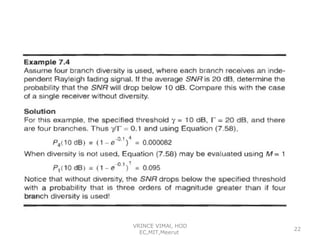
• Example:
– Average SNR is 20 dB
– Acceptable SNR is 10 dB
– Assume four branch diversity
– Determine that the probability that one signal has
SNR less than 10 dB

VRINCE VIMAl, HOD
EC,MIT,Meerut

21
VRINCE VIMAl, HOD
EC,MIT,Meerut

22
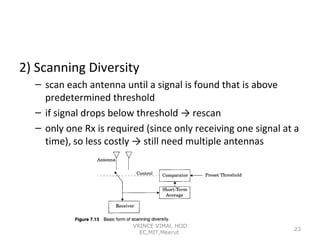
2) Scanning Diversity
– scan each antenna until a signal is found that is above
predetermined threshold
– if signal drops below threshold → rescan
– only one Rx is required (since only receiving one signal at a
time), so less costly → still need multiple antennas

VRINCE VIMAl, HOD
EC,MIT,Meerut

23
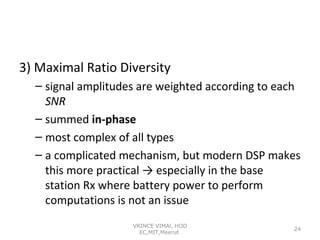
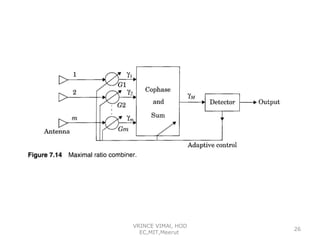
3) Maximal Ratio Diversity
– signal amplitudes are weighted according to each
SNR
– summed in-phase
– most complex of all types
– a complicated mechanism, but modern DSP makes
this more practical → especially in the base
station Rx where battery power to perform
computations is not an issue
VRINCE VIMAl, HOD
EC,MIT,Meerut

24
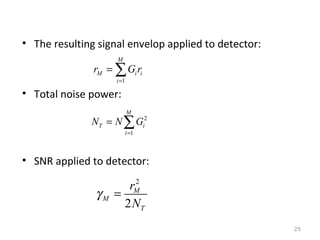
• The resulting signal envelop applied to detector:
M

rM = ∑ Gi ri
i =1

• Total noise power:
M

NT = N ∑ Gi2
i =1

• SNR applied to detector:

γM

2
rM
=
2 NT
25
VRINCE VIMAl, HOD
EC,MIT,Meerut

26
4) Equal Gain Diversity
– combine multiple signals into one
– G = 1, but the phase is adjusted for each received
signal so that
• The signal from each branch are co-phased
• vectors add in-phase

– better performance than selection diversity

VRINCE VIMAl, HOD
EC,MIT,Meerut

27
IV. Time Diversity
• Time Diversity → transmit repeatedly the information at
different time spacings
– Time spacing > coherence time (coherence time is the
time over which a fading signal can be considered to have
similar characteristics)
– So signals can be considered independent
– Main disadvantage is that BW efficiency is significantly
worsened – signal is transmitted more than once
• BW must ↑ to obtain the same Rd (data rate)
VRINCE VIMAl, HOD
EC,MIT,Meerut

28
• If data stream repeated twice then either
1) BW doubles for the same Rd or
2) Rd is reduced by ½ for the same BW

VRINCE VIMAl, HOD
EC,MIT,Meerut

29
# RAKE Receiver
 In CDMA SS chip rate >> FF BW of channel..
 CDMA spreading codes have low correlation betn bits
 Propagation delays in the MRC provide multiple copies of
Tx signals delayed in time
 Signal is only transmitted once
 Powerful form of time diversity available in spread
spectrum (DS) systems → CDMA
VRINCE VIMAl, HOD
EC,MIT,Meerut

30
 attempts to collect the time-shifted versions of the
original signal by providing a separate correlation
receiver for each of the multipath signals.
 Each correlation receiver may be adjusted in time delay,
so that a microprocessor controller can cause different
correlation receivers to search in different time windows
for significant multipath.
 The range of time delays that a particular correlator can
search is called a search window.

VRINCE VIMAl, HOD
EC,MIT,Meerut

31
 If time delay between multiple signals > chip period of
spreading sequence (Tc) → multipath signals can be
considered uncorrelated (independent)
o In a basic system, these delayed signals only appear as
noise, since they are delayed by more than a chip
duration. And ignored.
o Multiplying by the chip code results in noise because of
the time shift.
o But this can also be used to our advantage, by shifting the
chip sequence to receive that delayed signal separately
from the other signals.
VRINCE VIMAl, HOD
EC,MIT,Meerut

32
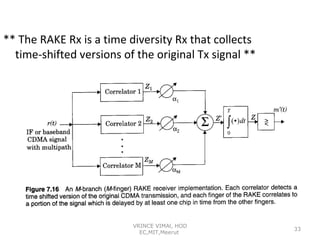
** The RAKE Rx is a time diversity Rx that collects
time-shifted versions of the original Tx signal **

VRINCE VIMAl, HOD
EC,MIT,Meerut

33
M branches or “fingers” = # of correlation Rx’s
Separately detect the M strongest signals
Weighted sum computed from M branches
• faded signal → low weight
• strong signal → high weight
• overcomes fading of a signal in a single branch

VRINCE VIMAl, HOD
EC,MIT,Meerut

34
• In outdoor environments
– the delay between multipath components is
usually large, the low autocorrelation properties
of a CDMA spreading sequence can assure that
multipath components will appear nearly
uncorrelated with each other.

VRINCE VIMAl, HOD
EC,MIT,Meerut

35
• In indoor environments
– RAKE receiver in IS-95 CDMA has been found to
perform poorly
• since the multipath delay spreads in indoor channels
(≈100 ns) are much smaller than an IS-95 chip duration
(≈ 800 ns).
• In such cases, a RAKE will not work since multipath is
unresolveable
• Rayleigh flat-fading typically occurs within a single chip
period.
VRINCE VIMAl, HOD
EC,MIT,Meerut

36

Equalisation, diversity, coding.

  • 1.
  • 2.
    I. Introduction • MRCImpairments: 1) ACI/CCI → system generated interference 2) Shadowing → large-scale path loss from LOS obstructions 3) Multipath Fading → rapid small-scale signal variations 4) Doppler Spread → due to motion of mobile unit • All can lead to significant distortion or attenuation of Rx signal • Degrade Bit Error Rate (BER) of digitally modulated signal VRINCE VIMAl, HOD EC,MIT,Meerut 2
  • 3.
    • Three techniquesare used to improve Rx signal quality and lower BER: 1) Equalization(BW > BWc ) 2) Diversity 3) Channel Coding Can be Used independently or together VRINCE VIMAl, HOD EC,MIT,Meerut 3
  • 4.
    • •Equalization compensatesfor ISI created by multipath with time dispersive channels (W>BC) • Linear equalization, nonlinear equalization • •Diversity also compensates for fading channel impairments, and is usually implemented by using two or more receiving antennas • Spatial diversity, antenna polarization diversity, frequency diversity, time diversity VRINCE VIMAl, HOD EC,MIT,Meerut 4
  • 5.
    •The former counters theeffects of time dispersion (ISI), while the latter reduces the depth and duration of the fades experienced by a receiver in a flat fading (narrowband) channel • Channel Coding improves mobile communication link performance by adding redundant data bits in the transmitted message •Channel coding is used by the Rx to detect or correct some (or all) of the errors introduced by the channel (Post detection technique) VRINCE VIMAl, code Block code and convolutionalHOD EC,MIT,Meerut 5
  • 6.
    Equalization Techniques • Theterm equalization can be used to describe any signal processing operation that minimizes ISI [2] • Two operation modes for an adaptive equalizer: training and tracking •Three factors affect the time spanning over which an equalizer converges: equalizer algorithm, equalizer structure and time rate of change of the multipath radio channel •TDMA wireless systems are particularly well suited for equalizers VRINCE VIMAl, HOD EC,MIT,Meerut 6
  • 7.
    Equalizer is usuallyimplemented at baseband or at IF in a receiver (see Fig. 1) y( t ) = x( t ) ∗ f ∗( t ) + n ( t ) b f*(t): complex conjugate of f(t) nb(t): baseband noise at the input of the equalizer VRINCE VIMAl, HOD EC,MIT,Meerut 7
  • 8.
  • 9.
    If heq(t) isimpulse response of the equalizer ˆ d ( t ) = y ( t ) ∗ heq ( t ) = x ( t ) ∗ f ∗ ( t ) ∗ heq ( t ) + mb ( t ) ∗ heq ( t ) In frequency domain above can be written as:∗ = δ (t) ∴ F ( − f ) ∗ H eq ( f ) = 1 •If the channel is frequency selective, the equalizer enhances the frequency components with small amplitudes and attenuates the strong frequencies in the received frequency response •For a time-varying channel, an adaptive equalizer is needed to track the channel variations VRINCE VIMAl, HOD EC,MIT,Meerut 9
  • 10.
    • These techniquesimprove mobile radio link performance  Effectiveness of each varies widely in practical wireless systems  Cost & complexity are also important issues • Complexity in mobile vs. in base station VRINCE VIMAl, HOD EC,MIT,Meerut 10
  • 11.
    III. Diversity Techniques •Diversity : Primary goal is to reduce depth & duration of small-scale fades – Spatial or antenna diversity → most common • Use multiple Rx antennas in mobile or base station • Why would this be helpful? • Even small antenna separation (∝ λ ) changes phase of signal → constructive /destructive nature is changed – Other diversity types → polarization, frequency, & time VRINCE VIMAl, HOD EC,MIT,Meerut 11
  • 12.
    • Exploits randombehavior of MRC – Goal is to make use of several independent (uncorrelated) received signal paths – Why is this necessary? • Select path with best SNR or combine multiple paths → improve overall SNR performance VRINCE VIMAl, HOD EC,MIT,Meerut 12
  • 13.
    • Microscopic diversity→ combat small-scale fading – Most widely used – Use multiple antennas separated in space • At a mobile, signals are independent if separation > λ / 2 • But it is not practical to have a mobile with multiple antennas separated by λ / 2 (7.5 cm apart at 2 GHz) • Can have multiple receiving antennas at base stations, but must be separated on the order of ten wavelengths (1 to 5 meters). VRINCE VIMAl, HOD EC,MIT,Meerut 13
  • 14.
    – Since reflectionsoccur near receiver, independent signals spread out a lot before they reach the base station. – a typical antenna configuration for 120 degree sectoring. – For each sector, a transmit antenna is in the center, with two diversity receiving antennas on each side. – If one radio path undergoes a deep fade, another independent path may have a strong signal. – By having more than one path one select from, both the instantaneous and average SNRs at the receiver may be improved VRINCE VIMAl, HOD EC,MIT,Meerut 14
  • 15.
    • Spatial orAntenna Diversity → 4 basic types  M independent branches  Variable gain & phase at each branch → G∠ θ  Each branch has same average SNR: Eb SNR = Γ = N0 γi  Instantaneous SNR = γ i, the pdf of  1 p (γ i ) = e Γ −γ i Γ γ i ≥ 0 (6.155) is MSNR & the probability that any branch have I SNR less γ γ 1 Pr [ γ i ≤ γ ] = ∫ p(γ i ) d γ i = ∫ e Γ 0 0 −γ i Γ dγ i = 1 − e −γ Γ 15
  • 16.
     The probabilitythat all M independent diversity branches Rx signal which are simultaneously less than some specific SNR threshold γ Pr [ γ 1 ,...γ M ≤ γ ] = (1 − e −γ / Γ ) M = PM (γ ) Pr [ γ i > γ ] = 1 − PM (γ ) = 1 − (1 − e −γ / Γ ) M  The pdf of γ : d M pM (γ ) = PM (γ ) = ( 1 − e −γ dγ Γ ) Γ M −1 e −γ Γ  Average SNR improvement offered by selection diversity ∞ ∞ 0 0 γ = ∫ γ pM (γ )d γ = Γ ∫ Mx ( 1 − e − x ) M −1 e − x dx, x = γ Γ M γ 1 =∑ Γ k =1 k 16
  • 17.
  • 18.
    • Space diversitymethods: 1) Selection diversity 2) Feedback diversity 3) Maximal radio combining 4) Equal gain diversity VRINCE VIMAl, HOD EC,MIT,Meerut 18
  • 19.
    1) Selection Diversity→ simple & cheap  Rx selects branch with highest instantaneous SNR • new selection made at a time that is the reciprocal of the fading rate • this will cause the system to stay with the current signal until it is likely the signal has faded  SNR improvement : • γ is new avg. SNR • Γ : avg. SNR in each branch 19
  • 20.
    Internal time constant< reciprocal of SFR VRINCE VIMAl, HOD EC,MIT,Meerut 20
  • 21.
    • Example: – AverageSNR is 20 dB – Acceptable SNR is 10 dB – Assume four branch diversity – Determine that the probability that one signal has SNR less than 10 dB VRINCE VIMAl, HOD EC,MIT,Meerut 21
  • 22.
  • 23.
    2) Scanning Diversity –scan each antenna until a signal is found that is above predetermined threshold – if signal drops below threshold → rescan – only one Rx is required (since only receiving one signal at a time), so less costly → still need multiple antennas VRINCE VIMAl, HOD EC,MIT,Meerut 23
  • 24.
    3) Maximal RatioDiversity – signal amplitudes are weighted according to each SNR – summed in-phase – most complex of all types – a complicated mechanism, but modern DSP makes this more practical → especially in the base station Rx where battery power to perform computations is not an issue VRINCE VIMAl, HOD EC,MIT,Meerut 24
  • 25.
    • The resultingsignal envelop applied to detector: M rM = ∑ Gi ri i =1 • Total noise power: M NT = N ∑ Gi2 i =1 • SNR applied to detector: γM 2 rM = 2 NT 25
  • 26.
  • 27.
    4) Equal GainDiversity – combine multiple signals into one – G = 1, but the phase is adjusted for each received signal so that • The signal from each branch are co-phased • vectors add in-phase – better performance than selection diversity VRINCE VIMAl, HOD EC,MIT,Meerut 27
  • 28.
    IV. Time Diversity •Time Diversity → transmit repeatedly the information at different time spacings – Time spacing > coherence time (coherence time is the time over which a fading signal can be considered to have similar characteristics) – So signals can be considered independent – Main disadvantage is that BW efficiency is significantly worsened – signal is transmitted more than once • BW must ↑ to obtain the same Rd (data rate) VRINCE VIMAl, HOD EC,MIT,Meerut 28
  • 29.
    • If datastream repeated twice then either 1) BW doubles for the same Rd or 2) Rd is reduced by ½ for the same BW VRINCE VIMAl, HOD EC,MIT,Meerut 29
  • 30.
    # RAKE Receiver In CDMA SS chip rate >> FF BW of channel..  CDMA spreading codes have low correlation betn bits  Propagation delays in the MRC provide multiple copies of Tx signals delayed in time  Signal is only transmitted once  Powerful form of time diversity available in spread spectrum (DS) systems → CDMA VRINCE VIMAl, HOD EC,MIT,Meerut 30
  • 31.
     attempts tocollect the time-shifted versions of the original signal by providing a separate correlation receiver for each of the multipath signals.  Each correlation receiver may be adjusted in time delay, so that a microprocessor controller can cause different correlation receivers to search in different time windows for significant multipath.  The range of time delays that a particular correlator can search is called a search window. VRINCE VIMAl, HOD EC,MIT,Meerut 31
  • 32.
     If timedelay between multiple signals > chip period of spreading sequence (Tc) → multipath signals can be considered uncorrelated (independent) o In a basic system, these delayed signals only appear as noise, since they are delayed by more than a chip duration. And ignored. o Multiplying by the chip code results in noise because of the time shift. o But this can also be used to our advantage, by shifting the chip sequence to receive that delayed signal separately from the other signals. VRINCE VIMAl, HOD EC,MIT,Meerut 32
  • 33.
    ** The RAKERx is a time diversity Rx that collects time-shifted versions of the original Tx signal ** VRINCE VIMAl, HOD EC,MIT,Meerut 33
  • 34.
    M branches or“fingers” = # of correlation Rx’s Separately detect the M strongest signals Weighted sum computed from M branches • faded signal → low weight • strong signal → high weight • overcomes fading of a signal in a single branch VRINCE VIMAl, HOD EC,MIT,Meerut 34
  • 35.
    • In outdoorenvironments – the delay between multipath components is usually large, the low autocorrelation properties of a CDMA spreading sequence can assure that multipath components will appear nearly uncorrelated with each other. VRINCE VIMAl, HOD EC,MIT,Meerut 35
  • 36.
    • In indoorenvironments – RAKE receiver in IS-95 CDMA has been found to perform poorly • since the multipath delay spreads in indoor channels (≈100 ns) are much smaller than an IS-95 chip duration (≈ 800 ns). • In such cases, a RAKE will not work since multipath is unresolveable • Rayleigh flat-fading typically occurs within a single chip period. VRINCE VIMAl, HOD EC,MIT,Meerut 36