Equalization Techniques
AANCHAL KUMARI
17001UEL01
1EQUALIZATION TECHNIQUES
INTRODUCTION:
 The Mobile communication system requires signal processing techniques
which improves the link performance in mobile radio environments.
 There are three most popular techniques:
1) Equalization
2) Diversity
3) Channel coding
2EQUALIZATION TECHNIQUES
EQUALIZATION TECHNIQUES 3
Equalization:
 If the modulation bandwidth exceeds the coherence bandwidth of the
radio channel, ISI occurs and modulation pulses are spread in time.
 It is used for compensating Inter Symbol Interference.
 Equalizers must be adaptive as the channel is unknown and time varying.
EQUALIZATION TECHNIQUES 4
Diversity:
 Diversity technique used to compensate for fading channel impairments.
 Types of Diversity Techniques:
 Antenna Diversity
 Frequency Diversity
 Time Diversity
 Polarization Diversity
 Angle Diversity
 Code Diversity
 Antenna Diversity is implemented by using two or more receiving antennas.
EQUALIZATION TECHNIQUES 5
 While Equalization is used to counter the effects of ISI, diversity is
usually employed to reduce the depth and duration of the fades
experienced by a receiver in flat fading channel.
 These techniques can be employed at both base station and
mobile receivers.
 Spatial Diversity is the most widely used diversity technique.
EQUALIZATION TECHNIQUES 6
Channel coding:
 Used to Improve mobile communication link performance by adding
redundant data bits in the transmitted message.
 The coded message is then modulated for transmission in the wireless channel.
 coding can be considered to be a post detection technique.
 Types of channel codes:
 block codes
 convolutional codes.
 Channel coding is generally treated independently from the type of modulation
used.
EQUALIZATION TECHNIQUES 7
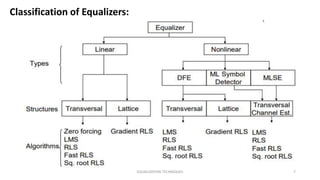
Classification of Equalizers:
EQUALIZATION TECHNIQUES 8
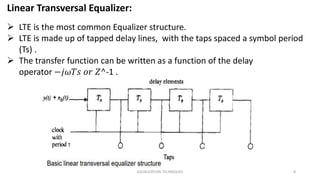
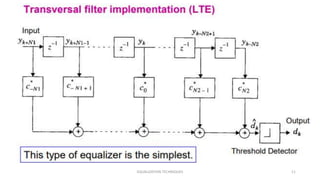
Linear Transversal Equalizer:
 LTE is the most common Equalizer structure.
 LTE is made up of tapped delay lines, with the taps spaced a symbol period
(Ts) .
 The transfer function can be written as a function of the delay
operator −𝑗𝜔𝑇𝑠 𝑜𝑟 𝑍^-1 .
EQUALIZATION TECHNIQUES 9
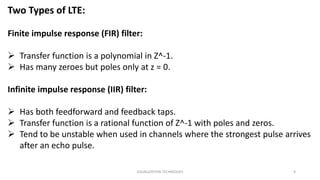
Two Types of LTE:
Finite impulse response (FIR) filter:
 Transfer function is a polynomial in Z^-1.
 Has many zeroes but poles only at z = 0.
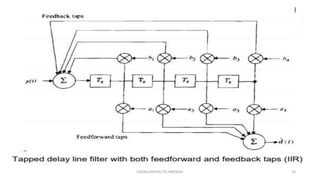
Infinite impulse response (IIR) filter:
 Has both feedforward and feedback taps.
 Transfer function is a rational function of Z^-1 with poles and zeros.
 Tend to be unstable when used in channels where the strongest pulse arrives
after an echo pulse.
EQUALIZATION TECHNIQUES 10
EQUALIZATION TECHNIQUES 11
EQUALIZATION TECHNIQUES 12
EQUALIZATION TECHNIQUES 13
EQUALIZATION TECHNIQUES 14
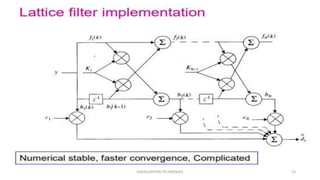
Advantages of Lattice Equalizer:
 Numerical stability
 Faster coverage time
 Its unique structure allows dynamic assignment of the most effective length
of the lattice equalizer.
 When the channel becomes more dispersive, the length of the equalizer
can be increased by the algorithm without stopping the operation of the
equalizer.
 Only a fractions of stages is used if the channel is not very time dispersive.
 The main disadvantage of the lattice equalizer is its complex structure.
EQUALIZATION TECHNIQUES 15
THANK YOU

Equalization techniques

  • 1.
  • 2.
    INTRODUCTION:  The Mobilecommunication system requires signal processing techniques which improves the link performance in mobile radio environments.  There are three most popular techniques: 1) Equalization 2) Diversity 3) Channel coding 2EQUALIZATION TECHNIQUES
  • 3.
    EQUALIZATION TECHNIQUES 3 Equalization: If the modulation bandwidth exceeds the coherence bandwidth of the radio channel, ISI occurs and modulation pulses are spread in time.  It is used for compensating Inter Symbol Interference.  Equalizers must be adaptive as the channel is unknown and time varying.
  • 4.
    EQUALIZATION TECHNIQUES 4 Diversity: Diversity technique used to compensate for fading channel impairments.  Types of Diversity Techniques:  Antenna Diversity  Frequency Diversity  Time Diversity  Polarization Diversity  Angle Diversity  Code Diversity  Antenna Diversity is implemented by using two or more receiving antennas.
  • 5.
    EQUALIZATION TECHNIQUES 5 While Equalization is used to counter the effects of ISI, diversity is usually employed to reduce the depth and duration of the fades experienced by a receiver in flat fading channel.  These techniques can be employed at both base station and mobile receivers.  Spatial Diversity is the most widely used diversity technique.
  • 6.
    EQUALIZATION TECHNIQUES 6 Channelcoding:  Used to Improve mobile communication link performance by adding redundant data bits in the transmitted message.  The coded message is then modulated for transmission in the wireless channel.  coding can be considered to be a post detection technique.  Types of channel codes:  block codes  convolutional codes.  Channel coding is generally treated independently from the type of modulation used.
  • 7.
  • 8.
    EQUALIZATION TECHNIQUES 8 LinearTransversal Equalizer:  LTE is the most common Equalizer structure.  LTE is made up of tapped delay lines, with the taps spaced a symbol period (Ts) .  The transfer function can be written as a function of the delay operator −𝑗𝜔𝑇𝑠 𝑜𝑟 𝑍^-1 .
  • 9.
    EQUALIZATION TECHNIQUES 9 TwoTypes of LTE: Finite impulse response (FIR) filter:  Transfer function is a polynomial in Z^-1.  Has many zeroes but poles only at z = 0. Infinite impulse response (IIR) filter:  Has both feedforward and feedback taps.  Transfer function is a rational function of Z^-1 with poles and zeros.  Tend to be unstable when used in channels where the strongest pulse arrives after an echo pulse.
  • 10.
  • 11.
  • 12.
  • 13.
  • 14.
    EQUALIZATION TECHNIQUES 14 Advantagesof Lattice Equalizer:  Numerical stability  Faster coverage time  Its unique structure allows dynamic assignment of the most effective length of the lattice equalizer.  When the channel becomes more dispersive, the length of the equalizer can be increased by the algorithm without stopping the operation of the equalizer.  Only a fractions of stages is used if the channel is not very time dispersive.  The main disadvantage of the lattice equalizer is its complex structure.
  • 15.