WLAN:VPN SECURITY
Zena Mohammed
What is VPN?
o A VPN is a closed (private) network provided on shared
infrastructure.
o A Virtual Private Network (VPN) connects the components and
resources of a private network over a public network.
o VPNs can be provided over both packet-switched and circuit-switched
public networks.
o The shared infrastructure can be the Internet, Frame Relay, or ATM
network, or the Public Voice Networks (PSTN).
Objectives of VPN
 From the user’s perspective, the VPN is a point-to-point
connection between the user’s computer and a corporate
server.
 VPNs allow tele-commuters, remote employees, or even
branch offices to connect in a secure fashion.
Is VPN a Solution to All Online Security Threats?
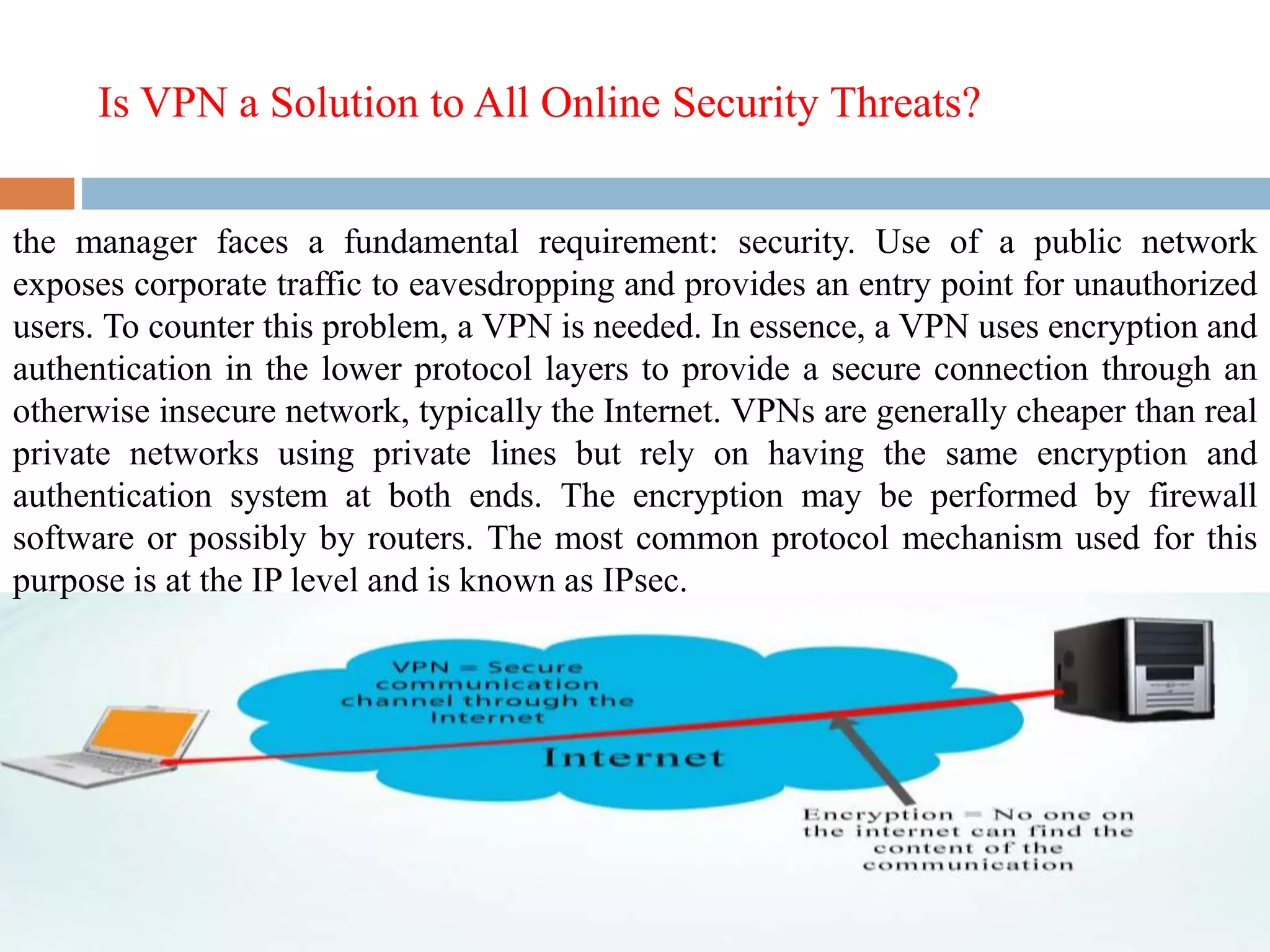
the manager faces a fundamental requirement: security. Use of a public network
exposes corporate traffic to eavesdropping and provides an entry point for unauthorized
users. To counter this problem, a VPN is needed. In essence, a VPN uses encryption and
authentication in the lower protocol layers to provide a secure connection through an
otherwise insecure network, typically the Internet. VPNs are generally cheaper than real
private networks using private lines but rely on having the same encryption and
authentication system at both ends. The encryption may be performed by firewall
software or possibly by routers. The most common protocol mechanism used for this
purpose is at the IP level and is known as IPsec.
Brief Overview of How it Works
o Two connections – one is made to the Internet and
the second is made to the VPN.
o Datagrams – contains data, destination and source
information.
o Firewalls – VPNs allow authorized users to pass
through the firewalls.
o Protocols – protocols create the VPN tunnels.
Four Critical Functions
Authentication – validates that the data was sent
from the sender.
Access control – limiting unauthorized users from
accessing the network.
Confidentiality – preventing the data to be read or
copied as the data is being transported.
Data Integrity – ensuring that the data has not been
altered
Encryption
o Encryption -- is a method of “scrambling” data
before transmitting it onto the Internet.
oPublic Key Encryption Technique
oDigital signature – for authentication
Network Isolation:VPN
 Idea: I want to create a collection of hosts which operate in a
coordinated way E.g., a virtual security perimeter over physical network
 Hosts work as if they are isolated from malicious hosts
 Solution: Virtual Private Networks Create virtual network
topology over physical network
 Use communications security protocol suites to secure virtual links
“tunneling”
 Manage networks as if they are physically separate
 Hosts can route traffic to regular networks (split-tunneling)
Tunneling
A virtual point-to-point connection made through a public
network.It transports encapsulated datagrams
Encrypted Inner Datagram
Original Datagram
Outer Datagram Data AreaDatagram Header
Data Encapsulation [From Comer]
Two types of end points:
Remote Access
Site-to-Site
Remote Access Virtual Private Network
Remote User Access over the Internet
• To connect remote users to a corporate intranet using an Internet Service Provider (ISP)
network.
• The VPN software creates a secure connection between the dial-up user and the
corporate intranet over the Internet.
Site-to-Site VPNs
Figure 19.7b shows how tunnel mode
operation can be used to set
up a virtual private network.
Case 2. Security is provided only between gateways (routers, firewalls, etc.)
and no hosts implement IPsec. This case illustrates simple virtual private network
support. The security architecture document specifies that only a single tunnel SA is
needed for this case. The tunnel could support AH, ESP, or ESP with the authentication
option. Nested tunnels are not required, because the IPsec services apply to
the entire inner packet.
Four Protocols used in VPN
 PPTP : Point-to-Point Tunneling Protocol
 L2TP : Layer 2 Tunneling Protocol
 IPsec : Internet Protocol Security
 SOCKS : is not used as much as the ones above
PPTP VPN
The Point-to-Point Tunneling Protocol (PPTP) is a method for implementing
virtual private networks. PPTP uses a control channel over TCP and a GRE tunnel
operating to encapsulate PPP packets
It is a VPN protocol only, and relies on various authentication methods to provide security
Pros
 Client built-in to just about all platforms
 Very easy to set up
 Fast
Cons
 Not at all secure (the vulnerable MS CHAPv2 authentication is still the most common
in use)
 Definitely compromised by the NSA
L2TP
Layer 2 Tunnel Protocol is a VPN protocol that on its own does not provide any
encryption or confidentiality to traffic that passes through it. For this reason it is usually
implemented with the IPsec encryption suite (similar to a cipher) to provide security
and privacy.
Pros
 Usually considered very secure
 Easy to set up
 Available on all modern platforms Cons
 Faster than OpenVPN
Cons
 May be compromised by the NSA
(unproven)
 Likely deliberately weakened by the NSA (
unproven)
 Can struggle with restrictive firewalls
IPSec and SOCKS VPN
Device Types: Hardware
 Usually a VPN type of router
Pros
o Highest network throughput
o Plug and Play
o Dual-purpose
Cons
o Cost
o Lack of flexibility
Device Types: Firewall
Pros
 “Harden” Operating
System
 Tri-purpose
 Cost-effective
Cons
• Still relatively costly
Device Types: Software
o Ideal for 2 end points not in same org.
o Great when different firewalls implemented
Pros
o Flexible
o Low relative
cost
Cons
• Lack of efficiency
• More labor training required
• Lower productivity;
higher labor costs
Advantages:
 Cost Savings
 Reducing the long-distance telephone charges for remote
access.
 Transferring the support burden to the service providers
 Operational costs
 Scalability
 Flexibility of growth
 Efficiency with broadband technology
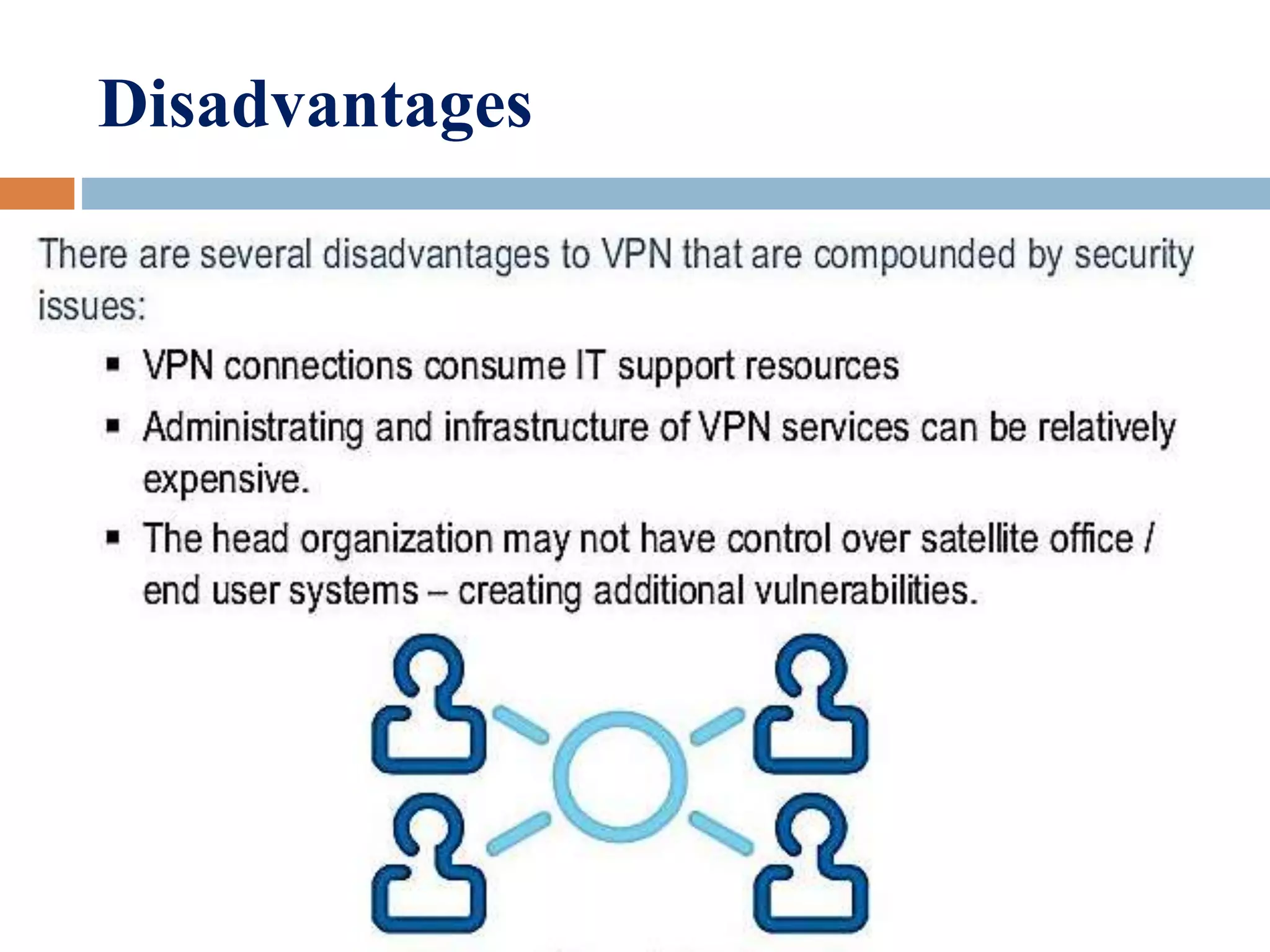
Disadvantages
Requirements for Internet-Based VPNs
 Security Requirements: User Authentication , User’s identity
must be verified, and VPN access must be restricted to
authorized users.
 Address Management and Privacy: Clients’ addresses on the
private network must be kept private and managed securely.
 Data Integrity: Data carried on the public network must be
rendered unreadable to unauthorized clients.
 Security can be implemented in hardware or software.
VPN stands for…
a) Virtual Public Network b) Virtual Private Network
c) Virtual Protocol Network d) Virtual Perimeter Network
Q.1
A.1
b) Virtual Private Network
VPN stands for…
VPN stands for "Virtual Private Network" or "Virtual Private Networking." A
VPN is a private network in the sense that it carries controlled information,
protected by various security mechanisms, between known parties. VPNs are
only "virtually" private, however, because this data actually travels over shared
public networks instead of fully dedicated private connections.
What are the acronyms for the 3 most common VPN
protocols?
Q.2
A.2
• PPTP
• L2TP
• IPsec
3 most common VPN protocols are…
PPTP, IPsec, and L2TP are three of today's most popular VPN tunneling protocols. Each one of these is capable
of supporting a secure VPN connection.
What is the main benefit of VPNs compared to dedicated networks
utilizing frame relay, leased lines, and traditional dial-up?
a) better network performance b) less downtime on average
c) reduced cost d) improved security
A.3
c) reduced cost
The main benefit of VPNs is…
The main benefit of a VPN is the potential for significant cost savings
compared to traditional leased lines or dial up networking. These savings come
with a certain amount of risk, however, particularly when using the public
Internet as the delivery mechanism for VPN data.
Q.3
Q.4
In VPNs, the term "tunneling" refers to
a) an optional feature that
increases network
performance if it is turned on
b) the encapsulation of packets inside packets
of a different protocol to create and maintain
the virtual circuit
c) the method a system
administrator uses to detect
hackers on the network
d) a marketing strategy that involves selling
VPN products for very low prices in return for
expensive service contracts
A.4
b) the encapsulation of packets inside packets of a different protocol to
create and maintain the virtual circuit
In VPNs, the term "tunneling" refers to…

WLAN:VPN Security

  • 1.
  • 2.
    What is VPN? oA VPN is a closed (private) network provided on shared infrastructure. o A Virtual Private Network (VPN) connects the components and resources of a private network over a public network. o VPNs can be provided over both packet-switched and circuit-switched public networks. o The shared infrastructure can be the Internet, Frame Relay, or ATM network, or the Public Voice Networks (PSTN).
  • 3.
    Objectives of VPN From the user’s perspective, the VPN is a point-to-point connection between the user’s computer and a corporate server.  VPNs allow tele-commuters, remote employees, or even branch offices to connect in a secure fashion.
  • 4.
    Is VPN aSolution to All Online Security Threats? the manager faces a fundamental requirement: security. Use of a public network exposes corporate traffic to eavesdropping and provides an entry point for unauthorized users. To counter this problem, a VPN is needed. In essence, a VPN uses encryption and authentication in the lower protocol layers to provide a secure connection through an otherwise insecure network, typically the Internet. VPNs are generally cheaper than real private networks using private lines but rely on having the same encryption and authentication system at both ends. The encryption may be performed by firewall software or possibly by routers. The most common protocol mechanism used for this purpose is at the IP level and is known as IPsec.
  • 5.
    Brief Overview ofHow it Works o Two connections – one is made to the Internet and the second is made to the VPN. o Datagrams – contains data, destination and source information. o Firewalls – VPNs allow authorized users to pass through the firewalls. o Protocols – protocols create the VPN tunnels.
  • 7.
    Four Critical Functions Authentication– validates that the data was sent from the sender. Access control – limiting unauthorized users from accessing the network. Confidentiality – preventing the data to be read or copied as the data is being transported. Data Integrity – ensuring that the data has not been altered
  • 8.
    Encryption o Encryption --is a method of “scrambling” data before transmitting it onto the Internet. oPublic Key Encryption Technique oDigital signature – for authentication
  • 9.
    Network Isolation:VPN  Idea:I want to create a collection of hosts which operate in a coordinated way E.g., a virtual security perimeter over physical network  Hosts work as if they are isolated from malicious hosts  Solution: Virtual Private Networks Create virtual network topology over physical network  Use communications security protocol suites to secure virtual links “tunneling”  Manage networks as if they are physically separate  Hosts can route traffic to regular networks (split-tunneling)
  • 10.
    Tunneling A virtual point-to-pointconnection made through a public network.It transports encapsulated datagrams Encrypted Inner Datagram Original Datagram Outer Datagram Data AreaDatagram Header Data Encapsulation [From Comer] Two types of end points: Remote Access Site-to-Site
  • 11.
    Remote Access VirtualPrivate Network Remote User Access over the Internet • To connect remote users to a corporate intranet using an Internet Service Provider (ISP) network. • The VPN software creates a secure connection between the dial-up user and the corporate intranet over the Internet.
  • 12.
  • 13.
    Figure 19.7b showshow tunnel mode operation can be used to set up a virtual private network. Case 2. Security is provided only between gateways (routers, firewalls, etc.) and no hosts implement IPsec. This case illustrates simple virtual private network support. The security architecture document specifies that only a single tunnel SA is needed for this case. The tunnel could support AH, ESP, or ESP with the authentication option. Nested tunnels are not required, because the IPsec services apply to the entire inner packet.
  • 14.
    Four Protocols usedin VPN  PPTP : Point-to-Point Tunneling Protocol  L2TP : Layer 2 Tunneling Protocol  IPsec : Internet Protocol Security  SOCKS : is not used as much as the ones above
  • 15.
    PPTP VPN The Point-to-PointTunneling Protocol (PPTP) is a method for implementing virtual private networks. PPTP uses a control channel over TCP and a GRE tunnel operating to encapsulate PPP packets It is a VPN protocol only, and relies on various authentication methods to provide security Pros  Client built-in to just about all platforms  Very easy to set up  Fast Cons  Not at all secure (the vulnerable MS CHAPv2 authentication is still the most common in use)  Definitely compromised by the NSA
  • 16.
    L2TP Layer 2 TunnelProtocol is a VPN protocol that on its own does not provide any encryption or confidentiality to traffic that passes through it. For this reason it is usually implemented with the IPsec encryption suite (similar to a cipher) to provide security and privacy. Pros  Usually considered very secure  Easy to set up  Available on all modern platforms Cons  Faster than OpenVPN Cons  May be compromised by the NSA (unproven)  Likely deliberately weakened by the NSA ( unproven)  Can struggle with restrictive firewalls
  • 17.
  • 18.
    Device Types: Hardware Usually a VPN type of router Pros o Highest network throughput o Plug and Play o Dual-purpose Cons o Cost o Lack of flexibility
  • 19.
    Device Types: Firewall Pros “Harden” Operating System  Tri-purpose  Cost-effective Cons • Still relatively costly
  • 20.
    Device Types: Software oIdeal for 2 end points not in same org. o Great when different firewalls implemented Pros o Flexible o Low relative cost Cons • Lack of efficiency • More labor training required • Lower productivity; higher labor costs
  • 21.
    Advantages:  Cost Savings Reducing the long-distance telephone charges for remote access.  Transferring the support burden to the service providers  Operational costs  Scalability  Flexibility of growth  Efficiency with broadband technology
  • 22.
  • 23.
    Requirements for Internet-BasedVPNs  Security Requirements: User Authentication , User’s identity must be verified, and VPN access must be restricted to authorized users.  Address Management and Privacy: Clients’ addresses on the private network must be kept private and managed securely.  Data Integrity: Data carried on the public network must be rendered unreadable to unauthorized clients.  Security can be implemented in hardware or software.
  • 24.
    VPN stands for… a)Virtual Public Network b) Virtual Private Network c) Virtual Protocol Network d) Virtual Perimeter Network Q.1 A.1 b) Virtual Private Network VPN stands for… VPN stands for "Virtual Private Network" or "Virtual Private Networking." A VPN is a private network in the sense that it carries controlled information, protected by various security mechanisms, between known parties. VPNs are only "virtually" private, however, because this data actually travels over shared public networks instead of fully dedicated private connections.
  • 25.
    What are theacronyms for the 3 most common VPN protocols? Q.2 A.2 • PPTP • L2TP • IPsec 3 most common VPN protocols are… PPTP, IPsec, and L2TP are three of today's most popular VPN tunneling protocols. Each one of these is capable of supporting a secure VPN connection.
  • 26.
    What is themain benefit of VPNs compared to dedicated networks utilizing frame relay, leased lines, and traditional dial-up? a) better network performance b) less downtime on average c) reduced cost d) improved security A.3 c) reduced cost The main benefit of VPNs is… The main benefit of a VPN is the potential for significant cost savings compared to traditional leased lines or dial up networking. These savings come with a certain amount of risk, however, particularly when using the public Internet as the delivery mechanism for VPN data. Q.3
  • 27.
    Q.4 In VPNs, theterm "tunneling" refers to a) an optional feature that increases network performance if it is turned on b) the encapsulation of packets inside packets of a different protocol to create and maintain the virtual circuit c) the method a system administrator uses to detect hackers on the network d) a marketing strategy that involves selling VPN products for very low prices in return for expensive service contracts A.4 b) the encapsulation of packets inside packets of a different protocol to create and maintain the virtual circuit In VPNs, the term "tunneling" refers to…