Presented by : Hina Amir
Introduction

Chemical Interpretation

Kinds of Epistasis

   (і)     Dominant Epistasis.
   (ii)    Recessive epistasis
   (iii)   Duplicate Recessive Genes
   (iv)    Duplicate Dominant Genes
   (v)     Duplicate Genes with Cumulative Effect
   (vi)    Dominant Recessive Interaction

References
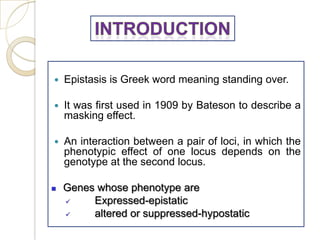
   Epistasis is Greek word meaning standing over.

   It was first used in 1909 by Bateson to describe a
    masking effect.

   An interaction between a pair of loci, in which the
    phenotypic effect of one locus depends on the
    genotype at the second locus.

   Genes whose phenotype are
        Expressed-epistatic
        altered or suppressed-hypostatic
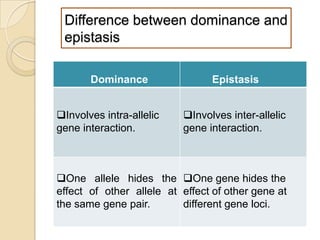
Difference between dominance and
 epistasis

       Dominance                 Epistasis


Involves intra-allelic   Involves inter-allelic
gene interaction.         gene interaction.


One allele hides the One gene hides the
effect of other allele at effect of other gene at
the same gene pair.       different gene loci.
Chemical interpretation:


   A gene is a chemical determiner.

   Gene products interact with the environment and
    factors such as temperature, light, hormones and
    enzymes.

   If there is any problem or mutation in the
    intermediates, it can lead to another phenotype
    and hence disturb the Mendelian ratios.
Example

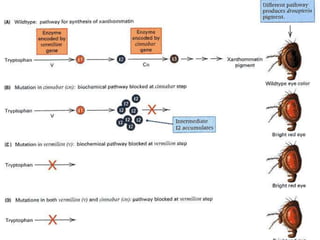
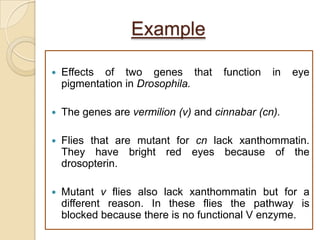
   Effects of two genes that         function   in   eye
    pigmentation in Drosophila.

   The genes are vermilion (v) and cinnabar (cn).

   Flies that are mutant for cn lack xanthommatin.
    They have bright red eyes because of the
    drosopterin.

   Mutant v flies also lack xanthommatin but for a
    different reason. In these flies the pathway is
    blocked because there is no functional V enzyme.
Kinds of Epistatic Interactions

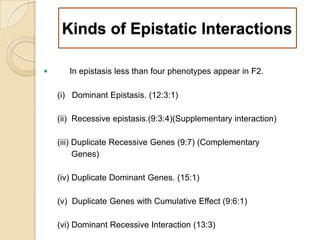
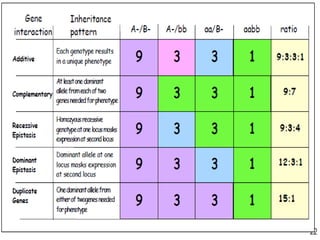
      In epistasis less than four phenotypes appear in F2.

    (і) Dominant Epistasis. (12:3:1)

    (ii) Recessive epistasis.(9:3:4)(Supplementary interaction)

    (iii) Duplicate Recessive Genes (9:7) (Complementary
          Genes)

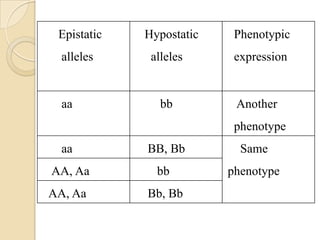
    (iv) Duplicate Dominant Genes. (15:1)

    (v) Duplicate Genes with Cumulative Effect (9:6:1)

    (vi) Dominant Recessive Interaction (13:3)
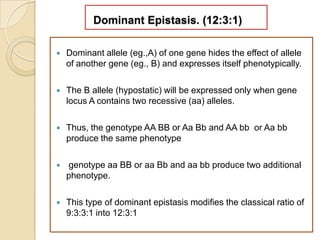
Dominant Epistasis. (12:3:1)

   Dominant allele (eg.,A) of one gene hides the effect of allele
    of another gene (eg., B) and expresses itself phenotypically.

   The B allele (hypostatic) will be expressed only when gene
    locus A contains two recessive (aa) alleles.

   Thus, the genotype AA BB or Aa Bb and AA bb or Aa bb
    produce the same phenotype

   genotype aa BB or aa Bb and aa bb produce two additional
    phenotype.

   This type of dominant epistasis modifies the classical ratio of
    9:3:3:1 into 12:3:1
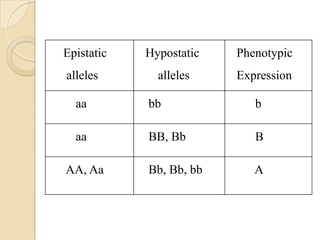
Epistatic   Hypostatic   Phenotypic
alleles       alleles    Expression

  aa        bb              b

  aa        BB, Bb          B

AA, Aa      Bb, Bb, bb      A
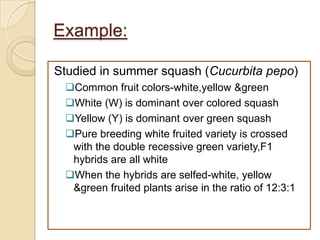
Example:

Studied in summer squash (Cucurbita pepo)
 Common fruit colors-white,yellow &green
 White (W) is dominant over colored squash
 Yellow (Y) is dominant over green squash
 Pure breeding white fruited variety is crossed
  with the double recessive green variety,F1
  hybrids are all white
 When the hybrids are selfed-white, yellow
  &green fruited plants arise in the ratio of 12:3:1
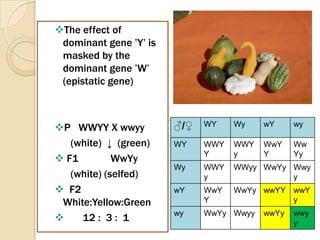
The effect of
 dominant gene ’Y’ is
 masked by the
 dominant gene ’W’
 (epistatic gene)


P WWYY X wwyy          ♂/♀   WY    Wy    wY     wy

   (white) ↓ (green)    WY    WWY   WWY   WwY    Ww
                              Y     y     Y      Yy
 F1         WwYy
                        Wy    WWY   WWyy WwYy Wwy
   (white) (selfed)           y               y
 F2                    wY    WwY   WwYy wwYY wwY
 White:Yellow:Green           Y               y
                        wy    WwYy Wwyy   wwYy   wwy
    12 : 3 : 1                                  y
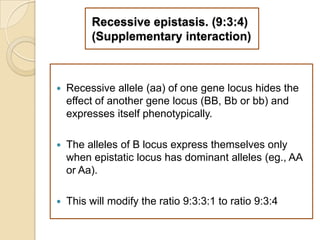
Recessive epistasis. (9:3:4)
         (Supplementary interaction)


   Recessive allele (aa) of one gene locus hides the
    effect of another gene locus (BB, Bb or bb) and
    expresses itself phenotypically.

   The alleles of B locus express themselves only
    when epistatic locus has dominant alleles (eg., AA
    or Aa).

   This will modify the ratio 9:3:3:1 to ratio 9:3:4
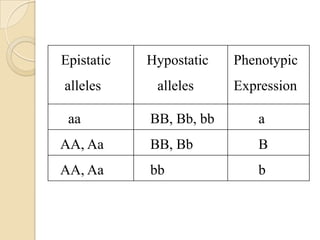
Epistatic   Hypostatic   Phenotypic
alleles      alleles     Expression

 aa         BB, Bb, bb      a
AA, Aa      BB, Bb          B
AA, Aa      bb              b
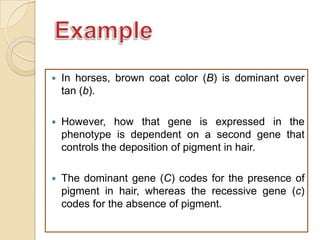
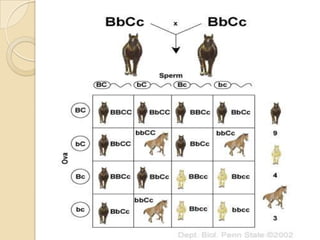
   In horses, brown coat color (B) is dominant over
    tan (b).

   However, how that gene is expressed in the
    phenotype is dependent on a second gene that
    controls the deposition of pigment in hair.

   The dominant gene (C) codes for the presence of
    pigment in hair, whereas the recessive gene (c)
    codes for the absence of pigment.
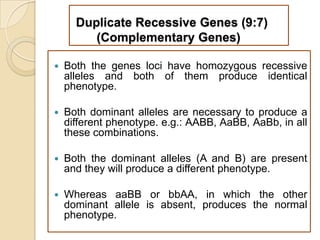
Duplicate Recessive Genes (9:7)
         (Complementary Genes)

   Both the genes loci have homozygous recessive
    alleles and both of them produce identical
    phenotype.

   Both dominant alleles are necessary to produce a
    different phenotype. e.g.: AABB, AaBB, AaBb, in all
    these combinations.

   Both the dominant alleles (A and B) are present
    and they will produce a different phenotype.

   Whereas aaBB or bbAA, in which the other
    dominant allele is absent, produces the normal
    phenotype.
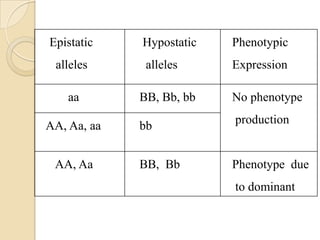
Epistatic    Hypostatic   Phenotypic
 alleles      alleles     Expression

    aa       BB, Bb, bb   No phenotype

AA, Aa, aa   bb           production


 AA, Aa      BB, Bb       Phenotype due
                          to dominant
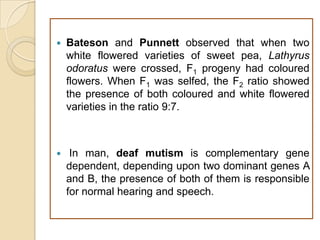
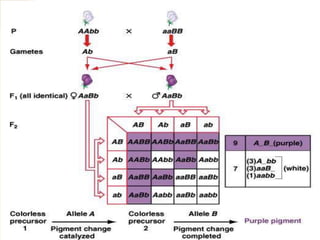
   Bateson and Punnett observed that when two
    white flowered varieties of sweet pea, Lathyrus
    odoratus were crossed, F1 progeny had coloured
    flowers. When F1 was selfed, the F2 ratio showed
    the presence of both coloured and white flowered
    varieties in the ratio 9:7.


    In man, deaf mutism is complementary gene
    dependent, depending upon two dominant genes A
    and B, the presence of both of them is responsible
    for normal hearing and speech.
   In this case dominant alleles on both locus
    are required hence wherever A and B both
    are present they result into purple effect
    masking the white.

   This is because A and B alleles modified the
    colorless precursor by showing their effects
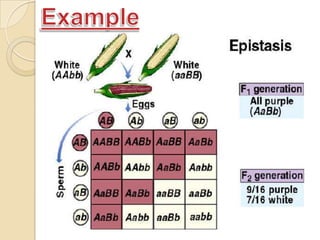
   The purple pigment in corn requires that two
    enzymes (controlled by two dominant alleles) must
    be active for the pigment to form.

    Two white varieties of corn showing the genotypes
    AAbb and aaBB, will produce a ratio of 9/16 purple
    and 7/16 white ears, depending upon the nine
    different    possible    arrangements      of   the
    chromosomes        (and     alleles)   for    these
    characteristics.
Duplicate Dominant Genes. (15:1)


   The dominant alleles of both the genes produce the same
    phenotypic effect giving the ratio 15:1.

   At least one of the dominant allele is necessary for the
    phenotypic effect. e.g. AABB, AaBb, Aabb, aaBB, aaBbgive one
    phenotype.

    In the absence of all the dominant genes (only in case of aabb),
    the recessive phenotype will be expressed.

   The duplicate genes are also called pseudoalleles
Epistatic   Hypostatic    Phenotypic
  alleles     alleles      expression


  aa            bb         Another
                           phenotype
  aa         BB, Bb         Same
AA, Aa         bb         phenotype
AA, Aa       Bb, Bb
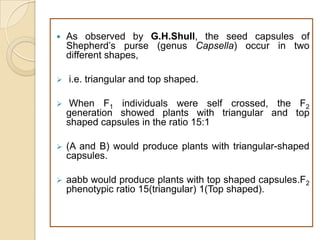
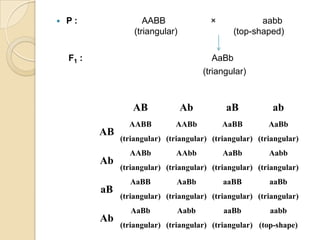
   As observed by G.H.Shull, the seed capsules of
    Shepherd’s purse (genus Capsella) occur in two
    different shapes,

   i.e. triangular and top shaped.

    When F1 individuals were self crossed, the F2
    generation showed plants with triangular and top
    shaped capsules in the ratio 15:1

   (A and B) would produce plants with triangular-shaped
    capsules.

   aabb would produce plants with top shaped capsules.F2
    phenotypic ratio 15(triangular) 1(Top shaped).
   P:                 AABB               ×            aabb
                    (triangular)                (top-shaped)

    F1 :                                   AaBb
                                        (triangular)


                   AB              Ab         aB           ab
                  AABB         AABb           AaBB        AaBb
           AB
                (triangular) (triangular) (triangular) (triangular)
                  AABb          AAbb          AaBb        Aabb
           Ab
                (triangular) (triangular) (triangular) (triangular)
                  AaBB          AaBb          aaBB        aaBb
           aB
                (triangular) (triangular) (triangular) (triangular)
                   AaBb         Aabb          aaBb        aabb
           Ab
                (triangular) (triangular) (triangular) (top-shape)
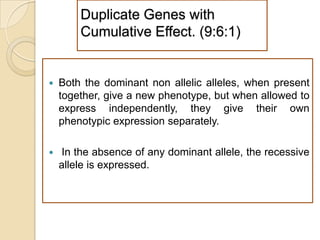
Duplicate Genes with
        Cumulative Effect. (9:6:1)


   Both the dominant non allelic alleles, when present
    together, give a new phenotype, but when allowed to
    express independently, they give their own
    phenotypic expression separately.

   In the absence of any dominant allele, the recessive
    allele is expressed.
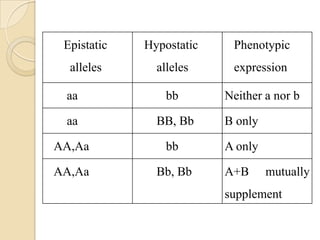
Epistatic   Hypostatic    Phenotypic
  alleles      alleles     expression

 aa              bb       Neither a nor b

 aa            BB, Bb     B only

AA,Aa            bb       A only

AA,Aa          Bb, Bb     A+B      mutually
                          supplement
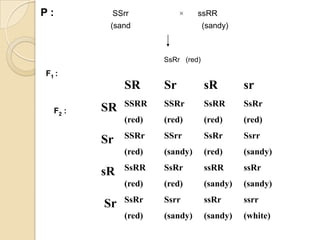
  In pigs S and s are allelic genes;
 S giving sandy colour
 ss giving white colour.


   A non-allelic gene R also gives sandy colour (same
    as S) but when both the dominant genes interact
    together, they give red colour.

   Non-allelic gene does not interact with ss
P:        SSrr             ×    ssRR
          (sand                    (sandy)


                      SsRr (red)
F1 :
              SR      Sr           sR        sr
              SSRR    SSRr         SsRR      SsRr
  F2 :   SR
              (red)   (red)        (red)     (red)
              SSRr    SSrr         SsRr      Ssrr
         Sr
              (red)   (sandy)      (red)     (sandy)
              SsRR    SsRr         ssRR      ssRr
         sR
              (red)   (red)        (sandy)   (sandy)
              SsRr    Ssrr         ssRr      ssrr
         Sr
              (red)   (sandy)      (sandy)   (white)
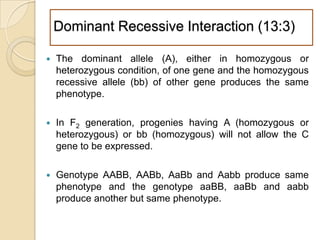
Dominant Recessive Interaction (13:3)

   The dominant allele (A), either in homozygous or
    heterozygous condition, of one gene and the homozygous
    recessive allele (bb) of other gene produces the same
    phenotype.

   In F2 generation, progenies having A (homozygous or
    heterozygous) or bb (homozygous) will not allow the C
    gene to be expressed.

   Genotype AABB, AABb, AaBb and Aabb produce same
    phenotype and the genotype aaBB, aaBb and aabb
    produce another but same phenotype.
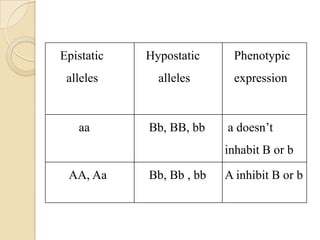
Epistatic   Hypostatic     Phenotypic
 alleles      alleles      expression


   aa       Bb, BB, bb    a doesn’t
                          inhabit B or b

 AA, Aa     Bb, Bb , bb   A inhibit B or b
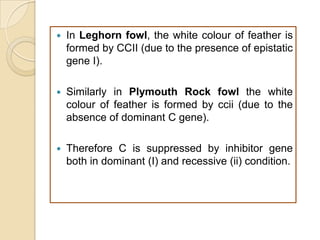
   In Leghorn fowl, the white colour of feather is
    formed by CCII (due to the presence of epistatic
    gene I).

   Similarly in Plymouth Rock fowl the white
    colour of feather is formed by ccii (due to the
    absence of dominant C gene).

   Therefore C is suppressed by inhibitor gene
    both in dominant (I) and recessive (ii) condition.
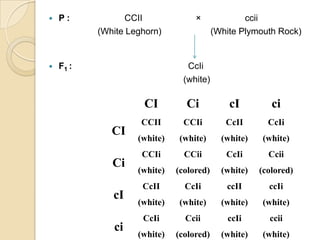
   P:           CCII              ×              ccii
           (White Leghorn)                (White Plymouth Rock)


   F1 :                        CcIi
                               (white)

                     CI         Ci            cI         ci
                     CCII       CCIi         CcII       CcIi
              CI
                    (white)   (white)       (white)   (white)
                     CCIi       CCii         CcIi       Ccii
              Ci
                    (white)   (colored)     (white)   (colored)
                     CcII       CcIi         ccII       ccIi
              cI
                    (white)   (white)       (white)   (white)
                     CcIi       Ccii         ccIi       ccii
              ci
                    (white)   (colored)     (white)   (white)
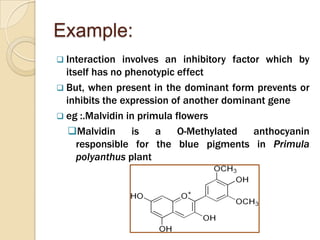
Example:
 Interaction  involves an inhibitory factor which by
  itself has no phenotypic effect
 But, when present in the dominant form prevents or
  inhibits the expression of another dominant gene
 eg :.Malvidin in primula flowers
  Malvidin      is    a    O-Methylated   anthocyanin
     responsible for the blue pigments in Primula
     polyanthus plant
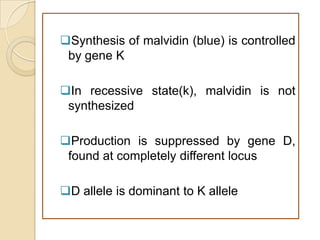
Synthesis of malvidin (blue) is controlled
 by gene K

In recessive state(k), malvidin is not
 synthesized

Production is suppressed by gene D,
 found at completely different locus

D allele is dominant to K allele
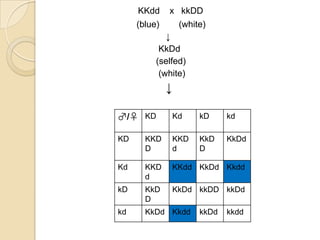
KKdd     x kkDD
     (blue)        (white)
             ↓
           KkDd
          (selfed)
           (white)
              ↓

♂/♀ KD            Kd    kD     kd

KD     KKD        KKD   KkD    KkDd
       D          d     D

Kd     KKD        KKdd KkDd Kkdd
       d
kD     KkD        KkDd kkDD kkDd
       D
kd     KkDd Kkdd        kkDd   kkdd
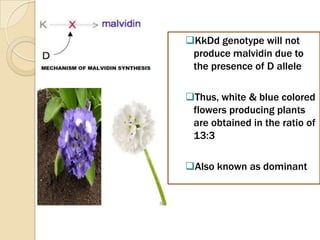
KkDd genotype will not
 produce malvidin due to
 the presence of D allele

Thus, white & blue colored
 flowers producing plants
 are obtained in the ratio of
 13:3

Also known as dominant
References:
   Hartl,D.L., & Jones,W.E., (1998) “Genetics Principles
    and Analysis” ed: 4th   Jones and Bartlett Publishers
    International London,UK, pp: 19,20,61-63

    Miko, I., (2008)    Epistasis: Gene interaction and
    phenotype effects. Nature Education 1(1)
   Richards,J.E. & Hawley, R. S., (2010) “ The human
    genome” ed: 3rd Academic Press, pp: 31

   Verma,P.S., & Agarwal,V.K.,      (2004) “Cell biology,
    Genetics, Molecular Biology, Evolution and Ecology” ed:
    24th S.Chand and Company Ltd,Ram           Nagar, New
    Delhi. Pp: 45-56

Epistasis

  • 1.
    Presented by :Hina Amir
  • 2.
    Introduction Chemical Interpretation Kinds ofEpistasis (і) Dominant Epistasis. (ii) Recessive epistasis (iii) Duplicate Recessive Genes (iv) Duplicate Dominant Genes (v) Duplicate Genes with Cumulative Effect (vi) Dominant Recessive Interaction References
  • 3.
    Epistasis is Greek word meaning standing over.  It was first used in 1909 by Bateson to describe a masking effect.  An interaction between a pair of loci, in which the phenotypic effect of one locus depends on the genotype at the second locus.  Genes whose phenotype are  Expressed-epistatic  altered or suppressed-hypostatic
  • 4.
    Difference between dominanceand epistasis Dominance Epistasis Involves intra-allelic Involves inter-allelic gene interaction. gene interaction. One allele hides the One gene hides the effect of other allele at effect of other gene at the same gene pair. different gene loci.
  • 5.
    Chemical interpretation:  A gene is a chemical determiner.  Gene products interact with the environment and factors such as temperature, light, hormones and enzymes.  If there is any problem or mutation in the intermediates, it can lead to another phenotype and hence disturb the Mendelian ratios.
  • 7.
    Example  Effects of two genes that function in eye pigmentation in Drosophila.  The genes are vermilion (v) and cinnabar (cn).  Flies that are mutant for cn lack xanthommatin. They have bright red eyes because of the drosopterin.  Mutant v flies also lack xanthommatin but for a different reason. In these flies the pathway is blocked because there is no functional V enzyme.
  • 8.
    Kinds of EpistaticInteractions  In epistasis less than four phenotypes appear in F2. (і) Dominant Epistasis. (12:3:1) (ii) Recessive epistasis.(9:3:4)(Supplementary interaction) (iii) Duplicate Recessive Genes (9:7) (Complementary Genes) (iv) Duplicate Dominant Genes. (15:1) (v) Duplicate Genes with Cumulative Effect (9:6:1) (vi) Dominant Recessive Interaction (13:3)
  • 9.
    Dominant Epistasis. (12:3:1)  Dominant allele (eg.,A) of one gene hides the effect of allele of another gene (eg., B) and expresses itself phenotypically.  The B allele (hypostatic) will be expressed only when gene locus A contains two recessive (aa) alleles.  Thus, the genotype AA BB or Aa Bb and AA bb or Aa bb produce the same phenotype  genotype aa BB or aa Bb and aa bb produce two additional phenotype.  This type of dominant epistasis modifies the classical ratio of 9:3:3:1 into 12:3:1
  • 10.
    Epistatic Hypostatic Phenotypic alleles alleles Expression aa bb b aa BB, Bb B AA, Aa Bb, Bb, bb A
  • 11.
    Example: Studied in summersquash (Cucurbita pepo) Common fruit colors-white,yellow &green White (W) is dominant over colored squash Yellow (Y) is dominant over green squash Pure breeding white fruited variety is crossed with the double recessive green variety,F1 hybrids are all white When the hybrids are selfed-white, yellow &green fruited plants arise in the ratio of 12:3:1
  • 12.
    The effect of dominant gene ’Y’ is masked by the dominant gene ’W’ (epistatic gene) P WWYY X wwyy ♂/♀ WY Wy wY wy (white) ↓ (green) WY WWY WWY WwY Ww Y y Y Yy  F1 WwYy Wy WWY WWyy WwYy Wwy (white) (selfed) y y  F2 wY WwY WwYy wwYY wwY White:Yellow:Green Y y wy WwYy Wwyy wwYy wwy  12 : 3 : 1 y
  • 13.
    Recessive epistasis. (9:3:4) (Supplementary interaction)  Recessive allele (aa) of one gene locus hides the effect of another gene locus (BB, Bb or bb) and expresses itself phenotypically.  The alleles of B locus express themselves only when epistatic locus has dominant alleles (eg., AA or Aa).  This will modify the ratio 9:3:3:1 to ratio 9:3:4
  • 14.
    Epistatic Hypostatic Phenotypic alleles alleles Expression aa BB, Bb, bb a AA, Aa BB, Bb B AA, Aa bb b
  • 15.
    In horses, brown coat color (B) is dominant over tan (b).  However, how that gene is expressed in the phenotype is dependent on a second gene that controls the deposition of pigment in hair.  The dominant gene (C) codes for the presence of pigment in hair, whereas the recessive gene (c) codes for the absence of pigment.
  • 17.
    Duplicate Recessive Genes(9:7) (Complementary Genes)  Both the genes loci have homozygous recessive alleles and both of them produce identical phenotype.  Both dominant alleles are necessary to produce a different phenotype. e.g.: AABB, AaBB, AaBb, in all these combinations.  Both the dominant alleles (A and B) are present and they will produce a different phenotype.  Whereas aaBB or bbAA, in which the other dominant allele is absent, produces the normal phenotype.
  • 18.
    Epistatic Hypostatic Phenotypic alleles alleles Expression aa BB, Bb, bb No phenotype AA, Aa, aa bb production AA, Aa BB, Bb Phenotype due to dominant
  • 19.
    Bateson and Punnett observed that when two white flowered varieties of sweet pea, Lathyrus odoratus were crossed, F1 progeny had coloured flowers. When F1 was selfed, the F2 ratio showed the presence of both coloured and white flowered varieties in the ratio 9:7.  In man, deaf mutism is complementary gene dependent, depending upon two dominant genes A and B, the presence of both of them is responsible for normal hearing and speech.
  • 21.
    In this case dominant alleles on both locus are required hence wherever A and B both are present they result into purple effect masking the white.  This is because A and B alleles modified the colorless precursor by showing their effects
  • 23.
    The purple pigment in corn requires that two enzymes (controlled by two dominant alleles) must be active for the pigment to form.  Two white varieties of corn showing the genotypes AAbb and aaBB, will produce a ratio of 9/16 purple and 7/16 white ears, depending upon the nine different possible arrangements of the chromosomes (and alleles) for these characteristics.
  • 24.
    Duplicate Dominant Genes.(15:1)  The dominant alleles of both the genes produce the same phenotypic effect giving the ratio 15:1.  At least one of the dominant allele is necessary for the phenotypic effect. e.g. AABB, AaBb, Aabb, aaBB, aaBbgive one phenotype.  In the absence of all the dominant genes (only in case of aabb), the recessive phenotype will be expressed.  The duplicate genes are also called pseudoalleles
  • 25.
    Epistatic Hypostatic Phenotypic alleles alleles expression aa bb Another phenotype aa BB, Bb Same AA, Aa bb phenotype AA, Aa Bb, Bb
  • 26.
    As observed by G.H.Shull, the seed capsules of Shepherd’s purse (genus Capsella) occur in two different shapes,  i.e. triangular and top shaped.  When F1 individuals were self crossed, the F2 generation showed plants with triangular and top shaped capsules in the ratio 15:1  (A and B) would produce plants with triangular-shaped capsules.  aabb would produce plants with top shaped capsules.F2 phenotypic ratio 15(triangular) 1(Top shaped).
  • 27.
    P: AABB × aabb (triangular) (top-shaped) F1 : AaBb (triangular) AB Ab aB ab AABB AABb AaBB AaBb AB (triangular) (triangular) (triangular) (triangular) AABb AAbb AaBb Aabb Ab (triangular) (triangular) (triangular) (triangular) AaBB AaBb aaBB aaBb aB (triangular) (triangular) (triangular) (triangular) AaBb Aabb aaBb aabb Ab (triangular) (triangular) (triangular) (top-shape)
  • 28.
    Duplicate Genes with Cumulative Effect. (9:6:1)  Both the dominant non allelic alleles, when present together, give a new phenotype, but when allowed to express independently, they give their own phenotypic expression separately.  In the absence of any dominant allele, the recessive allele is expressed.
  • 29.
    Epistatic Hypostatic Phenotypic alleles alleles expression aa bb Neither a nor b aa BB, Bb B only AA,Aa bb A only AA,Aa Bb, Bb A+B mutually supplement
  • 30.
     Inpigs S and s are allelic genes;  S giving sandy colour  ss giving white colour.  A non-allelic gene R also gives sandy colour (same as S) but when both the dominant genes interact together, they give red colour.  Non-allelic gene does not interact with ss
  • 31.
    P: SSrr × ssRR (sand (sandy) SsRr (red) F1 : SR Sr sR sr SSRR SSRr SsRR SsRr F2 : SR (red) (red) (red) (red) SSRr SSrr SsRr Ssrr Sr (red) (sandy) (red) (sandy) SsRR SsRr ssRR ssRr sR (red) (red) (sandy) (sandy) SsRr Ssrr ssRr ssrr Sr (red) (sandy) (sandy) (white)
  • 32.
    Dominant Recessive Interaction(13:3)  The dominant allele (A), either in homozygous or heterozygous condition, of one gene and the homozygous recessive allele (bb) of other gene produces the same phenotype.  In F2 generation, progenies having A (homozygous or heterozygous) or bb (homozygous) will not allow the C gene to be expressed.  Genotype AABB, AABb, AaBb and Aabb produce same phenotype and the genotype aaBB, aaBb and aabb produce another but same phenotype.
  • 33.
    Epistatic Hypostatic Phenotypic alleles alleles expression aa Bb, BB, bb a doesn’t inhabit B or b AA, Aa Bb, Bb , bb A inhibit B or b
  • 34.
    In Leghorn fowl, the white colour of feather is formed by CCII (due to the presence of epistatic gene I).  Similarly in Plymouth Rock fowl the white colour of feather is formed by ccii (due to the absence of dominant C gene).  Therefore C is suppressed by inhibitor gene both in dominant (I) and recessive (ii) condition.
  • 35.
    P: CCII × ccii (White Leghorn) (White Plymouth Rock)  F1 : CcIi (white) CI Ci cI ci CCII CCIi CcII CcIi CI (white) (white) (white) (white) CCIi CCii CcIi Ccii Ci (white) (colored) (white) (colored) CcII CcIi ccII ccIi cI (white) (white) (white) (white) CcIi Ccii ccIi ccii ci (white) (colored) (white) (white)
  • 36.
    Example:  Interaction involves an inhibitory factor which by itself has no phenotypic effect  But, when present in the dominant form prevents or inhibits the expression of another dominant gene  eg :.Malvidin in primula flowers Malvidin is a O-Methylated anthocyanin responsible for the blue pigments in Primula polyanthus plant
  • 37.
    Synthesis of malvidin(blue) is controlled by gene K In recessive state(k), malvidin is not synthesized Production is suppressed by gene D, found at completely different locus D allele is dominant to K allele
  • 38.
    KKdd x kkDD (blue) (white) ↓ KkDd (selfed) (white) ↓ ♂/♀ KD Kd kD kd KD KKD KKD KkD KkDd D d D Kd KKD KKdd KkDd Kkdd d kD KkD KkDd kkDD kkDd D kd KkDd Kkdd kkDd kkdd
  • 39.
    KkDd genotype willnot produce malvidin due to the presence of D allele Thus, white & blue colored flowers producing plants are obtained in the ratio of 13:3 Also known as dominant
  • 41.
    References:  Hartl,D.L., & Jones,W.E., (1998) “Genetics Principles and Analysis” ed: 4th Jones and Bartlett Publishers International London,UK, pp: 19,20,61-63  Miko, I., (2008) Epistasis: Gene interaction and phenotype effects. Nature Education 1(1)  Richards,J.E. & Hawley, R. S., (2010) “ The human genome” ed: 3rd Academic Press, pp: 31  Verma,P.S., & Agarwal,V.K., (2004) “Cell biology, Genetics, Molecular Biology, Evolution and Ecology” ed: 24th S.Chand and Company Ltd,Ram Nagar, New Delhi. Pp: 45-56