1. The document discusses gene interactions and how they can modify Mendelian ratios by altering phenotypic expression. It provides examples of different types of epistatic interactions like complementary, duplicate, dominant, and recessive gene interactions.
2. It also covers complementation analysis, which is used to determine if two mutations that cause the same phenotype are in the same or different genes. If the mutations complement, producing wild-type offspring, they are in different genes, while failure to complement means they are in the same gene.
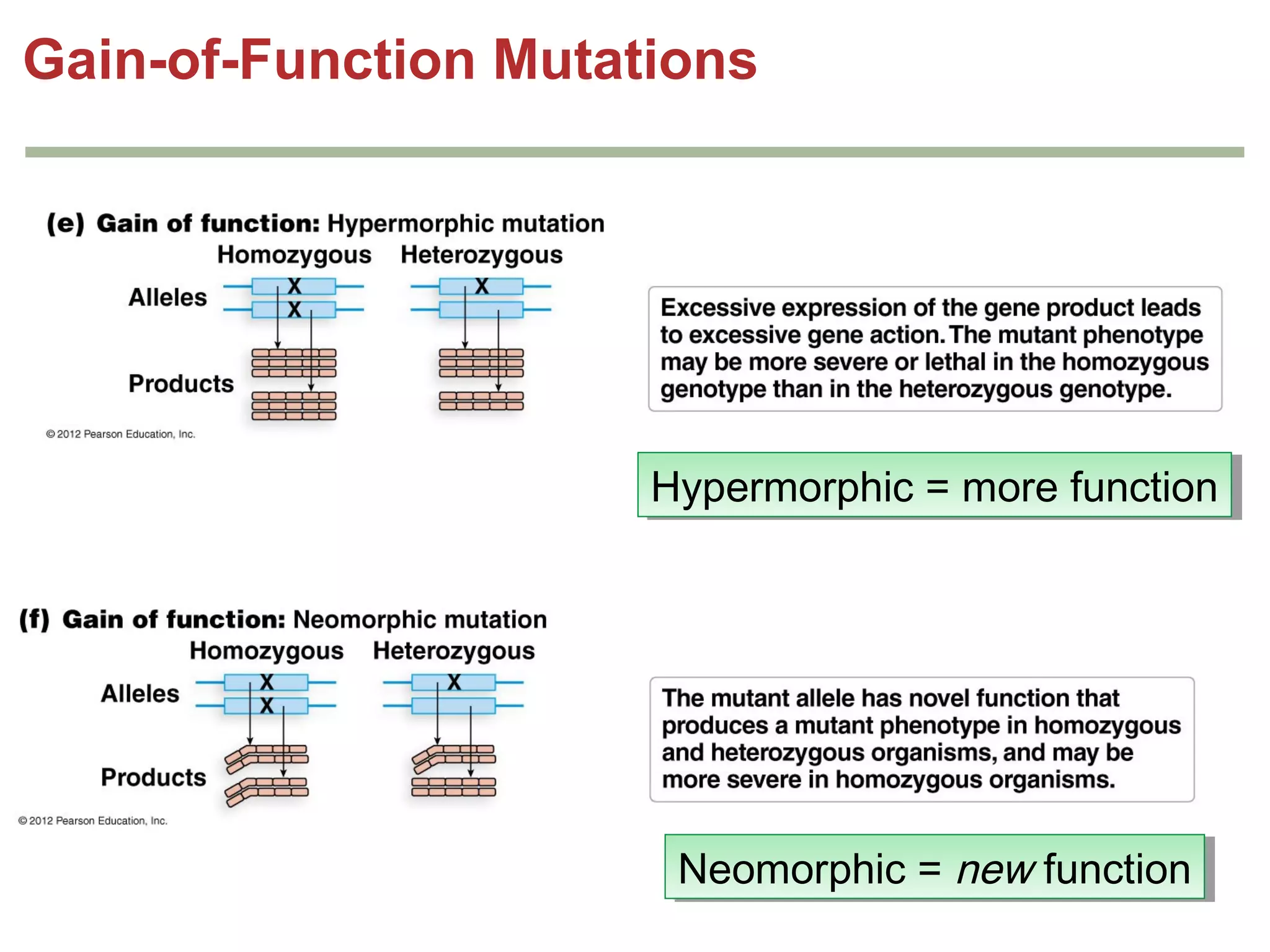
3. The functional consequences of mutations are described, including loss-of-function mutations like amorphic and hypomorphic, and gain-of-function mutations like hypermorphic and neomorphic.