Numerical chromosomal aberrations.
AtikaNoor 1
ASSIGNMENT ON GENETICS
NUMERICAL CHROMOSOMAL ABBERATIONS
Submitted to:
Sir IMRAN BASHIR.
Submitted By:
ATIKA NOOR.
Swot Degree College Liaquat Pur.
Numerical chromosomal aberrations.
AtikaNoor 2
Numerical chromosomal aberrations.
AtikaNoor 3
ACKNOWLEDGEMENT
Presentation, Inspiration and motivation have
always played an important role in the successof venture.
The successand final outcome of my assignmentrequired a
lot of guidance and assistance .I am acknowledged to indebted all my
success to my Botany teacher
“Sir IMRAN BASHIR”,who encouraged
appealed and enlighten my abilities to help me to prepare such an
excellent assignment.
At last but not the least I pay humble thanks to my college
principal, “Sir NAEEM AKHTAR.”
Atika Noor
Numerical chromosomal aberrations.
AtikaNoor 4
Dedication:
Dedicated to my teacher,
With words,
Across galaxies of time &space;
Travelling just to see my goal.
Lost amidst the countless stars;
To bring me back to where you are.
And my parents who say to inspire me,
“Though you can love you cannot master, you cannot
master what you don’t love.”
Atika Noor
Numerical chromosomal aberrations.
AtikaNoor 5
Table of contents:
Numerical Chromosomal Aberrations
Euploidy
Aneuploidy
Types of euploidy.
 Monoploidy (1n)
 Diploidy.(2n)
 Polyploidy.(3n,4n,5n…)
Types of polyploidy
Autopolyploidy.(AAA) or (AAAA)
Allopolyploidy.(AABB) or (AAB)
Types of Aneuploidy.
 Hypoploidy.(2n-x)
 Hyperploidy.(2n+x)
 Monosomy.(2n-1)
 Nullisomy.(2n-2)
 Trisomy.(2n+1)
 Tetrasomy.(2n+2)
Numerical chromosomal aberrations.
AtikaNoor 6
Numerical Chromosomal Aberrations
Introduction:
All animals and plants have a complete genome consisting of two sets of
chromosomesin somatic cell and one set in gametes .Sometimes
aberrations occur in number or structure which causes abnormality.
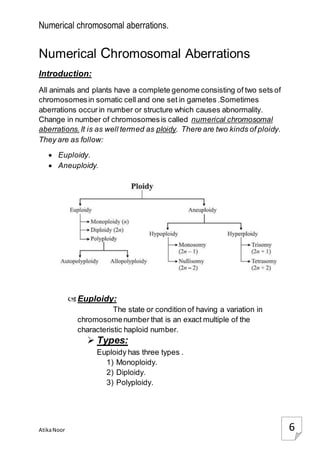
Change in number of chromosomesis called numerical chromosomal
aberrations. It is as well termed as ploidy. There are two kinds of ploidy.
They are as follow:
 Euploidy.
 Aneuploidy.
Euploidy:
The state or condition of having a variation in
chromosomenumber that is an exact multiple of the
characteristic haploid number.
 Types:
Euploidy has three types .
1) Monoploidy.
2) Diploidy.
3) Polyploidy.
Numerical chromosomal aberrations.
AtikaNoor 7
Monoploidy:
The condition where each chromosomeis represented only once is
called Monoploidy and the organisms having this condition are called
monoploids orhaploids.
 The haploids have only one set of chromosomes.
e.g. algae and fungi.
 A distinction should be made between monoploidsand haploid.
e.g.
In Barley=2n=x=7
Corn=2n=x=10
X= basic number.
Origin and productionof monoploids:
 Monoploids I some cases are found naturally and are produced
due to parthenogenesis as in male insects,bees,wasps, ants etc.
 In angiosperms monoploids mayalso originate spontaneously due
to parthenogenetic developmentof eggs.
 Rarely monoploids plants may originate from the pollen tube and
antipodal of the embryo sac called androgenic monoploids.
e.g. tomato and cotton under cultivation.
Artificial means of production:
1) X–ray treatment.
2) Delayed pollination.
3) Temperature shock (cold treatment)
4) Colchicines treatment.
5) Distant hybridization.
6) Anther pollen culture.
Numerical chromosomal aberrations.
AtikaNoor 8
Morphology of monoploids:
Monoploids plants have reduced size of;
 All vegetative parts
 Flowers, seeds and stomata.
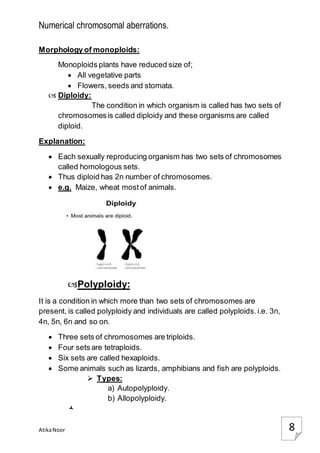
 Diploidy:
The condition in which organism is called has two sets of
chromosomesis called diploidy and these organisms are called
diploid.
Explanation:
 Each sexually reproducing organism has two sets of chromosomes
called homologous sets.
 Thus diploid has 2n number of chromosomes.
 e.g. Maize, wheat mostof animals.
Polyploidy:
It is a condition in which more than two sets of chromosomes are
present, is called polyploidy and individuals are called polyploids.i.e. 3n,
4n, 5n, 6n and so on.
 Three sets of chromosomes are triploids.
 Four sets are tetraploids.
 Six sets are called hexaploids.
 Some animals such as lizards, amphibians and fish are polyploids.
 Types:
a) Autopolyploidy.
b) Allopolyploidy.

Numerical chromosomal aberrations.
AtikaNoor 9
 Autopolyploidy:
By the addition of one or more sets of
chromosomesidentical to normal haploid complementof the
same speciesis called autopolyploidy.
 If a diploid specie has two sets of chromosomes (2n) or genome
(AA)an auto triploid has three similar sets or genome.
 Tetraploids have four sets of genome.
Origin and productionof autopolyploidy:
Polyploidymay arise naturally by following means;
o Due to interference with cytokinesis once replication has occurred.
o It may occur during meiosis when unreduced gametes are
produced.
o All these may occur during chilling.
Artificial methods to induce autopolyploidy are follows
o Chloral hydride.
o Mercury chloride etc.
o Radioactive substances and temperature shocks.
o Colchicines’method.
Autotriploids arise in severalways;
1) A failure of all gametes during meiotic division may produce diploid
gametes.If such gametes are fertilized by a haploid gamete a
triploid organism is produced.
2) Two sperms may fertilize an ovum resulting triploid zygote.
3) Triploids may be produced under experimental conditions by
crossing diploid with tetraploids.
Examples:
 Tomatoes.
 Grapes.
 Watermelonetc.
Numerical chromosomal aberrations.
AtikaNoor 10
Autotetraploids:
Organisms having four sets of chromosomes are called auto
tetraploids and are produced by applying colchicines technique to cells
undergoing mitosis.
They can be produced applying heat shock proteins.
Allopolyploidy:
When the polyploidyresults due to doubling of chromosome
number in a F1 hybrid which is derived from two distinctly varying
species,it is called allopolyploids.Organisms are called allopolyploids.
Explanation:
Allopolyploid has two or more genomes from two different
species.It is achieved by multiplication of chromosome sets of a hybrid
of two diploid species.
Examples:
1) A classicalexample of allotetraploidy in plants is the cultivated
species ofAmericancotton (Gossipium hirsutum).this speciehas
26 chromosomes,13 large and 13 small. It was noted that old
world cotton has only 13 pairs of large chromosomesand wild
American cotton has only 13 pairs of small chromosomes.
New American cotton is tetraploid and is hybrid between old world
cotton and wild American cotton.
2) Wheat and rye example is the best example to explain the
Allopolyploidy.
Tetraploid Triticum durum (wheat),(4n=28)is crossed with diploid
Scale cereal( rye plant),(2n=14).Triticale (6n=42) hexaploids is
obtained.
The hybrid demonstrates the characteristics of both wheat and rye.
Numerical chromosomal aberrations.
AtikaNoor 11
 Effects of polyploidy:
1. Morphologicaleffects:
The polyploidyis invariably related with gigantism. The
polyploid plant has large size of;
 Pollen grains.
 Cells.
 Leaves.
 Stomata.
 Xylem etc.
2. Physiologicaleffets:
 The ascorbic acid content is reported higher in tetraploid tomatoes
and cabbage.
 Tetraploid maize seed has 40 %more vitamin A as compared to
diploid corn.
3. Effects on fertility:
 The most important effectof polyploidyis that it produces infertility
in plants, as a result no seed formation.
4. Evolution through polyploidy:
 Interspecific hybridization combined with polyploidy offers a
mechanism whereby new speciesmay arise.
 Aneuploidy:
‘’Aneuploidy may be due to loss of one or more
chromosomesor due to addition of one or more
chromosomesto the complete setof chromosomes and not
the complete set of chromosomesis involved.’’
The nuclei of aneuploids contain chromosomes whose numberis not
true multiple of the basic number (n).
 Types:
1) Hypoploidy.
2) Hyperploidy.
Numerical chromosomal aberrations.
AtikaNoor 12
 Hypoploidy:
Hypoploidy is a state in which cells contain one or more, fewer
chromosomesthan what is normal.
Kinds:
a) Monosomy.
b) Nullisomy.
 Monosomy:
The loss of only one chromosomesfrom the whole set of
chromosomeis called monosomy.organisms are called monosomic
organisms.(2n-1)condition is present.
Explanation:
 In animals Monosomy for one sex is common i.e. XO mechanism
in Drosophilamelanogesterhave appearance;but is sterile male.
 Loss of 4 chromosomesresults in developmentof individual with
reduced body.
 Loss of chromosome 2 or 3 is lethal.
 Monosomy has been observed inmaize, tobacco and datura.
 A polyploid has many copies of same chromosomes so the loss of
one chromosomeis easily tolerated.
 Nullisomy:
Loss of a chromosomepair from the whole genome is called Nullisomy.
 (2n-2) condition is present.
 A nullisomy diploid often don’t survive.
 In polyploids nullisomic condition survive as they have many
copies of genome.
 Hyperploidy:
Having a chromosome number greater than but not an exact multiple of
the normal euploid number is called Hyperploidy.
Numerical chromosomal aberrations.
AtikaNoor 13
Kinds:
a) Trisomy.
b) Tetrasomy.
 Trisomy:
Trisomics are those diploid organisms which have an extra
chromosome.This condition is called Trisomy denoted by (2n+1).
Explanation:
Since the extra chromosome belongs to any of the differentchromosome
of a haploid complementthe number of possible Trisomics will be equal
to the haploid chromosomenumber, e.g. haploid chromosome number
of barley is 7 so there may 7 trisomics are possible .
Examples:
 Datura trisomics ;
Haploid number of chromosomein datura is 12 and there is
12 possible trisomics.i.e.A plant with 24 chromosomes+ chromosome
no. 1 or plant with 24+an extra chromosomeno. 2.
These trisomics have differentshapes of capsules than normal diploids.
Drosophila trisomics:
Trisomy was discovered by Bridges in 1921.He found that
there are some female drosophilawith an extra X chromosome(XXX).
The normal drosophilamale and female have XY and XX pairs of sex
chromosomesrespectively.
Chromosomeno. 4 of drosophilacan also exist in trisomics form.
Trisomy in man:
Man has also trisomics conditions in several differentchromosomes;
 Down’s syndrome at chromosomes no. 21.
 Patue syndrome at chromosomesno. 13.
Numerical chromosomal aberrations.
AtikaNoor 14
 Edward syndrome at chromosomes no. 18.
 Kline filter’s syndrome is rare and is presentat sex chromosomes.
Indicated by (XXY) or (XXX) females are also observed.
 Tetrasomy:
The diploid organisms having two extra chromosomesare
known as tetrasomic.
Genomic formula is (2n+2).
All the 21 possible tetrasomicsare available in wheat.
Numerical chromosomal aberrations.
AtikaNoor 15
Referances:
 Text Bookof Botany.
 Notes for B.Sc. by “Sir Imran Bashir.”
 Notes for B.Sc. by “Sir Azad Ali Mirza.”
 Genetics search on “Google”.
 Genetics: Analysis and Principles by RobertBrooker.
Numerical chromosomal aberrations.
AtikaNoor 16
Remarks:

chromosomal aberrations in number

  • 1.
    Numerical chromosomal aberrations. AtikaNoor1 ASSIGNMENT ON GENETICS NUMERICAL CHROMOSOMAL ABBERATIONS Submitted to: Sir IMRAN BASHIR. Submitted By: ATIKA NOOR. Swot Degree College Liaquat Pur.
  • 2.
  • 3.
    Numerical chromosomal aberrations. AtikaNoor3 ACKNOWLEDGEMENT Presentation, Inspiration and motivation have always played an important role in the successof venture. The successand final outcome of my assignmentrequired a lot of guidance and assistance .I am acknowledged to indebted all my success to my Botany teacher “Sir IMRAN BASHIR”,who encouraged appealed and enlighten my abilities to help me to prepare such an excellent assignment. At last but not the least I pay humble thanks to my college principal, “Sir NAEEM AKHTAR.” Atika Noor
  • 4.
    Numerical chromosomal aberrations. AtikaNoor4 Dedication: Dedicated to my teacher, With words, Across galaxies of time &space; Travelling just to see my goal. Lost amidst the countless stars; To bring me back to where you are. And my parents who say to inspire me, “Though you can love you cannot master, you cannot master what you don’t love.” Atika Noor
  • 5.
    Numerical chromosomal aberrations. AtikaNoor5 Table of contents: Numerical Chromosomal Aberrations Euploidy Aneuploidy Types of euploidy.  Monoploidy (1n)  Diploidy.(2n)  Polyploidy.(3n,4n,5n…) Types of polyploidy Autopolyploidy.(AAA) or (AAAA) Allopolyploidy.(AABB) or (AAB) Types of Aneuploidy.  Hypoploidy.(2n-x)  Hyperploidy.(2n+x)  Monosomy.(2n-1)  Nullisomy.(2n-2)  Trisomy.(2n+1)  Tetrasomy.(2n+2)
  • 6.
    Numerical chromosomal aberrations. AtikaNoor6 Numerical Chromosomal Aberrations Introduction: All animals and plants have a complete genome consisting of two sets of chromosomesin somatic cell and one set in gametes .Sometimes aberrations occur in number or structure which causes abnormality. Change in number of chromosomesis called numerical chromosomal aberrations. It is as well termed as ploidy. There are two kinds of ploidy. They are as follow:  Euploidy.  Aneuploidy. Euploidy: The state or condition of having a variation in chromosomenumber that is an exact multiple of the characteristic haploid number.  Types: Euploidy has three types . 1) Monoploidy. 2) Diploidy. 3) Polyploidy.
  • 7.
    Numerical chromosomal aberrations. AtikaNoor7 Monoploidy: The condition where each chromosomeis represented only once is called Monoploidy and the organisms having this condition are called monoploids orhaploids.  The haploids have only one set of chromosomes. e.g. algae and fungi.  A distinction should be made between monoploidsand haploid. e.g. In Barley=2n=x=7 Corn=2n=x=10 X= basic number. Origin and productionof monoploids:  Monoploids I some cases are found naturally and are produced due to parthenogenesis as in male insects,bees,wasps, ants etc.  In angiosperms monoploids mayalso originate spontaneously due to parthenogenetic developmentof eggs.  Rarely monoploids plants may originate from the pollen tube and antipodal of the embryo sac called androgenic monoploids. e.g. tomato and cotton under cultivation. Artificial means of production: 1) X–ray treatment. 2) Delayed pollination. 3) Temperature shock (cold treatment) 4) Colchicines treatment. 5) Distant hybridization. 6) Anther pollen culture.
  • 8.
    Numerical chromosomal aberrations. AtikaNoor8 Morphology of monoploids: Monoploids plants have reduced size of;  All vegetative parts  Flowers, seeds and stomata.  Diploidy: The condition in which organism is called has two sets of chromosomesis called diploidy and these organisms are called diploid. Explanation:  Each sexually reproducing organism has two sets of chromosomes called homologous sets.  Thus diploid has 2n number of chromosomes.  e.g. Maize, wheat mostof animals. Polyploidy: It is a condition in which more than two sets of chromosomes are present, is called polyploidy and individuals are called polyploids.i.e. 3n, 4n, 5n, 6n and so on.  Three sets of chromosomes are triploids.  Four sets are tetraploids.  Six sets are called hexaploids.  Some animals such as lizards, amphibians and fish are polyploids.  Types: a) Autopolyploidy. b) Allopolyploidy. 
  • 9.
    Numerical chromosomal aberrations. AtikaNoor9  Autopolyploidy: By the addition of one or more sets of chromosomesidentical to normal haploid complementof the same speciesis called autopolyploidy.  If a diploid specie has two sets of chromosomes (2n) or genome (AA)an auto triploid has three similar sets or genome.  Tetraploids have four sets of genome. Origin and productionof autopolyploidy: Polyploidymay arise naturally by following means; o Due to interference with cytokinesis once replication has occurred. o It may occur during meiosis when unreduced gametes are produced. o All these may occur during chilling. Artificial methods to induce autopolyploidy are follows o Chloral hydride. o Mercury chloride etc. o Radioactive substances and temperature shocks. o Colchicines’method. Autotriploids arise in severalways; 1) A failure of all gametes during meiotic division may produce diploid gametes.If such gametes are fertilized by a haploid gamete a triploid organism is produced. 2) Two sperms may fertilize an ovum resulting triploid zygote. 3) Triploids may be produced under experimental conditions by crossing diploid with tetraploids. Examples:  Tomatoes.  Grapes.  Watermelonetc.
  • 10.
    Numerical chromosomal aberrations. AtikaNoor10 Autotetraploids: Organisms having four sets of chromosomes are called auto tetraploids and are produced by applying colchicines technique to cells undergoing mitosis. They can be produced applying heat shock proteins. Allopolyploidy: When the polyploidyresults due to doubling of chromosome number in a F1 hybrid which is derived from two distinctly varying species,it is called allopolyploids.Organisms are called allopolyploids. Explanation: Allopolyploid has two or more genomes from two different species.It is achieved by multiplication of chromosome sets of a hybrid of two diploid species. Examples: 1) A classicalexample of allotetraploidy in plants is the cultivated species ofAmericancotton (Gossipium hirsutum).this speciehas 26 chromosomes,13 large and 13 small. It was noted that old world cotton has only 13 pairs of large chromosomesand wild American cotton has only 13 pairs of small chromosomes. New American cotton is tetraploid and is hybrid between old world cotton and wild American cotton. 2) Wheat and rye example is the best example to explain the Allopolyploidy. Tetraploid Triticum durum (wheat),(4n=28)is crossed with diploid Scale cereal( rye plant),(2n=14).Triticale (6n=42) hexaploids is obtained. The hybrid demonstrates the characteristics of both wheat and rye.
  • 11.
    Numerical chromosomal aberrations. AtikaNoor11  Effects of polyploidy: 1. Morphologicaleffects: The polyploidyis invariably related with gigantism. The polyploid plant has large size of;  Pollen grains.  Cells.  Leaves.  Stomata.  Xylem etc. 2. Physiologicaleffets:  The ascorbic acid content is reported higher in tetraploid tomatoes and cabbage.  Tetraploid maize seed has 40 %more vitamin A as compared to diploid corn. 3. Effects on fertility:  The most important effectof polyploidyis that it produces infertility in plants, as a result no seed formation. 4. Evolution through polyploidy:  Interspecific hybridization combined with polyploidy offers a mechanism whereby new speciesmay arise.  Aneuploidy: ‘’Aneuploidy may be due to loss of one or more chromosomesor due to addition of one or more chromosomesto the complete setof chromosomes and not the complete set of chromosomesis involved.’’ The nuclei of aneuploids contain chromosomes whose numberis not true multiple of the basic number (n).  Types: 1) Hypoploidy. 2) Hyperploidy.
  • 12.
    Numerical chromosomal aberrations. AtikaNoor12  Hypoploidy: Hypoploidy is a state in which cells contain one or more, fewer chromosomesthan what is normal. Kinds: a) Monosomy. b) Nullisomy.  Monosomy: The loss of only one chromosomesfrom the whole set of chromosomeis called monosomy.organisms are called monosomic organisms.(2n-1)condition is present. Explanation:  In animals Monosomy for one sex is common i.e. XO mechanism in Drosophilamelanogesterhave appearance;but is sterile male.  Loss of 4 chromosomesresults in developmentof individual with reduced body.  Loss of chromosome 2 or 3 is lethal.  Monosomy has been observed inmaize, tobacco and datura.  A polyploid has many copies of same chromosomes so the loss of one chromosomeis easily tolerated.  Nullisomy: Loss of a chromosomepair from the whole genome is called Nullisomy.  (2n-2) condition is present.  A nullisomy diploid often don’t survive.  In polyploids nullisomic condition survive as they have many copies of genome.  Hyperploidy: Having a chromosome number greater than but not an exact multiple of the normal euploid number is called Hyperploidy.
  • 13.
    Numerical chromosomal aberrations. AtikaNoor13 Kinds: a) Trisomy. b) Tetrasomy.  Trisomy: Trisomics are those diploid organisms which have an extra chromosome.This condition is called Trisomy denoted by (2n+1). Explanation: Since the extra chromosome belongs to any of the differentchromosome of a haploid complementthe number of possible Trisomics will be equal to the haploid chromosomenumber, e.g. haploid chromosome number of barley is 7 so there may 7 trisomics are possible . Examples:  Datura trisomics ; Haploid number of chromosomein datura is 12 and there is 12 possible trisomics.i.e.A plant with 24 chromosomes+ chromosome no. 1 or plant with 24+an extra chromosomeno. 2. These trisomics have differentshapes of capsules than normal diploids. Drosophila trisomics: Trisomy was discovered by Bridges in 1921.He found that there are some female drosophilawith an extra X chromosome(XXX). The normal drosophilamale and female have XY and XX pairs of sex chromosomesrespectively. Chromosomeno. 4 of drosophilacan also exist in trisomics form. Trisomy in man: Man has also trisomics conditions in several differentchromosomes;  Down’s syndrome at chromosomes no. 21.  Patue syndrome at chromosomesno. 13.
  • 14.
    Numerical chromosomal aberrations. AtikaNoor14  Edward syndrome at chromosomes no. 18.  Kline filter’s syndrome is rare and is presentat sex chromosomes. Indicated by (XXY) or (XXX) females are also observed.  Tetrasomy: The diploid organisms having two extra chromosomesare known as tetrasomic. Genomic formula is (2n+2). All the 21 possible tetrasomicsare available in wheat.
  • 15.
    Numerical chromosomal aberrations. AtikaNoor15 Referances:  Text Bookof Botany.  Notes for B.Sc. by “Sir Imran Bashir.”  Notes for B.Sc. by “Sir Azad Ali Mirza.”  Genetics search on “Google”.  Genetics: Analysis and Principles by RobertBrooker.
  • 16.