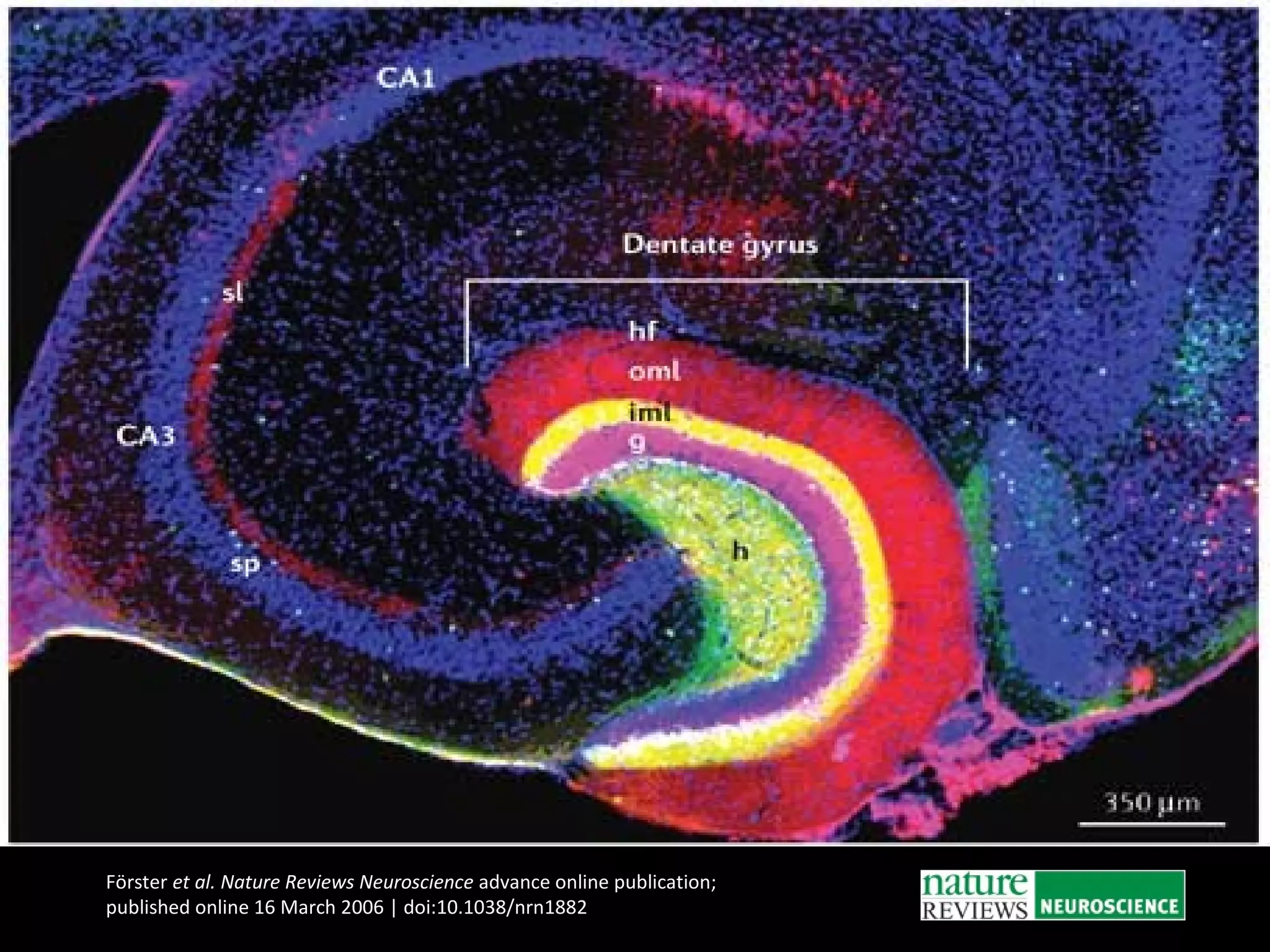
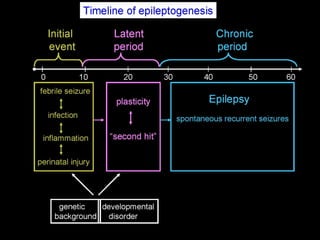
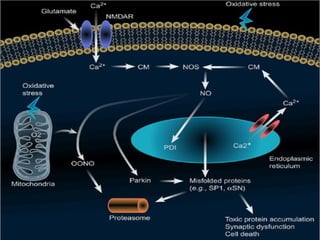
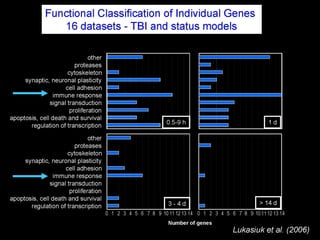
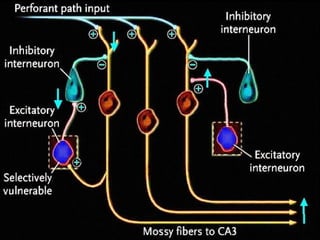
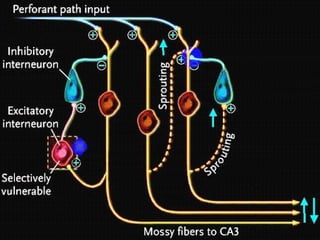
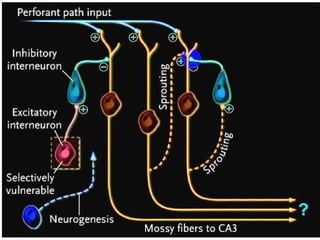
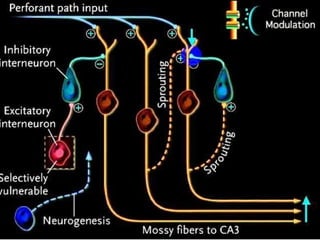
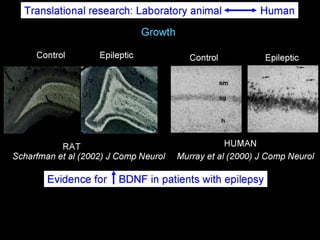
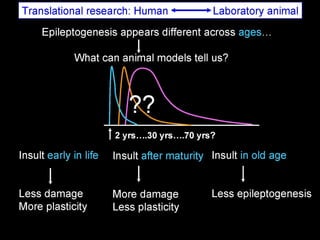
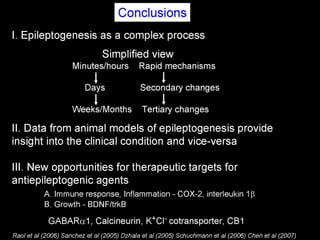
Förster et al. Nature Reviews Neuroscience advance online publication;
published online 16 March 2006 | doi:10.1038/nrn1882
Definition of Terms
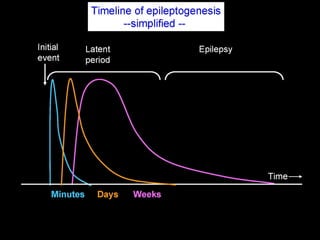
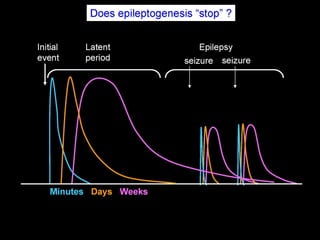
• Epileptogenesis refers to the transformation of the brain
to a long-lasting state in which recurrent, spontaneous
seizures occur
• Seizure expression is the process which is concerned
with processes that trigger and generate seizures
• Epileptogenicity is the property of a tissue that is
capable of generating spontaneous behavioral and/or
electrographic seizures
– Clark, S. and Wilson, W. A., Adv. Neurol., 1999, 79, 607–630.
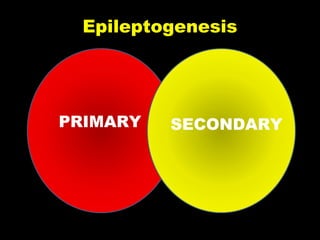
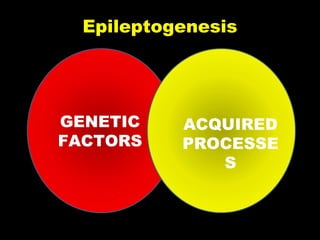
Epileptogenesis

PRIMARY

SECONDARY
Epileptogenesis

GENETIC
FACTORS

ACQUIRED
PROCESSE
S
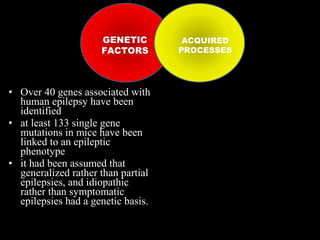
GENETIC
FACTORS

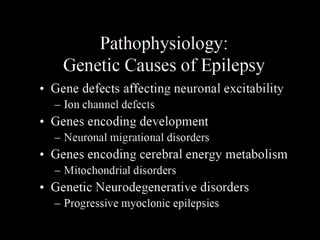
• Over 40 genes associated with
human epilepsy have been
identified
• at least 133 single gene
mutations in mice have been
linked to an epileptic
phenotype
• it had been assumed that
generalized rather than partial
epilepsies, and idiopathic
rather than symptomatic
epilepsies had a genetic basis.

ACQUIRED
PROCESSES
GENETIC
FACTORS

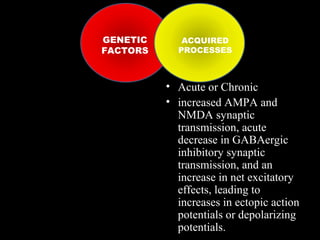
ACQUIRED
PROCESSES

• Acute or Chronic
• increased AMPA and
NMDA synaptic
transmission, acute
decrease in GABAergic
inhibitory synaptic
transmission, and an
increase in net excitatory
effects, leading to
increases in ectopic action
potentials or depolarizing
potentials.
GENETIC
FACTORS

ACQUIRED
PROCESSES

• Nonsynaptic mechanisms
such as changes in coupling
through gap junctions29,
iron-mediated changes in
Ca++ oscillations or
glutamate release and
generation of oxygen- free
radicals
• acute neuronal loss alone is
not necessary for the
generation of acute
epileptiform bursts in vitro
GENETIC
FACTORS

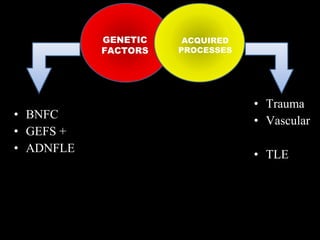
• BNFC
• GEFS +
• ADNFLE
GENETIC
FACTORS

• BNFC
• GEFS +
• ADNFLE

ACQUIRED
PROCESSES

• Trauma
• Vascular
• TLE
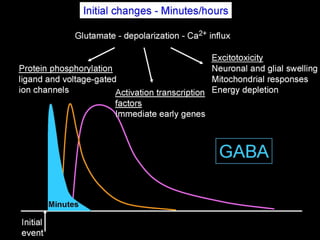
Minutes to hours
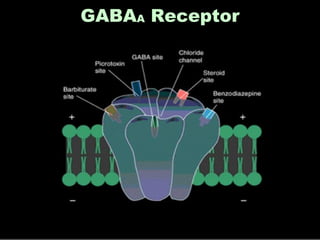
GABAA Receptor
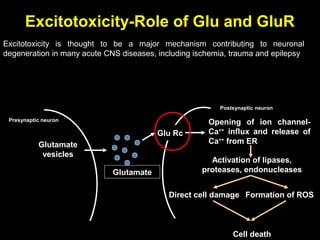
Excitotoxicity-Role of Glu and GluR
Excitotoxicity is thought to be a major mechanism contributing to neuronal
degeneration in many acute CNS diseases, including ischemia, trauma and epilepsy

Postsynaptic neuron
Presynaptic neuron

Glu Rc
Glutamate
vesicles
Glutamate

Opening of ion channelCa++ influx and release of
Ca++ from ER
Activation of lipases,
proteases, endonucleases

Direct cell damage Formation of ROS

Cell death
Days
Weeks to Months to Years
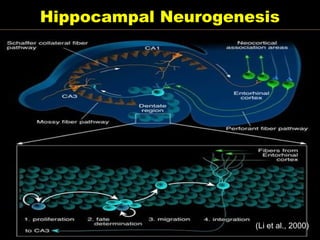
Hippocampal Neurogenesis

(Li et al., 2000)
2000
At the electrical Level
• PDS
• LTP
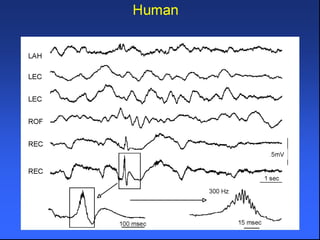
• Fast Ripples

• Kindling!!!!
At the electrical Level
• PDS
• LTP
• Fast Ripples

• Kindling!!!!
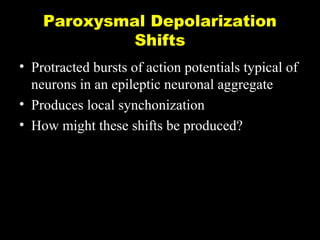
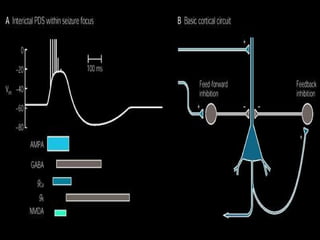
Paroxysmal Depolarization
Shifts
• Protracted bursts of action potentials typical of
neurons in an epileptic neuronal aggregate
• Produces local synchonization
• How might these shifts be produced?
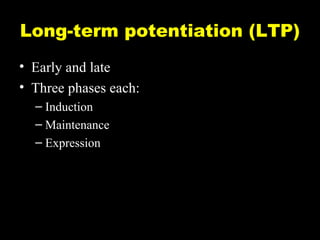
Long-term potentiation (LTP)
• Early and late
• Three phases each:
– Induction
– Maintenance
– Expression
Early-LTP induction
• Excitatory stimulus of the cell causes
excitatory post-synaptic potential (ESPS) (e.g.
glutamate binding to AMPA receptor)
• Stimulus may be either a large single stimulus
or many smaller rapid stimuli that summate
(post-tetanic potentiation)
• Sufficient stimulus leads to unblocking of
NMDA receptor and Ca influx into the cell
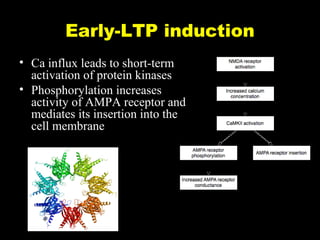
Early-LTP induction
• Ca influx leads to short-term
activation of protein kinases
• Phosphorylation increases
activity of AMPA receptor and
mediates its insertion into the
cell membrane

Calcium/calmodulin-dependent
protein kinase II (CaMKII)
Maintenance/expression EarlyLTP
• CaMKII and protein kinase C lose their Ca
dependence
• Continued phosphorylation and upregulation
of AMPA receptors
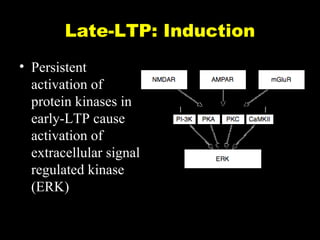
Late-LTP: Induction
• Persistent
activation of
protein kinases in
early-LTP cause
activation of
extracellular signal
regulated kinase
(ERK)
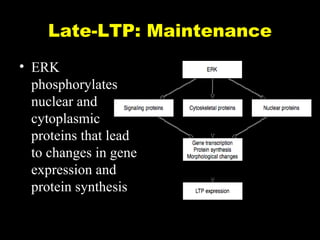
Late-LTP: Maintenance
• ERK
phosphorylates
nuclear and
cytoplasmic
proteins that lead
to changes in gene
expression and
protein synthesis
Late-LTP: Expression
• Protein products are thought to lead to increase
in:
– Number and surface area of dendritic spines
– Postsynaptic sensitivity to neurotransmitter
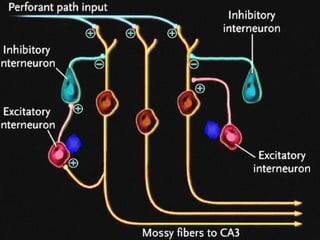
perhaps by enhanced synthesis of AMPA receptors
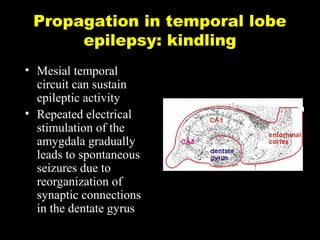
Propagation in temporal lobe
epilepsy: kindling
• Mesial temporal
circuit can sustain
epileptic activity
• Repeated electrical
stimulation of the
amygdala gradually
leads to spontaneous
seizures due to
reorganization of
synaptic connections
in the dentate gyrus
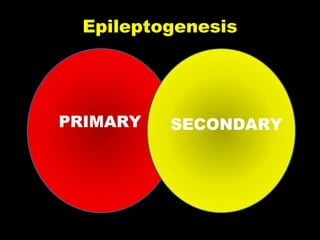
Epileptogenesis

PRIMARY

SECONDARY
• Gowers in 1912 - ‘seizures beget seizures’

• Secondary epileptogenesis
• Mirror focus
• Kindling
• A primary epileptogenic area has a macroscopic abnormality
and can generate seizures independent of the presence of
surrounding or remote epileptogenic areas
• A secondary epileptogenic area becomes epileptogenic
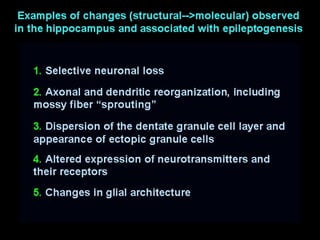
because of the influence of epileptogenic activity in a primary
epileptogenic area, which is separated from it by at least one
synapse
• Morrell, F., Epilepsia, 1960, 1, 538–560
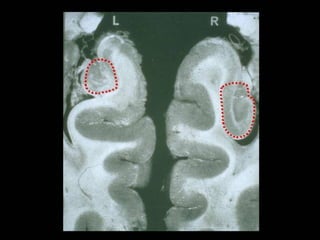
• A mirror focus is a type of secondary epileptogenesis in
which the secondary epileptogenic zone is located in a
contralateral homotopic area with regard to the primary
epileptogenic zone
• Morrell, F., in Basic Mechanisms of Epilepsies (eds Jasper, H. H., Ward, Jr A. A.
and Pope, A.), Little Brown, Boston, 1969, pp. 357–370

• Secondary epileptogenesis likely to be due to kindling
• Goddard, G. V., Nature, 1967, 214, 1020–1021
Phases of Secondary
Epileptogenesis
• dependent phase
• intermediate phase
• independent phase
– Depend on the interrelationship of primary and
secondary zones
– Morrell, F. and Tsuru, N., Biol. Bull., 1974, 147, 492,
Morrell, F. and Tsuru, N., electroencephalogr. Clin.
Neurophysiol., 1976, 60, 1–11
Epilepsy Biomarkers/
Surrogate Markers
• Markers of epileptogenesis
• Markers of epileptogenicity
Definition of Terms
• Epileptogenesis refers to the transformation of the brain
to a long-lasting state in which recurrent, spontaneous
seizures occur
• Seizure expression is the process which is concerned
with processes that trigger and generate seizures
• Epileptogenicity is the property of a tissue that is
capable of generating spontaneous behavioral and/or
electrographic seizures
– Clark, S. and Wilson, W. A., Adv. Neurol., 1999, 79, 607–630.
Epilepsy Biomarkers/
Surrogate Markers
• Markers of epileptogenesis
• Development of an epileptic condition
• Monitoring of the condition once epilepsy is established

• Markers of epileptogenicity
• Localization of the epileptogenic lesion
• Measurement of severity
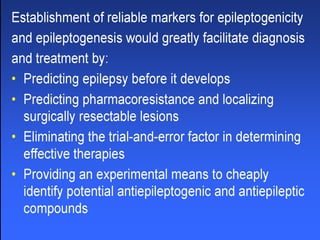
Use of biomarkers
• Predict who are likely to develop chronic
seizures
• Predict pharmacoresistance
• Delineate brain areas for resection
• Determine the efficacy of therapy
• Develop anti epileptogenic drugs…
Target Mechanisms
•
•
•
•
•
•
•
•
•

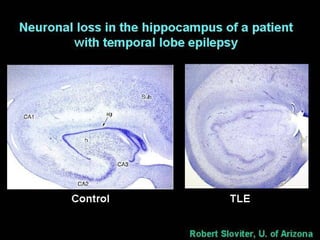
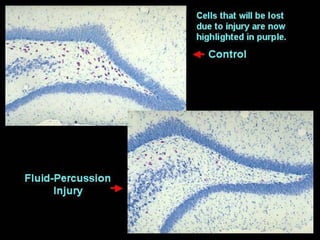
Cell Loss ( eg. Hippocampal atrophy)
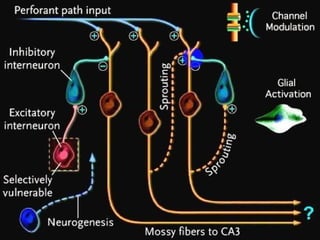
Axonal sprouting
Synaptic reorganization
Altered neuronal function
Neurogenesis
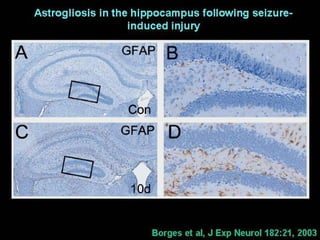
Altered glial function and gliosis
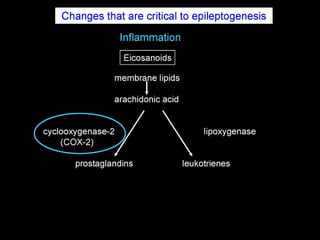
Inflammation
Angiogenesis
Altered excitability and synchrony
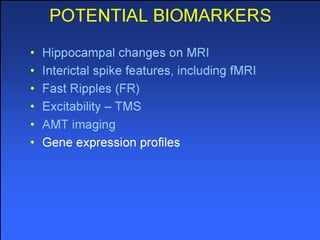
Potential Biomarkers
•
•
•
•
•
•

Hippocampal changes on MRI
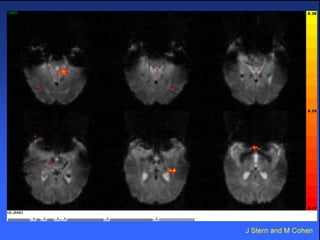
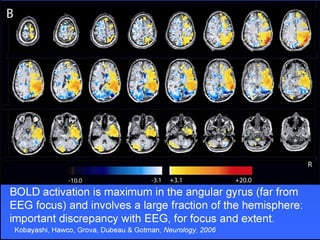
Interictal Spikes, fMRI
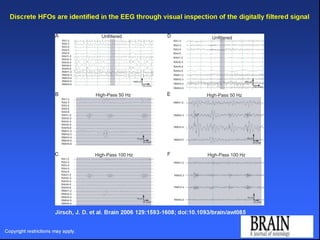
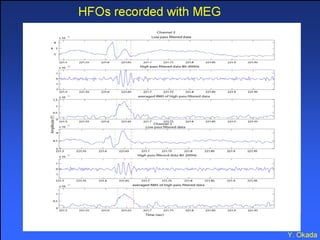
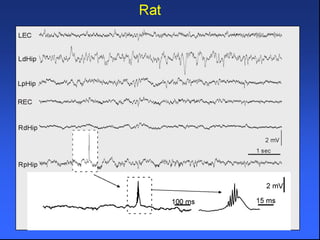
Fast Ripples
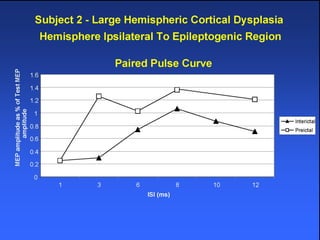
Excitability
AMT imaging
Gene expression profiles
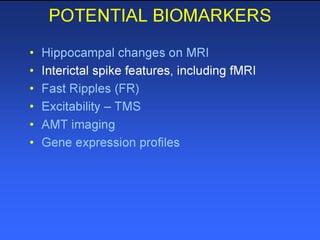
Potential Biomarkers
•
•
•
•
•
•

Hippocampal changes on MRI
Interictal Spikes, fMRI
Fast Ripples
Excitability
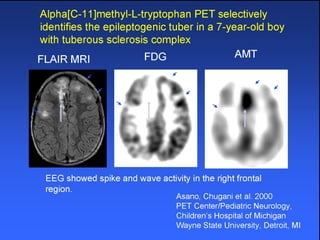
AMT imaging
Gene expression profiles
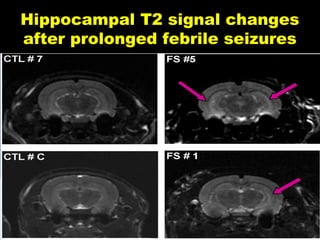
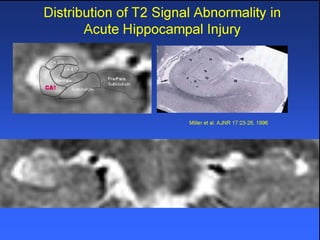
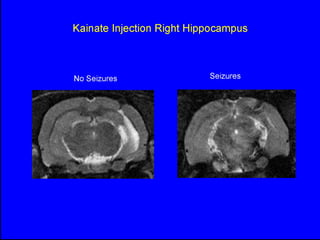
Hippocampal T2 signal changes
after prolonged febrile seizures
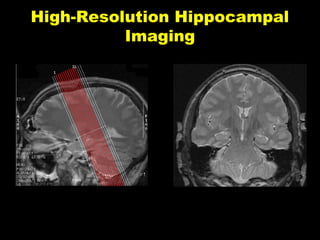
High-Resolution Hippocampal
Imaging

HHR Structural (voxel size = .4 x .4 x 3mm)
HHR Functional EPI (voxel size = 1.6 x 1.6 x 3 mm)
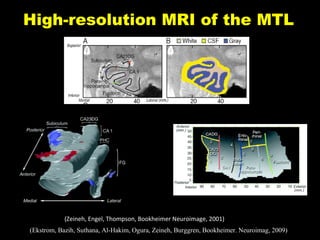
High-resolution MRI of the MTL

(Zeineh, Engel, Thompson, Bookheimer Neuroimage, 2001)
(Ekstrom, Bazih, Suthana, Al-Hakim, Ogura, Zeineh, Burggren, Bookheimer. Neuroimag, 2009)
Can we modify epileptogenesis ?
• Topiramate
• Vigabatrin
• Zonisamide
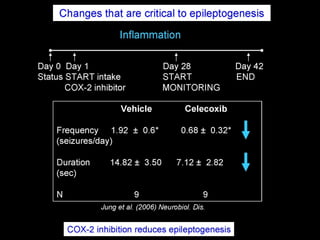
• Celecoxib
• Verapamil !!!
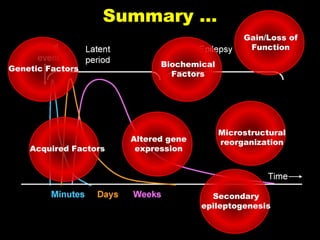
Summary …
Gain/Loss of
Function
Genetic Factors

Acquired Factors

Biochemical
Factors

Altered gene
expression

Microstructural
reorganization

Secondary
epileptogenesis
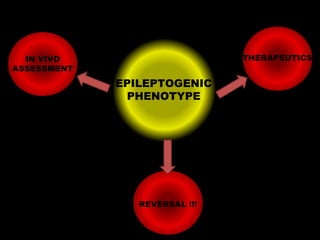
THERAPEUTICS

IN VIVO
ASSESSMENT

EPILEPTOGENIC
PHENOTYPE

REVERSAL !!!
Epileptogenesis - Mechanisms and Clinical Implications

Epileptogenesis - Mechanisms and Clinical Implications

  • 1.
    Förster et al.Nature Reviews Neuroscience advance online publication; published online 16 March 2006 | doi:10.1038/nrn1882
  • 2.
    Definition of Terms •Epileptogenesis refers to the transformation of the brain to a long-lasting state in which recurrent, spontaneous seizures occur • Seizure expression is the process which is concerned with processes that trigger and generate seizures • Epileptogenicity is the property of a tissue that is capable of generating spontaneous behavioral and/or electrographic seizures – Clark, S. and Wilson, W. A., Adv. Neurol., 1999, 79, 607–630.
  • 3.
  • 4.
  • 6.
    GENETIC FACTORS • Over 40genes associated with human epilepsy have been identified • at least 133 single gene mutations in mice have been linked to an epileptic phenotype • it had been assumed that generalized rather than partial epilepsies, and idiopathic rather than symptomatic epilepsies had a genetic basis. ACQUIRED PROCESSES
  • 7.
    GENETIC FACTORS ACQUIRED PROCESSES • Acute orChronic • increased AMPA and NMDA synaptic transmission, acute decrease in GABAergic inhibitory synaptic transmission, and an increase in net excitatory effects, leading to increases in ectopic action potentials or depolarizing potentials.
  • 8.
    GENETIC FACTORS ACQUIRED PROCESSES • Nonsynaptic mechanisms suchas changes in coupling through gap junctions29, iron-mediated changes in Ca++ oscillations or glutamate release and generation of oxygen- free radicals • acute neuronal loss alone is not necessary for the generation of acute epileptiform bursts in vitro
  • 9.
  • 11.
    GENETIC FACTORS • BNFC • GEFS+ • ADNFLE ACQUIRED PROCESSES • Trauma • Vascular • TLE
  • 17.
  • 18.
  • 19.
    Excitotoxicity-Role of Gluand GluR Excitotoxicity is thought to be a major mechanism contributing to neuronal degeneration in many acute CNS diseases, including ischemia, trauma and epilepsy Postsynaptic neuron Presynaptic neuron Glu Rc Glutamate vesicles Glutamate Opening of ion channelCa++ influx and release of Ca++ from ER Activation of lipases, proteases, endonucleases Direct cell damage Formation of ROS Cell death
  • 23.
  • 29.
  • 44.
  • 65.
    At the electricalLevel • PDS • LTP • Fast Ripples • Kindling!!!!
  • 66.
    At the electricalLevel • PDS • LTP • Fast Ripples • Kindling!!!!
  • 67.
    Paroxysmal Depolarization Shifts • Protractedbursts of action potentials typical of neurons in an epileptic neuronal aggregate • Produces local synchonization • How might these shifts be produced?
  • 69.
    Long-term potentiation (LTP) •Early and late • Three phases each: – Induction – Maintenance – Expression
  • 70.
    Early-LTP induction • Excitatorystimulus of the cell causes excitatory post-synaptic potential (ESPS) (e.g. glutamate binding to AMPA receptor) • Stimulus may be either a large single stimulus or many smaller rapid stimuli that summate (post-tetanic potentiation) • Sufficient stimulus leads to unblocking of NMDA receptor and Ca influx into the cell
  • 71.
    Early-LTP induction • Cainflux leads to short-term activation of protein kinases • Phosphorylation increases activity of AMPA receptor and mediates its insertion into the cell membrane Calcium/calmodulin-dependent protein kinase II (CaMKII)
  • 72.
    Maintenance/expression EarlyLTP • CaMKIIand protein kinase C lose their Ca dependence • Continued phosphorylation and upregulation of AMPA receptors
  • 73.
    Late-LTP: Induction • Persistent activationof protein kinases in early-LTP cause activation of extracellular signal regulated kinase (ERK)
  • 74.
    Late-LTP: Maintenance • ERK phosphorylates nuclearand cytoplasmic proteins that lead to changes in gene expression and protein synthesis
  • 75.
    Late-LTP: Expression • Proteinproducts are thought to lead to increase in: – Number and surface area of dendritic spines – Postsynaptic sensitivity to neurotransmitter perhaps by enhanced synthesis of AMPA receptors
  • 76.
    Propagation in temporallobe epilepsy: kindling • Mesial temporal circuit can sustain epileptic activity • Repeated electrical stimulation of the amygdala gradually leads to spontaneous seizures due to reorganization of synaptic connections in the dentate gyrus
  • 77.
  • 78.
    • Gowers in1912 - ‘seizures beget seizures’ • Secondary epileptogenesis • Mirror focus • Kindling
  • 79.
    • A primaryepileptogenic area has a macroscopic abnormality and can generate seizures independent of the presence of surrounding or remote epileptogenic areas • A secondary epileptogenic area becomes epileptogenic because of the influence of epileptogenic activity in a primary epileptogenic area, which is separated from it by at least one synapse • Morrell, F., Epilepsia, 1960, 1, 538–560
  • 80.
    • A mirrorfocus is a type of secondary epileptogenesis in which the secondary epileptogenic zone is located in a contralateral homotopic area with regard to the primary epileptogenic zone • Morrell, F., in Basic Mechanisms of Epilepsies (eds Jasper, H. H., Ward, Jr A. A. and Pope, A.), Little Brown, Boston, 1969, pp. 357–370 • Secondary epileptogenesis likely to be due to kindling • Goddard, G. V., Nature, 1967, 214, 1020–1021
  • 81.
    Phases of Secondary Epileptogenesis •dependent phase • intermediate phase • independent phase – Depend on the interrelationship of primary and secondary zones – Morrell, F. and Tsuru, N., Biol. Bull., 1974, 147, 492, Morrell, F. and Tsuru, N., electroencephalogr. Clin. Neurophysiol., 1976, 60, 1–11
  • 82.
    Epilepsy Biomarkers/ Surrogate Markers •Markers of epileptogenesis • Markers of epileptogenicity
  • 83.
    Definition of Terms •Epileptogenesis refers to the transformation of the brain to a long-lasting state in which recurrent, spontaneous seizures occur • Seizure expression is the process which is concerned with processes that trigger and generate seizures • Epileptogenicity is the property of a tissue that is capable of generating spontaneous behavioral and/or electrographic seizures – Clark, S. and Wilson, W. A., Adv. Neurol., 1999, 79, 607–630.
  • 84.
    Epilepsy Biomarkers/ Surrogate Markers •Markers of epileptogenesis • Development of an epileptic condition • Monitoring of the condition once epilepsy is established • Markers of epileptogenicity • Localization of the epileptogenic lesion • Measurement of severity
  • 85.
    Use of biomarkers •Predict who are likely to develop chronic seizures • Predict pharmacoresistance • Delineate brain areas for resection • Determine the efficacy of therapy • Develop anti epileptogenic drugs…
  • 86.
    Target Mechanisms • • • • • • • • • Cell Loss( eg. Hippocampal atrophy) Axonal sprouting Synaptic reorganization Altered neuronal function Neurogenesis Altered glial function and gliosis Inflammation Angiogenesis Altered excitability and synchrony
  • 87.
    Potential Biomarkers • • • • • • Hippocampal changeson MRI Interictal Spikes, fMRI Fast Ripples Excitability AMT imaging Gene expression profiles
  • 88.
    Potential Biomarkers • • • • • • Hippocampal changeson MRI Interictal Spikes, fMRI Fast Ripples Excitability AMT imaging Gene expression profiles
  • 89.
    Hippocampal T2 signalchanges after prolonged febrile seizures
  • 91.
    High-Resolution Hippocampal Imaging HHR Structural(voxel size = .4 x .4 x 3mm) HHR Functional EPI (voxel size = 1.6 x 1.6 x 3 mm)
  • 92.
    High-resolution MRI ofthe MTL (Zeineh, Engel, Thompson, Bookheimer Neuroimage, 2001) (Ekstrom, Bazih, Suthana, Al-Hakim, Ogura, Zeineh, Burggren, Bookheimer. Neuroimag, 2009)
  • 109.
    Can we modifyepileptogenesis ? • Topiramate • Vigabatrin • Zonisamide • Celecoxib • Verapamil !!!
  • 110.
    Summary … Gain/Loss of Function GeneticFactors Acquired Factors Biochemical Factors Altered gene expression Microstructural reorganization Secondary epileptogenesis
  • 111.

Editor's Notes

  • #20 is the essential factor in excitotoxicity (overactivation of enzymes and further cell damage and death) and further neurodegeneration