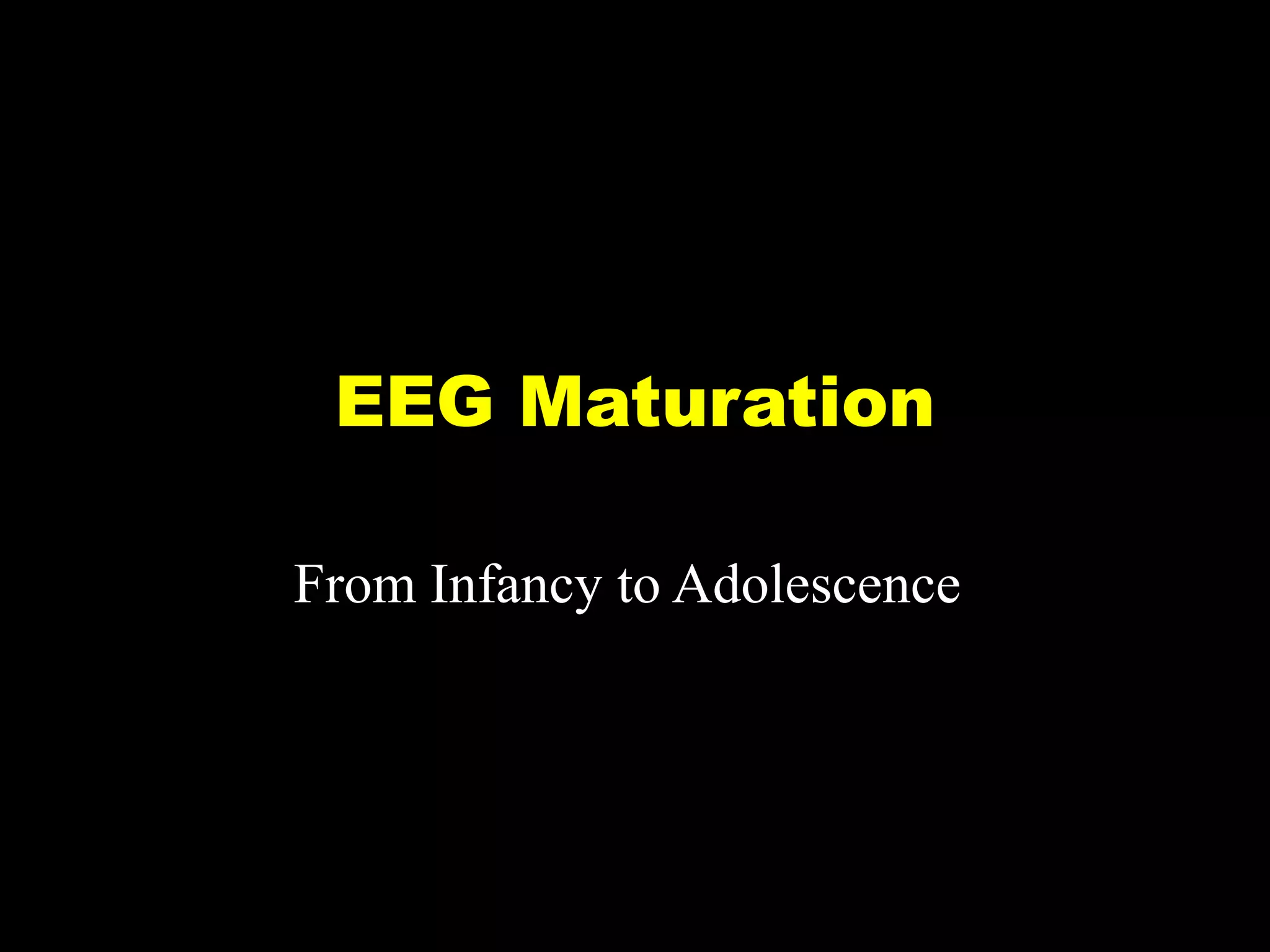
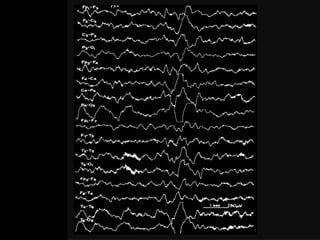
EEG Maturation
From Infancy to Adolescence
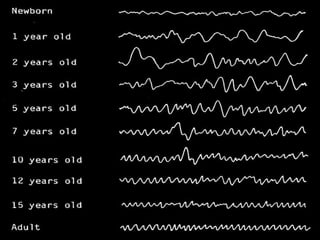
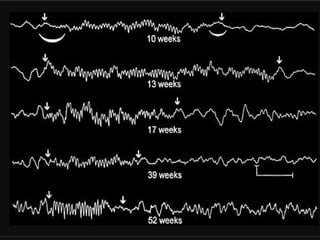
Dendritic Spreading
1
3

3

2
1

2
3

1
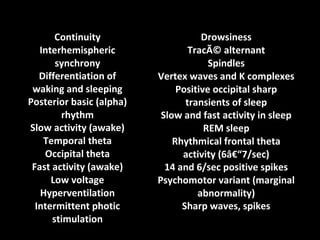
Continuity
Interhemispheric
synchrony
Differentiation of
waking and sleeping
Posterior basic (alpha)
rhythm
Slow activity (awake)
Temporal theta
Occipital theta
Fast activity (awake)
Low voltage
Hyperventilation
Intermittent photic
stimulation

Drowsiness
Tracé alternant
Spindles
Vertex waves and K complexes
Positive occipital sharp
transients of sleep
Slow and fast activity in sleep
REM sleep
Rhythmical frontal theta
activity (6–7/sec)
14 and 6/sec positive spikes
Psychomotor variant (marginal
abnormality)
Sharp waves, spikes
Full Term (36-41 week)
Continuity

Continuous except for tracé alternant in nonREM (quiet) sleep

Interhemispheric synchrony

Minor asynchronies still present

Differentiation of waking and sleeping

Good

Posterior basic (alpha) rhythm

None

Slow activity (awake)

Slow (delta), mostly of moderate voltage

Temporal theta
Occipital theta
Fast activity (awake)

Disappearing or absent
Absent
Decreasing ripples, sparse fast activity

Low voltage

Very low-voltage records are due to severe
cerebral pathology; prognosis ominous

Hyperventilation
Intermittent photic stimulation

Not feasible
Driving response below 4 flashes/sec may occur,
not easily elicited

Drowsiness
Tracé alternant

Undifferentiated
Present in non-REM (quiet) sleep
Full Term (36-41 week),
contd…
Spindles
Vertex waves and K complexes

None (but scanty ripples)
None

Positive occipital sharp transients of sleep

None

Slow and fast activity in sleep

Much delta and theta activity, continuous
in REM sleep

REM sleep

Continuous slow activity, REM in EOG
(more REM or “active” than non-REM
sleep)

Rhythmical frontal theta activity
(6–7/sec)
14 and 6/sec positive spikes
Psychomotor variant (marginal
abnormality)
Sharp waves, spikes

None
None
None
Some minor sharp transients (normal)
(abnormal spikes more consistent and
prominent)
Infancy (2-12 months)
Continuity
Interhemispheric synchrony
Differentiation of waking and sleeping

Continuous
No significant asynchrony
Good

Posterior basic (alpha) rhythm

Starting at age 3–4 mos at 4/sec, reaching
about 6/sec at 12 mos

Slow activity (awake)
Temporal theta
Occipital theta
Fast activity (awake)
Low voltage

Considerable
None
None
Very moderate
Uncommon, usually abnormal

Hyperventilation
Intermittent photic stimulation

Not feasible
Improving driving to low flash rates after age 6
mos
Around age 6 mos, appearance of rhythmical
theta

Drowsiness
Infancy (2-12 months),
contd…
Tracé alternant

Disappears in 1st (seldom 2nd) mo

Spindles
Vertex waves and K complexes

Appear after 2nd mo; 12–15/sec, sharp,
shifting
Appear mainly at 5 mos, fairly large, blunt

Positive occipital sharp transients of sleep

None

Slow and fast activity in sleep

Much diffuse 0.75–3/sec activity with
posterior maximum; moderate fast activity

REM sleep

REM portion decreasing; mostly slow activity

Rhythmical frontal theta activity (6–7/sec)

None

14 and 6/sec positive spikes
Psychomotor variant (marginal abnormality)

None
None

Sharp waves, spikes

Essential as abnormal phenomena
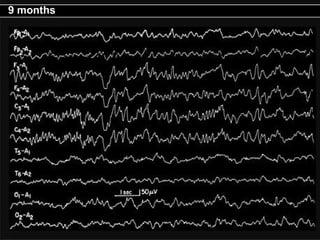
9 months
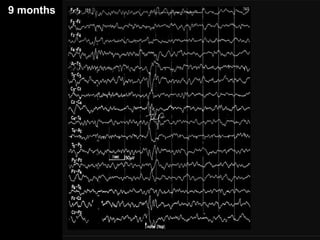
9 months
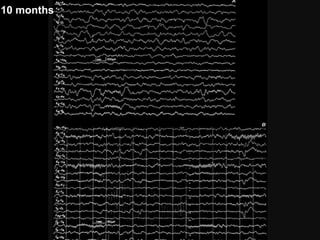
10 months
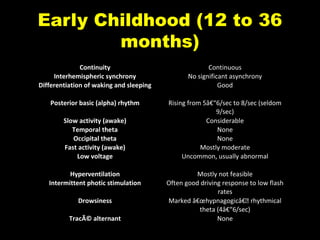
Early Childhood (12 to 36
months)
Continuity
Interhemispheric synchrony
Differentiation of waking and sleeping

Continuous
No significant asynchrony
Good

Posterior basic (alpha) rhythm

Rising from 5–6/sec to 8/sec (seldom
9/sec)
Considerable
None
None
Mostly moderate
Uncommon, usually abnormal

Slow activity (awake)
Temporal theta
Occipital theta
Fast activity (awake)
Low voltage
Hyperventilation
Intermittent photic stimulation
Drowsiness
Tracé alternant

Mostly not feasible
Often good driving response to low flash
rates
Marked “hypnagogic” rhythmical
theta (4–6/sec)
None
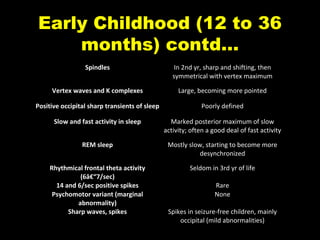
Early Childhood (12 to 36
months) contd…
Spindles

In 2nd yr, sharp and shifting, then
symmetrical with vertex maximum

Vertex waves and K complexes

Large, becoming more pointed

Positive occipital sharp transients of sleep

Poorly defined

Slow and fast activity in sleep

Marked posterior maximum of slow
activity; often a good deal of fast activity

REM sleep

Mostly slow, starting to become more
desynchronized

Rhythmical frontal theta activity
(6–7/sec)
14 and 6/sec positive spikes
Psychomotor variant (marginal
abnormality)
Sharp waves, spikes

Seldom in 3rd yr of life
Rare
None
Spikes in seizure-free children, mainly
occipital (mild abnormalities)
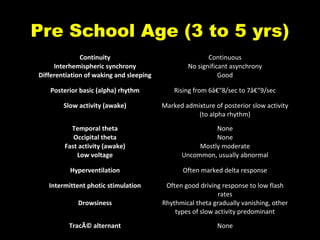
Pre School Age (3 to 5 yrs)
Continuity
Interhemispheric synchrony
Differentiation of waking and sleeping

Continuous
No significant asynchrony
Good

Posterior basic (alpha) rhythm

Rising from 6–8/sec to 7–9/sec

Slow activity (awake)

Marked admixture of posterior slow activity
(to alpha rhythm)

Temporal theta
Occipital theta
Fast activity (awake)
Low voltage

None
None
Mostly moderate
Uncommon, usually abnormal

Hyperventilation

Often marked delta response

Intermittent photic stimulation

Often good driving response to low flash
rates
Rhythmical theta gradually vanishing, other
types of slow activity predominant

Drowsiness
Tracé alternant

None
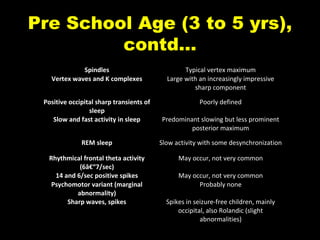
Pre School Age (3 to 5 yrs),
contd…
Spindles
Vertex waves and K complexes

Typical vertex maximum
Large with an increasingly impressive
sharp component

Positive occipital sharp transients of
sleep
Slow and fast activity in sleep

Poorly defined
Predominant slowing but less prominent
posterior maximum

REM sleep

Slow activity with some desynchronization

Rhythmical frontal theta activity
(6–7/sec)
14 and 6/sec positive spikes
Psychomotor variant (marginal
abnormality)
Sharp waves, spikes

May occur, not very common
Probably none
Spikes in seizure-free children, mainly
occipital, also Rolandic (slight
abnormalities)
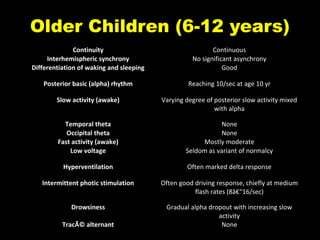
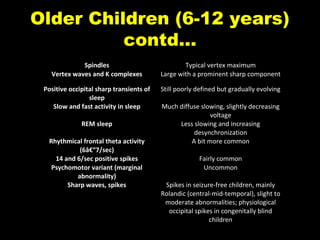
Older Children (6-12 years)
Continuity
Interhemispheric synchrony
Differentiation of waking and sleeping

Continuous
No significant asynchrony
Good

Posterior basic (alpha) rhythm

Reaching 10/sec at age 10 yr

Slow activity (awake)

Varying degree of posterior slow activity mixed
with alpha

Temporal theta
Occipital theta
Fast activity (awake)
Low voltage

None
None
Mostly moderate
Seldom as variant of normalcy

Hyperventilation

Often marked delta response

Intermittent photic stimulation

Often good driving response, chiefly at medium
flash rates (8–16/sec)

Drowsiness

Gradual alpha dropout with increasing slow
activity
None

Tracé alternant
Older Children (6-12 years)
contd…
Spindles
Vertex waves and K complexes

Typical vertex maximum
Large with a prominent sharp component

Positive occipital sharp transients of
sleep
Slow and fast activity in sleep

Still poorly defined but gradually evolving

REM sleep
Rhythmical frontal theta activity
(6–7/sec)
14 and 6/sec positive spikes
Psychomotor variant (marginal
abnormality)
Sharp waves, spikes

Much diffuse slowing, slightly decreasing
voltage
Less slowing and increasing
desynchronization
A bit more common
Fairly common
Uncommon
Spikes in seizure-free children, mainly
Rolandic (central-mid-temporal), slight to
moderate abnormalities; physiological
occipital spikes in congenitally blind
children
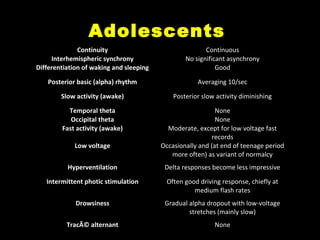
Adolescents
Continuity
Interhemispheric synchrony
Differentiation of waking and sleeping

Continuous
No significant asynchrony
Good

Posterior basic (alpha) rhythm

Averaging 10/sec

Slow activity (awake)

Posterior slow activity diminishing

Temporal theta
Occipital theta
Fast activity (awake)

None
None
Moderate, except for low voltage fast
records
Occasionally and (at end of teenage period
more often) as variant of normalcy

Low voltage
Hyperventilation

Delta responses become less impressive

Intermittent photic stimulation

Often good driving response, chiefly at
medium flash rates

Drowsiness

Gradual alpha dropout with low-voltage
stretches (mainly slow)

Tracé alternant

None
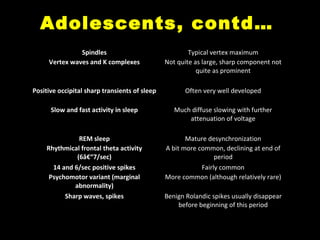
Adolescents, contd…
Spindles
Vertex waves and K complexes

Typical vertex maximum
Not quite as large, sharp component not
quite as prominent

Positive occipital sharp transients of sleep

Often very well developed

Slow and fast activity in sleep

Much diffuse slowing with further
attenuation of voltage

REM sleep
Rhythmical frontal theta activity
(6–7/sec)
14 and 6/sec positive spikes
Psychomotor variant (marginal
abnormality)
Sharp waves, spikes

Mature desynchronization
A bit more common, declining at end of
period
Fairly common
More common (although relatively rare)
Benign Rolandic spikes usually disappear
before beginning of this period
Continuity
Interhemispheric
synchrony
Differentiation of
waking and sleeping
Posterior basic (alpha)
rhythm
Slow activity (awake)
Temporal theta
Occipital theta
Fast activity (awake)
Low voltage
Hyperventilation
Intermittent photic
stimulation

Drowsiness
Tracé alternant
Spindles
Vertex waves and K complexes
Positive occipital sharp
transients of sleep
Slow and fast activity in sleep
REM sleep
Rhythmical frontal theta
activity (6–7/sec)
14 and 6/sec positive spikes
Psychomotor variant (marginal
abnormality)
Sharp waves, spikes
EEG Maturation - Serial evolution of changes from Birth to Old Age

EEG Maturation - Serial evolution of changes from Birth to Old Age

  • 1.
  • 3.
  • 4.
  • 5.
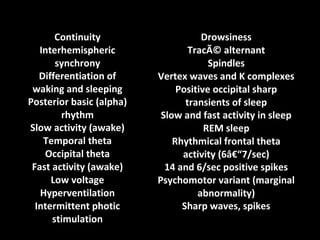
    Continuity Interhemispheric synchrony Differentiation of waking andsleeping Posterior basic (alpha) rhythm Slow activity (awake) Temporal theta Occipital theta Fast activity (awake) Low voltage Hyperventilation Intermittent photic stimulation Drowsiness Tracé alternant Spindles Vertex waves and K complexes Positive occipital sharp transients of sleep Slow and fast activity in sleep REM sleep Rhythmical frontal theta activity (6–7/sec) 14 and 6/sec positive spikes Psychomotor variant (marginal abnormality) Sharp waves, spikes
  • 6.
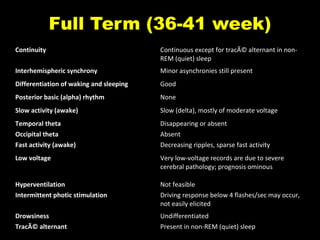
    Full Term (36-41week) Continuity Continuous except for tracé alternant in nonREM (quiet) sleep Interhemispheric synchrony Minor asynchronies still present Differentiation of waking and sleeping Good Posterior basic (alpha) rhythm None Slow activity (awake) Slow (delta), mostly of moderate voltage Temporal theta Occipital theta Fast activity (awake) Disappearing or absent Absent Decreasing ripples, sparse fast activity Low voltage Very low-voltage records are due to severe cerebral pathology; prognosis ominous Hyperventilation Intermittent photic stimulation Not feasible Driving response below 4 flashes/sec may occur, not easily elicited Drowsiness Tracé alternant Undifferentiated Present in non-REM (quiet) sleep
  • 7.
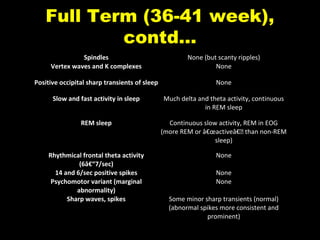
    Full Term (36-41week), contd… Spindles Vertex waves and K complexes None (but scanty ripples) None Positive occipital sharp transients of sleep None Slow and fast activity in sleep Much delta and theta activity, continuous in REM sleep REM sleep Continuous slow activity, REM in EOG (more REM or “active” than non-REM sleep) Rhythmical frontal theta activity (6–7/sec) 14 and 6/sec positive spikes Psychomotor variant (marginal abnormality) Sharp waves, spikes None None None Some minor sharp transients (normal) (abnormal spikes more consistent and prominent)
  • 8.
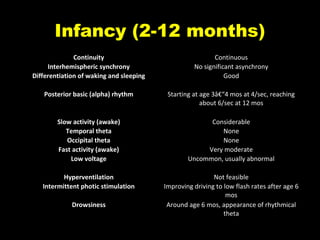
    Infancy (2-12 months) Continuity Interhemisphericsynchrony Differentiation of waking and sleeping Continuous No significant asynchrony Good Posterior basic (alpha) rhythm Starting at age 3–4 mos at 4/sec, reaching about 6/sec at 12 mos Slow activity (awake) Temporal theta Occipital theta Fast activity (awake) Low voltage Considerable None None Very moderate Uncommon, usually abnormal Hyperventilation Intermittent photic stimulation Not feasible Improving driving to low flash rates after age 6 mos Around age 6 mos, appearance of rhythmical theta Drowsiness
  • 9.
    Infancy (2-12 months), contd… Tracéalternant Disappears in 1st (seldom 2nd) mo Spindles Vertex waves and K complexes Appear after 2nd mo; 12–15/sec, sharp, shifting Appear mainly at 5 mos, fairly large, blunt Positive occipital sharp transients of sleep None Slow and fast activity in sleep Much diffuse 0.75–3/sec activity with posterior maximum; moderate fast activity REM sleep REM portion decreasing; mostly slow activity Rhythmical frontal theta activity (6–7/sec) None 14 and 6/sec positive spikes Psychomotor variant (marginal abnormality) None None Sharp waves, spikes Essential as abnormal phenomena
  • 10.
  • 11.
  • 12.
  • 14.
    Early Childhood (12to 36 months) Continuity Interhemispheric synchrony Differentiation of waking and sleeping Continuous No significant asynchrony Good Posterior basic (alpha) rhythm Rising from 5–6/sec to 8/sec (seldom 9/sec) Considerable None None Mostly moderate Uncommon, usually abnormal Slow activity (awake) Temporal theta Occipital theta Fast activity (awake) Low voltage Hyperventilation Intermittent photic stimulation Drowsiness Tracé alternant Mostly not feasible Often good driving response to low flash rates Marked “hypnagogic” rhythmical theta (4–6/sec) None
  • 15.
    Early Childhood (12to 36 months) contd… Spindles In 2nd yr, sharp and shifting, then symmetrical with vertex maximum Vertex waves and K complexes Large, becoming more pointed Positive occipital sharp transients of sleep Poorly defined Slow and fast activity in sleep Marked posterior maximum of slow activity; often a good deal of fast activity REM sleep Mostly slow, starting to become more desynchronized Rhythmical frontal theta activity (6–7/sec) 14 and 6/sec positive spikes Psychomotor variant (marginal abnormality) Sharp waves, spikes Seldom in 3rd yr of life Rare None Spikes in seizure-free children, mainly occipital (mild abnormalities)
  • 18.
    Pre School Age(3 to 5 yrs) Continuity Interhemispheric synchrony Differentiation of waking and sleeping Continuous No significant asynchrony Good Posterior basic (alpha) rhythm Rising from 6–8/sec to 7–9/sec Slow activity (awake) Marked admixture of posterior slow activity (to alpha rhythm) Temporal theta Occipital theta Fast activity (awake) Low voltage None None Mostly moderate Uncommon, usually abnormal Hyperventilation Often marked delta response Intermittent photic stimulation Often good driving response to low flash rates Rhythmical theta gradually vanishing, other types of slow activity predominant Drowsiness Tracé alternant None
  • 19.
    Pre School Age(3 to 5 yrs), contd… Spindles Vertex waves and K complexes Typical vertex maximum Large with an increasingly impressive sharp component Positive occipital sharp transients of sleep Slow and fast activity in sleep Poorly defined Predominant slowing but less prominent posterior maximum REM sleep Slow activity with some desynchronization Rhythmical frontal theta activity (6–7/sec) 14 and 6/sec positive spikes Psychomotor variant (marginal abnormality) Sharp waves, spikes May occur, not very common May occur, not very common Probably none Spikes in seizure-free children, mainly occipital, also Rolandic (slight abnormalities)
  • 20.
    Older Children (6-12years) Continuity Interhemispheric synchrony Differentiation of waking and sleeping Continuous No significant asynchrony Good Posterior basic (alpha) rhythm Reaching 10/sec at age 10 yr Slow activity (awake) Varying degree of posterior slow activity mixed with alpha Temporal theta Occipital theta Fast activity (awake) Low voltage None None Mostly moderate Seldom as variant of normalcy Hyperventilation Often marked delta response Intermittent photic stimulation Often good driving response, chiefly at medium flash rates (8–16/sec) Drowsiness Gradual alpha dropout with increasing slow activity None Tracé alternant
  • 21.
    Older Children (6-12years) contd… Spindles Vertex waves and K complexes Typical vertex maximum Large with a prominent sharp component Positive occipital sharp transients of sleep Slow and fast activity in sleep Still poorly defined but gradually evolving REM sleep Rhythmical frontal theta activity (6–7/sec) 14 and 6/sec positive spikes Psychomotor variant (marginal abnormality) Sharp waves, spikes Much diffuse slowing, slightly decreasing voltage Less slowing and increasing desynchronization A bit more common Fairly common Uncommon Spikes in seizure-free children, mainly Rolandic (central-mid-temporal), slight to moderate abnormalities; physiological occipital spikes in congenitally blind children
  • 23.
    Adolescents Continuity Interhemispheric synchrony Differentiation ofwaking and sleeping Continuous No significant asynchrony Good Posterior basic (alpha) rhythm Averaging 10/sec Slow activity (awake) Posterior slow activity diminishing Temporal theta Occipital theta Fast activity (awake) None None Moderate, except for low voltage fast records Occasionally and (at end of teenage period more often) as variant of normalcy Low voltage Hyperventilation Delta responses become less impressive Intermittent photic stimulation Often good driving response, chiefly at medium flash rates Drowsiness Gradual alpha dropout with low-voltage stretches (mainly slow) Tracé alternant None
  • 24.
    Adolescents, contd… Spindles Vertex wavesand K complexes Typical vertex maximum Not quite as large, sharp component not quite as prominent Positive occipital sharp transients of sleep Often very well developed Slow and fast activity in sleep Much diffuse slowing with further attenuation of voltage REM sleep Rhythmical frontal theta activity (6–7/sec) 14 and 6/sec positive spikes Psychomotor variant (marginal abnormality) Sharp waves, spikes Mature desynchronization A bit more common, declining at end of period Fairly common More common (although relatively rare) Benign Rolandic spikes usually disappear before beginning of this period
  • 26.
    Continuity Interhemispheric synchrony Differentiation of waking andsleeping Posterior basic (alpha) rhythm Slow activity (awake) Temporal theta Occipital theta Fast activity (awake) Low voltage Hyperventilation Intermittent photic stimulation Drowsiness Tracé alternant Spindles Vertex waves and K complexes Positive occipital sharp transients of sleep Slow and fast activity in sleep REM sleep Rhythmical frontal theta activity (6–7/sec) 14 and 6/sec positive spikes Psychomotor variant (marginal abnormality) Sharp waves, spikes