Basic mechanisms of
epilepsy
Dr Pramod Krishnan
Consultant Neurologist and Epileptologist
HOD Neurology,
Manipal Hospital, Bengaluru
Outline of the presentation
• Introductions and definitions.
• Histology of cerebral cortex.
• Neurotransmitters involved.
• Neuronal excitability.
• Genetic mechanism of epilepsy.
• Neuroinflammation and epilepsy.
• Conclusion.
Why is this topic important?
• To understand how varied etiological factors result in epilepsy.
• To understand the basis of the electro-clinical features of different
epilepsies.
• To identify potential therapeutic targets for anti seizure medications.
• To prevent epileptogenesis (ultimate goal).
Definition:
Seizure: The clinical manifestation of an abnormal and excessive excitation and
synchronization of a population of cortical neurons.
Epilepsy:
• ≥2 unprovoked (or reflex) seizures occurring > 24 hours apart, or
• A single unprovoked (or reflex) seizure and a probability of further seizures
similar to the general recurrence risk (atleast 60%) after 2 unprovoked seizures
occurring over the next 10 years, or
• Diagnosis of an epilepsy syndrome.
Epileptogenesis: Sequence of events that converts a normal neuronal network
into a hyperexcitable network.
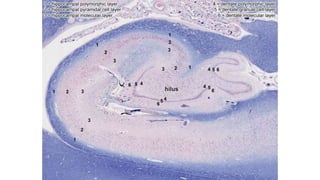
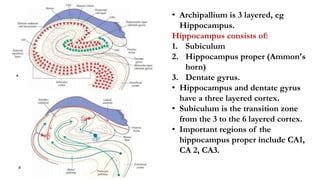
• Archipallium is 3 layered, eg
Hippocampus.
Hippocampus consists of:
1. Subiculum
2. Hippocampus proper (Ammon's
horn)
3. Dentate gyrus.
• Hippocampus and dentate gyrus
have a three layered cortex.
• Subiculum is the transition zone
from the 3 to the 6 layered cortex.
• Important regions of the
hippocampus proper include CA1,
CA 2, CA3.
Babb TL, Brown WJ. In: Engel J. Jr. Ed. Surgical Treatment of the Epilepsies. New York: Raven Press 1987: 511-540.
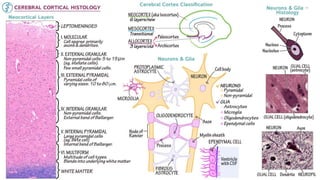
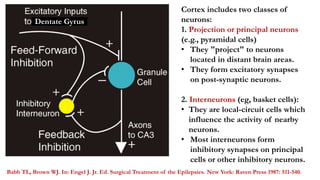
Cortex includes two classes of
neurons:
1. Projection or principal neurons
(e.g., pyramidal cells)
• They "project" to neurons
located in distant brain areas.
• They form excitatory synapses
on post-synaptic neurons.
2. Interneurons (eg, basket cells):
• They are local-circuit cells which
influence the activity of nearby
neurons.
• Most interneurons form
inhibitory synapses on principal
cells or other inhibitory neurons.
Dentate Gyrus
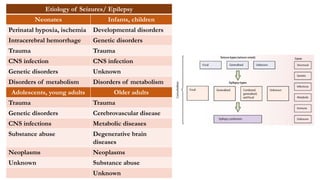
Etiology of Seizures/ Epilepsy
Neonates Infants, children
Perinatal hypoxia, ischemia Developmental disorders
Intracerebral hemorrhage Genetic disorders
Trauma Trauma
CNS infection CNS infection
Genetic disorders Unknown
Disorders of metabolism Disorders of metabolism
Adolescents, young adults Older adults
Trauma Trauma
Genetic disorders Cerebrovascular disease
CNS infections Metabolic diseases
Substance abuse Degenerative brain
diseases
Neoplasms Neoplasms
Unknown Substance abuse
Unknown
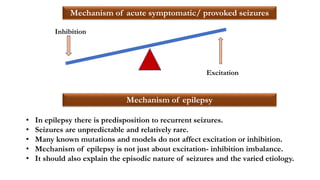
Inhibition
Excitation
Mechanism of acute symptomatic/ provoked seizures
Mechanism of epilepsy
• In epilepsy there is predisposition to recurrent seizures.
• Seizures are unpredictable and relatively rare.
• Many known mutations and models do not affect excitation or inhibition.
• Mechanism of epilepsy is not just about excitation- inhibition imbalance.
• It should also explain the episodic nature of seizures and the varied etiology.
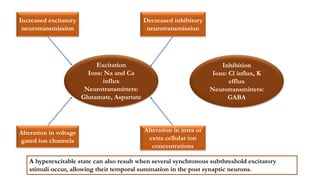
Excitation
Ions: Na and Ca
influx
Neurotransmitters:
Glutamate, Aspartate
Inhibition
Ions: Cl influx, K
efflux
Neurotransmitters:
GABA
A hyperexcitable state can also result when several synchronous subthreshold excitatory
stimuli occur, allowing their temporal summation in the post synaptic neurons.
Increased excitatory
neurotransmission
Decreased inhibitory
neurotransmission
Alteration in voltage
gated ion channels
Alteration in intra or
extra cellular ion
concentrations
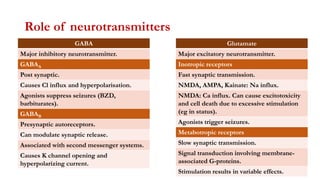
Role of neurotransmitters
Glutamate
Major excitatory neurotransmitter.
Inotropic receptors
Fast synaptic transmission.
NMDA, AMPA, Kainate: Na influx.
NMDA: Ca influx. Can cause excitotoxicity
and cell death due to excessive stimulation
(eg in status).
Agonists trigger seizures.
Metabotropic receptors
Slow synaptic transmission.
Signal transduction involving membrane-
associated G-proteins.
Stimulation results in variable effects.
GABA
Major inhibitory neurotransmitter.
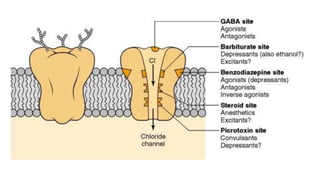
GABAA
Post synaptic.
Causes Cl influx and hyperpolarisation.
Agonists suppress seizures (BZD,
barbiturates).
GABAB
Presynaptic autoreceptors.
Can modulate synaptic release.
Associated with second messenger systems.
Causes K channel opening and
hyperpolarizing current.
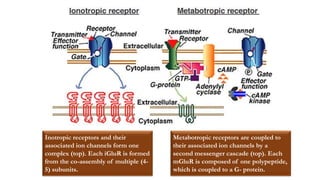
Inotropic receptors and their
associated ion channels form one
complex (top). Each iGluR is formed
from the co-assembly of multiple (4-
5) subunits.
Metabotropic receptors are coupled to
their associated ion channels by a
second messenger cascade (top). Each
mGluR is composed of one polypeptide,
which is coupled to a G- protein.
Glutamate and GABA reuptake
• Relevant to epilepsy, glutamate and GABA both require active reuptake
to be cleared from the synaptic cleft.
• Transporters for both glutamate and GABA exist on both neurons and
glia (primarily astrocytes).
• Interference with transporter function has also been shown to activate
or suppress epileptiform activity in animal models, depending on which
transporter is being blocked.
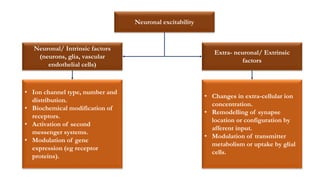
Neuronal excitability
Extra- neuronal/ Extrinsic
factors
Neuronal/ Intrinsic factors
(neurons, glia, vascular
endothelial cells)
• Changes in extra-cellular ion
concentration.
• Remodelling of synapse
location or configuration by
afferent input.
• Modulation of transmitter
metabolism or uptake by glial
cells.
• Ion channel type, number and
distribution.
• Biochemical modification of
receptors.
• Activation of second
messenger systems.
• Modulation of gene
expression (eg receptor
proteins).
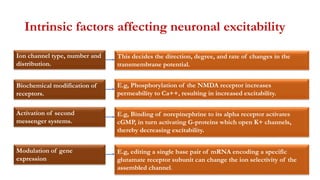
Ion channel type, number and
distribution.
Intrinsic factors affecting neuronal excitability
Biochemical modification of
receptors.
Activation of second
messenger systems.
Modulation of gene
expression
This decides the direction, degree, and rate of changes in the
transmembrane potential.
E.g, Phosphorylation of the NMDA receptor increases
permeability to Ca++, resulting in increased excitability.
E.g, Binding of norepinephrine to its alpha receptor activates
cGMP, in turn activating G-proteins which open K+ channels,
thereby decreasing excitability.
E.g, editing a single base pair of mRNA encoding a specific
glutamate receptor subunit can change the ion selectivity of the
assembled channel.
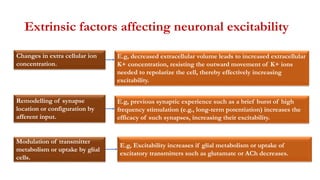
Changes in extra cellular ion
concentration.
Extrinsic factors affecting neuronal excitability
Remodelling of synapse
location or configuration by
afferent input.
Modulation of transmitter
metabolism or uptake by glial
cells.
E.g, decreased extracellular volume leads to increased extracellular
K+ concentration, resisting the outward movement of K+ ions
needed to repolarize the cell, thereby effectively increasing
excitability.
E.g, previous synaptic experience such as a brief burst of high
frequency stimulation (e.g., long-term potentiation) increases the
efficacy of such synapses, increasing their excitability.
E.g, Excitability increases if glial metabolism or uptake of
excitatory transmitters such as glutamate or ACh decreases.
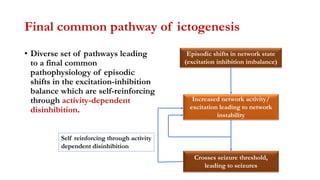
Final common pathway of ictogenesis
• Diverse set of pathways leading
to a final common
pathophysiology of episodic
shifts in the excitation-inhibition
balance which are self-reinforcing
through activity-dependent
disinhibition.
Episodic shifts in network state
(excitation inhibition imbalance)
Increased network activity/
excitation leading to network
instability
Crosses seizure threshold,
leading to seizures
Self reinforcing through activity
dependent disinhibition
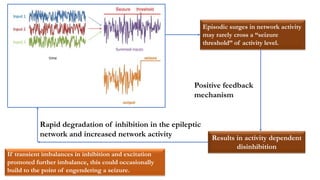
Results in activity dependent
disinhibition
Episodic surges in network activity
may rarely cross a “seizure
threshold” of activity level.
Positive feedback
mechanism
Rapid degradation of inhibition in the epileptic
network and increased network activity
If transient imbalances in inhibition and excitation
promoted further imbalance, this could occasionally
build to the point of engendering a seizure.
Timing of seizures
• This is due to episodic shifts in the balance of excitation and inhibition.
• Change in network (brain) states:
1. ADNFLE occurring in NREM sleep.
2. Catamenial epilepsy occurring at specific stages of menstrual cycle.
• However, seizures do not occur in most of the at-risk periods. So other
additional factors are at play during the at-risk period.
• Low-probability ictal transitions and ictal stability (stereotyped seizure
duration) can be explained by positive feedback mechanism.
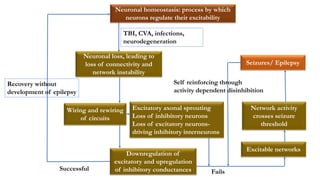
Neuronal homeostasis: process by which
neurons regulate their excitability
Neuronal loss, leading to
loss of connectivity and
network instability
Wiring and rewiring
of circuits
Downregulation of
excitatory and upregulation
of inhibitory conductances
Excitable networks
Seizures/ Epilepsy
Recovery without
development of epilepsy
FailsSuccessful
TBI, CVA, infections,
neurodegeneration
Network activity
crosses seizure
threshold
Self reinforcing through
activity dependent disinhibition
Excitatory axonal sprouting
Loss of inhibitory neurons
Loss of excitatory neurons-
driving inhibitory interneurons
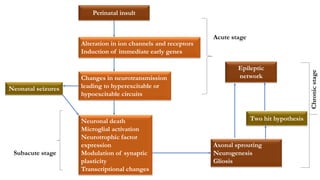
Perinatal insult
Alteration in ion channels and receptors
Induction of immediate early genes
Changes in neurotransmission
leading to hyperexcitable or
hypoexcitable circuits
Neuronal death
Microglial activation
Neurotrophic factor
expression
Modulation of synaptic
plasticity
Transcriptional changes
Axonal sprouting
Neurogenesis
Gliosis
Neonatal seizures
Epileptic
network
Two hit hypothesis
Acute stage
Subacute stage
Chronicstage
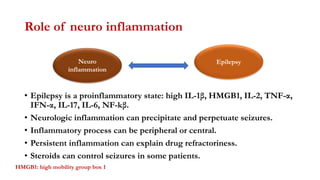
Role of neuro inflammation
• Epilepsy is a proinflammatory state: high IL-1β, HMGB1, IL-2, TNF-α,
IFN-α, IL-17, IL-6, NF-kβ.
• Neurologic inflammation can precipitate and perpetuate seizures.
• Inflammatory process can be peripheral or central.
• Persistent inflammation can explain drug refractoriness.
• Steroids can control seizures in some patients.
HMGB1: high mobility group box 1
Neuro
inflammation
Epilepsy
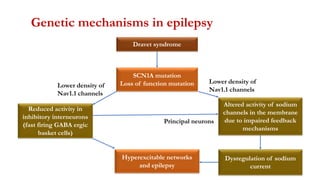
Dravet syndrome
SCN1A mutation
Loss of function mutation
Hyperexcitable networks
and epilepsy
Reduced activity in
inhibitory interneurons
(fast firing GABA ergic
basket cells)
Altered activity of sodium
channels in the membrane
due to impaired feedback
mechanisms
Genetic mechanisms in epilepsy
Dysregulation of sodium
current
Lower density of
Nav1.1 channels
Lower density of
Nav1.1 channels
Principal neurons
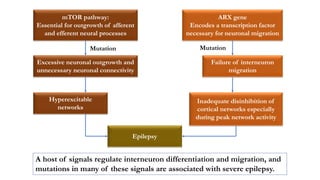
mTOR pathway:
Essential for outgrowth of afferent
and efferent neural processes
ARX gene
Encodes a transcription factor
necessary for neuronal migration
Excessive neuronal outgrowth and
unnecessary neuronal connectivity
Epilepsy
Failure of interneuron
migration
Inadequate disinhibition of
cortical networks especially
during peak network activity
A host of signals regulate interneuron differentiation and migration, and
mutations in many of these signals are associated with severe epilepsy.
Hyperexcitable
networks
Mutation Mutation
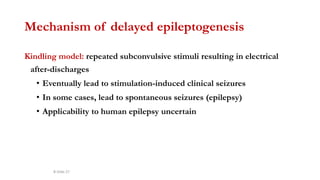
Mechanism of delayed epileptogenesis
Kindling model: repeated subconvulsive stimuli resulting in electrical
after-discharges
• Eventually lead to stimulation-induced clinical seizures
• In some cases, lead to spontaneous seizures (epilepsy)
• Applicability to human epilepsy uncertain
B-Slide 27
Conclusion
• Epilepsy can arise due to various causes.
• Final common pathway is disturbance of excitation- inhibition balance
(neuronal homeostasis) resulting in self reinforcing episodic shifts in
neuronal and network excitability.
• This involves multiple neurotransmitters (primarily GABA and
Glutamate), ion conductance (primarily Na, K, Ca, Cl) and genetic
factors.
• Major role for interneurons and glial cells in epileptogenesis.
• Neuroinflammation plays a role in epileptogenesis.
THANK YOU
Recommended articles
• Staley K. Molecular mechanisms of epilepsy. Nat Neurosci. 2015
Mar;18(3):367-72. doi: 10.1038/nn.3947. Epub 2015 Feb 24.
• Vitaliti G, et al. Molecular mechanisms involved in the pathogenesis of
early onset epileptic encephalopathy. Front Mol Neurosci. 2019 May
15;12:118. doi: 10.3389/fnmol.2019.00118.
• Nikkola E, et al. Genetic mechanisms of epilepsy. Practical Neurology
Oct 2019; 56-59.
• Goldberg EM, et al. Mechanisms of epileptogenesis: a convergence on
neural circuit dysfunction. Nat Rev Neurosci. 2013 May;14(5):337-49.
doi: 10.1038/nrn3482

Basic mechanism of epilepsy

  • 1.
    Basic mechanisms of epilepsy DrPramod Krishnan Consultant Neurologist and Epileptologist HOD Neurology, Manipal Hospital, Bengaluru
  • 2.
    Outline of thepresentation • Introductions and definitions. • Histology of cerebral cortex. • Neurotransmitters involved. • Neuronal excitability. • Genetic mechanism of epilepsy. • Neuroinflammation and epilepsy. • Conclusion.
  • 3.
    Why is thistopic important? • To understand how varied etiological factors result in epilepsy. • To understand the basis of the electro-clinical features of different epilepsies. • To identify potential therapeutic targets for anti seizure medications. • To prevent epileptogenesis (ultimate goal).
  • 4.
    Definition: Seizure: The clinicalmanifestation of an abnormal and excessive excitation and synchronization of a population of cortical neurons. Epilepsy: • ≥2 unprovoked (or reflex) seizures occurring > 24 hours apart, or • A single unprovoked (or reflex) seizure and a probability of further seizures similar to the general recurrence risk (atleast 60%) after 2 unprovoked seizures occurring over the next 10 years, or • Diagnosis of an epilepsy syndrome. Epileptogenesis: Sequence of events that converts a normal neuronal network into a hyperexcitable network.
  • 7.
    • Archipallium is3 layered, eg Hippocampus. Hippocampus consists of: 1. Subiculum 2. Hippocampus proper (Ammon's horn) 3. Dentate gyrus. • Hippocampus and dentate gyrus have a three layered cortex. • Subiculum is the transition zone from the 3 to the 6 layered cortex. • Important regions of the hippocampus proper include CA1, CA 2, CA3.
  • 8.
    Babb TL, BrownWJ. In: Engel J. Jr. Ed. Surgical Treatment of the Epilepsies. New York: Raven Press 1987: 511-540. Cortex includes two classes of neurons: 1. Projection or principal neurons (e.g., pyramidal cells) • They "project" to neurons located in distant brain areas. • They form excitatory synapses on post-synaptic neurons. 2. Interneurons (eg, basket cells): • They are local-circuit cells which influence the activity of nearby neurons. • Most interneurons form inhibitory synapses on principal cells or other inhibitory neurons. Dentate Gyrus
  • 9.
    Etiology of Seizures/Epilepsy Neonates Infants, children Perinatal hypoxia, ischemia Developmental disorders Intracerebral hemorrhage Genetic disorders Trauma Trauma CNS infection CNS infection Genetic disorders Unknown Disorders of metabolism Disorders of metabolism Adolescents, young adults Older adults Trauma Trauma Genetic disorders Cerebrovascular disease CNS infections Metabolic diseases Substance abuse Degenerative brain diseases Neoplasms Neoplasms Unknown Substance abuse Unknown
  • 10.
    Inhibition Excitation Mechanism of acutesymptomatic/ provoked seizures Mechanism of epilepsy • In epilepsy there is predisposition to recurrent seizures. • Seizures are unpredictable and relatively rare. • Many known mutations and models do not affect excitation or inhibition. • Mechanism of epilepsy is not just about excitation- inhibition imbalance. • It should also explain the episodic nature of seizures and the varied etiology.
  • 11.
    Excitation Ions: Na andCa influx Neurotransmitters: Glutamate, Aspartate Inhibition Ions: Cl influx, K efflux Neurotransmitters: GABA A hyperexcitable state can also result when several synchronous subthreshold excitatory stimuli occur, allowing their temporal summation in the post synaptic neurons. Increased excitatory neurotransmission Decreased inhibitory neurotransmission Alteration in voltage gated ion channels Alteration in intra or extra cellular ion concentrations
  • 12.
    Role of neurotransmitters Glutamate Majorexcitatory neurotransmitter. Inotropic receptors Fast synaptic transmission. NMDA, AMPA, Kainate: Na influx. NMDA: Ca influx. Can cause excitotoxicity and cell death due to excessive stimulation (eg in status). Agonists trigger seizures. Metabotropic receptors Slow synaptic transmission. Signal transduction involving membrane- associated G-proteins. Stimulation results in variable effects. GABA Major inhibitory neurotransmitter. GABAA Post synaptic. Causes Cl influx and hyperpolarisation. Agonists suppress seizures (BZD, barbiturates). GABAB Presynaptic autoreceptors. Can modulate synaptic release. Associated with second messenger systems. Causes K channel opening and hyperpolarizing current.
  • 13.
    Inotropic receptors andtheir associated ion channels form one complex (top). Each iGluR is formed from the co-assembly of multiple (4- 5) subunits. Metabotropic receptors are coupled to their associated ion channels by a second messenger cascade (top). Each mGluR is composed of one polypeptide, which is coupled to a G- protein.
  • 15.
    Glutamate and GABAreuptake • Relevant to epilepsy, glutamate and GABA both require active reuptake to be cleared from the synaptic cleft. • Transporters for both glutamate and GABA exist on both neurons and glia (primarily astrocytes). • Interference with transporter function has also been shown to activate or suppress epileptiform activity in animal models, depending on which transporter is being blocked.
  • 16.
    Neuronal excitability Extra- neuronal/Extrinsic factors Neuronal/ Intrinsic factors (neurons, glia, vascular endothelial cells) • Changes in extra-cellular ion concentration. • Remodelling of synapse location or configuration by afferent input. • Modulation of transmitter metabolism or uptake by glial cells. • Ion channel type, number and distribution. • Biochemical modification of receptors. • Activation of second messenger systems. • Modulation of gene expression (eg receptor proteins).
  • 17.
    Ion channel type,number and distribution. Intrinsic factors affecting neuronal excitability Biochemical modification of receptors. Activation of second messenger systems. Modulation of gene expression This decides the direction, degree, and rate of changes in the transmembrane potential. E.g, Phosphorylation of the NMDA receptor increases permeability to Ca++, resulting in increased excitability. E.g, Binding of norepinephrine to its alpha receptor activates cGMP, in turn activating G-proteins which open K+ channels, thereby decreasing excitability. E.g, editing a single base pair of mRNA encoding a specific glutamate receptor subunit can change the ion selectivity of the assembled channel.
  • 18.
    Changes in extracellular ion concentration. Extrinsic factors affecting neuronal excitability Remodelling of synapse location or configuration by afferent input. Modulation of transmitter metabolism or uptake by glial cells. E.g, decreased extracellular volume leads to increased extracellular K+ concentration, resisting the outward movement of K+ ions needed to repolarize the cell, thereby effectively increasing excitability. E.g, previous synaptic experience such as a brief burst of high frequency stimulation (e.g., long-term potentiation) increases the efficacy of such synapses, increasing their excitability. E.g, Excitability increases if glial metabolism or uptake of excitatory transmitters such as glutamate or ACh decreases.
  • 19.
    Final common pathwayof ictogenesis • Diverse set of pathways leading to a final common pathophysiology of episodic shifts in the excitation-inhibition balance which are self-reinforcing through activity-dependent disinhibition. Episodic shifts in network state (excitation inhibition imbalance) Increased network activity/ excitation leading to network instability Crosses seizure threshold, leading to seizures Self reinforcing through activity dependent disinhibition
  • 20.
    Results in activitydependent disinhibition Episodic surges in network activity may rarely cross a “seizure threshold” of activity level. Positive feedback mechanism Rapid degradation of inhibition in the epileptic network and increased network activity If transient imbalances in inhibition and excitation promoted further imbalance, this could occasionally build to the point of engendering a seizure.
  • 21.
    Timing of seizures •This is due to episodic shifts in the balance of excitation and inhibition. • Change in network (brain) states: 1. ADNFLE occurring in NREM sleep. 2. Catamenial epilepsy occurring at specific stages of menstrual cycle. • However, seizures do not occur in most of the at-risk periods. So other additional factors are at play during the at-risk period. • Low-probability ictal transitions and ictal stability (stereotyped seizure duration) can be explained by positive feedback mechanism.
  • 22.
    Neuronal homeostasis: processby which neurons regulate their excitability Neuronal loss, leading to loss of connectivity and network instability Wiring and rewiring of circuits Downregulation of excitatory and upregulation of inhibitory conductances Excitable networks Seizures/ Epilepsy Recovery without development of epilepsy FailsSuccessful TBI, CVA, infections, neurodegeneration Network activity crosses seizure threshold Self reinforcing through activity dependent disinhibition Excitatory axonal sprouting Loss of inhibitory neurons Loss of excitatory neurons- driving inhibitory interneurons
  • 23.
    Perinatal insult Alteration inion channels and receptors Induction of immediate early genes Changes in neurotransmission leading to hyperexcitable or hypoexcitable circuits Neuronal death Microglial activation Neurotrophic factor expression Modulation of synaptic plasticity Transcriptional changes Axonal sprouting Neurogenesis Gliosis Neonatal seizures Epileptic network Two hit hypothesis Acute stage Subacute stage Chronicstage
  • 24.
    Role of neuroinflammation • Epilepsy is a proinflammatory state: high IL-1β, HMGB1, IL-2, TNF-α, IFN-α, IL-17, IL-6, NF-kβ. • Neurologic inflammation can precipitate and perpetuate seizures. • Inflammatory process can be peripheral or central. • Persistent inflammation can explain drug refractoriness. • Steroids can control seizures in some patients. HMGB1: high mobility group box 1 Neuro inflammation Epilepsy
  • 25.
    Dravet syndrome SCN1A mutation Lossof function mutation Hyperexcitable networks and epilepsy Reduced activity in inhibitory interneurons (fast firing GABA ergic basket cells) Altered activity of sodium channels in the membrane due to impaired feedback mechanisms Genetic mechanisms in epilepsy Dysregulation of sodium current Lower density of Nav1.1 channels Lower density of Nav1.1 channels Principal neurons
  • 26.
    mTOR pathway: Essential foroutgrowth of afferent and efferent neural processes ARX gene Encodes a transcription factor necessary for neuronal migration Excessive neuronal outgrowth and unnecessary neuronal connectivity Epilepsy Failure of interneuron migration Inadequate disinhibition of cortical networks especially during peak network activity A host of signals regulate interneuron differentiation and migration, and mutations in many of these signals are associated with severe epilepsy. Hyperexcitable networks Mutation Mutation
  • 27.
    Mechanism of delayedepileptogenesis Kindling model: repeated subconvulsive stimuli resulting in electrical after-discharges • Eventually lead to stimulation-induced clinical seizures • In some cases, lead to spontaneous seizures (epilepsy) • Applicability to human epilepsy uncertain B-Slide 27
  • 28.
    Conclusion • Epilepsy canarise due to various causes. • Final common pathway is disturbance of excitation- inhibition balance (neuronal homeostasis) resulting in self reinforcing episodic shifts in neuronal and network excitability. • This involves multiple neurotransmitters (primarily GABA and Glutamate), ion conductance (primarily Na, K, Ca, Cl) and genetic factors. • Major role for interneurons and glial cells in epileptogenesis. • Neuroinflammation plays a role in epileptogenesis.
  • 29.
  • 30.
    Recommended articles • StaleyK. Molecular mechanisms of epilepsy. Nat Neurosci. 2015 Mar;18(3):367-72. doi: 10.1038/nn.3947. Epub 2015 Feb 24. • Vitaliti G, et al. Molecular mechanisms involved in the pathogenesis of early onset epileptic encephalopathy. Front Mol Neurosci. 2019 May 15;12:118. doi: 10.3389/fnmol.2019.00118. • Nikkola E, et al. Genetic mechanisms of epilepsy. Practical Neurology Oct 2019; 56-59. • Goldberg EM, et al. Mechanisms of epileptogenesis: a convergence on neural circuit dysfunction. Nat Rev Neurosci. 2013 May;14(5):337-49. doi: 10.1038/nrn3482