Neonatal EEG
Dr. Rahul Kumar
Road Map for the Session
•
•
•
•
•
•
•

Continuity
Inter-hemispheric Synchrony
Beta-Delta Complexes
Temporal Theta Bursts
Frontal Sharp Waves
Reactivity to Stimulus
Differentiation between sleep and awake eeg
Road Map for the Session
•
•
•
•
•
•
•

Continuity
Inter-hemispheric Synchrony
Beta-Delta Complexes
Temporal Theta Bursts
Frontal Sharp Waves
Reactivity to Stimulus
Differentiation between sleep and awake eeg
•
•
•
•

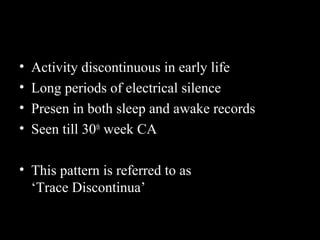
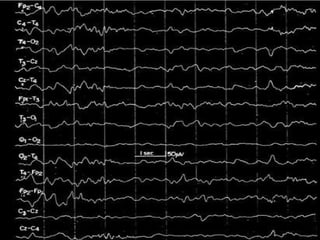
Activity discontinuous in early life
Long periods of electrical silence
Presen in both sleep and awake records
Seen till 30th week CA

• This pattern is referred to as
‘Trace Discontinua’
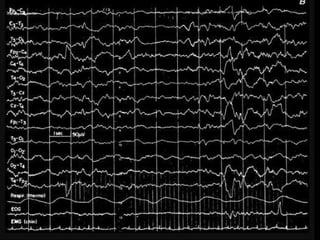
• EEG activity becomes continuous during
waking by 34 weeks CA
• EEG activity becomes continuous during
NREM by 37 weeks CA
• However, semi-periodic, voltage attenuation
still seen during NREM sleep, lasting for 1015 seconds
• Present upto 5-6 weeks of age
Road Map for the Session
•
•
•
•
•
•
•

Continuity
Inter-hemispheric Synchrony
Beta-Delta Complexes
Temporal Theta Bursts
Frontal Sharp Waves
Reactivity to Stimulus
Differentiation between sleep and awake eeg
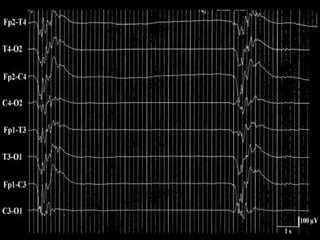
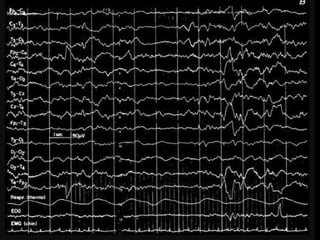
• EEG activity asynchronous till 28 weeks CA
• Degree of asynchrony decreases with age,
mature brain has minimal asynchrony
Road Map for the Session
•
•
•
•
•
•
•

Continuity
Inter-hemispheric Synchrony
Beta-Delta Complexes
Temporal Theta Bursts
Frontal Sharp Waves
Reactivity to Stimulus
Differentiation between sleep and awake eeg
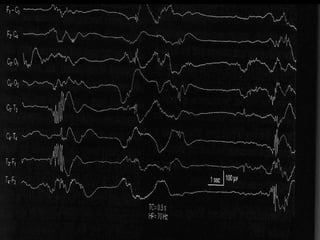
• Beta-delta waveforms are composed of
random wave forms
• 0.3-1.5 Hz frequency, superimposed on fast
frequency
• Fast frequency in two frequency bands
• 8-12 Hz and 18-22 Hz
• Voltage <75
• Also known as spindle delta bursts, ripples of
prematurity, etc
Road Map for the Session
•
•
•
•
•
•
•

Continuity
Inter-hemispheric Synchrony
Beta-Delta Complexes
Temporal Theta Bursts
Frontal Sharp Waves
Reactivity to Stimulus
Differentiation between sleep and awake eeg
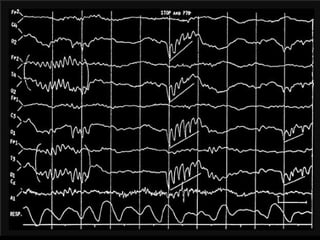
• Appear by 26 weeks CA
• 4.5-6 Hz, 20-200 µv
• Occur independently for short bursts, <2 sec
• Expressed maximally at 30-32 weeks CA, then
decline in frequency
• Used to determine CA, replaced by alpha
rhythm
Road Map for the Session
•
•
•
•
•
•
•

Continuity
Inter-hemispheric Synchrony
Beta-Delta Complexes
Temporal Theta Bursts
Frontal Sharp Waves
Reactivity to Stimulus
Differentiation between sleep and awake eeg
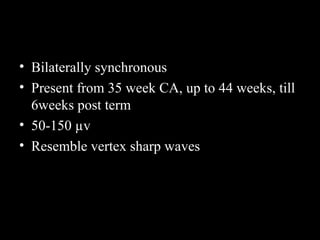
• Bilaterally synchronous
• Present from 35 week CA, up to 44 weeks, till
6weeks post term
• 50-150 µv
• Resemble vertex sharp waves
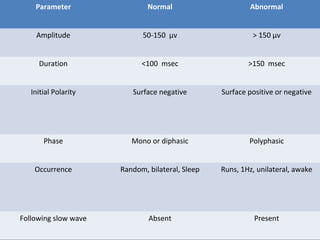
Parameter

Normal

Abnormal

Amplitude

50-150 µv

> 150 µv

Duration

<100 msec

>150 msec

Initial Polarity

Surface negative

Surface positive or negative

Phase

Mono or diphasic

Polyphasic

Occurrence

Random, bilateral, Sleep

Runs, 1Hz, unilateral, awake

Following slow wave

Absent

Present
Road Map for the Session
•
•
•
•
•
•
•

Continuity
Inter-hemispheric Synchrony
Beta-Delta Complexes
Temporal Theta Bursts
Frontal Sharp Waves
Reactivity to Stimulus
Differentiation between sleep and awake eeg
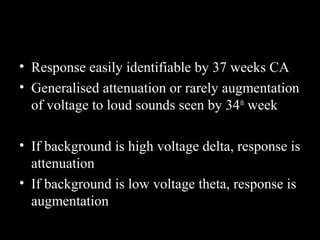
• Response easily identifiable by 37 weeks CA
• Generalised attenuation or rarely augmentation
of voltage to loud sounds seen by 34 th week
• If background is high voltage delta, response is
attenuation
• If background is low voltage theta, response is
augmentation
Road Map for the Session
•
•
•
•
•
•
•

Continuity
Inter-hemispheric Synchrony
Beta-Delta Complexes
Temporal Theta Bursts
Frontal Sharp Waves
Reactivity to Stimulus
Differentiation between sleep and awake eeg
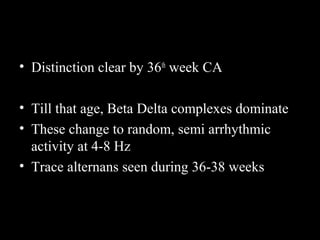
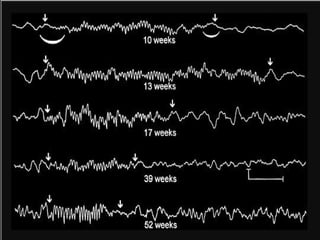
• Distinction clear by 36th week CA
• Till that age, Beta Delta complexes dominate
• These change to random, semi arrhythmic
activity at 4-8 Hz
• Trace alternans seen during 36-38 weeks
Summary …
Road Map for the Session
•
•
•
•
•
•
•

Continuity
Inter-hemispheric Synchrony
Beta-Delta Complexes
Temporal Theta Bursts
Frontal Sharp Waves
Reactivity to Stimulus
Differentiation between sleep and awake eeg
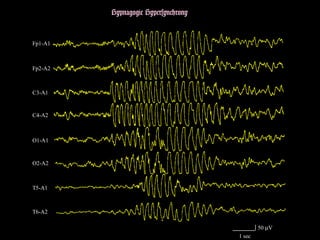
Hypnagogic Hypersynchrony

Fp1-A1

Fp2-A2

C3-A1

C4-A2

O1-A1

O2-A2

T5-A1

T6-A2
50 µV
1 sec
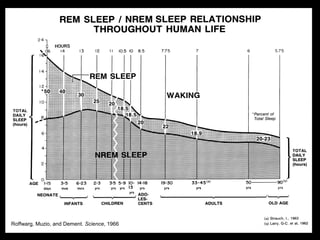
Roffwarg, Muzio, and Dement. Science, 1966

34

Neonatal EEG Patterns

  • 1.
  • 3.
    Road Map forthe Session • • • • • • • Continuity Inter-hemispheric Synchrony Beta-Delta Complexes Temporal Theta Bursts Frontal Sharp Waves Reactivity to Stimulus Differentiation between sleep and awake eeg
  • 4.
    Road Map forthe Session • • • • • • • Continuity Inter-hemispheric Synchrony Beta-Delta Complexes Temporal Theta Bursts Frontal Sharp Waves Reactivity to Stimulus Differentiation between sleep and awake eeg
  • 5.
    • • • • Activity discontinuous inearly life Long periods of electrical silence Presen in both sleep and awake records Seen till 30th week CA • This pattern is referred to as ‘Trace Discontinua’
  • 7.
    • EEG activitybecomes continuous during waking by 34 weeks CA • EEG activity becomes continuous during NREM by 37 weeks CA • However, semi-periodic, voltage attenuation still seen during NREM sleep, lasting for 1015 seconds • Present upto 5-6 weeks of age
  • 11.
    Road Map forthe Session • • • • • • • Continuity Inter-hemispheric Synchrony Beta-Delta Complexes Temporal Theta Bursts Frontal Sharp Waves Reactivity to Stimulus Differentiation between sleep and awake eeg
  • 12.
    • EEG activityasynchronous till 28 weeks CA • Degree of asynchrony decreases with age, mature brain has minimal asynchrony
  • 13.
    Road Map forthe Session • • • • • • • Continuity Inter-hemispheric Synchrony Beta-Delta Complexes Temporal Theta Bursts Frontal Sharp Waves Reactivity to Stimulus Differentiation between sleep and awake eeg
  • 14.
    • Beta-delta waveformsare composed of random wave forms • 0.3-1.5 Hz frequency, superimposed on fast frequency • Fast frequency in two frequency bands • 8-12 Hz and 18-22 Hz • Voltage <75 • Also known as spindle delta bursts, ripples of prematurity, etc
  • 16.
    Road Map forthe Session • • • • • • • Continuity Inter-hemispheric Synchrony Beta-Delta Complexes Temporal Theta Bursts Frontal Sharp Waves Reactivity to Stimulus Differentiation between sleep and awake eeg
  • 17.
    • Appear by26 weeks CA • 4.5-6 Hz, 20-200 µv • Occur independently for short bursts, <2 sec • Expressed maximally at 30-32 weeks CA, then decline in frequency • Used to determine CA, replaced by alpha rhythm
  • 19.
    Road Map forthe Session • • • • • • • Continuity Inter-hemispheric Synchrony Beta-Delta Complexes Temporal Theta Bursts Frontal Sharp Waves Reactivity to Stimulus Differentiation between sleep and awake eeg
  • 20.
    • Bilaterally synchronous •Present from 35 week CA, up to 44 weeks, till 6weeks post term • 50-150 µv • Resemble vertex sharp waves
  • 21.
    Parameter Normal Abnormal Amplitude 50-150 µv > 150µv Duration <100 msec >150 msec Initial Polarity Surface negative Surface positive or negative Phase Mono or diphasic Polyphasic Occurrence Random, bilateral, Sleep Runs, 1Hz, unilateral, awake Following slow wave Absent Present
  • 22.
    Road Map forthe Session • • • • • • • Continuity Inter-hemispheric Synchrony Beta-Delta Complexes Temporal Theta Bursts Frontal Sharp Waves Reactivity to Stimulus Differentiation between sleep and awake eeg
  • 23.
    • Response easilyidentifiable by 37 weeks CA • Generalised attenuation or rarely augmentation of voltage to loud sounds seen by 34 th week • If background is high voltage delta, response is attenuation • If background is low voltage theta, response is augmentation
  • 24.
    Road Map forthe Session • • • • • • • Continuity Inter-hemispheric Synchrony Beta-Delta Complexes Temporal Theta Bursts Frontal Sharp Waves Reactivity to Stimulus Differentiation between sleep and awake eeg
  • 25.
    • Distinction clearby 36th week CA • Till that age, Beta Delta complexes dominate • These change to random, semi arrhythmic activity at 4-8 Hz • Trace alternans seen during 36-38 weeks
  • 26.
  • 27.
    Road Map forthe Session • • • • • • • Continuity Inter-hemispheric Synchrony Beta-Delta Complexes Temporal Theta Bursts Frontal Sharp Waves Reactivity to Stimulus Differentiation between sleep and awake eeg
  • 33.
  • 34.
    Roffwarg, Muzio, andDement. Science, 1966 34