Recent Advancements in Epilepsy Dr. Helal Uddin Ahmed Assistant Registrar National Institute of Mental Health [email_address]
Introduction Definition:   The occurrence of transient  paroxysms of excessive or uncontrolled discharges of neurons, which may be caused by a number of different etiologies, leading to epileptic seizures.   Synonyms:  Seizure Disorder
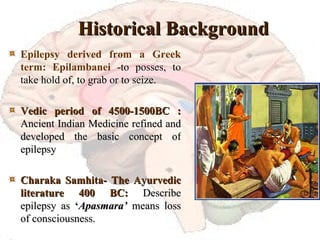
Historical Background Epilepsy derived from a Greek term: Epilambanei - to posses, to take hold of, to grab or to seize. Vedic period of 4500-1500BC : Ancient Indian Medicine refined and developed the basic concept of epilepsy Charaka Samhita- The Ayurvedic literature 400 BC:  Describe epilepsy as  ‘ Apasmara’   means loss of consciousness.
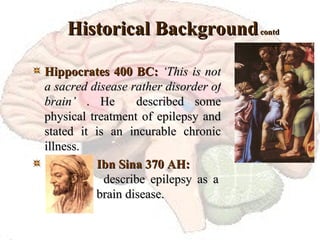
Historical Background  contd Hippocrates 400 BC:   ‘This is not a sacred disease rather disorder of brain’  . He  described some physical treatment of epilepsy and stated it is an incurable chronic illness. Ibn Sina 370 AH:   describe epilepsy as a  brain disease.
Historical Background  contd Europe and USA 1857:  Bromide was used as first anti-epileptic drugs. 1873 H. Jackson:  Neurologist of London-described relationship of electrochemical discharge of brain and seizure. 1920 H. Berger:  German Psychiatrist developed EEG to measure brainwaves and its application in the field of epilepsy.
Historical Background  contd 1909: Formation International league against epilepsy (ILAE). 1912: Use Phenobarbitone as AED. 1938: Use Phenytoin  as AED. 1950-1970: Developed many AED. 1981: ILAE classified epilepsy. 1997: ILAE, IBE and WHO jointly established Global campaign against epilepsy.
Epilepsy synonyms in  South East Asia India: Apasamra, Mirgee,Lata, Laran Srilanka: Apasamra Indonesia: Ayan Thailand: Rake Lom Ba Mu, Role Lom Chak Bangladesh: Khichuni, Mrigee, Batash (bad wind)
Epidemiology of Epilepsy Epilepsy knows no geographical, racial or social boundaries. About 50 million people in World have Epilepsy. It occurs in men and women and can begin at any age, but is most frequently diagnosed in infancy, childhood, adolescence and old age. Prevalence:   Developed countries- 0.5% (0.4% - 1%) Developing countries- five times higher Incidence: After infancy  annual incidence-  20-70/100000 in developed countries. Developing countries- Incidence is double. (100/100000) The life time risk of  having a single seizure: About  5%.
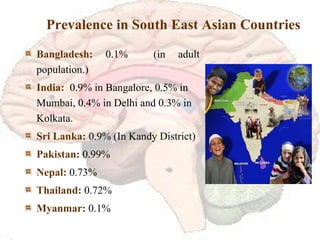
Prevalence in South East Asian Countries Bangladesh:  0.1%  (in adult population.) India:   0.9% in Bangalore, 0.5% in Mumbai, 0.4% in Delhi and 0.3% in Kolkata. Sri Lanka:  0.9% (In Kandy District) Pakistan:  0.99% Nepal:  0.73% Thailand:  0.72% Myanmar:  0.1%
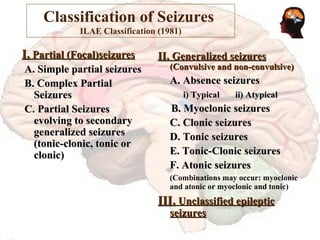
Classification of Seizures  ILAE Classification (1981) I.  Partial (Focal)seizures A. Simple partial seizures B. Complex Partial Seizures C. Partial Seizures evolving to secondary generalized seizures (tonic-clonic, tonic or clonic) II.  Generalized seizures  (Convulsive and non-convulsive) A. Absence seizures   i) Typical   ii) Atypical  B. Myoclonic seizures C. Clonic seizures D. Tonic seizures E. Tonic-Clonic seizures F. Atonic seizures (Combinations may occur: myoclonic and atonic or myoclonic and tonic) III.  Unclassified epileptic seizures
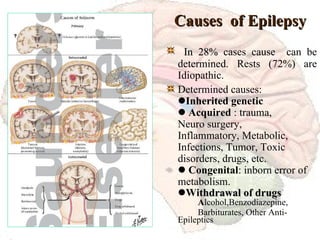
Causes  of Epilepsy In 28%  cases cause  can be determined. Rests (72%) are Idiopathic. Determined causes:  Inherited genetic    Acquired  : trauma,  Neuro surgery,  Inflammatory, Metabolic, Infections, Tumor, Toxic  disorders, drugs, etc.    Congenital : inborn error of metabolism.  Wi thdrawal of drugs A lcohol,Benzodiazepine, Barbiturates, Other Anti- Epileptics
Drugs That Induce Seizures Antibiotics:  Penicillin,  INH, Cycloserin, Ciprofloxacin, Metronidazole. Anti Diabetic:  Insulin,Phenformin. Hormonal : Prednisolone, OCP, Oxytocin Cardiac:  Lidocaine,Procaine, Disopiramide Anesthetics:  Methohexital, Ketamin, Halothane,Propofol Antimalarial:  Chroloquine, Mefloquine, Proguanil. Anti Spastic:  Baclofen Stimulant:  Aminophylline, Doxapram, Theophyline. Radiographic contrast:  Meglumine derivatives, Metrizamide.
Drugs That Induce Seizures Antidepressant:   TCA- (Amitriptaline,  Imipramine, Clomipramine), Dosulepin, Buproprion. Venlafaxine, Duloxitine,Reboxetine Antipsychotics:  Chlorpromazine, Zotepine, Loxapine,Depot Anti-psychotics,Clozapine  Mood Stabilizer:  Lithium Psycho stimulant:  Amphetamine Safe Psychiatric medication in Epilepsy Antidepressant:  Moclobemide, SSRI (with cautious) Antipsychotics : Haloperidol, Trifluphenazine, Sulpiride
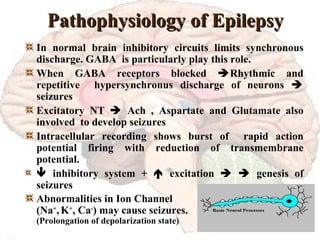
Pathophysiology of Epilepsy In normal brain inhibitory circuits limits synchronous discharge. GABA  is particularly play this role. When GABA receptors blocked   Rhythmic and repetitive  hypersynchronus discharge of neurons    seizures Excitatory NT    Ach , Aspartate and Glutamate also involved  to develop seizures Intracellular recording shows burst of  rapid action potential firing with reduction of transmembrane potential.    inhibitory system +    excitation       genesis of seizures Abnormalities in Ion Channel (Na + ,   K + , Ca - ) may cause seizures. (Prolongation of depolarization state)
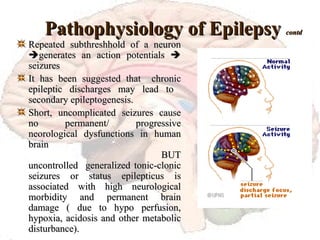
Pathophysiology of Epilepsy  contd Repeated subthreshhold of a neuron   generates an action potentials    seizures It has been suggested that  chronic epileptic discharges may lead to  secondary epileptogenesis. Short, uncomplicated seizures cause no permanent/ progressive neorological dysfunctions in human brain   BUT uncontrolled  generalized tonic-clonic seizures or status epilepticus is associated with high neurological morbidity and permanent brain damage ( due to hypo perfusion, hypoxia, acidosis and other metabolic disturbance).
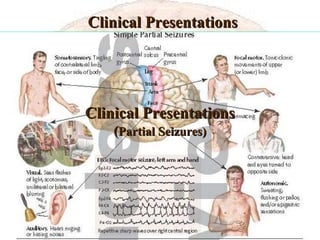
Clinical Presentations ( Partial Seizures) Simple Partial Seizures:    Consciousness is fully preserved     Motor disturbance may involve any body part     Tingling , numbness, electrical shock like feelings     Flashing light and colours, Simple hallucinations     Changes in skin color, Blood pressure, Heart rate,    Pupil size,  Piloerection.     Psychic manifestation: Dysphasic- when cortical  speech  area affected, Dysmnestic- disturbance of  memory,  Cognitive symptoms- dreamy state,  Affective  symptoms- fear, depression, anger,  irritability, elation,  erotic thoughts, Illusion of size,  structured hallucination .
Clinical Presentations Definition: Clinical Presentations ( Partial Seizures)
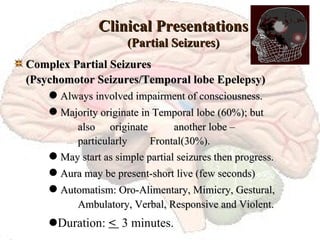
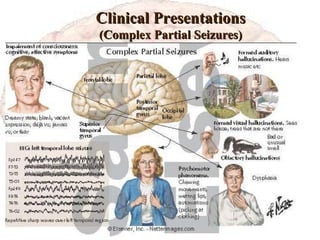
Clinical Presentations (Partial Seizures) Complex Partial Seizures  (Psychomotor Seizures/Temporal lobe Epelepsy)      Always involved impairment of consciousness.     Majority originate in Temporal lobe (60%); but  also  originate  another lobe –   particularly    Frontal(30%).     May start as simple partial seizures then progress.     Aura may be present-short live (few seconds)     Automatism: Oro-Alimentary, Mimicry, Gestural,  Ambulatory, Verbal, Responsive and Violent.    Duration:  <  3 minutes.
Clinical Presentations (Complex Partial Seizures) Definition:
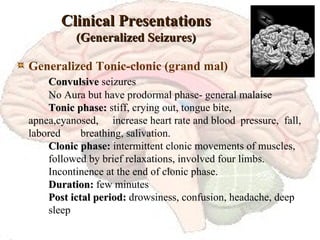
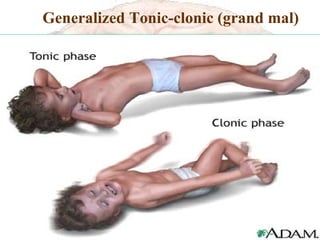
Clinical Presentations (Generalized Seizures) Generalized Tonic-clonic (grand mal) Convulsive  seizures No Aura but have prodormal phase- general malaise Tonic phase:  stiff, crying out, tongue bite,  apnea,cyanosed,  increase heart rate and blood  pressure,  fall, labored  breathing, salivation. Clonic phase:  intermittent clonic movements of muscles,  followed by brief relaxations, involved four limbs. Incontinence at the end of clonic phase. Duration:  few minutes Post ictal period:  drowsiness, confusion, headache, deep  sleep
Generalized Tonic-clonic (grand mal) Definition:
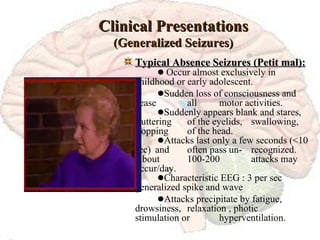
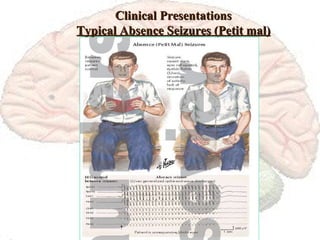
Clinical Presentations (Generalized Seizures) Typical Absence Seizures (Petit mal):      Occur almost exclusively in  childhood or early adolescent.    Sudden loss of consciousness and  cease  all  motor activities.       Suddenly appears blank and stares,  fluttering  of the eyelids,  swallowing, flopping  of the head.    Attacks last only a few seconds (<10  sec)  and  often pass un- recognized. About  100-200  attacks may occur/day.    Characteristic EEG : 3 per sec  generalized spike and wave     Attacks precipitate by fatigue,  drowsiness,  relaxation , photic  stimulation or  hyperventilation.
Clinical Presentations Typical Absence Seizures (Petit mal)
Clinical Presentations Myoclonic seizures Abrupt , very brief, involuntery flexion movements. Involve whole body or part of the body Occur most commonly at morning, shortly after walking. May occur in healthy people (physiological) Atonic Seizures Brief loss of muscle tone. Heavy fall , with or without loss of consciousness. Versive seizures A frontal epileptic foci may  involve the frontal eye field. Force deviation of the eyes and turning head to the opposite  side. Status Epilepticus   Series  of recurrent Tonic-Clonic seizures occurs without  regaining consciousness over 30 min. Waist Syndrome:  Infantile spasm, hypsarrhythmic patterns of  EEG, severe encepalopathy with mental retardation.
Clinical Presentations Infantile Spasm:  Sudden brief seizures, typically tonic flexor spasm of waist, extremities and neck. 20% mortality, who survive 75% have mental retardation, 50% have life long seizures. Juvenile myoclonic epilepsy : Inherited condition.Under recognized syndrome with myoclonic jerks, tonic-clonic or clonic- tonic-clonic  seizures or absence seizures.  EEG shows spike and wave pattern of 3.5-6 Hz. Lennox-Gastaut syndrome : Devastating disorder in children. Mixed types of seizures and mental retardation. Usually cognitive deficit present.  EEG shows slow (<2.5 Hz ) spike and wave patterns. Catamenial epilepsy : Epileptic women experienced that their seizures worsen during menstruation; due to the imbalance  between the proconvulsant estrogen and  anticonvulsant progestogen.
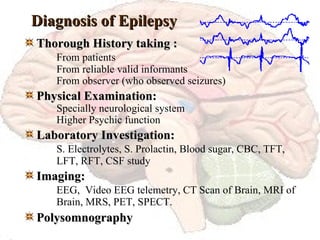
Diagnosis of Epilepsy Thorough History taking : From patients From reliable valid informants From observer (who observed seizures) Physical Examination: Specially neurological system Higher Psychic function Laboratory Investigation: S. Electrolytes, S. Prolactin, Blood sugar, CBC, TFT,  LFT, RFT, CSF study Imaging: EEG,  Video EEG telemetry, CT Scan of Brain, MRI of  Brain, MRS, PET, SPECT. Polysomnography
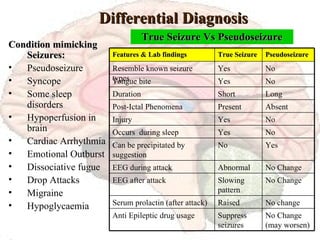
Differential Diagnosis Condition mimicking Seizures: Pseudoseizure Syncope Some sleep disorders Hypoperfusion in brain Cardiac Arrhythmia Emotional Outburst Dissociative fugue Drop Attacks Migraine Hypoglycaemia True Seizure Vs Pseudoseizure No Change (may worsen) Suppress seizures Anti Epileptic drug usage  No change Raised Serum prolactin (after attack) No Change Slowing pattern EEG after attack No Change Abnormal EEG during attack Yes No Can be precipitated by suggestion No Yes Occurs  during sleep No Yes Injury Absent Present Post-Ictal Phenomena Long Short Duration No Yes Tongue bite No Yes Resemble known seizure types Pseudoseizure True Seizure Features & Lab findings
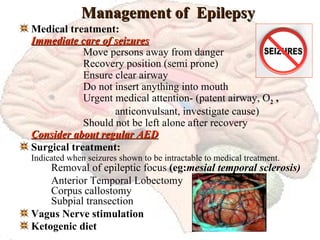
Management of  Epilepsy Medical treatment: Immediate care of seizures Move persons away from danger Recovery position (semi prone) Ensure clear airway Do not insert anything into mouth Urgent medical attention- (patent airway, O 2  ,  anticonvulsant, investigate cause) Should not be left alone after recovery Consider about regular AED Surgical treatment: Indicated when seizures shown to be intractable to medical treatment.   Removal of epileptic focus  (eg: mesial temporal sclerosis)   Anterior Temporal Lobectomy Corpus callostomy Subpial transection Vagus Nerve stimulation Ketogenic diet
Guidelines for Anticonvulsant Therapy Start with one first line drugs Start with low dose: Gradually increase to effective dose or  until side effects. Check compliance If first drug fails due to side effects or continue seizures, start second line drugs whilst gradually withdrawing first. Try Three AED singly before using combinations Beware about drug interactions Do not use more than two drugs in combination at any one time If above fails consider occult structural or metabolic lesion and whether seizures are truly epileptic.
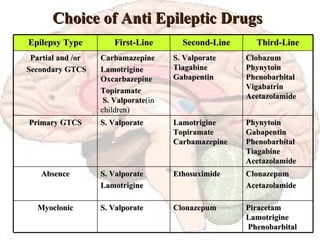
Choice of Anti Epileptic Drugs Piracetam Lamotrigine  Phenobarbital Clonazepum S. Valporate Myoclonic Clonazepum Acetazolamide Ethosuximide S. Valporate Lamotrigine Absence Phynytoin Gabapentin Phenobarbital Tiagabine Acetazolamide Lamotrigine Topiramate Carbamazepine S. Valporate Primary GTCS Clobazum Phynytoin Phenobarbital Vigabatrin Acetazolamide S. Valporate Tiagabine Gabapentin Carbamazepine Lamotrigine Oxcarbazepine Topiramate  S. Valporate (in children) Partial and /or Secondary GTCS Third-Line Second-Line First-Line Epilepsy Type
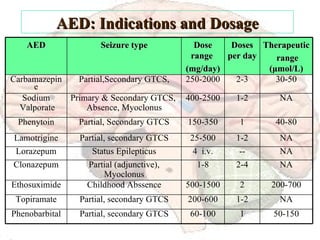
AED: Indications and Dosage NA 1-2 25-500 Partial, secondary GTCS Lamotrigine NA -- 4  i.v. Status Epilepticus Lorazepum 200-700 2 500-1500 Childhood Abssence Ethosuximide NA 1-2 200-600 Partial, secondary GTCS Topiramate NA 2-4 1-8 Partial (adjunctive), Myoclonus Clonazepum 50-150 1 60-100 Partial, secondary GTCS Phenobarbital 40-80 1 150-350 Partial, Secondary GTCS Phenytoin NA 1-2 400-2500 Primary & Secondary GTCS,  Absence, Myoclonus Sodium Valporate 30-50 2-3 250-2000 Partial,Secondary GTCS, Carbamazepine Therapeutic range ( μmol/L) Doses per day Dose range  (mg/day) Seizure type AED
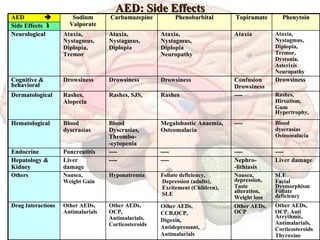
AED: Side Effects SLE Facial Dysmorphism Foliate deficiency Nausea, depression, Taste alteration, Weight loss Foliate deficiency, Depression (adults), Excitement (Children), SLE Hyponatremia Nausea, Weight Gain Others Other AEDs, OCP Nephro- -lithiasis ---- ---- ---- Confusion Drowsiness Ataxia Topiramate Side Effects   Other AEDs, OCP, Anti Arrythmic, Antimalarials, Corticosteroids Thyroxine Other AEDs, CCB,OCP,  Digoxin,  Antidepressant, Antimalarials Other AEDs, OCP,  Antimalarials, Corticosteroids Other AEDs, Antimalarials Drug Interactions Liver damage ---- ---- Liver  damage Hepatology &  Kidney ---- ---- ---- Pancreatitis Endocrine Blood  dyscrasias Osteomalacia Megalobastic Anaemia, Osteomalacia Blood  Dyscrasias, Thrombo- -cytopenia Blood  dyscrasias Hematological Rashes, Hirsutism, Gum Hypertrophy, Rashes Rashes, SJS, Rashes, Alopecia Dermatological Drowsiness Drowsiness Drowsiness Drowsiness Cognitive & behavioral Ataxia,  Nystagmus, Diplopia,  Tremor, Dystonia, Asterixis Neuropathy Ataxia,  Nystagmus, Diplopia Neuropathy Ataxia,  Nystagmus, Diplopia Ataxia,  Nystagmus, Diplopia,  Tremor Neurological Phenytoin Phenobarbital Carbamazepine Sodium Valporate AED  
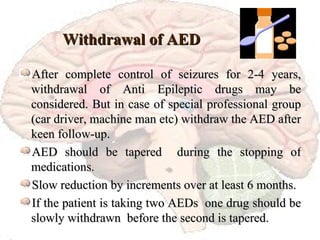
Withdrawal of AED  After complete control of seizures for 2-4 years, withdrawal of Anti Epileptic drugs may be considered. But in case of special professional group (car driver, machine man etc) withdraw the AED after keen follow-up. AED should be tapered  during the stopping of medications.  Slow reduction by increments over at least 6 months. If the patient is taking two AEDs  one drug should be slowly withdrawn  before the second is tapered.
Prognosis Generalized seizures are more readily  controlled than partial seizures. Childhood onset epilepsy (particularly classical absence seizures) carries the best prognosis for successful drug withdrawal. The presence of a structural lesion makes complete control of epilepsy less likely. Epilepsy outcome: After 20 years 50% seizure-free, without drugs, for last 5 years 20% seizure-free, continue to take medication, for last 5 years 30% seizures continue in spite of adequate dose of AEDs. Refractory epilepsy:   When seizure control is not achieved with the  first two appropriate  and  well tolerated   AED schedules  taken as mono therapy or in combination.
Psychiatric comorbidities in Epilepsy Mood variation : Nearly  1 in 3 patients of epilepsy report significant concern about their mood. Depression:  Upto 55% prevalent in patients with epilepsy. Suicide rate:  In  depressed patients with  epilepsy  is 5 times higher than that in the general population and  25 times higher in patients with  complex partial seizures of temporal lobe origin . Anxiety  : Upto 50%  prevalent in patients with epilepsy. Psychosis : Incidence of Psychosis 3.3% in patients with idiopathic generalized epilepsy, 14% in Temporal lobe epilepsy. In the concern of severity;  Psychosis occurs in 0.6-0.7% patients with epilepsy in community and  19-27% of epilepsy patients who require hospitalization.
Recent Research and Achievements Drug treatments:  Sodium valporate or Lamotrigin  is chosen as  first line treatments for Absence seizures and partial seizures.  [BMJ vol 318 ] SANAD ( Standard and New Anti-epileptic Drugs ) study  :  Valporate is significantly better than Topiramate and Lamotrigine in treatment of idiopathic generalized seizures .[Lancet vol 369 March 2007] Surgery:  In developing countries, in patients with Mesial  TLE are feasible by a knowledgeable team consisting epileptologist, neurosurgeon, and technicians with using MRI and EEG.  [Epilepsia 49(3):381-5.2008] In Benign Rolandic Epilepsy:  Children with BRE demonstrated specific recognition impairments due to cortical auditory dysfunction.  [Epilepsia, 49(6):1018-1026.2008]
Recent Research and Achievements Seizure after Stroke:  Overall incidence of seizures within 24 hours after stroke was 3.1%. Higher incidence seen in hemorrhagic stroke (8.4%). Seizures after stroke had higher mortality at 30 days after stroke .[ Epilepsia 49(6):974-981.2008] Akershus Study : Seizure free epilepsy patients on AED monotherapy improve neuropsychological performance after withdrawn  the AED but a relative risk of seizures relapse 2.46, compared to those continuing medications.  [Epilepsia 49(3):455-463.2008 ]
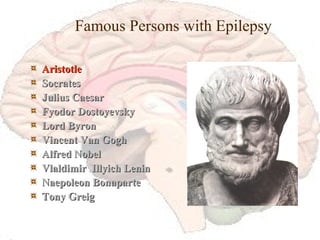
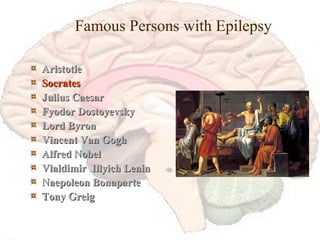
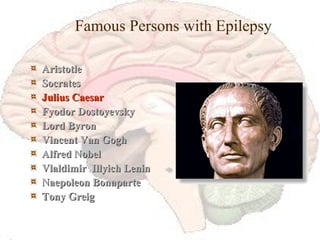
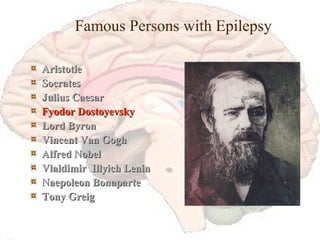
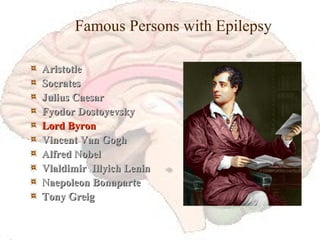
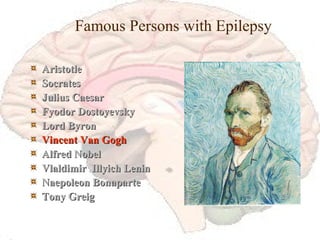
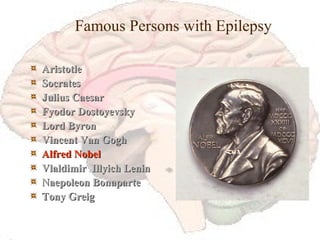
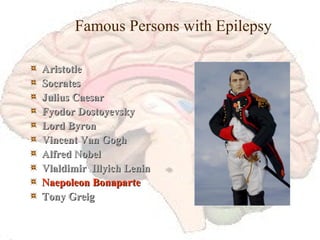
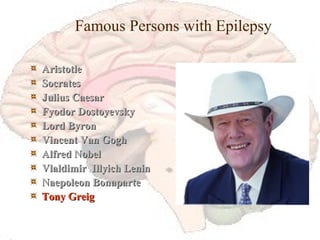
Famous Persons with Epilepsy Aristotle Socrates Julius Caesar Fyodor Dostoyevsky Lord Byron Vincent Van Gogh Alfred Nobel Vlaldimir  Illyich Lenin Naepoleon Bonaparte Tony Greig
Acknowledgements Professor AH Mohammad Firoz Director-cum-Professor, NIMH Professor Dr. Md. Enayet Karim Professor, NIMH All Respected Teachers of NIMH All Doctors of NIMH   & Dr. Imtiaz Ahmed, Sanofi Aventis Mr. Subrata Kumar Saha, Sanofi Aventis.
THANK YOU
 

Epilepsy an overview

  • 1.
    Recent Advancements inEpilepsy Dr. Helal Uddin Ahmed Assistant Registrar National Institute of Mental Health [email_address]
  • 2.
    Introduction Definition: The occurrence of transient paroxysms of excessive or uncontrolled discharges of neurons, which may be caused by a number of different etiologies, leading to epileptic seizures. Synonyms: Seizure Disorder
  • 3.
    Historical Background Epilepsyderived from a Greek term: Epilambanei - to posses, to take hold of, to grab or to seize. Vedic period of 4500-1500BC : Ancient Indian Medicine refined and developed the basic concept of epilepsy Charaka Samhita- The Ayurvedic literature 400 BC: Describe epilepsy as ‘ Apasmara’ means loss of consciousness.
  • 4.
    Historical Background contd Hippocrates 400 BC: ‘This is not a sacred disease rather disorder of brain’ . He described some physical treatment of epilepsy and stated it is an incurable chronic illness. Ibn Sina 370 AH: describe epilepsy as a brain disease.
  • 5.
    Historical Background contd Europe and USA 1857: Bromide was used as first anti-epileptic drugs. 1873 H. Jackson: Neurologist of London-described relationship of electrochemical discharge of brain and seizure. 1920 H. Berger: German Psychiatrist developed EEG to measure brainwaves and its application in the field of epilepsy.
  • 6.
    Historical Background contd 1909: Formation International league against epilepsy (ILAE). 1912: Use Phenobarbitone as AED. 1938: Use Phenytoin as AED. 1950-1970: Developed many AED. 1981: ILAE classified epilepsy. 1997: ILAE, IBE and WHO jointly established Global campaign against epilepsy.
  • 7.
    Epilepsy synonyms in South East Asia India: Apasamra, Mirgee,Lata, Laran Srilanka: Apasamra Indonesia: Ayan Thailand: Rake Lom Ba Mu, Role Lom Chak Bangladesh: Khichuni, Mrigee, Batash (bad wind)
  • 8.
    Epidemiology of EpilepsyEpilepsy knows no geographical, racial or social boundaries. About 50 million people in World have Epilepsy. It occurs in men and women and can begin at any age, but is most frequently diagnosed in infancy, childhood, adolescence and old age. Prevalence: Developed countries- 0.5% (0.4% - 1%) Developing countries- five times higher Incidence: After infancy annual incidence- 20-70/100000 in developed countries. Developing countries- Incidence is double. (100/100000) The life time risk of having a single seizure: About 5%.
  • 9.
    Prevalence in SouthEast Asian Countries Bangladesh: 0.1% (in adult population.) India: 0.9% in Bangalore, 0.5% in Mumbai, 0.4% in Delhi and 0.3% in Kolkata. Sri Lanka: 0.9% (In Kandy District) Pakistan: 0.99% Nepal: 0.73% Thailand: 0.72% Myanmar: 0.1%
  • 10.
    Classification of Seizures ILAE Classification (1981) I. Partial (Focal)seizures A. Simple partial seizures B. Complex Partial Seizures C. Partial Seizures evolving to secondary generalized seizures (tonic-clonic, tonic or clonic) II. Generalized seizures (Convulsive and non-convulsive) A. Absence seizures i) Typical ii) Atypical B. Myoclonic seizures C. Clonic seizures D. Tonic seizures E. Tonic-Clonic seizures F. Atonic seizures (Combinations may occur: myoclonic and atonic or myoclonic and tonic) III. Unclassified epileptic seizures
  • 11.
    Causes ofEpilepsy In 28% cases cause can be determined. Rests (72%) are Idiopathic. Determined causes:  Inherited genetic  Acquired : trauma, Neuro surgery, Inflammatory, Metabolic, Infections, Tumor, Toxic disorders, drugs, etc.  Congenital : inborn error of metabolism.  Wi thdrawal of drugs A lcohol,Benzodiazepine, Barbiturates, Other Anti- Epileptics
  • 12.
    Drugs That InduceSeizures Antibiotics: Penicillin, INH, Cycloserin, Ciprofloxacin, Metronidazole. Anti Diabetic: Insulin,Phenformin. Hormonal : Prednisolone, OCP, Oxytocin Cardiac: Lidocaine,Procaine, Disopiramide Anesthetics: Methohexital, Ketamin, Halothane,Propofol Antimalarial: Chroloquine, Mefloquine, Proguanil. Anti Spastic: Baclofen Stimulant: Aminophylline, Doxapram, Theophyline. Radiographic contrast: Meglumine derivatives, Metrizamide.
  • 13.
    Drugs That InduceSeizures Antidepressant: TCA- (Amitriptaline, Imipramine, Clomipramine), Dosulepin, Buproprion. Venlafaxine, Duloxitine,Reboxetine Antipsychotics: Chlorpromazine, Zotepine, Loxapine,Depot Anti-psychotics,Clozapine Mood Stabilizer: Lithium Psycho stimulant: Amphetamine Safe Psychiatric medication in Epilepsy Antidepressant: Moclobemide, SSRI (with cautious) Antipsychotics : Haloperidol, Trifluphenazine, Sulpiride
  • 14.
    Pathophysiology of EpilepsyIn normal brain inhibitory circuits limits synchronous discharge. GABA is particularly play this role. When GABA receptors blocked  Rhythmic and repetitive hypersynchronus discharge of neurons  seizures Excitatory NT  Ach , Aspartate and Glutamate also involved to develop seizures Intracellular recording shows burst of rapid action potential firing with reduction of transmembrane potential.  inhibitory system +  excitation   genesis of seizures Abnormalities in Ion Channel (Na + , K + , Ca - ) may cause seizures. (Prolongation of depolarization state)
  • 15.
    Pathophysiology of Epilepsy contd Repeated subthreshhold of a neuron  generates an action potentials  seizures It has been suggested that chronic epileptic discharges may lead to secondary epileptogenesis. Short, uncomplicated seizures cause no permanent/ progressive neorological dysfunctions in human brain BUT uncontrolled generalized tonic-clonic seizures or status epilepticus is associated with high neurological morbidity and permanent brain damage ( due to hypo perfusion, hypoxia, acidosis and other metabolic disturbance).
  • 16.
    Clinical Presentations (Partial Seizures) Simple Partial Seizures:  Consciousness is fully preserved  Motor disturbance may involve any body part  Tingling , numbness, electrical shock like feelings  Flashing light and colours, Simple hallucinations  Changes in skin color, Blood pressure, Heart rate, Pupil size, Piloerection.  Psychic manifestation: Dysphasic- when cortical speech area affected, Dysmnestic- disturbance of memory, Cognitive symptoms- dreamy state, Affective symptoms- fear, depression, anger, irritability, elation, erotic thoughts, Illusion of size, structured hallucination .
  • 17.
    Clinical Presentations Definition:Clinical Presentations ( Partial Seizures)
  • 18.
    Clinical Presentations (PartialSeizures) Complex Partial Seizures (Psychomotor Seizures/Temporal lobe Epelepsy)  Always involved impairment of consciousness.  Majority originate in Temporal lobe (60%); but also originate another lobe – particularly Frontal(30%).  May start as simple partial seizures then progress.  Aura may be present-short live (few seconds)  Automatism: Oro-Alimentary, Mimicry, Gestural, Ambulatory, Verbal, Responsive and Violent.  Duration: < 3 minutes.
  • 19.
    Clinical Presentations (ComplexPartial Seizures) Definition:
  • 20.
    Clinical Presentations (GeneralizedSeizures) Generalized Tonic-clonic (grand mal) Convulsive seizures No Aura but have prodormal phase- general malaise Tonic phase: stiff, crying out, tongue bite, apnea,cyanosed, increase heart rate and blood pressure, fall, labored breathing, salivation. Clonic phase: intermittent clonic movements of muscles, followed by brief relaxations, involved four limbs. Incontinence at the end of clonic phase. Duration: few minutes Post ictal period: drowsiness, confusion, headache, deep sleep
  • 21.
  • 22.
    Clinical Presentations (GeneralizedSeizures) Typical Absence Seizures (Petit mal):  Occur almost exclusively in childhood or early adolescent.  Sudden loss of consciousness and cease all motor activities.  Suddenly appears blank and stares, fluttering of the eyelids, swallowing, flopping of the head.  Attacks last only a few seconds (<10 sec) and often pass un- recognized. About 100-200 attacks may occur/day.  Characteristic EEG : 3 per sec generalized spike and wave  Attacks precipitate by fatigue, drowsiness, relaxation , photic stimulation or hyperventilation.
  • 23.
    Clinical Presentations TypicalAbsence Seizures (Petit mal)
  • 24.
    Clinical Presentations Myoclonicseizures Abrupt , very brief, involuntery flexion movements. Involve whole body or part of the body Occur most commonly at morning, shortly after walking. May occur in healthy people (physiological) Atonic Seizures Brief loss of muscle tone. Heavy fall , with or without loss of consciousness. Versive seizures A frontal epileptic foci may involve the frontal eye field. Force deviation of the eyes and turning head to the opposite side. Status Epilepticus Series of recurrent Tonic-Clonic seizures occurs without regaining consciousness over 30 min. Waist Syndrome: Infantile spasm, hypsarrhythmic patterns of EEG, severe encepalopathy with mental retardation.
  • 25.
    Clinical Presentations InfantileSpasm: Sudden brief seizures, typically tonic flexor spasm of waist, extremities and neck. 20% mortality, who survive 75% have mental retardation, 50% have life long seizures. Juvenile myoclonic epilepsy : Inherited condition.Under recognized syndrome with myoclonic jerks, tonic-clonic or clonic- tonic-clonic seizures or absence seizures. EEG shows spike and wave pattern of 3.5-6 Hz. Lennox-Gastaut syndrome : Devastating disorder in children. Mixed types of seizures and mental retardation. Usually cognitive deficit present. EEG shows slow (<2.5 Hz ) spike and wave patterns. Catamenial epilepsy : Epileptic women experienced that their seizures worsen during menstruation; due to the imbalance between the proconvulsant estrogen and anticonvulsant progestogen.
  • 26.
    Diagnosis of EpilepsyThorough History taking : From patients From reliable valid informants From observer (who observed seizures) Physical Examination: Specially neurological system Higher Psychic function Laboratory Investigation: S. Electrolytes, S. Prolactin, Blood sugar, CBC, TFT, LFT, RFT, CSF study Imaging: EEG, Video EEG telemetry, CT Scan of Brain, MRI of Brain, MRS, PET, SPECT. Polysomnography
  • 27.
    Differential Diagnosis Conditionmimicking Seizures: Pseudoseizure Syncope Some sleep disorders Hypoperfusion in brain Cardiac Arrhythmia Emotional Outburst Dissociative fugue Drop Attacks Migraine Hypoglycaemia True Seizure Vs Pseudoseizure No Change (may worsen) Suppress seizures Anti Epileptic drug usage No change Raised Serum prolactin (after attack) No Change Slowing pattern EEG after attack No Change Abnormal EEG during attack Yes No Can be precipitated by suggestion No Yes Occurs during sleep No Yes Injury Absent Present Post-Ictal Phenomena Long Short Duration No Yes Tongue bite No Yes Resemble known seizure types Pseudoseizure True Seizure Features & Lab findings
  • 28.
    Management of Epilepsy Medical treatment: Immediate care of seizures Move persons away from danger Recovery position (semi prone) Ensure clear airway Do not insert anything into mouth Urgent medical attention- (patent airway, O 2 , anticonvulsant, investigate cause) Should not be left alone after recovery Consider about regular AED Surgical treatment: Indicated when seizures shown to be intractable to medical treatment. Removal of epileptic focus (eg: mesial temporal sclerosis) Anterior Temporal Lobectomy Corpus callostomy Subpial transection Vagus Nerve stimulation Ketogenic diet
  • 29.
    Guidelines for AnticonvulsantTherapy Start with one first line drugs Start with low dose: Gradually increase to effective dose or until side effects. Check compliance If first drug fails due to side effects or continue seizures, start second line drugs whilst gradually withdrawing first. Try Three AED singly before using combinations Beware about drug interactions Do not use more than two drugs in combination at any one time If above fails consider occult structural or metabolic lesion and whether seizures are truly epileptic.
  • 30.
    Choice of AntiEpileptic Drugs Piracetam Lamotrigine Phenobarbital Clonazepum S. Valporate Myoclonic Clonazepum Acetazolamide Ethosuximide S. Valporate Lamotrigine Absence Phynytoin Gabapentin Phenobarbital Tiagabine Acetazolamide Lamotrigine Topiramate Carbamazepine S. Valporate Primary GTCS Clobazum Phynytoin Phenobarbital Vigabatrin Acetazolamide S. Valporate Tiagabine Gabapentin Carbamazepine Lamotrigine Oxcarbazepine Topiramate S. Valporate (in children) Partial and /or Secondary GTCS Third-Line Second-Line First-Line Epilepsy Type
  • 31.
    AED: Indications andDosage NA 1-2 25-500 Partial, secondary GTCS Lamotrigine NA -- 4 i.v. Status Epilepticus Lorazepum 200-700 2 500-1500 Childhood Abssence Ethosuximide NA 1-2 200-600 Partial, secondary GTCS Topiramate NA 2-4 1-8 Partial (adjunctive), Myoclonus Clonazepum 50-150 1 60-100 Partial, secondary GTCS Phenobarbital 40-80 1 150-350 Partial, Secondary GTCS Phenytoin NA 1-2 400-2500 Primary & Secondary GTCS, Absence, Myoclonus Sodium Valporate 30-50 2-3 250-2000 Partial,Secondary GTCS, Carbamazepine Therapeutic range ( μmol/L) Doses per day Dose range (mg/day) Seizure type AED
  • 32.
    AED: Side EffectsSLE Facial Dysmorphism Foliate deficiency Nausea, depression, Taste alteration, Weight loss Foliate deficiency, Depression (adults), Excitement (Children), SLE Hyponatremia Nausea, Weight Gain Others Other AEDs, OCP Nephro- -lithiasis ---- ---- ---- Confusion Drowsiness Ataxia Topiramate Side Effects  Other AEDs, OCP, Anti Arrythmic, Antimalarials, Corticosteroids Thyroxine Other AEDs, CCB,OCP, Digoxin, Antidepressant, Antimalarials Other AEDs, OCP, Antimalarials, Corticosteroids Other AEDs, Antimalarials Drug Interactions Liver damage ---- ---- Liver damage Hepatology & Kidney ---- ---- ---- Pancreatitis Endocrine Blood dyscrasias Osteomalacia Megalobastic Anaemia, Osteomalacia Blood Dyscrasias, Thrombo- -cytopenia Blood dyscrasias Hematological Rashes, Hirsutism, Gum Hypertrophy, Rashes Rashes, SJS, Rashes, Alopecia Dermatological Drowsiness Drowsiness Drowsiness Drowsiness Cognitive & behavioral Ataxia, Nystagmus, Diplopia, Tremor, Dystonia, Asterixis Neuropathy Ataxia, Nystagmus, Diplopia Neuropathy Ataxia, Nystagmus, Diplopia Ataxia, Nystagmus, Diplopia, Tremor Neurological Phenytoin Phenobarbital Carbamazepine Sodium Valporate AED 
  • 33.
    Withdrawal of AED After complete control of seizures for 2-4 years, withdrawal of Anti Epileptic drugs may be considered. But in case of special professional group (car driver, machine man etc) withdraw the AED after keen follow-up. AED should be tapered during the stopping of medications. Slow reduction by increments over at least 6 months. If the patient is taking two AEDs one drug should be slowly withdrawn before the second is tapered.
  • 34.
    Prognosis Generalized seizuresare more readily controlled than partial seizures. Childhood onset epilepsy (particularly classical absence seizures) carries the best prognosis for successful drug withdrawal. The presence of a structural lesion makes complete control of epilepsy less likely. Epilepsy outcome: After 20 years 50% seizure-free, without drugs, for last 5 years 20% seizure-free, continue to take medication, for last 5 years 30% seizures continue in spite of adequate dose of AEDs. Refractory epilepsy: When seizure control is not achieved with the first two appropriate and well tolerated AED schedules taken as mono therapy or in combination.
  • 35.
    Psychiatric comorbidities inEpilepsy Mood variation : Nearly 1 in 3 patients of epilepsy report significant concern about their mood. Depression: Upto 55% prevalent in patients with epilepsy. Suicide rate: In depressed patients with epilepsy is 5 times higher than that in the general population and 25 times higher in patients with complex partial seizures of temporal lobe origin . Anxiety : Upto 50% prevalent in patients with epilepsy. Psychosis : Incidence of Psychosis 3.3% in patients with idiopathic generalized epilepsy, 14% in Temporal lobe epilepsy. In the concern of severity; Psychosis occurs in 0.6-0.7% patients with epilepsy in community and 19-27% of epilepsy patients who require hospitalization.
  • 36.
    Recent Research andAchievements Drug treatments: Sodium valporate or Lamotrigin is chosen as first line treatments for Absence seizures and partial seizures. [BMJ vol 318 ] SANAD ( Standard and New Anti-epileptic Drugs ) study : Valporate is significantly better than Topiramate and Lamotrigine in treatment of idiopathic generalized seizures .[Lancet vol 369 March 2007] Surgery: In developing countries, in patients with Mesial TLE are feasible by a knowledgeable team consisting epileptologist, neurosurgeon, and technicians with using MRI and EEG. [Epilepsia 49(3):381-5.2008] In Benign Rolandic Epilepsy: Children with BRE demonstrated specific recognition impairments due to cortical auditory dysfunction. [Epilepsia, 49(6):1018-1026.2008]
  • 37.
    Recent Research andAchievements Seizure after Stroke: Overall incidence of seizures within 24 hours after stroke was 3.1%. Higher incidence seen in hemorrhagic stroke (8.4%). Seizures after stroke had higher mortality at 30 days after stroke .[ Epilepsia 49(6):974-981.2008] Akershus Study : Seizure free epilepsy patients on AED monotherapy improve neuropsychological performance after withdrawn the AED but a relative risk of seizures relapse 2.46, compared to those continuing medications. [Epilepsia 49(3):455-463.2008 ]
  • 38.
    Famous Persons withEpilepsy Aristotle Socrates Julius Caesar Fyodor Dostoyevsky Lord Byron Vincent Van Gogh Alfred Nobel Vlaldimir Illyich Lenin Naepoleon Bonaparte Tony Greig
  • 39.
    Famous Persons withEpilepsy Aristotle Socrates Julius Caesar Fyodor Dostoyevsky Lord Byron Vincent Van Gogh Alfred Nobel Vlaldimir Illyich Lenin Naepoleon Bonaparte Tony Greig
  • 40.
    Famous Persons withEpilepsy Aristotle Socrates Julius Caesar Fyodor Dostoyevsky Lord Byron Vincent Van Gogh Alfred Nobel Vlaldimir Illyich Lenin Naepoleon Bonaparte Tony Greig
  • 41.
    Famous Persons withEpilepsy Aristotle Socrates Julius Caesar Fyodor Dostoyevsky Lord Byron Vincent Van Gogh Alfred Nobel Vlaldimir Illyich Lenin Naepoleon Bonaparte Tony Greig
  • 42.
    Famous Persons withEpilepsy Aristotle Socrates Julius Caesar Fyodor Dostoyevsky Lord Byron Vincent Van Gogh Alfred Nobel Vlaldimir Illyich Lenin Naepoleon Bonaparte Tony Greig
  • 43.
    Famous Persons withEpilepsy Aristotle Socrates Julius Caesar Fyodor Dostoyevsky Lord Byron Vincent Van Gogh Alfred Nobel Vlaldimir Illyich Lenin Naepoleon Bonaparte Tony Greig
  • 44.
    Famous Persons withEpilepsy Aristotle Socrates Julius Caesar Fyodor Dostoyevsky Lord Byron Vincent Van Gogh Alfred Nobel Vlaldimir Illyich Lenin Naepoleon Bonaparte Tony Greig
  • 45.
    Famous Persons withEpilepsy Aristotle Socrates Julius Caesar Fyodor Dostoyevsky Lord Byron Vincent Van Gogh Alfred Nobel Vlaldimir Illyich Lenin Naepoleon Bonaparte Tony Greig
  • 46.
    Famous Persons withEpilepsy Aristotle Socrates Julius Caesar Fyodor Dostoyevsky Lord Byron Vincent Van Gogh Alfred Nobel Vlaldimir Illyich Lenin Naepoleon Bonaparte Tony Greig
  • 47.
    Famous Persons withEpilepsy Aristotle Socrates Julius Caesar Fyodor Dostoyevsky Lord Byron Vincent Van Gogh Alfred Nobel Vlaldimir Illyich Lenin Naepoleon Bonaparte Tony Greig
  • 48.
    Acknowledgements Professor AHMohammad Firoz Director-cum-Professor, NIMH Professor Dr. Md. Enayet Karim Professor, NIMH All Respected Teachers of NIMH All Doctors of NIMH & Dr. Imtiaz Ahmed, Sanofi Aventis Mr. Subrata Kumar Saha, Sanofi Aventis.
  • 49.
  • 50.