EPILEPSY
Evaluator: Presenter:
Mr. L Anand Shruti Shirke
Asso. Professor M.Sc nursing
CON AIIMS BBSR Neurosciences nursing
Introduction
• Seizure: A single (finite) event of abnormal discharge in the brain that results in an
abrupt and temporary altered state of cerebral function.
• Seizure disorder: a term adopted by some clinicians when referring to epilepsy.
Although this has led to some confusion, the terms epilepsy and seizure disorder are
used interchangeably.
• Epileptic syndrome: an epileptic disorder characterized by a cluster of signs and
symptoms customarily occurring together.
The Indian Epilepsy Society (IES)
• The Indian Epilepsy Society (IES) was constituted and registered With the Registrar
of Societies, Govt. of India, Delhi on May 13, 1997. The main objectives of the IES
are to:
• Maintain the highest standard in the ethics and practice for the promoting of
prevention, diagnosis, treatment and care of all persons with epilepsy.
• Promote and encourage research concerning the epilepsies.
• Improve education, and dissemination of knowledge concerning epilepsy.
• Maintain a good liaison with the organization of lay people.
Terminology
• Epilepsy: A chronic disorder of abnormal, recurrent, excessive, and self-
terminating discharge from neurons. Periods between seizures can vary widely
and can be measured in minutes, hours, days, weeks, months, or even years.
Clinically, Epilepsy is characterized by recurring seizures accompanied by a
disturbance in some type of behavior (i.e., motor, sensory, autonomic,
consciousness, or mentation).
Aura
• Aura is a premonitory sensation or warning experienced at the
beginning of a seizure, which the patient remembers. An aura may
be a gustatory, visual, auditory, or visceral experience, such as a
metallic taste or flashing lights. If a patient has an aura, it usually
is the same experience each time.
Automatisms
• Automatisms are more or less coordinated, involuntary motor activities that
occur during a state of impaired consciousness either in the course of or after
an epileptic seizure, for which the person is usually amnesic. Several different
types of automatism have been recognized. Examples of automatisms are lip
smacking, chewing, fidgeting, and pacing.
• Automatisms are often associated with temporal lobe seizures but can also
occur with complex partial seizures as well as with other types.
Autonomic symptoms
• Autonomic symptoms are symptoms that occur as a result of
stimulation of the autonomic nervous system (e.g., epigastric
sensation, pallor, sweating, flushing, piloerection, pupillary
dilation).
Clonus
• Clonus is a term used to describe spasms in which a continuous
pattern of rigidity and relaxation is repeated. In the second phase
of a generalized seizure, called the clonic phase, rhythmic
movements are followed by muscle relaxation. In the clonic phase,
the process repeats again and again.
Ictus & Postictal
• Ictus refers to an actual seizure; a seizure may be referred to as an
ictal event.
• Postictal refers to the period immediately after a seizure has
occurred.
Prodromal & Tonus
• Prodromal refers to symptoms, such as a headache or feeling of
depression, that precede a seizure by hours.
• Tonus is the degree of tone or contraction present in muscle when
it is not undergoing shortening.
Todd’s paralysis
• Todd’s paralysis is a temporary, focal weakness or paralysis
following a partial or generalized seizure that can last for up to 24
hours. The deficit can be correlated with an epileptic focus on the
motor strip. Temporary neuronal exhaustion is probably the
physiologic basis for the deficit.
Jacksonian march
• A Jacksonian seizure is a type of focal partial seizure, also known as a
simple partial seizure. This means the seizure is caused by unusual electrical
activity that affects only a small area of the brain. The person maintains
awareness during the seizure. Jacksonian seizures are also known as
a Jacksonian march.
Reflex epilepsy
• In patients with epilepsy, seizures can be precipitated by various
stimuli called triggers. Sometimes the trigger is very specific for a
particular person. Common triggers include particular odors,
flashing lights, and certain types of music. If a specific stimulus can
be identified, then the pattern is called reflex epilepsy
Classification
Absence seizures
• Typical absence seizures: Common in children; characterized by brief
interruption in consciousness without loss of postural control. Typically,
there is an interruption of activity with a momentary lapse of
consciousness lasting 3 to 30 sec. If talking, the speech stops or slows; if
eating, the hand and mouth stop, and if patient is called, there is no
response.
• During an attack, the eyes may appear vacant, stare, or roll upward; the
eyelids may twitch.
Absence seizures
• Seizures occur a few times to hundreds of times per day; person
may not be aware of them.
• Atypical absence seizures: The lapse of consciousness is usually of
longer duration and less abrupt in onset; more obvious motor signs.
Myoclonic seizures
• Sporadic jerks that are sudden, brief; contractions that are usually
symmetrical.
• When confined to one area, it may be the face and trunk; one or more
extremities; an individual muscle; or a muscle group.
• Myoclonic jerks are rapidly repetitive or relatively isolated.
• Common around time of sleep or awakening; must be differentiated from
myoclonic jerks of nonepileptic myoclonus.
Tonic seizures & Clonic seizures
• Tonic seizures: Stiffening of the musculature, mostly of the body,
but may also involve the arms.
• Clonic seizures : Repetitive rhythmic clonic movements that are
bilateral and symmetric.
Atonic seizures
• Abrupt loss of postural muscle tone; last 1–2 sec.
• Consciousness is briefly impaired, but usually there is not postictal
confusion.
• Common in children
Phases of GTCS
Prodromal
Phase
Tonic
Phase
Clonic
Phase
Post-ictal
Phase
Few hours or days
less than 1 minute
(average of 15
seconds)
Last for 1-2 minutes
30 seconds, although
it may be longer
Phases of GTCS
• Prodromal Phase: Irritability and tension may precede the seizure by several hours or
days. people may or may not have warning signs like aura. Neuronal hyperexcitation
spreads to the subcortex, thalamus, and upper brainstem, and consciousness is
suddenly lost
• Tonic phase: There is a major tonic contraction (increased tonus) of the voluntary
muscles, the body stiffens with legs and arms extended. If standing, the person falls to
the ground. The jaw snaps shut and the tongue may be bitten in the process. The
bladder and, less often, the bowel may empty. The pupils dilate and are unresponsive
to light. Apnea occurs and lasts for only a few seconds.
Phases of GTCS
• Clonic phase: Inhibitory neurons of the cortex, anterior thalamus, and basal
ganglion nuclei become active, intermittently interrupting the tonic seizure
discharge with clonic activity. The clonic phase is characterized by violent,
rhythmic, muscular contractions accompanied by hyperventilation. The face is
contorted, the eyes roll, and there is excessive salivation with frothing from the
mouth. Profuse sweating and a tachycardia are common.
• Postictal phase: The clonic jerking gradually subsides in frequency and
amplitude over a period of about 30 seconds, although it may be longer. The
involved cells cease firing
Status Epilepticus
• Status Epilepticus defined as either continuous seizures lasting at
least 5 minutes or two or more discrete seizures between which
there is incomplete recovery of consciousness.
• The most common cause of status epilepticus is an abrupt
discontinuation of antiepileptic drugs (AEDs). Other causes include
withdrawal from alcohol, sedatives, or fever.
Status Epilepticus
• Status epilepticus constitutes a medical emergency associated with
significant morbidity and mortality (20%). If not treated
aggressively, cardiorespiratory dysfunction, hyperthermia, and
metabolic imbalances can develop, leading to cerebral ischemia
and neuronal death.
Epidemiology
• Approximately 30% of all epilepsies and about 60% of all
childhood epilepsies may have a significant genetic susceptibility.
The risk of epilepsy is about 1% from birth through 20 years and
3% for the 70-year and older age group. The prevalence and
cumulative incidence of epilepsy and partial seizures increase in
the elderly
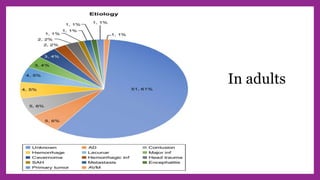
Etiology
In adults
Pathophysiology of
seizures
GLUTAMATE ExNT
NMDA
GABA InNT
GABA
Ca++
Ca++ Ca++
Calcium influx
Cl--
Cl--
Cl--
Chlorine influx
Long lasting activation of
NMDA, or dysfunctional
GABA Receptors leads to
too much excitation and
too low inhibition.
Diagnosis
• Computed tomography (CT) scan
• Magnetic resonance imaging (MRI) (two to three times more sensitive than CT scan in
identifying potential epileptogenic lesions)
• EEG • Video-EEG monitoring with either non-invasive scalp electrodes or deep
invasive electrodes
• Possibly a positron emission tomography (PET) scan (limited availability due to high
expense)
• Single proton emission computerized tomography (SPECT) scan (helpful for seizure
localization and not diagnosis)
Treatment of
Epilepsy
The approach to a patient with a seizure disorder is
multidimensional and comprehensive. It includes:
1) Treatment of any underlying condition
2) Avoidance of precipitating factors
3) Suppression of recurrent seizures by prophylactic therapy
with AEDs or surgery
4) Comprehensive management of physiologic and social issues
related to having seizures
Medical Management
Commonly Used AEDs
Protocol for the
management of
SE
The following are principles recommended for
seizure management:
• Begin with a single drug, called monotherapy, which is the drug of choice for the
particular seizure type.
• Increase the drug gradually over 3 to 4 weeks until seizure control is achieved,
intolerable side effects occur, toxicity develops, or the maximum therapeutic range
has been reached.
• Recognize that many AEDs are CNS depressants and that drowsiness, lethargy, and
tiredness are common in the beginning of therapy; however, these symptoms will
usually subside in 7 to 10 days.
Principles of Drug Therapy: cont..
• Because of pharmacokinetics (cited later) and variations in requirements for specific
seizure types with the same drug, expect to make individual adjustments in dosage.
• Some patients may need more or less than the recommended average therapeutic
range for a particular drug.
• Titrate a single drug until maximum benefit is achieved or intolerance or serious
side effects occur. If a therapeutic blood concentration has been achieved and
seizure control has not been achieved, a second drug may be added. A second drug
may be used in combination with the first or replace the first. With replacement, the
first drug should be gradually tapered after the second drug has been titrated to the
desired dosage. This practice is necessary because the sudden withdrawal of a drug
can cause status epilepticus, even though a new drug has been introduced in its
place
Principles of Drug Therapy: cont..
• If the patient is seizure free, check drug concentration in blood after 5 to 8 half-lives
or a period of 3 to 4 weeks.
• The drug’s half-life is important because drugs of long duration (phenytoin,
phenobarbital) may be taken once daily in some circumstances.
• Have the patient keep a daily drug diary routinely, but especially when a new drug is
introduced. The diary should include dosage and side effects. The diary is helpful in
evaluating the effectiveness of the drug therapy
Principles of Drug Therapy: cont..
Summary of drug therapy
• Any patient receiving long-term drug therapy should be monitored carefully
for the development of side effects or toxicity. Most drugs are metabolized
by the liver and excreted by the kidneys. Periodic drug blood levels should be
monitored. If anemia or blood dyscrasias are common side effects, a CBC
should be done routinely. Folic acid deficiency has also been reported with
some AEDs; therefore, folic acid levels should be monitored.
Refractory Epilepsy
• About 1/3rd of patients with epilepsy do not respond well to treatment with
monotherapy. It then becomes necessary to try a combination of drugs to
control seizures. Although there are no guidelines for combining drugs, a
combination of two first-line drugs (i.e., carbamazepine, phenytoin, valproic
acid, lamotrigine) is tried. If this is not effective, adding one of the newer
drugs (i.e., gabapentin or topiramate) is suggested. When seizures cannot be
controlled by drug therapy, the condition is called refractory epilepsy and
surgery becomes a consideration.
Surgical Management
• Mesial temporal lobectomy
• Lesionectomy
• Corpus callosotomy
• Hemispherectomy
• Vagus nerve stimulation
MANAGEMENT OF
SEIZURES AND
STATUS EPILEPTICUS
IN AN ACUTE CARE
SETTING
Before and During a Seizure
• If the patient is seated when a major seizure occurs, ease him or her to the floor, if possible.
• Provide for privacy by pulling the bed curtains or screen or closing the door.
• If the patient experiences an aura, have him or her lie down to prevent injury that might
occur from falling to the floor.
• Remove patient’s eyeglasses and loosen any constricting clothing.
• Do not try to force anything into the mouth.
• Guide the movements to prevent injuries; do not try to restrain the patient.
• Stay with the patient throughout the seizure to ensure safety.
After a Seizure
• Position the patient on the side to facilitate drainage of secretions.
• Provide for adequate ventilation by maintaining a patent airway; suctioning
may be necessary to prevent aspiration.
• Allow the patient to sleep after the seizure.
• On awakening, orient the patient (he or she will probably be amnesic about
the event).
Nursing Assessment and Documentation
• The following are several points to consider when organizing information about a seizure:
• Was the seizure witnessed or not witnessed?
• Were there any warning signs or was there an aura?
• Where did the seizure begin and how did it proceed?
• What type of movement was noted and what parts of the body were involved?
• Were there any changes in the size of the pupils or was there conjugate gaze deviation?
• What was the duration of the entire attack and of each phase?
• Was the patient unconscious throughout the seizure?
• Was there urinary or bowel incontinence?
• What was the person’s behavior after the seizure?
• Was there any weakness or paralysis of the extremities after the seizure?
• Were there any injuries noted?
• Did the patient sleep after the seizure? How long?
Nursing Management of Status Epilepticus
• The nurse works as part of a collaborative team in addressing the medical emergency.
Goals and responsibilities include:
• Maintaining a patent airway to ensure adequate ventilation.
• Suctioning as necessary to prevent obstruction of the airway and possible aspiration
• Providing oxygen by nasal cannula as ordered
• Protecting the IV site to allow for continuous access for medication
• Protecting the patient from injury
• Providing information to the family
Teaching Plan for Persons With Epilepsy or
a Seizure Disorder
DIET/NUTRITION/BEVERAGES
GENERAL HEALTH
FEVER AND ILLNESS
ENVIRONMENTAL, OCCUPATIONAL, AND RECREATIONAL RISK FACTORS
STRESS, ANXIETY, AND DEPRESSION
WOMEN’S HEALTH
LEGISLATION TO PROTECT PERSONS WITH EPILEPSY AND SEIZURE DISORDER
OTHER
Patient
Education
Patient education is the cornerstone of drug therapy and promotes a
partnership that supports compliance.
Patients who understand the purpose of drug therapy and the drugs
that they are taking are more compliant.
Patient education must be an ongoing process with reinforcement and
updates at each appointment. Because many patients are on long-term
or life-long therapy, education must also anticipate and prepare
patients for developmental changes and changes in normal life routine.
The drug must be taken as ordered to maintain a therapeutic blood level, even
if there is no seizure activity
Discontinuation of drugs without the knowledge of the health care provider is
the most common cause of seizure activity (e.g., status epilepticus); this
should not be done.
Know the signs of toxicity of the drugs prescribed. Symptoms of toxicity
should be reported promptly to the physician.
A Medic Alert bracelet or a card should be carried to indicate a chronic
condition.
Keep follow-up appointments with a health care provider for periodic
monitoring and re-evaluation.
A high incidence of new onset of epilepsy is found in persons 65 years old and older. The risk
factors associated with stroke, head trauma, dementia, infection, alcoholism, and aging.
Focal or diffuse slowing on EEG is not necessarily an indicator of epilepsy in older persons.
An EEG finding known as periodic lateralized epileptiform discharges (PLEDs) is abnormal
interictal EEG wave patterns characterized by paroxysmal, sharp wave complexes suggestive of an
underlying focal seizure disorder.
AED safe during pregnancy
AED safe during breast feeding
AED teratogenic effects
Conclusion
• Seizures are a problem of many. This not only cause physical
damage but may also cause emotional problem and social stigma.
Mood swings and depression from antiepileptic drugs is also a
common issue.
• Better understanding of epilepsy its pathophysiology, symptoms,
phases and its management it essential to bring change and to
provide quality comprehensive care.
THANK
YOU
References
1. Browne, T. R., & Holmes, G. L. (2000). Handbook of epilepsy (2nd ed., pp. 1–18).
Philadelphia: Lippincott Williams & Wilkins.
2. Lowenstein, D. H. (2005). Seizures and epilepsy. In D. L. Kasper, E. Braunwald, A.
S. Fauci, S. L. Hauser, D. L. Longo, & J. L. Jameson (Eds.). Harrison’s principles of
internal medicine (16th ed., pp. 2357–2372). New York: McGraw-Hill.
3. Ropper, A. H., & Brown, R. H. (2005). Adams and Victor’s principles of neurology
(8th ed., pp. 271–301). New York: McGrawHill.
4. Ropper, A. H., & Brown, R. H. (2005). Adams and Victor’s principles of neurology
(8th ed., p. 281). New York: McGraw-Hill.
5. Kotagel, P. (1997). Complex partial seizures with automatisms. In F. Wylie (Ed.).
The treatment of epilepsy: Principles and practice (2nd ed., pp. 385–400).
Baltimore: Williams & Wilkins.
6. Commission of Classification and Terminology of the International League Against
Epilepsy. (1981). Proposal for revised clinical and electroencephalographic
classification of epileptic seizures. Epilepsia, 22, 489–501.

Epilepsy

  • 1.
    EPILEPSY Evaluator: Presenter: Mr. LAnand Shruti Shirke Asso. Professor M.Sc nursing CON AIIMS BBSR Neurosciences nursing
  • 2.
    Introduction • Seizure: Asingle (finite) event of abnormal discharge in the brain that results in an abrupt and temporary altered state of cerebral function. • Seizure disorder: a term adopted by some clinicians when referring to epilepsy. Although this has led to some confusion, the terms epilepsy and seizure disorder are used interchangeably. • Epileptic syndrome: an epileptic disorder characterized by a cluster of signs and symptoms customarily occurring together.
  • 4.
    The Indian EpilepsySociety (IES) • The Indian Epilepsy Society (IES) was constituted and registered With the Registrar of Societies, Govt. of India, Delhi on May 13, 1997. The main objectives of the IES are to: • Maintain the highest standard in the ethics and practice for the promoting of prevention, diagnosis, treatment and care of all persons with epilepsy. • Promote and encourage research concerning the epilepsies. • Improve education, and dissemination of knowledge concerning epilepsy. • Maintain a good liaison with the organization of lay people.
  • 5.
    Terminology • Epilepsy: Achronic disorder of abnormal, recurrent, excessive, and self- terminating discharge from neurons. Periods between seizures can vary widely and can be measured in minutes, hours, days, weeks, months, or even years. Clinically, Epilepsy is characterized by recurring seizures accompanied by a disturbance in some type of behavior (i.e., motor, sensory, autonomic, consciousness, or mentation).
  • 6.
    Aura • Aura isa premonitory sensation or warning experienced at the beginning of a seizure, which the patient remembers. An aura may be a gustatory, visual, auditory, or visceral experience, such as a metallic taste or flashing lights. If a patient has an aura, it usually is the same experience each time.
  • 7.
    Automatisms • Automatisms aremore or less coordinated, involuntary motor activities that occur during a state of impaired consciousness either in the course of or after an epileptic seizure, for which the person is usually amnesic. Several different types of automatism have been recognized. Examples of automatisms are lip smacking, chewing, fidgeting, and pacing. • Automatisms are often associated with temporal lobe seizures but can also occur with complex partial seizures as well as with other types.
  • 8.
    Autonomic symptoms • Autonomicsymptoms are symptoms that occur as a result of stimulation of the autonomic nervous system (e.g., epigastric sensation, pallor, sweating, flushing, piloerection, pupillary dilation).
  • 9.
    Clonus • Clonus isa term used to describe spasms in which a continuous pattern of rigidity and relaxation is repeated. In the second phase of a generalized seizure, called the clonic phase, rhythmic movements are followed by muscle relaxation. In the clonic phase, the process repeats again and again.
  • 10.
    Ictus & Postictal •Ictus refers to an actual seizure; a seizure may be referred to as an ictal event. • Postictal refers to the period immediately after a seizure has occurred.
  • 11.
    Prodromal & Tonus •Prodromal refers to symptoms, such as a headache or feeling of depression, that precede a seizure by hours. • Tonus is the degree of tone or contraction present in muscle when it is not undergoing shortening.
  • 12.
    Todd’s paralysis • Todd’sparalysis is a temporary, focal weakness or paralysis following a partial or generalized seizure that can last for up to 24 hours. The deficit can be correlated with an epileptic focus on the motor strip. Temporary neuronal exhaustion is probably the physiologic basis for the deficit.
  • 13.
    Jacksonian march • AJacksonian seizure is a type of focal partial seizure, also known as a simple partial seizure. This means the seizure is caused by unusual electrical activity that affects only a small area of the brain. The person maintains awareness during the seizure. Jacksonian seizures are also known as a Jacksonian march.
  • 14.
    Reflex epilepsy • Inpatients with epilepsy, seizures can be precipitated by various stimuli called triggers. Sometimes the trigger is very specific for a particular person. Common triggers include particular odors, flashing lights, and certain types of music. If a specific stimulus can be identified, then the pattern is called reflex epilepsy
  • 15.
  • 19.
    Absence seizures • Typicalabsence seizures: Common in children; characterized by brief interruption in consciousness without loss of postural control. Typically, there is an interruption of activity with a momentary lapse of consciousness lasting 3 to 30 sec. If talking, the speech stops or slows; if eating, the hand and mouth stop, and if patient is called, there is no response. • During an attack, the eyes may appear vacant, stare, or roll upward; the eyelids may twitch.
  • 20.
    Absence seizures • Seizuresoccur a few times to hundreds of times per day; person may not be aware of them. • Atypical absence seizures: The lapse of consciousness is usually of longer duration and less abrupt in onset; more obvious motor signs.
  • 21.
    Myoclonic seizures • Sporadicjerks that are sudden, brief; contractions that are usually symmetrical. • When confined to one area, it may be the face and trunk; one or more extremities; an individual muscle; or a muscle group. • Myoclonic jerks are rapidly repetitive or relatively isolated. • Common around time of sleep or awakening; must be differentiated from myoclonic jerks of nonepileptic myoclonus.
  • 22.
    Tonic seizures &Clonic seizures • Tonic seizures: Stiffening of the musculature, mostly of the body, but may also involve the arms. • Clonic seizures : Repetitive rhythmic clonic movements that are bilateral and symmetric.
  • 23.
    Atonic seizures • Abruptloss of postural muscle tone; last 1–2 sec. • Consciousness is briefly impaired, but usually there is not postictal confusion. • Common in children
  • 24.
    Phases of GTCS Prodromal Phase Tonic Phase Clonic Phase Post-ictal Phase Fewhours or days less than 1 minute (average of 15 seconds) Last for 1-2 minutes 30 seconds, although it may be longer
  • 25.
    Phases of GTCS •Prodromal Phase: Irritability and tension may precede the seizure by several hours or days. people may or may not have warning signs like aura. Neuronal hyperexcitation spreads to the subcortex, thalamus, and upper brainstem, and consciousness is suddenly lost • Tonic phase: There is a major tonic contraction (increased tonus) of the voluntary muscles, the body stiffens with legs and arms extended. If standing, the person falls to the ground. The jaw snaps shut and the tongue may be bitten in the process. The bladder and, less often, the bowel may empty. The pupils dilate and are unresponsive to light. Apnea occurs and lasts for only a few seconds.
  • 26.
    Phases of GTCS •Clonic phase: Inhibitory neurons of the cortex, anterior thalamus, and basal ganglion nuclei become active, intermittently interrupting the tonic seizure discharge with clonic activity. The clonic phase is characterized by violent, rhythmic, muscular contractions accompanied by hyperventilation. The face is contorted, the eyes roll, and there is excessive salivation with frothing from the mouth. Profuse sweating and a tachycardia are common. • Postictal phase: The clonic jerking gradually subsides in frequency and amplitude over a period of about 30 seconds, although it may be longer. The involved cells cease firing
  • 28.
    Status Epilepticus • StatusEpilepticus defined as either continuous seizures lasting at least 5 minutes or two or more discrete seizures between which there is incomplete recovery of consciousness. • The most common cause of status epilepticus is an abrupt discontinuation of antiepileptic drugs (AEDs). Other causes include withdrawal from alcohol, sedatives, or fever.
  • 29.
    Status Epilepticus • Statusepilepticus constitutes a medical emergency associated with significant morbidity and mortality (20%). If not treated aggressively, cardiorespiratory dysfunction, hyperthermia, and metabolic imbalances can develop, leading to cerebral ischemia and neuronal death.
  • 30.
    Epidemiology • Approximately 30%of all epilepsies and about 60% of all childhood epilepsies may have a significant genetic susceptibility. The risk of epilepsy is about 1% from birth through 20 years and 3% for the 70-year and older age group. The prevalence and cumulative incidence of epilepsy and partial seizures increase in the elderly
  • 32.
  • 33.
  • 36.
  • 37.
    GLUTAMATE ExNT NMDA GABA InNT GABA Ca++ Ca++Ca++ Calcium influx Cl-- Cl-- Cl-- Chlorine influx Long lasting activation of NMDA, or dysfunctional GABA Receptors leads to too much excitation and too low inhibition.
  • 38.
    Diagnosis • Computed tomography(CT) scan • Magnetic resonance imaging (MRI) (two to three times more sensitive than CT scan in identifying potential epileptogenic lesions) • EEG • Video-EEG monitoring with either non-invasive scalp electrodes or deep invasive electrodes • Possibly a positron emission tomography (PET) scan (limited availability due to high expense) • Single proton emission computerized tomography (SPECT) scan (helpful for seizure localization and not diagnosis)
  • 39.
  • 40.
    The approach toa patient with a seizure disorder is multidimensional and comprehensive. It includes: 1) Treatment of any underlying condition 2) Avoidance of precipitating factors 3) Suppression of recurrent seizures by prophylactic therapy with AEDs or surgery 4) Comprehensive management of physiologic and social issues related to having seizures
  • 41.
  • 42.
  • 43.
  • 45.
    The following areprinciples recommended for seizure management: • Begin with a single drug, called monotherapy, which is the drug of choice for the particular seizure type. • Increase the drug gradually over 3 to 4 weeks until seizure control is achieved, intolerable side effects occur, toxicity develops, or the maximum therapeutic range has been reached. • Recognize that many AEDs are CNS depressants and that drowsiness, lethargy, and tiredness are common in the beginning of therapy; however, these symptoms will usually subside in 7 to 10 days.
  • 46.
    Principles of DrugTherapy: cont.. • Because of pharmacokinetics (cited later) and variations in requirements for specific seizure types with the same drug, expect to make individual adjustments in dosage. • Some patients may need more or less than the recommended average therapeutic range for a particular drug.
  • 47.
    • Titrate asingle drug until maximum benefit is achieved or intolerance or serious side effects occur. If a therapeutic blood concentration has been achieved and seizure control has not been achieved, a second drug may be added. A second drug may be used in combination with the first or replace the first. With replacement, the first drug should be gradually tapered after the second drug has been titrated to the desired dosage. This practice is necessary because the sudden withdrawal of a drug can cause status epilepticus, even though a new drug has been introduced in its place Principles of Drug Therapy: cont..
  • 48.
    • If thepatient is seizure free, check drug concentration in blood after 5 to 8 half-lives or a period of 3 to 4 weeks. • The drug’s half-life is important because drugs of long duration (phenytoin, phenobarbital) may be taken once daily in some circumstances. • Have the patient keep a daily drug diary routinely, but especially when a new drug is introduced. The diary should include dosage and side effects. The diary is helpful in evaluating the effectiveness of the drug therapy Principles of Drug Therapy: cont..
  • 49.
    Summary of drugtherapy • Any patient receiving long-term drug therapy should be monitored carefully for the development of side effects or toxicity. Most drugs are metabolized by the liver and excreted by the kidneys. Periodic drug blood levels should be monitored. If anemia or blood dyscrasias are common side effects, a CBC should be done routinely. Folic acid deficiency has also been reported with some AEDs; therefore, folic acid levels should be monitored.
  • 50.
    Refractory Epilepsy • About1/3rd of patients with epilepsy do not respond well to treatment with monotherapy. It then becomes necessary to try a combination of drugs to control seizures. Although there are no guidelines for combining drugs, a combination of two first-line drugs (i.e., carbamazepine, phenytoin, valproic acid, lamotrigine) is tried. If this is not effective, adding one of the newer drugs (i.e., gabapentin or topiramate) is suggested. When seizures cannot be controlled by drug therapy, the condition is called refractory epilepsy and surgery becomes a consideration.
  • 51.
    Surgical Management • Mesialtemporal lobectomy • Lesionectomy • Corpus callosotomy • Hemispherectomy • Vagus nerve stimulation
  • 52.
    MANAGEMENT OF SEIZURES AND STATUSEPILEPTICUS IN AN ACUTE CARE SETTING
  • 53.
    Before and Duringa Seizure • If the patient is seated when a major seizure occurs, ease him or her to the floor, if possible. • Provide for privacy by pulling the bed curtains or screen or closing the door. • If the patient experiences an aura, have him or her lie down to prevent injury that might occur from falling to the floor. • Remove patient’s eyeglasses and loosen any constricting clothing. • Do not try to force anything into the mouth. • Guide the movements to prevent injuries; do not try to restrain the patient. • Stay with the patient throughout the seizure to ensure safety.
  • 54.
    After a Seizure •Position the patient on the side to facilitate drainage of secretions. • Provide for adequate ventilation by maintaining a patent airway; suctioning may be necessary to prevent aspiration. • Allow the patient to sleep after the seizure. • On awakening, orient the patient (he or she will probably be amnesic about the event).
  • 55.
    Nursing Assessment andDocumentation • The following are several points to consider when organizing information about a seizure: • Was the seizure witnessed or not witnessed? • Were there any warning signs or was there an aura? • Where did the seizure begin and how did it proceed? • What type of movement was noted and what parts of the body were involved? • Were there any changes in the size of the pupils or was there conjugate gaze deviation? • What was the duration of the entire attack and of each phase? • Was the patient unconscious throughout the seizure? • Was there urinary or bowel incontinence? • What was the person’s behavior after the seizure? • Was there any weakness or paralysis of the extremities after the seizure? • Were there any injuries noted? • Did the patient sleep after the seizure? How long?
  • 57.
    Nursing Management ofStatus Epilepticus • The nurse works as part of a collaborative team in addressing the medical emergency. Goals and responsibilities include: • Maintaining a patent airway to ensure adequate ventilation. • Suctioning as necessary to prevent obstruction of the airway and possible aspiration • Providing oxygen by nasal cannula as ordered • Protecting the IV site to allow for continuous access for medication • Protecting the patient from injury • Providing information to the family
  • 58.
    Teaching Plan forPersons With Epilepsy or a Seizure Disorder DIET/NUTRITION/BEVERAGES GENERAL HEALTH FEVER AND ILLNESS ENVIRONMENTAL, OCCUPATIONAL, AND RECREATIONAL RISK FACTORS STRESS, ANXIETY, AND DEPRESSION WOMEN’S HEALTH LEGISLATION TO PROTECT PERSONS WITH EPILEPSY AND SEIZURE DISORDER OTHER
  • 59.
  • 60.
    Patient education isthe cornerstone of drug therapy and promotes a partnership that supports compliance. Patients who understand the purpose of drug therapy and the drugs that they are taking are more compliant. Patient education must be an ongoing process with reinforcement and updates at each appointment. Because many patients are on long-term or life-long therapy, education must also anticipate and prepare patients for developmental changes and changes in normal life routine.
  • 61.
    The drug mustbe taken as ordered to maintain a therapeutic blood level, even if there is no seizure activity Discontinuation of drugs without the knowledge of the health care provider is the most common cause of seizure activity (e.g., status epilepticus); this should not be done. Know the signs of toxicity of the drugs prescribed. Symptoms of toxicity should be reported promptly to the physician. A Medic Alert bracelet or a card should be carried to indicate a chronic condition. Keep follow-up appointments with a health care provider for periodic monitoring and re-evaluation.
  • 62.
    A high incidenceof new onset of epilepsy is found in persons 65 years old and older. The risk factors associated with stroke, head trauma, dementia, infection, alcoholism, and aging. Focal or diffuse slowing on EEG is not necessarily an indicator of epilepsy in older persons. An EEG finding known as periodic lateralized epileptiform discharges (PLEDs) is abnormal interictal EEG wave patterns characterized by paroxysmal, sharp wave complexes suggestive of an underlying focal seizure disorder. AED safe during pregnancy AED safe during breast feeding AED teratogenic effects
  • 64.
    Conclusion • Seizures area problem of many. This not only cause physical damage but may also cause emotional problem and social stigma. Mood swings and depression from antiepileptic drugs is also a common issue. • Better understanding of epilepsy its pathophysiology, symptoms, phases and its management it essential to bring change and to provide quality comprehensive care.
  • 65.
  • 66.
    References 1. Browne, T.R., & Holmes, G. L. (2000). Handbook of epilepsy (2nd ed., pp. 1–18). Philadelphia: Lippincott Williams & Wilkins. 2. Lowenstein, D. H. (2005). Seizures and epilepsy. In D. L. Kasper, E. Braunwald, A. S. Fauci, S. L. Hauser, D. L. Longo, & J. L. Jameson (Eds.). Harrison’s principles of internal medicine (16th ed., pp. 2357–2372). New York: McGraw-Hill. 3. Ropper, A. H., & Brown, R. H. (2005). Adams and Victor’s principles of neurology (8th ed., pp. 271–301). New York: McGrawHill. 4. Ropper, A. H., & Brown, R. H. (2005). Adams and Victor’s principles of neurology (8th ed., p. 281). New York: McGraw-Hill. 5. Kotagel, P. (1997). Complex partial seizures with automatisms. In F. Wylie (Ed.). The treatment of epilepsy: Principles and practice (2nd ed., pp. 385–400). Baltimore: Williams & Wilkins. 6. Commission of Classification and Terminology of the International League Against Epilepsy. (1981). Proposal for revised clinical and electroencephalographic classification of epileptic seizures. Epilepsia, 22, 489–501.