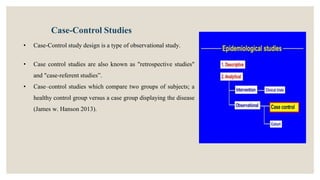
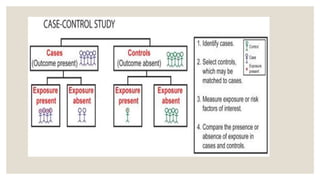
Case-control studies are a type of observational research that compare individuals with a disease (cases) to those without (controls) to identify risk factors, and they are characterized by their retrospective nature. Key strengths include cost-effectiveness, suitability for rare diseases, and the ability to examine multiple risk factors simultaneously, while key weaknesses involve biases related to selection, recall, and data quality. Various case-control studies illustrate their application, such as investigating psychological stress's link to breast cancer and smoking's association with lung cancer.