
Local anaesthetics
Dr. S. Parasuraman,
Faculty of Pharmacy,
AIMST University.
Course: PHARMACOTHERAPEUTICS II
Local anaesthetics
• Local anaesthetics (LAs) are drugs which upon topical
application or local injection cause reversible loss of
sensory perception, especially of pain, in a restricted area
of the body.
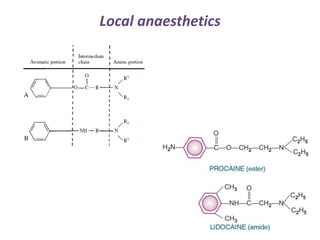
• Chemistry: The basic components in the structure of local
anesthetics are the lipophilic aromatic portion (a
benzene ring), an intermediate chain, and the hydrophilic
amine portion. The intermediate chain has either an
ester linkage from the combination of an aromatic acid
and an amino alcohol or an amide linkage from the
combination of an aromatic amine and an amino acid.
Local anaesthetics
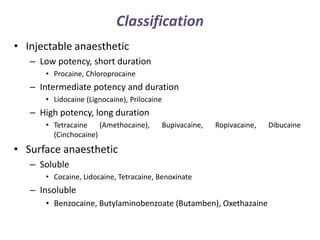
Classification
• Injectable anaesthetic
– Low potency, short duration
• Procaine, Chloroprocaine
– Intermediate potency and duration
• Lidocaine (Lignocaine), Prilocaine
– High potency, long duration
• Tetracaine (Amethocaine), Bupivacaine, Ropivacaine, Dibucaine
(Cinchocaine)
• Surface anaesthetic
– Soluble
• Cocaine, Lidocaine, Tetracaine, Benoxinate
– Insoluble
• Benzocaine, Butylaminobenzoate (Butamben), Oxethazaine
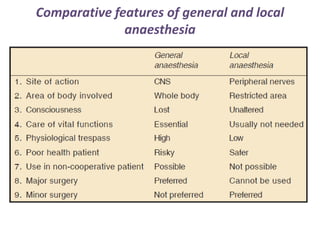
Comparative features of general and local
anaesthesia
Local anaesthetics
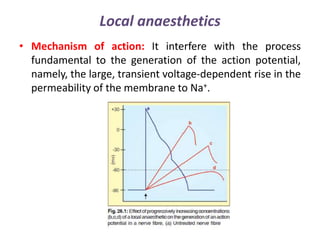
• Mechanism of action: It interfere with the process
fundamental to the generation of the action potential,
namely, the large, transient voltage-dependent rise in the
permeability of the membrane to Na+.
Local anaesthetic actions
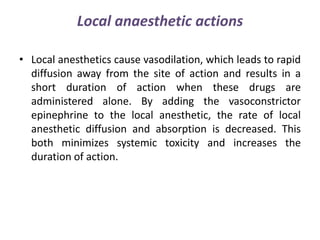
• Local anesthetics cause vasodilation, which leads to rapid
diffusion away from the site of action and results in a
short duration of action when these drugs are
administered alone. By adding the vasoconstrictor
epinephrine to the local anesthetic, the rate of local
anesthetic diffusion and absorption is decreased. This
both minimizes systemic toxicity and increases the
duration of action.
What is the use of vasoconstrictors on
anaesthetic action of any anaesthetics agents?
• Sympathomimetic drugs, are often added to local
anesthetics to delay absorption of the anesthetic from its
injection site.
• By slowing absorption, these drugs reduce the
anesthetic’s systemic toxicity and keep it in contact with
nerve fibers longer, thereby increasing the drug’s
duration of action.
• Epinephrine is most commonly used because of its
systemic α- and β-adrenergic actions.
Pharmacological actions
• Central nervous system: All LAs are capable of producing
a sequence of stimulation followed by depression.
– The basic action of LAs in CNS is neuronal inhibition. The
apparent stimulation seen initially and is due to inhibition of
inhibitory neurones. At high doses, all neurones are inhibited
and flattening of waves in the EEG.
– Effect of cocaine on CNS: euphoria—excitement—mental
confusion—restlessness—tremor and twitching of muscles—
convulsions—unconsciousness—respiratory depression—death,
in a dose-dependent manner.
Pharmacological actions
• Cardiovascular system: LAs are cardiac depressants, but
no significant effects are observed at conventional doses.
At high doses or on i.v. injection, LAs decrease
automaticity, excitability, contractility, conductivity and
prolong effective refractory period (ERP). Generally Las
produce quinidine like antiarrhythmic action.
• Blood vessels: LAs produce fall in BP and this is primarily
due to sympathetic blockade. In higher doses it causes
direct relaxation of arteriolar smooth muscle. At toxic
doses of LAs produce cardiovascular collapse.
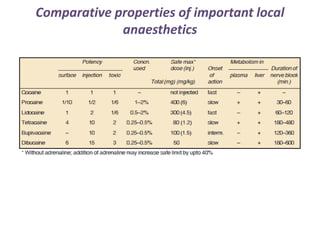
Comparative properties of important local
anaesthetics
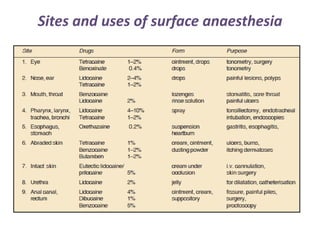
Sites and uses of surface anaesthesia
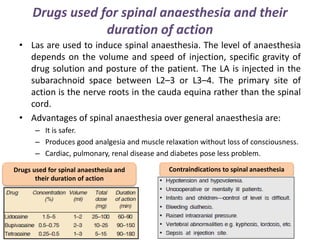
Drugs used for spinal anaesthesia and their
duration of action
• Las are used to induce spinal anaesthesia. The level of anaesthesia
depends on the volume and speed of injection, specific gravity of
drug solution and posture of the patient. The LA is injected in the
subarachnoid space between L2–3 or L3–4. The primary site of
action is the nerve roots in the cauda equina rather than the spinal
cord.
• Advantages of spinal anaesthesia over general anaesthesia are:
– It is safer.
– Produces good analgesia and muscle relaxation without loss of consciousness.
– Cardiac, pulmonary, renal disease and diabetes pose less problem.
Drugs used for spinal anaesthesia and
their duration of action
Contraindications to spinal anaesthesia
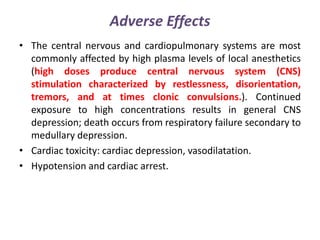
Adverse Effects
• The central nervous and cardiopulmonary systems are most
commonly affected by high plasma levels of local anesthetics
(high doses produce central nervous system (CNS)
stimulation characterized by restlessness, disorientation,
tremors, and at times clonic convulsions.). Continued
exposure to high concentrations results in general CNS
depression; death occurs from respiratory failure secondary to
medullary depression.
• Cardiac toxicity: cardiac depression, vasodilatation.
• Hypotension and cardiac arrest.
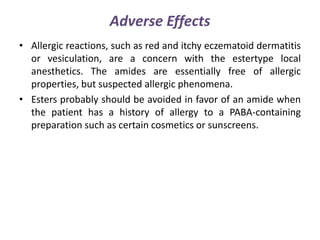
Adverse Effects
• Allergic reactions, such as red and itchy eczematoid dermatitis
or vesiculation, are a concern with the estertype local
anesthetics. The amides are essentially free of allergic
properties, but suspected allergic phenomena.
• Esters probably should be avoided in favor of an amide when
the patient has a history of allergy to a PABA-containing
preparation such as certain cosmetics or sunscreens.
Management of LAs over-dose
• Treatment requires ventilatory assistance and drugs to control
the seizures. The ultra–short-acting barbiturates and the
benzodiazepine derivatives, such as diazepam, are effective in
controlling these seizures.
• Respiratory stimulants are not effective.
Local anaesthetics

Local anaesthetics

  • 1.
    Local anaesthetics Dr. S.Parasuraman, Faculty of Pharmacy, AIMST University. Course: PHARMACOTHERAPEUTICS II
  • 2.
    Local anaesthetics • Localanaesthetics (LAs) are drugs which upon topical application or local injection cause reversible loss of sensory perception, especially of pain, in a restricted area of the body. • Chemistry: The basic components in the structure of local anesthetics are the lipophilic aromatic portion (a benzene ring), an intermediate chain, and the hydrophilic amine portion. The intermediate chain has either an ester linkage from the combination of an aromatic acid and an amino alcohol or an amide linkage from the combination of an aromatic amine and an amino acid.
  • 3.
  • 4.
    Classification • Injectable anaesthetic –Low potency, short duration • Procaine, Chloroprocaine – Intermediate potency and duration • Lidocaine (Lignocaine), Prilocaine – High potency, long duration • Tetracaine (Amethocaine), Bupivacaine, Ropivacaine, Dibucaine (Cinchocaine) • Surface anaesthetic – Soluble • Cocaine, Lidocaine, Tetracaine, Benoxinate – Insoluble • Benzocaine, Butylaminobenzoate (Butamben), Oxethazaine
  • 5.
    Comparative features ofgeneral and local anaesthesia
  • 6.
    Local anaesthetics • Mechanismof action: It interfere with the process fundamental to the generation of the action potential, namely, the large, transient voltage-dependent rise in the permeability of the membrane to Na+.
  • 7.
    Local anaesthetic actions •Local anesthetics cause vasodilation, which leads to rapid diffusion away from the site of action and results in a short duration of action when these drugs are administered alone. By adding the vasoconstrictor epinephrine to the local anesthetic, the rate of local anesthetic diffusion and absorption is decreased. This both minimizes systemic toxicity and increases the duration of action.
  • 8.
    What is theuse of vasoconstrictors on anaesthetic action of any anaesthetics agents? • Sympathomimetic drugs, are often added to local anesthetics to delay absorption of the anesthetic from its injection site. • By slowing absorption, these drugs reduce the anesthetic’s systemic toxicity and keep it in contact with nerve fibers longer, thereby increasing the drug’s duration of action. • Epinephrine is most commonly used because of its systemic α- and β-adrenergic actions.
  • 9.
    Pharmacological actions • Centralnervous system: All LAs are capable of producing a sequence of stimulation followed by depression. – The basic action of LAs in CNS is neuronal inhibition. The apparent stimulation seen initially and is due to inhibition of inhibitory neurones. At high doses, all neurones are inhibited and flattening of waves in the EEG. – Effect of cocaine on CNS: euphoria—excitement—mental confusion—restlessness—tremor and twitching of muscles— convulsions—unconsciousness—respiratory depression—death, in a dose-dependent manner.
  • 10.
    Pharmacological actions • Cardiovascularsystem: LAs are cardiac depressants, but no significant effects are observed at conventional doses. At high doses or on i.v. injection, LAs decrease automaticity, excitability, contractility, conductivity and prolong effective refractory period (ERP). Generally Las produce quinidine like antiarrhythmic action. • Blood vessels: LAs produce fall in BP and this is primarily due to sympathetic blockade. In higher doses it causes direct relaxation of arteriolar smooth muscle. At toxic doses of LAs produce cardiovascular collapse.
  • 11.
    Comparative properties ofimportant local anaesthetics
  • 12.
    Sites and usesof surface anaesthesia
  • 13.
    Drugs used forspinal anaesthesia and their duration of action • Las are used to induce spinal anaesthesia. The level of anaesthesia depends on the volume and speed of injection, specific gravity of drug solution and posture of the patient. The LA is injected in the subarachnoid space between L2–3 or L3–4. The primary site of action is the nerve roots in the cauda equina rather than the spinal cord. • Advantages of spinal anaesthesia over general anaesthesia are: – It is safer. – Produces good analgesia and muscle relaxation without loss of consciousness. – Cardiac, pulmonary, renal disease and diabetes pose less problem. Drugs used for spinal anaesthesia and their duration of action Contraindications to spinal anaesthesia
  • 14.
    Adverse Effects • Thecentral nervous and cardiopulmonary systems are most commonly affected by high plasma levels of local anesthetics (high doses produce central nervous system (CNS) stimulation characterized by restlessness, disorientation, tremors, and at times clonic convulsions.). Continued exposure to high concentrations results in general CNS depression; death occurs from respiratory failure secondary to medullary depression. • Cardiac toxicity: cardiac depression, vasodilatation. • Hypotension and cardiac arrest.
  • 15.
    Adverse Effects • Allergicreactions, such as red and itchy eczematoid dermatitis or vesiculation, are a concern with the estertype local anesthetics. The amides are essentially free of allergic properties, but suspected allergic phenomena. • Esters probably should be avoided in favor of an amide when the patient has a history of allergy to a PABA-containing preparation such as certain cosmetics or sunscreens.
  • 16.
    Management of LAsover-dose • Treatment requires ventilatory assistance and drugs to control the seizures. The ultra–short-acting barbiturates and the benzodiazepine derivatives, such as diazepam, are effective in controlling these seizures. • Respiratory stimulants are not effective.