Cross-Sectional Studies
Dr. Win Aye Hlaing
Lecturer
Department of Epidemiology
University of Public Health, Yangon
6/26/2017 1
Types of Descriptive Study
• Cross-sectional (Prevalence) Study
• Case Report
• Case Series
6/26/2017 2
Types of Analytic Study
• Cross-sectional Analytic Study
• Cohort
• Case-Control
6/26/2017 3
Cross Sectional Studies
• possible relationship of increased serum cholesterol level
(the exposure) to evidence of CHD (the disease)
• in cross-sectional study, both exposure and disease
outcome are determined simultaneously for each subject
• viewing a snapshot of the population at a certain point in
time
• to imagine that we have sliced through the population,
capturing levels of cholesterol and evidence of CHD at the
same time
• we identify are prevalent cases of the disease
• but we do not know their duration
• also called a prevalence study
6/26/2017 4
• Cross-sectional study is a study in which all
the measurements are taken at a particular
point in time
• When a study only measures health outcome,
it is known as descriptive cross-sectional study
• When a study only measures both exposure
and health outcome at the same time, it is
known as analytic (comparative) cross-
sectional study
6/26/2017 5
6/26/2017 6
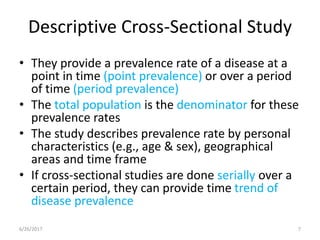
Descriptive Cross-Sectional Study
• They provide a prevalence rate of a disease at a
point in time (point prevalence) or over a period
of time (period prevalence)
• The total population is the denominator for these
prevalence rates
• The study describes prevalence rate by personal
characteristics (e.g., age & sex), geographical
areas and time frame
• If cross-sectional studies are done serially over a
certain period, they can provide time trend of
disease prevalence
6/26/2017 7
Analytic (Comparative) Cross-Sectional Study
• A cross-sectional study is an observational study
in which exposure and disease are determined at
the same point in time in a given population
• Often deal with exposures that can not change,
such as blood type or other invariable personal
characteristics
• Cases in a cross-sectional study will over
represent cases with a long duration of illness
and under represent those with a short duration
of illness
6/26/2017 8
6/26/2017 9
• association between increased cholesterol
level and CHD, we are left with several
problems
• First, we are identifying prevalent cases of
CHD rather than incident (new) cases
• may not be representative of all cases of CHD
6/26/2017 10
• Second, the presence or absence of both
exposure and disease was determined at the
same time in each subject
• it is not possible to establish a temporal
relationship
6/26/2017 11
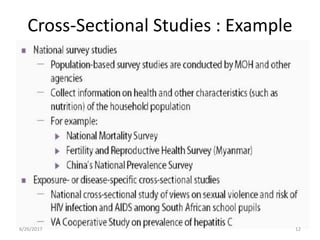
Cross-Sectional Studies : Example
6/26/2017 12
Uses of Cross-sectional Studies
• Assessment of Health Status of a Population
• Trend Analysis (by serial cross-sectional surveys)
– Secular trend, Cyclic changes, Seasonal variation,
Epidemics
• Health Care Planning
– prioritization, target population & resource allocation
• Clues about Disease Causation & Prevention
– Hypothesis generation
6/26/2017 13
Cross-sectional Study Strengths
• Relatively feasible and not too time-consuming,
since there is no follow-up period (though
random sampling in a large population can be
expensive and problematic)
• We can study several diseases and/or exposures;
thus, it is useful for screening new hypotheses
• We can describe disease frequency and health
needs of a large population; thus, it is useful for
health planning
6/26/2017 14
Cross-sectional Study Weaknesses
• Potential temporal ambiguity (exposure and
disease)
• It is inefficient for studying rare or highly fatal
diseases or diseases with short durations of
expression
6/26/2017 15
Case reports and case series
6/26/2017 16
6/26/2017 17
6/26/2017 18
• Advantages of Case Series
– Useful in hypothesis formation, describing "clinical
experience“
– Easy and inexpensive to do in hospital settings
– Can constitute the case group for a case-control
study
• Disadvantages of Case Series
– With no comparison group, no formal assessment
of relationship b/t exposure and outcome
6/26/2017 19
6/26/2017 20
THANK YOU!!

Cross sectional study-dr.wah

  • 1.
    Cross-Sectional Studies Dr. WinAye Hlaing Lecturer Department of Epidemiology University of Public Health, Yangon 6/26/2017 1
  • 2.
    Types of DescriptiveStudy • Cross-sectional (Prevalence) Study • Case Report • Case Series 6/26/2017 2
  • 3.
    Types of AnalyticStudy • Cross-sectional Analytic Study • Cohort • Case-Control 6/26/2017 3
  • 4.
    Cross Sectional Studies •possible relationship of increased serum cholesterol level (the exposure) to evidence of CHD (the disease) • in cross-sectional study, both exposure and disease outcome are determined simultaneously for each subject • viewing a snapshot of the population at a certain point in time • to imagine that we have sliced through the population, capturing levels of cholesterol and evidence of CHD at the same time • we identify are prevalent cases of the disease • but we do not know their duration • also called a prevalence study 6/26/2017 4
  • 5.
    • Cross-sectional studyis a study in which all the measurements are taken at a particular point in time • When a study only measures health outcome, it is known as descriptive cross-sectional study • When a study only measures both exposure and health outcome at the same time, it is known as analytic (comparative) cross- sectional study 6/26/2017 5
  • 6.
  • 7.
    Descriptive Cross-Sectional Study •They provide a prevalence rate of a disease at a point in time (point prevalence) or over a period of time (period prevalence) • The total population is the denominator for these prevalence rates • The study describes prevalence rate by personal characteristics (e.g., age & sex), geographical areas and time frame • If cross-sectional studies are done serially over a certain period, they can provide time trend of disease prevalence 6/26/2017 7
  • 8.
    Analytic (Comparative) Cross-SectionalStudy • A cross-sectional study is an observational study in which exposure and disease are determined at the same point in time in a given population • Often deal with exposures that can not change, such as blood type or other invariable personal characteristics • Cases in a cross-sectional study will over represent cases with a long duration of illness and under represent those with a short duration of illness 6/26/2017 8
  • 9.
  • 10.
    • association betweenincreased cholesterol level and CHD, we are left with several problems • First, we are identifying prevalent cases of CHD rather than incident (new) cases • may not be representative of all cases of CHD 6/26/2017 10
  • 11.
    • Second, thepresence or absence of both exposure and disease was determined at the same time in each subject • it is not possible to establish a temporal relationship 6/26/2017 11
  • 12.
    Cross-Sectional Studies :Example 6/26/2017 12
  • 13.
    Uses of Cross-sectionalStudies • Assessment of Health Status of a Population • Trend Analysis (by serial cross-sectional surveys) – Secular trend, Cyclic changes, Seasonal variation, Epidemics • Health Care Planning – prioritization, target population & resource allocation • Clues about Disease Causation & Prevention – Hypothesis generation 6/26/2017 13
  • 14.
    Cross-sectional Study Strengths •Relatively feasible and not too time-consuming, since there is no follow-up period (though random sampling in a large population can be expensive and problematic) • We can study several diseases and/or exposures; thus, it is useful for screening new hypotheses • We can describe disease frequency and health needs of a large population; thus, it is useful for health planning 6/26/2017 14
  • 15.
    Cross-sectional Study Weaknesses •Potential temporal ambiguity (exposure and disease) • It is inefficient for studying rare or highly fatal diseases or diseases with short durations of expression 6/26/2017 15
  • 16.
    Case reports andcase series 6/26/2017 16
  • 17.
  • 18.
  • 19.
    • Advantages ofCase Series – Useful in hypothesis formation, describing "clinical experience“ – Easy and inexpensive to do in hospital settings – Can constitute the case group for a case-control study • Disadvantages of Case Series – With no comparison group, no formal assessment of relationship b/t exposure and outcome 6/26/2017 19
  • 20.