EPIDEMIOLOGY
community dentistry
lecture 4
Epidemiological studies
Dr. Noorah
Murad DDS
OR
SLIDE SHARE
DR. NOORAH MURAD
https://www.slideshare.net/NoorahMurad
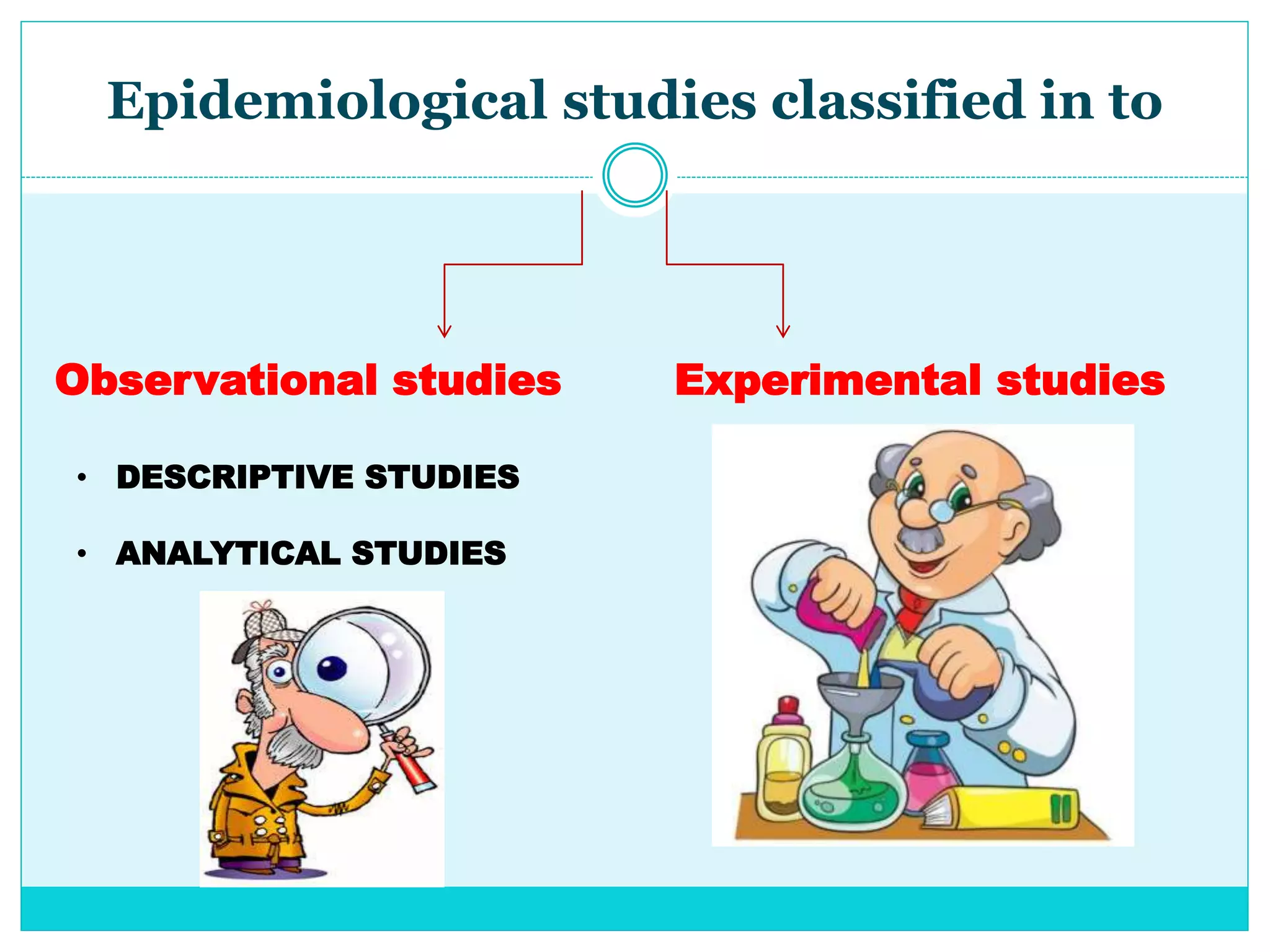
Epidemiological studies classified in to
Observational studies Experimental studies
• DESCRIPTIVE STUDIES
• ANALYTICAL STUDIES
OBSERVATIONAL STUDIES
DESCRIPTIVE :
 Fist phase in epidemiological study
 It’s purpose is to describe the occurrence and distribution
of disease with respect to time, person, and place.
 These studies make no attempt to analyze the links
between exposure and effect.
OBSERVATIONAL STUDIES
Analytical studies :
 it’s the next step in an epidemiological studies.
 It’s purpose is to determine the etiology of the disease by
testing the hypothesis derived from descriptive study.
 This study analyses relationship between health status
and other variables.
Also we can classified observational
studies to
 Retrospective studies : A study compares two groups one
with the disease or condition under study (cases) and a similar
group of people who do not have the disease or condition
(controls). Researchers study the medical and lifestyle histories
of the people in each group to learn what factors may be
associated with the disease or condition
Example : case control study
 Prospective studies :
This study watches for outcomes, looks foreword, such as the
development of a disease. it involves taking a group of
subjects and watching them over a long period.
Example: cohort study
Also studies could be a
 Prevalence study : that measures prevalence
(occurrence) of a disease in particular group at one point in
time.(not finding etiology)
OR
 Incidence study : (longitudinal study) examination
of same population over a prolonged period of time inform
of follow up. (for identifying etiology and risk factors)
The different study TYPES or DESIGNS
Cross - sectional study :
 It measures the prevalence of the disease, and was called
prevalence study.
 Based on a single examination at one point in time.
 Tells about distribution rather than etiology.
 Provide data about the history of the disease.
 it’s important to assessing the health care needs of a population.
Case – control study:
 Relatively simple and economical to carry out.
 Used to investigate causes of disease.
 It’s a retrospective study.
 Includes 2 groups:
1. People with the disease or variable case
2. People without the disease or variable control
Cohort study :
 Follow up or incident study.
 Begin with a group of people free from disease with
common characteristics within defined time period.
 Followed to see how the development of new cases of
disease among those with and without exposure.
 Expensive. (long time an large sample size) why?
 It is a prospective incident study, why?
 It is longitudinal, why?
 Example of cohort study: Studies of Dean et al
(1938 – 1942) are example of cohort study to
establish association of fluoride with dental caries.
 Example of cohort group :
Age, occupation, pregnancy ….etc.
Ecological study : (correlational )
 The units of analysis are populations.
 The study is by comparing populations in different
countries at same time or same population in one
country at different times.
EXPERIMENTAL STUDIES
Experiment or intervention : a diagnostic test or
procedure, prescribed therapy, or other action intended to
detect, prevent, or treat a health condition.
Its purpose is to :
1. Provide a method of measuring the effectiveness of health
services for the prevention, control, and treatment of
disease.
2. Provide scientific proof of etiological factor by using an
intervention.
Types and designs of experimental
study
Randomized controlled trials :
 Participants are randomly assigned to either
experimental group
or controlled group
 Experimental group receive the new intervention
controlled group receives placebo
 Best method to test preventive and therapeutic
measures.
Field trials :
 Involve people who are disease free but presumed to be at
risk.
 Data collection take place in the field.
 Field trials are often huge undertaking, involve major
logistic and financial considerations (expensive).
Community trials :
 The treatment groups are communities rather than
individuals
 A limitation of this study is that only small communities
can be included and random allocation is not practical.`
 The whole community is taken as study group.
 Communities in the neighborhood is taken as control
group.
BLINDING
 It is a procedure done to reduce the bias which may
occur due to errors from assessment of the outcome.
 It’s of three types :
1. Single blind trial
2. Double blind trial
3. Triple blind trial
Participant, investigator, person analyzing the data
Lec 3 (2019)

Lec 3 (2019)

  • 1.
  • 2.
    OR SLIDE SHARE DR. NOORAHMURAD https://www.slideshare.net/NoorahMurad
  • 4.
    Epidemiological studies classifiedin to Observational studies Experimental studies • DESCRIPTIVE STUDIES • ANALYTICAL STUDIES
  • 5.
    OBSERVATIONAL STUDIES DESCRIPTIVE : Fist phase in epidemiological study  It’s purpose is to describe the occurrence and distribution of disease with respect to time, person, and place.  These studies make no attempt to analyze the links between exposure and effect.
  • 6.
    OBSERVATIONAL STUDIES Analytical studies:  it’s the next step in an epidemiological studies.  It’s purpose is to determine the etiology of the disease by testing the hypothesis derived from descriptive study.  This study analyses relationship between health status and other variables.
  • 7.
    Also we canclassified observational studies to  Retrospective studies : A study compares two groups one with the disease or condition under study (cases) and a similar group of people who do not have the disease or condition (controls). Researchers study the medical and lifestyle histories of the people in each group to learn what factors may be associated with the disease or condition Example : case control study
  • 8.
     Prospective studies: This study watches for outcomes, looks foreword, such as the development of a disease. it involves taking a group of subjects and watching them over a long period. Example: cohort study
  • 9.
    Also studies couldbe a  Prevalence study : that measures prevalence (occurrence) of a disease in particular group at one point in time.(not finding etiology) OR  Incidence study : (longitudinal study) examination of same population over a prolonged period of time inform of follow up. (for identifying etiology and risk factors)
  • 10.
    The different studyTYPES or DESIGNS Cross - sectional study :  It measures the prevalence of the disease, and was called prevalence study.  Based on a single examination at one point in time.  Tells about distribution rather than etiology.  Provide data about the history of the disease.  it’s important to assessing the health care needs of a population.
  • 11.
    Case – controlstudy:  Relatively simple and economical to carry out.  Used to investigate causes of disease.  It’s a retrospective study.  Includes 2 groups: 1. People with the disease or variable case 2. People without the disease or variable control
  • 12.
    Cohort study : Follow up or incident study.  Begin with a group of people free from disease with common characteristics within defined time period.  Followed to see how the development of new cases of disease among those with and without exposure.  Expensive. (long time an large sample size) why?
  • 13.
     It isa prospective incident study, why?  It is longitudinal, why?  Example of cohort study: Studies of Dean et al (1938 – 1942) are example of cohort study to establish association of fluoride with dental caries.  Example of cohort group : Age, occupation, pregnancy ….etc.
  • 14.
    Ecological study :(correlational )  The units of analysis are populations.  The study is by comparing populations in different countries at same time or same population in one country at different times.
  • 15.
    EXPERIMENTAL STUDIES Experiment orintervention : a diagnostic test or procedure, prescribed therapy, or other action intended to detect, prevent, or treat a health condition. Its purpose is to : 1. Provide a method of measuring the effectiveness of health services for the prevention, control, and treatment of disease. 2. Provide scientific proof of etiological factor by using an intervention.
  • 16.
    Types and designsof experimental study Randomized controlled trials :  Participants are randomly assigned to either experimental group or controlled group  Experimental group receive the new intervention controlled group receives placebo  Best method to test preventive and therapeutic measures.
  • 17.
    Field trials : Involve people who are disease free but presumed to be at risk.  Data collection take place in the field.  Field trials are often huge undertaking, involve major logistic and financial considerations (expensive).
  • 18.
    Community trials : The treatment groups are communities rather than individuals  A limitation of this study is that only small communities can be included and random allocation is not practical.`  The whole community is taken as study group.  Communities in the neighborhood is taken as control group.
  • 19.
    BLINDING  It isa procedure done to reduce the bias which may occur due to errors from assessment of the outcome.  It’s of three types : 1. Single blind trial 2. Double blind trial 3. Triple blind trial Participant, investigator, person analyzing the data