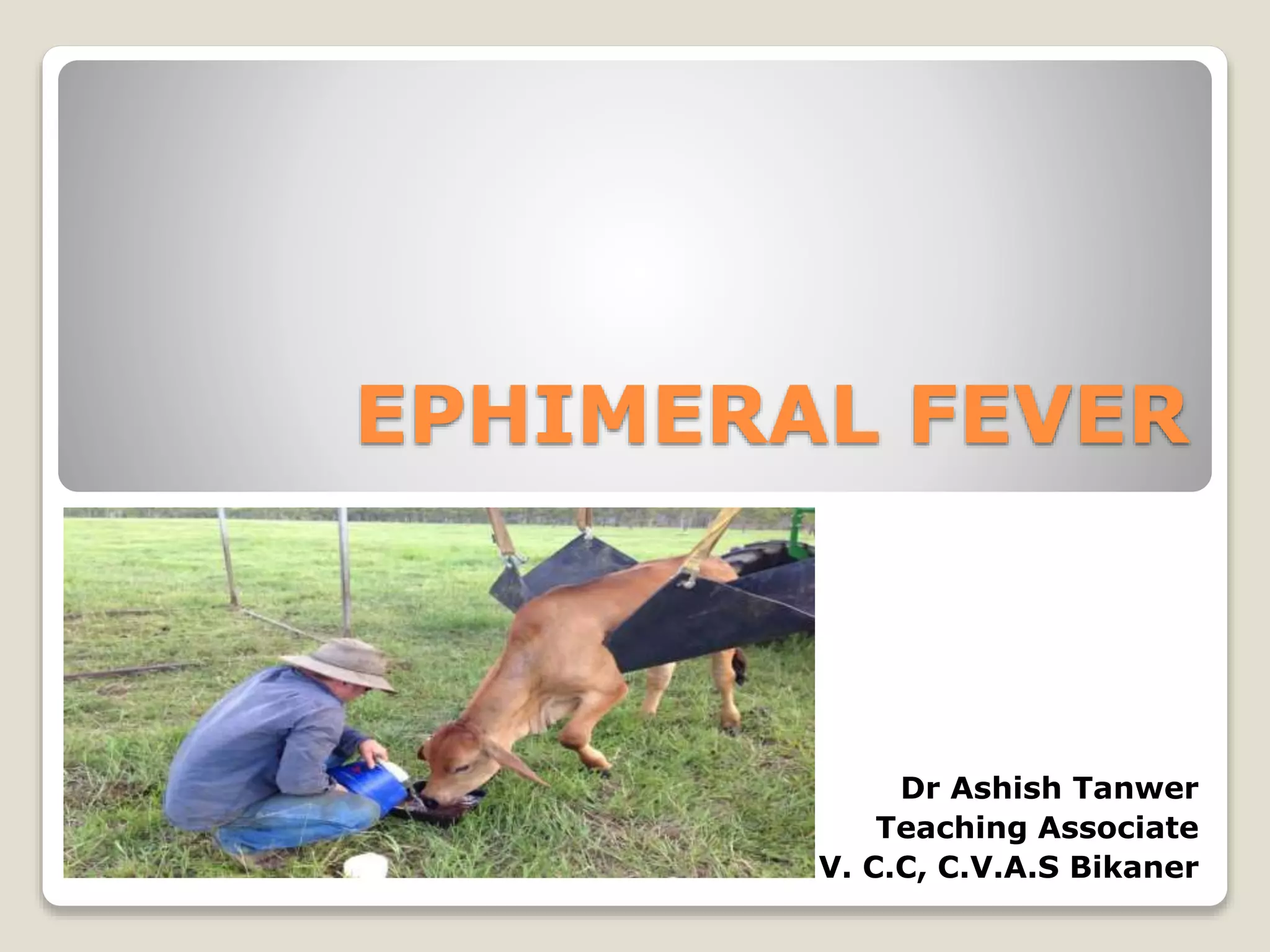
EPHIMERAL FEVER
Dr Ashish Tanwer
Teaching Associate
V. C.C, C.V.A.S Bikaner
SYNONYM AND INTRODUCTION
Synonym :-
Three-day sickness, 3-day fever, Dragon Boat disease
Introduction:-
• Bovine ephemeral fever (BEF) is a benign acute, non-contagious,
arthropod-borne viral disease of cattle and water buffalo
characterized by sudden onset, lameness and quick recovery with
high morbidity and low mortality.
• This disease occurs in tropical and subtropical regions of Africa,
Asia and Australia.
• The BEF virus belongs to the genus Rhabdovirus. This virus is
related to dengue fever virus in human.
•
All breeds of cattle are susceptible.
• Among the cattle, 6 months to 2 years are more susceptible.
• This disease is prevalent both in indigenous and exotic breeds
of cattle as well as water buffalo.
• The disease is not reported in goat, sheep, pig and dog. Virus
transmitted mainly by sand flies (Ceratopogonidae family).
• Mosquitoes (Aedes, Anophles and Culex), and biting midges
are playing a major role in transmission. • Strong wind can
transport vectors for longer distances.
• Epizootics associated with recent rainfall. The virus does not
spread by any other modes.
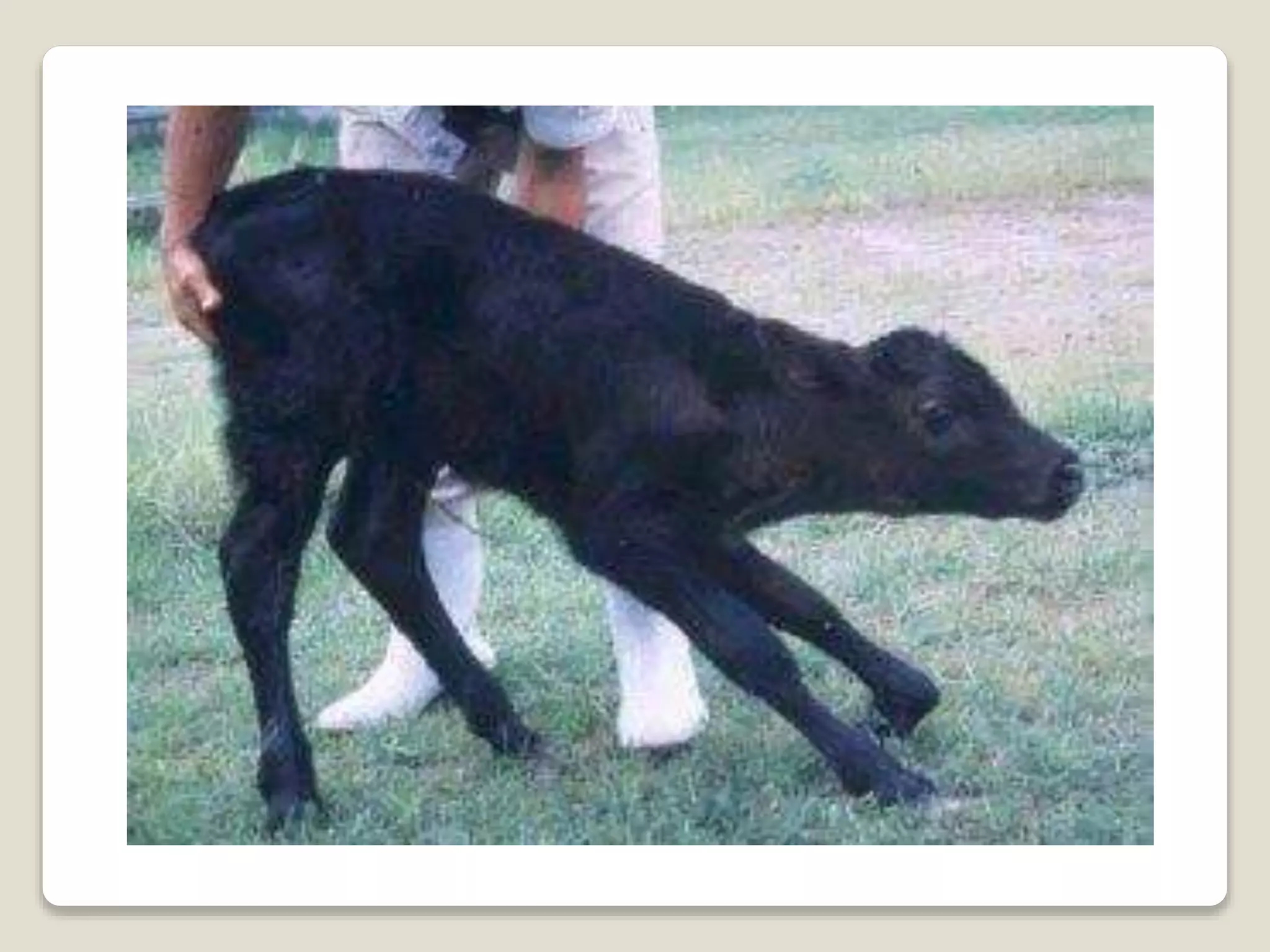
Signs of bovine ephemeral fever
CLINICAL MANIFESTATIONS :-
• The incubation period is 2 to 10 days
• Calves are least affected, those less than 6 months of age showing
no clinical signs.
• After an incubation period of 2-10 days, there is sudden onset of
fever. A biphasic or triphasic fever and sharp fall in milk yield are
commonly observed.
• There is severe ruminal stasis followed by constipation.
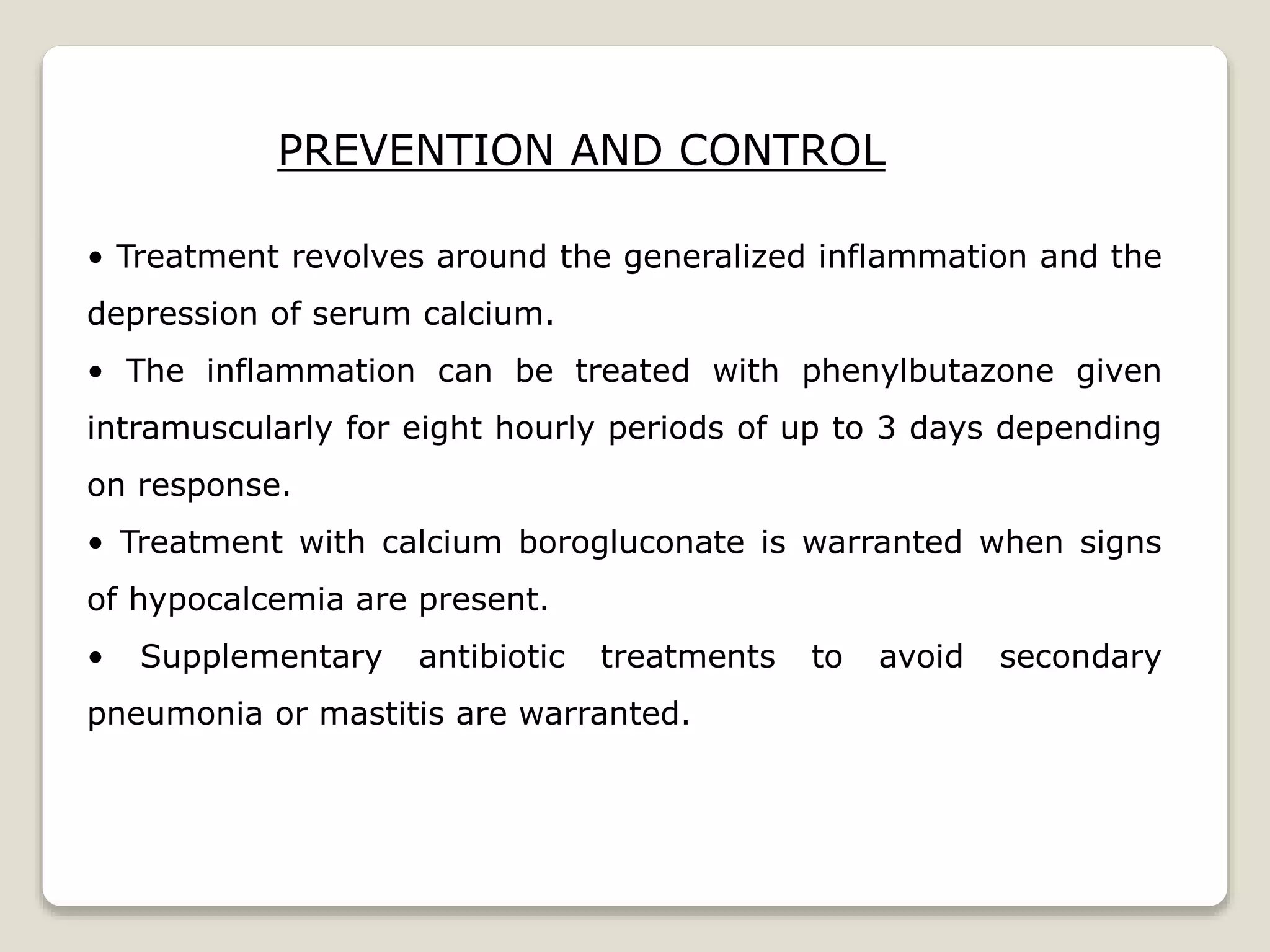
• Muscular signs become more evident on the second day with severe
stiffness.
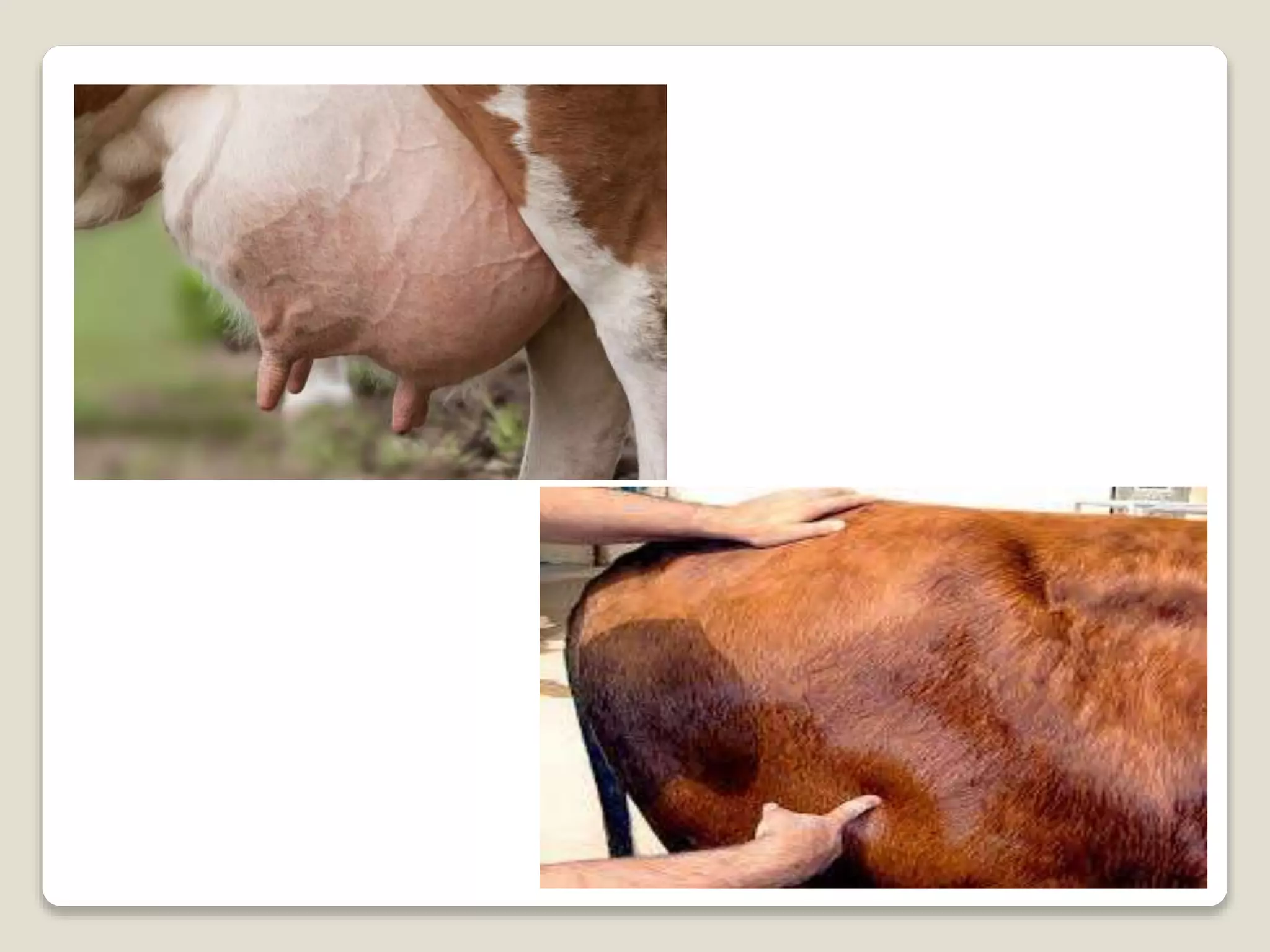
• Swellings in shoulders neck and back may be seen. A
posture similar to that of acute laminitis, with all four feet
bunched under the body is characteristic.
• On the third day the animal begins eating and ruminating
and the febrile reaction disappears
• Some animals remains standing in acute stage and exhibit
sternal recumbence associated with hypocalcaemia (Milk
fever posture). Most recovered animals develop a solid
immunity.
• The morbidity rate may reach 100% and the fatality rate
is 1%. Milk yield returns to normal within 2 to 3 weeks.
POST DISEASE COMPLICATIONS AND LESIONS
Post disease complications:-
• Fall in milk yield
• Increased susceptibility to mastitis
• Delay in next estrus
• Pneumonia due to prolonged recumbency
Lesions:-
• Enlargement and edema of the lymph nodes
• Polysinovitis, tendovaginitis and periarthritis
• Pulmonary and pleural congestion
• Edema and haemorrhages of the brain and meninges
• Necrotic changes in the skeletal muscle.
DIAGNOSIS :-
• Sample of choice - Blood (Buffy coat) and serum is the highly
suitable specimen.
• Based on clinical signs - rapid and short course affecting a large
number of cattle in an area
• Virus isolation - By intracerebral inoculation of mice or hamster
or isolation in cell culture such as Baby hamster kidney cell lines
and monkey kidney cell lines.
• Other tests - CFT, AGID, FAT, ELISA
• Based on clinical pathology - Increased level of plasma
fibrinogen and decreased serum calcium level, high level
of creatinine kinase and marked leukocytosis
Differential diagnosis :-
• Laminitis
• Milk fever
PREVENTION AND CONTROL
• Treatment revolves around the generalized inflammation and the
depression of serum calcium.
• The inflammation can be treated with phenylbutazone given
intramuscularly for eight hourly periods of up to 3 days depending
on response.
• Treatment with calcium borogluconate is warranted when signs
of hypocalcemia are present.
• Supplementary antibiotic treatments to avoid secondary
pneumonia or mastitis are warranted.
• Vector control is usually impractical in endemic areas. In
endemic areas, it is important to immunize cattle;
particularly highly valuable animals.
• Both formalin killed and attenuated vaccines are
available. Calves aged more than six months vaccinated.
• Trials have been carried out using a limited vaccine based
on the envelope-glycoprotein has been developed.
Thanks

Ephimeral fever

  • 1.
    EPHIMERAL FEVER Dr AshishTanwer Teaching Associate V. C.C, C.V.A.S Bikaner
  • 2.
    SYNONYM AND INTRODUCTION Synonym:- Three-day sickness, 3-day fever, Dragon Boat disease Introduction:- • Bovine ephemeral fever (BEF) is a benign acute, non-contagious, arthropod-borne viral disease of cattle and water buffalo characterized by sudden onset, lameness and quick recovery with high morbidity and low mortality. • This disease occurs in tropical and subtropical regions of Africa, Asia and Australia. • The BEF virus belongs to the genus Rhabdovirus. This virus is related to dengue fever virus in human. •
  • 4.
    All breeds ofcattle are susceptible. • Among the cattle, 6 months to 2 years are more susceptible. • This disease is prevalent both in indigenous and exotic breeds of cattle as well as water buffalo. • The disease is not reported in goat, sheep, pig and dog. Virus transmitted mainly by sand flies (Ceratopogonidae family). • Mosquitoes (Aedes, Anophles and Culex), and biting midges are playing a major role in transmission. • Strong wind can transport vectors for longer distances. • Epizootics associated with recent rainfall. The virus does not spread by any other modes.
  • 5.
    Signs of bovineephemeral fever
  • 6.
    CLINICAL MANIFESTATIONS :- •The incubation period is 2 to 10 days • Calves are least affected, those less than 6 months of age showing no clinical signs. • After an incubation period of 2-10 days, there is sudden onset of fever. A biphasic or triphasic fever and sharp fall in milk yield are commonly observed. • There is severe ruminal stasis followed by constipation. • Muscular signs become more evident on the second day with severe stiffness.
  • 8.
    • Swellings inshoulders neck and back may be seen. A posture similar to that of acute laminitis, with all four feet bunched under the body is characteristic. • On the third day the animal begins eating and ruminating and the febrile reaction disappears • Some animals remains standing in acute stage and exhibit sternal recumbence associated with hypocalcaemia (Milk fever posture). Most recovered animals develop a solid immunity. • The morbidity rate may reach 100% and the fatality rate is 1%. Milk yield returns to normal within 2 to 3 weeks.
  • 10.
    POST DISEASE COMPLICATIONSAND LESIONS Post disease complications:- • Fall in milk yield • Increased susceptibility to mastitis • Delay in next estrus • Pneumonia due to prolonged recumbency Lesions:- • Enlargement and edema of the lymph nodes • Polysinovitis, tendovaginitis and periarthritis • Pulmonary and pleural congestion • Edema and haemorrhages of the brain and meninges • Necrotic changes in the skeletal muscle.
  • 12.
    DIAGNOSIS :- • Sampleof choice - Blood (Buffy coat) and serum is the highly suitable specimen. • Based on clinical signs - rapid and short course affecting a large number of cattle in an area • Virus isolation - By intracerebral inoculation of mice or hamster or isolation in cell culture such as Baby hamster kidney cell lines and monkey kidney cell lines. • Other tests - CFT, AGID, FAT, ELISA
  • 13.
    • Based onclinical pathology - Increased level of plasma fibrinogen and decreased serum calcium level, high level of creatinine kinase and marked leukocytosis Differential diagnosis :- • Laminitis • Milk fever
  • 15.
    PREVENTION AND CONTROL •Treatment revolves around the generalized inflammation and the depression of serum calcium. • The inflammation can be treated with phenylbutazone given intramuscularly for eight hourly periods of up to 3 days depending on response. • Treatment with calcium borogluconate is warranted when signs of hypocalcemia are present. • Supplementary antibiotic treatments to avoid secondary pneumonia or mastitis are warranted.
  • 17.
    • Vector controlis usually impractical in endemic areas. In endemic areas, it is important to immunize cattle; particularly highly valuable animals. • Both formalin killed and attenuated vaccines are available. Calves aged more than six months vaccinated. • Trials have been carried out using a limited vaccine based on the envelope-glycoprotein has been developed.
  • 18.