

CANINE DEMODICOSIS
Presenter: Manoj karki
(BVSC&AH)
Nepal
Agenda:
• Introduction
• Etiology
• Pathogenesis
• Clinical sign
• Diagnosis
• Prognosis
• Treatment and control
• Reference
Introduction
• Canine demodicosis is a severe parasitic skin disease of a dog
caused by overpopulation of the follicular mite of various
demodex species.
• One of the most common cutaneous infection encountered in
canine practice is demodicosis.
• Demodex mites are normal flora localized in the skin of most
apparently healthy dog, when Secondary bacterial infection of
the hair follicle often occurs, and rupture of the hair follicle wall
may lead to presence of free mites in the dermis and a severe
pyogenic infection.
• .
• Although, demodex canis is acquired by puppies within the first few hours of
suckling it is a normal inhabitant of canine skin and demodicosis is not a
contagious disease
• Fig: 1. Life cycle of Demodex canis: (1) the life cycle of Demodex includes, apart from the adult mite,
egg, larva, and two nymphal stages; (2) the lifecycle happens in hair follicles. The puppy is infected by
the dam during the first days of its life. The infestation is preceded by the multiplication of the mites
on the dam’s skin (3). The mechanism, which accelerates the multiplication just before whelping, is not
known. Most dogs harbor single, latent Demodex mites in their hairfollicles, living in quiet seclusion.
In some individuals and in some circumstances the mites can start to multiply uncontrollably, leading
into the symptomatic demodicosis.
Etiology:
• Demodex canis is the main causative agent of canine
demodicosis.
• The mites residue in the hair follicle and sometimes the
sebaceous gland.
• Four stage are seen, the diamond shaped egg, the 6 legged
larvae and 8 legged nymph form which develops into adult.
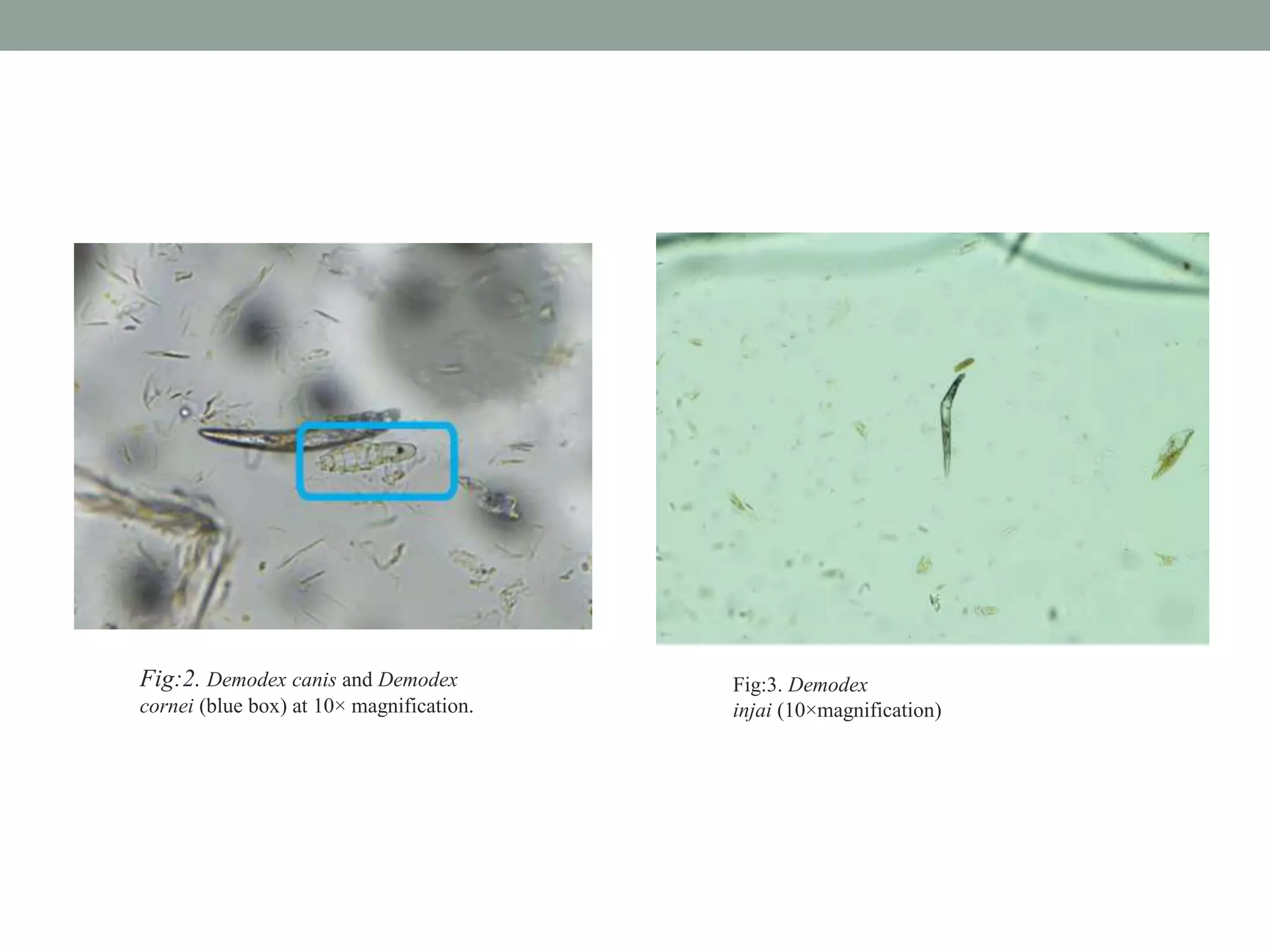
• Generally three types of Demodex mites are found in dog.
Demodex canis (long bodied mites), Demodex injai (large
bodied mites) and Demodex cornei (short bodied mites)
Fig:2. Demodex canis and Demodex
cornei (blue box) at 10× magnification.
Fig:3. Demodex
injai (10×magnification)
Pathogenesis:
• The mites enter the hair follicle, reach the root and multiply.
• Due to inflammation the papilla is destroyed and the hair is lost.
•
• The parasite then enter the sebaceous gland where condition
appear to be very congenial for the growth of mites, since the
altered sebum is very favorable medium for them to grow.
• The sebaceous gland may be dilated and become cystic and
lined by squamous epithelium.
Conti…
• Thus the skin comes to be covered by scaly material which may
be desquamated.
• The sebaceous cyst may rupture, the spilled sebum causing
inflammation locally.
• The blood vessels are congested and dilated.
Clinical sign:
• The most common clinical sign are alopecia, scaly-crustly
thickened skin with hyperpigmentation, leechinification,
erythema, pruritus and seropurulent discharge seems mostly on
per ocular area, face, neck, shoulder and fore quarter region.
• Anemia may also occur in this condition due to loss of skin
proteins and leukocytosis.
• Most case of demodecosis are non-pruritus unless there is
secondary pyoderma.
Conti….
• Very rare ulceration may develop, especially on the face and
mucocutaneous area which may mimic autoimmune disease.
• Canine demodectic mange is classified as two forms.
• Localized and Generalized form
Localized form:
• The localized form typically starts as one or more focal alopecic
lesion, erythema and comedomes in dog less than 1.5 years old.
• Usually only the head (perioral, peri ocular) or the forelimb are
involved.
• There is no significant pruritus. This is commonly seen in pups
of 3 to 9 month old and spontaneous recovery without
treatment.
Generalized form:
• Generalize demodicosis is a severe disease requiring aggressive
therapy.
• This form involves the large part of the dogs skin and bears a
guarded prognosis.
• Generalized form is however, characterized by number of area
of localized disease or even infection in entire skin areas.
• Generalized demodicosis can be severe often complicated with
secondary bacterial infection and life threatening.
Conti….
• It should be remember that every case of generalized
demodicosis was localized form.
• Juvenile onset demodicosis (onset prior to puberty) and adult
onset demodicosis
• Juvenile onset is by far the most common and although a
serious disease, often a better prognosis than does adult onset.
• Adult onset is usually associated with severe internal disease
and Is often very difficult to control.
Clinical sign
Fig:4. Dog with lesions at face and neck
regions Fig: 5. Alopecia and scale/crusts formation throughout
the body due to infestion of demodectic mite
Diagnosis:
• Canine demodicosis is usually diagnosis by identifying mites in
skin scrapping and hair plugs.
• Performing of skin scrapping:
• Some 3-5 site are selected for skin scrapping
• The hair, if present, is clipped
• The skin is gently squeezed between thumb and forefinger to
force the mites more superficially in the hair follicle.
• The skin is moistened with liquid paraffin or mineral oil
• Some is also placed on the slide
Conti…
• The skin is then scraped using a blunted scalpel blade until
capillary bleeding is observed.
• The material is transferred to the slide
• The entire slide is scanned using 10X objective
• Focus on suspicious area using the 40Xobjective if necessary.
• The proportion of live and dead mites of adult and young forms
and of eggs should be recorded.
Or
• The scraping was placed in the test tube and 10% KOH solution
was added.
• Then, the solution was gently heated (near up to the boiling)
with frequent shaking for about 5-10 min until all the debris was
digested.
• Often the solution was allowed to cool for some time and was
allowed to centrifuge at 2000 rpm for 10min, supernatant were
discarded and remaining sediment were a coverslip.
• The sediment was observed for mites with the help of
compound (10x) microscope.
Prognosis:
• The prognosis for juvenile onset localized demodicosis is very
good.
• The prognosis for juvenile for onset generalized demodicosis is
always guarded.
• The demodicosis mange upto 1 year of age were more
susceptible to infection and the highest prevalence of the
disease was found in winter season rather than summer or rainy
season.
• Demodicosis is highly prevalent in dog whose immune system
is distributed or not well developed. So it is highly
recommended that dog should be given proper nourishment,
immunization, deworming and care to avoid skin disorder like
demodicosis.
Treatment and control:
• Treatment should be occur in localized and generalized
demodicosis
• In localized, this is usually a self-limiting disease that cures
spontaneously. Treatment with parasiticides is usually not
warranted.
• But 10 % of case of localized demodicosis go on to become
generalized. Therefore whether or not treatment is given a
careful follow up is necessary.
• In generalized demodicosis, it can be one of the most frustrating
skin disease, one will ever treat.
• Specific treatment of demodectic mange are:
• Amitraz: 0.025% whole body dip applied every 2 weeks interval 5-8
application or till skin scraping are negative. Not recommended for
cat and puppy
• Ivermectin: 0.3-0.6 mg/kg bwt PO single dose
• Moxidectin: 0.4mg/kg bw POsingle dose
• Before application of medicine crust, scale and debris should be
removed with soap and shampoo.
• A course of antibiotic should be given to inhibit bacterial infection.
• Antibiotic therapy should be continued until the mite population is
well controlled.
•
Reference:
• Ashfaq, K., et al. (2019). “Alternative therapeutic approach to treat
canine demodicosis”. EC veterinary science 4.4 :251-256
• Islam, M.M., et al. (2000). “Prevalence and pathology of demodectic
mange in stray dog in Bangladesh”. Journal of science and
technology. 11: 118-121
• Shrestha, D., et al. (2015). “Prevalence of demodectic mange in
canine of KTM valley having skin disorder and its associated risk
factor”. Int. Appl sci biotechnol, vol 3(3): 459-463
• Salem, N.Y., et al. (2020). “Canine demodicosis hematological and
biochemical alteration”. Veterinary world.org., vol(13):68-72
• Bhatia, B.B., et al.(2016). “ text book of veterinary parasitology”. 4th
edition.
• Picture are taken from google.
Thank you

canine demodex

  • 1.
  • 2.
    Agenda: • Introduction • Etiology •Pathogenesis • Clinical sign • Diagnosis • Prognosis • Treatment and control • Reference
  • 3.
    Introduction • Canine demodicosisis a severe parasitic skin disease of a dog caused by overpopulation of the follicular mite of various demodex species. • One of the most common cutaneous infection encountered in canine practice is demodicosis. • Demodex mites are normal flora localized in the skin of most apparently healthy dog, when Secondary bacterial infection of the hair follicle often occurs, and rupture of the hair follicle wall may lead to presence of free mites in the dermis and a severe pyogenic infection. • .
  • 4.
    • Although, demodexcanis is acquired by puppies within the first few hours of suckling it is a normal inhabitant of canine skin and demodicosis is not a contagious disease • Fig: 1. Life cycle of Demodex canis: (1) the life cycle of Demodex includes, apart from the adult mite, egg, larva, and two nymphal stages; (2) the lifecycle happens in hair follicles. The puppy is infected by the dam during the first days of its life. The infestation is preceded by the multiplication of the mites on the dam’s skin (3). The mechanism, which accelerates the multiplication just before whelping, is not known. Most dogs harbor single, latent Demodex mites in their hairfollicles, living in quiet seclusion. In some individuals and in some circumstances the mites can start to multiply uncontrollably, leading into the symptomatic demodicosis.
  • 5.
    Etiology: • Demodex canisis the main causative agent of canine demodicosis. • The mites residue in the hair follicle and sometimes the sebaceous gland. • Four stage are seen, the diamond shaped egg, the 6 legged larvae and 8 legged nymph form which develops into adult. • Generally three types of Demodex mites are found in dog. Demodex canis (long bodied mites), Demodex injai (large bodied mites) and Demodex cornei (short bodied mites)
  • 6.
    Fig:2. Demodex canisand Demodex cornei (blue box) at 10× magnification. Fig:3. Demodex injai (10×magnification)
  • 7.
    Pathogenesis: • The mitesenter the hair follicle, reach the root and multiply. • Due to inflammation the papilla is destroyed and the hair is lost. • • The parasite then enter the sebaceous gland where condition appear to be very congenial for the growth of mites, since the altered sebum is very favorable medium for them to grow. • The sebaceous gland may be dilated and become cystic and lined by squamous epithelium.
  • 8.
    Conti… • Thus theskin comes to be covered by scaly material which may be desquamated. • The sebaceous cyst may rupture, the spilled sebum causing inflammation locally. • The blood vessels are congested and dilated.
  • 9.
    Clinical sign: • Themost common clinical sign are alopecia, scaly-crustly thickened skin with hyperpigmentation, leechinification, erythema, pruritus and seropurulent discharge seems mostly on per ocular area, face, neck, shoulder and fore quarter region. • Anemia may also occur in this condition due to loss of skin proteins and leukocytosis. • Most case of demodecosis are non-pruritus unless there is secondary pyoderma.
  • 10.
    Conti…. • Very rareulceration may develop, especially on the face and mucocutaneous area which may mimic autoimmune disease. • Canine demodectic mange is classified as two forms. • Localized and Generalized form
  • 11.
    Localized form: • Thelocalized form typically starts as one or more focal alopecic lesion, erythema and comedomes in dog less than 1.5 years old. • Usually only the head (perioral, peri ocular) or the forelimb are involved. • There is no significant pruritus. This is commonly seen in pups of 3 to 9 month old and spontaneous recovery without treatment.
  • 12.
    Generalized form: • Generalizedemodicosis is a severe disease requiring aggressive therapy. • This form involves the large part of the dogs skin and bears a guarded prognosis. • Generalized form is however, characterized by number of area of localized disease or even infection in entire skin areas. • Generalized demodicosis can be severe often complicated with secondary bacterial infection and life threatening.
  • 13.
    Conti…. • It shouldbe remember that every case of generalized demodicosis was localized form. • Juvenile onset demodicosis (onset prior to puberty) and adult onset demodicosis • Juvenile onset is by far the most common and although a serious disease, often a better prognosis than does adult onset. • Adult onset is usually associated with severe internal disease and Is often very difficult to control.
  • 14.
    Clinical sign Fig:4. Dogwith lesions at face and neck regions Fig: 5. Alopecia and scale/crusts formation throughout the body due to infestion of demodectic mite
  • 15.
    Diagnosis: • Canine demodicosisis usually diagnosis by identifying mites in skin scrapping and hair plugs. • Performing of skin scrapping: • Some 3-5 site are selected for skin scrapping • The hair, if present, is clipped • The skin is gently squeezed between thumb and forefinger to force the mites more superficially in the hair follicle. • The skin is moistened with liquid paraffin or mineral oil • Some is also placed on the slide
  • 16.
    Conti… • The skinis then scraped using a blunted scalpel blade until capillary bleeding is observed. • The material is transferred to the slide • The entire slide is scanned using 10X objective • Focus on suspicious area using the 40Xobjective if necessary. • The proportion of live and dead mites of adult and young forms and of eggs should be recorded.
  • 17.
    Or • The scrapingwas placed in the test tube and 10% KOH solution was added. • Then, the solution was gently heated (near up to the boiling) with frequent shaking for about 5-10 min until all the debris was digested. • Often the solution was allowed to cool for some time and was allowed to centrifuge at 2000 rpm for 10min, supernatant were discarded and remaining sediment were a coverslip. • The sediment was observed for mites with the help of compound (10x) microscope.
  • 18.
    Prognosis: • The prognosisfor juvenile onset localized demodicosis is very good. • The prognosis for juvenile for onset generalized demodicosis is always guarded. • The demodicosis mange upto 1 year of age were more susceptible to infection and the highest prevalence of the disease was found in winter season rather than summer or rainy season. • Demodicosis is highly prevalent in dog whose immune system is distributed or not well developed. So it is highly recommended that dog should be given proper nourishment, immunization, deworming and care to avoid skin disorder like demodicosis.
  • 19.
    Treatment and control: •Treatment should be occur in localized and generalized demodicosis • In localized, this is usually a self-limiting disease that cures spontaneously. Treatment with parasiticides is usually not warranted. • But 10 % of case of localized demodicosis go on to become generalized. Therefore whether or not treatment is given a careful follow up is necessary. • In generalized demodicosis, it can be one of the most frustrating skin disease, one will ever treat.
  • 20.
    • Specific treatmentof demodectic mange are: • Amitraz: 0.025% whole body dip applied every 2 weeks interval 5-8 application or till skin scraping are negative. Not recommended for cat and puppy • Ivermectin: 0.3-0.6 mg/kg bwt PO single dose • Moxidectin: 0.4mg/kg bw POsingle dose • Before application of medicine crust, scale and debris should be removed with soap and shampoo. • A course of antibiotic should be given to inhibit bacterial infection. • Antibiotic therapy should be continued until the mite population is well controlled. •
  • 21.
    Reference: • Ashfaq, K.,et al. (2019). “Alternative therapeutic approach to treat canine demodicosis”. EC veterinary science 4.4 :251-256 • Islam, M.M., et al. (2000). “Prevalence and pathology of demodectic mange in stray dog in Bangladesh”. Journal of science and technology. 11: 118-121 • Shrestha, D., et al. (2015). “Prevalence of demodectic mange in canine of KTM valley having skin disorder and its associated risk factor”. Int. Appl sci biotechnol, vol 3(3): 459-463 • Salem, N.Y., et al. (2020). “Canine demodicosis hematological and biochemical alteration”. Veterinary world.org., vol(13):68-72 • Bhatia, B.B., et al.(2016). “ text book of veterinary parasitology”. 4th edition. • Picture are taken from google.
  • 22.