Dr Ashish Tanwer
Teaching Associate
V. C.C, C.V.A.S Bikaner
Bovine tuberculosis is a chronic bacterial
disease of cattle that occasionally affects
other species of mammals.
This disease is asignificant zoonosis that
can spread to humans, typically by the
inhalation of aerosols or the ingestion of
unpasteurized milk.
3
Define
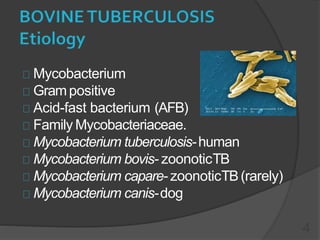
Mycobacterium
Grampositive
Acid-fast bacterium (AFB)
Family Mycobacteriaceae.
Mycobacterium tuberculosis-human
Mycobacterium bovis- zoonoticTB
Mycobacterium capare- zoonoticTB(rarely)
Mycobacterium canis-dog
4
4
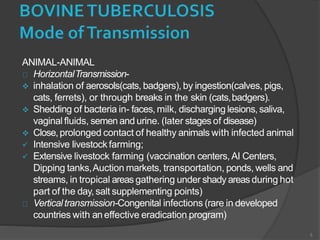
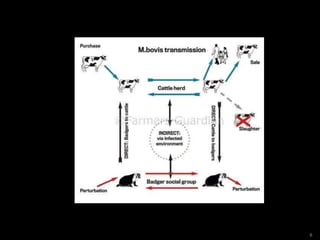
ANIMAL-ANIMAL
HorizontalTransmission-
 inhalation of aerosols(cats, badgers), by ingestion(calves, pigs,
cats, ferrets), or through breaks in the skin (cats,badgers).
 Shedding of bacteria in- faces,milk, discharging lesions,saliva,
vaginal fluids, semen and urine. (later stages of disease)
 Close,prolonged contact of healthy animals with infected animal
 Intensive livestock farming;
 Extensive livestock farming (vaccination centers,AI Centers,
Dipping tanks,Auction markets, transportation, ponds, wells and
streams, in tropical areas gathering under shady areas during hot
part of the day, salt supplementing points)
Verticaltransmission-Congenital infections (rare in developed
countries with an effective eradication program)
5
6
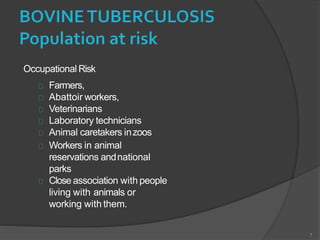
Occupational Risk
7
Farmers,
Abattoir workers,
Veterinarians
Laboratory technicians
Animal caretakers inzoos
Workers in animal
reservations andnational
parks
Close association with people
living with animals or
working with them.
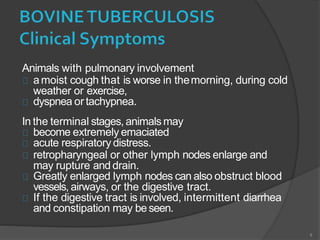
Animals with pulmonary involvement
amoist cough that is worse in themorning, during cold
weather or exercise,
dyspnea or tachypnea.
In the terminal stages,animals may
become extremely emaciated
acute respiratory distress.
retropharyngeal or other lymph nodes enlarge and
may rupture and drain.
Greatly enlarged lymph nodes can also obstruct blood
vessels, airways, or the digestive tract.
If the digestive tract is involved, intermittent diarrhea
and constipation may be seen.
8
Animals: Early on it remainsasymptomatic
Late stages
progressive emaciation,
alow–grade fluctuating fever,
weakness and
inappetence.
9
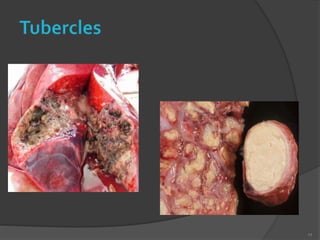
granulomas (tubercles) where bacteria
have localized.
usually yellowish
either caseous,caseo-calcareousor calcified
often encapsulated.
found in the lymph nodes, particularly
those of the head andthorax.
common in the lung, spleen,liver and the
surfaces of bodycavities
10
11
 Tuberculin skin test(screening test)
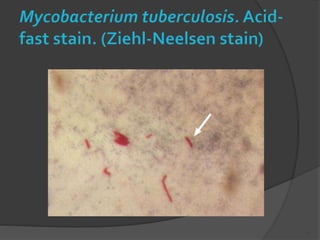
 Microscopic examination ofAFB
 Ziehl/Neelson stain
 Flourescent acid-faststain
 Isolation on selective culture media (8 weeks)
 PCR
 Biological safety cabinet should be used
 Wildlife: Lymphocyte proliferation
assay/gamma-interferon assays/ ELISA
 (
12
Samples from Liveanimal:
 Sputum andother body fluids
 Blood samples
 Samples atnecropsy:
 Abnormal lymphnodes
 Lungs
 Liver
 Spleen
13
Contagious bovinepleuropneumonia
Pasteurella
Corynebacterium pyogenespneumonia
Aspiration pneumonia
Traumaticpericarditis
Caseouslymphadenitis
Liver flukeinfestation
14
BovineTB
BCG vaccination in animals less effective.
Isunder consideration in Europeancountries,
NorthAmericaand someAfrican countries.
Attenuated strain of wild type of M. bovis
isolate fromcattle
15
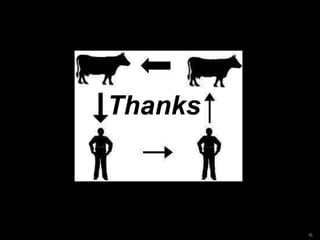
Thanks
16

Bovine tuberculosis

  • 1.
    Dr Ashish Tanwer TeachingAssociate V. C.C, C.V.A.S Bikaner
  • 2.
    Bovine tuberculosis isa chronic bacterial disease of cattle that occasionally affects other species of mammals. This disease is asignificant zoonosis that can spread to humans, typically by the inhalation of aerosols or the ingestion of unpasteurized milk. 3 Define
  • 3.
    Mycobacterium Grampositive Acid-fast bacterium (AFB) FamilyMycobacteriaceae. Mycobacterium tuberculosis-human Mycobacterium bovis- zoonoticTB Mycobacterium capare- zoonoticTB(rarely) Mycobacterium canis-dog 4
  • 4.
  • 5.
    ANIMAL-ANIMAL HorizontalTransmission-  inhalation ofaerosols(cats, badgers), by ingestion(calves, pigs, cats, ferrets), or through breaks in the skin (cats,badgers).  Shedding of bacteria in- faces,milk, discharging lesions,saliva, vaginal fluids, semen and urine. (later stages of disease)  Close,prolonged contact of healthy animals with infected animal  Intensive livestock farming;  Extensive livestock farming (vaccination centers,AI Centers, Dipping tanks,Auction markets, transportation, ponds, wells and streams, in tropical areas gathering under shady areas during hot part of the day, salt supplementing points) Verticaltransmission-Congenital infections (rare in developed countries with an effective eradication program) 5
  • 6.
  • 7.
    Occupational Risk 7 Farmers, Abattoir workers, Veterinarians Laboratorytechnicians Animal caretakers inzoos Workers in animal reservations andnational parks Close association with people living with animals or working with them.
  • 8.
    Animals with pulmonaryinvolvement amoist cough that is worse in themorning, during cold weather or exercise, dyspnea or tachypnea. In the terminal stages,animals may become extremely emaciated acute respiratory distress. retropharyngeal or other lymph nodes enlarge and may rupture and drain. Greatly enlarged lymph nodes can also obstruct blood vessels, airways, or the digestive tract. If the digestive tract is involved, intermittent diarrhea and constipation may be seen. 8
  • 9.
    Animals: Early onit remainsasymptomatic Late stages progressive emaciation, alow–grade fluctuating fever, weakness and inappetence. 9
  • 10.
    granulomas (tubercles) wherebacteria have localized. usually yellowish either caseous,caseo-calcareousor calcified often encapsulated. found in the lymph nodes, particularly those of the head andthorax. common in the lung, spleen,liver and the surfaces of bodycavities 10
  • 11.
  • 12.
     Tuberculin skintest(screening test)  Microscopic examination ofAFB  Ziehl/Neelson stain  Flourescent acid-faststain  Isolation on selective culture media (8 weeks)  PCR  Biological safety cabinet should be used  Wildlife: Lymphocyte proliferation assay/gamma-interferon assays/ ELISA  ( 12
  • 13.
    Samples from Liveanimal: Sputum andother body fluids  Blood samples  Samples atnecropsy:  Abnormal lymphnodes  Lungs  Liver  Spleen 13
  • 14.
    Contagious bovinepleuropneumonia Pasteurella Corynebacterium pyogenespneumonia Aspirationpneumonia Traumaticpericarditis Caseouslymphadenitis Liver flukeinfestation 14
  • 15.
    BovineTB BCG vaccination inanimals less effective. Isunder consideration in Europeancountries, NorthAmericaand someAfrican countries. Attenuated strain of wild type of M. bovis isolate fromcattle 15
  • 16.